The Thirty-Third AAAI Conference on Artificial Intelligence (AAAI-19)
Enhancing Lazy Grounding with Lazy
Normalization in Answer-Set Programming
Jori Bomanson,
1Tomi Janhunen,
1Antonius Weinzierl
1,2 1Department of Computer Science, Aalto University, Finland2Institute of Logic and Computation, TU Wien, Austria
[email protected], [email protected], [email protected]
Abstract
Answer-Set Programming (ASP) is an expressive rule-based knowledge-representation formalism. Lazy grounding is a solving technique that avoids the well-known grounding bot-tleneck of traditional ASP evaluation but is restricted to nor-mal rules, severely limiting its expressive power. In this work, we introduce a framework to handle aggregates by normaliz-ing them on demand durnormaliz-ing lazy groundnormaliz-ing, hence relievnormaliz-ing the restrictions of lazy grounding significantly. We term our approach as lazy normalization and demonstrate its feasibil-ity for different types of aggregates. Asymptotic behavior is analyzed and correctness of the presented lazy normalizations is shown. Benchmark results indicate that lazy normalization can bring up-to exponential gains in space and time as well as enable ASP to be used in new application areas.
1
Introduction
Answer-Set Programming (ASP) is an expressive rule-based knowledge-representation formalism whose success is much due to efficient solver technology available for evaluation (Gebser, Kaufmann, and Schaub 2012; Alviano et al. 2013; Leone et al. 2002). State-of-the-art ASP systems follow the ground-and-solve approach, where a first-order input pro-gram is turned into a correspondingground(variable-free) program for which answer sets are then computed. But, in the worst case, the resulting ground program may become exponentially larger than the original non-ground input gram. Even a polynomial-size increase may already be pro-hibitive in practice. This drawback impairs the scalability of ASP for practical applications (cf. (Falkner et al. 2016)) and is known as the grounding bottleneck of ASP. To cir-cumvent such blow-ups, lazy-groundingASP solvers have been developed; cf. (Pal`u et al. 2009; Lef`evre et al. 2017; Dao-Tran et al. 2012; Weinzierl 2017). The main idea is to interleave grounding with solving and to generate only ground rules necessary in each position of the search space. However, existing lazy-grounding ASP systems only ac-ceptnormal rulesas input and they do not support a broad range of syntactic primitives as defined by, e.g., the ASP
core language (Calimeri et al. 2012). Most notably miss-ing are aggregates, which occur in many ASP programs,
Copyright c2019, Association for the Advancement of Artificial Intelligence (www.aaai.org). All rights reserved.
because they are highly expressive and enable a program-mer to state complex conditions in a very concise manner. The importance of aggregates is witnessed by a rich body of research, see e.g., (Greco 1999; Simons, Niemel¨a, and Soininen 2002; Liu and Truszczynski 2006; Ferraris 2011; Faber, Pfeifer, and Leone 2011; Gelfond and Zhang 2014; Alviano, Faber, and Gebser 2015). The integration of aggre-gates into lazy-grounding ASP systems, however, has not been attempted so far, although there is work on first-order rewriting of aggregates for ground-and-solve ASP systems (Polleres et al. 2013). Realizing aggregates is feasible as na-tive extensions of solvers in the form of propagators or by unfolding (monotone) ground aggregates as normal rules. The latter is known asnormalization(Janhunen and Niemel¨a 2011; Bomanson and Janhunen 2013). Both approaches are logical avenues of research in the lazy grounding setting. However, normalization is particularly appealing because it readily benefits from existing lazy solving techniques, such that conflict-driven learning and lazy instantiation naturally carry over to normalized aggregates. Furthermore, it eas-ily allows to revise encodings of aggregates in a systematic fashion. For these reasons, we focus on normalization as the implementation strategy in this work. Moreover, we concen-trate on monotoneaggregates, and in particular count and sum aggregates with only lower bounds and non-negative weights. This provides a natural basis for implementing ag-gregates in practice, and paves a way for future support of
non-monotoneaggregates via rewritings into monotone ones (Alviano, Faber, and Gebser 2015).
the program to be fully grounded, since due to predicate de-pendency this can easily cascade and require large portions of the program to be fully grounded and hence degenerate into requiring a full grounding of the input program.
Our investigation revealed that ground instance enumer-ation is the key principle to enable non-ground normaliza-tion in a lazy-grounding setting and, based on this, the con-tributions of this paper are:(1) the introduction of an ele-gant framework for lazy normalizationwhere the result of normalization can be instantiated lazily; (2) effective lazy normalizations forcountingandsummationaggregates with lower bounds; (3) a far optimized lazy normalization for count aggregates based on lazily generated sorting circuits, inheriting attractive properties from ground-and-solve nor-malizations; (4) proof-of-concept implementations of lazy normalizations within the Alpha solver;(5)several bench-marks showing, i.a., that lazy normalization opens up new application areas like simulation with many time steps, and enables up-to exponential savings in space and time; and(6) an unprecedented lazy-grounding ASP evaluation beyond normal rules and a significant step towards the full expres-sive power of ASP in lazy-grounding ASP.
Following preliminaries in Section 2, Section 3 introduces the lazy normalization framework. Actual lazy normaliza-tions are presented in Section 4 whereas their evaluation takes place in Section 5. Related work and generalizations are addressed in Section 6, and Section 7 concludes.
2
Preliminaries
We refer to (Eiter, Ianni, and Krennwallner 2009) for a com-prehensive introduction to ASP, and present here briefly a fragment of ASP containing aggregates. A rule is of the form
a1∨. . .∨am←b1, . . . , bn
wherem, n≥0anda1, . . . , amare atoms over a first-order
languageL, andb1, . . . , bnare literals overL, where a literal
is either an atoma, a negated atomnot a, or an aggregate. Aggregates are of the form
l≺#func{T1:l1;. . .;Tn :ln} ≺u (1)
where l (resp. u) are integer lower (resp. upper) bounds;
≺ the comparison relation ≤ or <; #func the aggregate function#count,#sumor#max;T1, . . . , Tnthe (lists of)
terms involving non-negative weights over which the aggre-gate is evaluated; andl1, . . . , ln the (conjunctions of)
posi-tive and negaposi-tive atoms that specify the condition(s) under which the corresponding terms should be considered by the aggregate function. The upper bound of an aggregate may be omitted, leaving a lower-bounded aggregated.
The head of a ruler is the set H(r) = {a1, . . . , am},
thebodyisB(r) = {b1, . . . , bn}, and the positive body is
B+(r) =B(r)∩L. A rule withm= 0is aconstraint, a rule withn= 0is afact. A ruleris aground instanceof another rule if it is the result of substituting all first-order variables in that other rule with ground terms,r isground if it is a ground instance of itself, andris callednormalifm ≤ 1, i.e., its head contains at most one atom. The ASP core lan-guage (Calimeri et al. 2012) standardizes further lanlan-guage constructs such as comparison relations and choice rules.
A programPis a set of rules. Its Herbrand baseHB(P)is the set of all ground atoms based on the predicates, constants and function symbols inP. AninterpretationI ⊆ HB(P)
is an assignment of truth values toHB(P). Given an inter-pretationI, thesatisfaction relation|=for ground objects is such thatI|=aif the atomais assigned true, i.e., ifa∈I; I|=not aifI6|=a;I|=agfor an aggregateagof the form (1) if the application of#functo the set of first elements of tuplesTifor which each literal inliis satisfied byIreturns a
value within the lower and upper boundslanduin the sense of≺(cf. (Calimeri et al. 2012) for details);I |=rifris a ground rule andI|=bifor allbi∈B(r)implies thatI|=aj
for someaj ∈H(r);I |=P holds ifI |=rfor allr∈ P.
For first-order programsP,I |=P ifI|=r0for all ground instancesr0of all rulesr ∈P. Thereductof a programP w.r.t.Iis the set of ground instances of rulesrinP whose body is satisfied inI. An interpretationIis amodelofP if I|=Pand ananswer setofPif it is a⊆-minimal model of the reduct ofPw.r.t.I.
The semantics of aggregates as defined in (Calimeri et al. 2012) follows the intuition, for example an aggre-gate ag=7≤#sum3:p(a); 4:p(b); 5:p(c) is true when-ever the sum of3,4, and5is at least7, given thatp(a),p(b), andp(c)holds, respectively. This holds whenever two out of the three literalsp(a),p(b), and p(c)are true. Given an interpretationIwithI |= p(a),I 6|= p(b), and I |= p(c), then the sum amounts to3 + 5 = 8≥7, soI|=ag.
In general, lazy grounding is an implementation technique that avoids upfront grounding and instead produces indi-vidual ground instances of rules only as they become rele-vant, implying that more ground rules appear gradually dur-ing solvdur-ing. Moreover, a typical lazy grounder recursively guesses and deduces tentative truth values for atoms, which are detracted or revised in a backtracking process upon con-flict. A ground instancer0 of a normal rulerbecomes rel-evant when these tentative assignments amount to a partial interpretationIthat satisfies the positive bodyB+(r0)ofr0 and subsequently the ground headH(r0)is obtained.
Count and sum aggregates in ground programs can be normalized into sets of normal rules (Bomanson 2017). In particular, count aggregates can be replaced with encodings ofodd-even merge sorting networks(Batcher 1968). A sort-ing network is a data-oblivious sortsort-ing algorithm for a fixed number of inputs that conditionally swaps input element pairs at predetermined positions (Batcher 1968).
Example 1. Below is a sorting network with four wires and a depth of three operating on Boolean inputs from left to right. Values on vertically connected wires are sorted using
comparators, whose wiresI <J and depthsD we give in factscomp(I,J,D)on the right.
0
1 1 0
1 0 1 0
1 0 1 0
1 1 0 0
comp(1,2,1). comp(3,4,1). comp(1,3,2). comp(2,4,2). comp(2,3,3).
right expresses the cardinality of the inputs in such a way that thekthoutput tells whetherkor more inputs are true.
These networks and their evaluation on Boolean inputs can be conveniently encoded in ASP due to their data-oblivious nature. With such encodings, a ground aggregate with n input terms and a bound of k can be turned into
O(n(logk)2)normal rules involving auxiliary atoms in the same order of magnitude (Bomanson 2017).
3
Framework for Lazy-Grounding
First-Order Normalization
The expressive power of aggregates is reflected by the high numbers of normal rules required to state them otherwise. In the process of normalization, an aggregate is replaced by a sub-program solely consisting of normal rules. In the traditional ground-and-solve approach, this takes place after grounding which means that all atoms occuring in a partic-ular aggregate are already ground and known a priori. This facilitates the normalization step substantially, since the di-mensions and parameters of the aggregate have been fixed.
Example 2. Consider an aggregateag= 2≤#count{X :
p(X)}and the set of constantsC = {a, b, c}acting as the universe for instantiation. The resulting grounding ofag is
2 ≤#count{a : p(a); b : p(b); c : p(c)}. One potential normalization of this aggregate consists of
holds(ag)←p(a), p(b). holds(ag)←p(a), p(c).
holds(ag)←p(b), p(c).
These rules simply encode subsets of conditions that suffice to reach the given lower bound2of the aggregate.
It is not immediately clear how to normalize aggregates when rules are instantiated lazily. If all ground instances of some predicatep(X)are determined, it may require the re-cursive grounding of rules used to derive atoms overp, po-tentially degenerating into a full grounding of the entire pro-gram. Therefore, lazy-grounding normalizationshould not
presume the knowledge of all ground instances of predicates involved. This is why normalizations deployed in the tradi-tional ground-and-solve approach are not directly feasible.
In Example 2, the normalization effectively enumerates all ground instances ofp(X). In the lazy-grounding setting, they are not readily available and forming such an enumera-tion becomes a challenge of its own. In principle, there is a natural order for ground terms (cf. (Calimeri et al. 2012)), but the exploitation of this order in lazy normalization is jeopardized by two factors. First, particular ground terms might never occur as arguments of predicates due to the rules of the program. Second, the underlying lazy-grounding solver could produce ground instances of predicates against such a predetermined order of terms. In the following, we present a surprisingly simple yet practical solution to the enumeration problem in question:built-inatoms that keep track of the order in which ground terms are lazily formed.
Definition 1. Anenumeration built-inis an atom
enum(ag, t, i)
where the termagidentifies an aggregate with a grounding order,tis a ground term, andiis the index oftin the order.
In practice, when a given ground termtis formed by the solver for the first time, the indexi ≥1forenum(ag, t, i)
can be computed as i0 + 1 for the largest index i0 in the ground atomsenum(ag, t0, i0)generated so far. As a conse-quence, the index oft is unique for each identifieragand the indices introduced forag are contiguous. On the other hand, the term tmay be assigned different indices for dif-ferent aggregates, i.e.,enum(ag1, t, i)andenum(ag2, t, j)
withag16=ag2andi6=jmay be formed. As regards imple-mentation, the enumeration built-in can be realized by using a counter and a map data structure for each aggregate.
Since first-order variables are naturally available in the lazy-grounding setting, it is possible to encode particular normalizations in terms of non-ground rules, to be subse-quently instantiated on demand only. This paves the way for fixed-size first-order normalizations that do not depend on the actual instantiations of aggregates. To preserve the an-swer sets of the original, non-normal ASP programP, the sub-program realizing the aggregate evaluation must be kept transparent with respect to reported answer sets. This holds in particular for the enumeration built-in, whose extension depends on the order of grounding. To formalize this, all predicates occurring inP are consideredvisiblewhile any auxiliary predicates introduced in the normalization ofPare keptinvisibleas detailed by the following definition. Definition 2. Given a finite set of rulesR, alazy normal-ization programofRis a pair(S, G)of sets of normal rules such that (i) all rules inSare over invisible predicates and (ii) all rules inGare over both visible and invisible predi-cates, including the built-in enumeration predicate.
Intuitively, a lazy normalization program(S, G)consists of a sub-programS for the actual normalization of aggre-gates and agluingprogramGthat connectsSinto its text. Typically, such a normalization takes place in a con-text of some program P that is already normal. However, Definition 2 is also applicable to individual rulesr by set-tingR={r}and allowing non-normal contexts. The roles played by the different programs are demonstrated below. Example 3. Consider the ruler=
ok←10≤#max{V :pick(I),cand(I, V)}.
with an aggregate in the context of the normal program
P =
( cand(a,7).cand(b,12).cand(c,13). pick(I)←notdrop(I), cand(A, V). drop(I)←notpick(I), cand(A, V).
)
Intuitively, the programP ∪ {r} determines if the highest value of picked items is at least10units. One potential lazy normalization program(S, G)ofris given by
S={out(ag)←B≤V,in(ag, I, V),bound(ag, B).}
G=
in(ag, I, V)←pick(I),cand(I, V). bound(ag,10). ok←out(ag).
Note that the built-in predicateenumis not needed here but will be vital for the normalizations presented later. As re-gards the semantics of lazy normalization programs, answer sets are obtained as projections over visible atoms:
Definition 3. Given a lazy normalization program(S, G)of a rule setRwith aggregates, a setAof ground atoms is an
answer setof(S, G)in the context of a programP, if there is an ordinary answer setA+⊇AofP∪S∪Gsuch thatA=
{a∈A+|the atomais based on a predicate inP∪R}.
Example 4(Ex. 3 continued). One answer set ofr in the context ofP isA={cand(a,7),cand(b,12),cand(c,13),
pick(a), pick(b), drop(c), ok}. The corresponding an-swer setA+ ofP ∪S∪G extendsA by bound(ag,10),
in(ag, a,7),in(ag, b,12), andout(ag). Likewise, one can show that the answer sets ofP∪ {r}andP ∪S∪G coin-cide in the sense of Definition 3.
Next, we address the correctness of lazy normalization in a simplified setting where a first-order program has only one rule r involving an aggregate. Let (Sr, Gr)be the
corre-sponding normalization program in the contextP forming the rest of the program, i.e., Gr glues the first-order
nor-malization Sr withP. Since P is an arbitrary context for
Sr∪Gr, the correctness ofSr∪Gras a normalization of
rmust aim at thestrong equivalenceof randSr∪Gr to
cater for arbitrary interactions betweenrandP as well as recursion through the aggregate inr. However, since auxil-iary predicates are allowed inSr∪Gr, we must resort to a
notion of strong equivalence (Woltran 2004) that excludes any interactions through such auxiliary predicates.
Definition 4. Letrbe a first-order rule with an aggregate. A first-order normalization(Sr, Gr)ofris calledfaithful, if
randSr∪Grinduce the same answer sets in every context
Pnot referring to the auxiliary predicates of(Sr, Gr).
Let us illustrate the faithfulness of normalization in practice. Example 5. Consider a ruler=ok←1≤#count{1, X :
p(X)}with a count aggregateagand its first-order normal-ization determined bySrandGrbelow:
Sr = { out(ag)←in(ag, X). }
Gr = { in(ag, X)←p(X). ok ←out(ag). }
Intuitively, the atom ok is included in an answer setA iff
p(t) ∈ A for some ground term t. Such an inclusion is equally feasible given eitherror(Sr, Gr). Also, an empty
answer set is obtained in the recursive context ofp(a)←ok.
As regards negative literalsnot aoccurring in an aggre-gate, it is possible to remove such occurrences by substitut-ing a new atomnadefined by a normal rulena ← not a. Thus, since normalizations to be presented in Section 4 are based on positive programs, we may assume without loss of generality that aggregates and normalizations addressed in correctness proofs are negation-free. The proposition below formalizes our proof strategy based on Herbrand models.
Proposition 1. A negation-free first-order normalization
(Sr, Gr)of a negation-free aggregate ruler is faithful, if
the classical Herbrand models of rcoincide with those of
Sr ∪Rr, neglecting the ⊆-minimal interpretations of any
auxiliary predicates used in the normalization(Sr, Gr).
4
Lazy-Normalization of Aggregates
In what follows, we apply our normalization framework and obtain the first normalizations of count aggregates in lazy-grounding answer-set solving. We present two novel eval-uation programsS with a gluing program G to form two alternative lazy normalization programs(S, G).Definition 5. Given a rulerof the form
h←K≤#count{T1:l1;. . .;Tn:ln}, dom(K), B.
whereT1, . . . , Tnare (lists of) terms andl1, . . . , lnare (lists
of) literals,Bis a list of ordinary literals, and the aggregate is identified byag, thegluing programGrforris:
in(ag,element tuple(Ti))←li, B. (∀i: 1≤i≤n)
idx(R, I)←in(R, X),enum(R, X, I). bound(ag, K)←dom(K).
h←out(ag, K),dom(K), B.
The termsTiof satisfied input literalsliare captured by
the in predicate and then mapped to indices obtained via
enumfor storage inidx. Based on these indices and lower bounds marked withbound, the evaluation programSis ex-pected to define the output atomout(R, K), which substi-tutes the original aggregate in the final gluing rule forh.
Counting Grid. Our first evaluation program is essen-tially a first-order version of thecounting gridencoding of ground cardinality rules (Janhunen and Niemel¨a 2011) or equivalently thesequential counterencoding of cardinality constraints (H¨olldobler, Manthey, and Steinke 2012). Definition 6. Thecounting gridevaluation programSis:
span(R,1..I−1)←idx(R, I).
sum(R,0,0)←idx(R, ).
sum(R, I, S)←sum(R, I−1, S),span(R, I). sum(R, I, S+1)←sum(R, I−1, S),idx(R, I),
bound(R, K), S < K.
out(R, K)←bound(R, K), K ≤S,sum(R, , S).
This encoding defines sum(R, I, S) to be equivalent to a count aggregate with a lower bound S and inputs
idx(R,1), . . . ,idx(R, I). The definition proceeds by induc-tion onI: for each atomidx(R, I), any bounds already sat-isfied atI−1are carried over and also incremented by one if the atom is satisfied. An output atomout(R, K)is derived if a boundKof the original aggregate is reached at any in-dexI. The use of any indexIinstead of the last index only enables lazy-grounding to work properly without having to unnecessarily ground all input atoms of the aggregate. Proposition 2. The ground size of a counting grid program isO(kn)forninputs grounded so far and the boundk.
Definition 7. The sorting network application (SNA) pro-gramAis
span(R,1..I)←idx(R, I).
v(R, I, D)←idx(R, I), D= 0.
v(R, I, D)←v(R, I, D−1),comp(I,,D),dh(R, D). v(R, I, D)←v(R, J, D−1),comp(I, J, D),dh(R, D). v(R, J, D)←v(R, I, D−1),comp(I, J, D),dh(R, D),
v(R, J, D−1).
v(R, I, D)←v(R, I, D−1),pass(I, D),dh(R, D). out(R, K)←bound(R, K),v(R, K, D),done(N, D),
K≤N.
out(R, K)←bound(R, K), K≤0.
For a given aggregate, thespan predicate marks a range of indices that covers all its inputs, andvencodeswire val-uescomputed from those inputs based on an SN. In figures of networks such as the one in Example 1, wire values are the0s and1s overlaying the network. Here, satisfied atoms
v(R, I, D) mark indices I and depths D that correspond to the vertical and horizontal coordinates of the1s, respec-tively. The comparatorscomp(I, J, D)are shown as vertical wires in the figures and are implemented by taking as inputs the values of the wires I andJ from the previous depth, from the left of the comparators, and computing new val-ues forIandJ as the disjunction and conjunction of those inputs, respectively. This causes true values to gravitate to-wards low indices. Wire values atpassthroughspass(I, D), corresponding to unconnected wires and depths, are simply copied from the previous depth. The predicatescomp and
passare defined by the encoding of the SN, which also in-dicates via a predicatedh(R, D)the range of depthsDthat are relevant for sorting the inputs of an aggregateR, as well as via predicatedone(N, D)depthsDat which exactlyN of the first inputs are known to be sorted. Thedone(N, D)
predicate guarantees that aggregate bounds up toN are im-plied by corresponding wire values at depthD, and this is used in defining the outputoutof the network. Inferring the output based on multiple stages of the computation, instead of the final sorted output, is crucial for lazy-grounding, as the output may be inferred early without fully grounding. Proposition 3. The ground size of an SNA program is
O(nd)ground rules forninputs and a relevant depthd.
In practice,dis a function ofndetermined by the SN. Example 6. The SN from Ex. 1 is encoded bycomp(1,2,1),
comp(3,4,1) comp(1,3,2), comp(2,4,2), comp(2,3,3),
pass(1,3), pass(4,3), done(1,0), done(2,1), and
done(4,3). Let us then consider a count aggregate with four grounded input terms, such thatidx(ag,1..4)have been generated using enum and, moreover, that bound(ag,2),
idx(ag,2..3), and dh(ag,1..3) hold. The encoding yields the locations of 1s in Ex. 1 as v(ag,2,0), v(ag,3,0),
v(ag,1,1),v(ag,3,1),v(ag,1,2),v(ag,3,2),v(ag,1,3), and v(ag,2,3). Finally, the outputout(ag,2)depends on
v(ag,2, d)for d = 1,3 since done declares that enough values are sorted at these depths; and the case withd= 3
gives the resultout(ag,2).
Odd-Even Sorting Network. Encoding an SN is a matter of determining which pairs of wires are mutually connected by a comparator at a given depth. We employ Batcher’s odd-even sorting networks (Batcher 1968), since these are well known for encodings of cardinality constraints in SAT (E´en and S¨orensson 2006) as well as for normalizations of ground cardinality rules (Bomanson and Janhunen 2013). In the ground case they are typically realized via two intertwined divide-and-conquer algorithms, which generate networks that sort and merge, respectively. To make a first-order en-coding possible, we substitute the divide-and-conquer algo-rithms by a closed form expression (Bekbolatov 2015) that unfolds them. The encoding allows that a single ground stance of it can support any number of SNA programs in-stantiated for count aggregates, even for differing sizes. Definition 8. The odd-even sorting network (OESN) pro-gramFis
part(P)←span(, I), P =P1+ 1,log2(I−1, P1).
lvl(1,1,1)←part(1).
lvl(L, P + 1, D+L)←L= 1..P+ 1,lvl(P, P, D), part(P+ 1).
comp(I, J, D)←lvl(1, P, D),span(, I), I < J,
J = (I−1)⊕2(P−1)+ 1.
comp(I, J, D)←lvl(L, P, D),span( , I), J=I+S,
1< L, N6= 0, N 6=B−1,1 =N mod 2,Φ. pass(I, D)←lvl(L,P ,D),span(, I),1< L, N= 0,Φ. pass(I, D)←lvl(L,P ,D),span(, I),1<L, N=B−1,Φ. dh(R,1..D)←span(R, N+1),done(N ,),done(2N ,D). done(N, D)←log2(N, P),lvl(P, P, D). done(1,0).
log2(Ip2, I)←Ip2= 2I, I = 0..30.
where⊕stands for bit-wise XOR andΦfor the conditions:
B= 2L, S= 2(P−L), N = (I−1)/S−((I−1)/S/B)·B.
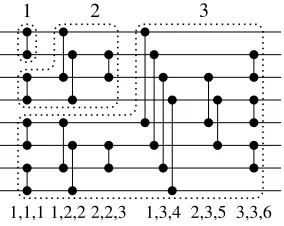
The part predicate indicates how large parts of an SN are required to accommodate the largest seen aggregate. Part numbers from 1 topsuffice for2p inputs. The atom
lvl(L, P, D)associates depthsDwith these partsPand lev-elsLwithin the parts. These concepts are depicted in Fig-ure 1 and they stem from the two levels of hierarchy in the typical divide-and-conquer generation algorithms. The rules forcompapply the closed form expression, while the rules forpasscomplement the conditions appropriately to detect wires untouched by comparators. The rule fordh states that for an aggregate withninputs, as large depths are necessary as are required to sort2dlogneinputs.
Proposition 4. The OESN program when up toninput lit-erals are needed hasO(n(logn)2)ground rules. The
com-bined grounded size of the SNA and OESN programs for a single aggregate isO(n(logn)2).
Example 7 (Ex. 6 continued). The SNA program A also yields span(ag,1..3), based on which the definition pro-gram F produces the used sorting network in form of the atomspart(1),part(2),lvl(1,1,1),lvl(1,2,2),lvl(2,2,3),
1 2 3
1,1,1 1,2,2 2,2,3 1,3,4 2,3,5 3,3,6
Figure 1: An odd-even sorting network for eight inputs with part numbers captured bypart at the top and tuples cap-tured bylvl for each layer at the bottom. Part 1 sorts two inputs, parts 1-2 sort four, and parts 1-3 sort all eight inputs. Each part yields adepth(N, D)atom where N andD are the greatest wire and depth indices of comparators within them, respectively.
comp(2,3,3),pass(1,3), dh(ag,1),dh(ag,2),dh(ag,3),
done(1,0),done(2,1), anddone(4,3).
Definition 9. Let r be a rule of the form h ← K ≤ #count{T1:l1;. . .;Tn :ln}, dom(K)with a count
aggre-gate. Thecount aggregate lazy normalizationofris the lazy normalization program(Ar∪Fr, Gr)whereAr,Fr, andGr
are the SNA, OESN, and gluing programs forr, resp.
The following correctness result can be established, es-sentially using the strategy provided by Proposition 1.
Theorem 1. Given a rulerwith a count aggregate, the lazy normalization(Ar∪Fr, Gr)is faithful.
Lazy-Normalization of Sum Aggregates. Sum aggre-gates are similar to count aggreaggre-gates in the sense that they consider each ground instance and increment some aggre-gated value, with the difference that counting increases the value by 1 while summation increases by a given value.
The gluing programGr is the same as in Definition 5,
except that the in predicate is now used in the form of
in(ag,element tuple(Ti), Vi)whereTiis a tuple of terms
as before andViis the value ofTi, which is the first term in
Ti(Calimeri et al. 2012). The evaluation program is almost
the same as in Definition 6 and mainly differs by the rule
sum(R, I, S+V)←sum(R, I−1, S),idx(R, I, V).
whereS+V substitutesS+1in the counting grid encoding. The respective normalization program is defined below.
Definition 10. Let r be a rule h ← K≤#sum{T1:l1;
. . .;Tn:ln}, dom(K)with a sum aggregate. The sum
ag-gregate lazy normalizationofris the lazy normalization pro-gram(Sr, Gr)whereSris the summation grid encoding and
Gris the gluing program forr.
Theorem 2. Given a rulerwith a sum aggregate, the lazy normalization(Sr, Gr)is faithful.
5
Evaluation
Lazy grounding is a recent approach aimed at solving large-scale instances in the long run and it is partially incom-patible with existing ground-and-solve techniques, which often require a complete grounding. Thus lazy-grounding cannot directly be put on top of ground-and-solve systems. Consequently, lazy-grounding ASP systems lack a decade of solver optimizations and a variety of solving techniques (e.g., equivalence preprocessing, learned clause deletion, and rapid restarts). The ASP competition benchmarks, how-ever, are tuned to exercise those techniques while problems where grounding is an issue are explicitly excluded, see (Gebser, Maratea, and Ricca 2017). We therefore evaluate our approach, implemented in the lazy-grounding ASP sys-tem Alpha (Weinzierl 2017), on a custom, yet meaningful, set of benchmarks. Since no other lazy-grounding ASP sys-tem supports aggregates, we can only compare with ground-and-solve systems and chose Clingo (Gebser et al. 2016) and Dlv2 (Alviano et al. 2017) as representatives. The evaluated version of Clingo is 5.2.2 and the version of Dlv2 is 2.0. If not otherwise indicated, each benchmark had 300 seconds and 8GB of memory on a single core of a Linux cluster with Intel Xeon E5-2680 v3 CPUs. For each instance we report CPU time averaged over 10 runs of computing the first 10 answer sets. Count aggregates are evaluated using the com-pact normalization.
Simulation. ASP is very suitable for encoding rule-based simulations, but the number of potential outcomes is pro-hibitive for ground-and-solve systems once many time steps are to be simulated. As this benchmark shows, lazy ground-ing with lazy normalization does not suffer from that issue. This benchmark simulates a robot free to move on the edges of a random graph as long as its energy resources are not de-pleted, where depletion is checked using a count aggregate. To avoid trivial solutions, visits to some pairs of nodes are mutually exclusive and the robot may not end in its start-ing position. Figure 2a shows the result of this benchmark for time steps (and graph sizes) from 100 up to 2000, each one being run on 10 random instances. Clingo is faster only for 100 time steps, while at 200 time steps Alpha is already faster. Clingo runs out of memory starting at 600 time steps while Alpha can still deal with instances of size 2000. Dlv2 suffers from the same issues as Clingo and performs even worse: it is always slower than Alpha and runs out of mem-ory at 500 time steps.
ver-Size Alpha Clingo Dlv2 100 2.6(0) 0.8(0) 4.7(0) 200 3.2(0) 6.2(0) 100.1(3) 500 9.1(0) 110.5(0) memout 600 7.7(0) memout memout 800 27.8(0) memout memout 1000 47.4(1) memout memout 2000 86.8(1) memout memout
(a) Simulation.
Size Alpha Clingo 100 1.9(0) 1.2(0) 150 2.2(0) 5.2(0) 200 2.5(0) 15.2(0) 250 2.9(0) 37.5(0) 300 3.0(0) 96.8(0) 350 3.2(0) 247.0(3) 1000 6.5(0) 300.0(10)
(b) Summation.
Size Alpha Clingo Dlv2
1k (100/10) 4.4(0) 1.5(0) 2.5(0) 3k (100/30) 13.0(0) 13.7(0) 8.1(0) 4k (200/10) 11.3(0) 25.1(0) 4.0(0) 5k (100/50) 18.7(0) 38.9(0) 3.4(0) 6k (250/10) 13.9(0) 62.7(0) 6.1(0) 12k (200/30) 36.5(0) 271.8(1) 9.6(0) 25k (500/10) 47.9(0) 300.0(10) 39.3(0)
(c) Dynamic Indegree Counting.
Figure 2: Benchmark results with runtimes in seconds and timeouts in parentheses. Size is: (a) number of time steps and graph size, (b) size of the domain that numbers are selected from, and (c) approx. number of edges (number of vertices / percentage of edge presence).
tices of a (random) graph, after one edge is removed non-deterministically. Clingo is fast for small graphs, but lazy normalization out-performs it on larger ones (cf. Figure 2c). Interestingly, Dlv2 performs better than Alpha and Clingo.
Exponential Space Saving. Lazy normalization can save up-to exponential space, as shown by the next ASP program:
dom(0..1). { a;b;c }. :- a, b. exp(X) :- a,b, dom(X).
holds :- 2 <= #count { X1, X2, . . ., Xn :
exp(X1), exp(X2), . . ., exp(Xn) }.
There is a domain dom with 2 elements and a non-deterministic guess overa,bandcsuch thataandbcannot both hold (cf. (Calimeri et al. 2012) for the employed lan-guage constructs). Atomsexp(0)andexp(1)are derived if bothaandbare true (which they are for no answer set). Fi-nally, an aggregate counts the number ofn-tuples overexp. The results of this benchmark are shown in Table 1, where size is the numbernof variables in the aggregate and 40 GB of memory are provided. Memory consumption of Clingo is growing exponentially until it hits 40 GB with size 26, where it runs out of memory. Dlv2 performs similarly but has a significantly higher memory consumption and exhibits some peculiar behavior starting at size 20, where it runs into timeouts despite being able to compute all actual answer sets of the program after a few seconds. Starting at size 26, how-ever, Dlv2 also runs out of memory before being able to compute any answer set. In contrast to that, Alpha never runs out of memory, requires about 80 MB for small instances (below size 30), and a constant amount of about 620 MB for larger ones. Closer investigation of the latter cases revealed a inefficiency in the grounding component of Alpha, occur-ing only for rules with hundreds of body literals. The 620 MB memory requirement is a subsequent artifact of Java’s garbage collection (GC) algorithm. Comparing Alpha with Clingo and Dlv2, it is apparent that lazy normalization can bring exponential space savings.
Comparing Normalizations. Since both lazy normaliza-tions of count aggregates were realized in Alpha, we can also show that the compact lazy normalization based on the odd-even sorting network performs much better than the count-ing grid-based one.
Alpha Clingo Dlv2
Size Time Memory Time Memory Time Memory
10 0.8 70 MB 0.0 3 MB 0.0 5 MB
18 0.8 83 MB 0.8 124 MB 249.3 1.4 GB
20 0.9 82 MB 3.3 504 MB 900.0 6.3 GB
22 0.8 82 MB 14.7 2.06 GB 900.0 12.0 GB
24 0.9 82 MB 63.7 8.47 GB 900.0 37.6 GB
26 0.9 83 MB 370.0 34.9 GB – memout
28 0.9 87 MB – memout – memout
500 12.3 620 MB – memout – memout
1000 80.0 616 MB – memout – memout
Table 1: Exponential Space Saving benchmark: time and space consumption of Alpha, Clingo, and Dlv2. Size is the number of variables in the aggregate. Maximum memory is 40 GB and timeout is at 900s.
6
Discussion
Related Work. Lazy normalization, in principle, can be added to any lazy-grounding ASP system. So far, these are: GASP (Pal`u et al. 2009), ASPeRiX (Lef`evre et al. 2017), Omiga (Dao-Tran et al. 2012), and Alpha (Weinzierl 2017). These solvers all have in common that they process only nor-mal rules, i.e., they allow for only ordinary literals in rule bodies and no disjunction in heads, and in particular, they do not support aggregates. Recent developments around Al-pha are on exploiting justifications (Bogaerts and Weinzierl 2018) as well as its use in evaluating external atoms (Eiter, Kaminski, and Weinzierl 2017). Furthermore, Alpha is the only lazy-grounding ASP system with efficient techniques for search (CDNL), hence it was taken as basis for this work. Related to lazy grounding is recent work in (Cuteri et al. 2017) exploring lazy instantiation for constraints alone, i.e., rules without heads, through use of propagators. Although aggregates are not addressed therein, the approach may ef-ficiently solve some of our benchmark problems, provided that the benchmarks were refactored to utilize a mix of con-straints, aggregates, and additional guess-and-check atoms in place of the current rules with aggregates.
reasons behind conflicts (Gebser et al. 2009) or normaliza-tion on the ground level (Bomanson 2017). A first-order nor-malization of these rules is already present in (Polleres et al. 2013) along with the motivation of debugging answer-set programs involving aggregates. Interestingly, the normaliza-tion schemes of Polleres et al. (2013) rely on a fixed to-tal order on input terms in contrast with the dynamic or-der created by the enumeration built-in devised in this work. On the downside, their encodings suffer from higher space complexity, which is witnessed by the fact that an early ver-sion of our normalization toolLP2NORMAL(Janhunen and Niemel¨a 2011) produces more compact normalizations than what is obtained by grounding the first-order translations de-vised by Polleres et al. (2013).
Aggregates have their roots in database operations (see, e.g., (Greco 1999)). The approach therein is based on DAT-ALOG programs where dedicated predicates are used to express summation, for instance. Consequently, linear con-straints can be embedded into rules. In particular, recursion through such special predicates is forbidden in terms of strat-ification. The evaluation of summation aggregates resem-bles our approach in the sense that (i) it is based on first-order rewriting and (ii) terms contributing to the sum are ordered and the aggregate is recursively evaluated in a cho-sen order. However, this order is produced upfront via non-deterministic choice, which is suitable for the implementa-tion considered in (Greco 1999) but impractical in ASP solv-ing. In contrast, we commit the next available positioniin an aggregateag to a ground termton-the-fly by using the built-in predicateenum(ag, t, i). In this way, the evaluation of the aggregate need not be delayed until the completion of the resulting order of terms.
Aggregates in ASP have also been studied on a higher level of abstraction and the central properties of aggre-gates were identified when, e.g.,monotone,anti-monotone, andconvexaggregates were studied (Liu and Truszczynski 2006). Since ASP deploys recursive definitions in terms of rules, the introduction of aggregates posed a challenge from the semantic perspective and a number of proposals were made; cf. (Ferraris 2011; Faber, Pfeifer, and Leone 2011; Gelfond and Zhang 2014)). Results on rewriting aggregates, such asnon-monotoneaggregates into monotone ones (Al-viano, Faber, and Gebser 2015), support the general idea adopted in this paper that monotone aggregates provide a natural basis for implementing aggregates in practical ASP systems. We note that proper disjunctive rules seem indis-pensable for such rewritings in general, and therefore such techniques do not fall strictly under the concept of normal-ization as understood in this paper.
Convex Aggregates. Monotone aggregates serve as natu-ral primitives in practical implementations and more com-plex aggregates can be realized on top of them. To illustrate this, let us consider counting and summation aggregates with
upper boundsin addition to lower bounds, such as in:
ok←10≤#sum{V, I:pick(I),cand(I, V)} ≤20.
The body of the rule is an example of a convex aggregate condition that can be understood as a conjunction of
mono-tone and an anti-monomono-tone aggregate conditions. This can be made explicit by rewriting the rule using the ideas from (Simons, Niemel¨a, and Soininen 2002):
enough ←10≤#sum{V, I:pick(I),cand(I, V)}. toomuch ←21≤#sum{V, I:pick(I),cand(I, V)}. ok←enough, nottoomuch.
Considering performance, both bounds can now be evalu-ated lazily, but the upper bound poses some challenge: if the solver assignsoktrue andtoomuchfalse before all relevant ground instances ofpick(·)are generated, then backtracking may be necessary if new instances ofpick(·)are grounded later on. Besides that, convex aggregates can be evaluated within our framework, but an implementation is future work.
7
Conclusion
In this paper, we presented a lean framework for lazy nor-malization, which enables the first-order normalization of aggregates subject to lazy grounding. To illustrate the feasi-bility of the framework, we devised several novel first-order encodings of counting and summation aggregates. Their cor-rectness and asymptotic behavior was formally analyzed. To the best of our knowledge, this is the first systematic ap-proach to the evaluation of aggregates in a lazy-grounding setting.
The lazy grounding ASP system Alpha was extended to support lazy normalization of aggregates and benchmarks demonstrate that lazy normalization can outperform the state-of-the-art ground-and-solve system Clingo on aggre-gate evaluation if grounding is an issue. Lazy grounding may also bring up-to exponential savings in space and time, as shown experimentally. Furthermore, the results on running rule-based simulations for hundreds of time steps indicate a potential new application area for ASP solving based on lazy grounding and lazy normalization. Together this sug-gests that lazy normalization is a useful new technique for ASP solving and knowledge representation in general.
In future work, we plan to investigate further normaliza-tion schemes for monotone/convex aggregates, potentially with upper bounds and other aggregate types like average. Lazy normalization may also prove useful with other for-malisms such as FO(ID) proposed by de Cat et al. (2015).
Acknowledgments
This work has been supported by the Academy of Finland, project 251170 and the research project DynaCon (FFG-PNr.: 861263), which is funded by the Austrian Federal Ministry of Transport, Innovation and Technology (BMVIT) under the program “ICT of the Future” between 2017 and 2020 (see https://iktderzukunft.at/en/ for more information).
References
Alviano, M.; Dodaro, C.; Faber, W.; Leone, N.; and Ricca, F. 2013. WASP: A native ASP solver based on constraint learning. In Cabalar and Son (2013), 54–66.
ASP system DLV2. InLPNMR, volume 10377 ofLNCS, 215–221.
Alviano, M.; Faber, W.; and Gebser, M. 2015. Rewriting recursive aggregates in answer set programming: back to monotonicity. Theory and Practice of Logic Programming
15(4-5):559–573.
Batcher, K. E. 1968. Sorting networks and their applica-tions. InAFIPS, volume 32 ofAFIPS Conference Proceed-ings, 307–314.
Bekbolatov, R. 2015. Batcher’s odd-even merge based sorting network node partner calculation. Available at http://sparkydots.blogspot.fi/2015/05/ batchers-odd-even-merging-network.html.
Bogaerts, B., and Weinzierl, A. 2018. Exploiting justifica-tions for lazy grounding of answer set programs. InIJCAI, 1737–1745.
Bomanson, J., and Janhunen, T. 2013. Normalizing car-dinality rules using merging and sorting constructions. In
LPNMR, volume 8148 ofLNCS, 187–199.
Bomanson, J. 2017. lp2normal - A normalization tool for ex-tended logic programs. InLPNMR, volume 10377 ofLNCS, 222–228.
Cabalar, P., and Son, T. C., eds. 2013.LPNMR, volume 8148 ofLNCS.
Calimeri, F.; Faber, W.; Gebser, M.; Ianni, G.; Kaminski, R.; Krennwallner, T.; Leone, N.; Ricca, F.; and Schaub, T. 2012. ASP-CORE-2 input language format.
Cuteri, B.; Dodaro, C.; Ricca, F.; and Sch¨uller, P. 2017. Con-straints, lazy conCon-straints, or propagators in ASP solving: An empirical analysis. Theory and Practice of Logic Program-ming17(5-6):780–799.
Dao-Tran, M.; Eiter, T.; Fink, M.; Weidinger, G.; and Weinzierl, A. 2012. Omiga : An open minded grounding on-the-fly answer set solver. InJELIA, volume 7519 ofLNCS, 480–483.
de Cat, B.; Denecker, M.; Bruynooghe, M.; and Stuckey, P. J. 2015. Lazy model expansion: Interleaving grounding with search. Journal of Artificial Intelligence Research52:235– 286.
E´en, N., and S¨orensson, N. 2006. Translating pseudo-Boolean constraints into SAT. Journal on Satisfiability, Boolean Modeling and Computation2(1-4):1–26.
Eiter, T.; Ianni, G.; and Krennwallner, T. 2009. Answer set programming: A primer. InReasoning Web, volume 5689 of
LNCS, 40–110.
Eiter, T.; Kaminski, T.; and Weinzierl, A. 2017. Lazy-grounding for answer set programs with external source ac-cess. InIJCAI, 1015–1022.
Faber, W.; Pfeifer, G.; and Leone, N. 2011. Semantics and complexity of recursive aggregates in answer set program-ming. Artificial Intelligence175(1):278–298.
Falkner, A. A.; Friedrich, G.; Haselb¨ock, A.; Schenner, G.; and Schreiner, H. 2016. Twenty-five years of successful application of constraint technologies at Siemens. AI Mag-azine37(4):67–80.
Ferraris, P. 2011. Logic programs with propositional con-nectives and aggregates. ACM Transactions on Computa-tional Logic12(4):25:1–25:40.
Gebser, M.; Kaminski, R.; Kaufmann, B.; and Schaub, T. 2009. On the implementation of weight constraint rules in conflict-driven ASP solvers. InICLP, 250–264.
Gebser, M.; Kaminski, R.; Kaufmann, B.; Ostrowski, M.; Schaub, T.; and Wanko, P. 2016. Theory solving made easy with clingo 5. In ICLP (Technical Communications), vol-ume 52 ofOASICS, 2:1–2:15.
Gebser, M.; Kaufmann, B.; and Schaub, T. 2012. Conflict-driven answer set solving: From theory to practice.Artificial Intelligence187:52–89.
Gebser, M.; Maratea, M.; and Ricca, F. 2017. The sixth answer set programming competition. Journal of Artificial Intelligence Research60:41–95.
Gelfond, M., and Zhang, Y. 2014. Vicious circle principle and logic programs with aggregates.Theory and Practice of Logic Programming14(4-5):587–601.
Greco, S. 1999. Dynamic programming in datalog with aggregates. IEEE Trans. Knowl. Data Eng.11(2):265–283. H¨olldobler, S.; Manthey, N.; and Steinke, P. 2012. A com-pact encoding of pseudo-Boolean constraints into SAT. In
KI, volume 7526 ofLNCS, 107–118.
Janhunen, T., and Niemel¨a, I. 2011. Compact transla-tions of non-disjunctive answer set programs to proposi-tional clauses. InGelfond Festscrift, volume 6565 ofLNCS, 111–130.
Lef`evre, C.; Beatrix, C.; Stephan, I.; and Garcia, L. 2017. Asperix, a first-order forward chaining approach for answer set computing. Theory and Practice of Logic Programming
17(3):266–310.
Leone, N.; Pfeifer, G.; Faber, W.; Eiter, T.; Gottlob, G.; Perri, S.; and Scarcello, F. 2002. The DLV system for knowledge representation and reasoning. ACM Transactions on Com-putational Logic7:499–562.
Liu, L., and Truszczynski, M. 2006. Properties and appli-cations of programs with monotone and convex constraints.
Journal of Artificial Intelligence Research27:299–334. Pal`u, A. D.; Dovier, A.; Pontelli, E.; and Rossi, G. 2009. Gasp: Answer set programming with lazy grounding. Fun-damenta Informaticae96(3):297–322.
Polleres, A.; Fr¨uhst¨uck, M.; Schenner, G.; and Friedrich, G. 2013. Debugging non-ground ASP programs with choice rules, cardinality and weight constraints. In Cabalar and Son (2013), 452–464.
Simons, P.; Niemel¨a, I.; and Soininen, T. 2002. Extend-ing and implementExtend-ing the stable model semantics. Artificial Intelligence138(1-2):181–234.
Weinzierl, A. 2017. Blending lazy-grounding and CDNL search for answer-set solving. InLPNMR, volume 10377 of
LNCS, 191–204.