The Thirty-Third AAAI Conference on Artificial Intelligence (AAAI-19)
Combining Axiom Injection and Knowledge Base
Completion for Efficient Natural Language Inference
Masashi Yoshikawa
Nara Institute of Science and Technology, Nara, Japan [email protected]
Koji Mineshima
Ochanomizu University, Tokyo, Japan [email protected]
Hiroshi Noji
Artificial Intelligence Research Center, AIST, Tokyo, Japan [email protected]
Daisuke Bekki
Ochanomizu University, Tokyo, Japan [email protected]
Abstract
In logic-based approaches to reasoning tasks such as Recog-nizing Textual Entailment (RTE), it is important for a system to have a large amount of knowledge data. However, there is a tradeoff between adding more knowledge data for im-proved RTE performance and maintaining an efficient RTE system, as such a big database is problematic in terms of the memory usage and computational complexity. In this work, we show the processing time of a state-of-the-art logic-based RTE system can be significantly reduced by replacing its search-based axiom injection (abduction) mechanism by that based on Knowledge Base Completion (KBC). We integrate this mechanism in a Coq plugin that provides a proof automa-tion tactic for natural language inference. Addiautoma-tionally, we show empirically that adding new knowledge data contributes to better RTE performance while not harming the processing speed in this framework.
1
Introduction
RTE is a challenging NLP task where the objective is to judge whether a hypothesis H logically follows from premise(s)P. Advances in RTE have positive implications in other areas such as information retrieval, question answer-ing and readanswer-ing comprehension. Various approaches have been proposed to the RTE problem in the literature. Some methods are based on deep neural networks (Rockt¨aschel et al. 2016; Chen et al. 2018; Nie and Bansal 2017), where a classifier is trained to predict using H and P encoded in a high-dimensional space. Other methods are purely symbolic (Bos et al. 2004; Mineshima et al. 2015; Abzianidze 2015), where logical formulas that representH andP are constructed and used in a formal proof system. In this paper, we adopt a strategy based on logic, encour-aged by the high-performance that these systems achieve in linguistically complex datasets (Mineshima et al. 2015; Abzianidze 2015), which contain a variety of semantic phe-nomena that are still challenging for the current neural mod-els (Wang et al. 2018).
Contrary to the end-to-end machine learning approaches, a logic-based system must explicitly maintain lexical knowl-edge necessary for inference. A critical challenge here is to deal with such knowledge in an efficient and scalable way. A
Copyright c2019, Association for the Advancement of Artificial Intelligence (www.aaai.org). All rights reserved.
promising approach in past work is on-demand axiom injec-tion (abducinjec-tion mechanism; Mart´ınez-G´omez et al. 2017), which allows one to construct knowledge between words in P andH as lexical axioms, and feed them to a logic prover when necessary. Combined with ccg2lambda (Mineshima et al. 2015), a higher-order logic-based system, their method demonstrates that injecting lexical knowledge from Word-Net (Miller 1995) and VerbOcean (Chklovski and Pantel 2004) significantly improves the performance.
Although their method provides a basis for handling ex-ternal knowledge with a logic-based RTE system, there still remains a practical issue in terms of scalability and effi-ciency. Their abduction mechanism generates relevant ax-ioms on-the-fly for a presentP andH pair, but this means we have to maintain a large knowledge base inside the sys-tem. This is costly in terms of memory, and it also leads to slower search due to a huge search space during infer-ence. WordNet already contains relations among more than 150,000 words, and in practice, we want to increase the coverage of external knowledge more by adding different kinds of database such as Freebase. To achieve such a scal-able RTE system, we need a more efficient way to preserve database knowledge.
In this paper, we present an approach to axiom injection, which, by not holding databases explicitly, allows handling of massive amount of knowledge without losing efficiency. Our work is built on Knowledge Base Completion (KBC), which recently has seen a remarkable advancement in the machine learning community. Although KBC models and logic-based approaches to RTE have been studied separately so far, we show that they can be combined to improve the overall performance of RTE systems. Specifically, we re-place the search of necessary knowledge on the database with a judgment of whether the triplet (s, r, o)is a fact or not in ann-dimensional vector space that encodes entitiess andoand relationr. For each triplet, this computation is ef-ficient and can be done inO(n)complexity. To this end we construct a new dataset from WordNet for training a KBC model that is suitable for RTE. We then show that this ap-proach allows adding new knowledge from VerbOcean with-out losing efficiency.
of a sentence, distinguishing them from common sense rea-soning (e.g.,John jumped into the lakeentailsJohn is wet) and inferences based on world knowledge (e.g.,Chris lives in Hawaii entails Chris lives in USA). For evaluation, we use the SICK (Sentences Involving Compositional Knowld-edge) dataset (Marelli et al. 2014), which focuses on lexical inferences combined with linguistic phenomena.1
Another advantage of our approach is that we can comple-ment the missing lexical knowledge in existing knowledge bases as latent knowledge. The previous method is limited in that it can only extract relations that are directly connected or reachable by devising some relation path (e.g. transitive closure for hypernym relation); however, there are also lex-ical relations that are not explicitly available and hence la-tent in the networks. To carefully evaluate this aspect of our method, we manually create a small new RTE dataset, where each example requires complex lexical reasoning, and find that our system is able to find and utilize such latent knowl-edge that cannot be reached by the existing approach.
Our final system achieves a competitive RTE performance with Mart´ınez-G´omez et al.’s one, while keeping the pro-cessing speed of the baseline method that does not use any external resources. The last key technique for this efficiency is a newabductiontactic, a plugin for a theorem prover Coq (The Coq Development Team 2017). One bottleneck of Mart´ınez-G´omez et al.’s approach is that in their system Coq must be rerun each time new axioms are added. To remedy this overhead we developabductiontactic that enables searching knowledge bases and executing a KBC scoring function during running Coq.
Our contributions are summarized as follow:2
• We propose to combine KBC with a logic-based RTE sys-tem for efficient and scalable reasoning.
• We develop an efficient abduction plugin for Coq, which we make publicly available.
• We show that our techniques achieve a competitive score to the existing abduction technique while maintaining the efficiency of the baseline with no knowledge bases. • We construct a set of lexically challenging RTE problems
and conduct extensive experiments to evaluate the latent knowledge our KBC model has learned. We demonstrate many examples of those knowledge that are not available for the previous method.
2
Related work
2.1
Logic-based RTE systems
Earlier work on logic-based approaches to RTE exploited off-the-shelf first-order reasoning tools (theorem provers and model-builders) for the inference component (Bos and
1
Large-scale datasets for training neural natural language inference models such as SNLI (Bowman et al. 2015) and MultiNLI (Williams, Nangia, and Bowman 2018) are not con-strained to focus on lexical and linguistic aspects of inferences, which can produce confounding factors in analysis, hence are not suitable for our purposes.
2
All the programs and resources used in this work are publicly available at: https://github.com/masashi-y/abduction kbc.
Markert 2005). Such a logic-based system tends to have high precision and low recall for RTE tasks, suffering from the lack of an efficient method to integrate external knowledge in the inference system.
Meanwhile, researchers in Natural Logic (van Benthem 2008) have observed that the iteration depth of logical op-erators such as negations and quantifiers in natural lan-guages is limited and, accordingly, have developed a vari-ety of proof systems such as monotonicity calculus (Icard and Moss 2014) adapted for natural languages that use small parts of first-order logic.
The idea of natural logic has recently led to a renewed interest in symbolic approaches to modeling natural lan-guage inference in the context of NLP (MacCartney and Manning 2008). In particular, theorem provers designed for natural languages have been recently developed, where a proof system such as analytic tableau (Abzianidze 2015) and natural deduction (Mineshima et al. 2015) is used in combination with wide-coverage parsers. These systems al-low a controlled use of higher-order logic, folal-lowing the tra-dition of formal semantics (Montague 1974), and thereby have achieved efficient reasoning for logically complex RTE problems such as those in the FraCaS test suite (Cooper et al. 1994). However, it has remained unclear how one can add robust external knowledge to such logic-based RTE systems without loss of efficiency of reasoning. The aim of this paper is to address this issue.
We use Coq, an interactive proof assistant based on the Calculus of Inductive Constructions (CiC), in order to im-plement an RTE system with our method of axiom inser-tion. Although Coq is known as an interactive proof assis-tant, it has a powerful proof automation facility where one can introduce user-defined proof strategies called tactics. The work closest to our approach in this respect is a system based on Modern Type Theory (Chatzikyriakidis and Luo 2014), which uses Coq as an automated theorem prover for natural language inferences. It was shown that the system achieved high accuracy on the FraCaS test suite (Bernardy and Chatzikyriakidis 2017). However, the system relies on a hand-written grammar, suffering from scalability issues. Ad-ditionally, this work did not evaluate the efficiency of theo-rem proving for RTE, nor address the issue of how to extend their RTE system with robust external knowledge.
Generally speaking, it seems fair to say that the issue of efficiency of logic-based reasoning systems with a large database has been underappreciated in the literature on RTE. To fill this gap, we investigate how our logic-based approach to RTE, combined with machine learning-based Knowledge Base Completion, can contribute to robust and efficient nat-ural language reasoning.
2.2
Knowledge Base Completion (KBC)
Search Wordnet Add new
axioms
list of predicates
Retry (a) CCG
Parsing
(b) Semantic Parsing
(c) Theorem Proving
(Coq)
Yes, No, Unknown Premise
& Hypothesis
(d) Axiom Injection 8x.(hike(x)!walk(x))
(hike, hypernyms, walk)
A NP/N
λF.λG.∃x.F(x)∧G(x)
man N
λx.man(x) NP
λG.∃x.man(x)∧G(x)
> walks
S\NP
λQ.Q(λx.∃e.walk(e)∧subj(e, x)) S
∃x.man(x)∧ ∃e.walk(e)∧subj(e, x)
< A
NP/N
λF.λG.∃x.F(x)∧G(x)
man N
λx.man(x)
NP
λG.∃x.man(x)∧G(x)
> hikes
S\NP
λQ.Q(λx.∃e.hike(e)∧subj(e, x))
S
∃x.man(x)∧ ∃e.hike(e)∧subj(e, x)
< Premise
Hypothesis
Figure 1: A pipeline of ccg2lambda. It firstly applies CCG parser to premise (P) and hypothesis (H) sentences (a), and then convert them to logical formulas (b). It tries to prove if entailment (contradiction) can be established by applying Coq to the theoremP →H(P → ¬H) (c). If the proving fails, it tries axiom injection (d).
relationr∈ Rin ann-dimensional complex vector space3:
ψr(s, o) =σ(Re(hes,er,eoi)), (1)
wherees,er,eo∈Cn,hx,y,zi=P
ixiyizi, andσis the sigmoid function. Since Eq. 1 consists of one dot-product among three vectors, its computational complexity isO(n). The training is done by minimizing the logistic loss:
X
((s,r,o),t)∈D
tlogψr(s, o)+(1−t) log(1−ψr(s, o)), (2)
whereDis the training data. We havet = 1if the triplet is a fact andt = 0if not (negative example). While negative examples are usually collected by negative sampling, 1-N scoring has been proposed to accelerate training (Dettmers et al. 2017). In 1-N scoring, unlike other KBC models that take an entity pair and a relation as a triplet (s, r, o) and score it (1-1 scoring), one takes one (s, r)pair and scores it against all entitieso∈ Esimultaneously. It is reported that this brings over 300 times faster computation of the loss for their convolution-based model. This method is applicable to other models including ComplEx and scales to large knowl-edge bases. We employ this technique in our experiments.
3
System overview
We build our system on ccg2lambda (Mineshima et al. 2015)4, an RTE system with higher-order logic. Figure 1 shows a pipeline of the system.
Note that although we use a particular RTE system to test our hypotheses, other logic-based RTE systems can also
3
Cdenotes the set of complex numbers. Forx ∈ C,Re(x) denotes its real part andxits complex conjugate.
4
https://github.com/mynlp/ccg2lambda
benefit from our KBC-based method. In so far as a lexical re-lation is modeled as a triplet, it could be adapted to their in-ference modules; for instance, ifris a hypernym relation, a triplet(s, r, o)is mapped tosvo, wherevis a containment relation in Natural Logic (MacCartney and Manning 2008) or a subtyping relation in Modern Type Theory (Chatzikyri-akidis and Luo 2014), rather than to∀x.(s(x)→o(x))as in the standard logic we use in this paper.
3.1
CCG and semantic parsing
The system processes premise(s) (P) and a hypothesis (H) using Combinatory Categorial Grammar (CCG; Steed-man 2000) parsers. CCG is a lexicalized grammar that pro-vides syntactic structures transparent to semantic represen-tations (Figure 1a). In CCG, each lexical item is assigned a pair (C, M)of the syntactic category C and a meaning representationM encoded as aλ-term; for instance, “man” is assigned (N, λx.man(x)). The parses (called derivation trees) are converted into logical formulas by composingλ -terms assigned to each terminal word in accordance with combinatory rules (Figure 1b).
3.2
Theorem proving
The system uses automated theorem proving in Coq (Fig-ure 1c) to judge whether entailment (P → H) or contra-diction (P → ¬H) holds between the premise and the hy-pothesis. It implements a specialized prover for higher-order features in natural language, which is combined with Coq’s build-in efficient first-order inference mechanism. Coq has a language called Ltac for user-defined automated tactics (De-lahaye 2000). The additional axioms and tactics specialized for natural language constructions are written in Ltac. We run Coq in a fully automated way, by feeding to its inter-active mode a set of predefined tactics combined with user-defined proof-search tactics.
3.3
Axiom insertion (abduction)
Previous work (Mart´ınez-G´omez et al. 2017) extends ccg2lambda with an axiom injection mechanism using databases such as WordNet (Miller 1995). When a proof of T → H or T → ¬H fails, it searches these databases for lexical relations that can be used to complete the theorem at issue. It then restarts a proof search after declaring the lexical relations as axioms (Figure 1d). This mechanism of on-demand insertion of axioms is calledabduction.
A problem here is that this abduction mechanism slows down the overall processing speed. This is mainly due to the following reasons: (1) searches for some sort of relations in-cur multi-step inference over triplets (e.g. transitive closure of hypernym relation); (2) the theorem proving must be done all over again to run an external program that searches the knowledge bases. In this work, to solve (1), we propose an efficientO(n)abduction mechanism based on KBC (§4.1). For (2), we developabductiontactic, that enables adding new lexical axioms without quitting a Coq process (§4.2).
4
Proposed method
Our abduction mechanism adds new axioms whenever the prover stops due to the lack of lexical knowledge. Specif-ically, the system collects pairs of predicates from a cur-rent proof state and evaluates the pairs for every rela-tion r ∈ R = {synonym,hypernym,antonym,hyponym,
derivationally–related}with ComplEx (Eq. 1). It then declares as axioms logical formulas converted from the triplets whose scores are above a predefined thresholdθ. See Table 1 for the conversion rules. We describe the construc-tion of a training data for ComplEx in§4.1 andabduction
tactic that performs the axiom injection in§4.2.
4.1
Data creation
Although there already exist benchmark datasets for Word-Net completion (e.g., WN18 (Bordes et al. 2013)), we con-struct our own dataset. We find two problems on the exist-ing datasets considerexist-ing its application to RTE tasks. One is a gap between the entities and relations appearing in those benchmark datasets and those needed to solve RTE datasets. For example the knowledge on disease names are not neces-sary for the present dataset.
Another, more critical issue is that in WordNet many rela-tions including hypernym and hyponym are defined among
synsets, i.e., sets of synonymous lemmas, and the existing datasets also define a graph on them. This is problematic in practice for ccg2lambda, which normalizes a word’s surface form into its lemma when obtaining a logical formula. A possible option to mitigate this discrepancy is to normalize each word into synset by adding word-sense disambiguation (WSD) step in ccg2lambda. Another option is to construct a new dataset in which each relation is defined among lem-mas. We choose the latter for two reasons: (1) existing WSD systems do not perform well and cause error propagation; and (2) a dataset defined among lemmas eases the data aug-mentation using other resources. For example, VerbOcean defines relations between lemmas so it is straightforward to augment the training data with it, as we show later.
We use different strategies to extract relations for each relationr∈ Rfrom WordNet as follows.5
synonym Since synonym relation is not defined in Word-Net, we find them from other relations. We regard two synsetss1ands2as synonym if they are inalso sees,
verb groups, or similar tos relation, or if they share some lemmal ∈ s1∩s2. Then, we take a Carte-sian product ofs1ands2, that is,(l1,synonym, l2)for all l1∈s1andl2∈s2, and add them to the dataset.
hypernym and hyponym These relations are defined among synsets in WordNet. As in synonym, for
hypernym we take a Cartesion product of s1 and s2, when they are in hypernym relation. We also collect the triplets obtained from its transitive closure, since
hypernymis a transitive relation.6We process hyponym relations in the same way.
antonym and derivationally-related Since antonym and derivationally-related relations are defined among lem-mas in WordNet, we simply collect them.
Since the constructed dataset contains many entities that will not be used in the existing RTE datasets, we strip off triplets(s, r, o)ifsorois not found in our predefined lemma list, consisting of all lemmas of words appearing in the train-ing part of SICK (Marelli et al. 2014) and SNLI (Bowman et al. 2015), as well as the pre-trained GloVe word vectors.7 The resulting dataset contains 1,656,021 triplets and the number of the entities is 41,577. We spare random 10,000 triplets for development and use the rest for training.
VerbOcean is a semi-automatically constructed reposi-tory of semantic relations among verbs. Since it defines a triplet among lemmas, we simply map the relations in the dataset toRafter filtering triplets using the lemma list above. Concretely, in the experiments we usesimilar re-lations, which consists of 17,694 triplets.
5
For simplicity, we use the set theoretical notation:l ∈ s de-notes lemmalis an element of synsets.
6
e.g., (puppy,hypernym,animal) follows from
(puppy,hypernym,dog)and(dog,hypernym,animal).
7
Relationr Generated Axiom Example
synonym,hypernym, ∀x.s
(x)→o(x) (make,synonym,build) ;∀e.make(e)→build(e)
derivationally-related
antonym ∀x.s(x)→ ¬o(x) (parent, r,child) ;∀x.parent(x)→ ¬child(x)
hyponym ∀x.o(x)→s(x) (talk, r,advise) ;∀e.advise(e)→talk(e)
Table 1: Triplet(s, r, o)and axioms generated in terms ofr. The type of an argument is determined in the semantic parsing part of ccg2lambda. While we use unary predicates (Neo-Davidsonian semantics), it can be generalized to any arity.
1 subgoal
(exists x : Entity, man x /\ (exists e : Event, hike e /\ subj e x)) -> exists x : Entity, man x /\ (exists e : Event, walk e /\ subj e x) t < intro.
H : exists x : Entity, man x /\ (exists e : Event, hike e /\ subj e x) ============================
exists x : Entity, man x /\ (exists e : Event, walk e /\ subj e x) t < abduction.
H : exists x : Entity, man x /\ (exists e : Event, hike e /\ subj e x) NLax1 : forall x : Event, hike x -> walk x
============================
exists x : Entity, man x /\ (exists e : Event, walk e /\ subj e x)
(man, walk) (man, hike) (hike, walk)
(hike, hypernym, walk)
Send them to Python server
Evaluate all the predicate pairs using ComplEx Construct a list of predicate pairs from context and goal
Filter them by score
Add them as axioms
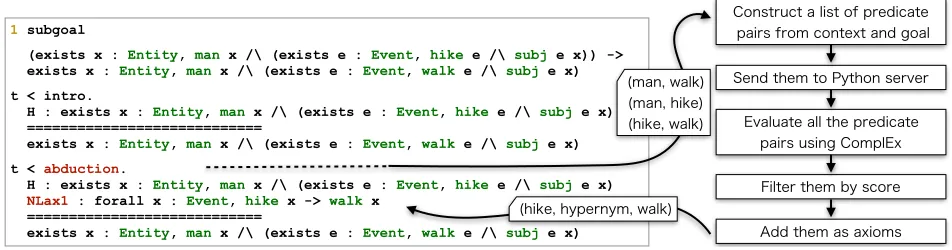
Figure 2: Running example ofabductiontactic in a Coq session proving “A man hikes”→“A man walks”. When the tactic is executed, it interacts with a ComplEx model on a different process and injects high scoring triplets as axioms.
4.2
Axiom injection with
abduction
tactic
As mentioned earlier, the abduction method in the previous work needs to rerun Coq when adding new axioms. Now we introduce our abductiontactic that enables adding new axioms on the fly without quitting the program.
Figure 2 shows a running example ofabductiontactic. When executed, this tactic collects from the context (the set of hypotheses) and the goal (the theorem to be proven) all the pairs of predicates and sends them to a Python server running on other process. The Python program evaluates the pairs for all relations in Rwith ComplEx and then sends back the triplets whose score is above a thresholdθ. In Coq, these are converted to logical formulas according to Table 1 and finally added to the context as axioms.
In Coq, as one can compose tactics into another tactic, it is possible to construct a tactic that performs higher-order rea-soning for natural language that additionally injects lexical axioms when needed. Note that search-based axiom injec-tion also can be performed with this tactic, by replacing the KBC-based scoring function with the search on databases.
We should note that one can combine ourabduction
tactic with other semantic theories (e.g. Chatzikyriakidis and Luo 2014; Bernardy and Chatzikyriakidis 2017) and put the system in application. Coq has been used mainly for system verification and formalization of mathematics and there has been no tactic that is solely aimed at natural lan-guage reasoning. However, Coq provides an expressive for-mal language that combines higher-order logic and richly-typed functional programming language, and thus offers a general platform for various natural language semantics. We believe that with our work, it will be easier to develop an NLP systems based on advanced linguistic theories. This
ar-chitecture also opens up new opportunities to integrate theo-rem proving and sophisticated machine-learning techniques. For example, we could implement in a tactic more complex tasks such as premise selection with deep models (Alemi et al. 2016).
5
Experiments
5.1
SICK dataset
We evaluate the proposed method on SICK dataset (Marelli et al. 2014). The dataset contains 4,500 problems (a pair of premise and hypothesis) for training, 500 for trial and 4,927 for testing, with a ratio of entailment/contradiction / un-known problems of .29 / .15 / .56 in all splits. Note that ccg2lambda itself is an unsupervised system and does not use any training data. We use the train part for the lemma list in data construction (§4.1) only and use the trial part to determine a thresholdθand to evaluate the processing speed.
5.2
New LexSICK lexical inference dataset
While SICK dataset provides a good testbed for evaluat-ing logical inference involvevaluat-ing levaluat-inguistic phenomena such as negation and quantification, we found that the dataset is not ideal for evaluating complex lexical inference, specifically latent knowledge learned by a KBC model.construc-Id: (a) Label:CONTRADICTION
P:A white and tan dog is running through the tall and green grass
H:A white and tan dog is ambling through a field
Id: (b) Label:ENTAILMENT
P:Someone is dropping the meat into a pan
H:The meat is being thrown into a pan
Id: (c) Label:ENTAILMENT
P:The man is singing and playing the guitar
H:The guitar is being performed by a man
Id: (d) Label:CONTRADICTION
P:A man and a woman are walking together through the wood
H:A man and a woman are staying together
Id: (e) Label:ENTAILMENT
P:A man is emptying a container made of plastic completely
H:A man is clearing a container made of plastic completely
Table 2: LexSICK RTE problems require a mix of logical reasoning and external lexical knowledge.
tion is as follow: a human expert picks a sentence (premise) from SICK dataset, changes a word to its synonym/antonym according to thesauruses,8 and then changes its sentence structure as well to construct a hypothesis.
The dataset (we refer to it as LexSICK) contains 58 problems, 29 of which is labeledentailment, 29 contradic-tion, and nounknownlabel. The whole dataset is publicly available.2
5.3
Experimental settings
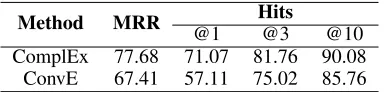
Settings for ComplEx Unless otherwise stated, we set the dimension of embeddingsn= 50and train it on the triplets obtained from WordNet (excluding VerbOcean triplets) in §4.1 by minimizing the logistic loss (Eq. 2) using Adam optimizer. We use 1-N scoring (§2.2), since our dataset is fairly large compared to standard benchmark datasets. For the other hyperparameters, we use the same setting as in Trouillon et al. (2016), except for the batch size of 128. In Table 3, we show Mean Reciprocal Rank (MRR) and Hits@N(N = 1,3,10) of ComplEx model (and the state-of-the-art ConvE (Dettmers et al. 2017) with the default hyperparameters for comparison) on development part of the dataset in§4.1.9 The ComplEx model scores 77.68 in MRR, which is comparably lower than scores reported for the widely used WN18 benchmark data (above 93). Notably, ComplEx performs better than ConvE in terms of all metrics in this experiment. We adopt ComplEx in this work, since it achieves better results with much lower computational load.
Settings for ccg2lambda We decide the threshold θ = 0.4 for filtering triplets based on the accuracy on the SICK trial set. As baselines, we replicate the system of Mart´ınez-G´omez et al. (2017) with the default settings of
8
We avoided WordNet and used thesaurus.com (http: //www.thesaurus.com/) and Merriam-Webster (http://www. merriam-webster.com/).
9
We report the scores in filtered setting. That is, compute the rank ofofor gold(s, r, o)against alle ∈ Esuch that(s, r, e)is not in either of training or development data.
Method MRR Hits
@1 @3 @10
ComplEx 77.68 71.07 81.76 90.08
ConvE 67.41 57.11 75.02 85.76
Table 3: The performance of KBC models trained and eval-uated on WordNet triplets in§4.1. We report filtered scores9.
ccg2lambda10 except for the use of CCG parsers mentioned below.
One bottleneck of ccg2lambda is errors in CCG parsing. To mitigate the error propagation, it uses four CCG parsers and aggregates the results: C&C (Clark and R. Curran 2007), EasyCCG (Lewis and Steedman 2014), EasySRL (Lewis, He, and Zettlemoyer 2015) and depccg (Yoshikawa, Noji, and Matsumoto 2017). We regard two results as contradicted with each other if one isentailmentand the other is contra-diction. In such cases the system outputsunknown; other-wise, if at least one parser results inentailmentor contradic-tion, that is adopted as the system output.
We report accuracy / precision / recall / F1 on the test part and processing speed (macro average of five runs) in the trial set.11
5.4
Results on SICK set
Table 4 shows the experimental results on SICK. The first row is a baseline result without any abduction mechanism, followed by ones using WordNet and VerbOcean additively with the search-based axiom injection. By introducing our
abductiontactic that is combined with the search-based axiom injection (4th row), we have successfully reduced the computation time (-2.35 sec. compared to 3rd row). By replacing the search-based abduction with the ComplEx model, the averaged time to process an RTE problem is again significantly reduced (5th row). The time gets close to the baseline without any database (only +0.24 sec.), with much improvement in terms of RTE performance, achiev-ing the exactly same accuracy with Mart´ınez-G´omez et al.’s WordNet-based abduction.
Finally, we re-train a ComplEx model withsimilar re-lations from VerbOcean (final row). When combining the datasets, we find that setting the dimension of embeddings larger to n = 100 leads to better performance. This may help the KBC model accommodate the relatively noisy na-ture of VerbOcean triplets. The VerbOcean triplets have con-tributed to the improved recall by providing more knowl-edge not covered by WordNet, while it has resulted in drops in the other metrics. Inspecting the details, it has actu-ally solved more examples than when using only Word-Net triplets; however, noisy relations in the data, such as (black,similar,white), falsely lead to proving entail-ment / contradiction for problems whose true label is
un-10
We use a version of ccg2lambda committed to the master branch on October 2, 2017.
11
System Method Dataset Accuracy Precision Recall F1 Speed
search KBC tactic WN VO
Mineshima et al. (2015) 77.30 98.93 48,07 64.68 3.79
Mart´ınez-G´omez et al. (2017) 3 3 83.55 97.20 63.63 76.90 9.15
3 3 3 83.68 96.88 64.15 77.16 9.42
Ours
3 3 3 3 83.64 97.15 64.01 77.16 7.07
3 3 3 83.55 96.28 64.38 77.14 4.03
3 3 3 3 83.45 95.75 64.47 77.04 3.84
Table 4: Results on SICK test set. The results of the baseline systems are above the dashed line. TheMethodcolumns represent the use of search-based abduction, KBC-based abduction andabductiontactic, while theDatasetcolumns datasets used in abduction: WordNet (WN) and VerbOcean (VO).Speedshows macro average of processing time (sec.) of an RTE problem.
Method #Correct
ResEncoder (Nie and Bansal 2017) 18 / 58 search-based abduction 20 / 58
KBC-based abduction 21 / 58
Table 5: Experimental results on LexSICK. Both search- and KBC-based abductions use WordNet and VerbOcean.
known. The higher recall has contributed to the overall pro-cessing speed, since it has led more problems to be proven before the timeout (-0.25 sec.).
We conduct detailed error analysis on 500 SICK trial problems. The RTE system combined with our KBC-based abduction (trained only on WordNet) has correctly solved one more problem than a Mart´ınez-G´omez et al.’s baseline system (which additionally uses VerbOcean), resulting in the accuracy of 84.8%. In this subset, we found the following er-ror cases: 71 cases related to lexical knowledge, 4 failures in CCG parsing, and 1 timeout in theorem proving. This shows that CCG parsing is quite reliable. Around five cases among lexical ones are due to false positively asserted lexical ax-ioms, while the most of the others are due to the lack of knowledge. In the following, we exclusively focus on issues related to lexical inference.
5.5
Evaluating latent knowledge
Table 5 shows experimental results on LexSICK dataset. For comparison, we add a result of ResEncoder (Nie and Bansal 2017), one of the state-of-the-art neural network-based RTE models. When trained on the training part of SICK, it scores 82.00% accuracy on the SICK test part, while performs badly on LexSICK, indicating this dataset is more challeng-ing. The accuracies of two logic-based methods are also not high, suggesting the difficulty of this problem. The KBC-based method shows the same tendency as in the results in the previous section; it solves more examples than the search-based method, along with false positive predictions.
We observe interesting examples that show the ef-fectiveness of using latent lexical knowledge. One is Example (d) in Table 2, for which a latent relation (walk,antonym,stay) is predicted by the KBC model, while it is not available for the search-based method. Another case is Example (e) in Table 2, where our method obtains the axiom ∀x.clear(x) → empty(x) by
scoring the triplet (empty,synonym,clear) as high as (empty,hyponym,clear), leading to the correct predic-tion. The search-based method derives only∀x.empty(x)→
clear(x), which is not relevant in this case.
Similarly, by examining the results on SICK dataset, we found more examples that the KBC-based method has suc-cessfully solved by utilizing latent lexical knowledge. For example, in SICK-6874 we have a premise A couple of white dogs are running and jumping along a beachand a hypothesis Two dogs are playing on the beach. The KBC model successfully proves the inference by producing mul-tiple axioms: ∀x.along(x) → on(x), ∀x.couple(x) →
two(x) and∀x.run(x) →play(x). One characteristic of the KBC-based method is that it can utilize lexical relations between general words such as frequent verbs and prepo-sitions. Though this may cause more false positive predic-tions, our experiments showed that under the control of the abduction method, it contributed to improving recall while keeping high precision.
6
Conclusion and future direction
In this work, we have proposed an automatic axiom injection mechanism for natural language reasoning based on Knowl-edge Base Completion. In the experiments, we show that our method has significantly improved the processing speed of an RTE problem, while it also achieves the competitive ac-curacy, by utilizing the obtained latent knowledge.In future work, we are interested in extending this framework to generate phrasal axioms (e.g.,∀x.have(x)∧
fun(x) → enjoy(x)). Generating this sort of axioms ac-curately is the key for logic-based systems to achieve high performance. In order to do that, we will need a framework to learn to compute compositionally a vector from those of haveandfunand to predict relations such assynonym be-tween the vector and that ofenjoy.
Acknowledgements
References
Abzianidze, L. 2015. A Tableau Prover for Natural Logic and Language. InProc. of EMNLP, 2492–2502.
Alemi, A. A.; Chollet, F.; Een, N.; Irving, G.; Szegedy, C.; and Urban, J. 2016. DeepMath - Deep Sequence Models for Premise Selection. InProc. of NIPS, 2243–2251.
Bernardy, J.-P., and Chatzikyriakidis, S. 2017. A type-theoretical system for the FraCaS test suite: Grammatical framework meets Coq. InProc. of IWCS.
Bordes, A.; Usunier, N.; Garcia-Dur´an, A.; Weston, J.; and Yakhnenko, O. 2013. Translating Embeddings for Modeling Multi-relational Data. InNIPS, 2787–2795.
Bos, J., and Markert, K. 2005. Recognising textual entail-ment with logical inference. InProc. of EMNLP, 628–635.
Bos, J.; Clark, S.; Steedman, M.; Curran, J. R.; and Hock-enmaier, J. 2004. Wide-coverage Semantic Representations from a CCG Parser. InProc. of COLING.
Bowman, S. R.; Angeli, G.; Potts, C.; and D. Manning, C. 2015. A large annotated corpus for learning natural language inference. InProc. of EMNLP, 632–642.
Chatzikyriakidis, S., and Luo, Z. 2014. Natural language in-ference in Coq.Journal of Logic, Language and Information 23(4):441–480.
Chen, Q.; Zhu, X.; Ling, Z.-H.; Inkpen, D.; and Wei, S. 2018. Neural Natural Language Inference Models Enhanced with External Knowledge. InProc. of ACL, 2406–2417.
Chklovski, T., and Pantel, P. 2004. VerbOcean: Mining the Web for Fine-Grained Semantic Verb Relations. In Lin, D., and Wu, D., eds.,Proc. of EMNLP, 33–40.
Clark, S., and R. Curran, J. 2007. Wide-Coverage Efficient Statistical Parsing with CCG and Log-Linear Models. Com-putational Linguistics33(4):493–552.
Cooper, R.; Crouch, R.; van Eijck, J.; Fox, C.; van Genabith, J.; Jaspers, J.; Kamp, H.; Pinkal, M.; Poesio, M.; Pulman, S.; et al. 1994. FraCaS–a framework for computational seman-tics. DeliverableD6.
Delahaye, D. 2000. A Tactic Language for the System Coq. In Parigot, M., and Voronkov, A., eds.,Logic for Program-ming and Automated Reasoning, 85–95. Springer.
Dettmers, T.; Minervini, P.; Stenetorp, P.; and Riedel, S. 2017. Convolutional 2D Knowledge Graph Embeddings. In AAAI, 1811–1818.
Icard, T., and Moss, L. 2014. Recent progress in mono-tonicity. Linguistic Issues in Language Technology (LiLT) 9:1–29.
Lewis, M., and Steedman, M. 2014. A* CCG Parsing with a Supertag-factored Model. InProc. of EMNLP, 990–1000.
Lewis, M.; He, L.; and Zettlemoyer, L. 2015. Joint A* CCG Parsing and Semantic Role Labelling. InProc. of EMNLP, 1444–1454.
MacCartney, B., and Manning, C. D. 2008. Modeling se-mantic containment and exclusion in natural language infer-ence. InProc. of COLING, 140–156.
Marelli, M.; Menini, S.; Baroni, M.; Bentivogli, L.; bernardi, R.; and Zamparelli, R. 2014. A SICK cure for the evaluation of compositional distributional semantic models. InProc. of LREC, 216–223.
Mart´ınez-G´omez, P.; Mineshima, K.; Miyao, Y.; and Bekki, D. 2017. On-demand Injection of Lexical Knowledge for Recognising Textual Entailment. InProc. of EACL, 710– 720.
Miller, G. A. 1995. WordNet: A Lexical Database for En-glish.Commun. ACM38(11):39–41.
Mineshima, K.; Mart´ınez-G´omez, P.; Miyao, Y.; and Bekki, D. 2015. Higher-order logical inference with compositional semantics. InProc. of EMNLP, 2055–2061.
Montague, R. 1974. Formal Philosophy: Selected Papers of Richard Montague. New Haven: Yale University Press. Nie, Y., and Bansal, M. 2017. Shortcut-stacked sen-tence encoders for multi-domain inference. arXiv preprint arXiv:1708.02312.
Parsons, T. 1990. Events in The Semantics of English: a Study in Subatomic Semantics. The MIT Press.
Rockt¨aschel, T.; Grefenstette, E.; Hermann, K. M.; Kocisk´y, T.; and Blunsom, P. 2016. Reasoning about Entailment with Neural Attention.ICLR.
Steedman, M. 2000.The Syntactic Process. The MIT Press. The Coq Development Team. 2017. The Coq Proof Assis-tant: Reference Manual: Version 8.7.1. INRIA.
Trouillon, T.; Welbl, J.; Riedel, S.; Gaussier, E.; and Bouchard, G. 2016. Complex embeddings for simple link prediction. InProc. of ICML, 2071–2080.
van Benthem, J. 2008. A brief history of natural logic. In Logic, Navya-Ny¯aya & Applications: Homage to Bimal Kr-ishna Matilal. College Publications. 21–42.
Wang, A.; Singh, A.; Michael, J.; Hill, F.; Levy, O.; and Bowman, S. R. 2018. GLUE: A Multi-Task Benchmark and Analysis Platform for Natural Language Understanding. CoRRabs/1804.07461.