The Thirty-Third AAAI Conference on Artificial Intelligence (AAAI-19)
A Hierarchical Framework for Relation
Extraction with Reinforcement Learning
Ryuichi Takanobu,
1,3∗Tianyang Zhang,
1,3∗Jiexi Liu,
2,3∗Minlie Huang
1,3†1Dept. of Computer Science & Technology,2Dept. of Physics, Tsinghua University, Beijing, China 3Institute for Artificial Intelligence, Tsinghua University (THUAI), China
3Beijing National Research Center for Information Science & Technology, China
{gxly15, zhang-ty15, liujx15}@mails.tsinghua.edu.cn, [email protected]
Abstract
Most existing methods determine relation types only after all the entities have been recognized, thus the interaction be-tween relation types and entity mentions is not fully mod-eled. This paper presents a novel paradigm to deal with re-lation extraction by regarding the related entities as the ar-guments of a relation. We apply a hierarchical reinforcement learning (HRL) framework in this paradigm to enhance the interaction between entity mentions and relation types. The whole extraction process is decomposed into a hierarchy of two-level RL policies for relation detection and entity extrac-tion respectively, so that it is more feasible and natural to deal with overlapping relations. Our model was evaluated on pub-lic datasets collected via distant supervision, and results show that it gains better performance than existing methods and is more powerful for extracting overlapping relations1.
Introduction
Extracting entities, relations, or events from unstructured texts is crucial for building large-scale, reusable knowl-edge which can facilitate many other tasks (Mintz et al. 2009; Nadeau and Sekine 2007), including knowledge base construction (Dong et al. 2014; Luan et al. 2018), ques-tion answering (Fader, Zettlemoyer, and Etzioni 2014), and biomedical text mining (Huang and Lu 2015).
The task of relation extraction is to identify relations
(es, r, et)2, a triple consisting of a relation typer, a source
entity es and a target entity et. In this paper, we propose
a novel joint extraction paradigm in the framework of hier-archical reinforcement learning (Sutton, Precup, and Singh 1999), where we first detect a relation and then extract the corresponding entities as the argument of a relation.
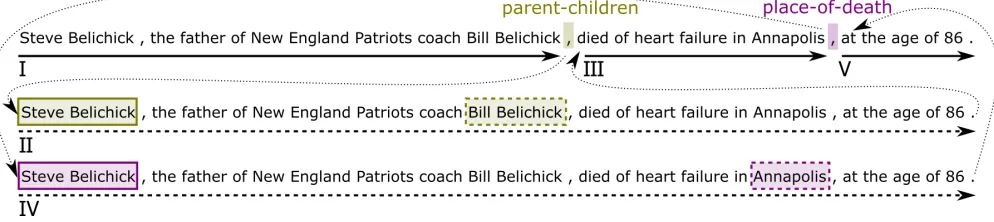
Our model detectsrelation indicatorsby a high-level re-inforcement learning (RL) process and identifies the partici-pating entities for the relation by a low-level RL process. As shown in Figure 1, the extraction process makes sequential
Copyright c2019, Association for the Advancement of Artificial Intelligence (www.aaai.org). All rights reserved.
1
Data and code are publicly available at: https://github.com/ truthless11/HRL-RE.
∗
All authors contributed equally to this work.
†
Corresponding author: Minlie Huang.
2
Throughout this paper, a relation refers to a triple(es, r, et), a relation type refers tor.
scans from the beginning to the end of a sentence (I). The high-level process is to detect a relation indicator at some particular position. If a certain relation is identified, a low-level sequential process is triggered to identify the corre-sponding entities for that relation (II). When the low-level subtask for entity extraction is completed (III), the high-level RL process continues its scan to search for the next relation (IV) in the sentence.
This paradigm has strengths in dealing with two issues existing in prior studies. First, most traditional models (Gormley, Yu, and Dredze 2015; Hoffmann et al. 2011; Miwa and Bansal 2016) determine a relation type only af-ter all the entities have been recognized, whereas the inaf-ter- inter-action between the two tasks is not fully captured. In some sense, these methods are aligning a relation to entity pairs, and therefore, they may introduce additional noisesince a sentence containing an entity pair may not truly mention the relation (Zhang et al. 2013), or may describe multiple rela-tions (Takamatsu, Sato, and Nakagawa 2012).
Second, there still lacks the elegance of the joint extraction method to deal with one-to-many problems
(overlapping relations): one entity may participate in mul-tiple relations in the same sentence (see Steve Blichickin Figure 1), or even the same entity pair within a sentence is associated with different relations. To our best knowledge, CopyR (Zeng et al. 2018) is the only method that discussed this issue, which views relation extraction as a triple gener-ation process. However, this method, as our experiments re-veal, strongly relies on the training data, and cannot extract multi-word entity mentions.
In our paradigm, thefirst issueis handled by treating enti-ties as the arguments of a relation. The dependency between entity mentions and relation types is formulated through de-signing the state representations and rewards in the high-level and low-high-level RL processes. The interaction is well captured since the main task (high-level RL process for re-lation detection) passes messages when launching a subtask (level RL process for entity extraction), and the low-level rewards, signifying how well a subtask is completed, are passed back to the main task. In this manner, the interac-tion between relainterac-tion types and entity meninterac-tions can be better modeled.
Figure 1: An example sentence which has twooverlapping relations(Steve Belichick,parent-children,Bill Belichick), (Steve Belichick,place-of-death,Annapolis). The solid arrow indicates the high-level relation detection process, and the dashed arrow for low-level entity extraction. The dotted arrow marks a transition between the two processes. This example shows how overlapping relations are extracted (Steve Blichickis included in both triples).
task for relation detection and a low-level task for entity extraction, multiple relations in a sentence can be handled separately and sequentially. As shown in Figure 1, the first relation is extracted when the main task detects the first relation type (parent-children), and the second rela-tion is subsequently extracted when the second relarela-tion type (place-of-death) is triggered, even though the two re-lations share the same entity (Steve Blichick). Experiments demonstrate the proposed paradigm achieves strong perfor-mance over the baselines in extracting overlapping relations.
In summary, our contributions are in two folds:
• We design a novel end-to-end hierarchical paradigm to jointly identify entity mentions and relation types, which decomposes the task into a high-level task for relation de-tection and a low-level task for entity extraction.
• By incorporating reinforcement learning into this paradigm, the proposed method outperforms baselines in modeling the interactions between the two tasks, and ex-tracting overlapping relations.
Related Work
Traditional pipelined approaches treat entity extraction and relation classification as two separate tasks (Mintz et al. 2009; Gormley, Yu, and Dredze 2015; Tang et al. 2015). They first extract the token spans in the text to detect en-tity mentions, and then discover the relational structures between entity mentions. Although it is flexible to build pipelined methods, these methods suffer from error prop-agationsince downstream modules are largely affected by the errors introduced by upstream modules.
To address this problem, a variety of joint learning meth-ods was proposed. Kate and Mooney (2010) proposed a card-pyramid graph structure for joint extraction, and Hoff-mann et al. (2011) developed graph-based multi-instance learning algorithms. However, the two methods both applied a greedy search strategy to reduce the exploration space aggressively, which limits the performance. Other studies employed a structured learning approach (Li and Ji 2014; Miwa and Sasaki 2014). All these models depend onheavy feature engineering, which requires much manual efforts and domain expertise.
On the other hand, Bj¨orne et al. (2011) proposed to first extractrelation triggers, which refer to a phrase that explic-itlyexpresses the occurrence of a relation in a sentence, and then determine their arguments to reduce the task complex-ity. Open IE systemsReVerb(Fader, Soderland, and Etzioni 2011) identifies relational phrases using lexical constraints, which also follows a “relation”-first, “argument”-second ap-proach. But there are many cases where no relation trigger appears in a sentence so that such relations cannot be cap-tured in these methods.
Neural models for joint relation extraction are investi-gated in recent studies (Katiyar and Cardie 2016; Zhang, Zhang, and Fu 2017). Miwa and Bansal (2016) proposed a neural model that shares parameters for entity extraction and relation classification, but the two tasks are separately han-dled, and the final decision is obtained via exhaustively enu-merating the combinations between detected entity mentions and relation types. Unlike aforementioned methods that all the entities are recognized first, Zheng et al. (2017) used a tagging scheme which applies a Cartesian product of the re-lation type tags and the entity mention tags, and thus each word is assigned a unique tag that encodes entity mentions and relation types simultaneously. However, it is unable to deal with overlapping relations in a sentence: if an entity is the argument of multiple relations, the tag for the entity should not be unique. The recent study (Zeng et al. 2018) is closely related to ours that aims to handle overlapping relations. It employs multiple decoders based on sequence-to-sequence (Seq2Seq) learning where a decoder copies an entity word from the source sentence and each triple in a sen-tence is generated by different decoders, but such a method strongly relies on the annotation of training data and it can-not extract an entity that has multiple words.
posi-tives into the negative examples (Qin, Xu, and Wang 2018).
Hierarchical Extraction Framework
Overview
First of all, we definerelation indicatoras follows:
Definition 1. Relation indicatoris the position in a sentence when sufficient information has been mentioned to iden-tify a semantic relation. Different fromrelation trigger(i.e., explicit relation mention), relation indicators can be verbs (e.g. die of), nouns (e.g. his father), or even prepositions (e.g.from/by), other symbols such as comma and period (As shown in Figure 1, the relation type place-of-death
can be signified till thecommaposition).
Relation indicator is crucial for our model to complete the extraction task, because the entire extraction task is decom-posed into relation indicator detection and entity mention extraction.
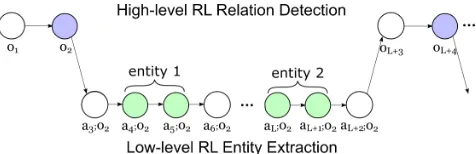
Figure 2: Overview of a hierarchical agent in relation extrac-tion.
The entire extraction process works as follows. An agent predicts a relation type at a particular position when it scans a sentence sequentially. Note that this process of relation de-tection needs no annotation of entities, thus different from relation classification which is to identify the relations be-tween pairs of entities. When there is no sufficient evidence to indicate a semantic relation at a time step, the agent may choose NR, a special relation type that indicates no rela-tion. Otherwise a relation indicator is triggered, the agent launches a subtask for entity extraction to identify the argu-ments of the relation, the two entities. When the entity men-tions are identified, the subtask is completed and the agent continues to scan the rest of the sentence for other relations. Such a process can be naturally formulated as a semi-Markov decision process (Sutton, Precup, and Singh 1999): 1) a high-level RL process that detects a relation indicator in a sentence; 2) a low-level RL process that identifies the as-sociated entities for the corresponding relation. By decom-posing the task into a hierarchy of two RL processes, the model is advantageous at dealing with sentences which have multiple relation types for the same entity pair, or one-to-many entities in which an entity is the argument of multiple relations.
Relation Detection with High-level RL
The high-level RL policyµaims to detect the relations in a sentenceS=w1w2· · ·wL, which can be regarded as a
con-ventional RL policy over options. An option refers to a high-level action, and a low-high-level RL process will be launched
Figure 3: Illustration of a two-level hierarchical policy struc-ture. Left panel shows the high-level policy for relation de-tection, and right panel shows the low-level policy for entity extraction.
once an option is executed by the agent.
Option: The option ot is selected from O = {NR} ∪ R
whereNRindicates no relation, andRis the relation type set. When a low-level RL process enters a terminal state, the control of the agent will be taken over to the high-level RL process to execute the next options.
State: The statesh
t ∈ Sof the high level RL process at time
stept, is represented by: 1) the current hidden stateht, 2) the
relation type vectorvr
t (the embedding of thelatest option
ot0 thatot0 6= NR, a learnable parameter), and 3) the state
from the last time stepst−13, formally represented by
sht =fh(Whs[ht;vtr;st−1]), (1)
wherefh(·)is a non-linear function implemented by MLP.
To obtain the hidden stateht, we introduce a sequence
Bi-LSTM over the current input word embeddingwt:
− → ht=
−−−−→
LST M(−−→ht−1,wt),
←− ht=
←−−−−
LST M(←−−ht+1,wt),
ht= [
− → ht;
←− ht].
(2)
Policy: The stochastic policy for relation detectionµ:S → Owhich specifies a probability distribution over options:
ot∼µ(ot|sht) =sof tmax(Wµsht). (3)
Reward: Then, the environment provides intermediate re-wardrh
t to estimate the future return when executingot. The
reward is computed as below:
rth=
( −1, if o
tnot in S 0, if ot=NR 1, if otin S.
(4)
Ifot=NRat certain time step, the agent transfers to a new
high-level inter-option state at the next time step. Otherwise
3
Figure 4: The entity annotation scheme for the example sentence in Figure 1 when the agent predicts a relation type
parent-childrenbetweenSteve BelichickandBill Belichick. In this example,New England PatriotsandAnnapolisare not-concerned entities with respect to relation typeparent-children.
the low-level policy will execute the entity extraction pro-cess. The inter-option state will not transfer until the subtask over current optionotis done, which may take multiple time
steps. Such a semi-Markov process continues until the last option about the last wordwL of S is sampled. Finally, a
final rewardrh
f inis obtained to measure the sentence-level
extraction performance thatµdetects:
rf inh =Fβ(S) =
(1 +β2)P rec·Rec
β2P rec+Rec , (5)
where Fβ is the weighted harmonic mean ofprecisionand recallin terms of the relations inS.P rec/Recindicates pre-cision/recall respectively, computed over one sentence.
Entity Extraction with Low-level RL
Once the high-level policy has predicted a non-NRrelation type, the low-level policy π will extract the participating entities for the corresponding relation. The low-level pol-icy over actions (primitive actions) is formulated very simi-larly as the high-level policy over options. To make the pre-dicted relation type accessible in the low-level process, the optionot0from the high level RL is taken as additional input
throughout the low-level extraction process.
Action: The action at each time step is to assign an entity tag to the current word. The action space, i.e., entity tag space A = ({S,T,O} × {B,I})∪ {N}, whereSrepresents the participating source entity,Tfor the target one,Ofor the en-tities that are not associated with the predicted relation type ot0, andNfor for non-entity words. Note that, the same entity
mention may be assigned with differentS/T/Otags depend-ing on different relation types concerned at the moment. In this way, the model can deal with overlapping relations. In addition, we use theB/Isymbols to represent the beginning word and the inside of an entity, respectively. Refer to Fig-ure 4 for an example.
State: Similar to the policy for relation detection, the low-level intra-option state slt is represented by 1) the hidden
state ht of current word embedding wt, 2) the entity tag
vector vet which is a learnable embedding of at−1, 3) the
state from previous time stepst−1, and 4) the context vector
ct0 using the relational state representation assigned to the
latest optionsh
t0in Eq. (1), as follows:
ct0 =g(Whlsht0)
slt=fl(Wls[ht;vet;st−1;ct0]),
(6)
whereht is the hidden state obtained from the Bi-LSTM
module in Eq. (2), andfl(·),g(·)are non-linear functions implemented by MLP. Note thatst−1may be a state either
from the high-level RL process or the low-level one.
Policy: The stochastic policy for entity extractionπ: S → Aoutputs an action distribution given intra-option stateslt
and the high-level optionot0 that launches the current
sub-task.
at∼π(at|slt;ot0) =sof tmax(Wπ[ot0]slt), (7)
whereWπis an array of|R|matrices.
Reward4: Given the relation typeo
t0, the entity tag for each
word can be easily obtained by sampling actions from the policy. Therefore, an immediate rewardrl
tis provided when
the actionatis sampled by simply measuring the prediction
error over gold-standard annotation:
rtl=λ(yt)·sgn(at=yt(ot0)), (8)
where sgn(·) is the sign function, and y(ot0) is the
gold-standard entity tag conditioned on the predicted relation type ot0. Hereλ(y)is a bias weight for down-weighing non-entity
tag, defined as follows:
λ(y) =
1, if y6=N
α, if y=N. (9)
The smaller α leads to less reward on words that are not entities. In this manner, the model avoids to learn a trivial policy that predicts all words asN(non-entity words). When all the actions are sampled, an additional final rewardrl
f inis
computed. If all the entity tags are predicted correctly, then the agent receives +1 reward, otherwise -1.
Hierarchical Policy Learning
To optimize the high-level policy, we aim to maximize the expected cumulative rewards from the main task at each time steptas the agent samples trajectories following the high-level policyµ, which can be computed as follows:
J(θµ,t) =Esh,o,rh∼µ(o|sh)[ T X
k=t
γk−trhk], (10)
whereµis parameterized byθµ,γis a discount factor in RL,
and the whole sampling processµtakesTtime steps before it terminates.
Similarly, we learn the low-level policy by maximizing the expected cumulative intra-option rewards from the sub-task over optionot0 when the agent samples along low-level
policyπ(·|ot0)at time stept:
J(θπ,t;ot0) =Esl,a,rl∼π(a|sl;o t0)[
T0 X
k=t
γk−trkl], (11)
4
if the subtask ends at time stepT0.
By decomposing the cumulative rewards into a Bellman equation, we acquire:
Rµ(sht, ot) =E[ N−1
X
j=0
γjrht+j+
γNRµ(sht+N, ot+N)|sht, ot],
Rπ(slt, at;ot0) =E[rtl+γRπ(slt+1, at+1;ot0)|slt, at],
(12)
whereNis the number of time steps that a subtask continues when the entity extraction policy runs upon optionot, so the
agent’s next option isot+N. In particular, ifot =NR, then
N = 1.
Then, we use policy gradient methods (Sutton et al. 2000) with the REINFORCE algorithm (Williams 1992) to opti-mize both high-level and low-level policies. With the likeli-hood ratio trick, the gradient for the high-level policy yields:
∇θµJ(θµ,t) =Esh,o,rh∼µ(o|sh)[R µ(sh
t, ot)
∇θµlogµ(o|s h t)],
(13)
and the gradient for the low-level policy yields:
∇θπJ(θπ,t;ot0) =Esl,a,rl∼π(a|sl;ot0)[R
π(sl
t, at;ot0)
∇θπlogπ(a|slt;ot0)].
(14)
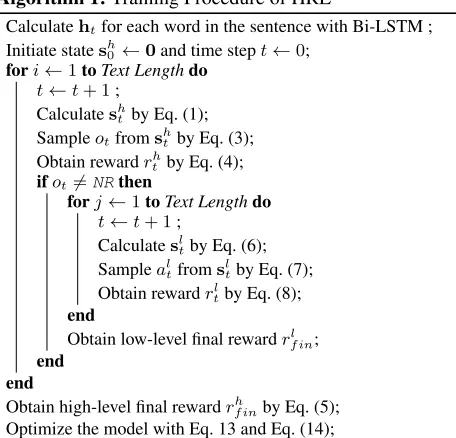
The entire training process is described at Algorithm 1.
Algorithm 1:Training Procedure of HRL
1 Calculatehtfor each word in the sentence with Bi-LSTM ;
2 Initiate statesh0 ←0and time stept←0; 3 fori←1toText Lengthdo
4 t←t+ 1;
5 Calculatesht by Eq. (1); 6 Sampleotfromsht by Eq. (3);
7 Obtain rewardrthby Eq. (4); 8 ifot6=NRthen
9 forj←1toText Lengthdo
10 t←t+ 1;
11 Calculatesltby Eq. (6);
12 Samplealtfromsltby Eq. (7);
13 Obtain rewardrtlby Eq. (8); 14 end
15 Obtain low-level final rewardrlf in; 16 end
17 end
18 Obtain high-level final rewardrhf inby Eq. (5); 19 Optimize the model with Eq. 13 and Eq. (14);
Experiments
Experimental Setting
Datasets We evaluated our model on the New York Times corpus which is developed by distant supervision and con-tains noisyrelations. The corpus has two versions: 1) The original version generated by aligning the raw data with
Freebase relations (Riedel, Yao, and McCallum 2010); 2) A smaller version of which the test set was manually anno-tated (Hoffmann et al. 2011). We name the original version asNYT10, and the smaller version asNYT11. We split some of the training data from NYT11to constructNYT11-plus, which will be described later.
We filtered the datasets by removing 1) the relations in the training set whose relation type does not exist in the test set; 2) the sentences that contain no relations at all. Such a preprocess is also in line with the settings in the literature (for instance,Tagging). All the baselines are evaluated in this setting for fair comparison. The statistics of the two filtered datasets are presented in Table 1.
Dataset NYT10 NYT11
# Relation types 29 12 # Training sentences 70,339 62,648 # Training relations 87,739 74,312 # Test sentences 4,006 369 # Test relations 5,859 370
Table 1: Statistics of the datasets.
For each dataset, we randomly chose 0.5% data from the training set for validation.
Parameter Settings All hyper-parameters are tuned on the validation set. The dimension of all vectors in Eq. (1), (2) and (6) is 300. The word vectors are initialized using Glove vectors (Pennington, Socher, and Manning 2014) and are updated during training. Bothrelation type vectorsand
entity tag vectorsare initialized randomly. The learning rate is 4e−5, the mini-batch size is16, α = 0.1 in Eq. (9), β = 0.9in Eq. (5), and the discount factorγ= 0.95.
Evaluation Metrics We adopted standard micro-F1 to
evaluate the performance. We compared whether the ex-tracted entity mentions can be exactly matched with those in a relation. A triplet is regarded as correct if the relation type and the two corresponding entities are all correct.
Baselines We chose two types of baselines: one is pipelined methods (FCM), and the other is joint learning methods which include feature-based methods (MultiR and CoType) and neural methods (SPTree, Tagging and CopyR). We used open source codes and conducted the experiments by ourselves.
FCM (Gormley, Yu, and Dredze 2015): a compositional model that combines lexicalized linguistic contexts and word embeddings to learn representations for the substruc-tures of a sentence in relation extraction5.
MultiR(Hoffmann et al. 2011): a typical distant supervision method performing sentence-level and corpus-level extrac-tion, which uses multi-instance weighting to deal with noisy labels in training data.
CoType(Ren et al. 2017): a domain-independent framework by jointly embedding entity mentions, relation mentions,
5
text features, and type labels into representations, which for-mulates extraction as a global embedding problem.
SPTree(Miwa and Bansal 2016): an end-to-end relation ex-traction model that represents both word sequence and de-pendency tree structures using bidirectional sequential and tree-structured LSTM-RNNs.
Tagging(Zheng et al. 2017): an approach that treats joint extraction as a sequential labeling problem using a tagging schema where each tag encodes entity mentions and relation types at the same time.
CopyR(Zeng et al. 2018): a Seq2Seq learning framework with a copy mechanism for joint extraction, where multiple decoders are applied to generate triples to handle overlap-ping relations.
Main Results
Model NYT10 NYT11
Prec Rec F1 Prec Rec F1
FCM – – – .432 .294 .350
MultiR – – – .328 .306 .317
CoType – – – .486 .386 .430
SPTree .492 .557 .522 .522 .541 .531 Tagging .593 .381 .464 .469 .489 .479 CopyR .569 .452 .504 .347 .534 .421
HRL .714 .586 .644 .538 .538 .538
Table 2: Main results on relation extraction.
The results on relation extraction are presented in Table 2. Noticeably, there is a significant gap between the per-formance on noisy data (NYT10) and that on clean data (NYT11) as all the models are trained on noisy data. It can be seen that our method (HRL) outperforms the baselines on the two datasets. Significant improvements can be ob-served onNYT10, which indicates that our method is more robust to noisy data. Results on NYT11 show that neural models (SPTree, Tagging and CopyR) are more effective than pipelined (FCM) or feature-based (MultiRandCoType) methods. CopyRis introduced to extract overlapping rela-tions, but it yields poor performance on theNYT11test set where there is almost no overlapping relation in a sentence (370 relations among 369 sentences). Whereas our model is still comparable toSPTreeand performs remarkably bet-ter than other baselines. Note thatSPTreeutilizes more lin-guistic resources (e.g., POS tags, chunks, syntactic parsing trees). This implies that our model is also robust to the data distribution of relations.
Overlapping Relation Extraction
We prepared another two test sets to verify the effectiveness of our model on extracting overlapping relations. Note that overlapping relations can be classified into two types.
• Type I:two triples share only one entity within a sentence
• Type II:two triples share two entities (both head and tail entities) within a sentence
The first set,NYT11-plus, is annotated manually and consists of 149 sentences split from the originalNYT11training data. The set contains 210/97 overlapping relations for type I/II respectively. The second set,NYT10-sub, is a subset of the test set ofNYT10, and has 715 sentences, but without manual annotation. This set contains 90/2,082 overlapping relations for type I/II respectively. To summarize, most of the over-lapping relations inNYT11-plusis of type I; while most in
NYT10-subis of type II. Table 3 shows the performance of extracting overlapping relations by different approaches.
Model NYT10-sub NYT11-plus Prec Rec F1 Prec Rec F1
FCM – – – .234 .199 .219
MultiR – – – .241 .214 .227
CoType – – – .291 .254 .271
SPTree .272 .315 .292 .466 .229 .307 Tagging .256 .237 .246 .292 .220 .250 CopyR .392 .263 .315 .329 .224 .264
HRL .815 .475 .600 .441 .321 .372
Table 3: Performance comparison on extracting overlapping relations.
Results onNYT10-sub show that the baselines are very weak to extract overlapping relations of type II on the noisy data, which is consistent with our statement that existing joint extraction approaches cannot deal with overlapping re-lations effectively in nature. By contrast, our method did not deteriorate too much in performance comparing to that in Table 2, and even obtained a larger gain onprecision.
Results onNYT11-plusdemonstrate that our method had a substantialF1 improvement over all the baselines in
ex-tracting overlapping relations of type I on the clean data, indicating that our method can extract overlapping relations more accurately.SPTreehad a highprecisionbut lowrecall
since it simply matches one relation type to an entity pair, suffering from ignoring the case of overlapping relations.
Tagginghad low performance in extracting overlapping re-lations because it assigns a unique tag to an entity even if that entity participates in overlapping relations. Though
CopyRclaimed that it can extract overlapping relations of both types, it fails to extract the relations from clean data ef-fectively as it strongly relies on the annotation of the noisy training data.
To conclude, we can see that extracting overlapping re-lations is more challenging by comparing results in Table 2 and those in Table 3, and our model is better in extracting two types of overlapping relations no matter the data is noisy or clean.
Interaction between the Two Policies
Figure 5: Extraction examples by our model. The words in a bracket represents an entity extracted by the model.Esstands for source entity andEtfor target entity. A predicted relation indicator is marked in background color (e.g. “Murdoch” in the first instance). The entities which form a triple are bracketed in the same color.
Model NYT11 NYT11-plus
Prec Rec F1 Prec Rec F1
FCM .502 .479 .490 .447 .327 .378 MultiR .465 .439 .451 .423 .336 .375 CoType .558 .558 .558 .491 .413 .449 SPTree .650 .614 .631 .700 .343 .460 CopyR .480 .714 .574 .626 .426 .507
HRL-Ent .676 .676 .676 .577 .321 .413 HRL .654 .654 .654 .626 .456 .527
Table 4: Performance comparison on relation detection.
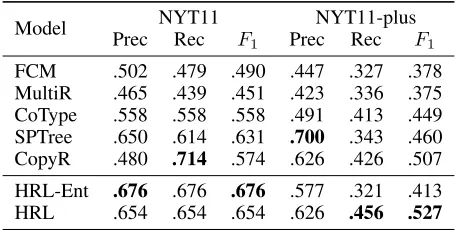
The results in Table 4 demonstrate that our method per-forms better in relation detection on both datasets. The improvements on NYT11-plus are more remarkable as our paradigm is more powerful to extract multiple relations from a sentence. The results indicate that our extraction paradigm which regards entities as arguments of a relation can better capture the relational information in the text.
When removing the low-level entity extraction policy from our model (HRL-Ent), the performance has changed slightly onNYT11 because each sentence almost contains only one relation in this test set (370 relations among 369 sentences). In this case, the interaction between the two poli-cies has almost no influence on relation detection. However, dramatic drops are observed onNYT11-pluswhere we have 327 relations from 149 sentences, implying that our method (HRL) captures the dependency across multiple extraction tasks and the high-level policy benefits from such interac-tions. Therefore, our hierarchical extraction framework in-deed enhances the interaction between relation detection and entity extraction.
Case Study
Fig. 5 presents some extraction examples by our model to demonstrate the ability to extract overlapping relations. The first sentence shows the case that an entity pair has mul-tiple relations (type II). Two relations (Rupert Murdoch,
person-company,News Corporation) and (News Cor-poration, company-founder, Rupert Murdoch) share the same entity pair but have different relation types. The model first detects the relation type person-company
at “Murdoch”, and then detects the other relation type
company-founder at thecomma position, just next to the word “Murdoch”. This shows that relation detection is triggered when sufficient evidence has been gathered at a particular position. And the model can classify the same en-tities into either source or target enen-tities (for instance, Ru-pert Murdoch is a source entity for person-company
whereas a target entity forcompany-founder), demon-strating the advantage of our hierarchical framework which can assign dynamic tags to words conditioned on different relation types. In addition, Rupert Murdoch has a relation withAustralia, where the two entities locate far from each other. Though this is more difficult to detect, our model can still extract the relation correctly.
The second sentence gives another example where an en-tity is involved in multiple relations (type I). In this sen-tence, (Steven A. Ballmer,person-company,Microsoft) and (Bill Gates,person-company,Microsoft) share the same relation type and target entity, but have different source entities. When the agent scans to the word “Microsoft”, the model detects the first relation. The agent then detects the second relation when it scans to the word “Gates”. This fur-ther demonstrates the benefit of our hierarchical framework which has strengths in extracting overlapping relations by firstly detecting relation and then finding the entity argu-ments. In addition, our model predicts another relation (Bill Gates,founder-of,Microsoft), which is wrong for this sentence because there is no explicit mention of the relation. This may result from the noise produced by distant supervi-sion, where there are many noisy sentences that are aligned to that relation.
Conclusion and Future Work
approach outperforms state-of-the-art baselines.
As future work, this hierarchical extraction framework can be generalized to many other pairwise or triple-wise ex-traction tasks such as aspect-opinion mining or ontology in-duction.
Acknowledgements
This work was jointly supported by the National Science Foundation of China (Grant No.61876096/61332007), and the National Key R&D Program of China (Grant No. 2018YFC0830200). We would like to thank Prof. Xiaoyan Zhu for her generous support.
References
Bj¨orne, J.; Heimonen, J.; Ginter, F.; Airola, A.; Pahikkala, T.; and Salakoski, T. 2011. Extracting contextualized com-plex biological events with rich graph-based feature sets.
Computational Intelligence27(4):541–557.
Dong, X.; Gabrilovich, E.; Heitz, G.; Horn, W.; Lao, N.; Murphy, K.; Strohmann, T.; Sun, S.; and Zhang, W. 2014. Knowledge vault: A web-scale approach to probabilistic knowledge fusion. InSIGKDD, 601–610.
Fader, A.; Soderland, S.; and Etzioni, O. 2011. Identifying relations for open information extraction. InEMNLP, 1535– 1545.
Fader, A.; Zettlemoyer, L.; and Etzioni, O. 2014. Open question answering over curated and extracted knowledge bases. InSIGKDD, 1156–1165.
Feng, J.; Huang, M.; Zhao, L.; Yang, Y.; and Zhu, X. 2018. Reinforcement learning for relation classification from noisy data. InAAAI, 5779–5786.
Gormley, M. R.; Yu, M.; and Dredze, M. 2015. Improved re-lation extraction with feature-rich compositional embedding models. InEMNLP, 1774–1784.
Hoffmann, R.; Zhang, C.; Ling, X.; Zettlemoyer, L.; and Weld, D. S. 2011. Knowledge-based weak supervision for information extraction of overlapping relations. InACL, 541–550.
Huang, C.-C., and Lu, Z. 2015. Community challenges in biomedical text mining over 10 years: success, failure and the future. Briefings in bioinformatics17(1):132–144. Kate, R. J., and Mooney, R. J. 2010. Joint entity and relation extraction using card-pyramid parsing. InCoNLL, 203–212. Katiyar, A., and Cardie, C. 2016. Investigating lstms for joint extraction of opinion entities and relations. InACL, 919–929.
Li, Q., and Ji, H. 2014. Incremental joint extraction of entity mentions and relations. InACL, 402–412.
Luan, Y.; He, L.; Ostendorf, M.; and Hajishirzi, H. 2018. Multi-task identification of entities, relations, and coref-erence for scientific knowledge graph construction. In
EMNLP, 3219—3232.
Mintz, M.; Bills, S.; Snow, R.; and Jurafsky, D. 2009. Dis-tant supervision for relation extraction without labeled data. InACL-IJCNLP, 1003–1011.
Miwa, M., and Bansal, M. 2016. End-to-end relation extrac-tion using lstms on sequences and tree structures. InACL, 1105–1116.
Miwa, M., and Sasaki, Y. 2014. Modeling joint entity and relation extraction with table representation. In EMNLP, 1858–1869.
Nadeau, D., and Sekine, S. 2007. A survey of named entity recognition and classification. Lingvisticae Investigationes
30(1):3–26.
Narasimhan, K.; Yala, A.; and Barzilay, R. 2016. Improving information extraction by acquiring external evidence with reinforcement learning. InEMNLP, 2355–2365.
Pennington, J.; Socher, R.; and Manning, C. D. 2014. Glove: Global vectors for word representation. InEMNLP, 1532– 1543.
Qin, P.; Xu, W.; and Wang, W. Y. 2018. Robust distant su-pervision relation extraction via deep reinforcement learn-ing. InACL, 2137–2147.
Ren, X.; Wu, Z.; He, W.; Qu, M.; Voss, C. R.; Ji, H.; Ab-delzaher, T. F.; and Han, J. 2017. Cotype: Joint extraction of typed entities and relations with knowledge bases. InWWW, 1015–1024.
Riedel, S.; Yao, L.; and McCallum, A. 2010. Modeling relations and their mentions without labeled text. InECML, 148–163.
Sutton, R. S.; McAllester, D. A.; Singh, S. P.; and Mansour, Y. 2000. Policy gradient methods for reinforcement learning with function approximation. InNIPS, 1057–1063.
Sutton, R. S.; Precup, D.; and Singh, S. P. 1999. Between mdps and semi-mdps: A framework for temporal abstraction in reinforcement learning. Artificial Intelligence112:181– 211.
Takamatsu, S.; Sato, I.; and Nakagawa, H. 2012. Reducing wrong labels in distant supervision for relation extraction. In
ACL, 721–729.
Tang, J.; Qu, M.; Wang, M.; Zhang, M.; Yan, J.; and Mei, Q. 2015. Line: Large-scale information network embedding. In
WWW, 1067–1077.
Williams, R. J. 1992. Simple statistical gradient-following algorithms for connectionist reinforcement learning. Ma-chine learning8(3):229–256.
Zeng, X.; Zeng, D.; He, S.; Liu, K.; and Zhao, J. 2018. Ex-tracting relational facts by an end-to-end neural model with copy mechanism. InACL, 506–514.
Zhang, X.; Zhang, J.; Zeng, J.; Yan, J.; Chen, Z.; and Sui, Z. 2013. Towards accurate distant supervision for relational facts extraction. InACL, 810–815.
Zhang, M.; Zhang, Y.; and Fu, G. 2017. End-to-end neu-ral relation extraction with global optimization. InEMNLP, 1730–1740.