R E S E A R C H
Open Access
Parenting around child snacking:
development of a theoretically-guided,
empirically informed conceptual model
Kirsten K. Davison
1,2*, Christine E. Blake
4, Rachel E. Blaine
1,3, Nicholas A. Younginer
4, Alexandria Orloski
5,
Heather A. Hamtil
5, Claudia Ganter
1, Yasmeen P. Bruton
5, Amber E Vaughn
6and Jennifer O. Fisher
5Abstract
Background:Snacking contributes to excessive energy intakes in children. Yet factors shaping child snacking are virtually unstudied. This study examines food parenting practices specific to child snacking among low-income caregivers.
Methods:Semi-structured interviews were conducted in English or Spanish with 60 low-income caregivers of preschool-aged children (18 non-Hispanic white, 22 African American/Black, 20 Hispanic; 92 % mothers). A structured interview guide was used to solicit caregivers’definitions of snacking and strategies they use to decide what, when and how much snack their child eats. Interviews were audio-recorded, transcribed verbatim and analyzed using an iterative theory-based and grounded approach. A conceptual model of food parenting specific to child snacking was developed to summarize the findings and inform future research.
Results:Caregivers’ descriptions of food parenting practices specific to child snacking were consistent with previous models of food parenting developed based on expert opinion [1, 2]. A few noteworthy differences however emerged. More than half of participants mentioned permissive feeding approaches (e.g., my child is the boss when it comes to snacks). As a result, permissive feeding was included as a higher order feeding dimension in the resulting model. In addition, a number of novel feeding approaches specific to child snacking emerged
including child-centered provision of snacks (i.e., responding to a child’s hunger cues when making decisions about snacks), parent unilateral decision making (i.e., making decisions about a child’s snacks without any input from the child), and excessive monitoring of snacks (i.e., monitoring all snacks provided to and consumed by the child). The resulting conceptual model includes four higher order feeding dimensions including autonomy support, coercive control, structure and permissiveness and 20 sub-dimensions. Conclusions: This study formulates a language around food parenting practices specific to child snacking, identifies dominant constructs, and proposes a conceptual framework to guide future research.
Keywords:Children, Diet, Snack, Snacking, Parenting, Schemas, Qualitative
* Correspondence:[email protected]
1
Department of Nutrition, Harvard T.H. Chan School of Public Health, 665 Huntington Ave, Boston, MA 02445, USA
2
Department of Social and Behavioral Sciences, Harvard T.H. Chan School of Public Health, 665 Huntington Ave, Boston, MA 02445, USA
Full list of author information is available at the end of the article
Introduction
Behavioral aspects of energy imbalance that lead to obesity in young children are multi-factorial, but remain poorly characterized. Snacking has been identified as a potential contributor to excessive energy intakes because children in the United States (US) snack more frequently and consume greater energy from snacks than in past decades [3].
The contribution of snacks to daily energy intake is not trivial; US preschoolers consume approximately 27 % of their daily energy from snacks [3]. Similar pat-terns have been observed in Chinese [4], Brazilian [5], and British [6] children. Snacking also represents a key source of“empty”calories, which offer few nutrients be-yond energy and are seen as the root cause of dietary imbalances [7]. Desserts, salty snacks, and sweetened beverages are top snacks consumed by US children and represent foods high in solid fats and added sugars (SoFAS) [8]. Surprisingly, factors that shape young chil-dren’s snacking are virtually unstudied.
Young children consume the majority of their daily energy intake at home [9]. Parents socialize children’s eating behaviors through the types and amounts of foods made available to children in and outside the home, the dietary behaviors they model, and through food parent-ing styles and practices [10]. While a burgeonparent-ing body of research documents the importance of parental feed-ing styles and practices for shapfeed-ing children’s obesity risk [11–15], parenting influences on children’s snacking habits have not been appreciably studied. Identifying parents’ feeding goals and practices specific to child snacking is central to understanding parenting influ-ences on snacking. While a number of existing question-naires include individual items about snacking [16–18], few have been developed to include empirically-based constructs that reflect parenting approaches to feeding children snacks. Moreover, the general literature on food parenting has focused on the negative effects of highly controlling feeding practices such as restriction [19, 20] and pressure to eat [21] to a greater extent than poten-tially supportive practices. As such, there is a particular need to consider a wider range of parental feeding goals and practices that may be supportive of healthy snacking behaviors in children.
The goal of this study is to advance research on food parenting by qualitatively characterizing practices that caregivers use when feeding snacks to their preschool-aged children. We focus specifically on low-income caregivers given that children in low-income families demonstrate a disproportionate risk of obesity and poor diet quality compared with children from more affluent families [23, 24]. In addition, prior work by members of our research team suggests that low-income mothers of preschool-aged children may perceive snacks as serving
a more important role in managing child behavior than in nutrition [25]. Therefore, based on in-depth inter-views with low-income parents from diverse racial/eth-nic backgrounds, this study will (1) identify food parenting practices specific to snacking, (2) link such practices with higher order food parenting constructs, and (3) develop a conceptual model of food parenting specific to snacking to guide and frame future research including quantitative measures of parenting around child snacking.
Methods
Participants
Participants included 60 low-income parents or primary caregivers (18 White, 22 African American, 20 Hispanic) who reported primary responsibility for feeding the tar-get child, aged 3 to 5 years. Caregivers were recruited in Philadelphia and Boston using flyers posted in offices of the Special Supplemental Nutrition Program for Women, Infants and Children (WIC) and online com-munity listings such as craigslist. All caregivers reported eligibility for federal assistance programs such as WIC, Head Start or the Free and Reduced Cost School Meals program. Such programs have income eligibility criteria typically ranging from 100 to 185 % of the federal pov-erty line. Exclusion criteria included a caregiver younger than 18 years or a a child with severe food allergy, chronic medical condition or developmental disorder that influenced feeding. All study procedures were reviewed and approved by the Institutional Review Boards at Temple University and Harvard T.H. Chan School of Public Health and all participants completed an informed consent form. Caregivers were compensated with a $45 gift card for their time.
Design
The current study was part of a larger mixed methods study to delineate parents’ conceptualization of child snacking or their child snacking schemas. Schemas are cognitive frameworks that organize information around concepts [26] and define what might be expected in given situations [27]. Cognitive schemas are often assessed using a card sorting procedure [28, 29]. This article focuses on the semi-structured interview ques-tions which were integrated into a card sorting protocol in which parents were asked to sort a set of 65 cards of snack foods into piles reflecting snacking purposes and contexts. Results from the card sorting procedure are not reported in this study.
Procedures
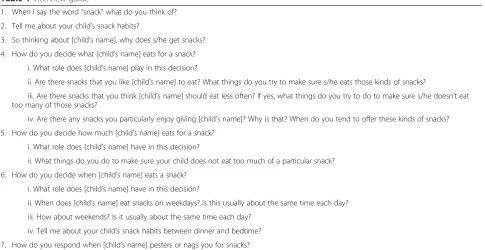
research centers or at a community location close to the participant’s home. An expert in qualitative methods trained the interviewers during a 2 day workshop in quali-tative methods including card sort procedures and semi-structured interviews. A semi-semi-structured interview guide with scripted procedures was utilized by all interviewers. Interview questions focused on (a) caregivers’definitions of snacking, (b) how caregivers decide what, when and how much snack their child eats, and (c) how caregivers respond when their child pesters or nags for a snack (see Table 1). Prior to completing the interview, caregivers completed a number of brief questionnaires assessing demographic characteristics and food security [30].
Data analysis
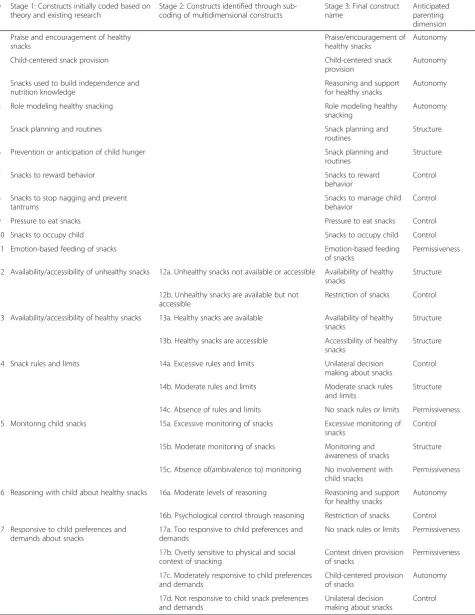
All interviews were audiotaped, transcribed verbatim and later verified by the interviewer. Field notes were completed immediately after each interview to provide a description of the setting and other observations not captured directly through the interview to facilitate data analysis. NVivo10 was used to analyze the transcribed text. An iterative coding process was adopted which in-cluded both theory-based and grounded coding [31–33] (see Table 2).
Code development
A preliminary code list was developed based on existing parenting [34] and food parenting [2, 35] literatures as well as emerging conceptual/theoretical frameworks re-garding food parenting, particularly Vaughn’s conceptual map of food parenting [1]. Developed by a team of
experts in food parenting, the conceptual map outlines three higher order feeding constructs including coercive control, structure and autonomy support and associated sub-dimensions; for example, sub-dimensions of auton-omy support include nutrition education, child involve-ment, encouragement and support, praise, reasoning and negotiation. Based on this map, a list of anticipated snacking-related food parenting practices under the di-mensions of structure, coercive control and autonomy support [36] was created. Three senior authors (KD, CEB, and JOF) with expertise in food parenting coded five randomly selected transcripts using the preliminary code list. This process led to two key modifications. First, food parenting practices reflecting permissiveness (e.g., reluctance to say no to child requests for snacks) were added to the coding scheme given repeated exam-ples of permissiveness identified in the transcripts. Sec-ond, coding was broken into a two-step process, as summarized in Table 2, including an initial round of coding with a simplified code list and a second round of coding with a more detailed set of codes to permit theme refinement.
A comprehensive coding manual with standardized operational definitions for each construct was created for each stage of coding. In addition to defining what the specific food parenting practice encompassed, oper-ational definitions included examples of what the con-struct did not include or how it separated itself from other food parenting constructs. For example, the defin-ition for Emotion-based feeding of snacks included the statement “This construct does not include providing
Table 1Interview guide
1. When I say the word“snack”what do you think of?
2. Tell me about your child’s snack habits?
3. So thinking about [child’s name], why does s/he get snacks?
4. How do you decide what [child’s name] eats for a snack?
i. What role does [child’s name] play in this decision?
ii. Are there snacks that you like [child’s name] to eat? What things do you try to make sure s/he eats those kinds of snacks?
iii. Are there snacks that you think [child’s name] should eat less often? If yes, what things do you try to do to make sure s/he doesn’t eat too many of those snacks?
iv. Are there any snacks you particularly enjoy giving [child’s name]? Why is that? When do you tend to offer these kinds of snacks?
5. How do you decide how much [child’s name] eats for a snack?
i. What role does [child’s name] have in this decision?
ii. What things do you do to make sure your child does not eat too much of a particular snack?
6. How do you decide when [child’s name] eats a snack?
i. What role does [child’s name] have in this decision?
ii. When does [child’s name] eat snacks on weekdays? Is this usually about the same time each day?
iii. How about weekends? Is it usually about the same time each day?
iv. Tell me about your child’s snack habits between dinner and bedtime?
Table 2Summary of data analysis process by which the final constructs were identified
# Stage 1: Constructs initially coded based on theory and existing research
Stage 2: Constructs identified through sub-coding of multidimensional constructs
Stage 3: Final construct name
Anticipated parenting dimension
1 Praise and encouragement of healthy snacks
Praise/encouragement of healthy snacks
Autonomy
2 Child-centered snack provision Child-centered snack
provision
Autonomy
3 Snacks used to build independence and nutrition knowledge
Reasoning and support for healthy snacks
Autonomy
4 Role modeling healthy snacking Role modeling healthy
snacking
Autonomy
5 Snack planning and routines Snack planning and
routines
Structure
6 Prevention or anticipation of child hunger Snack planning and
routines
Structure
7 Snacks to reward behavior Snacks to reward
behavior
Control
8 Snacks to stop nagging and prevent tantrums
Snacks to manage child behavior
Control
9 Pressure to eat snacks Pressure to eat snacks Control
10 Snacks to occupy child Snacks to occupy child Control
11 Emotion-based feeding of snacks Emotion-based feeding
of snacks
Permissiveness
12 Availability/accessibility of unhealthy snacks 12a. Unhealthy snacks not available or accessible Availability of healthy snacks
Structure
12b. Unhealthy snacks are available but not accessible
Restriction of snacks Control
13 Availability/accessibility of healthy snacks 13a. Healthy snacks are available Availability of healthy snacks
Structure
13b. Healthy snacks are accessible Accessibility of healthy snacks
Structure
14 Snack rules and limits 14a. Excessive rules and limits Unilateral decision
making about snacks
Control
14b. Moderate rules and limits Moderate snack rules
and limits
Structure
14c. Absence of rules and limits No snack rules or limits Permissiveness
15 Monitoring child snacks 15a. Excessive monitoring of snacks Excessive monitoring of
snacks
Control
15b. Moderate monitoring of snacks Monitoring and
awareness of snacks
Structure
15c. Absence of(ambivalence to) monitoring No involvement with child snacks
Permissiveness
16 Reasoning with child about healthy snacks 16a. Moderate levels of reasoning Reasoning and support for healthy snacks
Autonomy
16b. Psychological control through reasoning Restriction of snacks Control
17 Responsive to child preferences and demands about snacks
17a. Too responsive to child preferences and demands
No snack rules or limits Permissiveness
17b. Overly sensitive to physical and social context of snacking
Context driven provision of snacks
Permissiveness
17c. Moderately responsive to child preferences and demands
Child-centered provision of snacks
Autonomy
17d. Not responsive to child snack preferences and demands
Unilateral decision making about snacks
food in response to child negative emotions (such as whining or nagging); in this manner it distinguishes itself from providing snacks for behavior management”. The manual was iteratively revised to resolve discrepancies that emerged through inductive analysis and to integrate language and examples from the interviews previously coded. In cases where a code was conceptually modified or added, the coders went back and recoded the data using the revised guide.
Stage one: Initial coding (column 1, Table 2). During stage one coding, food parenting practices were coded without reference to the anticipated parenting dimen-sion(s) to which they were linked. A food parenting practice may reflect multiple parenting dimensions (i.e., autonomy support, coercive control, structure, permis-siveness) depending on the valence of the practice. For example, very low limit setting may reflect permissive-ness, whereas moderate limit setting might reflect au-tonomy support, and high limit setting could reflect coercive control. During stage one coding, all examples of a particular food parenting practice were coded as a single unidimensional construct regardless of magnitude or valence (i.e., low, moderate, high). In addition, food parenting practices with considerable overlap (e.g., healthy snacks are available and healthy snacks are accessible) were coded as a single theme. This resulted in identification of 17 food parenting constructs specific to child snacking.
Stage two: Theme refinement (column 2, Table 2). During stage two, coding results from stage one were reviewed to identify food parenting practices that con-tained more than one theme or parenting dimension. In such cases, sub-coding was performed. Two authors dis-cussed emergent sub-themes that arose from initial cod-ing. The coding guide was modified to incorporate the subthemes. One author (RB) then re-coded the tran-scripts using the modified guide. Of note, only food par-enting constructs that were multidimensional or multi-thematic were re-coded in this manner. As shown in column 2, Table 2 (numbers 12–17), a total of six con-structs were sub-coded during stage two. For example, all text coded asMonitoring child snacks(#15) was sub-coded as: (15a) Excessive monitoring; (15b) Moderate monitoring; or (15c) Absence, or ambivalence to, monitoring.
Stage three: Construct labeling (column 3, Table 2). In the final coding stage, labels were given to the final list of constructs that could be parsimoniously used in the conceptual model and a parent-report survey currently under development (see column 3, Table 2). Where ne-cessary, constructs with significant conceptual overlap were consolidated. For example, Absence of snack rules or limits (14c) and Too responsive to child preferences and demands (17a) were both labeled asNo snack rules or limits.
Conceptual model development
The final food parenting practices were linked with the original parenting dimensions from which they were de-rived based on a plausible theoretical association, as agreed upon by author consensus (KD, JOF, CEB, AV) (see column 4, Table 2). The resulting information formed the basis of the final conceptual model for food parenting practices specific to child snacking (Fig. 1). Operational definitions of each construct were generated using an abbreviated version of the definitions from the coding guide and example quotes were identified.
Racial/ethnic differences in food parenting practices specific to child snacking were examined using the matrix function within NVivo which tallies the number of participants who mention a specific food parenting practice and the total number of references to that prac-tice across participants. Given that few noteworthy dif-ferences in the tallied frequencies were observed for non-Hispanic white, Black/African American, and His-panic caregivers, results are presented for the total sam-ple and not by race/ethnicity.
Results
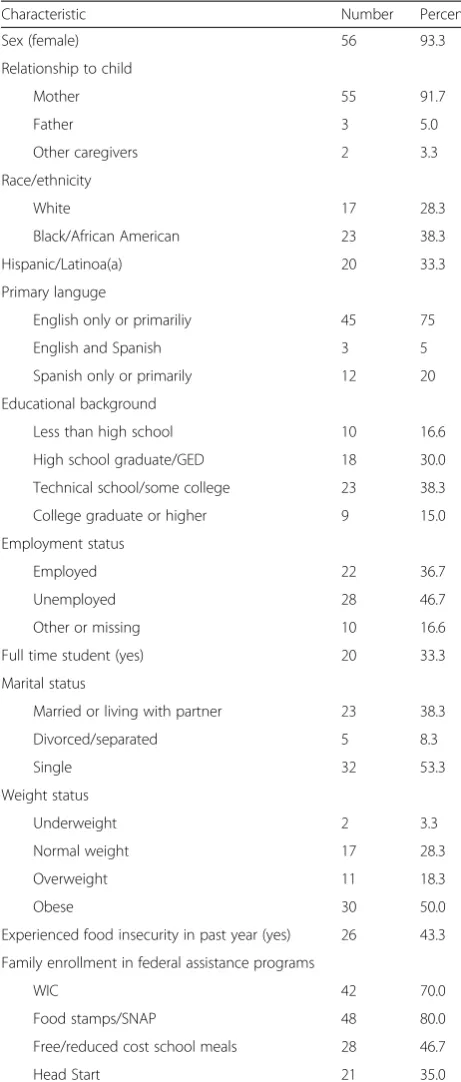
Participant characteristics
Caregivers were predominantly mothers, had an average age of 31.2 (8.4) years, and were from diverse racial/eth-nic, educational, marital, and employment backgrounds (see Table 3). Half of participating caregivers were obese based on self-reported height and weight and most were enrolled in a federal nutrition program (e.g., WIC, Food stamps).
Conceptual model
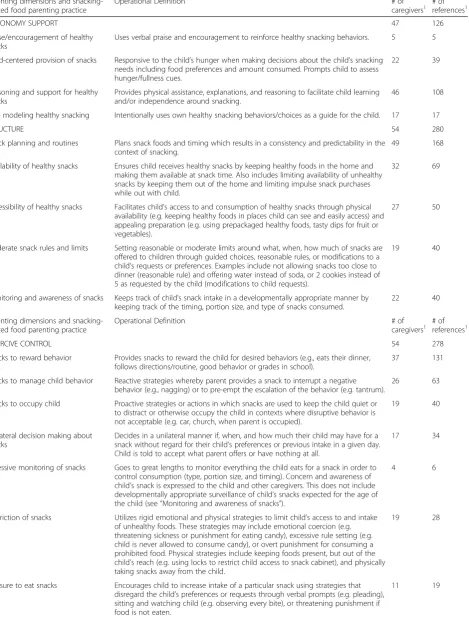
The resulting conceptual model, presented in Fig. 1, summarizes the final list of food parenting practices or-ganized by their anticipated higher order parenting di-mension. Autonomy support and permissiveness each included four food parenting practices. Structure in-cluded five and coercive control inin-cluded seven food parenting practices. Table 4 lists the operational defini-tions for each food parenting practice along with (a) the number of caregivers (i.e., number of sources) who men-tioned a particular food parenting practice and (b) the number of times a practice was mentioned across all in-terviews (i.e., number of references). Illustrative quotes for each food parenting practice, organized by parenting dimension, are summarized below.
Autonomy support
an opportunity to promote independence and build child nutrition knowledge. A total of 46 caregivers mentioned this food parenting practice at least once, with 108 refer-ences to it across all interviews. Caregivers recalled strat-egies such as having the child assist with preparing a snack or describing how a particular snack may affect the child's health or energy levels. Child-centered provision of snacks and Role modeling of healthy snack-ing were mentioned to a moderate degree across care-givers with 22 and 17 carecare-givers mentioning each approach respectively. Surprisingly few examples of Praise and encouragement were identified. Examples of the three predominant food parenting practices specific to snacking that reflect autonomy support include the following:
Child-centered snack provision: If he’s hungry and it’s after school or it’s in between meals, he asks and tells me he’s hungry. I’ll always give him something to eat if he says that he’s hungry. (White mother of 4-year-old boy) Reasoning and support for healthy snacks: The peanut butter and celery. . . I think it’s fun to make like she can help me spread the peanut butter on there and she enjoys eating it and I know it’s good for her. Um, sometimes we make like the fruit kabobs like where
we’ll dice the fruit. So I’m trying to work on cutting with her too. (White mother of 4-year-old girl) Role modeling healthy snacking:I'm trying to get her to eat broccoli. . . Like, I was started to sit down with her like,“Look, this is good, Mami. Hey look at Mommy eating it.”(Hispanic mother of a 4-year-old girl)
Structure
Fifty four caregivers mentioned a snacking-related food parenting practice that reflected structure, with a total of 280 references to such practices identified across all caregivers. The most commonly recalled approach was Snack planning and routines with 168 references identi-fied. Availability and accessibility of healthy snacks, Moderate snack rules and limits and Monitoring and awareness of snackswere also mentioned at least moder-ately with 40 references each. Examples of each food parenting practice reflecting structure include the following:
Snack planning and routines:Like I got-I got‘em on a schedule so he know that he gonna get a snack at this time. (African American father of a 3-year-old boy) Availability of healthy snacks:I don’t keep chips in the house, so if we was in the house, she would grab-I
keep the fruit snacks, fruit cups and apple sauce inside the house, so she would grab this more when she in the house. (African American mother of a 3-year-old girl)
Accessibility of healthy snacks:I try to dice him oranges, or buy the apples in the bags. That’s easier for him to grab versus–of course, he can't prepare that his self. So if there’s something there fast as the bag of chips, you can go in the refrigerator and get a Ziploc bag of oranges that I cut up, or you know the Motts Apples-to-Go or apple sauce. (African American mother of a 5-year-old boy)
Moderate snack rules and limits:He wanted Oreos. You know, he had the whole pack ready to eat them. I gave him two, and that was it, so he was happy with the two. Now if I didn’t see him, he would have went through the whole box. I’ll, you know, I’ll
compromise. If he wants some, he’s not going to have ten of them but I give him two. (White mother of a 3-year-old boy)
Monitoring and awareness of snacks:If I know she ate a lot or she ate a big meal, then my snack will be limited because I know how could you have room for anything else if you just ate? You know, let the food digest. (African American mother of a 4-year-old girl)
Coercive control
Snacking-related food parenting practices reflecting co-ercive control were also frequently mentioned with 278 references from 54 caregivers. The most frequently men-tioned approaches include using Snacks to reward be-havior and Snacks to manage behavior with approximately half of caregivers mentioning such ap-proaches. Using snacks to occupy a child, Restriction of snacks, Unilateral decision making about snacks and Pressure to eat snackswere mentioned by approximately 20–30 % of caregivers. Very few caregivers reported Ex-cessive monitoring of snacks. Some examples of coercive food parenting practices include the following:
Snacks to reward behavior:Because, like I said, I buy cheeseburgers at McDonalds, that’s my reward for them behaving at church. (Hispanic mother of a 4-year-old girl).
Snacks to manage behavior:He just wanna constantly, “I’m hungry. I’m hungry. I’m hungry,”so I turned around and give him a bag of chips or something or, like, a piece of candy or something.“Boy, just be quiet and wait until I’m finished. It’s almost done.”(African American mother of a 5-year-old boy)
Restriction of snacks:You don’t open those cabinets unless you ask me first or you will be punished immediately. Um, the same thing with opening the fridge. You know you don’t get to touch any of those things. You know you didn’t pay for it, you don’t know whose it is; don’t touch it. (White mother of a 5-year-old girl)
Table 3Sample characteristics (N= 60)
Characteristic Number Percent
Sex (female) 56 93.3
Relationship to child
Mother 55 91.7
Father 3 5.0
Other caregivers 2 3.3
Race/ethnicity
White 17 28.3
Black/African American 23 38.3
Hispanic/Latinoa(a) 20 33.3
Primary languge
English only or primariliy 45 75
English and Spanish 3 5
Spanish only or primarily 12 20
Educational background
Less than high school 10 16.6
High school graduate/GED 18 30.0
Technical school/some college 23 38.3
College graduate or higher 9 15.0
Employment status
Employed 22 36.7
Unemployed 28 46.7
Other or missing 10 16.6
Full time student (yes) 20 33.3
Marital status
Married or living with partner 23 38.3
Divorced/separated 5 8.3
Single 32 53.3
Weight status
Underweight 2 3.3
Normal weight 17 28.3
Overweight 11 18.3
Obese 30 50.0
Experienced food insecurity in past year (yes) 26 43.3
Family enrollment in federal assistance programs
WIC 42 70.0
Food stamps/SNAP 48 80.0
Free/reduced cost school meals 28 46.7
Head Start 21 35.0
GEDGeneral Educational Development (high school completion certificate);
WICSpecial Supplemental Nutrition Program for Women, Infants and Children;
Table 4Food parenting practices specific to child snacking and their operational definitions
Parenting dimensions and snacking-related food parenting practice
Operational Definition # of
caregivers1 # ofreferences1
AUTONOMY SUPPORT 47 126
Praise/encouragement of healthy snacks
Uses verbal praise and encouragement to reinforce healthy snacking behaviors. 5 5
Child-centered provision of snacks Responsive to the child’s hunger when making decisions about the child’s snacking needs including food preferences and amount consumed. Prompts child to assess hunger/fullness cues.
22 39
Reasoning and support for healthy snacks
Provides physical assistance, explanations, and reasoning to facilitate child learning and/or independence around snacking.
46 108
Role modeling healthy snacking Intentionally uses own healthy snacking behaviors/choices as a guide for the child. 17 17
STRUCTURE 54 280
Snack planning and routines Plans snack foods and timing which results in a consistency and predictability in the context of snacking.
49 168
Availability of healthy snacks Ensures child receives healthy snacks by keeping healthy foods in the home and making them available at snack time. Also includes limiting availability of unhealthy snacks by keeping them out of the home and limiting impulse snack purchases while out with child.
32 69
Accessibility of healthy snacks Facilitates child’s access to and consumption of healthy snacks through physical availability (e.g. keeping healthy foods in places child can see and easily access) and appealing preparation (e.g. using prepackaged healthy foods, tasty dips for fruit or vegetables).
27 50
Moderate snack rules and limits Setting reasonable or moderate limits around what, when, how much of snacks are offered to children through guided choices, reasonable rules, or modifications to a child’s requests or preferences. Examples include not allowing snacks too close to dinner (reasonable rule) and offering water instead of soda, or 2 cookies instead of 5 as requested by the child (modifications to child requests).
19 40
Monitoring and awareness of snacks Keeps track of child’s snack intake in a developmentally appropriate manner by keeping track of the timing, portion size, and type of snacks consumed.
22 40
Parenting dimensions and snacking-related food parenting practice
Operational Definition # of
caregivers1 # of references1
COERCIVE CONTROL 54 278
Snacks to reward behavior Provides snacks to reward the child for desired behaviors (e.g., eats their dinner, follows directions/routine, good behavior or grades in school).
37 131
Snacks to manage child behavior Reactive strategies whereby parent provides a snack to interrupt a negative behavior (e.g., nagging) or to pre-empt the escalation of the behavior (e.g. tantrum).
26 63
Snacks to occupy child Proactive strategies or actions in which snacks are used to keep the child quiet or to distract or otherwise occupy the child in contexts where disruptive behavior is not acceptable (e.g. car, church, when parent is occupied).
19 40
Unilateral decision making about snacks
Decides in a unilateral manner if, when, and how much their child may have for a snack without regard for their child’s preferences or previous intake in a given day. Child is told to accept what parent offers or have nothing at all.
17 34
Excessive monitoring of snacks Goes to great lengths to monitor everything the child eats for a snack in order to control consumption (type, portion size, and timing). Concern and awareness of child’s snack is expressed to the child and other caregivers. This does not include developmentally appropriate surveillance of child’s snacks expected for the age of the child (see“Monitoring and awareness of snacks”).
4 6
Restriction of snacks Utilizes rigid emotional and physical strategies to limit child’s access to and intake of unhealthy foods. These strategies may include emotional coercion (e.g. threatening sickness or punishment for eating candy), excessive rule setting (e.g. child is never allowed to consume candy), or overt punishment for consuming a prohibited food. Physical strategies include keeping foods present, but out of the child’s reach (e.g. using locks to restrict child access to snack cabinet), and physically taking snacks away from the child.
19 28
Pressure to eat snacks Encourages child to increase intake of a particular snack using strategies that disregard the child’s preferences or requests through verbal prompts (e.g. pleading), sitting and watching child (e.g. observing every bite), or threatening punishment if food is not eaten.
Unilateral decision making about snacks:Um, I give it to him with no choice, like he has to eat these or he eats nothing at all. He gets no snack. (African American mother of a 3-year-old girl)
Permissiveness
Thirty seven, or slightly more than half of caregivers, made a total of 115 references to using permissive food parenting practices in the context of snacking. Such practices –which includedNo snack rules or limits, No involvement in child snacking, Context-driven provision of snacks, and Emotion-based feeding of snacks – were each reported between 25 and 41 times across 37 care-givers. Examples of food parenting practices reflecting permissiveness include the following:
No snack rules or limits:Oh, he’s eating throughout the day. I mean, it’s not like only certain times or anything. It’s like when he wants a snack, I’ll give him a snack. I don’t ever want to deny him something, you know, be mean to him, be the hateful father. (White father of a 3-year-old boy)
No involvement with snacks:I never know who’s really feeding him. (African American mother of a 5-year-old boy)
Context-driven provision of snacks:Or she sees somebody eating something. She’ll be like,“Mom.”So, say the ice cream truck–buy her ice cream, or ice cream pops. There’s like a corner store. She’ll tell me she wanna go. I’ll take her and she’ll get chips and juice. Or, donuts, or she likes some Tasty Cakes. (Hispanic mother of a 3-year-old girl)
Emotion-based feeding of snacks:To, make him feel better I gave him ice cream. So it was ice cream and candy. It–it helped, you know. He was crying, but
then the tears went away. (White father of a 3-year-old boy)
Discussion
This qualitative study examined food parenting practices specific to child snacking among low-income non-Hispanic white, African American and non-Hispanic care-givers who were predominantly mothers. While a recent Delphi study compiled the opinions of research experts regarding anticipated food parenting practices used in the context of snacking [2], this is the first comprehen-sive assessment of such practices from the perspective of caregivers. Given that snacks consumed by children are often calorie-dense and high in SoFAS [7], greater un-derstanding of the approaches parents use to feed their children snacks may highlight important intervention targets. While the provision of snacks to young children is generally encouraged [37] there is virtually no infor-mation to guide parents’decision-making about when or under what circumstances it is appropriate or recom-mended to provide a snack. This study serves as a pre-cursor to the assessment of these important areas for research by developing a language around food parent-ing specific to child snackparent-ing and identifyparent-ing predomin-ant constructs that should be assessed further in future work.
Parents’ descriptions of their snacking-related food parenting practices were consistent with what has been previously observed for food parenting practices in gen-eral [1, 34, 35, 38] and specific to child snacking as re-ported in the Delphi study [2]. There were a few exceptions, however. First, in this study permissive feed-ing approaches were mentioned by more than half of the caregivers. As such, they warranted greater consideration as a food parenting strategy in the context of snacking Table 4Food parenting practices specific to child snacking and their operational definitions(Continued)
Parenting dimensions and snacking-related food parenting practice
Operational Definition # of
caregivers1 # of references1
PERMISSIVENESS 37 115
No snack rules or limits Places few to no limits on what, when and how much of a snack a child consumes. Unhealthy snacks may be readily available to child without limits. Parent may still have awareness of what snacks child is eating (see“No involvement”below), but not feel they have control over child’s choices.
24 41
No involvement with child snacks Lacks awareness of child’s daily snack consumption and is uninvolved with the child’s regulation of intake. This construct is distinct from“No rules about snacks”in that parents are completely disengaged from what child is eating.
15 31
Context-driven provision of snacks Allows child’s snack consumption to be influenced by external pressures related to the social environment (e.g. pressure from grandparent) or context of eating occasion (e.g. always gets an ice cream if the truck drives by). Parent does not act as a buffer between the child and the social environment.
19 26
Emotion-based feeding of snacks Uses snacks to show the child they love him/her or to make the child happy. 17 31 1
than has previously been considered. While permissive feeding styles have been discussed in reference to child obesity [39, 40], less attention has been directed toward the specific parenting practices that reflect permissive feeding approaches. We propose that permissive feeding should be conceptualized as a higher order construct with multiple sub-constructs when child snacking is the focal context. A stronger emphasis on permissive ap-proaches to providing children snacks compared with a general feeding context not specific to snacking makes sense given that snacks, particularly “tasty snacks” or “treats”, are often the vehicle through which permissive practices such as emotion-based feeding and feeding as a reward are expressed.
A second difference is that our model does not include the construct of food preparation (i.e., the methods par-ents employ to prepare foods which can affect their healthfulness), which is included in Vaughn’s concept map. Our qualitative findings do not support the rele-vance of food preparation for child snacking. Similarly, food parenting experts did not identify food preparation as a pertinent construct in the Delphi study of snacking-related food parenting [2]. A third difference is that a number of practices delineated by Vaughn [1] (i.e., nutri-tion educanutri-tion, child involvement and reasoning) were better captured in this study as a single practice when related to snacking. Finally, our model presents a num-ber of novel food parenting practices not included in prior models [1, 2] including child-centered feeding of snacks, unilateral decision making and excessive moni-toring of snacks. While we have explicitly compared our model with existing models to ensure that readers can integrate information across studies, it is worth noting that all models outlined are hypothetical at this point and have not been explicitly tested.
The primary strength of this study is the detailed as-sessment of parents’ approaches to feeding children snacks. While there is accumulating evidence that chil-dren’s snacking behaviors may place them at risk of obesity and it is widely recognized that parents are highly influential in shaping children’s diet behaviors, food parenting practices specific to snacking have re-ceived very little attention. Additional strengths of the study include the compilation of a relatively large num-ber of in-depth interviews with low-income parents from racial/ethnically diverse backgrounds and the utilization of multiple theoretical models. Noted strengths of the study need to be weighed against study limitations in-cluding the inability to test or validate the model pro-posed and the low number of fathers who participated. While fathers were eligible to participate, they were not explicitly targeted which may be necessary to success-fully engage fathers in such research. Despite these weaknesses, this study clearly informs future research by
articulating dominant constructs in food parenting specific to child snacking which warrant greater consideration. It also presents a conceptual model that can be used to frame and focus future research and which could be iteratively updated and revised based on the data gathered.
Competing interests
The authors declare that they have no competing interests.
Authors’contributions
KKD, CEB and JOF designed the study, obtained funding for the study, and designed the coding scheme. REB, NY, AO, HAH, CG, YPB interviewed the participants and REB, NY, AO, and HAH analyzed the data. KKD, CEB, JOF and AEV conceptualized the manuscript. KKD and REB drafted the manuscript. All authors revised the manuscript for important intellectual content and all authors read and approved the final version.
Acknowledgements
This study and publication was supported by Grant R21 HD074554 from the Eunice Kennedy Shriver National Institute of Child Health and Human Development (NICHD). Its contents are solely the responsibility of the authors and do not necessarily represent the views of the NICHD.
Author details
1
Department of Nutrition, Harvard T.H. Chan School of Public Health, 665 Huntington Ave, Boston, MA 02445, USA.2Department of Social and
Behavioral Sciences, Harvard T.H. Chan School of Public Health, 665 Huntington Ave, Boston, MA 02445, USA.3Department of Family and
Consumer Sciences, California State University, Long Beach, , 1250 Bellflower Blvd, Long Beach, CA 90840-0501, USA.4Department of Health Promotion,
Education and Behavior, University of South Carolina, 915 Greene Street, Columbia, SC 29208, USA.5Center for Obesity Research and Education,
Temple University, 3323 N Broad St, Suite 175, Philadelphia, PA 19140, USA.
6Center for Health Promotion and Disease Prevention, University of North
Carolina at Chapel Hill, 1700 Martin L. King Jr. Blvd, CB 7426, Chapel Hill, NC 27599-7426, USA.
Received: 10 May 2015 Accepted: 18 August 2015
References
1. Vaughn AE, Ward DS, Fisher JO, Faith MS, Hughes SO, Kremers S, et al. Fundamental constructs in food parenting practices: A conceptual model to guide future research. Nutrition Reviews. In press.
2. Gevers DW, Kremers SP, de Vries NK, van Assema P. Clarifying concepts of food parenting practices. A Delphi study with an application to snacking behavior. Appetite. 2014;79:51–7.
3. Piernas C, Popkin BM. Trends in snacking among U.S. children. Health Aff (Millwood). 2010;29(3):398–404.
4. Wang Z, Zhai F, Zhang B, Popkin BM. Trends in Chinese snacking behaviors and patterns and the social-demographic role between 1991 and 2009. Asia Pac J Clin Nutr. 2012;21(2):253–62.
5. Duffey KJ, Pereira RA, Popkin BM. Prevalence and energy intake from snacking in Brazil: analysis of the first nationwide individual survey. Eur J Clin Nutr. 2013;67(8):868–74.
6. Kerr MA, Rennie KL, McCaffrey TA, Wallace JM, Hannon-Fletcher MP, Livingstone MB. Snacking patterns among adolescents: a comparison of type, frequency and portion size between Britain in 1997 and Northern Ireland in 2005. Br J Nutr. 2009;101(1):122–31.
7. Maillot M, Drewnowski A. Energy allowances for solid fats and added sugars in nutritionally adequate U.S. diets estimated at 17–33 % by a linear programming model. J Nutr. 2011;141(2):333–40.
8. Reedy J, Krebs-Smith S. Dietary sources of energy, solid fats, and added sugars among children and adolescents in the United States. J Am Diet Assoc. 2010;110(10):1477–84.
9. Poti JM, Popkin BM. Trends in energy intake among US children by eating location and food source, 1977–2006. J Am Diet Assoc. 2011;111(8):1156–64. 10. Birch LL, Fisher JO. Development of eating behaviors among children and
11. Ventura A, Birch L. Does parenting affect children’s eating and weight status? International Journal of Behavioral Nutrition and Physical Activity. 2008;5(15). Available at http://www.ijbnpa.org/content/5/1/15. 12. Seach K, Dharmage S, Lowe A, Dixon J. Delayed introduction of solid
feeding reduces child overweight and obesity 10 years later. Int J Obes. 2010;34:1475–9.
13. Burrows TL, Martin RJ, Collins CE. A systematic review of the validity of dietary assessment methods in children when compared with the method of doubly labeled water. J Am Diet Assoc. 2010;110(0):1501–10. 14. Hurley K, Cross M, Hughes S. A systematic review of responsive feeding and child obesity in high-income countries. J Nutr. 2011;29(2):132–41. 15. Hughes SO, Power TG, Orlet Fisher J, Mueller S, Nicklas TA. Revisiting a
neglected construct: parenting styles in a child-feeding context. Appetite. 2005;44(1):83–92.
16. Birch LL, Fisher JO, Grimm-Thomas K, Markey CN, Sawyer R, Johnson SL. Confirmatory factor analysis of the Child Feeding Questionnaire: a measure of parental attitudes, beliefs and practices about child feeding and obesity proneness. Appetite. 2001;36(3):201–10.
17. Larios SE, Ayala GX, Arredondo EM, Baquero B, Elder JP. Development and validation of a scale to measure Latino parenting strategies related to children’s obesigenic behaviors. The parenting strategies for eating and activity scale (PEAS). Appetite. 2009;52(1):166–72.
18. Musher-Eizenman D, Holub S. Comprehensive Feeding Practices Questionnaire: validation of a new measure of parental feeding practices.
J Pediatr Psychol. 2007;32(8):960–72.
19. Fisher JO, Birch LL. Restricting access to palatable foods affects children’s behavioral response, food selection, and intake. Am J Clin Nutr. 1999;69(6):1264–72.
20. Birch LL, Fisher JO, Davison KK. Learning to overeat: maternal use of restrictive feeding practices promotes girls’eating in the absence of hunger. Am J Clin Nutr. 2003;78(2):215–20.
21. Galloway AT, Fiorito LM, Francis LA, Birch LL.‘Finish your soup’: counterproductive effects of pressuring children to eat on intake and affect. Appetite. 2006;46(3):318–23.
22. Fisher JO, Mitchell DC, Smiciklas-Wright H, Birch LL. Parental influences on young girls’fruit and vegetable, micronutrient, and fat intakes. J Am Diet Assoc. 2002;102(1):58–64.
23. Drewnowski A. Obesity, diets, and social inequalities. Nutr Rev. 2009;67 Suppl 1:S36–39.
24. Schefske S, Bellows A, Byrd-Bredbenner C, Cuite C, Rapport H, Vivar T. Nutrient analysis of varying socioeconomic status home food environments in New Jersey. Appetite. 2010;54(2):384–9.
25. Fisher JO, Wright G, Herman AN, et al.“Snacks are not food”. Low-income, urban mothers’perceptions of feeding snacks to their preschool-aged children. Appetite. 2015;84:61–7.
26. Barsalou L. Cognitive Psychology: An Overview for Cognitive Scientists. Hillsdale, NJ: Lawrence Erlbaum Associates; 1992.
27. Blake CE, Bisogni CA, Sobal J, Jastran M, Devine CM. How adults construct evening meals. Scripts for food choice. Appetite. 2008;51(3):654–62.
28. Blake CE, Bisogni CA, Sobal J, Devine CM, Jastran M. Classifying foods in contexts: how adults categorize foods for different eating settings. Appetite. 2007;49(2):500–10.
29. Weller S, Romney A. Systematic data collection. Newbury Park, CA: Sage Publications, Inc; 1998.
30. Bickel G, Nord M, Price C, Hamilton W, Cook J. Guide to Measuring Household Food Security, Revised 2000. United States: Department of Agriculture; 2000.
31. Greene J. The role of theory in qualitative program evaluation. In: Flinders D, Mills G, editors. Theory and Concepts in Qualitative Research: Perspectives from the Field. New York, NY: Teachers College Press; 1993. p. 24–45.
32. Holton J. The coding process and its challenges. The SAGE handbook of grounded theory. London: Sage Publications Ltd; 2007:265–289. 33. MacQueen K, McLellan E, Kay K, Milstein B. Codebook development for
team-based qualitative analysis. Cult Anthropol. 1998;10(2):31–6. 34. Power TG. Parenting dimensions and styles: a brief history and
recommendations for future research. Child Obes. 2013;9(Suppl):S14–21.
35. Musher-Eizenman DR, Kiefner A. Food parenting: a selective review of current measurement and an empirical examination to inform future measurement. Child Obes. 2013;9(Suppl):S32–39.
36. Grolnick W, Pomerantz E. Issues and challenges in studying parental control: Toward a new conceptualization. Child Dev Perspect. 2009;3(3):165–70. 37. Barlow SE. Expert committee recommendations regarding the prevention,
assessment, and treatment of child and adolescent overweight and obesity: summary report. Pediatrics. 2007;120 Suppl 4:S164–192.
38. Vaughn AE, Tabak RG, Bryant MJ, Ward DS. Measuring parent food practices: a systematic review of existing measures and examination of instruments. Int J Behav Nutr Phys Act. 2013;10:61.
39. Hennessy E, Hughes SO, Goldberg JP, Hyatt RR, Economos CD. Permissive parental feeding behavior is associated with an increase in intake of low-nutrient-dense foods among American children living in rural communities. J Acad Nutr Diet. 2012;112(1):142–8.
40. Hughes SO, Shewchuk RM, Baskin ML, Nicklas TA, Qu H. Indulgent feeding style and children’s weight status in preschool. J Dev Behav Pediatr. 2008;29(5):403–10.
doi:10.1186/s12966-015-0268-3
Cite this article as:Davisonet al.:Parenting around child snacking: development of a theoretically-guided, empirically informed conceptual model.International Journal of Behavioral Nutrition and Physical Activity 201512:.
Submit your next manuscript to BioMed Central and take full advantage of:
• Convenient online submission
• Thorough peer review
• No space constraints or color figure charges
• Immediate publication on acceptance
• Inclusion in PubMed, CAS, Scopus and Google Scholar
• Research which is freely available for redistribution