University of Trento University of Brescia University of Padova University of Trieste University of Udine University IUAV of Venezia
Jia Chuanguo (Ph.D. Student)
MONOLITHIC AND PARTITIONED
ROSENBROCK-BASED TIME INTEGRATION METHODS FOR
DYNAMIC SUBSTRUCTURE TESTS
Prof. Oreste S. Bursi (Tutor)
UNIVERSITY OF TRENTO
Structural Engineering - Modelling, Preservation and Control of Materials and Structures
Cycle: XXII
Head of the Doctoral School: Prof. Davide Bigoni
Final Examination 19 / 04 / 2010
Board of Examiners
Prof. Mauro Da Lio (Università di Trento)
Prof. Alain Molinari (Università Paul Verlaine-Metz)
SUMMARY
Real-time testing with dynamic substructuring provides an efficient way to simulate the nonlinear dynamic behaviour of civil structures or mechanical facilities. In this technique, the test structure is divided onto two substructures: the relatively crucial substructure is tested physically and the other is modelled numerically in the computer. The key challenge is to ensure that both substructures interact in real-time, in order to simulate the behaviour of the emulated structure. This has special demands on the utilized integration methods and their implementations. Researchers have devoted significant effort to implement second-order integrators, such as Newmark integration methods, in a monolithic way where both substructures are integrated altogether. However, in view of large and complex structures, time integration methods are required to advance large-scale systems hence endowed with high-frequency components of the response or mixed first- and second- order systems like in the case of controlled systems. In this case, the monolithic implementation of a second-order time integration method becomes inefficient or inaccurate.
With these promises, the thesis adopts the Rosenbrock-based time integration methods for both dynamic simulations of complex systems and substructure tests, and in particular, focuses on the development of monolithic schemes with subcycling strategies for nonlinear cases and partitioned methods with staggered and parallel solution procedures for linear and nonlinear cases.
ACKNOWLEDGEMENTS
First of all, I want to express my gratitude to my supervisor Prof. Oreste S. Bursi for his constant encouragement and illuminating instruction in all the time of the research. I am heartily thankful to him for all his help in my life.
I would like to thank Dr. Alessio Bonelli, Dr. Leonardo Vulcan and Dr. Leqia He who helped me a lot on time integration methods and gave me valuable advice. I also
owe my sincere gratitude to Alessandro Zambonin for his contribution to the partitioned time integration methods. Moreover, I want to thank Iker.Elorza and Wang Zhen for collaborating in design the TT1 test-rig.
I want to thank the University of Trento for giving me the Ph.D. fellowship to commence this thesis and to do the necessary research work. Meanwhile, the research has benefited from the financial support of the SERIES project.
I have also enjoyed a lot of support from many people around me. For this I think the entire DIMS group of the UNITN. I owe special thanks to all of my colleagues along the way: Dr. Marco Molinari, Dr. Fabio Ferrario, Li Gu, Alireza Savadkoohi, Seema, Wu Huayong, Nicola Tondini, Md Shahin Reza and Yue Yanchao.
C
ONTENTS1 Introduction 1
1.1 Context . . . 1
1.2 Motivation of the research . . . 3
1.3 Thesis organization . . . 7
2 State of the art 11 2.1 Introduction . . . 11
2.2 Experimental dynamic tests . . . 11
2.2.1 Quasi-static testing method . . . 12
2.2.2 Shaking table testing method . . . 12
2.2.3 Pseudo-dynamic testing method . . . 13
2.2.4 PsD testing method with dynamic substructuring . . . 15
2.2.5 Real-time testing with dynamic substructuring . . . 16
2.3 Integration methods for RTDS testing . . . 18
2.3.1 Central difference method . . . 20
2.3.2 Explicit Newmark method . . . 21
2.3.3 Constant average acceleration method . . . 23
2.3.4 Generalized-αmethod . . . 24
2.3.5 Newmark-Chang method . . . 25
2.3.6 The CR method . . . 26
2.3.7 Summary . . . 27
2.4 Partitioned time integration methods . . . 27
2.4.1 Introduction to domain decomposition methods . . . 28
2.4.3 Introduction to the GC method . . . 32
2.4.4 The interfield parallel method - the PM method . . . 35
2.5 Summary . . . 38
3 Analysis of L-stable real time compatible algorithms 39 3.1 Introduction . . . 39
3.2 Rosenbrock based algorithms . . . 40
3.2.1 L-stable real-time one-stage (LSRT1) method . . . 41
3.2.2 L-stable real-time two-stage (LSRT2) method . . . 42
3.2.3 L-stable real-time three-stage (LSRT3) method . . . 42
3.3 Accuracy analysis . . . 43
3.3.1 Local truncation error analysis for the LSRT1 algorithm . . . . 44
3.3.2 Local truncation error analysis for the LSRT2 algorithm . . . . 45
3.3.3 Global error analysis for the LSRT algorithm . . . 46
3.4 Stability analysis via the energy method . . . 47
3.4.1 Stability analysis for the LSRT1 algorithm . . . 48
3.4.2 Stability analysis for the LSRT2 algorithm . . . 49
3.5 Numerical experiments on a spring-pendulum oscillator . . . 52
3.5.1 Governing equations . . . 53
3.5.2 Static analysis . . . 55
3.5.3 Numerical integration . . . 58
3.5.3.1 Implementation . . . 59
3.5.3.2 Absolute stability analysis . . . 60
3.5.3.3 Accuracy analysis . . . 61
3.5.3.4 Numerical simulation . . . 63
3.6 Conclusions . . . 63
4 Monolithic time integration methods for real-time substructure tests 65 4.1 Introduction . . . 65
4.2 Substructuring strategy . . . 68
4.2.1 Partitioning and coupling . . . 68
4.3.1 Subcycling strategies for the LSRT algorithms . . . 71
4.3.2 Subcycling strategies for the Explicit Newmark method and the Newmark-Chang method . . . 73
4.4 Numerical application on a coupled spring-pendulum system . . . 74
4.4.1 Zero Stability analysis . . . 74
4.4.2 Numerical simulations . . . 76
4.4.3 Accuracy analysis . . . 77
4.5 Application tests . . . 80
4.5.1 The Bouc-Wen model . . . 80
4.5.2 Heterogeneous tests . . . 81
4.6 Conclusions . . . 83
5 Partitioned time integration methods based on acceleration continuity 87 5.1 Introduction . . . 87
5.2 Derivation of an explicit Lagrange multiplier . . . 89
5.3 Formulations of the partitioned time integration methods . . . 92
5.3.1 A parallel solution procedure with no subcycling and based on the LSRT1 integrator (APNR1) . . . 93
5.3.2 A parallel solution procedure with no subcycling and based on the LSRT2 integrator (APNR2) . . . 94
5.4 Accuracy analysis . . . 96
5.4.1 Local truncation error analysis of theAPNR1method . . . 97
5.4.2 Local truncation error analysis of theAPNR2method . . . 98
5.4.3 Global error estimates . . . 100
5.5 Stability analysis . . . 100
5.5.1 Stability analysis for theAPNR1method . . . 101
5.5.2 Stability analysis for theAPNR2method . . . 102
5.6 Conclusions . . . 104
6 Partitioned time integration methods with a staggered solution proce-dure 107 6.1 Introduction . . . 107
6.2.1 A staggered solution procedure with subcycling and based on
the LSRT1 integrator (ASSR1) . . . 109
6.2.2 A staggered solution procedure with subcycling and based on the LSRT2 integrator (ASSR2) . . . 110
6.3 Accuracy analysis . . . 114
6.3.1 Local truncation error analysis of theASSR1method . . . 114
6.3.2 Local truncation error analysis of theASSR2method . . . 115
6.3.3 Local truncation error analysis for the GC method . . . 120
6.4 Numerical analysis and simulations of a Single-DoF split mass system 123 6.4.1 The Single-DoF split mass system . . . 123
6.4.2 Spectral stability analysis . . . 124
6.4.3 Investigation of the principal eigenvalues . . . 135
6.4.4 Investigation of spurious eigenvalues . . . 136
6.4.5 Numerical convergence analysis . . . 140
6.4.6 Numerical simulations . . . 142
6.5 Numerical simulation of partitioned Multiple-DoF linear systems . . . . 144
6.5.1 Partitioned Multiple-DoF systems . . . 144
6.5.2 Spectral stability analysis for the Multiple-DoF systems . . . . 146
6.5.3 Drift analysis . . . 149
6.5.4 Simulations . . . 153
6.6 Conclusions . . . 157
7 Partitioned time integration methods with an interfield parallel solution procedure 159 7.1 Introduction . . . 159
7.2 Formulations of parallel partitioned methods . . . 160
7.2.1 An interfield parallel solution procedure based on the LSRT1 time-stepping method (APSR1) . . . 160
7.2.2 An interfield parallel solution procedure based on the LSRT2 time-stepping method (APSR2) . . . 162
7.3 Accuracy analysis . . . 165
7.4.2 Numerical convergence analysis . . . 173
7.4.3 Numerical simulation . . . 174
7.5 Numerical analysis and simulations for Multiple-DoF split mass systems179 7.5.1 Spectral stability analysis . . . 179
7.5.2 Numerical simulations . . . 179
7.6 Conclusions . . . 185
8 Partitioned time integration methods based on projection methods 187 8.1 Introduction . . . 187
8.2 Formulation of the projection methods . . . 188
8.2.1 Derivation of the LSRT1-based projection method (VPNR1) . . 188
8.2.2 Derivation of the LSRT2-based projection method (VPNR2) . . 189
8.3 Accuracy analysis . . . 190
8.3.1 Local truncation error analysis for the LSRT1-based projection method . . . 190
8.3.2 Local truncation error analysis for the LSRT2-based projection method . . . 193
8.4 Stability analysis . . . 197
8.5 Numerical analysis and simulations of a Single-DoF split mass system 202 8.5.1 Spectral stability analysis . . . 202
8.5.2 Numerical convergence analysis . . . 208
8.5.3 Numerical simulations . . . 210
8.6 Numerical simulation of Multiple-DoF systems . . . 213
8.7 Conclusions . . . 217
9 Experimental validation and real-time implementation 221 9.1 Introduction . . . 221
9.2 General test rig design . . . 221
9.3 Detailed experimental equipment . . . 223
9.3.1 The masses and the bearings . . . 225
9.3.2 Springs and damping devices . . . 227
9.3.3 Electro-thrust actuators . . . 228
9.3.5 Instrumentation package . . . 230
9.4 Different test configurations . . . 231
9.5 Conclusions . . . 232
10 Conclusions and future perspectives 235
10.1 Summary . . . 235
10.2 Conclusions . . . 236
L
IST OFF
IGURES1.1 Block diagram representation including delay for RTDS tests . . . 5
1.2 Organization of the thesis . . . 8
2.1 Flow of the PsD testing method . . . 14
2.2 Control loop of the RTDS testing method . . . 17
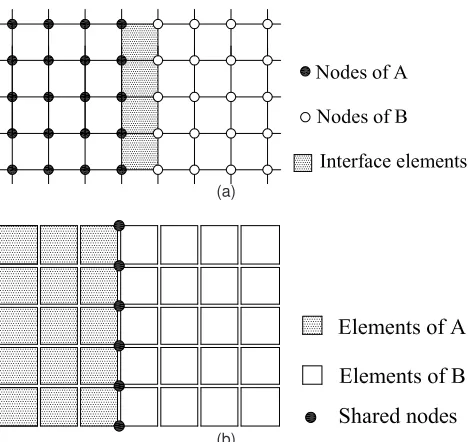
2.3 (a) Overlapping domain decomposition method; (b) Non-overlapping domain decomposition method . . . 28
2.4 The partitioning approach: (a) Node partitioning; (b) element partitioning 29 2.5 The solution procedure of the GC method . . . 32
2.6 The solution procedure of the PM method . . . 35
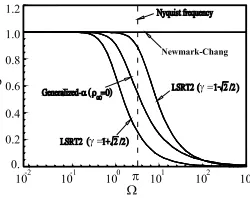
3.1 Spectral radiiρof the LSRT2 method with respect to the Generalized-αmethod and Newmark-Chang method vs. the non-dimensional fre-quencyΩ . . . 42
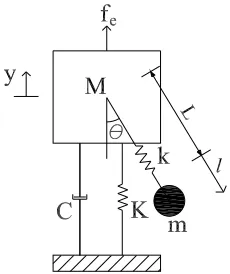
3.2 Schematic representation of a spring-pendulum system . . . 53
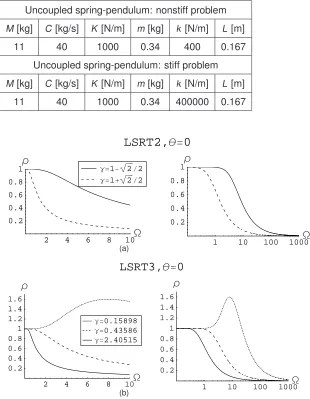
3.3 Spectral radii of the LSRT methods applied to the uncoupled spring-pendulum oscillator linearized aroundθ= 0: a) the LSRT2 method; b) the LSRT3 method. . . 61
3.5 Numerical simulations for the uncoupled spring-pendulum stiff problem
summarized in Table 3.1: (a) velocity ˙l obtained with different methods
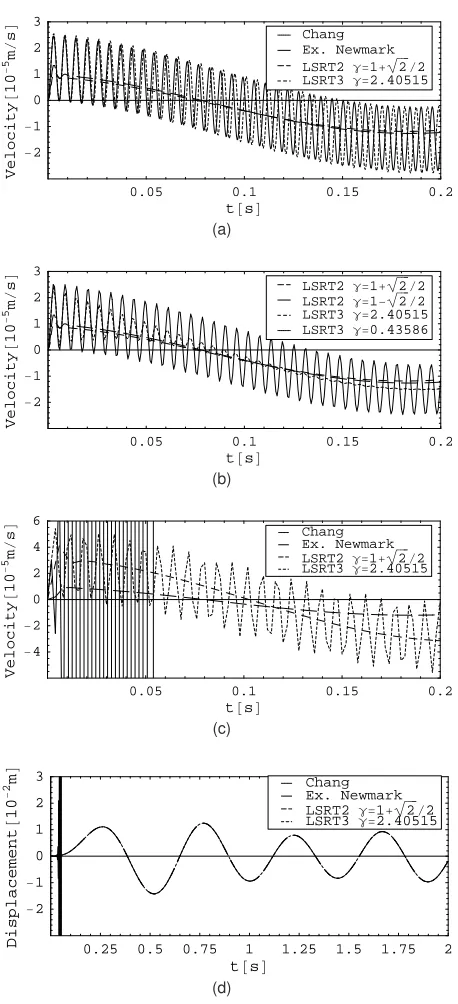
and∆t0 = 1/3ms; (b) velocity ˙l provided by different LSRT algorithms and∆t0= 1/3ms; (c) velocity ˙l with∆t0= 2ms; (d) displacement y with ∆t0= 2ms. . . 64
4.1 (a)-(d) Schematic representation of a substructured spring-pendulum
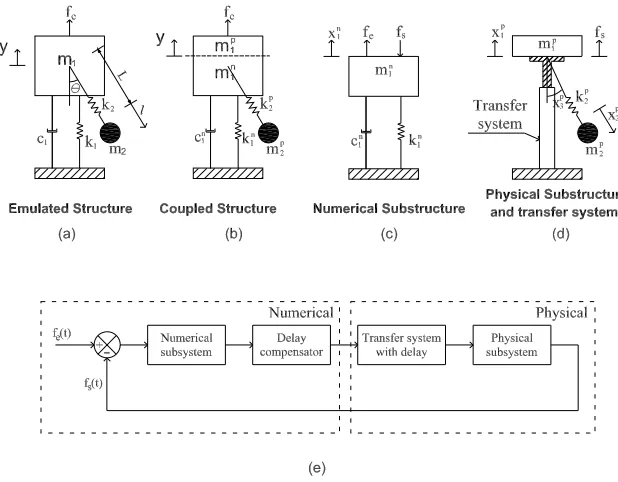
oscillator; (e) block diagram representation including delay . . . 69
4.2 Coupled integration in real time: (a) force-displacement(mixed)
cou-pling strategy; and (b) mixed strategy with algebraic coucou-pling conditions 70
4.3 Solution sequence of the time integration of a coupled system with
the LSRT3 algorithm: (a) single step strategy; (b) multiple step strategy with equilibrium-based interpolation; (c) multiple
time-step strategy with differentiation-based interpolation. . . 72
4.4 Numerical simulations for the coupled spring-pendulum stiff problem
summarized in Table 3.1: (a) velocity ˙x2p obtained with different meth-ods and∆t0= 1/3ms; (b) velocity ˙x2pprovided by different LSRT algo-rithms and ∆t0 = 1/3ms; (c) velocity ˙x2p with∆t0 = 2ms; (d) displace-ment x1pwith∆t0= 2ms. . . 78
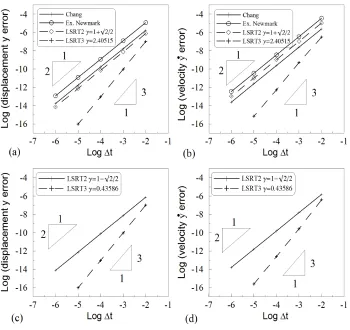
4.5 Convergence of displacement and velocity for the coupled spring-pendulum
nonstiff problem summarized in Table 3.1: (a) displacement x1 error without subcycling; (b) velocity ˙x1error without subcycling; (c)
displace-ment x2error with equilibrium-based interpolation; (d) displacement x2
error with differentiation-based interpolation. . . 79
4.6 Real-time test on an SDoF system with a nonlinear NS excited by an external sinusoidal force with f = 1.5 Hz and A = 12 N: (a) PS and
set-up; (b) experimental results. . . 82
4.7 Real-time test on a spring-pendulum system with a linear NS excited
by an external sinusoidal force with f = 2.2 Hz and A = 12 N: (a) PS
and set-up; (b) experimental results. . . 83
4.8 Real-time test on a spring-pendulum system with nonlinear Numerical
Substructure excited by an external sinusoidal force with f = 1.2 Hz and
5.1 The staggered solution procedure of the LSRT1-based partitioned method
with ss = 1 . . . 93
5.2 The staggered solution procedure of the LSRT2-based partitioned method
with ss = 1 . . . 95
6.1 The staggered solution procedure of the LSRT1-based partitioned method
with ss>1 . . . 111
6.2 The staggered solution procedure of the LSRT2-based partitioned method
with ss>1 . . . 113
6.3 Representation of the linear interpolation in the GC method and its equivalent solution procedure . . . 122
6.4 A Single-DoF split mass system . . . 124
6.5 |λi |for the partitioned method integrated with LSRT1 and ss = 1: (a)
b1= 2and (b) b1= 10. . . 126
6.6 |λi |for the partitioned method integrated with LSRT1 and ss = 2: (a)
b1= 2and (b) b1= 10. . . 126
6.7 |λi |for the partitioned method integrated with LSRT1 and ss = 10: (a)
b1= 0.1, (b) b1= 1, (c) b1= 2, and (d) b1= 10 . . . 127
6.8 | λi | for the partitioned method integrated by LSRT2 with γA = γB =
1−√2
2 and ss = 1: (a) b1= 2and (b) b1= 10 . . . 127 6.9 | λi | for the partitioned method integrated by LSRT2 with γA = γB =
1 +√2
2 and ss = 1: (a) b1= 2and (b) b1= 10 . . . 127 6.10| λi | for the partitioned method integrated by LSRT2 with γA = 1−
√ 2
2 ,γB = 1 + √
2
2 and ss = 1: (a) b1= 2and (b) b1= 10 . . . 128 6.11| λi | for the partitioned method integrated by LSRT2 withγA = 1 +
√ 2
2 ,γB = 1− √
2
2 and ss = 1: (a) b1= 2and (b) b1= 10 . . . 128 6.12| λi | for the partitioned method integrated by LSRT2 with γA = γB =
1−√2
2 and ss = 2: (a) b1= 2and (b) b1= 10 . . . 128 6.13| λi | for the partitioned method integrated by LSRT2 with γA = γB =
1 + √
2
2 and ss = 2: (a) b1= 2and (b) b1= 10 . . . 129 6.14| λi | for the partitioned method integrated by LSRT2 with γA = 1−
√ 2
2 ,γB = 1 + √
2
6.15| λi | for the partitioned method integrated by LSRT2 with γA = 1 +
√ 2
2 ,γB = 1− √
2
2 and ss = 2: (a) b1= 2and (b) b1= 10 . . . 129 6.16| λi | for the partitioned method integrated by LSRT2 with γA = γB =
1−√2
2 and ss = 10: (a) b1= 0.1, (b) b1= 1, (c) b1= 2, and (d) b1= 10 . 130 6.17| λi | for the partitioned method integrated by LSRT2 with γA = γB =
1 + √
2
2 and ss = 10: (a) b1= 0.1, (b) b1= 1, (c) b1= 2, and (d) b1= 10 . 130 6.18| λi | for the partitioned method integrated by LSRT2 with γA = 1−
√ 2
2 ,γB = 1 + √
2
2 and ss = 10: (a) b1= 0.1, (b) b1= 1, (c) b1= 2, and (d) b1= 10 . . . 131
6.19| λi | for the partitioned method integrated by LSRT2 with γA = 1 +
√ 2
2 ,γB = 1− √
2
2 and ss = 10: (a) b1= 0.1, (b) b1= 1, (c) b1= 2, and (d) b1= 10 . . . 131
6.20| λi |for the partitioned method integrated by two-stage Rosenbrock
method withγ= 1/4and ss = 1: (a) b1= 2and (b) b1= 10 . . . 132
6.21| λi |for the partitioned method integrated by two-stage Rosenbrock
method withγ= 1/2and ss = 1: (a) b1= 2and (b) b1= 10 . . . 133
6.22| λi |for the partitioned method integrated by two-stage Rosenbrock
method with γ = 1/4and ss = 10: (a) b1 = 0.1, (b) b1 = 1, (c) b1 = 2, and (d) b1= 10 . . . 133
6.23| λi |for the partitioned method integrated by two-stage Rosenbrock
method with γ = 1/2and ss = 10: (a) b1 = 0.1, (b) b1 = 1, (c) b1 = 2,
and (d) b1= 10 . . . 134
6.24 Numerical damping ratio and relative frequency error for the staggered
procedure: (a), (b) ss=1; (c), (d) ss=10. . . 135
6.25| λi | for the partitioned method using dual Lagrange multipliers and
integrated with LSRT2 and ss = 10: (a) b1= 1and (b) b1= 5 . . . 139
6.26 Global error of the partitioned methods with b1 = 10 and integrated
by: (a) LSRT1 and ss = 1, (b) LSRT1 and ss = 10, (c) LSRT2 with
γ= 1−√2
2 and ss = 1; (d) LSRT2 withγ= 1 + √
2
2 and ss = 1; (e) LSRT2 withγ= 1−√2
2 and ss = 10; and (f) LSRT2 withγ= 1 + √
2
6.27 The displacement and velocity responses in free vibration of the
Single-DoF system with b1 = 10 integrated by the partitioned method with
ss = 1and∆t = 0.01: (a), (b) LSRT2 withγ = 1−√2
2 ; (c), (d) LSRT2 withγ= 1 +
√ 2
2 . . . 142
6.28 The displacement and velocity responses in free vibration of the Single-DoF system with b1 = 10 integrated by the partitioned method with ss = 10and∆t = 0.01: (a), (b) LSRT2 withγ = 1−√2 2 ; (c), (d) LSRT2 withγ= 1 + √ 2 2 . . . 143
6.29 Partitioned Two-DoF system 1 with two subdomains . . . 144
6.30 Partitioned Two-DoF system 2 with three subdomains . . . 144
6.31 Partitioned Three-DoF system with two DoFs at interface . . . 145
6.32 Partitioned Four-DoF system 1 with one interface . . . 146
6.33| λi | for the partitioned method applied to the partitioned Two-DoF system 1 with LSRT2, ss = 1 and b1 = 10: (a) γ = 1− √2 2 and (b) γ= 1 + √ 2 2 . . . 146
6.34| λi | for the partitioned method applied to the partitioned Two-DoF system 1 with LSRT2, ss = 10 andγ= 1−√2 2 : (a) b1= 0.1and (b) b1= 10147 6.35| λi | for the partitioned method applied to the partitioned Two-DoF system 1 with LSRT2, ss = 10 andγ= 1 + √ 2 2 : (a) b1= 0.1and (b) b1= 10147 6.36| λi | for the partitioned method applied to the partitioned Two-DoF system 2 with LSRT2, ss = 1 (a)γ= 1−√2 2 and (b)γ= 1 + √ 2 2 . . . 147
6.37| λi |for the partitioned method applied to the partitioned Three-DoF system with LSRT2, ss = 1 and r = 2: (a)γ= 1−√2 2 and (b)γ= 1 + √ 2 2 148 6.38| λi | for the partitioned method applied to: (a) the partitioned Three-DoF system with LSRT2, ss = 10, r = 2 and γ = 1− √2 2 , (b) the partitioned Four-DoF system with LSRT2, ss = 1 andγ= 1−√2 2 (c) the partitioned Four-DoF system with LSRT2, ss = 1 andγ = 1 + √ 2 2 and (b) the partitioned Four-DoF system with LSRT2, ss = 10 andγ= 1 +√2 2 148 6.39 Partitioned Four-DoF system 2 with two subdomains . . . 150
6.41 Drift analysis for the partitioned methods with LSRT2 for different
sys-tems: (a),(b) displacement drift and velocity drift at the interface of the
partitioned Single DoF system with b1 = 10; (c), (d) displacement drift
and velocity drift at the interface of the partitioned Single-DoF system
with b1= 10and kB= 0. . . 151
6.42 Drift analysis for the partitioned methods with LSRT2 for different
sys-tems: (a) drifts at the first interface of the partitioned Four-DoF system
with two interfaces; (b) drifts at the second interface of the partitioned
Four-DoF system with two interfaces; (c) drifts at the first interface of
the partitioned Four-DoF system with three interfaces; (d) drifts at the
second interface of the partitioned Four-DoF system with three
inter-faces. . . 152
6.43 Numerical simulations for the partitioned Two-DoF system with one
in-terface: (a) displacements at the interface obtained with ss = 1 and
γ= 1−√2
2 ; (b) displacements at the interface obtained with ss = 1 and
γ= 1 +√2
2 ; (c) displacements at the interface obtained with ss = 10 and
γ = 1− √2
2 ; (d) displacements at the interface obtained with ss = 10 andγ= 1 +
√ 2
2 . . . 154
6.44 Numerical simulations for the partitioned Three-DoF system with one interface: (a) velocities of the translational DoF at the interface
ob-tained with ss = 1 and γ = 1− √2
2 ; (b) velocities of the translational DoF at the interface obtained with ss = 1 and γ = 1 +
√ 2
2 ; (c) veloci-ties of the translational DoF at the interface obtained with ss = 10 and
γ = 1−√2
2 ; (d) velocities of the translational DoF at the interface ob-tained with ss = 10 andγ= 1 +
√ 2
2 . . . 155
6.45 Numerical simulations for the partitioned spring-pendulum stiff system
with one interface: (a) extensional velocities of the pendulum obtained
with ss = 1 and γ = 1−√2
2 ; (b) extensional velocities of the pendu-lum obtained with ss = 1 andγ = 1 +
√ 2
2 ; (c) extensional velocities of the pendulum obtained with ss = 10 andγ = 1−√2
2 ; (d) extensional velocities of the pendulum obtained with ss = 10 andγ= 1 +√2
7.1 The interfield parallel solution procedure of the LSRT1-based
parti-tioned method . . . 160
7.2 Flowchart for the interfield parallel solution procedure of the LSRT1-based partitioned method . . . 161
7.3 The interfield parallel solution procedure of the LSRT2-based
parti-tioned method . . . 163
7.4 Flowchart for the interfield parallel solution procedure of the
LSRT2-based partitioned method . . . 163
7.5 The input and output representation of the integration loop for the
inter-field parallel solution procedure of the LSRT2-based partitioned method168
7.6 |λi |for the parallel partitioned method integrated by LSRT2 with b1=
0.1andγ= 1−√2
2 : (a) ss = 2; (b) ss = 5; (c) ss = 10; (d)ss = 50 . . . . 169 7.7 |λi |for the parallel partitioned method integrated by LSRT2 with ss =
10andγ= 1−√2
2 : (a) b1= 0.1; (b) b1= 0.5; (c) b1= 1; (d)b1= 10 . . . 169 7.8 |λi |for the parallel partitioned method integrated by LSRT2 with ss =
10andγ= 1 +√2
2 : (a) b1= 0.1; (b) b1= 0.5; (c) b1= 1; (d)b1= 10 . . . 170 7.9 |λi |for the parallel partitioned method integrated by LSRT2 with ss =
10andγ= 1/4: (a) b1= 0.1; (b) b1= 0.5; (c) b1= 1; (d)b1= 10 . . . 170
7.10|λi |for the parallel partitioned method integrated by LSRT2 with ss =
10andγ= 1/2: (a) b1= 0.1; (b) b1= 0.5; (c) b1= 1; (d)b1= 10 . . . 171
7.11 Global error of the Single-DoF system for the parallel partitioned method
integrated by LSRT2 with ss = 10: (a) b1 = 0.1and γ = 1− √2 2 ; (b) b1 = 10 andγ = 1− √2
2 ; (c) b1 = 0.1andγ = 1 + √
2
2 ; (d)b1 = 10 and
γ= 1 +√2
2 . . . 173 7.12 Global error of the Single-DoF system for the parallel partitioned method
integrated by LSRT2 with ss = 10: (a) b1= 0.1andγ= 1/4; (b) b1= 10
andγ= 1/4; (c) b1= 0.1andγ= 1/2; (d)b1= 10andγ= 1/2 . . . 174
7.13 The numerical simulations the Single-DoF system integrated by the
parallel method with ss = 10, ∆t = 0.01 andγ = 1 + √
2
2 : (a), (b) the displacement and velocity responses with b1 = 0.1; (c), (d) the
dis-placement and velocity responses with b1= 1; (e), (f) the displacement
7.14 The numerical simulations the Single-DoF system integrated by the
parallel method with ss = 10,∆t = 0.01andγ= 1−√2
2 : (a), (b) the dis-placement and velocity responses with b1 = 0.1; (c) the displacement
response with b1= 1; (d) the displacement response with b1= 10 . . . 176
7.15 The numerical simulations the Single-DoF system integrated by the
parallel method with ss = 10 and∆t = 0.01: (a)the displacement re-sponse with b1= 0.1andγ= 1/4; (b) the displacement response with
b1= 10andγ = 1/4; (c) the displacement response with b1= 0.1and
γ= 1/2; (d) the displacement response with b1= 10andγ= 1/2 . . . 177
7.16|λi |for the parallel method appled to the paritioned Two-DoF system
1 with LSRT2 and ss = 10: (a) b1= 0.1andγ= 1−√2
2 ; (b) b1= 10and
γ= 1−√2
2 ; (c) b1= 0.1andγ= 1 + √
2
2 ; (d) b1= 10andγ= 1 + √
2
2 . . . 180 7.17 The displacement responses of the partitioned Two-DoF system 1
in-tegrated with: (a) the GC method; (b) the PM method; (c) the
LSRT2-based staggered method; and the LSRT2-LSRT2-based parallel method . . . 181
7.18 The velocity responses of the partitioned Two-DoF system 1 integrated
with: (a) the GC method; (b) the PM method; (c) the LSRT2-based
staggered method; and the LSRT2-based parallel method . . . 182
7.19 The displacement and velocity responses of the partitioned
Three-DoF system integrated with: (a) and (b) the LSRT2-based staggered
method; (c) and (d) the LSRT2-based parallel method . . . 183
7.20 The displacement and velocity responses of the coupled spring-pendulum
system integrated by the LSRT2-based parallel method with: (a) and
(b)γ= 1−√2
2 ; (c) and (d)γ= 1 + √
2
2 . . . 184
8.1 |λi |for the LSRT1-based projection method integrated without
subcy-cling: (a) b1= 2andγ= 1; (b) b1= 10andγ= 1; (c) b1= 100andγ= 1;
(b) b1= 10andγ= 1/2. . . 203
8.2 Numerical damping ratio and relative frequency error for the
LSRT1-based projection methods: (a) numerical damping ratio; (b) relative
8.3 |λi |for the LSRT2-based projection method integrated without
subcy-cling: (a) b1= 2andγ= 1−√2
2 ; (b) b1= 10andγ= 1− √
2
2 ; (c) b1= 2 andγ= 1 +
√ 2
2 ; (b) b1= 10andγ= 1 + √
2
2 . . . 205 8.4 |λi |for the projection method integrated with conservative integrators:
(a) b1= 2andγ= 1/4; (b) b1= 10andγ= 1/4; (c) b1= 2andγ= 1/2;
(b) b1= 10andγ= 1/2. . . 206
8.5 | λi |for the LSRT2-based projection method integrated withγA = 1−
√ 2
2 andγB = 1 + √
2
2 : (a) b1= 0.1; (b) b1= 0.5; (c) b1= 2; (b) b1= 10. . . 207 8.6 Numerical damping ratio and relative frequency error for the
LSRT2-based projection methods with: (a), (b) L-stable integrator; (c), (d)
con-servative integrator. . . 208
8.7 Global error of the Partitioned Single-DoF system emulated with the
LSRT1-based projection method: (a)γ= 1; (b)γ= 1/2. . . 209
8.8 Global error of the Partitioned Single-DoF system emulated with the
LSRT2-based projection method: (a) γ = 1− √2
2 ; (b)γ = 1 + √
2 2 ; (c)
γ= 1/4; (d)γ= 1/2. . . 209
8.9 The displacement responses of the LSRT1-based projection method
applied to the Partitioned Single-DoF system emulated with : (a)γ= 1;
(b)γ= 1/2. . . 210
8.10 The displacement responses of the LSRT2-based projection method
applied to the partitioned Single-DoF system with b1 = 10: (a) γ =
1−√2
2 ; (b)γ= 1 + √
2
2 ; (c)γ= 1/4; (d)γ= 1/2 . . . 211 8.11 The displacement responses of the LSRT2-based projection method
applied to the partitioned Single-DoF system with b1 = 10: (a) γ =
1−√2
2 ; (b)γ= 1 + √
2
2 ; (c)γ= 1/4; (d)γ= 1/2 . . . 212 8.12 The displacement responses of the LSRT2-based projection method
applied to the partitioned Two-DoF system 1 with b1 = 10: (a) γ =
1−√2
2 ; (b)γ= 1 + √
2
2 ; (c)γ= 1/4; (d)γ= 1/2 . . . 214 8.13 The displacement responses of the LSRT2-based projection method
applied to the partitioned Two-DoF system 2 with b1 = 10: (a) γ =
1−√2
2 ; (b)γ= 1 + √
2
8.14 The displacement responses of the LSRT2-based projection method
applied to the partitioned Three-DoF system with r = 2: (a)γ= 1−√2 2 ; (b)γ= 1 +
√ 2
2 ; (c)γ= 1/4; (d)γ= 1/2 . . . 216 8.15 The displacement and velocity responses of the LSRT2-based
projec-tion method applied to the coupled spring-pendulum stiff problem with:
(a), (b)γ= 1−√2
2 ; (c), (d)γ= 1 + √
2
2 . . . 218 8.16 The elongational velocity responses of the LSRT2-based projection
method applied to the partitioned Three-DoF system 1 with b1 = 10: (a)γ= 1−√2
2 ; (b)γ= 1 + √
2
2 ; (c)γ= 1/4; (d)γ= 1/2 . . . 218
9.1 Test set-up . . . 223
9.2 Schematic representation of the rotation of the mass . . . 224
9.3 Schematic representation of the emulated four-DoF system . . . 225
9.4 Numerical simulations for the four-DoF system as shown in Fig. 9.3
using the LSRT2 time integration method withγ= 1−√2
2 : (a) transla-tional displacements h1and h2; (b) rotational displacementsθ1andθ2; (c) translational velocities ˙h1and ˙h2; (b) rotational velocities ˙θ1and ˙θ2; 226 9.5 Main configurations of the masses and the bearings . . . 227
9.6 (a) A coil spring and its configurations with continuous and
discontinu-ous supports; (b) detail of mounting spring; and (c) dampers . . . 228
9.7 (a) Electro-thrust actuators; (b) AC890 units . . . 229
9.8 (a) PPC 1103 unit and its connector panel; (b) detail of optical fiber
connection to PC . . . 230
9.9 Laser sensor mounted on actuator for measurement of displacement.. 231
9.10 Schematic test configuration with single physical and two numerical
substructures. . . 232
9.11 Schematic test configuration with two physical and single numerical
C
HAPTER1
I
NTRODUCTION1.1 Context
With the higher-rise, longer-span and smarter-material tendencies of structural
sys-tems and the higher requirements of safety and reliability, structural dynamic testing is
becoming more and more important. As structures become higher and/or longer, their
mathematical models and failure modes turn out to be more unpredictable with purely
analytical techniques and their responses under dynamic loads, such as earthquake or wind, require advanced dynamic testing techniques. Also, with more efficient
intro-duction of smart materials and devices to structures, their applications reduces the
robustness and applicabilities of the existing design codes and need specific dynamic
tests. Meanwhile, the introduction of new design concepts, such as
performance-based seismic design, requires experimental techniques to validate their suitabilities.
Current dynamic testing includes a various methods: Free-vibration tests;
Monitor-ing of ambient vibrations; Harmonic excitation tests; ShakMonitor-ing table tests; Quasi-static
tests; Pseudodynamic tests and Real-time substructure tests (Negro and Magonette,
1998). To evaluate the dynamic performance of structures and components subjected
to complex dynamic loading, such as earthquake, two basic experimental methods
co-existed for a long time: the shaking table testing which frequently allows full
time-scale but reduced space-time-scale; the Pseudodynamic testing which usually permits full
space-scale but expanded time-scale. In a word, they both have inherent predomi-nances but limitations (Williams and Blakeborough, 2001).
the shaking table testing and the Pseudodynamic (PsD) testing, Real-time Testing
with Dynamic substructuring (RTDS) was developed in the early 1990s (Nakashima
et al., 1992) and, since then, it was used and advanced by researchers worldwide
for seismic simulation studies (Nakashima and Masaoka, 1999; Dimig et al., 1999;
Horiuchi et al., 1999; Darby et al., 1999; Williams, 2000; Bonnet, 2006; Bursi, 2007;
Chen et al., 2007). The RTDS test method involves the combination of the
real-time dynamic testing of a Physical Substructure (PS), that contains the key regions of
interest, with the analytical simulation of a Numerical Substructure (NS), that contains the remainder of the emulated structure. The interaction of both substructures is
achieved by imposing compatibility and equilibrium conditions at the interface.
The increasing interest of the RTDS method is motivated by two major features of this method: i) compared to the shaking table testing method, critical structural
com-ponents of interest, such as portions with nonlinear behaviour or more prone to
dam-age under dynamic loading, can be tested at full scale while the remainder is
mod-elled numerically, which to some extent leads to significant cost savings and makes it
possible to conduct full-scale test; ii) with respect to the PsD testing method,
velocity-dependent phenomena can be taken into account, moreover, distributed-mass
sys-tems can be considered. Because of those two advantages, RTDS method is thus
an desirable approach for earthquake engineering. However, those advantages are
offset by the complexities of implementation (Nakashima, 2001; Blakeborough et al.,
2001). The key challenge of the applications of the RTDS method to large or complex structures is to ensure that the PS and the NS interact in real-time. To confront this
challenge, current RTDS research focuses both on the development of sophisticated
control strategies (Horiuchi and Konno, 2001; Darby et al., 2001, 2002; Wallace et al.,
2005; Neild et al., 2005; Gawthrop et al., 2009) and on the development of efficient
numerical integration schemes (Bursi, 2007; Bonnet et al., 2007; Sajeeb et al., 2007;
Shing, 2008; Bonnet et al., 2008). The research proposed herein is mainly related to
numerical integration issues of the RTDS method.
Although the field of RTDS method is the main target of this thesis, both
numeri-cal strategies and methods developed for time-stepping schemes herein can also be
applied to PsD testing with dynamic substructuring and pure numerical simulations.
(Der-mitzakis and Mahin, 1985) is scaling effects which extends the application to large
structures. Likewise, with this method, the structure can be divided into two
substruc-tures: one is numerically simulated in computer in that it has a simple behaviour or
it is not considered to be critical for the emulated structure; the remainder requires
physical replication with PsD technique because it contains nonlinear behaviour or
it is critical to the performance of the structure concerned (Pegon and Pinto, 2000).
In the test, both substructures are solved monolithically with a direct time integration
method (Bursi and Shing, 1996) or separately by using a partitioned time integration scheme (Pegon and Magonette, 2002). Differently from the conventional PsD testing
methods and the direct integration algorithms, in the substructuring test the restoring
forces in the NS are numerically modelled while the restoring forces in the PS are
not numerically modelled but are measured from a test conducted in parallel with the
direct/partitioned time integration (Williams and Blakeborough, 2001).
In this document, the time integration methods are developed for solving
second-order systems, i.e. structural dynamics. But the utilized integrators are expressed in the first-order form. Besides the field of structural dynamics, it is believed that
the time integration methods proposed, in particular the partitioned methods, can be
implemented on both first- and second-order coupled problems in different fields of
engineering or science (Nakshatrala et al., 2008; Felippa et al., 2001; Prakash and
Hjelmstad, 2004).
1.2 Motivation of the research
A brief review of dynamic testing was given within the context of earthquake
en-gineering in the previous section. Real time testing with dynamic substructuring
was described and its limitations, especially its complexities of implementation, were
pointed out. Moreover, the PsD testing with dynamic substructuring was introduced
as well as its computational limitation. These limitations as well as the implementation
difficulties of both hybrid testing methods, to some extent, reflect the high requirement
follow these requirements.
As underlined above, RTDS is efficient for modeling structures exhibiting complex
nonlinear behaviour, especially if the nonlinearity is concentrated in specific regions
of the structure. However, if a large structure is considered, computational model of
the NS is expected to be nonlinear to take into account phenomena such as material
plasticity, geometric nonlinearity and buckling. In order to integrate the nonlinear NS
coupled to the PS in real time, an efficient time integration method is required capable
to exhibit the following desirable properties: i) real-time compatibility; ii) unconditional
stability; iii) explicit target displacements and velocities; iv) time efficiency.
Frequently, structural models for large-scale structures contain non-physical
high-frequency components that are artifacts of standard finite-element modeling of the
spatial domain. Moreover, physical high-frequency models are included but not accu-rately treated. Therefore, the equations of motion can contain stiff components of the
response. In this case, an advanced integration method is required to filter out
high-frequency oscillations without sacrificing the accuracy of low-high-frequency modes. With
these considerations, we propose Rosenbrock-based L-stable ReTime (LSRT)
al-gorithms. These methods are linearly implicit, because they are unconditionally
sta-ble, but require only a single linearization and matrix decomposition per time step
where the Jacobian is formed only at the beginning of each time step. The methods
are real-time compatible and possess high-frequency dissipation capabilities.
Most of the aforementioned research works carried out on substructure tests
con-sidered structural integrators applied to the equations of motion expressed as
second-order in time. Nonetheless, it is well known that the motion of the PS in a substructure
test, see Fig.1.1, is driven by a transfer system -actuator- and sensors, governed by a control unit. Since the control system is typically described by first-order
Differential-Algebraic Equations (DAEs), the utilized integrators have to deal with mixed first- and
second-order DAEs. In order to solve this problem, there are mainly three options:
i) to use different integrators for structural and control systems, respectively, Csee
for instance Wu et al. (2007), that utilizes the Newmark- method for the emulated
structure and a proprietary MTS controller with its own built-in time integrator; ii) to
reformulate the control equations in a second-order form (Br ¨uls and Golinval, 2006),
Hul-bert, 1993) for both systems; to use first-order integrators like the LSRT algorithms,
for both structural and control systems. Herein, we adopt the last option owing to the
favourable properties of LSRT algorithms employed in control (Vulcan, 2006).
Fig. 1.1: Block diagram representation including delay for RTDS tests
With regard to applications time-stepping methods to RTDS tests, they can be
broadly classified in monolithic and partitioned. In a monolithic approach, the method
integrates: i) the Numerical Substructure (NS) only, whilst the Physical
Substruc-ture (PS) can be considered as a black box (Bursi et al., 2008) or as a grey box (Lamarche et al., 2009), with estimates of stiffness and damping of the PS included
in the Jacobian matrix; ii) both the NS and the PS by means of stiffness estimates
(Jung et al., 2007), like in a typical pseudo-dynamic (PsD) test. Conversely, a
par-titioned approach typically solves both NS and PS through different integrators and
takes into account the interface problem, for instance by prediction, substitution and
synchronization of Lagrange multipliers (Pegon and Magonette, 2002). In detail,
par-titioned algorithms can be applied to the Euler-Lagrange form of the equations of
motion -second-order in time- (Prakash and Hjelmstad, 2004; Bonelli et al., 2008b)
or to the Hamilton form of the equations of motion -first-order in time- (Nakshatrala
et al., 2008). In this thesis, we consider both monolithic and partitioned approaches based on L-stable real-time compatible Rosenbrock algorithms applied to equations
of motion first-order in time.
As far as complex emulated structures are concerned, numerical and control
main techniques can be identified to tackle this problem: i) model reduction, that
rep-resents an effective way to lower computation burdens related to the integration of a
complex NS, but becomes very inaccurate especially for non-linear systems; ii)
multi-time methods that allow to employ different multi-time integrators in distinct subdomains.
Moreover, subcycling permits to use different time steps in different subdomains. The
last strategy is relatively simple to implement, but stability and accuracy properties of
the original schemes can be hindered. Therefore, this thesis proposes some novel
multi-time method with subcycling strategies, and also investigates relevant stability and accuracy issues.
When using subcycling strategies, the computer for RTDS tests must keep
send-ing displacement signals without interruption to the digital servo-controller. On the
other hand, the next target displacement is not ready at the instant when loading in
the current integration time-step is completed. To overcome this problem, Nakashima (2001) proposed a approach in which the task of creating the target displacement (by
solving the equations of motion) at an integration time step∆tand the task of creating displacement signals (to be sent to the servo-controller) at a smaller time-intervalδt
are separated. The signal generation task is programmed as: if the displacement
target is not available, i.e. before the completion of numerical integration, the signals
are generated by the extrapolation of previous displacements; once the numerical
integration is completed and the target displacement is available, the signal
gener-ation task stops extrapolgener-ation and starts performing interpolgener-ation (Nakashima and
Masaoka, 1999). In this thesis, a parallel solution procedure is proposed where the target displacement and velocity is provided in advance so that only interpolation is
needed for signal generation task.
Hence, the objectives of this thesis can be summarised as follows:
1. To consider one- and two-stage linearly implicit Rosenbrock-based integrators applied to equations first-order in time for RTDS tests and PsD tests with DS;
2. To develop monolithic Rosenbrock-based time integration methods and
subcy-cling strategies for RTDS;
3. To develop partitioned Rosenbrock-based time integration methods and
4. To develop a proper framework of accuracy and stability analysis for partitioned
methods;
5. To apply both monolithic and parallel partitioned integration methods to
real-time substructure tests and to compare their efficiencies.
1.3 Thesis organization
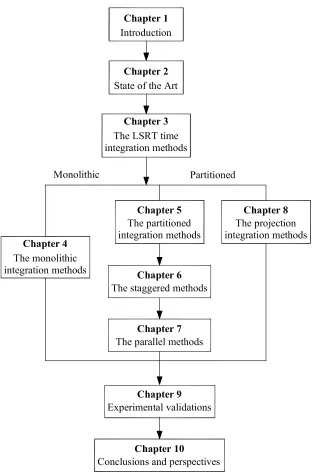
With the objectives described in the previous subsection, the thesis presents the
re-search work conducted by the author on the development of integration schemes for
RTDS tests: monolithic methods and partitioned methods without and with consider-ing subcyclconsider-ing strategies. The properties of the proposed methods are investigated in
terms of stability, accuracy, high-frequency dissipation and implementation efficiency.
Moreover, for experimental validations of the involved methods a test rig is conceived
and constructed within the SERIES project. The organization is depicted in Fig. 1.2.
In detail, the thesis is organised as follows:
The first chapter focuses on the motivation of the thesis with respect to the
require-ments of the newly-developed RTDS technique.
The second chapter provides a detailed review of the previous work accomplished
by other researchers, their contributions and the problems encountered. Firstly, the
assessment of the RTDS method within the dynamic laboratory testing of structures is made in terms of advantages and limitations. Secondly, the RTDS technique is
detailed as well as the problems restricting its development. Thirdly, the
commonly-used integration methods are reviewed and the requirements for advanced integration
schemes are underlined. Lastly, the development of partitioned methods is stated and
both the GC and the PM methods are analysed in depth.
Chapter 3 introduces the Rosenbrock-based LSRT methods and their accuracy and
stability are analysed when applied to second-order systems. Initially, the LSRT
meth-ods are introduced and their applications by other research are shortly discussed.
Fig. 1.2: Organization of the thesis
to investigate their stability properties with respect to second order systems. Lastly,
an uncoupled spring-pendulum system is emulated numerically to validate both the
im-plicit time integration methods.
In Chapter 4, the monolithic integration schemes developed for RTDS are extended
to nonlinear systems and subcycling strategies are developed for real time
applica-tions. Firstly partitioning and coupling techniques are introduced and applied to an
uncoupled spring-pendulum system to achieve a coupled spring-pendulum system.
Secondly, zero-stability analysis is performed for the coupled spring-pendulum
sys-tem and both stability and accuracy analysis by means of simulations. Lastly, in order
to validate the methods in real testing environment, we present RTDS test results for nonlinear Single-DoF system, and the Multiple-DoF spring-pendulum system.
From Chapter 5 to 7, the partitioned methods based on linearly implicit
integra-tors are developed and studied. Chapter 5 mainly proposes the partitioned methods
based on acceleration continuity. In chapter 6, subcycling strategies are proposed for
the partitioned method which is inherently staggered. Chapter 7 extends the
stag-gered methods to the parallel form. With respect to each type of partitioned methods,
both theoretical analyses and numerical simulations of linear and nonlinear systems
are carried out to investigate their performances.
Another family of partitioned methods, based on a projection solution procedure
and velocity continuity, are presented in Chapter 8. Their accuracy and stability anal-yses are conducted. The numerical analysis is performed on a Single-DoF
split-mass system and rechecked on Two- and Three-DoF systems. Finally, their
ap-plications to nonlinear systems are investigated through simulations of the coupled
spring-pendulum system.
In Chapter 9, a test rig is designed and its different configurations are presented
to appraise its capabilities. Finally, conclusions and future perspectives are drawn in
C
HAPTER2
S
TATE OF THE ART2.1 Introduction
This chapter provides a review of previous research related to this thesis. First, a
briefly introduction is presented on the well-established themes of dynamic
experi-mental testing of structures and the significance of the RTDS within the testing
meth-ods assessed. Then, the second section focuses on the RTDS in terms of control
and actuator dynamics. Thirdly, the overview of the global integration methods used
for solving the numerical substructure(s) are conducted in the third section, and
sev-eral are emphasized which will be used for comparison. Finally, the fourth section
presents the developments of the partitioned time integration methods, and the GC
method and the PM method are introduced in great detail.
2.2 Experimental dynamic tests
This section provides a description of the experimental techniques which can be
used for earthquake testing of civil engineering structures. In particular, the PsD test
method and the RTDS method which are the focus of this thesis. A historical review
is given as well as their advantages and limitations.
With the development of long-span and high-rise structures, a variety of testing
evaluation of structures. Articles by Takanashi and Nakashima (1987), Negro and
Magonette (1998), and Williams and Blakeborough (2001), provide comprehensive
overviews on contemporary research related to laboratory testing of structures under
earthquake loads. The focus is on the context of the RTDS, for which four principal
methods are introduced and discussed: quasi-static testing method, shaking table
method, PsD testing method, PsD tests with dynamic substructuring and RTDS
test-ing method. By comparison, the advantages of RTDS are discussed. Finally, key
challenges ahead are detailed and possible contributions of the thesis are listed for the RTDS.
2.2.1 Quasi-static testing method
First, the most common technique, quasi-static testing method is briefly introduced.
Quasi-static tests are performed by imposing predefined displacement or force
histo-ries on the specimen by actuators at an extended time scale. The specimen tested is generally composed of a series of single elements or simple portions of the
emu-lated structure. By imposing cyclic displacements and measuring the corresponding
restoring forces, one can predict the effect of systematic changes in material
prop-erties, details, boundary conditions, loading rates, and even the dynamic behaviour
of the structures subjected to any dynamic input. Such tests are relatively easy and
economical to execute. Since the displacement is predefined but not online, it may
not cover the range of the displacements that a structure undergoes during an actual
seismic event (Negro and Magonette, 1998).
2.2.2 Shaking table testing method
Shaking table method is used extensively in seismic research. In a real test, a
reduced-scale model considering the law of similarity is mounted on a rigid platform,
and both the specimen and the platform are excited to replicate ground motions,
including recorded earthquakes time-histories (Bonnet, 2006). This testing method
(either real or artificial), considering the inertial and damping characteristics of the
tested structure and the phenomena of geometric nonlinearities, localized yielding
and damage, and component failure. However, reduced-scale or highly simplified
specimens are required for large-scale structures. This may cause problems in
en-suring correct dynamic scaling: i) scale factors may not be optimized to be completely
satisfied; ii) it is difficult to have confidence in the extrapolation of nonlinear dynamic
response to full scale (Williams and Blakeborough, 2001); iii) scaling may result in
poor representation of the behaviour of specific portions, such as connections (Negro and Magonette, 1998). In addition to the issues related to similitude, the
perfor-mance of the shaking table tests requires sophisticated control system (Negro and
Magonette, 1998; Williams and Blakeborough, 2001).
2.2.3 Pseudo-dynamic testing method
The third method reviewed is Pseudo-dynamic testing method, also termed as the
online computer-controlled testing method or the quasi-static online testing method
(Nakashima, 2001). In this experimental testing technique, a simulation is executed
based on a step-by-step numerical solution of the governing equations of motion for
model formulated considering both the numerical and physical components of an emulated structure:
M ¨u+C ˙u+r(u) =fe (2.1)
whereM is the mass matrix, Cthe damping matrix,uthe vector of nodal
displace-ment, ris the restoring force vector, fe is the vector of the external forces, and the
dots represent differentiation with respect to time. In Eq. (2.1), the mass and
vis-cous damping characteristics of the emulated structure are numerically modelled.
Differently from conventional computational modelling and simulation where the
en-tire structure is simulated analytically, the restoring force vector which contains
un-certainties over the nonlinear stiffness and hysteretic damping characteristics is not
evaluated numerically but directly measured on the structure at certain controlled
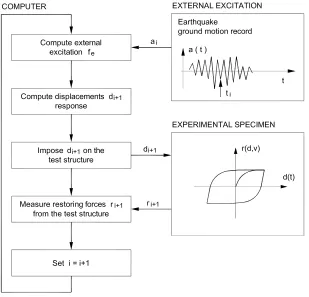
lo-cations. The detailed process of the PsD testing method is illustrated in Fig. 2.1.
generated earthquake ground acceleration history is used to compute the external
ex-citation ferunning the PsD algorithm. The displacement vector of the structure (where
the mass of the structure can be considered to be concentrated) is calculated using a
suitable integration method. The displacements are then applied to the test structure
by servo-controlled hydraulic actuators fixed to the reaction wall. Load cells on the
actuators measure the forces necessary to achieve the required displacements and
these restoring forces are returned to the computer for use in the next time step
calcu-lation (Pegon and Pinto, 2000; Bursi, 2008). Even though Eq. (2.1) can be expressed
Fig. 2.1: Flow of the PsD testing method
for any number of degrees of freedom (DoFs), it is not feasible to test large structures.
This is because the number of DoFs tested is determined by the number of available
actuators and some other laboratory facilities. Even for a simple structure, the mass
has to be concentrated in certain location through standard condensation techniques.
enough for their in-plane deformability to be ignored and most of the mass is
concen-trated in the floor slabs. However, earthquake loading often leads to severe damage
and unpredictable uncertainty only in parts of the structure. It would be much more
desirable to test the critical parts of the emulated structure while also the restoring
forces for the remainder are modelled in the computer. This is the main idea of the
PsD testing method with dynamic substructuring.
2.2.4 PsD testing method with dynamic substructuring
It was observed that during structural testing, damage (and therefore nonlinear
be-haviour) often occurred in specific, limited regions of an entire structure. Hence, the
substructuring technique was introduced to the PsD testing method by Dermitzakis
and Mahin (1985). With the aid of the substructuring methodology, a physical model
is built only of the part or parts where nonlinearity is expected (the PS) while the
re-mainder is computationally modelled (the NS). The principle of the method is similar
as the PsD testing method. The only difference is that the restoring force of the NS is
numerically modelled.
With the substructuring technique, the number of DoFs of the tested structure is
likely to be quite large. As far as utilized integrator is concerned, it was initially
ex-pected to use an explicit integration (Shing and Mahin, 1984). Solving large ODEs
system with an explicit integrator may lead to stability problem, which blocks the
application of the PsD testing to large-scale structural models. To overcome this,
Dermitzakis and Mahin (1985) proposed a mixed implicit-explicit algorithm based on
the work by Hughes and Liu (1978). Due to the increasing complexity of the tested structures, many efficient, unconditionally stable numerical algorithms were
devel-oped, such as Operator-splitting (OS) method (Nakashima, 1990), implicit Newmark
method (Dorka and Heiland, 1991) and the alpha method (Shing et al., 1991).
How-ever, the direct application of implicit integration algorithms to PsD tests has been
partially limited by the requirement to iterate with experimental substructures and
dif-ficulties in estimating the experimental tangent stiffness matrix. To implement implicit
integration methods, (Shing et al., 1991), (Bursi and Shing, 1996) adopted a modified
more detailed coverage of the development of numerical integration methods for PsD
testing with substructuring.
Before moving to the RTDS testing in the next subsection, another efficient
tech-nique, the so-called continuous PsD testing method is introduced here, in which the
loading rate is increased and the hold period is eliminated. This technique, by sus-taining a smooth motion and a continuous loading of the test structure, eliminates
or at least reduces force relaxation of structural materials. Moreover, capabilities for
fast rate or near real-time also partially allows for rate-dependent effects of the tested
structure. The new techniques for fast rate are built upon the same integration
meth-ods and principles developed for PsD testing in Subsection 2.2.3. As faster rate of
testing with no hold period are achieved, additional challenges arise in solving this
equations of motion: i) the use of shorter time step; ii) the adoption of parallel
solu-tion procedure; iii) the higher requirement to dealing with the inherent control error
and response lag of servo-hydraulic systems. For this technique, Researchers at the
JRC, ISpra have made a considerable effort and substantial contributions on the de-velopment both on parallel integration algorithms (Buchet and Pegon, 1994; Pegon
and Magonette, 2002, 2005) and on control issues (Magonette et al., 1998).
2.2.5 Real-time testing with dynamic substructuring
When rate-dependent effects are of importance, the continuous PsD testing needs to
be extended to RTDS. This approach is similar to PsD testing with substructuring, but
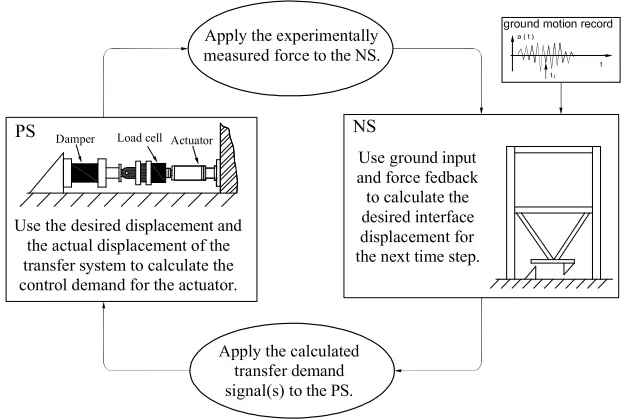
with the testing proceeding in real time. The test principles can be better understood
through a simple two-story building with a damper device as shown in Fig. 2.2. As shown in the figure, the tested structure is divided into a test specimen (the damper,
which is expected to reduce the response of the overall structure and make
possi-bly less damage to the main structure during the test) and a surrounding numerical
substructure. By imposing compatibility and equilibrium conditions at the interface,
the substructures are mode to interact possibly in real time, in order to emulate the
dynamic behaviour of the overall structure. In detail, the test process starts from time
integration in the numerical substructure, with the measured force from the PS and
and then sent to the actuator to advance the PS. At the end of the time-step the
ac-tuator loads and positions are measured and fed back to the numerical model. This
loop is completed at each time incremental until the test is completed. This technique,
Fig. 2.2: Control loop of the RTDS testing method
since it was developed by Nakashima et al. (1992), has been undergoing a rapid
de-velopment world-widely both on control issues and integration methods (Nakashima, 2001; Williams and Blakeborough, 2001; Blakeborough et al., 2001). The increasing
interest in RTDS testing is motivated by two major features: i) real time simulation
enable the technique to consider rate-dependent phenomena such as strain rate
ef-fects on material properties or viscous damping forces for specific dissipative devices;
ii) substructuring technique makes the possibility of large-scale structural tests with
common laboratory facilities.
Meanwhile, real time testing requires rapidly imposing high loads or accurate
dis-placements over a range of frequencies. This, on the one hand, imposes high
require-ment for efficient integration methods which will be detailed in the next section. On
the other hand, it is a difficult task to make the actuator(s) execute exactly and
con-tinuously within a shorter period. In the case of the work presented in the thesis, the
rapidly from the NS to the PS. Also, the restoring forces measured form the PS must
be quickly fed back to the NS. Communications between these two substructures
are thus of paramount importance which, to some extent, determine the accuracy
or the reliability of RTDS tests. To obtain desirable communications, efficient control
schemes are required to minimize propagations of the experimental error during tests
and to compensate for the actuator dynamics which is beyond emulated structures.
Historically, Horiuchi et al. (1996) pointed out that the effect of the effect actuator
dy-namics may introduces negative damping for a linear system which may cause the test to become unstable, and utilized polynomial extrapolations to compensate for
it. From then the effect has been gained sufficient attention by many researchers
working on this subject (Horiuchi et al., 1999; Nakashima and Masaoka, 1999). Also,
some control approaches were developed to considering actuator dynamics (Darby
et al., 2001; Wagg and Stoten, 2001; Neild et al., 2005; Bursi, 2007). A fuller review
of the delay compensation schemes used for RTDS testing is given in Chapter 5 of
the thesis (Bonnet, 2006).
2.3 Integration methods for RTDS testing
In a RTDS test, finite element method is used to discretize the problem spatially.
The resulting dynamic equations of motion are a system of second-order Ordinary Differential Equations (ODEs):
M ¨u+f(u ¨u) =fe (2.2)
wherefis the assembled resisting force vector (which depend on the structural
dis-placement vector and velocity vector). If the applied loads are entirely due to ground
acceleration, the external force vector fe on the right-hand side of (2.2) can be
re-placed by the following expression.
fe=−MB ¨ug (2.3)
where B is the ground acceleration transfer matrix and ¨ug is the specified support
When considering the substructuring methodology, the resisting force vector can
be divided by means of differential partitioning (Bursi, 2008) as follows
f(u ¨u) =fn(u ¨u) +fp(u ¨u) (2.4)
where subscript n refers to the NS and subscript p stands for the PS. Note that the
time integration methods discussed in this section are mainly used for the so-called
monolithic integration method. If the experimental mass is negligible, the resisting
force vector of the PSfp is directly measured from the specimen by a data
acquisi-tion system. Otherwise, the force vector measured includes the inertial forces of the
specimen. In order to avoid duplication, one way is to compensate for the initial forces
by measuring the corresponding acceleration. Another way is to remove components with respect to the mass of the NS from the matrixM. The RTDS test related to the
coupled spring-pendulum system in Chapter 4 adopts the latter way.
Since the RTDS testing was developed, various integration methods have been
implemented and validated in the past decade. In order to review them systematically,
they are classified into three groups: explicit methods, implicit methods and linearly
implicit methods. For an explicit method, the target displacement solution at ti+1can be entirely expressed by known solutions such as the current state at ti and k −1
previous solution states earlier, i.e.,
ui+1 =f(ui,˙ui,¨ui, ... ,ui−k+1,˙ui−k+1,¨ui−k+1) (2.5)
where k indicates that the method belongs to k-step method. Note that in order
to distinguish them from linearly implicit methods, the right hand side of 2.5 does
not involves tangent stiffness matrix or its approximation. The advantages of explicit methods are that they are computationally efficient, easy to implement, and fast in
their execution. However, they are conditionally stable -the second Dalquist barrier
(Lambert, 1991, p.243)-. This indicates that the time step used frequently has to
satisfy stability condition other than accuracy requirement, especially in presence of
high-frequency components. In other words, explicit integration method is not suitable
for stiff problems which have natural frequencies with different scales.
For an implicit method, the target displacement solution at ti+1not only depends on known solutions as explicit methods but also unknown solutions at ti+1, i.e.,
Most of implicit methods are unconditionally stable, thus rendering suitability for stiff
problems. It also implies that the choice of time step is due to the accuracy
require-ment, because this type of methods is stable for any time step. However, they are
computationally more complex than explicit methods, often requiring an iterative
so-lution process. Moreover, iterations may introduce spurious loading cycles for the PS
and/or unloading process within a step which therefore causes non-realistic stiffness
measurements.
Besides explicit methods and implicit methods, another type of integration methods
is of interest in RTDS tests, linearly implicit methods. The methods are called linearly
implicit in that they require only a single linearization and matrix decomposition per time step. This type of methods have explicit expression of target displacements as
(2.5). But they also have some properties of implicit method, A-stability or L-stability,
for the reason that single built-in iteration is included. A drawback of linearly implicit
methods is that evaluation of tangent stiffness matrix and its inversion is required
per time step. To solve this problem, users for RTDS testing frequently adopt initial
stiffness matrix (Chang, 2002) or other approximations (Bursi et al., 2008; Lamarche
et al., 2009).
In the following subsections a detailed review of time integration methods used for
RTDS is presented following the aforementioned classification. For each method, the
formulation is provided, and its stability, accuracy and efficiency for RTDS testing are
detailed.
2.3.1 Central difference method
The central difference method (CDM) is the most popular time integration method for
RTDS testing, especially RTDS testing applied to a Single- or Multiple-DoF systems
(Nakashima et al., 1992; Horiuchi et al., 1999; Nakashima and Masaoka, 1999; Darby
2005). It is mathematically described by:
M ¨ui+C ˙ui+ri =fe,i
¨ui =
1
∆t2(ui+1−2ui+ui−1)
˙ui =
1
2∆t (ui+1−ui−1)
(2.7)
where∆tis the time step chosen.
The CDM is explicit but conditionally stable. The stability limit of the CDM is
ωmax∆t ≤2whereωmaxis the greatest natural frequency of the tested structure.
Math-ematically, the method is second-order accurate, with no dissipation but slight period
delay with sufficiently small time step. For RTDS testing, (Nakashima and Masaoka,
1999) proposed that the choice of used time step satisfiesωmax∆t ≤ 0.3 ∼ 0.4 for
achieving accurate responses.
To implement the CDM for RTDS testing, inserting the acceleration and velocity
expressions into equilibrium equation yields a formula of target displacement in terms
of known solution of the two previous steps (Darby et al., 2001). The expression
of the target displacement contains an inverse term but no time-dependent tangent