RESEARCH
Implementation of gatekeeper training
programs for suicide prevention in Japan:
a systematic review
Naohiro Yonemoto
*, Yoshitaka Kawashima, Kaori Endo and Mitsuhiko Yamada
Abstract
Background: Suicide is a critical global health issue. Japan has had a high suicide rate for the last 12 decades. In 2007, the Japanese Central Government Office issued the “General Principles of Suicide Prevention Policy”. An impor‑ tant component of this policy was the gatekeeper training (GKT) program. GKT is a widely recommended suicide prevention intervention. This study aimed to investigate the association between the announcement of the national suicide prevention policy and implementation of GKT programs in Japan.
Methods: We performed a systematic review of public documents from central and local governments and research literature using three Japanese databases and PubMed. Characteristics of eligible reports and the report quality of local government information were summarized.
Results: All local governments provided information about GKT activities. Over 80% of local governments had specific GKT webpages, but useful localized information and program evaluations were limited. Our literature search identified 122 eligible reports. The number of reports increased markedly from 2011 to 2014. However, few of the reviewed research studies used validated outcome measures.
Conclusions: The announcement of the national suicide prevention policy increased the implementation of GKT programs in Japan. However, there remains a need for integration of knowledge and evaluation of GKT programs. Keywords: Suicide prevention, National policy, Gatekeeper program, Implementation, Japan
© The Author(s) 2019. This article is distributed under the terms of the Creative Commons Attribution 4.0 International License (http://creat iveco mmons .org/licen ses/by/4.0/), which permits unrestricted use, distribution, and reproduction in any medium, provided you give appropriate credit to the original author(s) and the source, provide a link to the Creative Commons license, and indicate if changes were made. The Creative Commons Public Domain Dedication waiver (http://creat iveco mmons .org/ publi cdoma in/zero/1.0/) applies to the data made available in this article, unless otherwise stated.
Background
Suicide is a critical global health issue. Japan is a devel-oped country and has had a high suicide rate for the last 12 decades. The suicide rate per 100,000 people remained high following a marked nationwide increase in 1998 (suicide rate 26.1) that lasted until 2011. Although the suicide rate decreased after 2011, it was still high (16.7 per 100,000 people) in 2017. Therefore, suicide remains a priority mental health issue in Japan [1].
A systematic review by Mann et al. [2] included gate-keeper training (GKT) programs as one of five rec-ommended suicide prevention strategies. The term “gatekeeper” refers to people who have primary contact
with individuals at risk for suicide, and who can iden-tify such individuals by recognizing suicidal risk factors. GKT “teaches specific groups of people to identify people at high risk for suicide and then to refer those people for treatment” [3]. GKT is often integrated into suicide pre-vention strategies aimed at educating social and commu-nity facilitators to identify signs of suicidal behavior and refer individuals to appropriate services [4].
In some countries, suicide prevention strategies and activities focus on increasing access to mental health services for vulnerable people via general practitioners. In contrast, prevention strategies in Japan are unique in that they emphasize public awareness of suicide and social and economic factors related to suicide prevention. Japan has adopted a comprehensive approach to suicide prevention that involves healthcare and non-healthcare sectors [5].
Open Access
*Correspondence: [email protected]
In 2007, the Japanese Cabinet Office released the “Gen-eral Principles of Suicide Prevention Policy”. This national policy recommended the use of GKT programs for sui-cide prevention, as these programs can be integrated into existing strategies. The policy suggested that GKT pro-grams should be provided to various groups, such as gen-eral physicians, teachers, public health nurses, long-term care support specialists, local welfare commissioners, child welfare volunteers, and local public health officers. Evidence suggests that GKT programs for suicide pre-vention are effective for increasing knowledge, building skills, and molding trainees’ attitudes. GKT programs have been implemented and tested with several different populations, including schools and minority groups [3]. Implementation of GKT has been led by Japan’s Minis-try of Health, Labour and Welfare (MHLW), with local authorities expected to implement and be primary coor-dinators for GKT programs. A special fund is available to support this function. Previous studies have reported the impact of the policy on overall suicide rates [5–8]. This study aimed to investigate the association between the announcement of the national suicide prevention policy and implementation of GKT programs in Japan.
Methods
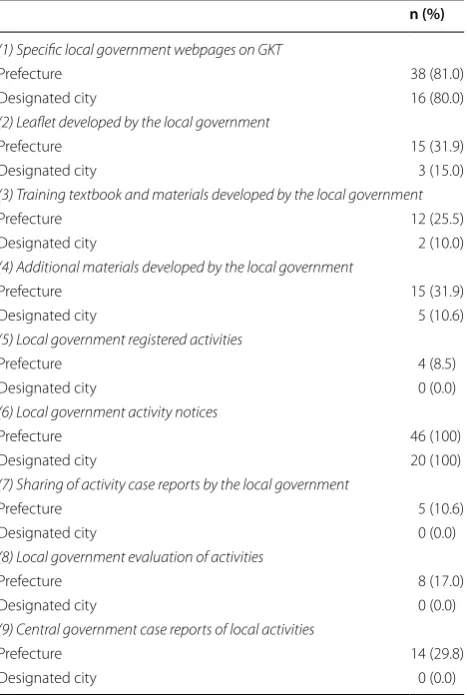
We were unable to find a comprehensive registered database or list of activities about GKT in Japan; there-fore, we used two methods to systematically review GKT implementation. First, we systematically searched public documents from central and local governments for any mention of GKT [9, 10]. This was because local authorities are responsible for planning and conducting GKT programs based on the national suicide prevention policy. These documents covered 47 prefectures and 20 major designated Japanese cities with high populations and other public resources. We also examined and evalu-ated websites and published documents linked to central and local government and other public institutions, such as non-governmental organizations (NGOs), for informa-tion about GKT [10, 11]. Most information was collected from public domain websites and Google searches. The search terms were “suicide”, “gatekeeper”, or the name of the local government. If necessary, we contacted institu-tions to obtain information. Information was accessed up to July 2018. We evaluated the information collected using eight criteria developed for this study: (1) specific webpages, (2) leaflets developed by local government, (3) training textbooks and materials developed by local government, (4) additional materials developed by local government, (5) local government-registered activities, (6) local government activity notices, (7) local govern-ment activity case reports, and (8) evaluations of these activities. We calculated the frequencies of the types of
information provided by prefectures and major des-ignated cities. Table 1 shows the characteristics of the information provided on GKT.
Second, we searched for articles on GKT up to July 2018 using three Japanese literature databases: Ichushi, a Japanese medical journal database (http://www.jamas .or.jp/); Cinii, a database of academic information about articles, books, journals, and dissertations in Japan (https ://ci.nii.ac.jp/); and Google Scholar in Japanese. We also searched PubMed in English. We considered articles that represented an index of the implementation of GKT pro-grams. The English keywords and formulae used in the search were: (suicid*) OR (self-harm*) OR (selfharm*) OR (self-poison*) OR (selfpoison*) OR (overdose*) OR (over-dose*) OR injur*) OR (selfinjur*) OR (self-mutilation*) OR (self(self-mutilation*) OR (auto(self-mutilation*) OR (auto-mutilation*) OR (self-destructive*) OR (selfde-structive*) AND (gatekeeper*) AND Japan. The Japanese keywords and formulae used were: (jisatsu) OR (jishou)
Table 1 Characteristics of information on GKT provided by local governments (prefecture n = 47, designated city n = 20)
n (%)
(1) Specific local government webpages on GKT
Prefecture 38 (81.0)
Designated city 16 (80.0)
(2) Leaflet developed by the local government
Prefecture 15 (31.9)
Designated city 3 (15.0)
(3) Training textbook and materials developed by the local government
Prefecture 12 (25.5)
Designated city 2 (10.0)
(4) Additional materials developed by the local government
Prefecture 15 (31.9)
Designated city 5 (10.6)
(5) Local government registered activities
Prefecture 4 (8.5)
Designated city 0 (0.0)
(6) Local government activity notices
Prefecture 46 (100)
Designated city 20 (100)
(7) Sharing of activity case reports by the local government
Prefecture 5 (10.6)
Designated city 0 (0.0)
(8) Local government evaluation of activities
Prefecture 8 (17.0)
Designated city 0 (0.0)
(9) Central government case reports of local activities
Prefecture 14 (29.8)
OR (jikohakai koudou) OR (jison) OR (kishinenryo) AND (gatekeeper). Eligible criteria were reports on any activities and evaluations of GKT programs for suicide
prevention in Japan that contained “gatekeeper” and related terms. All types of reports were eligible, including conference and review papers. We classified report char-acteristics and calculated frequencies and percentages of the information provided (Table 2, Figs. 1, 2). This review was reported in accordance with Prefered Reporting Items for Systematic Reviews and Meta-Analyses state-ment (Additional file 1).
Results
Central government information
The website search identified GKT webpages by Japan’s MHLW that provided a sample handbook, a sample text-book on training, and video lectures. The relevant central government webpages also provided the names of staff members who offered lectures on GKT. From these web-sites, we extracted 228 case series reports of local govern-ment activities related to suicide prevention from 2012 to 2015 and 31 eligible cases of GKT from 14 prefectures.
Local government information
Our review identified different types of information on GKT provided by local governments (Table 1). All local governments had information about GKT activities, and over 80% had specific webpages about GKT. Useful and
Table 2 Characteristics of publications on GKT (N = 122)
n (%)
Target population
Lay persons 14 (11.5)
Public sector workers 27 (22.1)
Private sector workers 3 (2.5)
Schools 16 (13.1)
Clinics and hospitals 6 (4.9)
Health centers 12 (9.8)
Pharmacies 24 (19.7)
Internet and SNS users 6 (4.9)
Other 14 (11.5)
Report type
Review 54 (44.2)
Original article 28 (23.0)
Conference paper 40 (32.8)
Publication language
Japanese 117 (95.9)
English 5 (4.1)
localized information was provided by 15 prefectures (31.9%) and three cities (15.0%), which included a sample of a leaflet developed by the local government. In addi-tion, 12 prefectures (25.5%) and two cities (10.0%) pro-vided a sample of a training textbook developed by the local government, and 15 prefectures (31.9%) and five cities (10.6%) provided additional materials developed by local government. Unfortunately, few local government activity and evaluation reports were available. We also found that more than 20 NGOs conducted GKT. These NGOs provided GKT programs and sometimes collabo-rated with local governments. Some local governments contributed financial resources to NGO GKT programs.
Published research
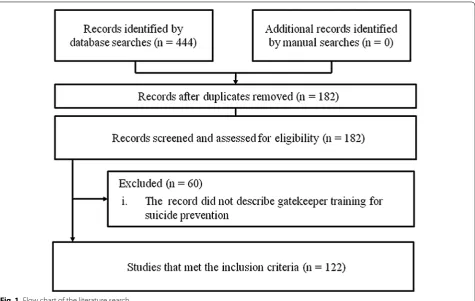
The literature search identified 424 studies: Ichushi n = 115, Cinii n = 51, Google Scholar (in Japanese) n = 245, and PubMed (in English) n = 13. There were 122 eligible studies after removing duplicates and excluding those that did not discuss GKT for suicide prevention (Fig. 1). The target populations of the reviewed studies varied (as indicated in the national suicide prevention policy): public sector workers, private sector workers, bar keepers, pharmacists, teachers, university officers, general physicians, nurses, mental health providers, and Internet and SNS users (Table 2). A variety of programs were conducted to train anyone who was able to recog-nize and refer someone at risk of suicide. Most programs had been developed based on MHLW information. The
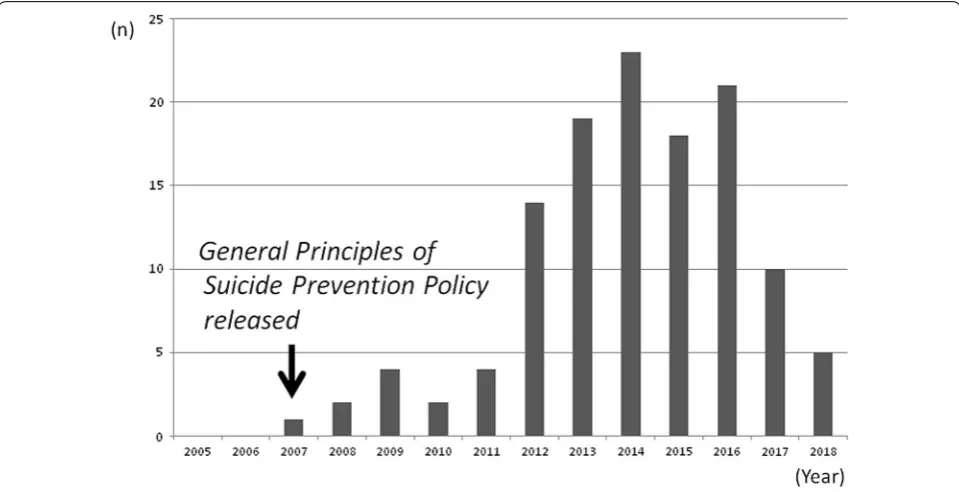
number of eligible studies increased between 2011 and 2014 (Fig. 2). Most were reports of activities rather than comparison studies that evaluated outcomes. Few studies used validated Japanese outcome measures, such as the Suicide Intervention Response Inventory [12], the Atti-tudes toward Suicide Scale [13], or the Gatekeeper Self-Efficacy Scale [14].
Discussion Findings
Our study demonstrated that the announcement of a national suicide prevention policy increased the imple-mentation of GKT programs in Japan. The policy announcement was strongly associated with the number of publications reporting GKT programs. This suggests that the policy announcement led to positive changes in GKT implementation; however, there was little evi-dence of the integration of knowledge and evaluation of programs.
Implementation status and related issues
There is substantial political support for GKT imple-mentation. In Japan, suicide prevention was promoted by a basic act for suicide prevention in 2006, a policy in 2007 outlining general principles of suicide prevention, and the establishment of a special fund for local govern-ment programs. These measures led to the developgovern-ment of a comprehensive and multi-sector approach to suicide
prevention. Their effectiveness is illustrated by the con-sistent decrease in the number of suicides since 2011 [5–8]. GKT is a core component of suicide prevention strategies and has been widely implemented in Japan.
Strong collaboration between the public sector and NGOs is an important part of the implementation of GKT programs, and some prefectures and cities closely collaborated with NGOs. Many suicide prevention activi-ties were conducted by NGOs, and information about some of these activities was not available on local gov-ernment websites. However, local govgov-ernments pro-vided some financial incentives and resources to support NGOs in providing GKT programs. In addition, some prefectures had a major designated city; in those prefec-tures, the suicide prevention role was allocated to a local authority. This is consistent with previous research that identified collaboration between NGOs and some local governments on suicide prevention in Japan [5].
Local governments provided limited information about evaluation and feedback of GKT programs. Only a small number of local government websites provided numbers of registered members, and few MHLW case report col-lections were provided on local government webpages. Only a few prefectures examined public awareness of GKT as part of questionnaire surveys on suicide preven-tion and mental health. Some research publicapreven-tions used pre–post designs for outcome evaluation. Although most studies reported positive effects of GKT, there was sub-stantial variation in outcomes and some studies used ad hoc self-developed measures.
Limitations
The study had some limitations. First, our review of web-sites and public documents may not have identified all GKT activities in Japan. Second, some sources may have used alternative terms for “gatekeeper” (which was one of our search terms) that were more user-friendly and attractive to the public. Additionally, some so-called GKT programs only consisted of a lecture on mental health or psychiatric information, such as a classroom lecture of 1–2 h. Other community interventions comprised mul-timodal programs, and it was difficult for us to isolate the GKT program (which might not have been categorized as such). Third, many programs were independently pro-vided by small local town council offices, making it diffi-cult to obtain a comprehensive overview of the provision of GKT programs. Fourth, some of the reports might have been misclassified, especially as some activities were multimodal or comprehensive community interventions. Fifth, we could not evaluate the outcomes of the imple-mented GKT programs. Our review of published scien-tific research found limited evidence of the short-term
effects of GKT and no clear confirmation or validation of common outcomes. More studies are needed to develop databases to share knowledge and outcomes and monitor the quality of GKT programs.
Conclusions
The announcement of a national suicide prevention pol-icy increased the implementation of GKT programs in Japan. However, there remains a need for integration of knowledge and evaluation of GKT programs.
Additional file
Additional file 1. PRISMA checklist.
Authors’ contributions
NY was responsible for the study concept and design. NY also performed the review, analysis and drafted the manuscript. YK and KE performed the review, contributed to writing the manuscript and provided critical review. MY contributed to writing the manuscript and provided critical review. All authors read and approved the final manuscript.
Acknowledgements
We thank for Ms. Hiroko Kobayashi and Ms. Hiromi Muramatsu for her helpful assistance. We also thank Edanz Group for editing a draft of this manuscript.
Competing interests
The authors declare that they have no competing interests.
Availability of data and materials
The data supporting this review can be found in the databases and journals mentioned throughout the manuscript text.
Consent for publication
Not applicable.
Ethics approval and consent to participate
Not applicable.
Funding
This review was supported by funding from the Grant‑in‑Aid for Scientific Research, Kaken(C) (16K08899), Japan.
Publisher’s Note
Springer Nature remains neutral with regard to jurisdictional claims in pub‑ lished maps and institutional affiliations.
Received: 10 September 2018 Accepted: 24 December 2018
References
1. Cabinet Office, Government of Japan. Jisatsu‑Taisaku Hakusyo. Tokyo: Cabinet Office, Government of Japan; 2018 (Japanese).
2. Mann JJ, Apter A, et al. Suicide prevention strategies: a systematic review. JAMA. 2005;294(16):2064–74.
•fast, convenient online submission •
thorough peer review by experienced researchers in your field • rapid publication on acceptance
• support for research data, including large and complex data types •
gold Open Access which fosters wider collaboration and increased citations maximum visibility for your research: over 100M website views per year •
At BMC, research is always in progress.
Learn more biomedcentral.com/submissions
Ready to submit your research? Choose BMC and benefit from:
4. Cross W, Matthieu MM, Lezine D, Knox KL. Does a brief suicide preven‑ tion gatekeeper training program enhance observed skills? Crisis. 2010;31(3):149–59.
5. Takeshima T, Yamauchi T, Inagaki M, Kodaka M, Matsumoto T, Kawano K, et al. Suicide prevention strategies in Japan: a 15‑year review (1998– 2013). J Public Health Policy. 2015;36(1):52–66.
6. Nakanishi M, Yamauchi T, Takeshima T. National strategy for suicide prevention in Japan: impact of a national fund on progress of developing systems for suicide prevention and implementing initiatives among local authorities. Psychiatry Clin Neurosci. 2015;69(1):55–64.
7. Nakanishi M, Endo K, Ando S. The Basic Act for Suicide Prevention: effects on longitudinal trend in deliberate self‑harm with reference to national suicide data for 1996–2014. Int J Environ Res Public Health. 2017;14(1):E104.
8. Nakanishi M, Endo K. National suicide prevention, local mental health resources, and suicide rates in Japan. Crisis. 2017;38(6):384–92. 9. The website lists of suicide prevention by local governments. https
://www.mhlw.go.jp/stf/seisa kunit suite /bunya /hukus hi_kaigo /shoug
aisha hukus hi/jisat su/local _gov_link.html. Accessed 15 July 2018
(Japanese).
10. The website of collection of suicide prevention activity by local govern‑ ments. https ://www.mhlw.go.jp/stf/seisa kunit suite /bunya /00001 34737
.html. Accessed 15 July 2018 (Japanese).
11. The website lists of NGO consultation activities for suicidal issues by e‑mail and SNS. https ://www.mhlw.go.jp/stf/seisa kunit suite /bunya
/00001 88968 .html. Accessed 15 July 2018 (Japanese).
12. Kawashima D, Kawano K. The validity of the Japanese version of the suicide intervention response inventory. J Men Health. 2013;26:67–74. 13. Kodaka M, Inagaki M, Poštuvan V, Yamada M. Exploration of factors associ‑
ated with social worker attitudes toward suicide. Int J Soc Psychiatry. 2013;59(5):452–9.