Small but tough: What can ecophysiology of croaking
gourami Trichopsis vittata (Cuvier, 1831) tell us about
invasiveness of non-native fishes in Florida?
Pamela J. Schofield1, Jessica M. Schulte1
1 US Geological Survey, 7920 NW 71st Street, Gainesville, FL 32653, USA
Corresponding author: Pamela J. Schofield ([email protected])
Academic editor: E.García-Berthou | Received 8 May 2015 | Accepted 27 September 2015 | Published 8 January 2016 Citation: Schofield PJ, Schulte JM (2016) Small but tough: What can ecophysiology of croaking gourami Trichopsis vittata (Cuvier, 1831) tell us about invasiveness of non-native fishes in Florida?. NeoBiota 28: 51–65. doi: 10.3897/ neobiota.28.5259
Abstract
Trichopsis vittata (Cuvier, 1831) is a small, freshwater gourami (Fam: Osphronemidae) native to southeast
Asia. It was first detected in Florida in the 1970s and seems to have persisted for decades in a small area. In this study, we documented T. vittata’s ecophysiological tolerances (salinity and low-temperature) and qualitatively compared them to published values for other sympatric non-native species that have success-fully invaded much of the Florida peninsula. Trichopsis vittata survived acute salinity shifts to 16 psu and was able to survive up to 20 psu when salinity was raised more slowly (5 psu per week). In a cold-tolerance experiment, temperature was lowered from 24 °C at 1 °C hr-1 until fish died. Mean temperature at death
(i.e., lower lethal limit) was 7.2 °C. Trichopsis vittata seems as tolerant or more tolerant than many other sympatric non-native fishes for the variables we examined. However, T. vittata is the only species that has not dispersed since its introduction. Species other than T. vittata have broadly invaded ranges, many of which include the entire lower third of the Florida peninsula. It is possible that tolerance to environmental parameters serves as a filter for establishment, wherein candidate species must possess the ability to survive abiotic extremes as a first step. However, a species’ ability to expand its geographic range may ultimately rely on a secondary set of criteria including biotic interactions and life-history variables.
Keywords
Trichopsis, ecophysiology, low-temperature tolerance, salinity tolerance, invasiveness
Introduction
Destructive (sometimes catastrophic) ecological impacts have been attributed to the introduction and establishment of non-native fishes across the globe (Canonico et al. 2005; Pelicice and Agostinho 2009; Vitule et al. 2009). However, the severity of nega-tive consequences of non-nanega-tive fish invasions varies greatly amongst taxa. Variation in the ability of species to establish and spread (i.e., ‘invasiveness’ sensu Rejmánek et al. 2002) has provided clues to underlying ecological attributes correlated with in-vasiveness (García-Berthou 2007). Understanding the characteristics associated with invasiveness is especially important in predicting potential establishment and spread of newly introduced species or those considered a threat for introduction. Most studies aimed at discriminating ecological features of invasive species quantify, collate and re-port life-history, ecophysiological, and other data for species that have become invasive (Kolar and Lodge 2002; García-Berthou 2007). Less abundant are data on species that were introduced and died out over time, or those that were introduced and established but did not become invasive. Data on those non-invasive species can be difficult to obtain when species were not intentionally introduced (e.g., via stocking). Population dynamics of fishes that were not introduced intentionally (e.g., aquaculture escapes) may not be closely monitored. Nonetheless, the fate of these populations is important as they may provide clues to allow researchers to be able to identify characteristics unique to invasive fishes from those shared between invasive and non-invasive species.
Methods
Specimens of T. vittata were collected with dip nets in March and April 2014, from Loxa-hatchee National Wildlife Refuge, Florida, USA. Fish were transported to the USGS laboratory in Gainesville, Florida within 48 hours of capture. Upon arrival, fish were treated with Pond Rid-Ich® Plus™ (Kordon LLC, Hayward, CA, USA) and erythromycin antibiotic. In the laboratory, fish were held indoors in 380 L fiberglass tanks with aerated well water (0.2 psu, hereafter termed “0” psu, 21-25 °C) and were fed daily with com-mercial flake food. Individuals were held in these conditions for about one month before experiments began. Before each experiment, fish were measured (± 0.1 cm total length [TL]), weighed (± 0.1 g) and placed into individual plastic bins (17 × 14 × 11 cm) filled with 8 cm of well water. Bins were equipped with small plastic plants, lids to prevent escape and were blinded on three sides to prevent fish from seeing each other. Because gourami are obligate air breathers, no air was provided except for the low-temperature tolerance experiment, where an airstone was placed in each bin to aid in mixing of the water for even temperature distribution throughout the bin. For both salinity experi-ments, fish were kept in individual bins inside a temperature-controlled room set at 26 C for the duration of the experiments. Salt water was pre-mixed to various salinities using well water and aquarium salt (Crystal Sea® Marinemix, Marine Enterprises International, Baltimore, MD, USA) before water changes using YSI Professional Plus Multiparameter meter (YSI Inc., Yellow Springs, Ohio, USA; ± 0.05 psu). For all experiments, when death was confirmed, water temperature was measured using a hand-held digital ther-mometer (EXTECH® waterproof therther-mometer model #39240, EXTECH Instruments®, Nashua, NH, USA). Individual fish were used only once in one experiment (low-temper-ature tolerance, chronic salinity-tolerance or acute salinity-tolerance).
Low temperature tolerance
temperature at the rate of 1 °C per hour. Temperature of each bin was measured with a hand-held digital thermometer every 20 minutes. All fish were checked for LOE and death every 20 minutes; time and temperature were recorded when LOE and death were confirmed.
Chronic salinity tolerance
An initial pilot study was conducted on n = 20 individuals to establish a general range of salinity tolerance and determine what experimental salinity levels would be used for the experiment. For the chronic salinity tolerance experiment, fish were allocated ran-domly to one of five treatments (0 [control] = 8 replicates, 20 psu = 11 replicates, 22.5 psu = 12 replicates, 25 psu = 12 replicates, 27.5 psu = 13 replicates). Fish were held ini-tially for 48 hours in well water after which salinities were gradually increased at a rate of 2.5 psu every 2-3 days (5 psu per week) until fish reached the predetermined target salinity. Once the last experimental fish reached its target salinity, all fish remained in their respective salinities for an additional 30 days or until death. Fish reached their target salinities in a staggered (time-wise) fashion; however, each time the salinities were changed in one or more of the treatments, water changes were performed for all of the fish (including controls) to maintain similarity of handling across treatments. Fish were fed twice per week with a mixture of flake food and pellets on days before water changes. Fish were checked 1-2 times per day, seven days per week for death.
Acute salinity tolerance
To determine how T. vittata responded to acute salinity changes, fish were transferred directly from well water (0 psu) into various salinity treatments: 0 [control] = 8 repli-cates, 14, 16, 18, 20 psu = 10 replicates each. Similar to the chronic-salinity tolerance experiment, values for salinity treatments were derived from a pilot study. After being transferred to their respective treatments, fish were left in bins for seven days or until death. Fish were checked for mortalities every hour for the first six hours and then once per day for the remainder of the experiment.
Analyses
acclima-tion temperature, experimental equipment and rate of temperature decrease used here for T. vittata (Schofield et al. 2010; Schofield and Huge 2011; Schofield unpub. data). We only compared data for individuals tested in freshwater and acclimated to 24 °C. Mean temperature at death (lower lethal limit) for these species was compared with one-way analysis of variance (ANOVA), and Dunnett’s T3 post-hoc test was used to discriminate homogeneous subsets. Levene’s test was used to test for heteroscedasticity.
One-way ANOVA was used to compare fish mass among salinity treatments, and Levene’s test was used to check for heteroscedasticity. Life expectancy was estimated with the Kaplan-Meier product-limit estimator (Kaplan and Meier 1958) and the log-rank test was used to compare survivorship curves (Savage 1956; Cox and Oakes 1984). For the acute-salinity challenge, all treatments began at the same time (time = 0). However, for the chronic-salinity experiment, fish reached their target salinities sequentially (i.e., staggered over time). Thus, for the chronic-salinity experiment the day the fish reached their target salinity was designated as time = 0 for that treatment. We set our alpha level for statistical significance at 0.05. All data were analysed using SPSS version 13.0.
Results
Environmental variables measured while collecting T. vittata on several occasions (in-cluding fish used in this experiment) are provided in Table 1. Trichopsis vittata used in the cold-tolerance study averaged 0.73 g (+ 0.67 standard deviation [SD]; range 0.20–3.00 g; n = 25), and 3.7 cm TL (+ 0.99 SD; range 2.5–5.9 cm). Fish lost equilib-rium at 10.2 °C (+ 0.68 SD; range 8.2–11.2 °C) and died at 7.2 °C (+ 0.68 SD; range 6.4–8.8 °C). Trichopsis vittata was the second-most cold-tolerant species tested (after H. littorale), and exhibited greater tolerance to low temperatures than all cichlids (one-way ANOVA F = 49.46, df = 4, P <0.001, Fig. 2).
For the chronic salinity-tolerance experiment, fish mass averaged 0.93 g (+ 0.28 SD; range 0.30–1.5 g; n = 56) and mean TL was 4.2 cm (+ 0.55 SD; range 3.0–5.1 cm; n = 56). Fish mass did not vary significantly by treatment (one-way ANOVA F = 0.11, df = 4, P = 0.58). At the end of the experiment, survival was 100% at the control salinity (0 psu), 63% at 20 psu, 25% at 22.5 psu, and 8% at 25 psu (Fig. 3a). All fish at 27.5 psu died by the 24th day after reaching their 27.5 psu salinity goal. Because the majority of the data for the 20 psu treatment was censored (i.e., the majority of fish in this treatment survived the challenge), it was not possible to compute a survival es-timate. Mean (95% Confidence Interval [CI]) survival estimates for other treatments are: 18 days (11–25) at 22.5 psu, 10 days (4–16) at 25 psu, 7 days (3–11) at 27.5 psu. All treatments were significantly different from the control except 20 psu (although the P-value was close to significance; log-rank statistic = 3.41; P = 0.065)
Table 1. Environmental variables measured while collecting Trichopsis vittata on several occasions from Loxahatchee National Wildlife Refuge. Fish for experiments in this report were collected in March and April 2014. N/A = Not Available.
Collection date Temperature (°C) Salinity (psu) Dissolved Oxygen (mg L-1) pH
7 March 2014 20.6 0.07 0.87 N/A
23 April 2014 25.1 0.21 0.74 7.18
24 April 2014 21.8 0.22 0.67 7.12
31 March 2015 21.2 0.17 3.14 7.27
Figure 2. Mean temperature (+ 2 SE) at which fishes died in cold-temperature tolerance experiments (i.e., lower lethal limit). Letters denote significant differences (one-way ANOVA with Dunnett’s T3 post-hoc test; see text for details). References for data sources are given in Table 2.
Figure 3. Salinity tolerance of T. vittata. Results from a chronic and b acute salinity-tolerance trials.
b
Discussion
Trichopsis vittata has been known from Florida since the 1970s, when an established pop-ulation was discovered within 10 km of its current range (Courtenay et al. 1984, 1986; Schofield and Pecora 2013). Its introduction source is unknown; however, at the time of discovery it was speculated that it had escaped from nearby aquarium fish farms (Cour-tenay et al. 1984, 1986). Over time, the species was thought to have been extirpated (Shafland 1996; Shafland et al. 2008) until its recent rediscovery (Schofield and Pecora 2013). No fish-monitoring programmes cover urban areas in this region of Florida, so it is unclear how long the fish was established before its recent collection at Loxahatchee NWR. Furthermore, it is unclear whether the species had died out and was subsequently re-introduced or whether this is a remnant population. Nevertheless, its ability to persist in this small range for many decades makes it an interesting candidate for study. The purpose of this investigation was to document ecophysiological attributes of the species and qualitatively compare them to sympatric species, to see if perhaps reduced ecophysi-ological tolerance might be related to the lack of geographic expansion.
Tab le 2. E cophysiological traits for Trichopsis vittata and sev eral species of sympatric non-nativ e fishes. For hypo xia tolerance, ‘ extr emely tolerant ’ = can sur viv e in
water with no o
xygen (<0.02 mg L
-1) for pr
olonged periods, as long as sur
face access is allo
w ed. Species H ypo xia tolerance Chr
onic salinity tolerance
A
cute salinity tolerance
Cold tolerance (°C)
M
ax body siz
e in FL (cm
TL) H oploster num littor ale air-br eather unkno
wn for adults
7 psu (lar
vae M
ol 1994)
5.7 (Schofield and H
uge 2011) 10
(G
estring et al. 2009)
26.2 (G
estring et al. 2009)
Pter ygoplichthys spp . air-br eather unkno wn
10 psu (Capps et al. 2011)
9-11 for
P. multir
adiatus
; 4-6 for
P.
disjunctivus
(G
estring et al. 2010)
50.4 (G
estring et al. 2010)
Clarias batr achus air-br eather unkno wn U nkno wn 9.8 (S
hafland and P
estrak 1982) 52.9 (S hafland 1996) Trichopsis vittata air-br eather
20 psu (this study)
16 psu (this study)
7.2 (this study)
6.5 (Schofield and P
ecora 2013) Astr onotus ocellatus extr emely tolerant (Almeida-V
al et al. 2000)
14 psu (G utierr e et al. in pr ess) 16 psu (G utierr e et al. in pr ess) 12.9 (S
hafland and P
estrak 1982) 34.8 (S hafland 1996) Cichlasoma bimaculatum unkno wn unkno wn unkno wn
8.6 (Schofield and H
uge 2011) 8.9
(S
hafland and P
estrak 1982)
18.6 (S
hafland 1996)
Cichlasoma urophthalmus
extr
emely tolerant
(Schofield et al. 2009)
> 37 psu
(S
tauffer and Boltz 1994)
unkno
wn
8.7 (Schofield unpub
. data) 14-15
(S
tauffer and Boltz 1994)
28.8 (I
delberger et al. 2011)
H emichr omis letour neuxi extr emely tolerant
(Schofield et al. 2007)
50 psu
(Langston et al. 2010
)
20 psu
(Langston et al. 2010)
8.1 (Schofield unpub
. data) 9.5
(S
hafland and P
estrak 1982) 11.2 (S hafland 1996) O reochr omis aur eus unkno wn 52 psu (S ur esh and Lin 1992) unkno wn 6.2 (S
hafland and P
estrak 1982)
54.3 (S
hafland 1996)
Rocio octofasciata
extr
emely tolerant (Obor
do and Chapman 1997) unkno wn unkno wn 8.0 (S
hafland and P
estrak 1982)
13.7 (
a filter for establishment, wherein candidate species must possess the ability to survive abiotic extremes as a first step (Peterson et al. 2004). Once fish have passed through this step, invasiveness (at least in terms of geographic spread) may ultimately rely on a secondary set of criteria including biotic interactions and life-history variables.
The intriguing combination of high abiotic tolerance and low invasiveness in T. vit-tata may support the biotic-abiotic constraining hypothesis (Quist et al. 2003), wherein abiotic environmental variables structure population levels until overridden by biotic ones (e.g., predation, competition). For example, Quist et al. (2003) showed that varia-tion in walleye Stizostedion vitreum (now Sander vitreus [Mitchill, 1818]) populavaria-tions in Kansas reservoirs could be explained by environmental variables until a critical thresh-old for biotic interactions was reached. In that case, once the density of a predator (Pomoxis annularis Rafinesque, 1818) was exceeded, then biotic interactions overrode abiotic influences and S. vitreum population dynamics were related to P. annularis den-sity. Similarly, Weber and Brown (2011) showed that variation in density of native Figure 4. Graphic representation of relative ecophysiological ‘toughness’ for T. vittata and sympatric non-native fishes. References for cold and low-oxygen tolerance are given in Table 2. Two values are presented for cold tolerance of C. urophthalmus as two separate reports provided dissimilar data (Table 2). Two values are given for Pterygoplichthys spp. corresponding to two different species (Table 2). “O. aureus” = Oreochromis aureus; “Pterygo” = Pterygoplichthys spp.; “Hoplo” = Hoplosternum littorale; “Clarias” = Clarias
fish populations were related to environmental variables until a threshold density of Cyprinus carpio Linnaeus, 1758 was reached and then biotic interactions overrode abi-otic ones. As for T. vittata, future research on its co-occurrence with competitors and predators may shed light on the relative influences of abiotic versus biotic constraints.
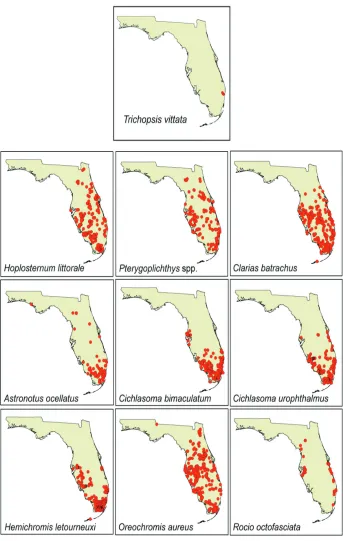
There are many other factors that could explain the lack of geographic range ex-pansion for T. vittata. Some of the most obvious candidates include body size, diet and their interaction. Trichopsis vittata is smaller than other sympatric non-native fishes and occupies a relatively low position on the predation spectrum (i.e., primarily con-sumes small invertebrates; Rainboth 1996). This combination of attributes separates T. vittata from the other non-native fishes that are either: 1) large-bodied species that consume benthic algae and detritus (e.g., Pterygoplichthys spp., O. aureus) or 2) large- to medium-sized fish predators (cichlids, C. batrachus). One species that does not fit this pattern is H. letourneuxi, which consumes both invertebrates and fish and does not reach a large body size (Table 2), yet is extremely invasive (Kline et al. 2013; Fig. 1). Protection from bony dermal plates may confer an additional advantage to catfishes (H. littorale, Pterygoplichthys spp.) and bolster their ability to spread geographically. Other factors that could affect invasiveness include biotic resistance (e.g., Thompson et al. 2012), specific requirements for egg/larval development or nesting, multiple in-troductions (Collins et al. 2002), predation susceptibility (e.g., Rehage et al. 2009) and propagule pressure (Colautti et al. 2006). Application of modern modelling tech-niques may allow researchers to identify which variables are most important for an invader’s success (and spread) and the critical thresholds for those variables (e.g. Kolar and Lodge 2002).
Acknowledgments
Support for this project was provided by the US Geological Survey, Invasive Species Programme and the Southeast Ecological Science Center. We thank D. Pecora, S. M. Gutierre and M. Brown for their assistance with various aspects of fish and data collec-tion. A. Benson kindly created the maps. S. Ruessler and W. Hyde provided generous assistance with laboratory facilities. M. Hunter and W. Loftus provided comments on an earlier version of the manuscript. Fish were collected under Special Use Permit B14-005 from ARM Loxahatchee Wildlife Refuge. All procedures were in compliance with Institutional Animal Care and Use Committee regulations (approved protocol USGS/ SESC 2014-10). Any use of trade, product or firm names is for descriptive purposes only and does not imply endorsement by the US Government.
References
Cichlidae): contribution of tissue enzyme levels. Comparative Biochemistry and Physiol-ogy Part B: Biochemistry and Molecular BiolPhysiol-ogy 125: 219–226. doi: 10.1016/S0305-0491(99)00172-8
Canonico GC, Arthington A, McCrary JK, Thieme ML (2005) The effects of introduced tila-pias on native biodiversity. Aquatic Conservation: Marine and Freshwater Ecosystems 15: 463–483. doi: 10.1002/aqc.699
Capps KA, Nico LG, Mendoza-Carranza M, Arévlo-Frías W, Ropicki AJ, Heilpern SA, Rodiles-Hernández R (2011) Salinity tolerance of non-native suckermouth armoured cat-fish (Loricariidae: Pterygoplichthys) in south-eastern Mexico: implications for invasion and dispersal. Aquatic Conservation: Marine and Freshwater Ecosystems 21: 528–540. doi: 10.1002/aqc.1210
Colautti RI, Grigorovich IA, MacIsaac HJ (2006) Propagule pressure: a null model for biologi-cal invasions. Biologibiologi-cal Invasions 8: 1023–1037. doi: 10.1007/s10530-005-3735-y Collins TM, Trexler JC, Nico LG, Rawlings TA (2002) Genetic diversity in a morphologically
conservative invasive taxon: multiple introductions of swamp eels to the southeastern Unit-ed States. Conservation Biology 16: 1024–1035. doi: 10.1046/j.1523-1739.2002.01182.x Courtenay WR Jr, Hensley DA, Taylor JN, McCann JA (1984) Distribution of exotic fishes
in the continental United States. In: Courtenay WR Jr, Stauffer JR Jr (Eds) Distribution, Biology and Management of Exotic Fishes. Johns Hopkins University Press, Baltimore, MD, 41–77.
Courtenay WR Jr, Hensley DA, Taylor JN, McCann JA (1986) Distribution of exotic fishes in North America. In: Hocutt CH, Wiley EO (Ed.) The Zoogeography of North American Freshwater Fishes. John Wiley and Sons, New York, NY, 675–698.
Cox DR, Oakes D (1984) Analysis of survival data. Monographs on statistics and applied prob-ability. Chapman and Hall, New York, NY.
García-Berthou E (2007) The characteristics of invasive fishes: what has been learned so far? Jour-nal of Fish Biology 71 (Supplement D): 33–55. doi: 10.1111/j.1095-8649.2007.01668.x Gestring KB, Shafland PL, Stanford MS, Eisenhauer RL (2009) Status and selected life his-tory attributes of the illegally introduced Brown Hoplo (Hoplosternum littorale) in Florida. Florida Scientist 72: 37–47.
Gestring KB, Shafland PL, Stanford MS (2010) Status of the exotic Orinoco sailfin catfish (Pterygoplichthys multiradiatus) in Florida. Florida Scientist 73: 122–137.
Gutierre SMM, Schofield PJ, Prodocimo V (in press) Salinity and temperature tolerance of an emergent alien species, the Amazon fish Astronotus ocellatus. Hydrobiologia.
Idelberger CF, Stafford CJ, Erickson SE (2011) Distribution and abundance of introduced fishes in Florida’s Charlotte Harbor estuary. Gulf and Caribbean Research 23: 13–22. Jennings DP (1986) Characterization of a localized Jack Dempsey, Cichlasoma octofasciatum,
population in Alachua County, Florida. Florida Scientist 49: 255–259.
Kolar CS, Lodge DM (2002) Ecological predictions and risk assessment for alien fishes in North America. Science 298: 1233–1236. doi: 10.1126/science.1075753
Langston JN, Schofield PJ, Hill JE, Loftus WF (2010) Salinity tolerance of the African jewelfish
Hemichromis letourneuxi, a non-native cichlid in south Florida (USA). Copeia, 475–480.
doi: 10.1643/CP-09-069
Mol JH (1994) Effects of salinity on distribution, growth and survival of three Neotropical armoured catfishes (Siluriformes—Callichthyidae). Journal of Fish Biology 45: 763–776. Obordo CO, Chapman LJ (1997) Respiratory strategies of a non-native Florida cichlid,
Cichla-soma octofasciatum. Florida Scientist 60: 40–52.
Pelicice FM, Agostinho AA (2009) Fish fauna destruction after the introduction of a non-native predator (Cichla kelberi) in a Neotropical reservoir. Biological Invasions 11: 1789–1801. doi: 10.1007/s10530-008-9358-3
Peterson MS, Comyns BH, Rakocinski CF (2004) Defining the fundamental physiological niche of young estuarine fishes and its relationship to understanding distribution, vital metrics, and optimal nursery conditions. Environmental Biology of Fishes 71: 143–149. doi: 10.1007/s10641-004-0302-1
Quist MC, Guy CS, Stephen JL (2003) Recruitment dynamics of walleyes (Stizostedion vitreum) in Kansas reservoirs: generalities with natural systems and effects of a centrarchid predator. Canadian Journal of Fisheries and Aquatic Sciences 60: 830–839. doi: 10.1139/f03-067 Rainboth WJ (1996) FAO Species Identification Field Guide for Fishery Purposes: Fishes of the
Cambodian Mekong. Food and Agriculture Organisation of the United Nations, Rome. Rehage JS, Dunlop KL, Loftus WL (2009) Antipredator responses by native mosquitofish to
non-native cichlids: an examination of the role of preynaiveté. Ethology 115: 1046–105. doi: 10.1111/j.1439-0310.2009.01694.x
Rejmánek M, Richardson DM, Barbour MG, Crawley MJ, Hrusa GF, Moyle PB, Randall JM, Simberloff D, Williamson M (2002) Biological invasions: politics and the discontinuity of ecological terminology. Bulletin of the Ecological Society of America 83: 131–133. Savage IR (1956) Contributions to the theory of rank order statistics – the two-sample case.
Annals of Mathematical Statistics 27: 590–615. doi: 10.1214/aoms/1177728170 Schofield PJ, Huge DH (2011) Low-temperature tolerance of two non-native fishes
(Hoplos-ternum littorale [Hancock 1828], Cichlasoma bimaculatum [Linnaeus 1758]) established in
Florida. Florida Scientist 74: 73–83.
Schofield PJ, Loftus WF (2014) Non-native fishes in Florida freshwaters: A literature review and synthesis. Reviews in Fish Biology and Fisheries. doi: 10.1007/s11160-014-9373-7 Schofield PJ, Pecora DH (2013) Croaking gourami, Trichopsis vittata (Cuvier, 1831), in Florida,
USA. BioInvasions Records 2: 247–251. doi: 10.3391/bir.2013.2.3.12
Schofield PJ, Loftus WF, Brown ME (2007) Hypoxia tolerance of two centrarchid sunfishes and an introduced cichlid in karstic Everglades wetlands of southern Florida, U.S.A. Jour-nal of Fish Biology 71 (Sup D): 87–99. doi: 10.1111/j.1095-8649.2007.01686.x
Schofield PJ, Loftus WF, Kobza RM, Cook MI, Slone DH (2010) Tolerance of nonindigenous cichlid fishes (Cichlasoma urophthalmus, Hemichromis letourneuxi) to low temperature: laboratory and field experiments in south Florida. Biological Invasions 12: 2441–2457. doi: 10.1007/s10530-009-9654-6
Shafland PL (1996) Exotic fishes of Florida – 1994. Reviews in Fisheries Science 4: 101–122. doi: 10.1080/10641269609388581
Shafland PL, Pestrak JM (1982) Lower lethal temperatures for fourteen non-native fishes in Florida. Environmental Biology of Fishes 7: 149–156. doi: 10.1007/BF00001785 Shafland PL, Gestring KB, Stanford MS (2008) Florida’s exotic freshwater fishes – 2007. Florida
Scientist 71: 220–245.
Stauffer JR Jr, Boltz SE (1994) Effect of salinity on the temperature preference and tolerance of age-0 Mayan cichlids. Transactions of the American Fisheries Society 123: 101–107. doi: 10.1577/1548-8659(1994)123<0101:EOSOTT>2.3.CO;2
Suresh AV, Lin CK (1992) Tilapia culture in saline waters: a review. Aquaculture 106: 201–226. doi: 10.1016/0044-8486(92)90253-H
Thompson KA, Hill JE, Nico LG (2012) Eastern mosquitofish resists invasion by nonindig-enous poeciliids through agonistic behaviors. Biological Invasions 14: 1515–1529. doi: 10.1007/s10530-012-0176-2
Vitule JRS, Freire CA, Simberloff D (2009) Introduction of non-native freshwater fish can certainly be bad. Fish and Fisheries 10: 98–108. doi: 10.1111/j.1467-2979.2008.00312.x Weber MJ, Brown ML (2011) Relationships among invasive common carp, native fishes and
physicochemical characteristics in upper Midwest (USA) lakes. Ecology of Freshwater Fish 20: 270–278. doi: 10.1111/j.1600-0633.2011.00493.x