R E S E A R C H
Open Access
Diplomatic advantages and threats in global
health program selection, design, delivery and
implementation: development and application
of the Kevany Riposte
Sebastian Kevany
Abstract
Background:Global health programs, as supported by organizations such as the Global Fund to Fight AIDS, Tuberculosis and Malaria and the President’s Emergency Plan for AIDS Relief (PEPFAR), stand to make significant contributions to international medical outcomes. Traditional systems of monitoring and evaluation, however, fail to capture downstream, indirect, or collateral advantages (and threats) of intervention selection, design, and
implementation from broader donor perspectives, including those of the diplomatic and foreign policy communities, which these programs also generate. This paper describes the development a newmétierunder which assessment systems designed to consider the diplomatic value of global health initiatives are described and applied based on previously-identified“Top Ten”criteria.
Methods:The“Kevany Riposte”and the“K-Score”were conceptualized based on a retrospective and collective assessment of the author’s participation in the design, implementation and delivery of a range of global health interventions related to the HIV/AIDS epidemic. Responses and associated scores reframe intervention worth or value in terms of global health diplomacy criteria such as“adaptability”,“interdependence”,“training,”and
“neutrality”. Response options ranged from“highly advantageous”to“significant potential threat”.
Results:Global health initiatives under review were found to generate significant advantages from the diplomatic perspective. These included (1) intervention visibility and associations with donor altruism and prestige, (2) development of international non-health collaborations and partnerships, (3) adaptability and responsiveness of service delivery to local needs, and (4) advancement of broader strategic goals of the international community. Corresponding threats included (1) an absence of formal training of project staff on broader political and international relations roles and responsibilities, (2) challenges to recipient cultural and religious practices, (3) intervention-related environmental concerns, and (4) a lack ofprima facieconsideration of intervention diplomatic and foreign policy consequences.
Conclusions:Global health interventions stand to generate significant diplomatic advantages for donor and recipient countries and organizations when appropriately selected, designed, targeted, and delivered. Conversely, in the absence of the application of standards such as those developed under the Kevany Riposte, threats to diplomacy and
international relations may occur. With the application of related systems to other global health programmes and settings, comparative results on the relative worth of alternate approaches from the diplomatic perspective may be generated to better inform political, strategic, and global health policy and programmatic decisions.
Keywords:Global health diplomacy, foreign policy, PEPFAR, HIV/AIDS, the Global Fund to Fight AIDS, Tuberculosis and Malaria,‘smart power’
Correspondence:[email protected]
University of California, San Francisco, 550 16th Street, 3rd Floor, San Francisco, California 94158, USA
Theoretical & philosophical basis Global health, diplomacy, and foreign policy
Foreign policy trends in both the European Union and the United States are increasingly aligned with “smart power” [1] approaches, in recognition of the “myriad newer uses” of global health and development initiatives [2]. The European Union advocates strategic use of for-eign assistance, combined with diplomacy and arbitra-tion, to pursue foreign policy goals under the Common Foreign & Security Policy [3,4] via a specific focus on global health [5]. Similarly, in the United States, increas-ing levels of alignment between the State Department, the United States Agency for International Development, the Department of Defense and the Department of Health and Human Services is indicative of their increasingly interchangeable roles [6]. In the United Kingdom, foreign assistance now forms an integral component of foreign af-fairs [7] under the stated goal of “policy coherence” [8]. Conversely but convergently, both the United Nations and international military forces have displayed an increased propensity to combine conflict resolution and humanitar-ian activities [9], whilst the World Bank has recommended that international development focus on security issues beyond primary programmatic goals [10]. These trends are of increasing importance to the design, delivery and evaluation of global health intervention programs under initiatives such as the United States’ President’s Emer-gency Plan for AIDS Relief (PEPFAR) [11] particularly in the context of the recent creation of the Office of Global Health Diplomacy [12] and related programs supported by the Global Fund to Fight AIDS, Tuberculosis and Malaria (“The Global Fund”) [13].
Aligning & sensitizing global health programs to international affairs
Unlike the medically-dominated ethos of global health, diplomatic and foreign policy perspectives are both multi-level and multicausal, involving the synthesis of informa-tion from a variety of social science knowledge systems [14]. Failure to consider foreign policy and international relations principles and objectives when designing, select-ing and implementselect-ing global health programs such as PEPFAR and the Global Fund’s related HIV/AIDS initia-tives may, therefore, create a“tense and confusing duality” [15]. For example, while global health programs that chal-lenge cultural, religious, ideological, social and behavioral norms are often compelling in terms of their capacity to achieve primary health outcomes, they may also create unquantified downstream benefits, or constitute potential liabilities, from the diplomatic and foreign policy perspec-tives. Although it is critically important for such initiatives to attempt to optimize outcomes such as quality-adjusted life years (QALYs), their design and delivery needs to be carefully evaluated in order to ensure that (1) these goals
are not being achieved at the cost of foreign policy, diplo-matic, international relations, or broader global strategic objectives, and (2) their potential to achieve such collateral objectives is optimized [16].
Ranking global health programs from the foreign policy and diplomatic perspectives
The rise of a utilitarian approach to global health evalu-ation, as represented by tools such as cost-effectiveness analysis, has resulted in the predominant use of narrow, single-metric measures as exclusive barometers of global health program worth or value [17]. No international ini-tiative, however, operates in isolation or without epistemic consequences [18]. In a variation on the McNamara Fallacy [19], such programs produce a range of down-stream, collateral or indirect outcomes that are not ad-equately quantified – and, therefore, considered to be non-existent. In the 21st century, both foreign policy-makers and global health professionals require an innova-tivemétierthat reflects these broader considerations, both (1) in order to portray global health expenditures as in-vestments rather than costs, and (2) to“speak a language that people with power really understand”[20]; foreign as-sistance priorities and associated resource allocation deci-sions should, where possible, include consideration of the universal and fundamental aspirations of global political, security, and strategic affairs [21]. The recent emergence of the smart power paradigm [22] has, at least in part, been a product of this increased integration between for-eign policy and global health initiatives [23], elevating glo-bal health to the status of a powerful diplomatic and foreign policy tool, rather than merely a humanitarian ef-fort. There has been, to date, a“lack of ability”to demon-strate the effectiveness of foreign assistance programs in this context [24]. This paper outlines the development and application of just such a“diplomatic assessment” ap-proach for global health programmes, adopting a term from the art of fencing, and eponymously entitled the Kevany Riposte, due to it’s conceptual basis as an innova-tive and interdisciplinary approach that challenges“siloed” [13] or “stovepiped” [25] perspectives. These efforts are based on the author’s prior identification of “Top Ten” lists for diplomatic effectiveness [25], and as applied to a retrospective and collective assessment of PEPFAR and Global Fund-supported HIV/AIDS initiatives in South Africa, Sudan, Kenya, South Sudan, Zimbabwe, Tanzania, Iraq, Afghanistan, Egypt, and elsewhere, in order, for the first time, to assess intervention program threats and ad-vantages from this broader perspective.
Methods
Defining“HIV/AIDS initiatives”
both the Global Fund and PEPFAR’s HIV/AIDS response paradigms [26,27]. Such programs provide, amongst other features, technical assistance to strengthen prevention programming; community support mechanisms; referral systems; and other behavioral and community-based health promotion and educational initiatives [28]. Within this broader operational context, HIV Counseling & Test-ing (HCT) based around “wellness days”, “community mobilization”, and “post-test support services”, amongst other forms of service delivery, are provided in commu-nity venues in order to increase, for example, numbers of persons tested for HIV/AIDS provided with personalized support and guidance regarding behavioral risk-reduction, as well as raising community awareness and engagement. In the health systems strengthening context, related inter-ventions also contribute to capacity building (e.g. the provision of district-level trainers to implement “ Preven-tion with Positives” programs) [29]. For the purposes of this paper, “HIV/AIDS interventions”, “HIV/AIDS pro-grammes”, and “HIV/AIDS initiatives” therefore refer to such community-based, multi-level HIV/AIDS responses, including combined diagnostic, prevention, behavioural, and health system strengthening programs under the auspices of Project Accept [30], the Global Fund, and PEPFAR South Africa [31], whilst excluding therapeutic programs such as antiretroviral treatment and surgical interventions such as voluntary adult male circumcision.
Kevany Riposte and K-Score development
Systems by which to quantify the latent and potential glo-bal health diplomacy and foreign policy value of gloglo-bal health programmes were developed based on previously-identified criteria for“global health diplomacy”and“global health and foreign policy”appropriateness and effective-ness in global health program design, delivery and evaluation [32]. Originally presented in the form of two “Top Ten” tables – representative of those features or characteristics of global health programs identified as effective in the foreign policy or diplomatic contexts, respectively, in the related literature–classifications were adapted to Excel-based questionnaire and scoring formats (see Additional file 1 Annex 1: Diplomatic Assessment Questionnaire and Scoring Tool). Development of the Kevany Riposte and K-Score also drew on the author’s prior contributions to the development and utilization of related designs, in particular the Global Fund’s Routine Service Quality Assessment (RSQA) and On-Site Data Verification (OSDV) tools [33]. The results presented in this paper relate specifically to “diplomatic”, rather than “foreign policy”, considerations.
Implementation & utilization
Diplomatic assessments of HIV/AIDS initiatives were based on the retrospective and collective assessment of
the author’s field deployments for diplomatic monitoring & evaluation, cost-effectiveness, and quality assurance purposes on behalf of the Global Fund, the United Nations Development Program, PEPFAR implementing organizations (e.g. the International Training and Educa-tion Center for Health), the University of California, San Francisco, and the Project Accept community-based vol-untary counseling and testing intervention (as imple-mented under the United States’ National Institutes for Mental Health) between 2007 and 2014. Related on-site engagements included field missions to service delivery points (e.g. mobile HIV/AIDS counseling and testing cen-ters in the Northwest Province of South Africa for PEP-FAR and in Sudan and South Sudan for the Global Fund) and engagements and liaisons with key governmental and non-governmental organizations and individuals (e.g. the South African, Sudanese and South Sudanese Ministries of Health on behalf of the Global Fund). Field-level and on-site observations conducted to inform assessment re-sponses were undertaken, where possible, with the assist-ance of an interview guide (see Additional file 2 Annex 2: Interview and Assessment Guide for Diplomatic and For-eign Policy Assessments) and were complemented, where necessary, by follow-up questions via e-mail exchanges and teleconferences with key managerial and field staff. Further on-site and desk research (e.g. review of interven-tion protocols and standard operating procedures) was also conducted to complete remaining questionnaire re-sponses, as necessary.
Defining assessment classifications & sub-classifications
The primary classifications employed in the Kevany Riposte and K-Score were based directly on previously-identified“Top Ten”criteria keywords (e.g.“ communi-cations”; “adaptability”), as described above. Related sub-classifications were based on interpretations and descriptions of each primary classification in the literature (e.g. the “adaptability” classification was associated with themes of “responsiveness to health needs”, “ responsive-ness to non-health needs”,“recipient-led program design”, and “recipient-led resource allocation”). For purposes of both detail and consistency, four such sub-classifications were developed for each classification, resulting in 40 as-sessment questions. In turn, these sub-classifications were expanded and articulated in the form of specific thematic questions to be addressed to relevant project staff, includ-ing program managers, field officers, and other project personnel, designed to be relevant to project activities at the individual, intervention and policy levels (see below).
Policy, intervention and individual level assessment dimensions
the above assessment procedures included implicit consid-eration of three main evaluation dimensions: (1) policy level (e.g. whether donor organization guidelines addressed relevant practices & procedures), (2) intervention level (e.g. whether intervention protocol and standard operating pro-cedures were appropriately designed from the diplomatic perspective), and (3) individual level performance and re-sponsibilities (e.g. sensitization of national and international project staff to consideration of broader local, national, and international strategic environments). Sub-classification questions were designed to be informed by, and completed based on consideration of, these three constructs.
Responses, scoring and comments
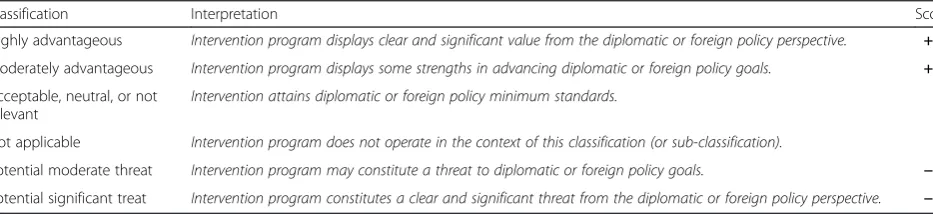
Response options to sub-classification questions were divided into six categories:“highly advantageous”,“ moder-ately advantageous”,“neutral, not relevant, or not consid-ered”, “not applicable”, “potential moderate threat”, and “potential significant threat”, in accordance with level of alignment with associated diplomatic goals and principles (Table 1). These response categories were associated with scores of +2, +1, zero (for both“neutral, not relevant, or not considered”and“not applicable”), -1, and -2, respect-ively. Sub-classification scores were then aggregated and averaged in order to provide an overall classification score. No weighting was attached to different classifications or sub-classifications, based on the assumption that all classi-fications were of equal value or importance from the dip-lomatic perspective. Scope for additional comments, narrative descriptions, and categorization justification was also included at the assessment and evaluation stage in order to provide further explanation, as necessary, for scoring decisions. Finally, all classification scores were ag-gregated and averaged in order to determine an overall intervention-specific diplomatic assessment rating, repre-sentative of the collective programs under review, in the diplomatic context (the“K-Score”).
Program performance from the diplomatic perspective
Overall diplomatic assessment results
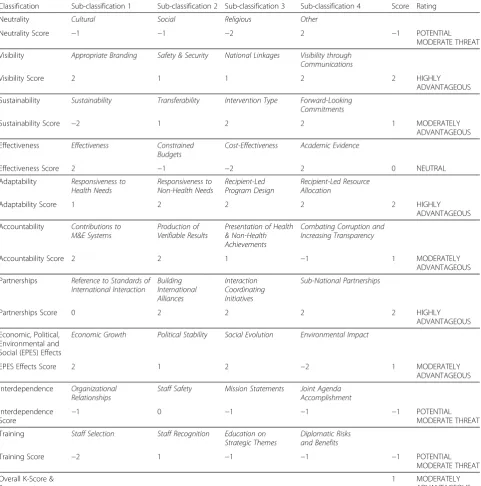
Diplomatic assessment ratings at the classification and sub-classification levels are presented in Table 2 and
Additional file 1 Annex 1. The HIV/AIDS initiatives under review were collectively found to be“moderately advantageous” from the diplomatic perspective, attain-ing an overall average score of +1 across diplomatic as-sessment classifications. This included three “highly advantageous”, three “moderately advantageous”, one “neutral”, and three“potential moderate threat” classifi-cation scores (Fig. 1).
“Highly advantageous”classifications
HIV/AIDS initiatives were considered to be“highly advan-tageous” under the diplomatic assessment classifications of“visibility”,“adaptability”, and “partnerships”. These re-sults are in keeping with prior findings related to both the structure and “unintended consequences” of HIV/AIDS intervention programs [18]. For example, the extensive intervention adaptability of related HIV/AIDS interven-tions has been documented elsewhere [34], including the importance of intervention visibility and communications through revisions to key practices (e.g. evolving interven-tion“branding”and terminology to fit with local cultures and social norms) and community mobilization activities. Similarly, the generation of international partnerships through collaborations based on international HIV/ AIDS initiatives is in keeping with prior findings related to the documented success of academic and inter-governmental collaborations under both the Global Fund and PEPFAR [35].
“Moderately advantageous”classifications
HIV/AIDS initiatives under review were found to be“ mod-erately advantageous”, from the diplomatic perspective, in terms of “sustainability”, “accountability”, and “economic, political, environmental and social effects”. These findings are also supported by reference to related studies. For ex-ample, positive assessments for sustainability were driven by intervention strengths in the context of“country owner-ship” [36] and transferability to local actors, while diplo-matic advantages in the“accountability”context are aligned with previously-documented strengths of PEPFAR and the Global Fund in monitoring and evaluation and other qual-ity assurance and control systems [37]. Similarly, positive economic, political, and social outcomes were driven by the
Table 1Scoring and Results Classifications for“Top Ten”Criteria
Classification Interpretation Score
Highly advantageous Intervention program displays clear and significant value from the diplomatic or foreign policy perspective. +2
Moderately advantageous Intervention program displays some strengths in advancing diplomatic or foreign policy goals. +1
Acceptable, neutral, or not relevant
Intervention attains diplomatic or foreign policy minimum standards. 0
Not applicable Intervention program does not operate in the context of this classification (or sub-classification). 0
Potential moderate threat Intervention program may constitute a threat to diplomatic or foreign policy goals. −1
widespread provision of social and economic support ser-vices (such as“Back to Work”or income-generating horti-cultural schemes), which were frequently attached to those primary service delivery components under review [30].
“Neutral”classifications
HIV/AIDS interventions were classified as“neutral”from the diplomatic perspective in the context of “ effective-ness”. The limited consideration of budgetary constraints
after the intervention or programmatic support period, combined with the high demand for affordable and cost-effective health care delivery and financing strategies in re-cipient countries, are current causes of concern through-out both the global health and international development contexts [38], most particularly in the current global re-cession era. In this context, the increased use of both health and non-health effectiveness and cost-effectiveness information as a key component of intervention design
Table 2Diplomatic Assessment Results
Classification Sub-classification 1 Sub-classification 2 Sub-classification 3 Sub-classification 4 Score Rating
Neutrality Cultural Social Religious Other
Neutrality Score −1 −1 −2 2 −1 POTENTIAL
MODERATE THREAT
Visibility Appropriate Branding Safety & Security National Linkages Visibility through Communications
Visibility Score 2 1 1 2 2 HIGHLY
ADVANTAGEOUS
Sustainability Sustainability Transferability Intervention Type Forward-Looking Commitments
Sustainability Score −2 1 2 2 1 MODERATELY
ADVANTAGEOUS
Effectiveness Effectiveness Constrained Budgets
Cost-Effectiveness Academic Evidence
Effectiveness Score 2 −1 −2 2 0 NEUTRAL
Adaptability Responsiveness to Health Needs
Responsiveness to Non-Health Needs
Recipient-Led Program Design
Recipient-Led Resource Allocation
Adaptability Score 1 2 2 2 2 HIGHLY
ADVANTAGEOUS
Accountability Contributions to M&E Systems
Production of Verifiable Results
Presentation of Health & Non-Health Achievements
Combating Corruption and Increasing Transparency
Accountability Score 2 2 1 −1 1 MODERATELY
ADVANTAGEOUS
Partnerships Reference to Standards of International Interaction
Building International Alliances
Interaction Coordinating Initiatives
Sub-National Partnerships
Partnerships Score 0 2 2 2 2 HIGHLY
ADVANTAGEOUS
Economic, Political, Environmental and Social (EPES) Effects
Economic Growth Political Stability Social Evolution Environmental Impact
EPES Effects Score 2 1 2 −2 1 MODERATELY
ADVANTAGEOUS
Interdependence Organizational Relationships
Staff Safety Mission Statements Joint Agenda
Accomplishment
Interdependence
Score −
1 0 −1 −1 −1 POTENTIAL
MODERATE THREAT
Training Staff Selection Staff Recognition Education on Strategic Themes
Diplomatic Risks and Benefits
Training Score −2 1 −1 −1 −1 POTENTIAL
MODERATE THREAT
Overall K-Score & Assessment
1 MODERATELY
and delivery on aprima facierather than apost-hocbasis may significantly strengthen intervention design and deliv-ery [39] in this regard.
“Potential moderate threat”classifications
Potential moderate threats to diplomatic considerations, interests and outcomes at both recipient and donor levels related to “neutrality”, “interdependence”, and “training”. These findings are, once again, in keeping with a range of contemporary recommendations on the design and delivery of global health intervention pro-grams. For example, in the context of neutrality, the im-position of international cultural, social and religious standards and norms on recipient societies, often with-out appropriate levels of consultation at the local and community levels, may represent a threat both to suc-cessful program implementationandto international re-lations [34]. Conversely, a lack of awareness of the strategic implications of global health’s resource alloca-tion decisions may mean that foreign assistance can un-intentionally support extremist organizations [40]. Similarly, in the context of “interdependence”, a lack of organizational and operational coordination and align-ment between health and non-health initiatives related to broader strategic and international affairs considerations has been identified as a possible source of conflict between health and diplomatic goals [41]. Finally, in the context of “training”, limited levels of broader political education and awareness in global health practitioners operating in inter-national environments has been identified as a key gap at the individual capacity level [42,43].
Potential significant threats at the sub-classification level
Although no classifications were rated as a“potential sig-nificant threat” from the diplomatic perspective, specific sub-classifications recording this result are highlighted here. These include programmatic threats to religious neutrality (under the “neutrality” classification), limited
assurances and planning regarding funding sustainability (under the “sustainability” classification), limited or no
prima facieuse of health and non-health cost-effectiveness findings (under the“effectiveness”classification, and as described above), limited or no consideration of envir-onmental impact (under the“economic, political, environ-mental and social effects” classification), and inadequate provision of broader diplomatic training, awareness, and formalization of related roles and responsibilities (under the “training” classification). Strategies to address these potentially significant diplomatic threats have been pre-sented, in recent years, via innovative recommendations on the 21st century design and delivery of global health service delivery [13].
Interpretation & conclusions Key findings
offset by significant intervention returns or value at the diplomatic level [35].
Enlightened strategic & resource allocation decisions: beyond cost-effectiveness
The results presented here are designed for use and ref-erence at both the global health policy level and across the broader milieu of bilateral and multilateral foreign policymaking and practice. For example, within global health and development, these results may help to inform “enlightened” resource allocation decisions be-yond the “potentially flawed” [35] reliance on cost-effectiveness analyses as the exclusive determinant of global health program worth or value. Perhaps even more importantly, the interpretation and use of these results at the diplomatic and foreign policy level pre-sents a range of opportunities for policymakers to le-verage, design, and refine global health and other development initiatives for the purposes of foreign pol-icy and diplomacy [45].
“Smart power”and“smart global health”
At its most optimal, the Kevany Riposte and the K-Score may help both health and non-health, bilateral and multilateral organizations to manipulate aid in order to substitute for, offset, complement, or support the use of hard power in favour of smart power options, via the creation of a new “stage” in the escalation of inter-national engagements, in keeping with 21st Century standards of acceptability for, and effectiveness of, inter-national military interventions [46,47]. A new step in the “escalation hierarchy” amongst traditional and accepted stratifications such as neutrality, diplomacy, soft power and hard power [48] would be epitomized by such smart global health initiatives [45]. This may, in turn, bring about (1) a transfer or collaboration of resources from hard to smart international initiatives operating under “military umbrellas” [46] and, where feasible and appro-priate, (2) the increased or enhanced use by military forces and related organizations of smart global health systems to pursue foreign policy and strategic preroga-tives [49].
Utilization in the international intelligence context
The employment of global health programs for strategic political ends in an unstructured manner has, in the past, put global health workers at a security risk by asso-ciation, regardless of whether or not individual- or organizational-level activities are in fact related to such ostensibly extraneous objectives [50]. At the same time, Western powers are increasingly open to the use of in-novative, collaborative and interdisciplinary efforts to re-solve contemporary international affairs and security challenges [51], against which conventional response
systems have faced significant challenges. In this highly nuanced, complex, and occasionally clandestine context, non-health dividends may be attained if global health programs are selected, designed and delivered in a man-ner that bears in mind potential international conflict resolution, cooperation, and security goalsas well as pri-mary health and development outcomes [52]; past re-search has suggested that locating highly-diplomatic global health projects in extremist regions, as informed by the “geo-strategic considerations” classification, pro-vides meaningful alternatives to political or other forms of extremism [53]. In this context, the Kevany Riposte and the K-Score may offer standards by which inter-national agencies such as the United Kingdom’s Security Service,(MI5), the European Union’s Intelligence Ana-lysis Centre [54], and the United States’ Central Intelligence Agency (CIA) liaise with both donor, supra-national, and recipient departments of international de-velopment and health in a fashion that both (1) reduces threats to aid workers and (2) integrates multifarious di-mensions to global health programs which are, in turn, (3) conducted in a style acceptable and transparent to recipient country governments. Such innovative collabo-rations, instead of acquiescing to demands that global health funding be transferred to defense [55], stand to achieve both altruistic, intelligence, and security goals simultaneously. Perhaps most importantly, employment of assessment systems under the Kevany Riposte in this context will also help to ensure that global health pro-grams do not inadvertently harm international security by providing aid, health, or other financial support to ex-tremist organizations [56]. Notwithstanding these other potential gains, traditional (and possibly flawed) ap-proaches to intelligence gathering through international development initiatives [57] stand to be both improved and made more effective by the application of relevant criteria, models, procedures and standards to both organizational and individual-level activities and liaisons in this context.
Limitations
policymakers regarding related resources allocation de-cisions. This review should, therefore, be characterized and interpreted as a pilot initiative, based on which, in fu-ture, Kevany Riposte systems, scope, and results may be further refined and applied by larger teams. In addition, future efforts might also (1) consider dividing the system’s structure and results across the three major evaluation di-mensions outlined above (i.e. individual, policy and inter-vention levels) in a more explicit fashion, (2) correlate health and diplomatic outcomes (see below), and (3) at-tempt to further describe the political and operational mechanisms by which the results of diplomatic and for-eign policy evaluations may be translated from findings such as those presented here into policy, and thence into practice [59–61] (see below).
Plotting health effectiveness against intervention effectiveness
A related area of potential interest and inquiry to organi-zations such as the United States’ Centers for Disease Control and Prevention (CDC) is consideration of the effects of diplomatically “highly advantageous” global health interventions on health outcomes. Do“more dip-lomatic” global health interventions relate to improved health outcomes – or vice versa – or both? Such find-ings, though beyond the scope of this paper, might be determined through cross-referencing intervention med-ical efficacy and effectiveness against diplomatic assess-ment values. Though direction of causality may be challenging to prove, the establishment of such relation-ships may help to further explain the manifold connec-tions between diplomatically and medically successful global health interventions [62].
Recommendations
Global health interventions and related Global Fund and PEPFAR-supported programs have the potential to be of significant importance in alleviating developing coun-tries from the worst effects of communicable and non-communicable disease and ill-health. More broadly, such interventions may also have the potential to advance diplomatic considerations related to the interests of both donor and recipient countries, as well as national and international, health and non-health, goals and initia-tives, such as strategic and security concerns. In order to optimize the potential future impact of these latter di-mensions, and based on the results presented here, re-lated recommendations include (1) consideration of the redesign of HIV/AIDS initiatives in the context of train-ing, organizational interdependence, and neutrality, whilst also addressing the specific“potential significant threats” at the sub-classification level described above; (2) the further development of intervention sustainability, ac-countability, and latent political, economic, social and
environmental potential; (3) the development and
prima facieintegration of intervention health and non-health effectiveness findings into intervention program design and delivery; (4) building on the successes and dip-lomatic advantages associated with intervention visibility, adaptability, and partnership development; and (5) lever-aging these latent diplomatic assets, at the individual, intervention and policy levels, in order to address broader national and international strategic concerns.
Next steps: utilization of results and“evidence into policy & practice”
The identification of five main opportunities and mecha-nisms for utilization of the results of the Kevany Riposte and K-Score have previously been identified by the author as (1) training, (2) evaluation, (3) resource allocation, (4) funding, and (5) military and international security consid-erations [25]. A range ofrealpolitikscenarios for such ap-plications are conceivable. In one possible example, widespread diplomatic reviews conducted under the aus-pices of organizations such as the Office of Global Health Diplomacy, the United Kingdom’s Royal Institute for International Affairs, or the European Union’s External Action Service, might provide a detailed picture of the comparative worth of global health interventions, from the diplomatic and foreign policy perspectives, across a range of key settings, population groups, and regions around the world. These results might then be overlaid, with the assistance of donor and recipient country foreign policymakers or professional diplomats, with global diplo-matic, political, foreign policy or strategic needs and threats in order to determine both (1) overall and targeted global health investments, (2) geo-strategic and demo-graphic focus, and (3) intervention program selection, whilst (4) better aligning interventions with broader stra-tegic considerations and the work of non-health inter-national initiatives and organizations. In this way, the smart use of global health initiatives may provide a mean-ingful and effective alternative or complement to other forms of international intervention on the world stage, ad-vancing both health and non-health goals [63].
Additional files
Additional file 1:Annex 1 Diplomatic Assessment Questionnaire and Scoring Tool.
Additional file 2:Annex 2 Interview and assessment guide for diplomatic and foreign policy assessments.
Competing interests
The author declares that he has no competing interests.
Acknowledgements
Novotny (University of California San Diego), Dr. Carlos Bruen (Royal College of Surgeons in Ireland), Professor Charles Normand (Trinity College Dublin), Dr. Starley Shade (University of California, San Francisco), Mr. Bertie Anter (SDL-BOL Advisory International), Ms. Jessica Grignon (I-TECH South Africa), Mr. Kevin Boden (Lincap International). Dr. James G. Kahn (University of California, San Francisco), Mr. Len Brennan (St. Andrew’s College, Dublin).
Received: 21 January 2015 Accepted: 6 May 2015
References
1. Ferrero-Waldener B (2007). The European Union and the World: A Hard Look at Soft Power. New York: Columbia University. September 24th, 2007. 2. Lancaster C. Foreign Aid: Diplomacy, Development. Domestic Politics:
University of Chicago Press; 2007.
3. Europa (2010). Foreign and Security Policy: Speaking with One Voice. Accessed through: www.europa.eu/pol/cfsp/index_en.htm
4. Kagan R. Power and Weakness. Policy Review. 2002;113:208–21. Retrieved from https://www.mtholyoke.edu/acad/intrel/bush/kagan.htm. 5. European Commission (2010). The EU Role in Global Health. European
Commission consultation document. Brussels: March 2010 Accessible through: https://ec.europa.eu/europeaid/eu-role-global-health_en 6. Department of State (2008). Joint Department of State, USAID Enterprise
Architecture Transition Strategy for FY2009. Accessed through: http:// www.state.gov/m/irm/rls/110469.htm
7. Tran M (2012). The Politics of UK Aid Explained. The Guardian. September 26th, 2012. Accessible through: http://www.theguardian.com/global-development/2012/sep/26/the-politics-uk-aid-explained
8. Kitchen N (2010). The Future of UK Foreign Policy: Executive Summary. IDEAS reports - special reports, Kitchen, Nicholas (ed.) SR006. LSE IDEAS, London School of Economics and Political Science, London, UK. Accessed through: http://eprints.lse.ac.uk/43547/1/The%20future%20of%20UK%20for-eign%20policy_executive%20summary
(lsero).pdf
9. The Lancet (2015). National Armies for Global Health? The Lancet 384: 1477. Retrieved from: http://www.thelancet.com/journals/lancet/article/PIIS0140-6736(14)61923-1/fulltext?rss=yes
10. The World Bank (2011). The World Development Report 2011: Conflict, Security, and Development. Accessed through: http://wdr2011.worldbank.org/ fulltext
11. O’Neill J & Pappas G (2007). Health Diplomacy: Lessons for Global Health from PEPFAR. The International Journal of World Health and Societal Politics. 7: 1. Accessed through: https://ispub.com/IJWH/7/1/3801.
12. United States Department of State (2014). About the Office of Global Health Diplomacy. Accessible through: http://www.state.gov/s/ghd/about/ 13. Novotny T, Kevany S. The way forward in global health diplomacy:
Definitions, research, and training. In: Novotny T, Kickbusch I, Told M, editors. 21st century health diplomacy. Geneva: World Scientific; 2013. p. 203–25.
14. Hudson V, Vore C (1995). Foreign policy Analysis: Yesterday, Today and Tomorrow. Mershon Int Stud Rev. 39 (2): 209–38. Accessible through: http:// bev.berkeley.edu/fp/readings/ForeignPolicyAnalysisDomesticPolitics.pdf. 15. Center for Strategic and International Studies (2010). Final Report of the
CSIS Commission on Smart Global Health Policy. Accessed through: http:// csis.org/event/rollout-final-report-csis-commission-smart-global-health-policy 16. Feldbaum H. Global Health & Foreign Policy. Epidemiological Review.
2010;32:82–92.
17. Kevany S, Jaf P, Workneh N, Abu Dalo M, Tabena M, Rashid S & Al Hilfii T (2014). Global health diplomacy in Iraq: international relations outcomes of multilateral tuberculosis programmes. Medicine, Conflict and Survival 30 (2): http://dx.doi.org/10.1080/13623699.2014.890827
18. Lyman N & Wittels S (2010). No Good Deed goes Unpunished: The Unintended Consequences of Washington’s HIV/AIDS programs. Foreign Affairs. July–August 2010. Retrieved from http://www.foreignaffairs.com/ articles/66464/princeton-n-lyman-and-stephen-bwittels/no-good-deed-goes-unpunished
19. Basler M. Utility of the McNamara Fallacy. Br Med J. 2009;339:b3141–23. 20. 24. Nye J (2004). The Decline of America’s Soft Power. Foreign Affairs: May &
June 2004 Issue. Accessible through: https://www.foreignaffairs.com/articles/ 2004-05-01/decline-americas-soft-power
21. Warmerdam W & de Haan A (2011). The Roles of Aid in Politics. International Institute for Social Studies. Accessible through: www.iss.nl/ Bibliography_The_Roles_of_Aid_in_Politics_February_
22. Center for Strategic & International Studies (2007). The CSIS Commission on Smart Power. Accessible through: http://csis.org/files/media/csis/pubs/ 071106_csissmartpowerreport.pdf
23. Feldbaum H, Michaud J. Health Diplomacy and the Enduring Relevance of Foreign Policy Interests. PLoS Med. 2010;7(4), e1000226. doi:10.1371/ journal.pmed.1000226.
24. Bonventre E. Monitoring and Evaluation of Department of Defense Humanitarian Assistance Programs. Military Review. 2008;88(1):66–72. 25. Garrett L (2007). The Challenge of Global Health. Foreign Affairs. January &
February 2007 Issue. Accessible through: https://www.foreignaffairs.com/ articles/2007-01-01/challenge-global-health
26. PEPFAR (2014). PEPFAR Prevention Guidance. Accessible through: http:// www.PEPFAR.gov/reports/guidance/171094.htm
27. The Global Fund (2012). The Global Fund Strategy 2012-2016. Accessible through: www.theglobalfund.org/Core_GlobalFundStrategy01_Attachment_en/ 28. United States Global health Initiative (2011). Global Health Initiative Strategy 2011-2016. Accessible through: http://www.ghi.gov/whereWeWork/docs/ SouthAfricaStrategy.pdf
29. PEPFAR (2010). Kenya Country Operational Plan 2010. Accessible through: www.PEPFAR.gov/documents/organization/228466.doc
30. Khumalo-Sakutukwa G, Morin S, Fritz K, Charlebois E, Van Rooyen H, Chingono A, et al. The NIMH Project Accept Study Team (2010). Project Accept (HPTN 043): A Community-Based Intervention to Reduce HIV Incidence in Populations at Risk for HIV in Sub-Saharan Africa and Thailand. J Acquir Immune Defic Syndr. 2008;49(4):422–31. http://www.academia.edu/ 8166578/Project_Accept_HPTN_043_A_Community-Based_Intervention_-to_Reduce_HIV_Incidence_in_Populations_at_Risk_for_HIV_in_Sub-Sahara. 31. International Teaching and Education Center for Health (2014). South Africa:
I-TECH Launches Re Mmogo Pholong [Together In Wellness] Program. Accessible through: http://news.go2itech.org/2012/10/south-africa-wellness-program/
32. Kevany S (2014). Global Health Diplomacy,‘Smart Power’, and the New World Order. Global Public Health: An International Journal for Research, Policy and Practice. 2014. doi:10.1080/17441692.2014.921219.
33. The Global Fund (2014). Data and Service Quality Assessment. Accessible through: http://www.theglobalfund.org/en/me/documents/dataquality/ 34. Kevany S, Khumalo-Sakutukwa G, Murima O, Chingono A, Modiba P, Gray G,
et al (2013). Health diplomacy and adapting global health interventions to local needs in sub-Saharan Africa and Thailand: evaluating findings from Project Accept. BMC Public Health. 2012;12(459):1–11. http://www. biomedcentral.com/1471-2458/12/459/abstract.
35. Walensky R, Kurtizkes G (2011). The Impact of The President's Emergency Plan for AIDS Relief (PEPFAR) beyond HIV and Why It Remains Essential. Clin Infect Dis. 50 (2): 272–5. Accessible through: http://cid.oxfordjournals.org/ content/50/2/272.abstract.
36. United States Agency for International Development (2013). Issue Brief: Country Ownership. Accessible through: http://www.usaid.gov/sites/default/ files/documents/1864/CountryOwnershipIssueBrief.pdf
37. Kevany S, Hatfield A, Workneh N, Aurang Zeb Durrani B, Bekele Y, Khan U, et al. Diplomatic and operational adaptations to global health programs in post-conflict settings: contributions of monitoring and evaluation systems to 'nation-building' in South Sudan. Med, Confl Surviv July-September; 2012;28(3):247–62. http://www.ncbi.nlm.nih.gov/pubmed/23189590. 38. Yang A, Farmer P. Sustainability: in Global health. Glob Public Health.
2010;5(2):129–35. Accessible through: http://www.ncbi.nlm.nih.gov/ pubmed/20213563.
39. United Kingdom Medical Research Council (2007). Developing and evaluating complex interventions: new guidance. Accessible through: http:// www.mrc.ac.uk/documents/pdf/complex-interventions-guidance/ 40. Eckenwiler L, Hunt M. Counterterrorism, Ethics, and Global Health. Hastings
Cent Rep. 2014;44(3):12–3. Accessible through: http://
www.thehastingscenter.org/Publications/HCR/Detail.aspx?id = 6885. 41. Royal Institute for International Affairs (2011). Global Health Diplomacy: A
Way Forward in International Affairs. Accessible through: https:// www.chathamhouse.org/sites/files/chathamhouse/public/Research/ Global%20Health/280611summary.pdf
Retrieved from http://onlinelibrary.wiley.com/doi/10.1111/j.1468-0009.2011.00637.x/abstract.
43. Kickbusch I, Novotny T, Drager N, Silberschmidt G, Alcazar S. Global health diplomacy: Training across disciplines. Bulletin of the World Health Organization. 2007;85:82–91. Retrieved from http://www.scielosp.org/ scielo.php?pid = S004296862007001200027&script = sci_arttext&tlng = es. 44. Marseille, E., & Khan, J. (2002). HIV prevention before HAART in sub-Saharan
Africa. The Lancet, 359, 1851–1856. Retrieved from http://www.thelancet.-com/journals/lancet/article/PIIS0140-6736(02)08705-6/abstract
45. Center for Strategic and International Studies. (2010). Final report of the CSIS Commission on smart global health policy. Retrieved from http:// csis.org/event/rollout-final-report-csis-commission-smart-global-health-policy 46. Burkle S (2013). Throwing the baby out with the bathwater. Prehosp
Disaster Med. (3):1–3. Retrieved from http://journals.cambridge.org/action/ displayAbstract?fromPage = online&aid = 892159
47. Burkle S, Garfield R. Civilian mortality after the 2003 invasion of Iraq. The Lancet. 2013;381:879. Retrieved from http://press.thelancet.com/ mortality.pdf.
48. Copeland D, Potter E. Public Diplomacy in Conflict Zones: Military Information Operations Meet Political Counter-Insurgency. The Hague J Diplomacy. 2008;3(3):277–97. Accessible through: http://booksandjournals.-brillonline.com/content/journals/10.1163/187119108x367161?crawler=true 49. Center for Strategic & International Studies (2014). Global Health
Engagement: Sharpening a Key Tool for the Department of Defense. Accessible through: http://csis.org/files/publication/
140930_Daniel_DODGlobalHealth_Web.pdf
50. United States Agency for International Development (2009). Development Assistance and Counter-Extremism. USAID Policy Document. Accessible through: https://dec.usaid.gov/dec/content/GetDoc.axd?
51. Vanderwagen W (2006). Health Diplomacy: Winning Hearts and Minds thorough the use of Health Interventions. Military medicine 171: 3-4. White B (2001). The Globalization of World Politics: An Introduction to International Relations. New York: Oxford University Press
52. Kevany S, Sahak O, Workneh N, Saeedzai A. Global health diplomacy investments in Afghanistan: adaptations and outcomes of Global Fund malaria programs. Med Confl Surviv. 2014;30(1):37–55. http:// www.tandfonline.com/doi/pdf/10.1080/13623699.2014.874187. 53. Novotny T, Adams V. Global health diplomacy—A call for a new field of
teaching and research. San Francisco Medicine. 2007;80(3):22–3. 54. Europa (2015). Factsheet on EU Intelligence Analyses Center (INTCEN).
Accessible through: http://eu-un.europa.eu/articles/en/article_16050_en.htm 55. Norton-Smith R (2015). MI5,‘Jihadi John’, terrorism, UK defense, budgets–all
connected. The Guardian. Defense and Security Blog, March 2nd, 2015. Accessible through: http://www.theguardian.com/news/defence-and- security-blog/2015/mar/02/mi5-jihadi-john-terrorism-uk-defence-budgets-all-connected
56. Williams J (2015). Countering violent extremism: improving U.S. strategy for the future. Brookings Institution: Middle East Politics & Policy Department. Accessed through: http://www.brookings.edu/blogs/markaz/posts/2015/02/ 06-countering-violent-extremism
57. Hider J (2014). US sent fake aid workers to spy on Cuba. The Times, US & Americas. August 5th, 2014. Accessible through: http://www.thetimes.co.uk/ tto/news/world/americas/article4166629.ece
58. Using cost-effectiveness league tables to compare interventions to prevent sexual transmission of HIV. Pinkerton S (2001). AIDS 215(7): 917-28. Access-ible through: http://www.ncbi.nlm.nih.gov/pubmed/11399964
59. Yamey G. Evidence-Based policymaking in Global health: The Payoffs & Pitfalls. Evid Based Med. 2011;16:97–9. Accessible through: http://ebm.bmj.-com/content/16/4/97.
60. Brown M, Mackey T, Shapiro C, Kolker J, Novotny T (2014). Bridging Public Health and Foreign Affairs: The Tradecraft of Global Health Diplomacy and the Role of Health Attachés. Science & Diplomacy 3: 3. Accessed through: http://www.sciencediplomacy.org/article/2014/bridging-public-health-and-foreign-affairs
61. Kevany, S., Benatar, S., & Fleischer, T. (2013). Improving resource allocations for health and HIV in South Africa: Bioethical, cost-effectiveness and health diplomacy considerations. Global Public Health, 8, 570–587. Retrieved from http://www.ncbi.nlm.nih.gov/pubmed/23651436
62. Kleinman A (2010). The art of medicine: Four social theories for global health. Vol 375 May 1, 2010. Accessible through: http://www.thelancet.com/ pdfs/journals/lancet/PIIS0140673610606460.pdf
63. Michaud J, Kates J. Global health diplomacy: Advancing foreign policy and global health interests. Global Health: Science & Practice. 2013;1(1):24–8. Retrieved from http://www.ghspjournal.org/content/1/1/24.full.
Submit your next manuscript to BioMed Central and take full advantage of:
• Convenient online submission
• Thorough peer review
• No space constraints or color figure charges
• Immediate publication on acceptance
• Inclusion in PubMed, CAS, Scopus and Google Scholar
• Research which is freely available for redistribution