ISSN: 2279-087X (P), 2279-0888(online) Published on 23 September 2012
www.researchmathsci.org
97
A Comparative Study on Fully Fuzzy Time Cost
Trade Off
M.Evangeline Jebaseeli1 and D.Paul Dhayabaran2
1PG and Research Department of Mathematics, Bishop Heber College, Tiruchirappalli-620 017 Tamil Nadu, India. E-mail: [email protected]
2PG and Research Department of Mathematics, Bishop Heber College, Tiruchirappalli-620 017, Tamil Nadu, India. E-mail: [email protected]
Received 4 September2012; accepted 18 September 2012
Abstract. Time Cost Trade Off problem is one of the main aspects of project scheduling. The Method of solving these kinds of problems requires a scheduling with more stability against environmental variations. In this paper, we propose a new solution procedure for time cost trade off problem with limited time period in which both times and costs are fuzzy. And a comparative study has been made on three different methods. Finally, illustrative examples are provided to demonstrate the efficiency of the proposed method.
Keywords: Fuzzy project management, fuzzy time cost trade off, Decomposition technique
AMS Mathematics Subject Classifications (2010): 90B10, 90C05, 90C70 1. Introduction
An important aspect of project management is scheduling time accurately. This is critical component of project planning as this will the deadline for the completion of a project. Since the late 1950’s critical Path Method techniques have become widely recognized as valuable tools for the planning and scheduling of projects. But in many cases, project should implement before the data that was calculated by Critical Path Method. Achieving this goal, can be used more productive equipment or hiring more workers.
98
indirect costs will be influenced in the project; therefore in some researches the term ‘time-cost trade-off ‘is also used for this purpose.
Several approaches are proposed over the past years for finding the optimum duration with minimum cost. In many researches, programming models are developed to solve optimally the trade off among time, cost and quality. For examples Cusack, 1985 and Babu and Suresh 1996 and Demeulemeester et al. 1996 were used linear programming and dynamic programming models are presented to crash projects.
Some authors have claimed that fuzzy set theory is more appropriate to model these problems. Wang et al. 1993 developed a model to project scheduling with fuzzy information. Leu et al. 1999 developed a fuzzy optimal model to formulate effects of both certain activity duration and resource constraint. Arican and Gungor presented fuzzy goal programming model for time-cost trade off problem. Leu et al. 2001 proposed a new fuzzy optimal time cost trade off method and GA based approach to solve it. Guang et al. 2005 presented a new solution approach for fuzzy time-cost trade off model based on Genetic Algorithm. Ghazanfari et al. 2007 developed a new possibilistic model to determine optimal duration for each activity in the form of triangular fuzzy number. Also Yousefli et al. 2008 presented a heuristic method to solve a project scheduling problem by using fuzzy decision making in fuzzy environment. Shakeela Sathish, 2012 proposed a new approach to solve fuzzy network crashing problems.
In this paper, we have presented a new solution procedure for time-cost trade off problem with limited time period in fuzzy environment. And a Comparative study has been made between the proposed method namely decomposition method, direct method and Existing method. We have considered time cost trade off problem in uncertain environment in which normal and crash durations of each activity are considered uncertain and shown in the form of triangular fuzzy numbers. Optimum durations of activities are calculated in the form of triangular fuzzy number. Finally to test the applicability of the method, suitable numerical examples have been illustrated.
2. Preliminaries
In this section, some basic definitions of fuzzy theory have been defined by Kaufmann and Gupta and Zimmermann, are presented.
Definition 2.1. A fuzzy set A~ is a set of ordered pairs,
{
(x,µ
A~//(x)/x∈R}
where] 1 , 0 [ : ) (
~ x R→
A
99
Definition 2.2. A fuzzy set A~ is called positive if its membership function is such that
µ
~A(x)=0 ∀x≤0.Definition 2.3. A fuzzy set A~ defined on the set of real numbers R is said to be a fuzzy number if its membership function has the following characteristics:
1.
µ
~A(x):R→[0,1] is continuous. 2.µ
~A(x)=0 for all (−∞,a]∪[c,∞).3.
µ
A~(x) is strictly increasing on [a,b] and strictly decreasing on [b,c]. 4.µ
~A(x)=1 for all x∈b wherea
≤
b
≤
c
.
Definition 2.4. A fuzzy number A~=(a,b,c) is said to be a triangular fuzzy number if its membership function is given by,
≤ ≤ − − ≤ ≤ − − = c x b b c c x b x a a b a x x A , ) ( ) ( , ) ( ) ( ) ( ~
µ
We use F(R) to denote the set of all triangular fuzzy numbers.
Definition 2.5. A triangular fuzzy number A~ =(a,a0,a)∈F(R) can also be represented as a pair A~=(a,a) of functions a(r) and a(r) for
0
≤
r
≤
1
which satisfies the following requirements:1. a(r) is a bounded monotonic increasing left continuous function. 2. a(r) is a bounded monotonic decreasing left continuous function. 3. a(r)≤a(r) ,
0
≤
r
≤
1
.
Definition 2.6. For an arbitrary triangular fuzzy numberA~=(&a&&,a), the number
2 ) 1 ( ) 1 ( 0 a a
a = + is said to be a location index number ofA~. The two non-decreasing left continuous functions ( ), ( 0)
* 0
* a a a a a
a = − = − are called the left fuzziness index function and right fuzziness index function respectively. Hence every triangular fuzzy number A~=(a,b,c)can also be represented by
).
,
,
(
~
* *0
a
a
a
100
2.1. Arithmetic Operations on Triangular Fuzzy Numbers
Arithmetic operations between two triangular fuzzy numbers A~=(a1,b1,c1) and )
, , ( ~
2 2
2 b c
a
B = are:
1. A~+B~=(a1 +a2,b1+b2,c1+c2) 2. A~−B~=(a1 −c2,b1 −b2,c1 −a2) 3. A~.B~=(a1a2,b1b2,c1c2)
4. A~/B~=(a1/c2,b1/b2,c1/a2)
Ming Ma et al. have proposed a new fuzzy arithmetic based upon both location index and fuzziness index functions which are given below:
If
~
(
,
,
*)
*
0
a
a
a
A
=
and~
(
,
,
*)
*
0
b
b
b
B
=
are any two fuzzy numbers then,1.
~
~
(
,
max{
,
},
max{
*,
*})
* * 0
0
b
a
b
a
b
a
B
A
+
=
+
2.
~
~
(
,
max{
,
},
max{
*,
*})
* * 0
0
b
a
b
a
b
a
B
A
−
=
−
3.
~
~
(
,
max{
,
},
max{
*,
*})
* * 0
0
b
a
b
a
b
a
B
A
×
=
×
4.
~
~
(
,
max{
,
},
max{
*,
*})
* * 0
0
b
a
b
a
b
a
B
A
÷
=
÷
2.2. Ranking of Fuzzy Number
Let F(R) denotes the set of all triangular fuzzy numbers. Let us define a ranking function ℜ:F(R)→R which maps all triangular fuzzy numbers into R.
If A~=(a,b,c) is a triangular fuzzy number, then the Graded Mean Integration Representation (GMIR) method to defuzzify the number is given by,
4 2 )
~
(A = a+ b+c
ℜ
2.3. Fuzzy Project Network
101
Let
A
⊂
V
×
V
be the set of all directed edges, A={aij =(vi,vj)/vi,vj ∈V}, that represents the activities to be performed in the project.A Critical Path is a longest path from the initial event
v
1to the terminal eventv
n of the project, and an activity aijon a critical path is called a critical activity.2.4. Fuzzy Linear Programming Problem
The mathematical form of fuzzy linear programming problem is as follows:
0 ~ , ~ ~ ~ : ~ ~ ≥ ≤ = x b x A to subject x C Z Maximize
where the coefficient matrix
A
~
=
(
a
~
ij)
m×n is a non-negative fuzzy matrix, the cost vectorC
=
(
c
1,
c
2,...
c
n)
is a non-negative crisp vector and1 1
)
~
(
~
,
)
~
(
~
× ×=
=
x
j nb
b
i mx
are non-negative real fuzzy vectors such that )( ~ ,
~x b∈F R for all 1≤ j≤n, and 1≤i≤m.
2.5. Fuzzy Mathematical model for Time Cost Trade Off
In this section, a suitable mathematical model from the existing literature [1] is chosen based on the available pre-assumptions, constraints and objective criterion of the problem. Pre-assumption of this problem are as follow:
The assumptions of the presented model are as follows:
• Normal and Crash durations are uncertain and their values are denoted in the form of triangular fuzzy number.
• Value of crashing cost is also a triangular fuzzy number. • The value of available time period and indirect cost are crisp.
Thus the model is:
102
where H is an indirect cost;
t
~
i is the planned date for event in
K
~
is the sum of direct cost ;D
~
n(i,j) denote the normal duration of activity (i,j)) , (
~
j i f
D
denote the crash duration of activity (i,j)T is an available time period of the project.
Theorem 2.1.[13] A fuzzy vector
~
x
=
(
x
1,
x
2,
x
3)
is an optimal solution of the problem (P) iffx
2,
x
1and
x
3 are optimal solutions of the following crisp integer linear programming problems(
P
2)
,(
P
1)
and
(
P
3)
respectively, where0 ~ , ~ ~ : ,
~ ~ )
(P Maximize Z =Cx subject to Ax ≤b x ≥
0
,
:
,
)
(
P
2Maximize
Z
2=
Cx
2subject
to
Ax
2≤
b
2x
2≥
are integers.0
0
,
:
,
)
(
P
1Maximize
Z
1=
Cx
1subject
to
Ax
1≤
b
1x
2−
x
1≥
and
x
1≥
are integers.
0
0
,
:
,
)
(
P
3Maximize
Z
3=
Cx
3subject
to
Ax
3≤
b
3x
3−
x
2≥
and
x
3≥
are integers.
3. Procedure for three different methods to find an optimum solution to fuzzy time cost trade off problem
3.1. METHOD I (Proposed Method-Decomposition)
The procedure to solve the fuzzy time-cost trade off problem is as follows:
Step 1: Convert the given problem into fuzzy mathematical model which is given in section 2.5.
Step 2: Decompose the converted problem into three set of crisp linear programming problems.
Step 3: Obtain the optimum solutions of these three set of crisp linear programming problems.
Step 4: Using the result of theorem (2.1), we find the fuzzy optimum duration and optimum project cost for the given problem.
3.2. METHOD II: (Existing Method): [14]
103
Step 1: Determine the critical path of the given project.
Step 2: Find the total normal duration and project cost using the formula
Project cost = (Direct Cost + (Indirect cost*project duration))
Step 3: Find the minimum cost slope by the formula:
Cost Slope = (Normal cost-Crash cost) / (Normal time-Crash time)
Step 4: Determine the crash time and crash cost for each activity to compute the cost slope.
Step 5: Identify the activity with the minimum cost slope and crash that activity. Identify the new critical path and find the cost of the project by formula,
Project cost = (Project Direct cost + Crashing cost of crashed activity) + Indirect cost*Project duration)
Step 6: Crash all activities in the project simultaneously.
Step 7: After crashing all activities, determine the Critical Path and non Critical Paths, also identify the critical activities.
Step 8: In the new Critical path select the activity with the next minimum cost slope, and repeat this step until all the activities along the critical path are crashed up to
desired time.
Step 9: At this point all the activities are crashed and further crashing is not possible. The crashing of non critical activities does not alter the project duration time and is of no use.
3.3. METHOD III: (Direct Method)
The procedure to solve fuzzy time cost trade off problem using direct method is the same as the procedure of Method II. Here we use the arithmetic operations of triangular fuzzy numbers which is given in first part of section (2.1).
Note: This method is applicable only if the difference between the normal time and crash time should not be zero.
4. Numerical Illustrations
104
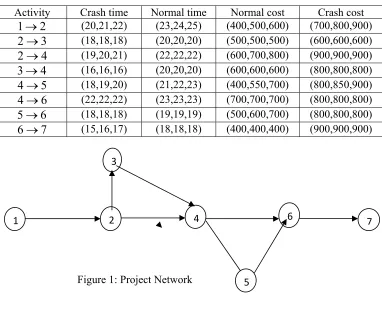
Table 1: Details of the project
Activity Crash time Normal time Normal cost Crash cost
2
1
→
(20,21,22) (23,24,25) (400,500,600) (700,800,900)3
2
→
(18,18,18) (20,20,20) (500,500,500) (600,600,600)4
2
→
(19,20,21) (22,22,22) (600,700,800) (900,900,900)4
3
→
(16,16,16) (20,20,20) (600,600,600) (800,800,800)5
4
→
(18,19,20) (21,22,23) (400,550,700) (800,850,900)6
4
→
(22,22,22) (23,23,23) (700,700,700) (800,800,800)6
5
→
(18,18,18) (19,19,19) (500,600,700) (800,800,800)7
6
→
(15,16,17) (18,18,18) (400,400,400) (900,900,900)Figure 1: Project Network
The Critical Path of the above problem is:
1
→
2
→
3
→
4
→
5
→
6
→
7
The direct cost of the given project is: (4100, 4550, 5000)
The Optimum time and cost of the above fuzzy time cost trade off problem using three different methods as mentioned in the previous sections are given in the following table:
Table 2. Optimum duration and Cost
Name of the methods Optimum Time Optimum Cost Decomposition method (105,108,111) (14600,15350,16100)
Existing method (110,2,2) (15750,150,150) Direct method (104,110,116) (14600,15750,16900)
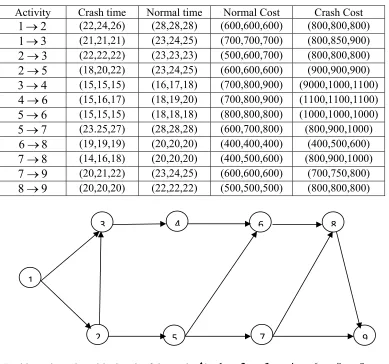
Example 4.2. In this project, an indirect cost is (150,150,150). The details of the project are given below in the Table 3.
1 2 4
3
7 6
105
Table 3. Details of the project
Activity Crash time Normal time Normal Cost Crash Cost
2
1
→
(22,24,26) (28,28,28) (600,600,600) (800,800,800)3
1
→
(21,21,21) (23,24,25) (700,700,700) (800,850,900)3
2
→
(22,22,22) (23,23,23) (500,600,700) (800,800,800)5
2
→
(18,20,22) (23,24,25) (600,600,600) (900,900,900)4
3
→
(15,15,15) (16,17,18) (700,800,900) (9000,1000,1100)6
4
→
(15,16,17) (18,19,20) (700,800,900) (1100,1100,1100)6
5
→
(15,15,15) (18,18,18) (800,800,800) (1000,1000,1000)7
5
→
(23.25,27) (28,28,28) (600,700,800) (800,900,1000)8
6
→
(19,19,19) (20,20,20) (400,400,400) (400,500,600)8
7
→
(14,16,18) (20,20,20) (400,500,600) (800,900,1000)9
7
→
(20,21,22) (23,24,25) (600,600,600) (700,750,800)9
8
→
(20,20,20) (22,22,22) (500,500,500) (800,800,800)In this project, the critical path of the project is:
1
→
2
→
3
→
4
→
6
→
8
→
9
.Direct cost of the project is: (7100, 7600, 8100)
The optimum time and cost of the above fuzzy time cost trade off problem using three different methods as mentioned in the previous sections are given in the following table:
Table 4. Optimum duration and Cost
Name of the methods Optimum Time Optimum Cost Decomposition method (113,116,119) (26750,27700,28650)
Existing method (116,2,2) (27900,100,100) Direct method (109,116,123) (26250,27900,29550) 1
8 6
4 3
106 5. Conclusion
Fuzzy duration and Fuzzy Cost are the useful information for the decision makers in planning and controlling the complex projects. That is the decision maker can model their project and express the terms such as ‘maybe’, ‘in between ‘ ,‘nearly’ and other linguistic variables for activity durations, whereas this specification do not exist in crisp models. Hence fuzzy models are more effective in determining durations and cost in a real project network. In this paper, a new solution procedure for crashing network has been presented, which helps the decision maker to decide the best solution in fuzzy environment.
REFERENCES
1. Amin, Z., An application of mathematical model to time-cost trade off problem, Australian Journal of Basic and Applied Sciences, 5(7) (2011) 208-214.
2. Arikan, F., Gungor, Z., An application of fuzzy goal programming to a multi objective project network problem, Fuzzy Sets and Systems, 119 (2001) 49-58.
3. Babu, A.J.G., and N, Suresh, Project management with time, cost and quality considerations, European Journal of Operational Research, 88(2) (1996) 320-327.
4. Chao-Guang, J., Zhuo-shang, J., Yan L, Yuan-min Z, Zhen-dong H, Research on the fully fuzzy time-cost trade off based on genetic algorithms, JMSA, 4(3) (2005) 18-23.
5. Cusack, M , Optimization of time and cost, International Journal of Project Management, 3(1) (1985) 50-54.
6. Demeulemeester, E. L., Willy, S., Herroelen and Salak E.Elmaghraby, Optimal procedures for the discrete time/cost trade off problem in project networks. European Journal of Operational Research, 88(1) (1996) 50-68.
7. Ghazanfari, M., Shahanaghi, K. and Yousefli, A., An application of possibility goal programming to the time cost trade off problem, First Joint Congress on Fuzzy and Intelligent Systems, Ferdowsi University of Mashhad.(2007).
8. Ghazanfari, M., Yousefli, A., Jabal Ameli, M.S., A. Bozorgi-Amiri, A new approach to solve time-cost trade off problem with fuzzy decision variables, Int J Manuf Tech, 42 (1) (2009) 408-414.
9. Leu, S.S., Chen, A.T. and Yang, C.H., A GA based fuzzy optimal model for construction time cost trade off, International Journal of Project Management, Vol.19, Issue.1, Jan 2001, pp.47-58
107
11. Ming Ma, Menahem Friedman, Abraham Kandel, A new fuzzy arithmetic, Fuzzy sets and Systems, 108 (1999) 83-90.
12. Nikoomaram, H., Lotfi, F.H., Jassbi, J. and Shahriari, M.R., A new mathematical model for time cost trade off problem with budget limited based on time value of money, Applied Mathematical Sciences, 4(63) (2010) 3107-3119.
13. P. Pandian and M. Jayalakshmi, 2010. A New Method for Solving Integer Linear Programming Problems with Fuzzy Variables. Applied Mathematical Sciences, 4(20) 997-1004.
14. Shakeela Sathish and Ganesan, K., Fully fuzzy time-cost trade-off in a project network – a new approach, Mathematical Theory and Modeling, 2(6) (2012) 53-65.
15. Siemens, N., A simple CPM time-cost trade off algorithms, Management Science, 17(6) (1971) B-354-B-363.
16. Wang, K.H., Chi, J.H. and Wan, E.H., Decision making of project under fuzzy information, J Chin Inst Engineers, 16(5) (1993) 33-41.
17. Yousefli, A., Ghazanfari, M., Shahanaghi, K., and Heydari M., A new heuristic model for fully fuzzy project scheduling, JUS World Aademic Press, 2(1) (2008) 73-78.