
Using Latin in diagnoses: a guide for the perplexed
9
0
0
Full text
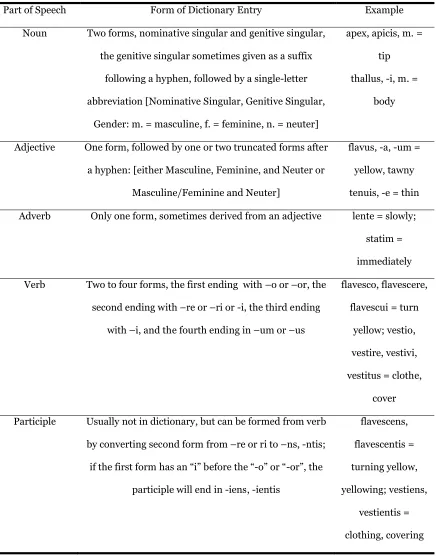
(2) 2 English does, the endings of words determine how they are to be understood. This article attempts to “drive out fear, so that everyone may work effectively” (Deming 1982). Writing Latin diagnoses: In writing the diagnosis, the first step is to prepare a draft in your native language that draws distinctions between primary and secondary characteristics. The primary characteristics each should take the form of a part of the new species (pileus, thallus, spores, etc.) followed by at least one adjective. The secondary characteristics should be introduced by a preposition for accompaniment (“with” in English), then take the form of a lesser part of the species followed by at least one adjective. Indicate location, dimension, or possession by the appropriate prepositions (“behind,” “on,” “up to,” “of,” etc.); these indications may seem obvious but will affect the Latin in different ways. If you need a verb to describe a process, use an active participle (in English, “-ing” or “-nt” forms of verbs, such as “growing”) instead of a fully-inflected verb (“will grow”). Finally, if your new species closely resembles another species, distinguish your species on the basis of salient characteristics. In English, write, “differs from [other species] in [characteristics].” The result can sound a bit like a telegram, for example: “Pileus brown to reddish-brown. Differs from Amanita muscaria in color of pileus. Hyphae long and filamentous. Found on southern red oak. Spores 50-75 µ in diameter. Dehiscent in KOH-.” Once the English (or other) version of your diagnosis is complete, it is time to turn attention to translating it into Latin. Some words, such as “thallus” and “hypha,” are. Ewald. Latin diagnoses. North American Fungi 4(2): 1-9. already Latin, and others you may already know from species names. Then, I suggest looking up words in Stearn 1992, which has an extensive and very useful glossary for translation into and out of Latin. Crebel and Wrobel 1998 include Latin words in common mycological use and focus chiefly on the names of families, genera, and species. Other useful resources include Cash 1965, whose glossary features the Latin equivalents of English words used in mycology, and Jackson 1928, who defines a wide array of botanical terminology, whether English, Latin, or Greek words borrowed into Latin. If you need a nontechnical word like “valley,” I suggest looking it up in an English-Latin dictionary such as Simpson 1977, Levine et al. 1967, or Smith and Hall 2000, then checking such resources as the LIAS glossary, Crebel and Wrobel 1998,or published species descriptions to see whether the word is in common use. Also, the online dictionary of Whitaker 2006 can be useful, but for a word you may find as many as 20 choices, with verbs, nouns, and adjectives all lumped together; checking your choice against common use becomes even more important here. The main parts of speech that appear in diagnoses are nouns, adjectives, participles, or adverbs. Authors generally will consult a Latin dictionary while composing the diagnosis, and the following table helps to distinguish among the different parts of speech as included in an entry in a Latin dictionary (Table 1). Note that Stearn 1992 has his own method that puts the part of speech in parentheses after the word, but nouns are abbreviated as “s.” for “substantive.” Once you have looked up the required Latin word, the next step is to convert it to the correct form. Each Latin noun has six cases indicating the grammatical function of the noun; only four appear in diagnoses (Table 2)..
(3) 3. Ewald. Latin diagnoses. North American Fungi 4(2): 1-9. Table 1. Parts of Speech Part of Speech. Form of Dictionary Entry. Example. Noun. Two forms, nominative singular and genitive singular,. apex, apicis, m. =. the genitive singular sometimes given as a suffix. tip. following a hyphen, followed by a single-letter. thallus, -i, m. =. abbreviation [Nominative Singular, Genitive Singular,. body. Gender: m. = masculine, f. = feminine, n. = neuter] Adjective. Adverb. One form, followed by one or two truncated forms after. flavus, -a, -um =. a hyphen: [either Masculine, Feminine, and Neuter or. yellow, tawny. Masculine/Feminine and Neuter]. tenuis, -e = thin. Only one form, sometimes derived from an adjective. lente = slowly; statim = immediately. Verb. Two to four forms, the first ending with –o or –or, the. flavesco, flavescere,. second ending with –re or –ri or -i, the third ending. flavescui = turn. with –i, and the fourth ending in –um or –us. yellow; vestio, vestire, vestivi, vestitus = clothe, cover. Participle. Usually not in dictionary, but can be formed from verb. flavescens,. by converting second form from –re or ri to –ns, -ntis;. flavescentis =. if the first form has an “i” before the “-o” or “-or”, the. turning yellow,. participle will end in -iens, -ientis. yellowing; vestiens, vestientis = clothing, covering.
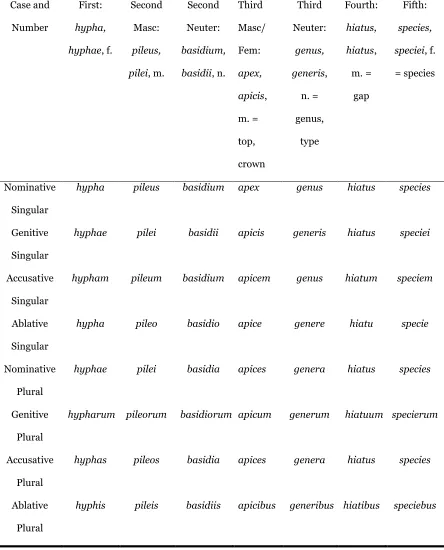
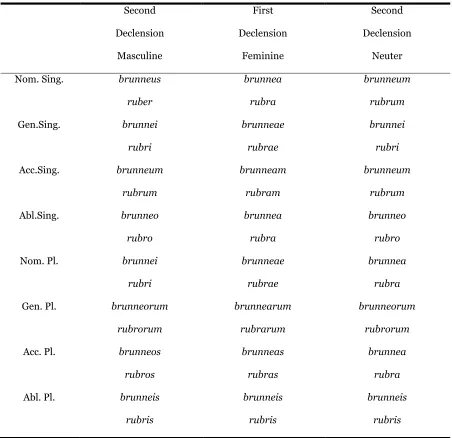
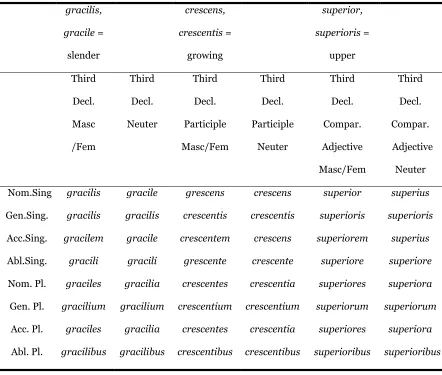
(4) 4. Ewald. Latin diagnoses. North American Fungi 4(2): 1-9. Table 2. Latin Cases Case. Function in Diagnoses. Nominative or “Naming”. primary characteristics. Genitive or “Producing. possession (“of”). Accusative or “Pointing”. after certain prepositions (“before” “after” “next to”). Ablative or “Removing” case. secondary characteristics or after certain prepositions showing source, location, or accompaniment (“from, in, on, with”). The form of each noun in Latin will depend on its declension or pattern of endings, which never changes and is inherent in the noun, and on its case, which will change depending on its use in your diagnosis (Table 3). Nouns also have grammatical gender, which is an arbitrary division of all nouns into one of three categories—masculine, feminine, or neuter. It is hard to predict the gender of nouns from their meaning but easier to predict their gender from their endings. For example, pileus is masculine, and most words ending in –us are masculine, except tree names like Quercus = oak; in Latin, trees are always feminine. Spora is feminine, and most words ending in –a in the singular also are feminine, except for agent nouns like nauta = sailor and agricola = farmer. Basidium is neuter, as are most words ending in –um in the singular. Most words that are abstract nouns or qualities rather than things are feminine: forma, formae = shape or magnitudo, magnitudinis = size. Other words, especially in the Third Declension, are hard to predict. For example apex, apicis = top, crown is masculine. Adjectives agree grammatically with the nouns they describe in gender, number and case. In a long, intricate diagnosis, grammatical agreement adds clarity in the face of a flexible word order:. endings with grammatical agreement indicate that an adjective belongs with a noun, no matter which word comes first or how many other words come between them. Adjectives fall into three major groups: First/Second Declension adjectives (Table 4, labeled “adj. A” in Stearn 1992), Third Declension adjectives (Table 5, “adj. B” in Stearn 1992), and Third Declension participles (Table 5, “-ing” or “-nt” forms in English, “part. B” in Stearn 1992). The Third Declension participles are Third Declension adjectives with a few declensional peculiarities. For example, “Thallus light brown or red with pileus red” would require the following words (listed here to include the different forms one would see in dictionary entries): thallus = thallus, -i, m., light brown = brunneus, -a, -um; or = vel; red = ruber, rubra, rubrum; pileus = pileus, -i, m.. These words become in a Latin diagnosis: thallus brunneus vel ruber pileo rubro. “Thallus brunneus vel ruber” is Nominative because it is a primary characteristic, while “pileo rubro” is Ablative because it is a secondary characteristic marked by English “with.”.
(5) 5. Ewald. Latin diagnoses. North American Fungi 4(2): 1-9. Table 3. Nouns by Declension Case and. First:. Second. Second. Third. Third. Fourth:. Fifth:. Number. hypha,. Masc:. Neuter:. Masc/. Neuter:. hiatus,. species,. hyphae, f.. pileus,. basidium,. Fem:. genus,. hiatus,. speciei, f.. pilei, m.. basidii, n.. apex,. generis,. m. =. = species. apicis,. n. =. gap. m. =. genus,. top,. type. crown Nominative. hypha. pileus. basidium. apex. genus. hiatus. species. hyphae. pilei. basidii. apicis. generis. hiatus. speciei. hypham. pileum. basidium. apicem. genus. hiatum. speciem. hypha. pileo. basidio. apice. genere. hiatu. specie. hyphae. pilei. basidia. apices. genera. hiatus. species. hypharum. pileorum. hyphas. pileos. basidia. apices. hyphis. pileis. basidiis. apicibus. Singular Genitive Singular Accusative Singular Ablative Singular Nominative Plural Genitive. basidiorum apicum. generum. hiatuum specierum. Plural Accusative. genera. hiatus. species. Plural Ablative Plural. generibus hiatibus. speciebus.
(6) 6. Ewald. Latin diagnoses. North American Fungi 4(2): 1-9. Table 4. First and Second Declension Adjectives: brunneus, -a, -um = brown, and ruber, rubra, rubrum = red. Nom. Sing.. Gen.Sing.. Acc.Sing.. Abl.Sing.. Nom. Pl.. Gen. Pl.. Acc. Pl.. Abl. Pl.. Second. First. Second. Declension. Declension. Declension. Masculine. Feminine. Neuter. brunneus. brunnea. brunneum. ruber. rubra. rubrum. brunnei. brunneae. brunnei. rubri. rubrae. rubri. brunneum. brunneam. brunneum. rubrum. rubram. rubrum. brunneo. brunnea. brunneo. rubro. rubra. rubro. brunnei. brunneae. brunnea. rubri. rubrae. rubra. brunneorum. brunnearum. brunneorum. rubrorum. rubrarum. rubrorum. brunneos. brunneas. brunnea. rubros. rubras. rubra. brunneis. brunneis. brunneis. rubris. rubris. rubris.
(7) 7. Ewald. Latin diagnoses. North American Fungi 4(2): 1-9. Table 5. Third Declension Adjectives and Participles gracilis,. crescens,. superior,. gracile =. crescentis =. superioris =. slender. growing. upper. Third. Third. Third. Third. Third. Third. Decl.. Decl.. Decl.. Decl.. Decl.. Decl.. Masc. Neuter. Participle. Participle. Compar.. Compar.. Masc/Fem. Neuter. Adjective. Adjective. Masc/Fem. Neuter. /Fem. Nom.Sing. gracilis. gracile. grescens. crescens. superior. superius. Gen.Sing.. gracilis. gracilis. crescentis. crescentis. superioris. superioris. Acc.Sing.. gracilem. gracile. crescentem. crescens. superiorem. superius. Abl.Sing.. gracili. gracili. grescente. crescente. superiore. superiore. Nom. Pl.. graciles. gracilia. crescentes. crescentia. superiores. superiora. Gen. Pl.. gracilium. gracilium. crescentium. crescentium. superiorum. superiorum. Acc. Pl.. graciles. gracilia. crescentes. crescentia. superiores. superiora. Abl. Pl.. gracilibus. gracilibus. crescentibus. crescentibus. superioribus. superioribus. For example, “Upper cortex slender with lower cortex thick” requires the words upper = superior, -ius, cortex = cortex, corticis, m. (3rd Declension Noun, like apex), slender = gracilis, -e (3rd Declension Adjective), with = [use Ablative Case for the next words, for a secondary characteristic] lower = inferior, -ius, thick = crassus, -a, -um (1st and 2nd Declension Adjective, like brunneus, -a, -um). Thus, the phrase becomes in diagnosis: cortex superior gracilis cortice inferiore crasso. Fortunately, adverbs have only one form and are often formed from adjectives. If the adjective looks like brunneus, -a, -um or ruber, rubra, rubrum, find the stem from the Genitive. Singular Masculine minus the –i ending and plus the letter –e. So, latus, -a, -um = broad, wide becomes late = broadly, widely. If the adjective looks like gracilis or crescens, remove the final –s of the Nominative Singular Masculine and add –ter; so gracilis becomes graciliter = gracefully while crescens becomes crescenter = growingly, as it grows. To form comparative adverbs with the idea of “more”, add the adverb magis = more just before the adverb it modifies, such as magis ruber = more red or magis gracilis = more slender. Finally, there are many participles that can describe processes, such as “growing, dehiscent, becoming yellow, becoming red”—crescens,.
(8) 8 dehiscens, flavescens, rubescens—and one verb, “differs,” differt. For example, if the thallus turns red in K+, first convert to a participial form, “thallus turning red in K+” then find the verb for “turn red,” rubesco, rubescere, rubui, whose participle takes the form rubescens, rubescentis by dropping the –re from the second form and adding –ns, -ntis. By convention, chemicals are left abbreviated and without prepositions or cases. The chemical process ends up with the following form in Latin: thallus K+ rubescens. As an example of differentiation of a new species from an existing one, “Differs from Amanita muscaria in color of pileus” would become ab Amanita muscaria; from = a or ab before a vowel, requires the Ablative following. The noun-adjective (or genus-species) pair Amanita muscaria follows the First Declension Feminine, so the Ablative Singular pair takes the form Amanita muscaria. Differt comes next to place emphasis on the new species, which is what differs. Next comes the Latin word for color = color, coloris, m. 3rd declension. The word “in,” when it does not refer to space but to respect or description, is expressed by the Ablative, so color, coloris, m. takes the form colore. The word pileus is Genitive Singular Masculine to handle the idea of Possession or “of,” so it takes the form pilei. The Latin diagnosis ends up as Ab amanita muscaria differt colore pilei. Discussion: Why translate diagnoses into Latin? Latin has a few advantages over modern languages. First, Latin is more concise. It lacks articles (“a,” “an,” and “the”) and, as seen above, can omit verbs without any loss of clarity. The Russo-American botanist Andrey Baranov comments, “One of the basic properties of the Latin language is the tendency to express one’s thoughts as briefly as possible” (Baranov 1971). Second, colors in Latin tend to be more precise, especially shades of brown. Latin has twelve different adjectives for this color; three very. Ewald. Latin diagnoses. North American Fungi 4(2): 1-9. common ones are: brunneus, -a, -um = donkeybrown, castaneus, -a, -um = darker, more chestnut-colored brown, and rufus, -a, -um = reddish-brown. While Latin historically had problems with the color orange (the fruits being unknown before the Middle Ages), the word aurantiacus, -a, -um = orange developed under the influence of aurum = gold, has come to the rescue (Stearn 1992). Third, in the interest of greater precision, a Latin diagnosis replaces common and potentially vague names like “southern red oak” with scientific names like Quercus falcata. Thus, mycologists with a little mycological Latin have many fewer words to look up than if the species description is in a completely unfamiliar language. Also, Latin is the official language of only the world’s smallest state (Vatican City) and thereby does not privilege a major nation over one of its political rivals. Conclusion: The case system may seem horribly and even unnecessarily complex, and the Romance languages dropped it except for pronouns, but the system was needed for precision in a language that had highly flexible word order. For examples of good recent diagnoses, please see Hypogymnia castanea (McCune 2008) or Alternaria undulata (Roberts 2008). Acknowledgements: The author would like to thank two anonymous referees for their suggestions. Literature cited Baranov, A. 1971. Basic Latin for Plant Taxonomists. Leutershausen, Germany: J. Cramer. 146 p. Quotation from p. 142. Cash, EK. 1965. A Mycological English-Latin Glossary. Mycologia Memoir 1. New York and London: Hafner. 152 p..
(9) 9. Ewald. Latin diagnoses. North American Fungi 4(2): 1-9. Crebel, G, Wrobel, M. 1998. Elsevier’s Dictionary of Fungi and Fungal Plant Diseases. Amsterdam and New York: Elsevier 400 p. Deming, W. 1982. Out of the Crisis. Cambridge (MA): MIT Press., 507 p. Quotation from p. 23. International Code of Botanical Nomenclature (St Louis Code). 1999. Regnum Vegetabile 138. Koenigstein, Germany: Koeltz Scientific Books. 568 p. Jackson, BD. 1928. A Glossary of Botanic Terms. Ed. 4. London: Duckworth. 481 p. Levine, EB, Beach, GE, Bocchetta, VE. 1967. Follett World-Wide English-Latin Dictionary. Chicago (IL): Follett. 767 p. LIAS: A Global Information System for Lichenized and Non-Lichenized Ascomycetes. Munich: Botanische Staatssammlung; [cited 2008 Aug 31]. Available from: http://glossary.lias.net McCune, B. 2008. Three new species of Hypogymnia (Ascomycota: Parmeliaceae) from. the Bering Sea region, Alaska and Russia. North American Fungi 3 (6): 1-10. http://dx. doi:10.2509/naf2008.003.006 Hypogymnia castanea on p. 3. Roberts, RG. 2008. Alternaria undulata, a new species from Citrus sinensis. Mycotaxon 104: 29-34. Diagnosis on p. 31. Simpson, DP. 1977. Cassell’s Latin-English and English-Latin Dictionary. London and New York: Cassell’s. 883 p. Smith, W, Hall, TD. 2000. Smith’s EnglishLatin Dictionary. Wauconda (IL): BolchazyCarducci. 754 p. Stearn, W. 1992. Botanical Latin. 4th ed. North Pomfret (VT): David and Charles. 560 p. Color discussion on p. 229-251. Glossary on p. 361532. Whitaker, W. 2006. Words [English-Latin Dictionary]. South Bend (IN): University of Notre Dame Archives; [cited 2008 Aug 31]. Available from http://www.archives.nd.edu/cgibin/wordes.exe..
(10)
Figure
Related documents
[r]
The health records of that patient in any hospital that was unavailable or disconnected from the system network during the update process will be incomplete, until the HIS
• Establishing well formed goals and setting benchmarks; • Excellent communication and project management; and • A thorough work flow analysis and implementation plan.. This
The data analysed so far suggests that New Zealand has similar exchange rate cycles to Australia and the two real exchange rate series appear to experience similar medium-term
เที่ยง ร ับประทานอาหารกลางวัน ณ ภัตตาคาร น าท่านเข ้าชม สวนอุเอโนะ (Ueno Park) ( ใช ้เวลาเดินทางประมาณ 20 นาที ) เป็น สวนสาธารณะขนาดใหญ่ของโตเกียว ภายในมีทั้งวัด ศาลเจ
Losses among Group companies (un-realised on a Group level) are also eliminated, except when the transaction provides evidence of impairment of the transferred asset. The accounting
This paper tests a validation model using data from a crowdsourcing game to collect information about human language to discover whether a validation stage is more efficient than
Actually, all study abroad students going to China would benefit from having a better understanding of Chinese language and culture; however, parents and Chinese American
