Role of Texting in Communicative Confidence Boosting: A Comparative Inter-Gender Study
Dr. Rana Faqir Muhammad Aslam1Obaid-ur-Rehman2Dr Muhammad Rashid Hafeez3Dr Ali Ahmad4
Abstract
Technology has played a significant role in improving users’ confidence and giving them power of expression. This is true of all factions of society; however, the students especially the female students have utilized the present day technology in a much better way. The present research has attempted to find the answer tothe question ‘Does texting give more power of expression to male and female students than they get in Face-to-face Communication?’ To find the answer to this question, the students at under-graduate, graduate and post-graduate levels were involved as participants. The data have been collected using questionnaire from two educational institutes in Multan. The participant students were asked to give their opinion whether they felt more empowered while communicating in text messaging as compared to the Face-to-face (FTF) communication. The collected data have been analyzed quantitatively applying Chi-Square test in SPSS-15. The quantitative method of analyses provided objective foundation for the results and discussion. The finding has revealed that text messaging plays a vital role in enhancing communicative confidence. It has also been found that gender discrimination is lessened to a greater degree in the use of text messaging as compared to the face-to-face communication.
Key Words: Face-To-Face Communication, Text Messaging, Gender Discrimination, Technology, Empowerment
Introduction
In the post-modern era technology has affected almost all aspects of human life. Mobile phone has played a significant role in this regard. It is one of the most remarkable things that human beings have ever produced and it has brought about revolutionary changes in communication. During the last few
1
PhD Linguistics
2
Department of English, Government K. A. Islamia Degree College, Jamia Mohammadi Shareef, Chiniot, Pakistan
3
Department of English, Government College Women University Sialkot, Pakistan
4
years, the popularity of mobile phones has augmented exceptionally. Today, there are more than 5000 million subscribers of mobile phones in the world (Mobile Economy, 2018). “More than two-thirds of the global population is now connected to a mobile service” (GSMA Press Release, 2017). The number is expected to grow by almost 1 billion which is equivalent to more than 70% of the world’s population, by the year 2025. The growth is expected to be driven by a number of developing countries, including Pakistan (Mobile Economy, 2018).
For the last decade or so, mobile phones have been used extensively for the exchange of text messages. In 2007, the GSM world reported that people were spending more on SMS as compared to voice services (GSM Press Release, 2007). Confirming this claim, Luo (2014) found that 31% of text-messaging users preferred texting over voice calling. According to a study conducted in the United States of America in 2011, approximately 83% of American adults owned cell phones and 73% of those who owned cell phones reported that they used those for texting (Smith, 2011).
Mobile phone users communicate via Short Messaging Service, abbreviated as SMS, and texting via chat applications, like Whatsapps. Texting is a form of asynchronous communication through mobile networks. The recent advancement in technology allows an extra facility of return receipts (or delivery reports) to the users. The sender receives a delivery report as soon as the short message reaches its destination. On the other hand,
Whatsapp not only provides the delivery information, it also informs the
sender if the message has been read or not.
Text messages can be sent over the mobile networks around the world. Messaging through the mobile apps requires internet connectivity for sending and receiving messages. There is no fee for sending and receiving messages via mobile apps. However, the service provider mobile companies charge for sending SMS.
Literature Review
Linguists have been studying electronic communication, including text messaging, for more than two decades. Since 1997 ‘The Information Society Research Centre at the University of Tampere in Finland’ has been researching the mobile communication (Thurlow, 2003). Kasesniemi and Rautiainen (2002) studied mobile communication culture of children and young people. They recognised the fact that “the unique writing style [in texting] provides opportunities for creativity” (p. 03).
Ling (2005) discussed the sociolinguistics of text messages and the ways in which the urge to communicate overcomes the technological limitations of the system. In his study, he found that the women and the teens/young adults were the most enthusiastic users of SMS. He analysed his corpus from different angles; the themes used in the messages, most frequently used words, message complexity, use of abbreviations and rural dialects, capitalisation and punctuation, openings and closings. Asif and Zahra (2006) studied the main features of the netspeak (Crystal, 2001) used by the young Pakistani net users in online social network called ‘Orkut’, a website operated by Google and named after its creator, Orkut Büyükkökten. Orkut was an asynchronous method of communication, where the interlocutors dropped their messages in the recipient’s scrap book.
Lenhart et al. (2010) studied text messaging behaviors among teenagers. In their study, 54% of all teens reported communicating with their friends daily through text messaging, while 38% of them made verbal phone calls, and 33% talked with their friends face-to-face. Xia (2012) researched how the Chinese used texting for relationship maintenance, social network construction, social coordination, emotional support, and business interaction.
Gender discrimination in Face-to-Face (FTF) communication
Gender discrimination is a logical behavioural expression of prejudice against women. Prejudice against women reaches all aspects of their lives up to and including the educational context. For example, male and female comparative study of face-to-face (FTF) interaction can help better understand the relative communicative behaviors of the genders. Patriarchy plays a significant role in affecting women’s conversational strategies (Lakoff, 1975) since the powerlessness expressed by women in such strategies usually has such features as exaggerations and super-politeness (Rodino, 1997).
As against male’s speech, which tends to be more dominating and controlling, female’s speech is ensures responses (Yates, 2001). In addition, the paralinguistic features like nodding, moving hands eye contact, and facial expressions also play a major role in reinforcing gendered behaviour in the FTF interactions. Such gender inequality is not confined to the Western contexts; instead it is a global phenomenon, and is quite evident in the Asian contexts as well, resulting in discrimination of women and girls (Gill & Stewart, 2010). According to Global Gender Gap Report (2017) “the average progress on closing the global gender gap stands at 68.0%, which means an average gap of 32.0% remains to be closed worldwide in order to achieve universal gender parity” (p. vii). Pakistani society lies under a patriarchal system, where men are the primary authority figures and women are subordinate (Ali, et al., 2011). Male dominance prevails in the society at all levels (Qaisrani, Liaquat, & Khokhar, 2016). Women are not given much liberty to express themselves in mixed group situations. However, the use of mobile phones for text messaging provides equal opportunities to both male and female students to express themselves in a more confident manner.
Empowerment through technology
to people’s communication needs across their life span” (Chiluwa, et al., 2015, p. 15).
There have been a number of researches on the technological empowerment; especially the use of computers and mobile phones. Technology empowers the people who use it. Those who do not use it or have no access to technology face problem of economic inequality. Khan (2006) conducted his research on the use of Computer Mediated Communication (CMC) by the women in Oman. His research shows that the use of CMC empowers the Omani higher education female students. The respondents in his research found themselves comfortable using the CMC more than when involved in FTF communication. On this basis, the researchers hypothesize that the use of text messaging empowers the female students than male students and they get more freedom of expression than they have in face-to-face communication. Chiluwa, et al., (2015) found that “texting can possibly keep relationships at various levels active and up to date” (p. 31), and in a sense empowers the users to maintain and enhance their interactional relationships.
Guerra (2015) observed communication patterns between male and female students in a face to face and online undergraduate level class. She studied how a classroom environment (face to face versus online) impacted the ability of student participation, and whether there was a difference in gender of the participants when comparing a face to face course to an online course. By applying a qualitative methods approach through an observational study with the examination of the data using thematic analysis, she found that male students were more likely to draw attention to the class and played more participatory role. Females were not called on as often as male students. More often their opinion was dismissed by being interrupted and feeling as if they did not matter. On the other hand, the online class allowed for female students to become more comfortable with voicing their opinions through online discussion posts. Female students were more likely to utilize self-disclosure and were more open to participation and providing feedback (Guerra, 2015).
relationship satisfaction. Significant statistical results were not found to reach conclusions about relationships between text messaging frequency or preference for voice communication over texting and romantic relationship satisfaction.
Research Methodology
The theoretical concepts related to this study consisted of technology, communication, empowerment and gender. The different genres of research consider the study to be applicable to different areas that are observed in academia. The studies in computer mediated communication (CMC), face to face (FTF) communication and social presence of gender differences have been surveyed in order to develop the research methodology for the present research.
Participants
The study has been conducted on the forty students coming from two educational institutes of Multan. Majority of respondents (35 out of 40) belonged to the age group of 20-25. All of the females (n=20), while majority of male respondents (n=15) belonged to this group. The rest of the respondents (n=5), all males, were more than 25 years of age. So, the majority of the participants were in the age group referred to as “Generation Text” i.e. 17-25 years (Okonowsky, 2016). All the respondents in this survey used mobile phones for text messaging. The educational profile of the participants showed that a majority of them, (n=17) (i.e. 42.5%) were graduate students, while 35% of them (n=14) were the post-graduate students, and nine (i.e. 22.5%) of them were under-graduate students.
Data Collection Tool and Method of Analysis
Analysis
The results of the quantitative analysis are presented in the form of tables and graphs followed by discussion in the sub-sections to follow:
Face-to-face (FTF) interaction
A large majority (n=37) of the participants interact ‘face-to-face’ with the opposite gender, while only 3 of them do not do so. In percentage terms, this translates into 92.5% ‘yes’ as against the 7.5% of them belong to the ‘no’ category as shown in Table 4.1 below.
Table 4.1. face-to-face interaction with opposite gender
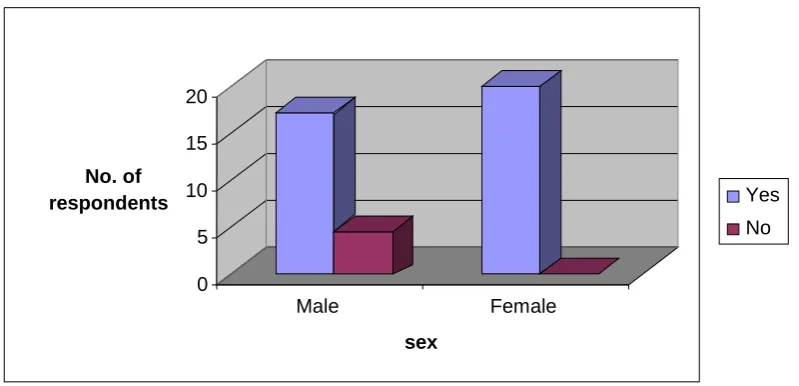
Gender-wise division reveals that all the females (n=20) and majority of males (n=17) interact face-to-face with opposite gender, while three male students have given their responses in the negative, as elaborated in the figure (Fig. 4.1) in the following:
Fig. 4.1. Gender-wise categories Answer
categories Frequency Percent
Valid Percent
Cumulative Percent
Yes 37 92.5 92.5 92.5
No 3 7.5 7.5 100.0
Total 40 100.0 100.0
0 5 10 15 20
No. of respondents
Male Female
sex
It is important to note that in this category members of opposite sex do not include family members of the respondents.
Feelings in face-to-face interaction with opposite sex
As far as the feelings at the time of face-to-face interaction with the opposite sex was concerned, out of 40 respondents, 14 (35%) felt confident, 7 (17%) felt shy, 12 (30%) felt confused, 5 (12.5%) felt afraid of being misunderstood, and 2 (5%) felt afraid of being laughed at. This is illustrated in the following table (Table 4.2):
Table 2 Feelings while face-to-face interaction with opposite sex
Confidence level Frequency Percent Valid Percent
Cumulative Percent
I feel confident 14 35.0 35.0 35.0
I feel shy 7 17.5 17.5 52.5
I feel confused 12 30.0 30.0 82.5
I feel afraid of being
misunderstood 5 12.5 12.5 95.0
I feel afraid of being
laughed at 2 5.0 5.0 100.0
Total 40 100.0 100.0
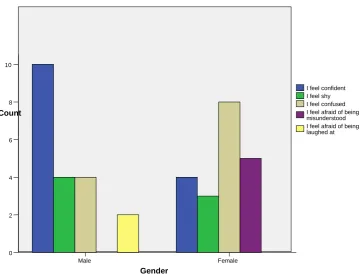
Inter-gender analysis of responses indicated that on the confidence continuum, greater number of males (n=10) opted for ‘a’ category which was ‘I feel confident’ than did females (n=4). The number of respondents who felt shy while interacting face-to-face with opposite sex was almost equal. This shows that even now when inter-gender barriers are collapsing due to communication revolution, there are some people, though small in percentages, who feel shy while communicating with opposite sex in face-to-face communication. While 20% of the respondents in the male group reported feeling confused, greater number of female respondents (40%) belonged to this category. For the category ‘I feel afraid of being misunderstood’, none of the male respondents have opted it, while 25% of the females belonged to this category.
Fig. 4.2. Gender-wise description of feelings in FTF interaction
This indicates that on the confidence continuum a smaller percentage (20%) of female respondents feel confident as against the 50% of male respondents opting for this category.
Another interesting point that emerges from this study is that the higher the educational level, the higher the confidence level. Three out of four female and six out of eleven male respondents, who reported feeling confident in inter-gender communication, are post-graduate students.
Texting for communication with opposite sex
Not only in face-to-face communication, but in text messaging as well, an overwhelming majority of our young generation is engaged in using this mode of communication. As shown in the table below (Table 4.3), 82.5% of the total respondents use texting for communication with opposite sex.
Table 3 Texting for communication with opposite sex Gender
Female Male
10
8
6
4
2
0
I feel afraid of being laughed at I feel afraid of being misunderstood I feel confused I feel shy I feel confident
Answer
categories Frequency Percent
Valid Percent
Cumulative Percent
Yes 33 82.5 82.5 82.5
No 7 17.5 17.5 100.0
Total 40 100.0 100.0
Gender-wise analysis indicates that all females (n=40) and 65% of males (n=13) used texting for communication with opposite sex. The rest of the male respondents (n=7) did not use this facility for such communication. Probably this can be accounted for by the traditional social restrictions on females in this society regarding inter-gender face-to-face communication that the number of females using texting for inter-gender communication is increasing. In other words, it can be deduced that texting helps them overcome the barriers imposed by social norms. The gender-wise bifurcation is illustrated in the following figure (Fig. 4.3):
Fig. 4.3. Texting for communication with opposite sex
Purpose of communication through text messaging
This survey has revealed several purposes for which mostly youngsters use text messaging. The most frequently reported category of purpose was what was labelled as) ‘general communication’. Among the 13 given answers, the 5 most frequently given purposes were ‘general communication’, ‘gossiping’, ‘chatting’, ‘information sharing’, and ‘clarification’ as shown in the following table (Table 4.4):
0 5 10 15 20
No. of Respondents
Male Female
Gender-wise categories
Table 4. Purposes of Communication
Feelings while communicating with opposite sex through text messaging
As regards the feelings of respondents while communicating with opposite sex through text messaging was concerned, a clear majority of them (75%) reported that they felt confident, while 5% felt shy, 15% confused and the rest 5% felt afraid of being misunderstood. None of them reported that they felt afraid of being laughed at. This has been shown in the following table (Table 4.5):
Table 5 Feelings while communicating through SMS with opposite sex
Confidence level Frequenc
y Percent
Valid Percent
Cumulative Percent I feel
confident 30 75.0 75.0 75.0
I feel shy 2 5.0 5.0 80.0
I feel confused 6 15.0 15.0 95.0
I feel afraid of being misunderstood
2 5.0 5.0 100.0
Total 40 100.0 100.0
Category-wise division on the basis of gender has been shown in figure (Fig. 4.5) below.
Purpose Categories Frequenc
y Percent
Valid Percent
Cumulative Percent
-- 2 5.0 5.0 5.0
Chatting 3 7.5 7.5 12.5
clarificat 1 2.5 2.5 15.0
communication 19 47.5 47.5 62.5
confiden 1 2.5 2.5 65.0
Discussi 1 2.5 2.5 67.5
Econo, S 1 2.5 2.5 70.0
Gossipin 4 10.0 10.0 80.0
Informat 3 7.5 7.5 87.5
Jokes 1 2.5 2.5 90.0
Jokes, e 1 2.5 2.5 92.5
Time Pas 1 2.5 2.5 95.0
Typing 1 2.5 2.5 97.5
Waste of 1 2.5 2.5 100.0
Fig. 5. Feelings while communicating through SMS with opposite sex
The figure shows that 19 out of 20 (i.e. 95%) females and 11 out of 20 (55%) males felt confident. The male respondents who felt ‘shy’, ‘confused’, and ‘afraid of being misunderstood’ were two (10%), four (20%), and three (15%) respectively as shown in the above-given figure.
The findings explicitly point to the confidence level among the respondents in general and in females, in particular. Here, the comparison with a previously mentioned category of ‘feelings while face-to-face interaction with opposite sex’ (shown in Table 4.2 and Figure 4.2) would be well in place. While in the previously mentioned category, only four (20%) females felt confident, 19 (95%) females felt ‘confident while texting for communication with opposite sex’.
Similarly, in the previously mentioned category, eight (40%) females had reported that they felt confused, while, in the present category, only one of them felt confused. The outcome illustrates that text messaging is a very effective tool particularly for females in inter-gender communication. This is evident from the findings that as against the face-to-face interaction, the confidence level among females increased almost five times in the interaction through text messaging.
Another interesting point to note is that if we compare the confidence
gender Female
Male 20
15
10
5
0
I feel afraid of being misunderstood I feel confused I feel shy I feel confident
difference between the two genders on this account. While females outperformed males on ‘confidence continuum in text messaging’, males outperformed females in ‘face-to-face communication’ (FTF).
More freedom of expression in texting than FTF
The analysis indicates that texting mode of communicative gives more freedom of expression as compared to face-to-face communication. Out of the total (n=40) respondents, 32 (80%) opined that it did, while eight (20%) responded in the negative as illustrated in the table (Table: 4.6):
Table 4.6. Freedom of expression through text messaging
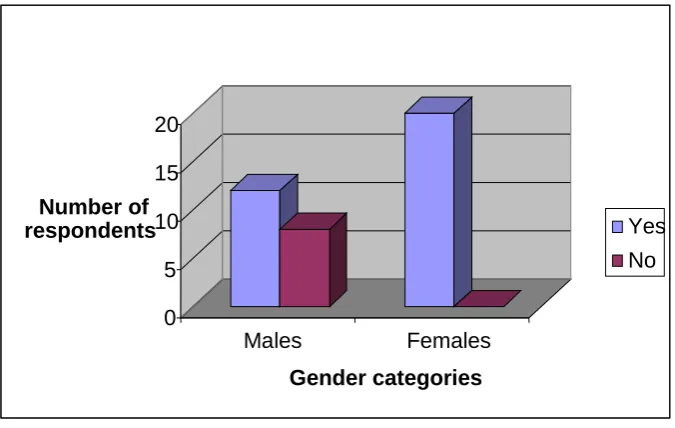
The breakup of outcomes on gender basis reveals that all females (n=20) were of the opinion that it did give freedom of expression in inter-gender communication as against 60% in the male (n=12) group, in this matter. For more clarity the results are shown in the form of a bar graph (Fig. 4.6) in the following:
Fig. 6 Freedom of expression through texting Answer
categories Frequency Percent
Valid Percent
Cumulative Percent
Yes 32 80.0 80.0 80.0
No 8 20.0 20.0 100.0
Total 40 100.0 100.0
0 5 10 15 20
Number of respondents
Males Females
Gender categories
Yes
These responses reveal that females prefer texting to face-to-face communication while interacting with opposite sex more than the male respondents do.
FTF or Text messaging: which one is better??
When asked about the better mode of communication for inter-gender communication, majority of the respondents (55%) favoured ‘communication through text messaging’, whereas, 45% preferred ‘face-to-face communication’ as elaborated in the table (Table 4.7) in the following:
Table 7 Better mode of communication: texting or FTF?
Mode categories Frequency Percent Valid Percent Cumulative Percent Face-to-face
communication 18 45.0 45.0 45.0
Communication
through SMS 22 55.0 55.0 100.0
Total 40 100.0 100.0
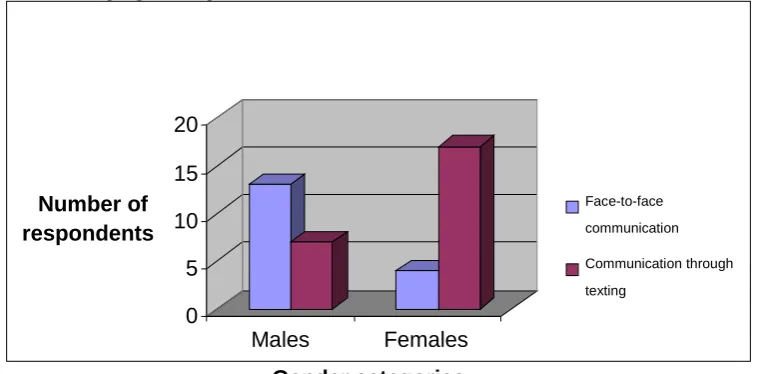
Representation in gender terms reveals that only three (15%) female respondents were in favour of face-to-face communication as against 17 (85%) favouring communication through text messaging. Whereas, in the male group, 13 (65%) favoured ‘face-to-face communication’ as against seven (35%) who favoured ‘communication through text messaging’ in inter-gender communication settings. The same results are shown in bar graph in the following figure (Fig. 4.7):
0 5 10 15 20
Number of respondents
Males Females
Gender categories
Face-to-face
communication
Communication through
Fig. 7 Better mode of communication for male and female students
Analysis further points out that more males (65%) prefer face-to-face communication in inter-gender communication than females (15%). As against this, females are overwhelmingly (85%) in favour of communication through text messaging.
4.8. Significance of differences in inter-gender outcomes
In most of social science as well as in natural science research, a researcher needs to compare two or more samples chosen from populations that have been treated somewhat differently. She/he needs to discover whether these samples do indeed differ significantly with regard to some measured but important characteristic or property.
In order to determine whether the difference between observed characteristic and expected characteristic is significant or the mere result of chance happening, the statistical test of Chi-Square was employed. The significance value in this test is ‘calculated by finding the difference between each observed and expected frequency for each possible outcome, squaring them, dividing each by the theoretical frequency, and taking the sum of the results’.
In our research, we wanted to find out whether the frequency of confidence level in communication through text messaging among respondents with respect to the variable of gender differed significantly or it was the result of mere chance happening. In order to determine the significance level in the frequency distribution of variables, we made use of software called SPSS 15.0 (Statistical Package for Social Sciences). For this purpose, we hypothesized that there was difference between male and female respondents with respect to confidence level while communicating through text messaging. But, according to scientific conventions, we disprove rather than prove. So, we devised a null hypothesis that there was no significant difference between the confidence levels among male and female respondents while communicating through text messaging and tested whether there was a significant difference or not.
Table 8 gender * Feelings while texting with opposite sex Cross tabulation
Table 9 Chi-Square Tests
Value df Asymp. Sig.
(2-sided)
Exact Sig. (2-sided) Pearson
Chi-Square 8.800(a) 3 .032 .013
Likelihood Ratio 10.616 3 .014 .020
Fisher's Exact Test 7.838 .020
N of Valid Cases 40
a 6 cells (75.0%) have expected count less than 5. The minimum expected count is 1.00.
As P- value for Pearson Chi-Square statistic is .032 which is less than .05, the typical acceptable value for a difference to be significant, the Null Hypothesis stood rejected, and our hypothesis stood proved that there existed significant difference between the confidence level among male and female students while texting in inter-gender communication.
Feelings while texting with opposite sex Total
Gender
I feel confident
I feel shy
I feel confused
I feel afraid of being misunderstood
Male Count 11 2 5 2 20
Expected Count 15.0 1.0 3.0 1.0 20.0
% within gender 55.0% 10.0% 25.0% 10.0% 100.0%
% within Feelings while texting with opposite sex
36.7% 100.0% 83.3% 100.0% 50.0%
% of Total 27.5% 5.0% 12.5% 5.0% 50.0%
Female Count 19 0 1 0 20
Expected Count 15.0 1.0 3.0 1.0 20.0
% within gender 95.0% .0% 5.0% .0% 100.0%
% within Feelings while texting with opposite sex
63.3% .0% 16.7% .0% 50.0%
% of Total 47.5% .0% 2.5% .0% 50.0%
Total Count 30 2 6 2 40
Expected Count 30.0 2.0 6.0 2.0 40.0
% within gender 75.0% 5.0% 15.0% 5.0% 100.0%
% within Feelings while texting with opposite sex
100.0% 100.0% 100.0% 100.0% 100.0%
Conclusion
Gender discrimination is so extensively practiced in society that it makes it appear like a natural law. The stereotypical behaviour of gender discrimination becomes a norm in the society so much so that men and women internalize it and always act in different ways. Thus, the society always seems to hold the opinion that males and females think differently, so they behave differently; they do not hold the same attitudes and beliefs. As a result, social distance is created and maintained between the two sexes. Hence, as the above mentioned stereotypical behaviours are everywhere internalized in society, it is generally believed that all the conditions and resources provided for the emancipation of women will prove fruitless.
FTF interaction is burdened with negative features as it evidently shows the females’ powerlessness. For example, ‘the feeling of shyness’, ‘the fear of being misunderstood’ in FTF communication prove that the person the respondent faces is like a stranger to her or that she has to behave in a very conventional formal way, not only because of the person she is interacting with but also because of the others who may witness their interaction. ‘The feeling of shyness’ may also show the feelings in the heart of the respondent(s) that whatever she is saying, is not up to the required standard of the interaction.
All the respondents of this research have been using texting for a long time. So, the data obtained from them sustain them as reliable sources of judgments. Most of the respondents express positive feelings towards using texting as compared to using FTF interactions. Thus, the outcomes of this study amply demonstrate that the use of text messaging play a pivotal role in enhancing inter-gender interaction.
References
Ali, T. S., Krantz, G., Gul, R., Asad, N., Johansson, E., & Mogren, I. (2011). Gender roles and their influence on life prospects for women in urban Karachi, Pakistan: a qualitative study. Global Health Action 2011, 4, 7448. Retrieved from: http://creativecommons.org/licenses/by-nc/3.0/, DOI: 10.3402/gha.v4i0.7448
Asif, S. I. & Zahra, S. F. (2006). The net speak of young Pakistani netizens.
Journal of Research: Faculty of Languages and Islamic Studies, BZU,
10, 1-16.Cambridge Dictionary Online. Retrieved from https://dictionary .cambridge. org/ dictionary/english/empowerment. Retrieved on August 10, 2018
Carli, L.L. (1999). Gender, interpersonal power and social influence. Journal
of Social Issues. 55(1), 81-99. DOI:
https://doi.org/10.1111/0022-4537.00106
Chiluwa, I., Chimuanya, L., Ajiboye, E., & Peter, A. (2015). Texting and relationship: Examining discourse strategies in negotiating and sustaining relationships using mobile phone. Covenant Journal of Language Studies
(CJLS), 3( 2), 15-38.
Crystal, D. (2001). Language and the internet. Cambridge: Cambridge University Press
Gill, R., & Stewart, D. E., (2010). Relevance of gender-sensitive policies and general health indicators to compare the status of South Asian Women’s Health. Women Health Issues, 21(1), 12-18.
Global Gender Gap Report (2017), World Economic Forum. Geneva
Switzerland Retrieved from: www.weforum.org. Retrieved on: August
15, 2018.
GSM World Press Release (2007). http://www.gsmworld. com/news/press_ 2007/ press07_48.shtml. Retrieved on: December 2n, 2007.
GSMA Press Release (2017). https://www.gsma.com/newsroom/press-release/number-mobile-subscribers-worldwide-hits-5-billion/. Retrieved on: December 10, 2017
Guerra, E. I. (2015). Talking or typing? Gender differences in communication
patterns of face to face versus online courses. Unpublished thesis for
Hendrick, S. S. (1988). A generic measure of romantic relationship satisfaction. Journal of Marriage and Family, 50(1), 93-98. DOI: 10.2307/352430
Johnson, P. (1976). Women and power: Toward a theory of effectiveness. Journal of Social Issues, 32, 99-110
Kasesniemi, E., Rautiainen, P. (2002). Mobile culture of children and
teenagers in Finland. In James, E., Katz, Mark, A., & Aakhus (Eds.),
Perpetual contact: Mobile communication, private talk, public performance (pp. 170-192), Cambridge: Cambridge University Press.
Khan, H. U. (2006). Affective and cognitive empowerment of female students
of higher education through the use of science and technology. A paper presented at International Conference on The Role of Women in Nation Building, BZU Multan, Unpublished.
Lakoff, R (1975)Language and women’s place. NY: Harper and Row.
Lenhart, A., Purcell, K., Smith, A., & Zickur, K. (2010). Social media and young adults. Pew Internet & American Life Project. Retrieved from: http://eric.ed.gov/?id=ED525056
Lincoln, N. D., Travers, C., Ackers, P., & Wilkinson, A. (2002). The Meaning of Empowerment: the interdisciplinary etymology of a new management concept. International Journal of Management Reviews. DOI: https://doi.org/10.1111/1468-2370.00087
Ling, R. (2005). The Socio-linguistcs of SMS: An analysis of SMS use by a
random sample of Norwegians. In Ling, R., & Pedersen, P. (Eds.) Mobile communications: Renegotiation of the social sphere, (pp. 335-349).
London: Springer.
Luo, S. (2014). Effects of texting on satisfaction in romantic relationships: The role of attachment. Computers in Human Behavior, 33, 145-152. DOI: 10.1016/j.chb.2014.01.014
Merriam-Webster Online Dictionary. https://www.merriam-webster.com/ dictionary/ empowerment. Retrieved on: August 10, 2018.
Mobile Economy (2018). https://www.gsma.com/mobileeconomy/. Retrieved on: October 8, 2018.
Okonowsky, L. (2016). The effect of text messaging preferences and behavior
on romantic relationship satisfaction. Unpublished thesis for Master of
Qaisrani, A., Liaquat, S., & Khokhar, E. N. (2016). Socio-economic and
cultural factors of violence against women in Pakistan. Working paper #
158. Sustainable Development Policy Institute (SDPI), Islamabad, Pakistan. Retrieved from: www.sdpi.org
Rodino, M (1997) Breaking out of binaries: reconceptualising gender and its relationship to language and Computer Mediated Communication.
Journal of CMC. 3 (3). Retrieved from: [http/ascusc.org/jcmc].
Schiffrin, D. (1996). Interactional Sociolinguistics. In S. L. Mc Kay, and N. H. Hornberger, (Eds.). Sociolinguistics and Language Teaching. (pp. 307-328). New York: Cambridge University Press
Sen, A. (2001). Guest voice: child survival and the agency of women. The State of World’s Children. UNICEF.
Smith, A. (2011). Why Americans use social media: Pew Internet &
American Life Project. Retrieved from: http://www.pewinternet. org/
2011/11/15/ why-americans- use-social-media/. Retrieved on: August 15, 2018.
Thurlow, C. (2003). Generation txt? The sociolinguistics of young people's
text-messaging. Retrieved from: http://extra.shu.ac.uk/daol /articles/v1/n1/ a3/thurlow2002003-02.html. Retrieved on: January 10, 2007
Xia, Y. (2012). Chinese use of mobile texting for social interactions: cultural implications in the use of communication technology. Intercultural
Communication Studies, 21 (2), 131-150.
Yates, S. (2001). Gender, language and CMC for education. Learning and
Instruction, 11, (21-34).