Acupuncture for patients with
functional dyspepsia: study protocol
of a randomised controlled trial
Hui Zheng,1Jing Xu,1Juan Li,1Xiang Li,1Ling Zhao,1Xiaorong Chang,2Mi Liu,2 Biao Gong,3Xuezhi Li,3Fanrong Liang1
To cite:Zheng H, Xu J, Li J,
et al. Acupuncture for
patients with functional dyspepsia: study protocol of a randomised controlled trial.BMJ Open2013;3: e003377. doi:10.1136/ bmjopen-2013-003377
▸ Prepublication history for this paper is available online. To view these files please visit the journal online (http://dx.doi.org/10.1136/ bmjopen-2013-003377).
HZ and JX contributed equally.
Received 13 June 2013 Revised 20 June 2013 Accepted 21 June 2013
For numbered affiliations see end of article.
Correspondence to Professor Fanrong Liang; cdutcm.fanrong.liang@gmail. com
ABSTRACT
Introduction:Whether acupuncture is efficacious for
patients with functional dyspepsia is still controversial. So we designed a randomised controlled trial to settle the problem.
Methods and analysis:We designed a multicentre,
two-arm, sham-controlled clinical trial. 200 participants with functional dyspepsia will be randomly assigned to the true acupuncture (TA) group and sham acupuncture (SA) group in a 1:1 ratio. Participants in the TA group will receive acupuncture at points selected according to syndrome differentiation. Participants in the sham acupuncture group will receive penetrations at sham points. Participants in both groups will receive 20 sessions of electroacupuncture in 4 weeks, five times continuously with a 2 day rest in a week. The primary outcome is the proportion of patients reporting the absence of dyspeptic symptoms at 16 weeks after inclusion. The secondary outcome includes a Short-Form Leeds Dyspepsia Questionnaire, the Chinese version of the 36-Item Short Form Survey, the Chinese version of the Nepean dyspepsia index, etc.
Ethics and dissemination:The study protocol has
been approved by the institutional review boards and ethics committees of the first affiliated hospital of Chengdu University of TCM, the first affiliated hospital of Hunan University of TCM and Chongqing Medical University, respectively (from April to August 2012). The results of this trial will be disseminated in a peer-reviewed journal and presented at international congresses.
Trials registration:ClinicalTrials.gov NCT01671670.
INTRODUCTION
Functional dyspepsia (FD) is a common gas-troduodenal disorder without structural lesions, which is claimed to affect 20–25% of the population in Western countries.1 In Asia, the prevalence of FD is reported to be 5.3% in the adult population of Taiwan,2 while it bothers 24% of the school children in Thailand.3 Overall, the prevalence of FD ranges from 8% to 23% in Asia.4 FD is closely related to low quality of life, psycho-logical disturbances, etc,5 6 leading to excess
healthcare services and costs as well as low work productivity.7 8
Reasonable treatment approaches based on current evidence are a daily proton pump inhibitor in patients with FD with Helicobacter pylori-negative, a tricyclic antidepressant, an antinociceptive agent, a prokinetic agent or some form of complementary and alternative medications.9–13 However, evidence support-ing these approaches is still limited.9–13 Acupuncture, as one of the most popular com-plementary therapies, is widely used for gastro-intestinal diseases in China.14 Our previous study showed that acupuncture is effective and efficacious for patients with FD.15However, in this trial, fixed acupuncture protocols were used, which is not quite the same as conven-tional acupuncture practice, in which
ARTICLE SUMMARY
Article focus
▪ Is acupuncture efficacious for patients with func-tional dyspepsia?
▪ How will the acupuncture effect change over time?
Key messages
▪ This study will increase the knowledge about the efficacy of acupuncture for functional dyspepsia.
▪ The primary outcome is the proportion of patients reporting the absence of dyspeptic symptoms at 16 weeks after inclusion.
▪ Outcome measurements will be assessed at 0, 4, 8, 12, 16, 20 and 24 weeks after inclusion.
Strengths and limitations of this study ▪ This trial is the first multicentre randomised
con-trolled trial using an individualised acupuncture protocol to test the efficacy of acupuncture for functional dyspepsia.
▪ The first trial focuses on the changes of acu-puncture effect on functional dyspepsia over time.
▪ Blinding the care providers is still not applied in this trial, since it is merely impossible to blind acupuncturists.
on September 22, 2020 by guest. Protected by copyright.
individualised acupuncture protocols are commonly applied. Moreover, we found a trend that the effect of acu-puncture seems to last for months, but we are not sure how long the effect will last because of the short follow-up period. Since FD is a chronic disorder with exacerbations and remissions, it is important tofind out the answers.16
Therefore, we will conduct another randomised con-trolled trial aiming at: first, confirming whether indivi-dualised acupuncture treatment is efficacious for patients with FD; second, observing and analysing the change of acupuncture effect over time.
METHODS
Overview of the study design
We designed a multicentre, two-arm, sham-controlled study, in which the interventions will be performed under ideal circumstances. Therefore, this trial will be carried out in academic settings, which were originally planned to be: The first affiliated hospital of Chengdu University of TCM, the first affiliated hospital of Hunan University of TCM and Chongqing Medical University.
If the participants meet the inclusion criteria, the acu-puncturists in each centre will send a phone text or an email (including the name, age, gender of a participant) that requires central randomisation, which is managed by a third party (the Brightech Magnsoft Data Services Company). The acupuncturists will receive a text con-taining the group assignment, randomisation sequence and project number, several minutes after sending out the requirement for randomisation.
Before baseline, participants will be screened in the aforementioned research centres. After the screening process, the patients with FD will be asked if they are willing to participate in this trial; if not, they will be given conventional treatment according to the guide-lines,17 and will be assessed using the same outcome measurements through telephone follow-up.
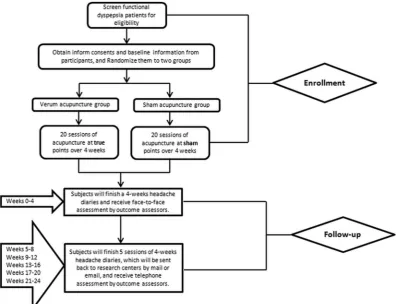
After randomisation, the participants will be either assigned to an acupuncture group or a sham acupunc-ture group. They will go through a total research period of 25 weeks, including 1 week at baseline, 4 weeks of acu-puncture treatment and 20 weeks of the follow-up phase. The included participants will receive 20 sessions of acupuncture treatment in 4 weeks,five times continu-ously with a 2-day rest in a week. Outcome measure-ments will be assessed at 0, 4, 8, 12, 16, 20 and 24 weeks after inclusion, with the outcome assessors blinded to the group assignment.
The study protocol has been approved by local institu-tional review boards and ethics committees (from April to August 2012). It follows the principles of the CONSORT and STRICTA statements as well as the Declaration of Helsinki (Sixth revision, 2008).
Participant eligibility
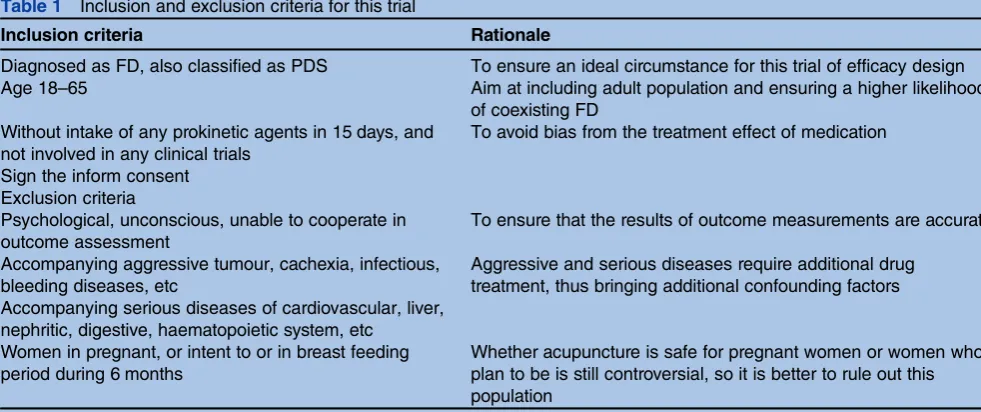
We are planning to recruit patients with FD diagnosed on the basis of the Rome III criteria.18 And we choose to include patients with FD classified with postprandial distress syndrome (PDS), ruling out those classified with epigastric pain syndrome (EPS). According to our previ-ous research, 70% of patients with FD were classified with PDS, which is a larger suffering population than those with EPS. Additionally, to ensure an ideal circum-stance for this efficacy trial, we will include only patients with PDS, although it will partially narrow the generality of the results. Doctors responsible for screening patients will be gathered and trained using the ROME III criteria in each centre. Then a pretrial screening will be per-formed, with all the doctors screening a group of partici-pants. Finally, a comparison of the screening results among different doctors will be made, and homogeneity should be achieved. Details of the inclusion and exclu-sion criteria of the participants are listed intable 1.
Table 1 Inclusion and exclusion criteria for this trial
Inclusion criteria Rationale
Diagnosed as FD, also classified as PDS To ensure an ideal circumstance for this trial of efficacy design Age 18–65 Aim at including adult population and ensuring a higher likelihood
of coexisting FD Without intake of any prokinetic agents in 15 days, and
not involved in any clinical trials
To avoid bias from the treatment effect of medication
Sign the inform consent Exclusion criteria
Psychological, unconscious, unable to cooperate in outcome assessment
To ensure that the results of outcome measurements are accurate
Accompanying aggressive tumour, cachexia, infectious, bleeding diseases, etc
Aggressive and serious diseases require additional drug treatment, thus bringing additional confounding factors Accompanying serious diseases of cardiovascular, liver,
nephritic, digestive, haematopoietic system, etc Women in pregnant, or intent to or in breast feeding period during 6 months
Whether acupuncture is safe for pregnant women or women who plan to be is still controversial, so it is better to rule out this population
FD, functional dyspepsia; PDS, postprandial distress syndrome.
on September 22, 2020 by guest. Protected by copyright.
After a diagnosis of FD was established, gastrointestinal symptoms and the quality of life will be evaluated to determine the patient’s baseline status. Then the partici-pants will go through the randomisation process.
Recruitment strategies and randomisation
We will recruit participants through three methods:first, call the participants who joined our previous study to
find out if they are interested in attending this study; second, specific doctors receiving training will screen and recruit participants in outpatient clinics in each centre; third, advertisements and recruitment notices will be placed in newspapers, the local media, health promotion manuals, etc.
If patients are eligible, the doctor will ask if they are interested in participating. If so, the doctor will refer them to a research coordinator, who will introduce the aim and the methods of this study and ask the partici-pants to sign the consent form. Participartici-pants who provide consent will be introduced to the outcome assessor for baseline evaluation and then be referred to an acupunc-turist to apply for randomisation.
Central randomisation is used in this study. The acu-puncturists are trained to apply for randomisation through text messages, online website or telephone appli-cation. Qualified acupuncturists will have their cell phone number registered in the randomisation centre (located in Brightech Magnsoft Data Services Company), with permission to send applications for randomisation of participants. Randomisation is automatically per-formed in a real-time mode by the central computer. Subjects are randomised in blocks of varying size within each site, stratified by age and duration of FD.
Blinding
Participants will be blinded to group assignment in this trial. We will inform them that there are two types of acupuncture treatment provided for FD in this trial, both of which are used in clinical practice. We will also notify that one of the acupuncture treatments is a trad-itional style, while the other is a style designed according to the rationale of Western medicine. Acupuncturists (care providers) will not be blinded in this trial, because it is impossible. Acupuncturists could easily guess the group assignment, through recognising the function of the acupuncture points, which we should clearly tell them. So in this trial, we ask the acupuncturists to use the same method of stimulating acupuncture points and sham acupuncture points, in order to control the risk of performance bias.
Study groups Acupuncture arm
In the planning phase, we formulated the acupuncture protocol in three steps:first, through a systematic review of published studies, textbooks and ancient literatures, we decided on the syndrome differentiation protocol for acupuncture treatment of FD (excess syndrome and
deficiency syndrome), as well as a range of acupuncture points to manage the condition. Second, we held a face-to-face meeting to discuss the protocol and turn it into a standardised approach. Third, we sent out ques-tionnaires to acupuncturists across the country, asking whether this standardised protocol is commonly used in their clinical practice and also asking suggestions for improvement. Fourth, afinal version of the protocol was used in the Phase I study, with 10 healthy subjects and 10 participants with FD included, to test the safety, effect size and tolerance of the acupuncture treatment for the condition.
We choose Zusanli (ST36) and Neiguan (PC6) as basic acupuncture points, which will be needled in every participant. ST36 belongs to the stomach meridian according to traditional acupuncture theories, which is believed to be one of the best acupuncture points specif-ically selected for gastrointestinal diseases. PC6 is fre-quently used for upper gastrointestinal conditions, such as nausea and vomiting, which are associated with acute myocardial infarction,19 chemotherapy,20 hyperemesis gravidarum,21 etc. Regarding patients with FD manifest-ing mainly with upper gastrointestinal discomfort, ST36 and PC6 were chosen as the basic points.
Additionally, there are two groups of optional points, which would be alternately selected according to syn-drome differentiation. First group: if the participants are differentiated as excess syndrome, Taichong (TR3) and Neiting (ST2) will be selected. Second group: if differen-tiated as deficiency syndrome, Gongsun (SP4) and Yinlingquan (SP9) will be selected. The excess and defi -ciency syndromes are defined according to the dyspepsia session in Guidance of clinical research of traditional Chinese medicine published by the State Food and Drug Administration (SFDA) in China.22The excess syndrome mainly refers to excess of liver Qi and stomach fire, while the deficiency syndrome mainly refers to defi -ciency of spleen and stomach Qi. So TR3 (which belongs to the liver meridian) and ST2 (which belongs to the stomach meridian) are fit for the excess syn-drome, whereas SP4 and SP9 (both belong to the spleen meridian) are selected for the deficiency syndrome. Therefore, selection of acupuncture points consists of two basic points and two optional points, which is similar to conventional acupuncture practice.
Each point is a puncture using a filiform needle (25– 40 mm in length and 0.25 mm in diameter), and achieving a Deqi sensation (refers to a sensation of numbness, distension or electrical tingling at the needling site which might radiate along the corresponding meridian) is needed. Then an auxiliary needle (13 mm in length and 0.18 mm in diameter) will be a puncture 2 mm lateral to thefirst needle, to a depth of 2 mm without the arrival of Deqi. Electroacupuncture will be used at every point with one electrode connected to the filiform needle and the other to the auxiliary needle. This method limits electrical stimulation on points, rather than going across the human body surface to cause performance bias. Electrical
on September 22, 2020 by guest. Protected by copyright.
stimulation will last for 30 min in each acupuncture session. A total of 20 acupuncture sessions will be per-formed during 4 weeks, once daily for 5 days with a 2-day rest in a week (figure 1).
Sham acupuncture arm
The same sham points as used in our previous study will be adopted in this trial, and details of the location of the points are described elsewhere.23 Participants in the sham control group will also receive the same electrical stimulation and the same duration of treatments as the participants received in the acupuncture group.
The intervention of this trial is the rigorous acupunc-ture schedule; to ensure the compliance of acupunctur-ists to the schedule, we ask them to take a pretrial training and an entrance exam for this trial. Only the qualified acupuncturists will be admitted to this trial. The principal investigator (FL)will assign a specific researcher in every centre to check if the acupuncturists follow the treatment protocol and report the compli-ance every month to the Brightech Magnsoft Data Services Company.
Outcome measurements Primary outcome
The primary outcome of this study was first targeted through a review of previous studies and then selected based on a consensus from researchers in the territory
of functional gastrointestinal disorders, patients with dys-pepsia and physicians. The proportion of patients reporting the complete absence of dyspeptic symptoms is considered to be the most important outcome meas-urement.24 So the participants in this trial will undergo a self-assessment of global relief of the dyspepsia symp-toms, with afive-grade scale: absence of dyspeptic symp-toms, significantly improved, moderately improved, not changed and deteriorated. The primary outcome is the proportion of patients reporting the absence of dyspep-tic symptoms at 16 weeks after inclusion, at which stage the participants are supposed to achieve maximum relief of the dyspeptic symptoms according to our previ-ous study.15
Secondary outcomes
The Short-Form Leeds Dyspepsia Questionnaire
(SF-LDQ)25 is a five question instrument for assessing the dyspeptic symptoms. Five symptoms including epi-gastric pain, postprandial distention, indigestion, heart-burn and nausea will be graded for severity on a
five-point Likert scale from very mild to very severe: no symptoms (0 point), mild symptoms without influence of regular work (1 point), mild symptoms with influence of regular work (2 points), moderate symptoms (3 points), severe symptoms (4 points) and extremely severe symptoms (5 points). SF-LDQ is a validated and reliable tool to assess the dyspeptic symptoms of patients
Figure 1 Flow chart of the trial.
on September 22, 2020 by guest. Protected by copyright.
with FD,25 26with higher scores indicating worse dyspep-tic outcomes.
A Chinese version of Nepean dyspepsia index (NDI) will be used in this trial to assess the disease-specific quality of life. This scale was validated and confirmed to be a reliable tool for the Chinese population in our pre-vious study.27 The NDI scale consists of 25 items, with a total score ranging from 0 to 99. Higher scores indicate a poorer quality of life. Each of the items is afive-point Likert scale that scores the severity of symptoms from
‘not at all’ to ‘extremely severe’. Moreover, the 25-item NDI scale measures the quality of life in four domains: interference (13 items), know/control (7 items), eat/ drink (3 items) and sleep/disturb (2 items). Finally, a Chinese version of the 36-Item Short Form Survey (SF-36) will be used to assess the overall health status of the included participants.
Time points of outcome measurement
We chose the time points of assessments, considering the following aims:first, to capture the key milestones in the management of patients with FD with acupuncture; second, to see how the acupuncture effect changes over time. According to our previous study,15 a duration of 4 weeks is reasonable and reliable to assess the change of dyspeptic symptoms of patients with FD. Therefore, we followed up participants at the time points of 4, 8, 12, 16, 20 and 24 weeks after inclusion. At baseline, the participants will be given the physical examination, outcome assessments and regular tests. The regular tests include routine blood, urine and stool tests, liver and kidney function test, gastroscopy, ultrasonic examination in the upper abdomen and pregnancy test. The preg-nancy test is to exclude the risk that acupuncture may bring to pregnant women, who do not know the infor-mation. An overview of the measurements at different time points is presented intable 2.
Assessment of adverse events
According to our previous study, acupuncture may cause several adverse events.28 So we will record adverse events caused by acupuncture and the reasons for these events during the treatment and follow-up phases. These adverse events include bleeding, haematoma, fainting, serious pain, local infection, etc. The number of adverse events will be calculated for each group.
Sample size calculation
On the basis of our previous study,15 after receiving 20 sessions of acupuncture treatments, 46.1% of patients with FD with PDS responded to true acupuncture, whereas 14.1% of the patients responded to sham acu-puncture, so a difference of 32% was observed. In this trial, different acupuncture protocols were used, so we conservatively expected a responder rate of 50% in the acupuncture group and 25% in the sham acupuncture group, in order to detect a difference of 25% between true and sham acupuncture. Considering a two-sided sig-nificant level of 5% and power of 90%, 85 participants per group will be needed, calculated by Fisher’s exact test in G*Power(V.3.1.5). To minimise attrition bias, a dropout rate of 15% was considered, making it necessary to include at least 100 participants per group.
Statistical analysis
The primary analysis will be a comparison of the propor-tion of patients reporting the absence of dyspeptic symp-toms between acupuncture and sham acupuncture at 16 weeks after inclusion (comparison of the primary endpoint). We will use χ2 test to detect the difference between groups, with a significant level of 0.05. To analyse how the primary outcome changes over time after acupuncture treatment, we will use the model of generalised estimating equations with adjustments for clinical centres, baseline assessments of dyspeptic symp-toms, duration of the FD symptoms (continuous value calculated by months) and age (continuous value calcu-lated by years). The secondary analysis will be per-formed to assess the changes of the SF-LDQ, NDI scores and SF-36 from baseline to 24 weeks after inclusion; we use linear mixed models adjusted for clinical sites and baseline scores. The rates of adverse events will be com-pared between groups. We perform the above analysis using the intention to treat method. Missing values will be handled using the multiple imputation method, on the assumption that values at each time point follow a specific distribution calculated by the computer software R project (V.2.15.3, http://www.R-project.org/). We will also perform a complete-case analysis without imput-ation of missing values, tofind out if the results are con-sistent with the above analysis. The data will be analysed using SPSS V.20.0 (IBM SPSS Statistics, IBM Corp, Somers, New York).
Table 2 Measurements at different time points
Measurements 0 week 4 weeks 8 weeks 12 weeks 16 weeks 20 weeks 24 weeks
PE × ×
GADS × × × × × × ×
LDQ × × × × × × ×
NDI × × × × × × ×
SF-36 × ×
Lab test ×
GADS, Global assessment of dyspeptic symptoms; LDQ, Leeds Dyspepsia Questionnaire; NDI, Nepean dyspepsia index; PE, physical examination; SF-36, 36-Item Short Form Survey.
on September 22, 2020 by guest. Protected by copyright.
Data management
All data are managed by the data coordinating centre through a third party, the Brightech Magnsoft Data Services Company. This company developed a password-protected website for this trial, which is designed with the function of randomisation, data entry of the research data (including information of screening and eligibility, outcome assessments, adverse events and quality control) and overview of the process of this trial. All data will be backed up in different network drives located both in Chengdu and Beijing.
DISCUSSION
We describe the rationale, design and analytic methods of a randomised controlled trial comparing acupuncture and sham acupuncture for patients with FD, at different time points. Hopefully, convincing evidence will be found to clarify whether acupuncture is efficacious for this condition.
Before this trial, we have conducted a multicentre ran-domised trial to assess the effect of acupuncture for patients with FD.15 In the trial, 712 patients with FD were randomly assigned to six groups, four acupuncture groups versus one sham acupuncture group and a drug (Itopride) control group. The results showed that acu-puncture at specific points of the stomach meridian is superior to acupuncture at points of other meridians and sham points, as well as oral administration of Itopride. Results of this trial, for the first time,
con-firmed that acupuncture is superior to Itopride, which was reported to be an efficacious treatment for patients with FD in the year 2006, a couple of months before planning and carrying out of the trial.29 However, Itopride was then reported to be a treatment no better than placebo in a larger sample phase III trial,24 which makes our conclusion that acupuncture is effective for FD still inconclusive. Moreover, although the results showed that acupuncture is superior to sham, it is not conclusive either. A design of four acupuncture arms versus one sham acupuncture arm was used, indicating that there may be a chance that the results are false posi-tive, because of multiple comparisons among groups. In outcome assessments, we used scores of the symptom index of dyspepsia as a primary outcome, which is a scale without going through the validation and reliability test, but is commonly used in China. Thus, the results are not as reliable as we expected, because of a weak primary outcome assessment.
An interesting result of that trial showed that the acu-puncture effect seems to last at least 3 months after 20 sessions of acupuncture treatment. However, we are not sure for how long this effect will last, since we followed up the participants for only 16 weeks. This long-lasting effect may be an advantage of acupuncture treatment, which therefore justifies a new trial with a much longer follow-up period.
Combining the above facts, we found that the existing evidence is not enough to draw afirm conclusion on the effectiveness and efficacy of acupuncture for FD. So we hypothesised that: acupuncture is superior to sham acu-puncture (acuacu-puncture is efficacious) in relieving the dyspeptic symptoms of patients with FD. To test these hypotheses, we designed this trial, with a control group of sham acupuncture, to reduce the likelihood of reach-ing a false-positive outcome caused by multiple compari-sons. We used a proportion of patients reporting the absence of dyspeptic symptoms as a primary outcome, in order to reach a more reliable conclusion as compared to our previous trial. Moreover, we planned a follow-up period of 24 weeks, in order to fully understand this long-lasting effect of acupuncture for relieving dyspeptic symptoms. In our previous trial, we included patients with FD classified with PDS or EPS. In this trial, we planned to recruit participants with PDS only, because a narrow and specific population will be more appropriate in a trial using efficacy design. To make the recruitment of the participants easier, we will call the participants who joined our previous study to find out if they are interested in attending this study. We will inform them that new types of acupuncture will be used, which will be conducted according to traditional and modern theor-ies, and will be different from the previous acupuncture they received. Also, we will exclude the participants who received sham acupuncture in the last trial, to reduce the risk of unblinding, since we will use the same sham points in this trial.
A major issue in designing this trial is how to distin-guish the treatment effect of acupuncture from the effect brought on by other factors, like improvement to a more healthy living style, administration of drugs to improve gastrointestinal function, etc. To minimise the bias con-tributed by these factors, we considered the following solutions:first, we give the participants an education of a healthy living style in both groups. The participants will receive a handbook of preventing FD, including a healthy style of diet, appropriate exercise to improve gastrointes-tinal function, etc; second, we ask the participants not to take drugs unless there is an urgent need, for example, dyspeptic symptoms are not relieved after 10 session of acupuncture treatment, or dyspeptic symptoms signifi -cantly lower the quality of life; third, we revise our acu-puncture protocols several times according to the literature review and expert experience, in order to ensure the effectiveness of the experimental arm.
Another major issue is how to collect data in different time points correctly. Five follow-up time points across 20 weeks are defined in this trial. So we may get inaccur-ate parameters during outcome assessments in such a long follow-up period. To avoid bias from outcome assessment, we first train the outcome assessors to use telephone interview, email contact to collect follow-up data; second, we ask the assessors to help the partici-pants to fully understand the follow-up questions, in which we try our best to minimise the number of
on September 22, 2020 by guest. Protected by copyright.
questions, in order to avoid frustration of participants in responding; third, we promise the participantsfive more acupuncture treatments if they respond to the whole follow-up interview.
CONCLUSION
This article presents a design and protocol of acupunc-ture for patients with FD, in order to clarify the efficacy of acupuncture for this condition. The results are expected to give answers to the following questions:first, whether acupuncture is superior to sham acupuncture; second, whether the acupuncture effect lasts longer than the sham effect.
Author affiliations
1The 3rd Teaching Hospital, Chengdu University of Traditional Chinese Medicine, Chengdu, Sichuan, China
2Department of Acupuncture & Tuina, Hunan University of Traditional Chinese Medicine, Changsha, Hunan, China
3Traditional Chinese Medicine, Chongqing Medical University, Chongqing, Chongqing, China
AcknowledgementsWe appreciate the help received from the staff of Brightech Magnsoft Data Services Company, who contributed a lot in the design and statistical analysis plan of this trial. We acknowledge the help and contributions from acupuncturists, experts and investigators in each centre. We also acknowledge the contributions from patients with FD participating in this trial.
Contributors HZ, JX, JL, XL, LZ, XrC, BG and FrL participated in the design of the trial, in writing the data analysis plan, and in drafting the manuscript. JL, ML and XzL collected the information needed for the performance of this trial in each centre. All the authors discussed, read, revised the manuscript and finally gave approval for publication of this protocol.
Funding This trial was financially supported by the National Basic Research Programme of China‘973 Program’(No. 2012CB518501). The funder will not have a role in the conduct or interpretation of this trial, or in any decision to publish the results.
Competing interests None.
Ethics approval The study protocol has been approved by the institutional review boards and ethics committees of the first affiliated hospital of Chengdu University of TCM, the first affiliated hospital of Hunan University of TCM and Chongqing Medical University, respectively (from April to August 2012). Provenance and peer review Not commissioned; internally peer reviewed. Open Access This is an Open Access article distributed in accordance with the Creative Commons Attribution Non Commercial (CC BY-NC 3.0) license, which permits others to distribute, remix, adapt, build upon this work non-commercially, and license their derivative works on different terms, provided the original work is properly cited and the use is non-commercial. See: http:// creativecommons.org/licenses/by-nc/3.0/
REFERENCES
1. Oustamanolakis P, Tack J. Dyspepsia: organic versus functional. J Clin Gastroenterol2012;46:175–90.
2. Chang FY, Chen PH, Wu TC,et al. Prevalence of functional gastrointestinal disorders in Taiwan: questionnaire-based survey for adults based on the Rome III criteria.Asia Pac J Clin Nutr 2012;21:594–600.
3. Phavichitr N, Koosiriwichian K, Tantibhaedhyangkul R. Prevalence and risk factors of dyspepsia in Thai schoolchildren.J Med Assoc Thai2012;95(Suppl 5):S42–7.
4. Ghoshal UC, Singh R, Chang FY,et al. Epidemiology of uninvestigated and functional dyspepsia in Asia: facts and fiction. J Neurogastroenterol Motil2011;17:235–44.
5. Filipovic BF, Randjelovic T, Ille T,et al. Anxiety, personality traits and quality of life in functional dyspepsia-suffering patients.Eur J Intern Med2013;24:83–6.
6. Aro P, Talley NJ, Agreus L,et al. Functional dyspepsia impairs quality of life in the adult population.Aliment Pharmacol Ther 2011;33:1215–24.
7. Sander GB, Mazzoleni LE, Francesconi CF,et al. Influence of organic and functional dyspepsia on work productivity: the HEROES-DIP study.Value Health2011;14(5 Suppl 1):S126–9. 8. Brook RA, Kleinman NL, Choung RS,et al. Excess comorbidity prevalence and cost associated with functional dyspepsia in an employed population.Dig Dis Sci2012;57:109–18.
9. Moayyedi P, Delaney BC, Vakil N,et al. The efficacy of proton pump inhibitors in nonulcer dyspepsia: a systematic review and economic analysis.Gastroenterology2004;127:1329–37.
10. Soo S, Forman D, Delaney BC,et al. A systematic review of psychological therapies for nonulcer dyspepsia.Am J Gastroenterol 2004;99:1817–22.
11. Hiyama T, Yoshihara M, Matsuo K,et al. Meta-analysis of the effects of prokinetic agents in patients with functional dyspepsia.
J Gastroenterol Hepatol2007;22:304–10.
12. Talley NJ, Tack J, Ptak T,et al. Itopride in functional dyspepsia: results of two phase III multicentre, randomised, double-blind, placebo-controlled trials.Gut2008;57:740–6.
13. Lacy BE, Talley NJ, Locke GR III,et al. Review article: current treatment options and management of functional dyspepsia.Aliment Pharmacol Ther2012;36:3–15.
14. Takahashi T. Acupuncture for functional gastrointestinal disorders. J Gastroenterol2006;41:408–17.
15. Ma TT, Yu SY, Li Y,et al. Randomised clinical trial: an assessment of acupuncture on specific meridian or specific acupoint vs. sham acupuncture for treating functional dyspepsia. Aliment Pharmacol Ther2012;35:552–61.
16. Oh T, Fass R. Commentary: functional dyspepsia-is acupuncture the solution?Aliment Pharmacol Ther2012;35:955–6.
17. National Guideline C.Dyspepsia. A national clinical guideline. Rockville, MD: Agency for Healthcare Research and Quality (AHRQ).
18. Drossman DA, Dumitrascu DL. Rome III: new standard for functional gastrointestinal disorders.J Gastrointest Liver Dis2006;15:237. 19. Dent H, Dewhurst N, Mills S,et al. Continuous PC6 wristband
acupressure for relief of nausea and vomiting associated with acute myocardial infarction: a partially randomised, placebo-controlled trial. Complement Ther Med2003;11:72–7.
20. Josefson A, Kreuter M. Acupuncture to reduce nausea during chemotherapy treatment of rheumatic diseases.Rheumatology 2003;42:1149–54.
21. Shin HS, Song YA, Seo S. Effect of Nei–Guan point (P6) acupressure on ketonuria levels, nausea and vomiting in women with hyperemesis gravidarum.J Adv Nurs2007;59:510–19. 22. Zheng X.Guidance of clinical research of traditional Chinese
medicine. Guidance of clinical research of traditional Chinese medicine. Beijing: China medical science press, 2002:134. 23. Zheng H, Tian XP, Li Y,et al. Acupuncture as a treatment for
functional dyspepsia: design and methods of a randomized controlled trial.Trials2009;10:75.
24. Talley NJ, Tack J, Ptak T,et al. Itopride in functional dyspepsia: results of two phase III multicentre, randomised, double-blind, placebo-controlled trials.Gut2008;57:740–6.
25. Fraser A, Delaney BC, Ford AC,et al. The Short-Form Leeds Dyspepsia Questionnaire validation study.Aliment Pharmacol Ther 2007;25:477–86.
26. Moayyedi P, Duffett S, Braunholtz D,et al. The Leeds Dyspepsia Questionnaire: a valid tool for measuring the presence and severity of dyspepsia.Aliment Pharmacol Ther1998;12:1257–62. 27. Tian X-P, Li Y, Liang F-R,et al. Translation and validation of the
Nepean Dyspepsia Index for functional dyspepsia in China.World J Gastroenterol2009;15:3173.
28. Zhao L, Zhang F, Li Y,et al. Adverse events associated with acupuncture: three multicentre randomized controlled trials of 1968 cases in China.Trials2011;12:87.
29. Holtmann G, Talley NJ, Liebregts T,et al. A placebo-controlled trial of itopride in functional dyspepsia.N Engl J Med 2006;354:832–40.
on September 22, 2020 by guest. Protected by copyright.