music improvisations: Experiments with
Dory
Stefano Kalonaris
RIKEN Center for Advanced Intelligence Project, Tokyo
Abstract. Current interactive music systems for human-machine impro-visation often employ sophisticated machine learning algorithms, achieving competence in style imitation and interaction with human performers within defined musical domains. However, in the context of free musical improvisation, it is probably not desirable to interact with a musical partner which one can largely anticipate or predict, because this might hinder the critical re-examination of one’s improvisational practice, to the detriment of an open-endedness that is crucial in this particular form of musical expression. The author’s contention is that, just as one would strive to collaborate with highly original and diverse musical personalities when freely improvising, a similar scenario would be desirable when collab-orating with a computer system. By settling for “good enough” solutions to the problems posed by the design of the latter, and negotiating expec-tations of the attainable, a more unpredictable and contradictory agent might arise. In this article, the author’s system’s conceptual framework, design and an evaluation of three performances using it are presented.
Keywords: Computational Creativity, Human-machine Improvisation, Subsumption Architecture.
1
Introduction
The primary goal of the author is a system aimed at real-performance envi-ronments, where a free improvising musician interacts with a computational collaborator as a duet, during which the musician feels sufficiently engaged and stimulated in the musical interaction. While there exist many systems employing sophisticated methods such as artificial neural networks and deep learning archi-tectures (Bretan et al., 2017; Eck & Schmidhuber, 2002; Hadjeres et al., 2017; Hutchings & McCormack, 2017; Mehri et al., 2016), the author considers here simple, unbaked and perhaps even naive solutions to musical problems so long as they meet his aspiration level, as he leans towards asatisficing1approach (Simon,
1956). The author aims to show that, by reducing the problem-solving scope of a system via specific design choices (e.g., methods for representing and generating musical input/output), an engaging musical agent might surface, appearing to
1
negotiate between contradictory goals (i.e., reacting versus learning). While endorsing approaches that consider improvising computer systems decoupled from anthropomorphising desires and analogies (Bown, 2015; Lewis, 2000; Linson et al., 2015), the author’s claim is that one would want to collaborate with some-one/something that is sufficiently different yet sufficiently similar. Paradoxically, accepting “to go only part of the way towards satisfying a given value” (Cook, 1994, p. 7), which can translate to rough-hewn strategies and moderate search in problem-solving, might seemingly produce such a contradiction.
In this article, the author presentsDory, an interactive system for human-machine musical improvisation which is an example of employing satisficing methods and design, where “the search is for sufficient, not necessary, actions for attaining goals” (Simon, 1996, p. 124). After describing the motivations behind this endeavour, the context and the system design ofDory, the author evaluates this computational improviser with respect to three public performances. This suggest thatDory is best appreciated if considered in its own right as a computational collaborator, whereby it is no longer “technology or computers at all, but musicality itself” (Lewis, 1999, p. 110).
2
Frame
other systems aimed at style imitation, which would normally be trained exten-sively over large corpora, leading to a peculiar scenario where the machine might well have “listened” to more music than its human collaborator. Furthermore, those systems often consider a wide range of options before committing to a musical decision, perhaps solving complex optimisation and inferential problems, and finding the best possible path or sequence given the data available. Not only are these unrealistic characteristics for a human improviser, who is too slow to do exhaustive systematic search, but it is perhaps even undesirable to collaborate with a musical agent which is infinitely competent, has memory of an arbitrarily large corpus, and is able to actuate the best response to a given problem. In other words, “it might be intrinsically rational not to seek, and to be satisfied with some ‘aspiration level’ of results less than the achievable best” (Slote, 2004, p. 28). Settling for coarse and rough-hewn strategies might, for example, help draw analogies with non-rational characteristics of human decision-making.
Naturalistic decision-making (NDM) studies (Klein et al., 1993) have shown that, under time and pressure constraints, humans are likely to opt for a “good enough” solution. This is akin to the concept of bounded rationality, first in-troduced by Herbert Simon (1956), who also coined the term satisficing. These ideas posit that, providing that one can define a minimum threshold with respect to given needs, the first solution that meets such criterion is that chosen. This threshold has been referred to asaspiration level, comparing the “expectations of the attainable . . . with the current level of achievement” (Simon, 1996, p. 30). Speculatively borrowing from this theory, the author’s aspiration levels were defined by several factors which are thought to be crucial in determining the appreciation and/or success of human-machine musical interaction. According to widespread opinions (Brown et al., 2017; Hsu & Sosnick, 2009; Peters et al., 2009), a system in this context should be:responsive, stimulating,engaging and
surprising. While the first two factors will be considered exclusively in the context of the performer’s perspective (see Section 4.3), the last two were also used as measures of the audience response (see Section 4.2).
A satisficing approach was also applied to the methods and the design of
accomplishedlearner would be Pachet’sContinuator (2003).Dory is thus liable to an arbitrarily fuzzy recognition of the “world” and musical misinterpretations of the human co-improviser(s). While these properties might seem at odds with a coherent musical output, writer and musician Rob Wallace reminds us that “a more nuanced view of improvisation reveals . . . a constantly negotiated frame-work of sometimes contradictory possibilities” (2010, p. 34). To understand better howDory’s behaviour emerges from the symbiosis of contradictory possibilities, it is crucial firstly to account for some important design considerations.
3
System Design
Although a thorough discussion regarding common design strategies is beyond the scope of this article, it is important to identify some essential design factors that can provide a compact description of computational musical collaborators. This can be particularly useful for comparing different systems or different versions of the same system, for example. The factors that can more succinctly illustrate what specific choices were made in the design ofDory are thearchitecture, the type ofinput/output, themodel type, and themethods used to generate musical material.
Architecture relates to how the system is built. Examples could be multi-agent architectures that simulate swarm intelligence (Blackwell, 2007) or complex interaction of independent music bots (Eigenfeldt et al., 2015). Input/output simply describes what data type the system is reading/processing and generating. The model type specifies whether the system is able to learn from a corpus, live input or both (Assayag et al., 2006; Hadjeres et al., 2017; Pachet, 2003; Young, 2008), whether it draws on embedded musical knowledge (Rowe, 1992b), or whether it is instead reactive (Bown et al., 2014; Lewis, 2000) or reflexive (Pachet et al., 2013; Weinberg et al., 2008). In other words, the model type is closely related to the motivations of the system designer. Methods used to generate musical output are diverse, including grammar-based (Gillick et al., 2010), L-systems (McCormack, 2003), knowledge-based and self-organising maps (SOM) (Rowe, 1992b), artificial neural networks (Manzolli & Verschure, 2005), evolutionary algorithms (Biles, 2002; Weinberg et al., 2008), and Markov processes (Wang et al., 2016). For a comprehensive review of algorithmic methods, the reader is encouraged to consult recent surveys (Fern´andez & Vico, 2013; Herremans et al., 2017). Armed with these four definitions, it is now possible to describeDory
accordingly.
3.1 Architecture
AI systems by entirely removing the plan stage. In the early 1990s Brooks argued for a sensory-motor coupling with the environment, connecting limited task-specific perception directly to required actions, and he built several robots following this radical approach, employing a decentralised network of interaction between simple modules (akin to agents, in Marvin Minsky’s terminology (1986)). This architecture is referred to assubsumption and inspired a wealth of later experiments (Hasslacher & Tilden, 1995; Quigley et al., 2009). Subsumption is based on a few key concepts, such assituatedness (whereby the world is its own best model), embodiment (having a concrete, integrated physical control system, with direct coupling of sensor data to actions), intelligence as a by-product of bottom-up approaches (mobility, locomotion and perception are the first foundations of intelligence), andemergence (systemic behaviours arise from the interaction of smaller local entities). In such systems the inputs and outputs to/from the modules can beinhibited orsuppressed depending on whether the signals are, respectively, blocked or replaced between layers. These modules operate in parallel and guarantee that the system will always function at some level. It is understood that higher levels subsume lower ones. For example, in Brooks’ robots the lowest operational level would be “avoid obstacles” and a higher one could be “move towards target”.
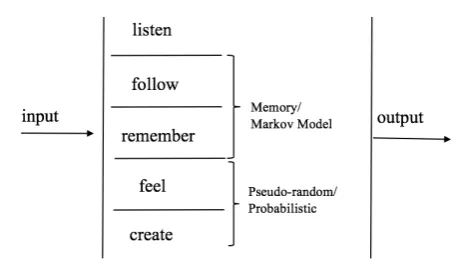
Studies related to dynamical systems and embodied cognition (Chemero, 2009; Clark, 1996), some of which have parallels in music (Borgo, 2005; Di Scipio, 2003), might exhibit similarities to Brooks’ approach, due to the connectionist model underlying them and to the shifted focus towards distributed, multidimensional, local and action-oriented representation, as opposed to being objective and action-independent. In terms of notable precedents in employing a subsumption architecture in the context of human-machine musical interaction, the work of Linson (Linson et al., 2015) stands out. When translating Brooks’ concepts to a musical system, bespoke choices were made for Dory. The author’s system comprises 7 modules, withlisten being the lowest level of operation (discussed in Section 3.2). A schema ofDory’s architecture can be seen in Fig. 1.
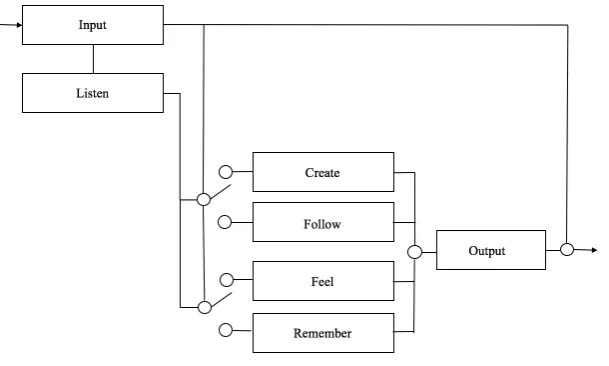
Two of these modules (follow andremember) explicate memory functions, while two others (feel andcreate) are responsible for more reactive traits of the system (these will be discussed in Section 3.3). A more in-depth flow diagram ofDory’s architecture is shown in Fig. 2. The next system characteristic to be described relates to how it receives and outputs signals.
3.2 I/O
Figure 1.A subsumption architecture. Modules/layers are activated in parallel and each connects the input to the output. Adapted from Brooks (1999, p. 67).
of the live audio input, further compromising Dory’s already partial learning capabilities (discussed in Section 3.3).
In the input module, raw audio from the human player is received and a simple averaging of the peak amplitude over three time windows (2500ms, 5000ms and 7500ms) with respect to asensitivity hyper-parameter is computed, as a list of three binary values (e.g., 0 0 1). This list is a measure of how “busy” the human player is, sonically. If no activity is detected within 7500ms then Dory
hibernates and theoutput module is inhibited. The binary lists so obtained are used to determine which of two finite state machines (FSMs) should be queried. These FSMs are in charge of deciding the activation state forcreate/follow and
feel/remember, respectively (discussed in Section 3.3). The transition weights can be adjusted, to confer a more or less reactive or learning personality toDory. However, this can only be done offline, and once the system is operational, the human performer no longer has control over these weights.
The audio input is then fed to thelisten module, where it is analysed and decomposed into three data streams, relating to pitch information, amplitude and time deltas between notes detected. This is done by estimating the fundamental frequency of the incoming audio by performing multiple layers of wavelet transform on an incoming vector, comparing the spacing between the peak in each. The peak amplitude is converted to a range of 0–127, used as MIDI velocity values. Similarly, pitch values are also converted to MIDI notes. As for the time deltas between the notes, these are calculated simply as the time elapsed between two consecutively detected onsets. The information so obtained will populate the corresponding transition matrices of the Markov chains in thefollow and
remember modules (see Section 3.3). The object that performs this analysis (part of the standard distribution of the software2 used to implement Dory) is specifically optimised for monophonic signals. This specification is, however,
2
Figure 2.Dory’s flow diagram. Modules are represented by named boxes and solid lines represent the data flow. Clearly visible are the two FSMs discussed in Section 3.2, determining which module(s) will be activated/inhibited.
purposively disregarded whenDory is playing with a human using a polyphonic instrument, resulting in an arbitrarily approximate and incorrect representation of the incoming audio. Additionally, the incoming audio’s tempo is estimated via a real-time beat-tracking model (Stark et al., 2009), and the chroma set3 is
calculated (Stark & Plumbley, 2009). This information is then used in thefeel
andcreate units (see Section 3.3).
The type of output thatDory produces is in MIDI format which can be sent to an external instrument (hardware or software) of the user’s choice. Thus,Dory
does not have the means to generate actual sounds, but only data streams. This strategy is common amongst system designers, because it frees them from choices relating to sounds which could become aesthetically obsolete or historically bound. In doing so, a much wider palette of sounds is made available to the human improviser, who might choose different “players” for different performances or occasions. Once again, this choice can only be made before the system is activated, after which point it is no longer possible to changeDory’s output sound. The next characteristics to be considered will be the system’s model type and the methods used to generate MIDI output.
3
3.3 Model Type and Methods
Dory can be said to be both reactive and learning, albeit unable to commit to one or the other. This is a result of the system’s architecture, as seen in Section 3.1.
The reactive aspect ofDory’s behaviour is obtained via the activation of the two modules namedcreate andfeel, which generate streams relative to pitch, time deltas between notes, amplitude and duration of the notes. This process is largely based on statistical distribution sampling, coupled with rhythmic subdivision based on the detected tempo. These two modules are similar, except that feel
computes an arbitrarily long averaging over incoming note speeds, chroma content and detected tempo. The time window over which these are calculated is the time between the last and the current activation of the module itself. The create
module, by contrast, does no averaging and simply computes the same elements as a running stream. In both modules, the duration and amplitude of the notes are pooled from an arbitrary distribution.
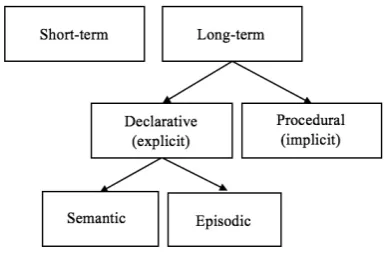
The learning side of the system is realised via Markov processes and is also implemented according to two different time scales, reflecting considerations made in an earlier paper by the author (Kalonaris, 2017), where a model of memory theorised by Tulving (1972) was considered (shown in Fig. 3). Following studies that have shown a positive correlation between declarative memory and high novelty (but low speed) in music improvisation (Moorman & Miner, 1988), a case was then made for implementingDory with a partial learning goal, using only two short bins of memory which represented the workings of short-term and episodic memory in the Tulving model. This choice was further supported by the findings of Huron (2006) and Snyder (2000).
Data regarding pitch, amplitude and time delta received from thelistenmodule (described in Section 3.2) is used to populate three corresponding transition matrices, in either a short memory module (follow) or a longer one (remember, representing episodic memory). The former is wiped every time the module is not active, during which period the transition matrix is filled with the new incoming streams. The latter was originally implemented to run for the duration of the performance, but its length can be heuristically reduced by the human performer, similarly to the sensitivity hyper-parameter (see Section 3.2) . When either module is active (i.e., when their output is not inhibited) second-order Markov chains are queried for the next values to be sent to theoutput module. As a result of this limited memory affordance,Dory is incapable of learning over a real-time corpus, which explains the system’s inability to model the human collaborator’s musical language. However, some local and time-sensitive characteristics might at times be reflected in the output of the system. In other words,Dory might occasionally and briefly elaborate on musical material derived from its human collaborator, or even from the environment around it (if audio is acquired via a microphone). Adding to the reduced ability to learn extensively is the fact that what the system feeds to the two memory bins might already be spurious and compromised to some degree, due to the flaws of the listen
module (see Section 3.2). Having described the anatomy and design philosophy ofDory, the preliminary results of the author’s experiments in real-performance environments with the system are now presented.
4
Evaluation
Evaluation of computationally creative music systems poses many problems and it is an open discourse voicing many perspectives, trends and approaches. In the context of autonomous musical agents such as those described in this article, one can identify a “first wave” of such systems which were eminently practice-based and whose designers were not perhaps particularly concerned with formal evaluation methodologies. A later stage saw attempts to evaluate these systems with tests inspired by the Imitation Game (Turing, 1950). These comprised Musical Directive Toy Tests (MDtTs), Musical Output Toy Tests (MOtTs) and Discrimination Tests (DTs), for example, although there seems to be a consensus that such tests seem to fall short of being able to say anything about the intelligence or creativity of the systems (Ariza, 2009) or about the aesthetic and artistic results. At best, they end up being measures of musical judgement. At times the need for evaluation has been challenged altogether, because “what purpose would be satisfied by creating qualitative criteria or quantitative metrics for artificial musical intelligence, given the lack of successful similar criteria for natural musical intelligence, musicality, or even music per se?” (Belgum et al., 1988, p. 9).
qualitative methods (Banerji, 2012; Bown, 2015), others are more inclined towards a mixture comprising both quantitative and qualitative measures (Stowell et al., 2009), with Human Computer Interaction (HCI) criteria also being common in this context (Hsu & Sosnick, 2009). Not only have attempts been made to design standardised procedures for comparing systems (Colton, Charnley, & Pease, 2011; Jordanous, 2012), but some also argue for the formal evaluation of different versions of the same system (Colton et al., 2014).
Dory is currently being developed, and a formal evaluation procedure has yet to be designed. The author shares many of the preoccupations presented above, and although he has not yet designed a rigorous evaluation method, he has attempted some preliminary evaluation of three public performances withDory. It is important to note that he argues for systems designed for real-performance environment with experienced practitioners, much in accordance with other researchers’ views (Bown, 2015; Lewis, 2000; Linson et al., 2015; Hsu & Sosnick, 2009).
4.1 Methodology
Dory was used by the author in three performances, which took place at the
Improvisational Creativity Workshop, Prato, July 20, 2017; at the2nd Conference on Computer Simulation of Musical Creativity, Milton Keynes, September 13, 2017; and at theNew River Studios, London, October 25, 2017. These were all scenarios where a rigorous, formal evaluation may have not been appropriate (concert environment, low response rate, etc.), however, both a quantitative study of the audience response and a descriptive analysis from the performer’s point of view are provided. The former relates to the first two performances, whereas the latter is cumulative over all three.
4.2 The Audience’s Perspective
Evaluation methods for creative systems have been divided into methods of external and internal evaluation (Agres et al., 2016). Amongst the former, both questionnaires and correlation tests feature as valid options. In particular, it is argued that Likert rating scales, although subjective, “can provide very robust and consistent measures” (Agres et al., 2016, p. 17). Given the context (a real-performance environment) and the above consideration, a simple questionnaire was used. This consisted of only three items:
– I enjoyed the performance (measure ofenjoyment)
– The musical interaction was sufficiently engaging (measure ofengagement)
– Dory sometimes responded in unexpected ways (measure ofsurprise)
A ten-point Likert scale ranging from “strongly disagree” to “strongly agree” (re-coded 1–10) was used to quantify the audience response. As already noted,
of a system’s creative ability. Therefore, these two measures were used for the second and third questionnaire items, respectively, whereas the first item is asking whether both the interaction between the human performer and the system, and the resulting musical output, were considered aesthetically effective and/or pleasing. Audience members were all domain experts and they were participants of the two events (July 20 and September 13, 2017), either presenting papers on creative computational systems or performing as part of the concerts. Amongst them, some of the most eminent practitioners of human-machine improvisation were present. One of them provided written feedback in a private email. In total, only 9 participants responded.
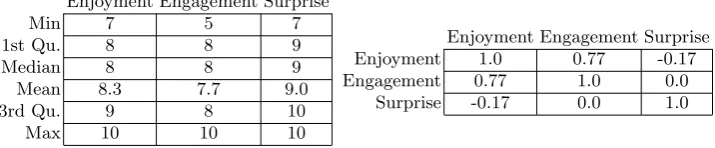
Mean and median values for all three items were very high, as seen in Tab. 1. Despite a strong positive correlation between enjoyment and engagement, a chi square test of independence showed that the relation between these two variables was not significant.
Enjoyment Engagement Surprise
Min 7 5 7
1st Qu. 8 8 9
Median 8 8 9
Mean 8.3 7.7 9.0
3rd Qu. 9 8 10
Max 10 10 10
Enjoyment Engagement Surprise Enjoyment 1.0 0.77 -0.17 Engagement 0.77 1.0 0.0
Surprise -0.17 0.0 1.0
Table 1.Basic descriptive statistics (left) and correlation matrix (right) for N=9 participants in 2 different performances, answering three questions using a 1–10 Likert scale.
Some of the respondents volunteered comments and suggestions, some of which indicated a high level of surprise (reflected in Tab. 1):
It surprised me in many ways – perhaps some graphical interaction with audience could help asDory makes (her/his/its) decisions.
At other times a sense of wonder, considered “intimately connected with creativity” (Boden, 2003, p. 277), was expressed:
It was difficult for me to get into your abstract communication with the program – and that is maybe a good sign that things are not too obvious.
Some comments also highlighted the short-term feedback of musical material between the author and the system:
I found a couple of central notes from you andDory, that kept coming back and heard you taking over ideas fromDory – my favourite moments.
4.3 The Performer’s Perspective
The author is a guitarist and electronic musician experienced in free improvised music. It has been claimed that “expert qualitative analysis should be recognised as fulfilling an essential role” (Linson et al., 2012, p. 148) in evaluating musical improvisations, therefore, despite the bias of the author being both the designer and the performer, a descriptive study is now offered. The standpoint of the following reflection is that of a practice-based approach, in full awareness that it might make more sense to consider it as instrumental to future implementations of the system.Dory was designed to achieve stimulating and engaging interac-tions with the human by freely improvising musical duets. Studies on creative partnership in human-machine musical improvisation (Brown et al., 2013, 2017) have identified some essential activities and relationships in a duet interaction. These are:
– initiate(new material)
– imitate(reuse of other’s material)
– loop(immediate reuse of own material)
– restate (reuse of other’s material over a longer time span)
– shadow (play in unison or close parallel)
– silence(not playing)
Such activities are intrinsically bound to the factors identified in Section 2 (i.e., that a system should beresponsive,stimulating, engaging andsurprising), and are discussed in relation to these. For example, initiating new or contrasting material, as well as not playing at times, is related to how the performer perceives the system in terms of being stimulating, engaging and surprising, while the capacity to imitate might be more associated with the responsiveness of the system.
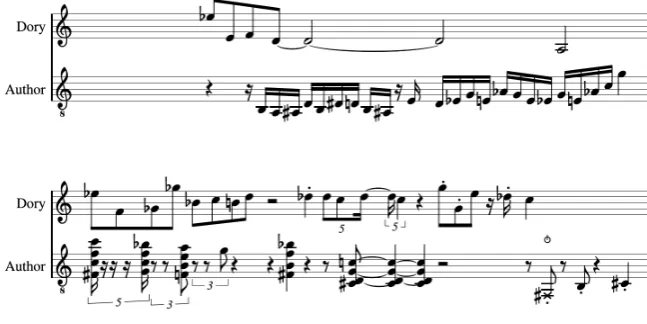
Dory’s ability toinitiate musical material, at times in discordance with the human performer’s musical behaviour, can be seen in Fig. 4. In this case,Dory
Figure 4.An example ofDory’s ability to initiate a musical idea independently from the material played by the author.
These musical behaviours make for engaging interactions and the author, after an initial period of familiarisation, was able to negotiate his expectations relating to the system and acceptDory as an active element of the musical experience. While relinquishing ideas of humanised behaviours, the author did not perceive
Dory simply as a “prop” or as a device/strategy for augmenting the sonic palette of the performance but, rather, as a fully fledged agent which contributed to it on an equal footing. He regarded the system as stimulating and engaging, because it helped him focus on musical interactions at a purely sonic level (given that
Dory lacks a physical dimension). This perception was shared by some of the audience members, as shown in the following remark:
I had to focus more on the listening as there was no performer to look at.
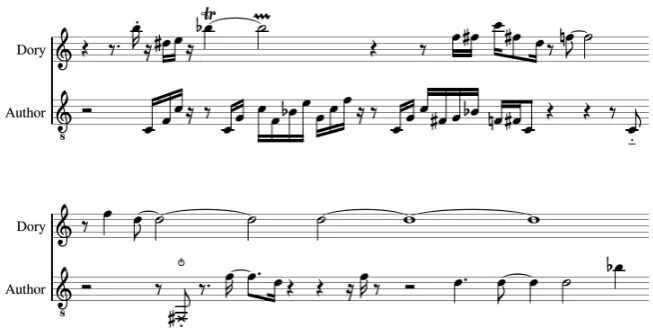
Figure 5.An example ofDory’s ability to produce and maintain diverging musical ideas.
opportunity for a harmonic commentary, where he adopted a supportive role, as well as trading short melodic interventions at times. The author was able to experiment with dynamics, which allowed him to perform solo for brief moments. Such an affordance is contingent uponDory’s sensitivity hyper-parameter, which sets an amplitude threshold for incoming audio below which even the listen
module is suppressed (see Section 3.2). This particular behaviour is referred to assilencein the crucial factors of a duet interaction listed at the beginning of this section. The sonic texture need not be congested at all times and, in fact, the author appreciated the opportunity to “prune” the density of the music at times. Although this resulted from a design feature of the system, it was still felt and perceived in terms of a positive musical affordance, in the context of the performances. This behaviour is illustrated in Fig. 7.
5
Discussion
Figure 6.An example of musical imitation betweenDoryand the author, with a C mixolydian modal anchor.
Figure 7.An example of sparse interaction and use of silence on the part ofDory.
by including some mechanism for simulating creative divergence, along the lines of that discussed already (i.e, contrastive ideas; see Fig. 5), in order to escape loops seemingly by the system’s initiative. To achieve the ability to restate it would be sufficient to stretch the memory length of theremember module and/or to alter the weights of the FSMs (see Section 3.2) to make the transitions to the long-term memory more probable. Another strategy would be to use more sophisticated algorithms for the Markov processes, for example Factor Oracle (Assayag & Dubnov, 2004). Such alterations would, however, be in stark contrast to the initial motivations behind Dory and, therefore, inappropriate for this particular system.
6
Conclusion
Dory was developed to be used for pairwise musical interaction and for freely improvised music, in real-performance environments. While it is tempting to desire human-like attributes in computational systems for music improvisation, it is important to negotiate these expectations with the awareness that these idiosyncratic systems might be better employed when they are granted bespoke status. By maintaining an open approach to performing with these systems, the human performer might not only learn dynamical couplings with the system, but might also be presented with opportunities for a critical re-examination of his/her improvisational and creative practices.
Dory set out to represent an example of satisficing design and of purposively reduced scope on several fronts. These choices were made following specific considerations regarding memory, perception and decision-making, and were realised via coarse machine listening and learning modules, as well as naturally emerging from the system’s architecture. The latter was such that Dorylacked a concept of “planning”, relying instead on distributed and parallel control and agency. Despite the limitation of the current implementation, such as the inability to sustain long-term musical interaction,Dory was received positively by expert audiences and by the human player alike, and it was deemed an engaging musical agent, exhibiting novel and idiosyncratic behaviours. These encouraging preliminary results warrant further exploration in this direction and the author intends to develop more formal methodologies for evaluating the system as well as strategies for attaining long-term capabilities that could perhaps simulate the desire to adapt to shared musical goals.
References
Agres, K., Forth, J., & Wiggins, G. A. (2016). Evaluation of musical creativity and musical metacreation systems. Computers in Entertainment, 14(3), 3:1–3:33. doi: 10.1145/2967506
Assayag, G., Bloch, G., Chemillier, M., Cont, A., & Dubnov, S. (2006). OMax brothers: A dynamic topology of agents for improvization learning. In
Proceedings of the 1st ACM Workshop on Audio and Music Computing Multimedia (pp. 125–132). New York, NY: ACM. doi: 10.1145/1178723 .1178742
Assayag, G., & Dubnov, S. (2004). Using factor oracles for machine improvisation.
Soft Computing,8(9), 604–610. doi: 10.1007/s00500-004-0385-4
Bailey, D. (1993). Improvisation: Its nature and practice in music. New York, NY: Da Capo Press.
Banerji, R. (2012). Maxine’s Turing test: A player-program as co-ethnographer of socio-aesthetic interaction in improvised music. In M. Riedl & G. Sukthankar (Eds.), Proceedings of the Artificial Intelligence and Interactive Digital Entertainment International Conference. Palo Alto, CA: AAAI Press. Retrieved fromhttps://www.aaai.org/ocs/index.php/AIIDE/AIIDE12/ paper/download/5533/5739
Belgum, E., Roads, C., Chadabe, J., Tobenfeld, T. E., & Spiegel, L. (1988). A Turing test for “musical intelligence”? Computer Music Journal, 12(4), 7–9.
Biles, J. A. (2002). GenJam: Evolution of a jazz improviser. In P. J. Bentley & D. W. Corne (Eds.),Creative evolutionary systems (pp. 165–187). San Francisco, CA: Morgan Kaufmann Publishers Inc.
Blackwell, T. (2007). Swarming and music. In E. R. Miranda & J. A. Biles (Eds.),Evolutionary computer music(pp. 194–217). London: Springer. doi: 10.1007/978-1-84628-600-1 9
Blackwell, T., Bown, O., & Young, M. (2012). Live algorithms: Towards au-tonomous computer improvisers. In J. McCormack & M. d’Inverno (Eds.),
Computers and creativity (pp. 147–174). Berlin, Heidelberg: Springer. doi: 10.1007/978-3-642-31727-9 6
Boden, M. A. (2003). The creative mind: Myths and mechanisms (2nd ed.). New York, NY: Routledge.
Borgo, D. (2005). Sync or swarm: Improvising music in a complex age. New York, NY: Continuum.
Bown, O. (2015). Player responses to a live algorithm: Conceptualising computa-tional creativity without recourse to human comparisons? In H. Toivonen, S. Colton, M. Cook, & D. Ventura (Eds.),Proceedings of the International Conference on Computational Creativity (pp. 126–133). Park City, UT:
Brigham Young University.
Bown, O., Gemeinboeck, P., & Saunders, R. (2014). The machine as autonomous performer. In L. Candy & S. Ferguson (Eds.),Interactive experience in the digital age: Evaluating new art practice (pp. 75–90). Cham: Springer
International Publishing. doi: 10.1007/978-3-319-04510-8 6
Bretan, M., Oore, S., Engel, J., Eck, D., & Heck, L. (2017). Deep music: Towards musical dialogue. InProceedings of the 31st AAAI Conference on Artificial Intelligence (pp. 5081–5082). San Francisco, CA: AAAI Press.
Cambridge, MA: MIT Press.
Brown, A. R., Gifford, T., & Voltz, B. (2013). Factors affecting audience perceptions of agency in human computer musical partnerships. In E. Y. Do, S. Dow, J. Ox, S. Smith, K. Nishimoto, & C. T. Tan (Eds.),Proceedings of the 9th ACM Conference on Creativity & Cognition (pp. 296–299). New York, NY: ACM. doi: 10.1145/2466627.2466661
Brown, A. R., Gifford, T., & Voltz, B. (2017). Stimulating creative partnerships in human-agent musical interaction. Computers in Entertainment,14(2), 5:1–5:17. doi: 10.1145/2991146
Chemero, A. (2009). Radical embodied cognitive science. Cambridge, MA: MIT Press.
Clark, A. (1996). Being there: Putting brain, body, and world together again (1st ed.). Cambridge, MA: MIT Press.
Colton, S., Charnley, J., & Pease, A. (2011). Computational creativity theory: The FACE and IDEA descriptive models. In D. Ventura, P. Gerv´as, D. F. Harell, M. L. Maher, A. Pease, & G. Wiggins (Eds.),Proceedings of the 2nd International Conference on Computational Creativity (pp. 90–95).
M´exico City. Retrieved from http://computationalcreativity.net/ iccc2011/proceedings/the foundational/colton 1 iccc11.pdf
Colton, S., Pease, A., Corneli, J., & Cook, M. (2014). Assessing progress in building autonomously creative systems. InInternational Conference on Computational Creativity (pp. 137–145).
Cook, J. (1994). Agent reflection in an intelligent learning environment architec-ture for musical composition. In M. Smith, A. Smaill, & G. A. Wiggins (Eds.), Music education: An artificial intelligence approach (pp. 3–23).
London: Springer.
Corbett, J. (2016). A listener’s guide to free improvisation. Chicago, IL: University of Chicago Press.
Di Scipio, A. (2003). ‘Sound is the interface’: From interactive to ecosys-temic signal processing. Organised Sound, 8(3), 269–277. doi: 10.1017/ S1355771803000244
Eck, D., & Schmidhuber, J. (2002). Finding temporal structure in music: Blues improvisation with LSTM recurrent networks. InProceedings of the 12th IEEE Workshop on Neural Networks for Signal Processing (pp. 747–756). Martigny, Switzerland: IEEE. doi: 10.1109/NNSP.2002.1030094
Eigenfeldt, A., Bown, O., & Casey, B. (2015). Collaborative composition with creative systems: Reflections on the first musebot ensemble. In H. Toivonen, S. Colton, M. Cook, & D. Ventura (Eds.),Proceedings of the International Conference on Computational Creativity (pp. 134–141). Park City, UT:
Brigham Young University.
Fern´andez, J. D., & Vico, F. (2013). AI methods in algorithmic composition: A comprehensive survey. Journal of Artificial Intelligence Research, 48(1), 513–582.
Gillick, J., Tang, K., & Keller, R. M. (2010). Machine learning of jazz grammars.
Hadjeres, G., Pachet, F., & Nielsen, F. (2017). DeepBach: a steerable model for Bach chorales generation. In D. Precup & Y. W. Teh (Eds.),Proceedings of the 34th International Conference on Machine Learning (pp. 1362–1371).
Sydney, Australia: PMLR.
Hasslacher, B., & Tilden, M. W. (1995). Living machines. Robotics and Autonomous Systems,15(1–2), 143–169.
Herremans, D., Chuan, C., & Chew, E. (2017). A functional taxonomy of music generation systems. ACM Compututing Surveys,50(5), 69:1–69:30. doi: 10.1145/3108242
Hsu, W. (2008). Two approaches for interaction management in timbre-aware improvisation systems. In Proceedings of the International Computer Music Conference. Belfast: International Computer Music Association. Retrieved from https://quod.lib.umich.edu/cgi/p/pod/dod-idx/ two-approaches-for-interaction-management-in-timbre-aware.pdf ?c=icmc;idno=bbp2372.2008.062;format=pdf
Hsu, W., & Sosnick, M. (2009). Evaluating interactive music systems: An HCI approach. InProceedings of the International Conference on New Interfaces for Musical Expression(pp. 25–28). Pittsburgh, PA.
Huron, D. (2006). Sweet anticipation: Music and the psychology of expectation. Cambridge, MA: MIT Press. doi: 10.1525/mp.2007.24.5.511
Hutchings, P., & McCormack, J. (2017). Using autonomous agents to improvise music compositions in real-time. In J. Correia, V. Ciesielski, & A. Liapis (Eds.), Computational intelligence in music, sound, art and design (pp. 114–127). Cham: Springer International Publishing.
Jordanous, A. (2012, 01). A standardised procedure for evaluating creative systems: Computational creativity evaluation based on what it is to be creative. Cognitive Computation,4(3), 246–279. doi: 10.1007/s12559-012 -9156-1
Kalonaris, S. (2017). Dory: A purposively flawed and forgetful artificial musical agent. In R. Laney (Ed.),Proceedings of the 2nd Conference on Computer Simulation of Musical Creativity. Milton Keynes, UK: Open University. Klein, G. A., Orasanu, J. M., & Calderwood, R. (1993). Decision making in
action: Models and methods. Norwood, NJ: Ablex Publishing Corporation. Lewis, G. E. (1999). Interacting with latter-day musical automata. Contemporary
Music Review,18(3), 99–112. doi: 10.1080/07494469900640381
Lewis, G. E. (2000). Too many notes: Computers, complexity and culture in Voyager. Leonardo Music Journal, 10(2000), 33–39. doi: 10.1162/ 096112100570585
Linson, A., Dobbyn, C., & Laney, R. (2012). Critical issues in evaluating freely improvising interactive music systems. In M. L. Maher, K. Hammond, A. Pease, R. P. P´erez, D. Ventura, & G. Wiggins (Eds.), International Conference on Computational Creativity (pp. 145–149). Dublin: University
College Dublin.
96–115. doi: 10.1162/COMJ a 00323
Manzolli, J., & Verschure, P. F. M. J. (2005). Roboser: A real-world com-position system. Computer Music Journal, 29(3), 55–74. doi: 10.1162/ 0148926054798133
McCormack, J. (2003). The application of l-systems and developmental models to computer art, animation and music synthesis (Unpublished doctoral
dissertation). Monash University.
Mehri, S., Kumar, K., Gulrajani, I., Kumar, R., Jain, S., Sotelo, J., . . . Bengio, Y. (2016). SampleRNN: An unconditional end-to-end neural audio generation
model. Computer Research Repository,abs/1612.07837. Retrieved from
http://arxiv.org/abs/1612.07837
Minsky, M. (1986). The society of mind. New York, NY: Simon & Schuster, Inc. Moorman, C., & Miner, A. S. (1988). Organizational improvisation and
organi-zational memory. The Academy of Management Review,23(4), 698–723. Pachet, F. (2003). The Continuator: Musical interaction with style. Journal of
New Music Research,32(3), 333–341. doi: 10.1076/jnmr.32.3.333.16861 Pachet, F., Roy, P., Moreira, J., & d’Inverno, M. (2013). Reflexive loopers for
solo musical improvisation. InProceedings of the SIGCHI Conference on Human Factors in Computing Systems (pp. 2205–2208). New York, NY: ACM. doi: 10.1145/2470654.2481303
Peters, C., Castellano, G., & de Freitas, S. (2009). An exploration of user engagement in HCI. In G. Castellano, M. J., J. Murray, K. Karpouzis, & C. Peter (Eds.),Proceedings of the International Workshop on Affective-Aware Virtual Agents and Social Robots (pp. 9:1–9:3). New York, NY: ACM. doi: 10.1145/1655260.1655269
Quigley, M., Gerkey, B. P., Conley, K., Faust, J., Foote, T., Leibs, J., . . . Ng, A. Y. (2009). ROS: An open-source robot operating system. In ICRA Workshop on Open Source Software.Retrieved fromhttp://www.robotics
.stanford.edu/~ang/papers/icraoss09-ROS.pdf
Rowe, R. (1992a). Interactive music systems: Machine listening and composing. Cambridge, MA: MIT Press.
Rowe, R. (1992b). Machine listening and composing with Cypher. Computer Music Journal,16(1), 43–63.
Simon, H. (1956). Rational choice and the structure of the environment. Psy-chological Review, 63(2), 129–138.
Simon, H. (1996). The sciences of the artificial. Cambridge, MA: MIT Press. Slote, M. (2004). Two views of satisficing. In M. Byron (Ed.),Satisficing and
maximizing: Moral theorists on practical reason (pp. 14–29). Cambridge: Cambridge University Press. doi: 10.1017/CBO9780511617058.002 Snyder, B. (2000). Music and memory: An introduction. Cambridge, MA: MIT
Press.
Solomon, L. (1986). Improvisation ii.Perspectives of New Music,24(2), 224–235. Stark, A. M., Davies, M. E. P., & Plumbley, M. D. (2009). Real-time
Como, Italy.
Stark, A. M., & Plumbley, M. D. (2009). Real-time chord recognition for live performance. In Proceedings of the International Computer Music Conference (pp. 85–88). Montreal, Canada.
Stowell, D., Robertson, A., Bryan-Kinns, N., & Plumbley, M. D. (2009). Evalua-tion of live human-computer music-making: Quantitative and qualitative approaches. International Journal of Human-Computer Studies,67(11), 960–975. doi: 10.1016/j.ijhcs.2009.05.007
Tulving, E. (1972). Episodic and semantic memory. In E. Tulving & W. Donaldson (Eds.),Organization of memory (pp. 381–402). New York, NY: Academic
Press.
Turing, A. M. (1950). Computing machinery and intelligence. Mind, 59(236), 433–460. doi: 10.1093/mind/LIX.236.433
Wallace, R. (2010).Improvisation and the making of American literary modernism. New York, NY: Continuum.
Wang, C., Hsu, J., & Dubnov, S. (2016). Machine improvisation with variable Markov oracle: Toward guided and structured improvisation. Computers in Entertainment,14(3), 4:1–4:18. doi: 10.1145/2905371
Weinberg, G., Godfrey, M., Rae, A., & Rhoads, J. (2008). A real-time genetic algorithm in human-robot musical improvisation. In R. Kronland-Martinet, S. Ystad, & K. Jensen (Eds.), Computer music modeling and retrieval. Sense of sounds (pp. 351–359). Berlin, Heidelberg: Springer. doi: 10.1007/ 978-3-540-85035-9 24