R E S E A R C H
Open Access
Land usage attributed to corn ethanol production
in the United States: sensitivity to technological
advances in corn grain yield, ethanol conversion,
and co-product utilization
Rita H Mumm
1*, Peter D Goldsmith
2, Kent D Rausch
3and Hans H Stein
4Abstract
Background:Although the system for producing yellow corn grain is well established in the US, its role among other biofeedstock alternatives to petroleum-based energy sources has to be balanced with its predominant purpose for food and feed as well as economics, land use, and environmental stewardship. We model land usage attributed to corn ethanol production in the US to evaluate the effects of anticipated technological change in corn grain production, ethanol processing, and livestock feeding through a multi-disciplinary approach. Seven scenarios are evaluated: four considering the impact of technological advances on corn grain production, two focused on improved efficiencies in ethanol processing, and one reflecting greater use of ethanol co-products (that is, distillers dried grains with solubles) in diets for dairy cattle, pigs, and poultry. For each scenario, land area attributed to corn ethanol production is estimated for three time horizons: 2011 (current), the time period at which the 15 billion gallon cap for corn ethanol as per the Renewable Fuel Standard is achieved, and 2026 (15 years out).
Results:Although 40.5% of corn grain was channeled to ethanol processing in 2011, only 25% of US corn acreage was attributable to ethanol when accounting for feed co-product utilization. By 2026, land area attributed to corn ethanol production is reduced to 11% to 19% depending on the corn grain yield level associated with the four corn production scenarios, considering oil replacement associated with the soybean meal substituted in livestock diets with distillers dried grains with solubles. Efficiencies in ethanol processing, although producing more ethanol per bushel of processed corn, result in less co-products and therefore less offset of corn acreage. Shifting the use of distillers dried grains with solubles in feed to dairy cattle, pigs, and poultry substantially reduces land area attributed to corn ethanol production. However, because distillers dried grains with solubles substitutes at a higher rate for soybean meal, oil replacement requirements intensify and positively feedback to elevate estimates of land usage.
Conclusions:Accounting for anticipated technological changes in the corn ethanol system is important for
understanding the associated land base ascribed, and may aid in calibrating parameters for land use models in biofuel life-cycle analyses.
Keywords:Agricultural biotechnology, Corn ethanol, Corn ethanol co-products, Corn gluten feed, Corn gluten meal, Corn grain production, DDGS, Distillers dried grains with solubles, Livestock feeding, Technological change
* Correspondence:[email protected] 1
Department of Crop Sciences, University of Illinois at Urbana-Champaign, Urbana, IL 61801, USA
Full list of author information is available at the end of the article
Background
As alternatives to petroleum-based energy sources are sought in the US, great attention has been given to renew-able fuel sources from agriculturally produced biofeed-stocks, for example, miscanthus, switchgrass, sugar cane, rapidly growing tree species, and corn. Renewable fuel sources not only reduce US dependence on foreign sources for energy, but support environmental stewardship through reduction of greenhouse gas production and promote rural development.
The system for producing and processing of corn grain (that is, US No. 2 yellow corn) is well established in the US and corn grain has been used as a source of biofuel for decades. According to the US Department of Agri-culture (USDA), of the 12.360 billion bushels of corn grain harvested in 2011, more than 40% (5.007 billion bushels) was processed to produce ethanol while 37% went to livestock feed, 11% to food and industrial uses, and 12% was exported (Figure 1) [1]. The use of corn grain among other biofeedstocks has to be balanced with its longtime predominant purpose for food and feed, and
other issues such as economic impacts affecting global food prices, land use, and environmental effects. The Energy Independence and Security Act adopted in 2007 established the Renewable Fuel Standard, recognizing the role of corn grain for ethanol production along with biofeedstocks for cellulosic fermentation [2]. The Re-newable Fuel Standard established a limit of 15 billion gallons for the use of corn grain for ethanol. The corn ethanol system produces significant quantities of co-products, including distillers dried grains with solubles (DDGS), corn gluten feed (CGF), and corn gluten meal (CGM). These co-products substitute for corn grain and soybean meal in livestock feed, mitigating to some ex-tent the trade-off between fuel and feed with corn grain channeled to ethanol production.
We examined three key ‘supply’ variables to quantify
the long-term effects and interactions involving corn grain yield, ethanol processing, and livestock feeding to illustrate how these factors affect land area attributed to corn ethanol production. In particular, we assessed the impact of technology as it relates to changes in corn
<1%
37%
12% 40%
11%
Seed
Feed
Exports
Ethanol
Food and Industrial
Figure 1Disposition (%) among major uses of No. 2 yellow corn harvested in the US in 2011 [1].
Mummet al. Biotechnology for Biofuels2014,7:61 Page 2 of 17
yields due to genetic and agronomic advancements, in ethanol processing due to more efficient fermentation resulting in greater ethanol output, and in changes in livestock feeding practices for beef cattle, dairy cattle, pigs, and poultry. To accomplish this, we first created a model of the US corn ethanol system featuring inputs and outputs involving production of corn grain, process-ing co-products, livestock feedprocess-ing, and oil for biofuels.
Secondly, we developed and explored seven scenarios representing various levels of efficiency due to antici-pated technological changes in corn production, ethanol processing, and livestock feeding. The seven scenarios feature: 1) corn yield estimates based on historical per-formance as well as publically shared information about industrial seed corn product pipelines and future product expectations which feature biotechnological advancements i.e.corn yield technology, 2) corn yield estimates (as in Sce-nario 1) minus 10% to represent a lower-bound estimate of yield with technological advancements, 3) corn yield esti-mates (as in Scenario 1) plus 10% to represent a upper-bound estimate of yield with technological advancements, and 4) corn yield estimates based on USDA projections which reflect mainly conventional plant breeding practices and take little account of biotechnological advancements; 5) ethanol processing advancements that feature conver-sion of all starch in the grain and 6) ethanol processing ad-vancements that feature complete fiber conversion; and 7) an average livestock feeding profile associated with a 65%: 35% corn grain to soybean meal substitution ratio repre-senting a shift toward more use of DDGS for dairy cattle, pigs, and poultry.
Thirdly, we considered three time horizons at which to estimate land use attributable to corn ethanol: 2011 (current); the time period at which the 15 billion gallon cap for corn ethanol is achieved; and 2026 (15 years out). With substituting DDGS in livestock diets, we computed land area attributable to corn ethanol accounting for the replacement of soybean oil that would otherwise be de-rived from DDGS-replaced soybeans, because typically that soybean oil would be directed to biofuel. We also computed land area estimates without accounting for soy-bean oil replacement.
Thus, we considered effects of three technology factors on the supply of corn and feed co-products within the US corn ethanol system. The analysis employed a‘micro’ approach in that the research directly involved discipline specialists and, as a result, integrated discipline-specific insights on the behavior of the production, processing, and feeding components of the corn-ethanol system and the rapid rate of scientific advancement. Furthermore, although other studies have considered the effects of these supply variables individually to some extent (for example, see [3-9]), our view is from a technological perspective and one that considers the interaction among these factors within
a particular geography. With this approach, we aim to provide a basis to aid in calibrating parameters for land use models and inform stakeholders of the importance of technological change in biofuel life-cycle analysis.
We limited ethanol demand in the model to a max-imum of 15 billion gallons, which corresponds to the maximum allowed for first generation biofuels under the 2007 Renewable Fuels Standard. The capping of demand, while reasonable over the near and medium term, also al-lows the analysis to solely focus on technological advances corresponding to production, processing, and livestock feeding. Capping demand allows us to limit our scenario analysis to seven but does not allow for analysis of de-mand or trade scenarios. Moreover, we do not address the implications of corn stover as a biofeedstock as this de-pends on cellulosic fermentation technology, which is presently in its infancy [10].
Results and discussion
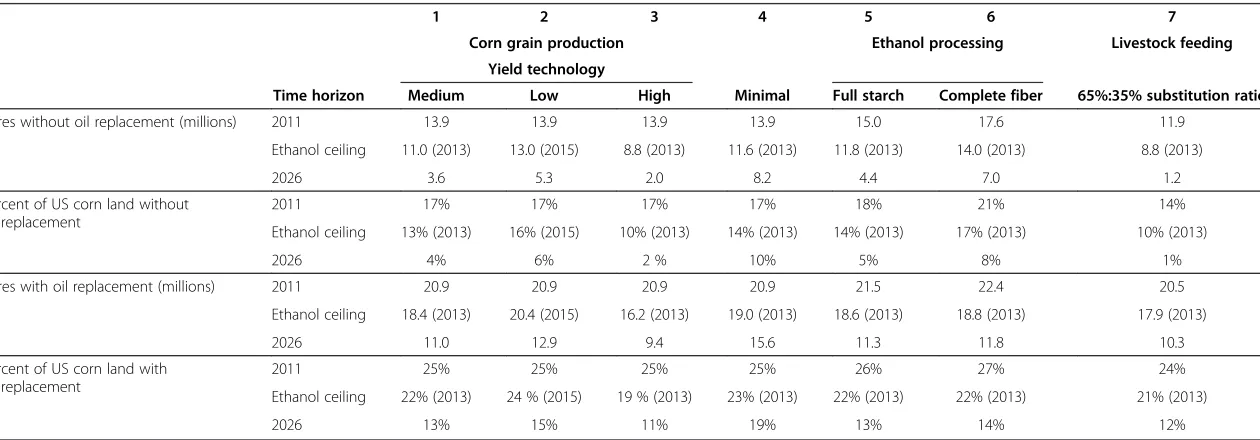
Scenarios 1 through 4 explore the impact of increasing corn grain yields over the 15-year period through 2026, with the rate of yield increase influenced by the imple-mentation and farmer adoption of yield technologies. Together, these four scenarios represent the range of growth in corn grain production over the next 15 years. Replacing corn and soybean meal in livestock diets with DDGS, CGF, and CGM has the effect of reducing the land area attributed to corn ethanol production; thus, the land area attributed to corn ethanol production is less than the acreage associated with production of the 40.5% of the corn grain directed to ethanol processing (Table 1). In 2011, not accounting for soybean oil replace-ment, land area for corn ethanol was 13.9 million acres, 17% of the total 83.98 million total corn acres, compared to 40.5% of all corn grain directed to ethanol processing. Because 2011 yield estimates were based on actual figures, not forecasts, the land area attributed to corn ethanol was the same across all four yield scenarios.
Accounting for soybean oil replacement, land area attrib-uted to corn ethanol production in 2011 was 20.9 million acres, 25% of the total 83.98 million corn acres, instead of 40.5% of all corn grain directed to ethanol processing (Table 1). However, the replacement of soybean oil through canola production contributes positive feedbacka to the system, meaning that more land area is attributed to corn ethanol than when not accounting for oil replacement.
Table 1 Estimated land area attributed to corn ethanol production expressed as acreage and percent of US land dedicated to corn grain production for each of seven scenarios, without and with oil replacement, for three time horizons
1 2 3 4 5 6 7
Corn grain production Ethanol processing Livestock feeding
Yield technology
Time horizon Medium Low High Minimal Full starch Complete fiber 65%:35% substitution ratio
Acres without oil replacement (millions) 2011 13.9 13.9 13.9 13.9 15.0 17.6 11.9
Ethanol ceiling 11.0 (2013) 13.0 (2015) 8.8 (2013) 11.6 (2013) 11.8 (2013) 14.0 (2013) 8.8 (2013)
2026 3.6 5.3 2.0 8.2 4.4 7.0 1.2
Percent of US corn land without oil replacement
2011 17% 17% 17% 17% 18% 21% 14%
Ethanol ceiling 13% (2013) 16% (2015) 10% (2013) 14% (2013) 14% (2013) 17% (2013) 10% (2013)
2026 4% 6% 2 % 10% 5% 8% 1%
Acres with oil replacement (millions) 2011 20.9 20.9 20.9 20.9 21.5 22.4 20.5
Ethanol ceiling 18.4 (2013) 20.4 (2015) 16.2 (2013) 19.0 (2013) 18.6 (2013) 18.8 (2013) 17.9 (2013)
2026 11.0 12.9 9.4 15.6 11.3 11.8 10.3
Percent of US corn land with oil replacement
2011 25% 25% 25% 25% 26% 27% 24%
Ethanol ceiling 22% (2013) 24 % (2015) 19 % (2013) 23% (2013) 22% (2013) 22% (2013) 21% (2013)
2026 13% 15% 11% 19% 13% 14% 12%
Mumm
et
al.
Biotechnolo
gy
for
Biofuels
2014,
7
:61
Page
4
o
f
1
7
http://ww
w.biotechn
ologyforbiofu
els.com/c
ontent/7/1/
replacement partially offsets the effects higher corn yields have on land usage. Although oil skimming occur-ring at 50% of the dry grind plants at the rate of 0.24 pounds per bushel of processed corn negatively feeds back into the system to mitigate some of the oil replace-ment by canola, the benefit is marginal because the vol-umes skimmed are relatively low. Land usage attributed to corn ethanol production in 2026 (Scenario 1) is more than three times greater when accounting for soybean oil replacement (4% versus 13%). Still, the terminal result dramatically differs from the 40.5% of the grain directed to corn ethanol.
Yield growth assumptions are critical to land usage es-timates. There is a difference of 8 percentage points or more than 6 million acres when comparing no/minimal yield technology (Scenario 4) with a high level of yield technology (Scenario 3) in 2026 (with or without oil re-placement). Scenario 2 is the only scenario in which the 15 billion gallon ethanol ceiling is reached in 2015; for all other yield scenarios, the ceiling is reached in 2013. Meeting this ceiling occurs when national average corn yields rise to levels in the range of 155.0 to 157.1 bushels per acre (bu/A).
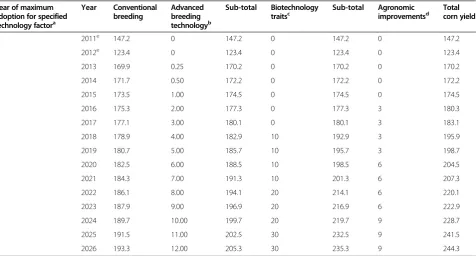
The array of corn yield forecasts provided by the four levels of yield technology implementation and adoption (Tables 2 and 3) is not inconsistent with other predictions
Table 2 Scenario 1 corn yield forecast (bu/A) by year through 2026 and contributing technology factors with associated step changes
Year of maximum adoption for specified technology factora
Year Conventional breeding
Advanced breeding technologyb
Sub-total Biotechnology
traitsc Sub-total Agronomicimprovementsd Totalcorn yield
2011e 147.2 0 147.2 0 147.2 0 147.2
2012e 123.4 0 123.4 0 123.4 0 123.4
2013 169.9 0.25 170.2 0 170.2 0 170.2
2014 171.7 0.50 172.2 0 172.2 0 172.2
1 2015 173.5 1.00 174.5 0 174.5 0 174.5
3 2016 175.3 2.00 177.3 0 177.3 3 180.3
2017 177.1 3.00 180.1 0 180.1 3 183.1
2 2018 178.9 4.00 182.9 10 192.9 3 195.9
2019 180.7 5.00 185.7 10 195.7 3 198.7
3 2020 182.5 6.00 188.5 10 198.5 6 204.5
2021 184.3 7.00 191.3 10 201.3 6 207.3
2 2022 186.1 8.00 194.1 20 214.1 6 220.1
2023 187.9 9.00 196.9 20 216.9 6 222.9
3 2024 189.7 10.00 199.7 20 219.7 9 228.7
2 2025 191.5 11.00 202.5 30 232.5 9 241.5
2026 193.3 12.00 205.3 30 235.3 9 244.3
a
Note that multiple waves are anticipated for some technology factors.b
Advanced breeding technology comprises genomic-based approaches to crop improvement including DNA sequencing, molecular markers, and doubled haploidy. This class of technologies does not include genetic engineering.c
Biotechnology traits comprises value-added characteristics manifested through genetic modification.d
Agronomic improvements comprise cultural production practices that relate to the way the corn crop is managed.eActual (not forecasted) US average yields provided for this year.
Table 3 Corn yield forecasts (bu/A) by year from 2013 through 2026 for Scenario 1 (medium yield technology), Scenario 2 (low yield technology), Scenario 3 (high yield technology), and Scenario 4 (no/minimal technology change factors)
Year Scenario 1 Scenario 2 Scenario 3 Scenario 4
2011a 147.2 147.2 147.2 147.2
2012a 123.4 123.4 123.4 123.4
2013 170.2 153.1 187.2 166.0
2014 172.2 155.0 189.4 168.0
2015 174.5 157.1 192.0 170.0
2016 180.3 162.3 198.3 172.0
2017 183.1 164.8 201.4 174.0
2018 195.9 176.3 215.5 176.0
2019 198.7 178.8 218.6 178.0
2020 204.5 184.1 225.0 180.0
2021 207.3 186.6 228.0 182.0
2022 220.1 198.1 242.1 184.0
2023 222.9 200.6 245.2 186.0
2024 228.7 205.8 251.6 188.0
2025 241.5 217.4 265.7 190.0
2026 244.3 219.9 268.7 192.0
a
of US corn yield averages, especially with technological improvements. Scenario 1 culminates in a 244.3 bu/A average whereas Scenarios 2 and 4, which are similar in depicting a negligible impact of yield technology, average 206.0 bu/A in 2026. A similar range (205 to 242 bu/A) was predicted for the US by 2030 by Miranowski et al., taking into account corn grain yield performance and forecasts by state [11]. Downinget al. predicted that corn yield growth will result in a considerably greater supply of corn grain, with a strong likelihood of a doubling in an-nual increase due to technology [12]. Even across the en-tire range of yield estimates provided by the four yield technology scenarios, corn grain yield is shown to be a key factor influencing land usage attributed to corn etha-nol production.
Scenarios 5 and 6 reveal the impact of increasing efficacy in ethanol processing on land usage for corn ethanol pro-duction. Two effects stand out: the direct effect is that im-proved ethanol processing increases the amount of ethanol per bushel of grain, which in turn reduces the amount of land needed to meet the 15 billion gallon cap. But improv-ing ethanol output introduces a significant positive feed-back force that ceteris paribus raises land usage. Small increases in ethanol output dramatically reduce the volume of co-products available for livestock feeding.
With Scenario 5 involving improved starch conversion efficiency, the ethanol yield increases from 2.759 to 2.829 gallons per bushel of corn. Correspondingly, the quantity of DDGS produced as a co-product in ethanol processing decreases from 17.44 to 16.38 pounds per bushel of processed corn (Tables 4 and 5). Scenario 5 presents an interesting trade-off in keeping with findings by Mueller and Kwik [13]: a net 2.5% increase in ethanol yield per bushel of corn processed for a net 6.1% decrease in the quantity of DDGS produced per bushel. The decrease in feed co-products results in less corn and soybean being substituted, which in turn raises land area attributed to corn ethanol production. In 2011, without oil replace-ment, land usage is 15.0 million acres, or 18% of the total
83.98 million acres used for US corn grain production, as compared to 17% with Scenario 1 involving baseline ethanol processing efficiencies (Table 1). Including oil replacement raises land area attributed to corn ethanol with full starch conversion to 21.5 million acres, 26% of the US corn grain-producing land. Therefore, increasing ethanol output per bushel of corn by extracting more from the starch component of the grain increases land area attributed to corn ethanol in Scenario 5 compared to Scenario 1, which is a surprising result.
This effect is even more exaggerated in Scenario 6, which features fermentation technology to convert C5 and C6 sugar to ethanol, converting not only residual starch but pericarp and endosperm fiber fractions as well. With complete fiber (and starch) conversion, the ethanol yield per bushel of processed corn increases from 2.759 to 3.078 gallons, compared with baseline ethanol processing efficiencies. Correspondingly, the quantity of DDGS pro-duced as co-product decreases from 17.44 to 12.67 pounds per bushel of processed corn (Table 5). Similar to Scenario 5, Scenario 6 presents an interesting trade-off: an overall 11.6% increase in ethanol yield per bushel of corn for a 27.4% decrease in the quantity of DDGS produced per bushel of corn. The decrease in feed co-products results in less corn and soybean meal being substituted, which in turn raises the land area attributed to corn ethanol. In gen-eral, land area for corn ethanol is higher when the system extracts more ethanol per bushel of corn.
With both full starch and complete fiber conversion, there is no advantage in terms of reduced land usage at-tributed to corn ethanol production, even after 15 years. In 2026, 13% (Scenario 5) and 14% (Scenario 6) of US corn-producing land is attributable to corn ethanol, com-pared to 13% (Scenario 1) without enhanced technological efficiency in ethanol processing to output more ethanol from every bushel of corn processed. The reverse side is that the land usage attributed to corn ethanol is negatively impacted only slightly from as much as an 11.6% increase in ethanol output as corn yields increase to 2026 levels.
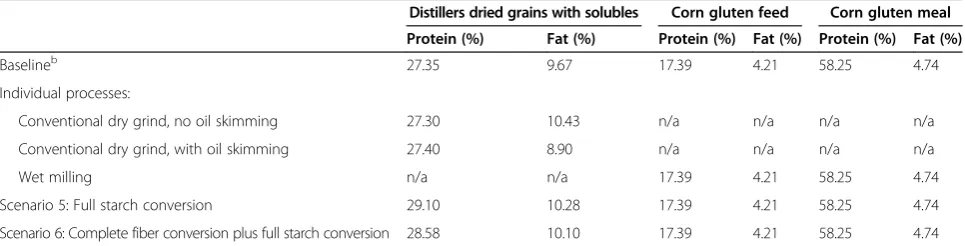
Table 4 Composition of feed co-productsafrom ethanol processing scenarios, assuming 86% dry grind with 50% skimming oil and 14% wet milling
Distillers dried grains with solubles Corn gluten feed Corn gluten meal
Protein (%) Fat (%) Protein (%) Fat (%) Protein (%) Fat (%)
Baselineb 27.35 9.67 17.39 4.21 58.25 4.74
Individual processes:
Conventional dry grind, no oil skimming 27.30 10.43 n/a n/a n/a n/a
Conventional dry grind, with oil skimming 27.40 8.90 n/a n/a n/a n/a
Wet milling n/a n/a 17.39 4.21 58.25 4.74
Scenario 5: Full starch conversion 29.10 10.28 17.39 4.21 58.25 4.74
Scenario 6: Complete fiber conversion plus full starch conversion 28.58 10.10 17.39 4.21 58.25 4.74
a
Expressed on a commercial or‘as is’basis. Dry matter contents of 89.31%, 87.13%, and 90.04% for DDGS, CGF, and CGM, respectively [40].b Weighted industry averages.
Mummet al. Biotechnology for Biofuels2014,7:61 Page 6 of 17
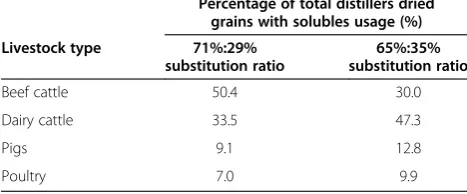
Scenario 7 demonstrates the impact of a shift in feed-ing value for DDGS, CGF, and CGM, with substitution for corn falling from 71% to 65% in livestock diets and substitution for soybean meal increasing from 29% to 35%. This shift reflects a change in the allocation of the feed co-products across livestock types. Specifically, non-ruminants and dairy cattle consume higher propor-tions of ethanol co-products, whereas beef cattle con-sume less (Table 6). The shift reflects a tension between offsetting corn grain or soybean meal consumption when feeding ethanol co-products to livestock. Feeding more DDGS to monogastric animals not only has the benefit of replacing more high cost protein from soybean meal with a lower cost alternative, but land usage attrib-uted to corn ethanol production is dramatically reduced as well. This effect is most pronounced with 2026 esti-mates: only 1.2 million of the total US corn acreage (1%) is attributed to corn ethanol production without oil placement (Table 1). However, with the shift to 35% re-placement of soybean meal in livestock diets, land area attributed to corn ethanol rises to 10.3 million acres (12%) due to higher oil replacement demands.
Interestingly, feeding a higher percentage of co-products to monogastrics and dairy cattle provides a negative feed-back force that reduces the land usage attributed to corn
ethanol production. Land usage falls in the terminal period by 0.7 million acres or one percentage point when compar-ing Scenario 7 with Scenario 1, assumcompar-ing oil replacement. This occurs because offsetting a low yield crop like soybean through co-product feeding reduces land usage more than a high yield crop like corn. However, this difference would diminish with increases in soybean yield (which were fixed in this analysis), perhaps making corn and soybeans more comparable as land use alternatives in the corn ethanol system.
Conclusions
Corn grain yield has a profound impact on estimates of land area attributable to corn ethanol production. In 2011, 25% of the acreage used for US production of corn grain was devoted to ethanol fuel production based on the his-toric corn yield for the year and accounting for replace-ment of soybean oil with the reduced demand for soybean production. Assuming reasonable increases in corn grain yield with anticipated new yield technologies coming into play in the next 15 years, this percentage could be reduced by nearly half to 13%. Even assuming the most conserva-tive estimate of corn yield growth, that is, Scenario 4, land area attributed to ethanol production drops to 19%. The high rate of technological change in corn production combined with the strong linkage between yield and land use requires biofuel life-cycle analysts to include insightful estimates of yield as well as yield dynamics within models.
Co-product utilization is a powerful force reducing the land usage attributable to corn ethanol in the US corn etha-nol system. Thus, the system complementarity between fuel production and livestock nutrition improves because etha-nol co-products provide a negative feedback substituting for corn and soybean meal, which in turn reduces land demand for corn and soybean production. System comple-mentarity may be an important element for biofuel life-cycle analysts as they think about the full impacts of the systems under study.
Table 6 Percentage of feed usage domestically of distillers dried grains with solubles produced from corn grain directed to dry grind processing (4.306 billion bushels) by livestock type with 71%:29% (baseline) and 65%:35% (Scenario 7) corn-to-soybean substitution ratios
Percentage of total distillers dried grains with solubles usage (%)
Livestock type 71%:29%
substitution ratio
65%:35% substitution ratio
Beef cattle 50.4 30.0
Dairy cattle 33.5 47.3
Pigs 9.1 12.8
Poultry 7.0 9.9
Table 5 Ethanol and co-product outputs associated with ethanol processing scenarios, assuming 86% dry grind with 50% skimming oil and 14% wet milling
Ethanol yield, L/t (gal/bu)
DDGS yield, kg/t (lb/bu)a
CGF yield, kg/t (lb/bu)a
CGM yield, kg/t (lb/bu)a
Dry grind oil recovery, kg/t (lb/bu)
Baselineb 410.3 (2.759) 310.1 (17.44) 229.3 (12.88) 49.77 (2.80) 2.145 (0.12)
Individual processes:
Conventional dry grind, no oil skimming 414.1 (2.785) 312.2 (17.56) n/a n/a 0
Conventional dry grind, with oil skimming 414.1 (2.785) 308.0 (17.32) n/a n/a 4.288 (0.24)
Wet milling 386.6 (2.600) n/a 229.3 (12.88) 49.77 (2.80) n/a
Scenario 5: Full starch conversion 420.7 (2.829)# 291.2 (16.38) 229.3 (12.88) 49.77 (2.80) 2.145 (0.12)
Scenario 6: Complete fiber conversion plus full starch conversion
457.6 (3.078)# 226.3 (12.67) 229.3 (12.88) 49.77 (2.80) 2.145 (0.12)
a
Commercial or‘as is’basis. Dry matter contents of 89.31%, 87.13%, and 90.04% for DDGS, CGF and CGM, respectively [40].b
Substitution of soybean meal through co-product feed-ing removes oil from the market. Accountfeed-ing for that oil through replacement significantly increases estimates of land area estimates attributed to corn ethanol production. This positive feedback force is especially acute because oil production (soybean or canola) is relatively land intensive compared to starch production (corn). This effect could be ameliorated by substituting an oil crop with a high land use efficiency. We use canola in our model, one of the highest oil-yielding crops on a per acre basis. But perhaps on the horizon, through plant breeding, more superior canola cultivars or other crop alternatives might emerge.
By contrast, improved efficiency in ethanol processing through anticipated fermentation technologies that increase ethanol output has little impact on land area attributed to corn ethanol over time. This is due to the trade-off between volumes of ethanol and co-product outputs, where small improvements in ethanol-processing efficiency significantly reduce amounts of co-product. Thus the need for less corn, and corn land, through advanced processing technologies is offset by reduced negative feedback because there is less co-product to substitute for corn and soybean meal in live-stock feeding. The ethanol/DDGS trade-off in dry grind processing may warrant greater scrutiny by ethanol proces-sors from an economic standpoint to maximize returns.
The anticipated change in the overall corn and soy-bean meal substitution ratio in DDGS livestock feeding only slightly decreases the amount of land area attrib-uted to corn ethanol production. A sizeable (11%) differ-ence in land area with oil replacement versus without oil replacement signifies the importance and prominence of oilseeds to US agriculture.
This analysis demonstrates clearly that, while 40.5% of harvested corn grain in the US goes to ethanol produc-tion, the percentage of total corn acreage attributed to corn ethanol production is much less. The estimate of land area attributed to corn ethanol production continues to fall as corn yields increase over time and the 15 billion gallon cap on corn ethanol is reached. As greater output is achieved in corn grain production, the land base required to produce a given volume of grain is reduced. This could translate to either less acreage to produce 15 billion gallons of corn ethanol or an enlarged market opportunity from the same allocation of land. Further research would be helpful to better specify both the demand side impacts of advancing technology, as well as the feedback processes af-fecting technology research and development investments.
The results challenge other findings about land use and indirect effects on land use change associated with corn ethanol at current and future production levels (for example, see [14-20]) and may be useful in establishing parameters for land use in models that consider a broader view of the biofuel arena. Furthermore, the re-sults cited herein support inferences of others about US
agricultural land productivity (for example, [11,12,21]) and the capacity to meet increasing demand in the fu-ture. Finally, this analysis also highlights the importance of accounting for technological change to better under-stand how a particular biofeedstock impacts various as-pects of the whole biofuel picture. Technological change challenges discipline specialists when they attempt to analyze an explicitly multidisciplinary system involving numerous technologies outside of their domain expertise. We would argue conceptually, and from our experience coming together on this project, that multidisciplinary teams are essential when researchers choose to explore the macro biofuels system.
Methods
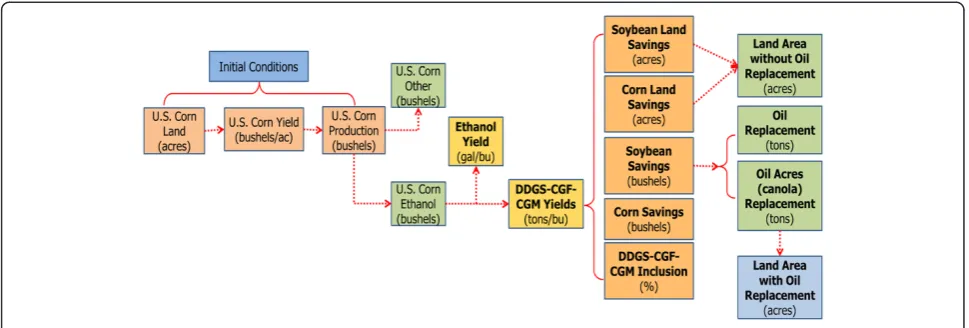
Technological changes anticipated in each of the three disciplinary areas are described in detail below and re-lated to the seven defined scenarios. In addition, details of the model of the US corn ethanol system created to simulate effects on land usage attributed to corn ethanol production are outlined. Inputs and outputs of this model are varied depending on the scenario.
Model
The systems dynamic package, STELLA [22], was used to model current practices and the effects of techno-logical changes related to corn yield, ethanol processing, and livestock feeding on US land usage attributed to corn ethanol production. Our approach was not to mimic real life because the agricultural system in which we are work-ing is extremely complex. Instead, focuswork-ing on the three factors of interest, we evaluated critical drivers identified through dialogue with scholars and industry to develop a model that is simultaneously manageable and useful for analysis.
Our simple model (Figure 2) is centered on the US agricultural land base, the proportion of the US corn crop processed for ethanol, soybean and canola crops, livestock population and feeding practices, a 15 billion gallon corn ethanol industry, and a time frame from 2011 to 2026. Estimates of land usage attributed to corn ethanol production are a function of time (future prediction) as well as the variables defined by the scenario. Variables in the model include average US yields of harvested corn grain; ethanol production volumes; availability of corn ethanol processing co-products including DDGS, CGF, and CGM; and inclusion rates of corn grain, soybean meal, and corn ethanol co-products in diets fed to poultry, pigs, beef cattle, and dairy cattle. The model is designed to track both positive and negative feedbacka processes, for example, the availability of skimmed oil from dry grind processing and replacement of the soybean oil from acres of soybean for meal that are displaced by DDGS feeding. Thus, the model is sensitive to variable inputs as well as
Mummet al. Biotechnology for Biofuels2014,7:61 Page 8 of 17
internal system feedbacks given the parameters and as-sumptions specified.
The model produces estimates of land usage attributed to corn ethanol under two conditions: without accounting for replacement of soybean oil from the displaced acres of soybean for meal; and accounting for replacement of soy-bean oil. With the latter, canola is given as the example of an oil crop replacement for soybean, although others or a mixture of oil crops could be envisioned. Trending on the side of conservatism and with the intent to highlight the three factors under study, yields of soybean and canola crops were held at 2011 levels in the model. Also, the model does not reflect the extra canola meal feed pro-duced through canola replacement of soybean acreage. Fixed in the model are US average soybean yields of 41.9 bu/A (2011 level) [23]; an average 78% yield of soybean meal from soybeans processed [24]; and US canola grain yields at 1,713 pounds per acre (2010/2011 level) [25], resulting in a canola oil yield of 753.7 pounds per acre given an average of 44% oil composition.
The dynamic model computes estimates of land use attributed to corn ethanol in 2011 and 2012 according to actual corn grain acreage and yield figures. The model estimates land use attributed to corn ethanol over the next 15 years (to 2026) under various assumptions related to the above variables and their interactions as defined by the specific scenario. In addition, the model identifies the year in which the 15 billion gallon cap is reached. The model commences with the corn production acreage in the US as a fixed land base according to 2011 levels (83.98 million acres), with harvested grain flowing to either pro-cessing for ethanol or other uses (for example, exports, feed). Ethanol production is capped over the 15-year period at no more than 40.5% of the US corn crop or 15 billion gallons of ethanol (or 14.71 billion gallons before denatur-ation at an assumed 2.2% denaturdenatur-ation rate). This prohibits a greater portion of the total corn grain harvested in any given year that is directed to corn ethanol exceeding either
2011 levels or US policy standards. Holding these factors at a steady state facilitates focus on the factors under investigation.
Over the 15-year window, the seven scenarios build on a baseline involving estimates of US corn grain yields forecasted as a result of a moderate effect of technological influence along with 2011 current practices in ethanol processing and livestock feeding. Only the specified effect (for corn grain yield, ethanol processing, or livestock feed-ing) is changed for each scenario.
Corn yield forecasts are based on historical trends and in-depth industry analysis and input. Ethanol processing forecasts are based on outputs reported by Mueller [26] and other industry data [27]. Livestock feeding forecasts were linearly extrapolated from the historical trend. De-tails of the baseline and specified scenarios for corn pro-duction, ethanol processing, and livestock feeding are provided in the following sub-sections.
Crop yield forecasts
Technologies in the area of corn production focus on in-creases in grain produced per unit of land through both genetic and agronomic improvements. Genetic improve-ments can be partitioned to identify increases due to quantitative incremental gains through breeding, increased efficiency realized in the seed product pipeline (that is, speed to market) due to new technological innovations, and biotechnology traits (traits manifest through genetic modifi-cation) [28]. Agronomic improvements focus on ways to maximally leverage the crop genetic potential through cultural production practices, including spatial arrange-ment of plants in the field, pre-emptive measures for plant health, soil management and fertility, and seed treat-ments. In addition, global positioning systems technologies enable increasingly precise application of added nutrients and variable spacing of seed to maximize response to the micro-environment defined by soil type, topography, and other factors.
To derive Scenario 1 yield estimates (Table 2), actual corn yields for 2011 and 2012 were used [1]. Corn grain yields forecast for 2013 through to 2026 in keeping with historical trends, anticipated commercial launch dates, and farmer adoption of technologies, with the following assumptions:
Based on trends observed from 1930 (development of hybrid corn and adoption replacing open-pollinated varieties) through 2012 [1], an average gain of 1.8 bu/ A has been realized per year. This gain coincides with realized gains per year of 1.81 bu/A based on USDA average yields during the single cross hybrid era from 1960 to 1995, before genetically modified traits were commercialized in corn [29]. Thus, an average yearly gain of 1.8 bu/A is assumed to carry forward through 2026 (Table2) from its historic trend line.
Advanced breeding technology facilitating genomic-based approaches to choosing parents and identify-ing superior progeny in breedidentify-ing populations as well as means to accelerate the breeding process to accu-mulate genetic gains more rapidly (for example, doubled haploid technology and associated breeding strategies) are expected to contribute additional gains of 1 bu/A per year. Based on widespread adoption of advanced technologies in the early to mid-2000s by the larger seed companies, this step change is likely to be fully realized beginning in 2015, with the launch of corn hybrids developed with these innovations (Table2). A phase-in period is assumed, with the portion of new hybrid offerings developed using advanced technologies estimated at 25% in 2013 and 50% in 2014.
Three releases of biotechnology traits are anticipated by 2026, each involving combinations (that is, trait stacks) of novel or improved biotechnology traits, with each combination delivering an estimated yield increase of 10 bu/A (Table2). The leading biotechnology trait provider in corn, Monsanto Company, together with trait discovery partner, BASF, anticipates that by 2020 new corn hybrids will include >10 biotechnology traits [30] and as many as 20 by 2030 [31]. Monsanto refers to‘yield and stress packages’, with enhancements to first-wave trait releases to follow in subsequent trait packages. The package of biotech-nology traits would produce a step change in yield by preserving genetic potential through pest and stress tolerances or resistance, enhancing genetic potential, or improving efficiency in the plant utilization of essential requirements such as water and nitrogen. Biotechnology traits in phase III and phase IV stages of development by 2012 were considered to be 2 to 5 years away from market launch [32], for example, drought tolerance I, high
yield corn, and CRW (corn rootworm) III featuring RNAi mode of action [33,34]. Biotechnology traits in phase II stage of development by 2012 were considered to be 3 to 7 years away from market launch [32], for example, drought tolerance II, nitrogen use efficiency, and ECB (European corn borer) III [33,34]; this would constitute a second-wave package. The third-wave package of traits is presumed to include next-wave enhancements of the traits in the earlier packages. No phase-in period is accounted for, that is, the effect is not included until the years forecasted for maximal adoption of each release: 2018, 2022, and 2025. Other biotechnology trait providers may also contribute to trait technology to the marketplace; however, product pipeline information from other potential providers was not available publicly for this analysis. Because biotechnology traits are licensed across seed companies in the industry, market penetration does not depend on the market share of any one seed company.
Agronomic improvements are anticipated in three waves by 2026, each accounting for a 3 bu/A yield increase (Table2). Seed companies are working with manufacturers of farm machinery to create‘smart systems’to maximize yield through best possible agronomic conditions. For example, Monsanto Company plans the market introduction of IFS (Integrated Farming Systems) I, featuring variable rate planting, as early as 2014 [33,34]. A second wave of agronomic improvements is anticipated, with prescription placement for fertility and water added to IFS II [33]. The development of
agricultural biologicals that boost the efficiency of pest controls such as BioDirect™Technology by Monsanto [33] may factor into a third wave of agronomic improvements. Conservative estimation of yield impact forecasts effect step changes at maximal technology adoption in 2016, 2020, and 2024, with no phase-in period.
Scenario 1 corn yield forecasts serve as a baseline to represent grain input to scenarios that do not consider grain yield (that is, Scenarios 5 to 7).
Scenarios 2 and 3 were developed following Lywood et al. [9], based on 10% decrease and 10% increase of Scenario 1 estimates, respectively (Table 3). Note that projections begin in 2013 because actual data are used to represent 2011 and 2012 yields. In contrast to the yield technology scenarios, Scenario 4, which reflects lit-tle/no yield gain from technological advancements, was developed using USDA long-term Projection figures that forecast corn yield increases at 2.0 bu/A through 2021 [35]. Extrapolating through 2026, corn yields are pre-dicted to reach a level of 192.0 bu/A with Scenario 4 (Table 3).
Mummet al. Biotechnology for Biofuels2014,7:61 Page 10 of 17
Future genetic improvement could be directed to a greater quantity of starch in corn and possibly a higher quality of starch for ethanol production. However, use of such corn grain for improved ethanol yield would re-quire identity preservation of grain destined for ethanol production; such a scenario for corn ethanol raw mater-ial supply is unlikely to be widely implemented in the next 15 years [36]. Therefore, this condition was not modeled.
Forecasted changes in ethanol production
There are two methods used to produce ethanol from corn grain: dry grind and wet milling, which account for 86% and 14% of total US production, respectively [26]. Technologies in corn ethanol production focus on increas-ing efficiencies, leadincreas-ing to greater ethanol output. Ad-vancements, mainly pertaining to dry grind, reflect process modifications that have been developed by researchers but are yet to be adopted at a large scale [37-43]. Enzyme prod-ucts are being tested and adopted that make more use of the starch in the corn kernel, serving to increase ethanol yields and reduce the residual starch content of the DDGS. Enzymes have been used at a commercial scale that aid li-quefaction and saccharification, thus improving the yeast’s ability to convert glucose to ethanol [44-47]. Furthermore, experimental enzymes show promise in converting the cel-lulose and hemicelcel-lulose in the kernel to increase ethanol yields as well as reduce these fiber compounds in the DDGS co-product [48-50].
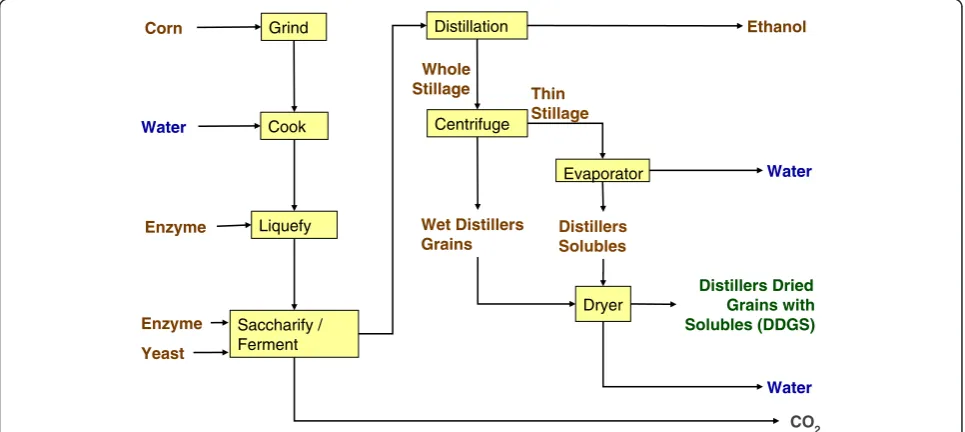
Dry grind and wet milling differ with respect to types and amounts of process outputs. The primary outputs from the dry grind process are ethanol, DDGS, and oil when skimming is practiced (Figures 3 and 4). With wet
milling, higher-value co-products result, in the form of CGF, CGM, and corn oil (from the germ) suitable for hu-man use; DDGS is not produced (Figure 5). DDGS, CGF, and CGM are relatively high in protein and thus directly supplant soybean meal, as well as corn grain, in livestock diets. Among dry grind ethanol plants, an estimated 50% practice oil skimming to recover crude oil that is mainly utilized for biodiesel production [26]. In this way, the skimmed oil competes with soy oil as a raw bioenergy feedstock. As soybean meal is supplanted in livestock diets by DDGS from corn ethanol, the soy oil produced along with soybean meal must be accounted for as well. Further-more, oil skimming has an effect on DDGS composition, lowering the fat (energy) component as well as the protein content. The composition of feed co-products, that is, protein and fat content, depends on the ethanol process-ing method (Table 4).
A weighted average of ethanol and co-product outputs was computed and used to formulate a baseline to repre-sent ethanol processing in scenarios other than Scenar-ios 5 and 6 that feature effects of technological changes to the ethanol process (Table 5). Baseline assumptions include:
A weighted industry yield of 2.759 gallons per bushel reflects dry grind and wet milling ethanol yields of 2.785 and 2.600 gallons per bushel,
respectively, with dry grind plants making up 86% of ethanol capacity and wet milling plants 14%.
Oil skimming, which is done at 50% of dry grind plants, leads to 0.24 pounds of oil per bushel, decreasing DDGS yield to 17.32 pounds per bushel at 89.31% dry matter content (that is, 15.45 pounds
Corn Distillation Ethanol
Centrifuge Whole
Stillage Thin
Stillage
Evaporator
Wet Distillers Grains
Distillers Solubles
Distillers Dried Grains with Solubles (DDGS)
Grind
Cook
Liquefy
Saccharify / Ferment
CO2
Enzyme
Enzyme
Dryer
Yeast Water
Water
Water
dry basis per bushel). Plants that do not skim have DDGS yields of 17.56 pounds (as is) per bushel [26]. Thus, the weighted dry grind average DDGS yield is 17.44 pounds (as is) per bushel.
Wet milling co-products CGF and CGM represent 23% and 5% output from each bushel of corn proc-essed for ethanol, respectively.
Based on the current US ethanol production capacity of 14.71 billion undenatured gallons per year [27] and assuming a 50% adoption rate for skimming oil at a rate of 0.24 pounds of oil per
bushel, oil production from skimming is estimated at 545.3 million pounds. This can be converted for use as biodiesel at a rate of 9 pounds of biodiesel per 10 pounds of oil, for a total biodiesel volume from skimmed oil of 66.68 million gallons (which is well below the US mandated biodiesel production of 1 billion gallons). It was assumed that biodiesel gallons from skimmed oil would replace gallons produced using soy oil; thus, skimmed oil feeds back into the model to reduce the amount of oil replacement acres by canola. Because oil skimmed from the dry
Corn Distillation Ethanol
Centrifuge Whole
Stillage Thin Stillage
Evaporator Distillers Wet
Grains
Distillers Solubles
DDGS with reduced fat content
Grind
Cook
Liquefy
Saccharify / Ferment
CO2 Enzyme
Enzyme
Dryer
Yeast
Water
Water
Water
Centrifuge Corn OilCrude
Figure 4Dry grind process with oil recovery for production of ethanol, oil, and reduced fat distillers dried grains with solubles.
Corn
Fermentation
Distillation Ethanol
Condensed Solubles
Steeping
Liquefy
Saccharify CO2
Enzyme
Enzyme
Germ Separation
Fiber Separation
Protein Separation
Starch
Steepwater
Germ
Fiber
Gluten Meal
Gluten Feed Mix / Dry
Cook
Yeast
Evaporator
Figure 5Wet milling process for production of ethanol, germ from which oil and germ meal are recovered, corn grain feed, and corn grain meal.
Mummet al. Biotechnology for Biofuels2014,7:61 Page 12 of 17
grind process is not economical for use in human food, this prevents the use of some of the soy oil for non-food use.
Scenario 5 anticipates a technological improvement in the dry grind process that allows for fermentation of all starch in the corn grain to ethanol, providing 2.5% more ethanol output per bushel of corn while reducing DDGS production by 6.1%. This scenario is referred to as‘full starch’. At present, a percentage of starch remains unconverted in the DDGS following fermentation, as indicated by average starch content (7.54% starch (dry basis)) of DDGS samples from the National Research Council [51]. If a greater percentage of starch could be converted into ethanol, ethanol yields would increase, DDGS output per bushel of corn would decrease, and DDGS composition would be altered. Dry grind processors continue to use new equipment, enzymes, and process de-signs in an effort to reduce residual starch content of DDGS. We assume this improved technology would be im-plemented at all dry grind facilities. Conservatively estimat-ing that 6% residual starch (dry basis) or other convertible sugars in DDGS from dry grind are converted (sources such as the National Research Council report DDGS starch contents of 7.5% to 10.8% (dry basis) [51]), the additional ethanol yield with full starch implementation is estimated at 0.081 gallons per bushel. In Scenario 5, we accounted for changes in yield and composition of DDGS but assumed no impact to CGF or CGM because of the comparatively small fraction of materials in the livestock feeding system and the minimal impact anticipated. Thus, the full starch scenario involves only changes to dry grind co-product out-puts; compositions of CGF and CGM were assumed to be unchanged. With more complete starch conversion during dry grind, dry grind ethanol yield increases to 2.866 gallons per bushel, and the improved aggregate industry yield is 2.829 gallons per bushel (Table 5; see Additional file 1 for calculations).
Concomitant with ethanol yield increase, the amount of DDGS produced per bushel decreases due to the complete fermentation of starch. The adjusted rate of DDGS pro-duction due to full starch conversion, assuming 50% adoption of oil skimming by the dry grind industry, is 16.38 pounds of DDGS per bushel of corn (Table 5; see Additional file 1 for calculations). At the same time, protein content per bushel of corn increases to 29.10%, although total protein in the DDGS produced per acre of corn re-mains the same; likewise, fat (oil content) increases per bushel of corn to 10.28% (Table 4).
Scenario 6 anticipates another technological improve-ment in ferimprove-mentation in the dry grind process to facilitate conversion of fiber fractions (C5 and C6 sugars) to ethanol, thus leading to 11.6% more ethanol output per bushel of corn while concomitantly reducing DDGS output 27.4%.
This scenario, referred to as ‘complete fiber’, anticipates conversion of fiber portions of the corn grain that are cur-rently unfermented, in addition to conversion of residual starch (as in Scenario 5). Dienet al.document conversion of C5 and C6 sugars to ethanol using conventional yeast and a bacterial strain (Escherichia coliFBR5) [48]. More re-cently, Ha et al. [52] and Bera et al. [53] document the conversion of C5 sugars to ethanol with new fermentation organisms. The fermentation included residual starch along with pericarp and endosperm fiber fractions. Dien et al. reported that use of two types of glucose-consuming organisms increased ethanol yields by 13.3% [48].
In dry grind processing, the 13.3% increase in ethanol yields is accompanied by changes in DDGS yields and composition. Because ethanol is a high-value product, it is assumed that 100% of dry grind producers would adopt this technology (although we do not expect the number and proportion of dry grind facilities to be af-fected by this technology). The wet milling facilities were not anticipated to adopt this technology because feasible production of CGF relies on a source of fiber that is mixed and dried with process streams such as steep-water and fermentation solids (distillers solubles). In wet milling, fiber is needed as a method to allow removal of steepwater and fermentation solids from the process. Without the fiber stream, drying these solids would not be economical.
The 13.3% increase in ethanol yield with the complete fiber scenario translates to an additional ethanol yield of 0.370 gallons per bushel for dry grind, bringing the aggre-gate industry yield to 3.078 gallons per bushel (Table 5; see Additional file 1 for calculations). Concomitant with ethanol yield increase, the composition of DDGS output in dry grind processing is altered with complete fiber con-version compared to the baseline. Protein content per bushel of corn increases to 28.58%; likewise, fat (oil con-tent) increases per bushel of corn to 10.10% (Table 4). It could be anticipated that protein and oil contents for Sce-nario 6 would be much higher than SceSce-nario 5. However, Scenario 5 assumes a 6.1% decrease in the DDGS yield, whereas Scenario 6 is based on actual conversion rates from Dienet al.[48]. With the decreased amount of DDGS produced per bushel, the adjusted rate of DDGS produc-tion due to complete fiber conversion, assuming continued 50% adoption of oil skimming by the dry grind industry, is 12.67 pounds of DDGS per bushel of corn (Table 5; see Additional file 1 for calculations).
DDGS assumes compliance with dietary nutrition con-sistent with maintaining high meat and milk quality.
In 2011, it is estimated that a total of 127.440 million metric tons (5.007 billion bushels) of corn was directed to ethanol production annually [25], with 86% (109.598 million metric tons; 4.306 billion bushels) being used in dry grind processing and 14% (17.842 million metric tons; 700.917 million bushels) being used in wet milling. Given a weighted average of 310.1 kg of DDGS produced per metric ton of corn grain in the dry grind process (Table 6), a total production of 34.091 million metric tons of DDGS resulted (Table 7). In addition, 4.098 mil-lion metric tons of CGF and 0.891 milmil-lion metric tons of CGM were generated as a result of production of etha-nol from corn in the wet milling process, assuming that 23% of the corn grain will end up in CGF and 5% of the grain will end up in CGM. Thus, an estimated total of 39.080 million metric tons of DDGS, CGF, and CGM are produced annually from corn ethanol processing. It is assumed that of the DDGS produced, 9 million metric tons are exported, and the remaining 25.091 million metric tons are used domestically.
Because DDGS, CGF, and CGM supplants different amounts of corn and soybean meal in diets fed to differ-ent groups of animals, it is necessary to know the ap-proximate market share for each group of animals for which DDGS is used. There are three recent estimates for the proportion of domestic DDGS fed to beef cattle, dairy, pigs, and poultry [54-56]. The average of these three estimates is 50.4% to beef cattle, 33.5% to dairy cattle, 9.1% to pigs, and 7.0% to poultry (Table 6). Based on these per-centages, the total usage of DDGS for each group of ani-mals can be calculated (Table 7).
Inclusion of DDGS, CGF, and CGM in livestock feeding regimes supplants corn or soybean meal in diets for beef
cattle, dairy, poultry, and livestock. At present, DDGS re-places approximately 60% corn and 40% soybean meal in the feeding of pigs and poultry [54,57], supporting a 1:1 substitution rate [58,59]. DDGS replaces various amounts of corn and soybean meal in diets for ruminant animals. The rate of substitution per species depends on the re-quirement for protein and energy. It is assumed that DDGS fed to beef cattle replaces no soybean meal and only corn because beef cattle are usually fed only limited quantities of soybean meal due to their relatively low re-quirement for protein and because protein equivalents can be obtained less expensively from other ingredients. Thus, it is assumed that DDGS included in diets fed to beef cattle replaces corn at a 1:1 rate, although it is ac-knowledged that substitution rates of 1.1:1 or 1.2:1 have been proposed [54]. However, currently there are very lim-ited biological data to support substitution rates greater than 1:1 and in the present calculations, the 1:1 rate is used to make sure the DDGS is not overvalued.
It is also assumed that the CGF produced from the wet milling industry is fed exclusively to beef cattle and that it replaces corn on a 1:1 basis and that no soybean meal is replaced by CGF. By contrast, DDGS fed to dairy cows replaces 47% corn and 53% soybean meal and DDGS fed to pigs and poultry replaces 60% corn and 40% soybean meal. As a consequence of these substitu-tion rates, more soybean meal is replaced if DDGS usage is shifted from beef cattle to dairy, pigs, or poultry. It is also assumed that the 9 million metric tons of DDGS that are exported are fed to dairy, pigs, and poultry and that the substitution rates for corn and soybean meal for the exported DDGS are similar to the replacement rates for the domestically used DDGS that is fed to dairy, pigs, and poultry (Table 7). Finally, it is assumed that the CGM that is produced from the wet milling industry is used
Table 7 Substitution of corn and soybean meal by distillers dried grains with solubles, corn grain feed, and corn grain meal produced from 5.007 billion bushels (127.440 million metric tons) of corn grain associated with 71%:29% substitution ratio overall
Substitution (%) Substitution tonnage (millions)
Co-product Million tons Corn Soybean meal Corn Soybean meal
Export 9.000 51.2 48.8 4,610 4,390
Domestic use 25.091 75.8 24.2 19.020 6.071
Beef usage 12.646 100 0 12.646 0
Dairy usage 8.405 47.0 53.0 3.951 4.455
Pig usage 2.283 60.0 40.0 1.370 0.913
Poultry usage 1.756 60.0 40.0 1.054 0.703
Domestic dairy, pigs, and poultry 12.445 51.2 48.8 6.374 6.071
Distillers dried grain with solubles domestic plus export 34.091 69.3 30.7 23.630 10.461
Corn grain feed 4.098 100 - 4.098
-Corn grain meal 0.891 - 100 - 0.891
Total substitution 39.080 71.0 29.0 27.728 11.352
Mummet al. Biotechnology for Biofuels2014,7:61 Page 14 of 17
exclusively in dairy feeding where it replaces soybean meal at a 1:1 rate. Under these assumptions, the total substitu-tion of corn and soybean meal can be calculated.
Overall, 27.728 million metric tons of corn and 11.352 million metric tons of soybean meal are replaced across livestock diets, reflecting a substitution ratio of 71% corn to 29% soybean meal in feeding of DDGS, CGM, and CGF (Table 7). This ratio serves as a baseline to represent live-stock feeding utilization of corn ethanol co-products in scenarios other than Scenario 7, which reflects an adjusted ratio based on technological changes.
Scenario 7 anticipates a modified overall substitution ra-tio of corn to soybean meal due to a shift in the utilizara-tion of DDGS in feeding diets among livestock types. Because economics favor replacement of soybean meal rather than corn (amount of protein on a per ton basis), it is expected that an increased proportion of DDGS will be consumed by dairy, pigs, and poultry in the future.
Dairy cattle are expected to be a primary target for in-creased rates of DDGS inclusion in the diet; dairy cattle require a high amount of protein, which is largely pro-vided by soybean meal at present, and can also handle the fiber load. DDGS can be used in diets for dairy cows by at least up to 20% and often up to 30% on a dry matter basis without changing animal performance [60,61]. Further-more, use of DDGS for dairy favors the lower fat content of DDGS from dry grind ethanol plants that skim oil (Table 4); thus, oil skimming may promote a higher rate of inclusion of DDGS in diets fed to dairy cows [61]. Pro-vided that diets are correctly formulated, there are no in-dications that milk composition will be changed or that the value components in milk will be reduced [62,63].
With the increased awareness of the benefits of DDGS in diets fed to pigs and poultry and the economic
competitiveness of DDGS relative to soybean meal, it is also likely that the penetration of DDGS in the swine and poultry feed markets will increase. This can be easily accomplished without exceeding the maximum recom-mended rates for inclusion of DDGS in diets fed to pigs or poultry. DDGS can be included in diets for pigs at levels of at least 20% without changing the composition or the nutritional value of the meat that is produced [59,64-67]. Likewise, for poultry, DDGS can be included in the diets by at least 10% to 15% without reducing product quality [68-70]. Because DDGS penetration can be increased greatly without exceeding these thresholds, it is possible to increase DDGS utilization in diets fed to pigs and poultry without negatively impacting pork or poultry meat quality. Furthermore, balancing of DDGS with specific indispensable amino acids will make DDGS more usable in the feeding of pigs and poultry, and use of specific microbial enzymes such as xylanase and phos-phatases in livestock diets containing DDGS may help in-crease the energy and phosphorus value of DDGS. By feeding more DDGS to pigs and poultry, these livestock types will consume an overall greater share of the total DDGS produced.
With greater use of DDGS in feeding of dairy cattle, pigs, and poultry, a decline in the proportional usage by beef cattle is anticipated. In Scenario 7, it is therefore es-timated that consumption of DDGS by beef cattle is re-duced from the current level of 50.4% to only 30% of total DDGS production, whereas dairy cattle, pigs, and poultry will increase consumption to 47.3%, 12.8%, and 9.9% of the produced DDGS, respectively (Table 6). Reflecting the shift in usage among livestock types, Sce-nario 7 depicts DDGS substitution of 65% corn and 35% soybean meal across livestock diets (Table 8).
Table 8 Substitution of corn and soybean meal by distillers dried grains with solubles, corn grain feed, and corn grain meal produced from 5.007 billion bushels (127.440 million metric tons) of corn grain associated with a 65%:35% substitution ratio overall
Substitution (%) Substitution tonnage (M)
Co-product Million tons Corn Soybean meal Corn Soybean meal
Export 9.0 51.2 48.8 4,610 4,390
Domestic use 25.091 75.8 24.2 19.020 6.071
Beef usage 7.527 100 0 7.527 0
Dairy usage 11.868 47.0 53.0 5.578 6.290
Pig usage 3.212 60.0 40.0 1.927 1.285
Poultry usage 2.484 60.0 40.0 1.490 0.994
Domestic dairy, pigs, and poultry 17.564 51.2 48.8 8.995 8.568
Distillers dried grain with solubles domestic plus export 34.091 62.0 38.0 21.132 12.959
Corn grain feed 4.098 100 - 4.098
-Corn grain meal 0.891 - 100 - 0.891
Endnote a
We define feedback drawing on terminology from the field of System Dynamics, http://www.systemdynamics. org/DL-IntroSysDyn/feed.htm. Positive feedback causes systems to grow or expand, and negative feedback causes decline or contraction. For example, in our case, a positive feedback effect results when a perturbation to the system increases land area, such as with higher ethanol yields, whereas a negative feedback effect, such as greater live-stock feeding with DDGS, reduces land area.
Additional file
Additional file 1:Additional documentation is available that shows the calculations related to ethanol processing used to generate estimates for Tables 4 and 5.See PDF file: Additional information: Calculations related to ethanol processing.
Abbreviations
bu/A:bushels per acre; CGF: corn gluten feed; CGM: corn gluten meal; db: dry basis; DDGS: distillers dried grains with solubles; USDA: United States Department of Agriculture.
Competing interests
The authors declare that they have no competing interests.
Authors’contributions
RM conceived the study. All authors were involved with designing the study. RM, KR, and HS performed the microanalyses. PG created the model and conducted the system analysis. RM and PG drafted the manuscript, with KR and HS contributing key portions. All authors read and approved the final manuscript.
Acknowledgments
This study was supported in part by funding from the Illinois Corn Growers’ Association and Illinois Corn Marketing Board. We wish to acknowledge David Gustafson of Monsanto Company for verifying public accessibility of information on Monsanto’s product pipeline. Furthermore, we wish to thank Steffen Mueller and Geoff Cooper for helpful discussions and review of the manuscript. Finally, we are grateful for the helpful comments of three anonymous reviewers, which improved the quality of this publication.
Author details
1Department of Crop Sciences, University of Illinois at Urbana-Champaign, Urbana, IL 61801, USA.2Department of Agricultural and Consumer Economics, University of Illinois at Urbana-Champaign, Urbana, IL 61801, USA.3Department of Agricultural and Biological Engineering, University of Illinois at Urbana-Champaign, Urbana, IL 61801, USA.4Department of Animal Sciences, University of Illinois at Urbana-Champaign, Urbana, IL 61801, USA.
Received: 13 September 2013 Accepted: 19 March 2014 Published: 12 April 2014
References
1. United States Department of Agriculture Economic Research Service:Feed Grains Database. http://www.ers.usda.gov/data-products/feed-grains-database/feed-grains-yearbook-tables.aspx#26766.
2. US Department of Energy, US Energy Information Administration:Energy Independence and Security Act of 2007: Summary of Provisions.http:// www.eia.doe.gov/oiaf/aeo/otheranalysis/aeo_2008analysispapers/eisa.html. 3. Wang M, Huo H, Arora S:Methods of dealing with co-products of biofuels
in life-cycle analysis and consequent results within the U.S. context.
Energy Policy2011,39:5726–5736.
4. Arora S, Wu M, Wang M:Update of Distillers Grains Displacement Ratios for Corn Ethanol Life-cycle Analysis.Argonne, IL: Argonne National Laboratory; 2008.
5. Farrell AE, Plevin RJ, Turner BT, Jones AD, O’Hare M, Kammen DM:Ethanol can contribute to energy and environmental goals.Science2006, 311:506–508.
6. Wang M:Development and Use of GREET 1.6 Fuel-Cycle Model for Transportation Fuels and Vehicle Technologies.Argonne, IL: Tech. Rep. ANL/EDS/TM-163, Argonne National Laboratory. http://www.transportation.anl.gov/pdfs/TA/153.pdf. 7. Taheripour F, Hertel TW, Tyner WE:Implications of biofuels mandates for
the global livestock industry: a computable general equilibrium analysis.
Agr Econ2010,42:325–342.
8. Taheripour F, Hertel TW, Tyner WE, Beckman JF, Birur DK:Biofuels and their by-products: Global economic and environmental implications.Biomass Bioenerg2010,34:278–289.
9. Lywood W, Pinkney J, Cockerill S:Impact of protein concentrate coproducts on net land requirement for European biofuel production.
GCB Bioenerg2009,1:346–359.
10. Service RF:Is there a road ahead for cellulosic ethanol?Science2010, 329:784–785.
11. Miranowski J, Rosburg A, Aukayanagul J:US maize yield growth implications for ethanol and greenhouse gas emissions.Ag Bio Forum
2011,14:120–132.
12. Downing M, Eaton LM, Graham RL, Langholtz MH, Perlack RD, Turhollow AF Jr, Stokes B, Brandt CC, for US Department of Energy:U.S. Billion-ton Update: Biomass Supply for a Bioenergy and Bioproducts Industry.Oak Ridge TN: Oak Ridge National Laboratory; 2011. http://www1.eere.energy.gov/bioenergy/ pdfs/billion_ton_update.pdf.
13. Mueller S, Kwik J:Corn Ethanol: Emerging Plant Energy and Environmental Technologies.Chicago, IL: University of Illinois at Chicago; 2013. http:// ethanolrfa.org/page/-/PDFs/2012%20Corn%20Ethanol%20FINAL.pdf?nocdn=1. 14. Dunn JB, Mueller S, Kwon H, Wang MQ:Land-use change and greenhouse gas
emissions from corn and cellulosic ethanol.Biotechnol Biofuels2013,6:51. 15. Wallington TJ, Anderson JE, Mueller SA, Kolinski Morris E, Winkler SL, Ginder JM,
Nielsen OJ:Corn ethanol production, food exports, and indirect land use change.Environ Sci Tech2012,46:6379–6384.
16. Hertel TW, Golub AA, Jones AD, O’Hare M, Plevin RJ, Kammen DM:Effects of US maize ethanol on global land use and greenhouse gas emissions: estimating market-mediated responses.Bioscience2010,60:223–231. 17. Hoekman SK:Biofuels in the U.S.–challenges and opportunities.Renew
Energy2009,34:14–22.
18. Mitchell D:A Note on Rising Food Prices.Washington, DC: Policy Research Working Paper 4682, World Bank Development Prospects Group, World Bank; 2008. https://openknowledge.worldbank.org/handle/10986/6820. 19. Havlik P, Schneider UA, Schmid E, Bottcher H, Fritz S, Skalsky R, Aoki K,
de Cara S, Kindermann G, Kraxner F, Leduc S, McCallum I, Mosnier A, Sauer T, Obersteiner M:Global land-use implications of first and second generation biofuel targets.Energy Policy2011,39:5690–5702.
20. Johansson DJA, Azar C:A scenario based analysis of land competition between food and bioenergy production in the US.Clim Change2007, 82:267–291.
21. Cai X, Zhang X, Wang D:Land availability for biofuel production.Environ Sci Technol2011,45:334–339.
22. Isee Systems:STELLA, v 9.1.4. 2011. http://www.iseesystems.com. 23. USDA, National Agricultural Statistics Service:Crop Production: 2012
Summary.http://usda01.library.cornell.edu/usda/nass/CropProdSu//2010s/ 2013/CropProdSu-01-11-2013.pdf.
24. North Carolina Soybean Producers Association, Inc:How soybeans are used.http://www.ncsoy.org/ABOUT-SOYBEANS/Uses-of-Soybeans.aspx. 25. USDA, National Agricultural Statistics Service:Crop production and
agricultural prices.http://www.nass.usda.gov.
26. Mueller S:2008 national dry mill corn ethanol survey.Biotechnol Lett2010, 32:1261–1264.
27. Renewable Fuels Association:Ethanol Production Capacity.http://www. ethanolrfa.org/pages/statistics.
28. Moose SP, Mumm RH:Molecular plant breeding as the foundation for 21stcentury crop improvement.Plant Physiol2008,147:969–977. 29. Troyer AF:Adaptedness and heterosis in corn and mule hybrids.Crop Sci
2006,46:528–543.
30. Fraley R:Monsanto Company, Credit Suisse Global AgroChemicals Conference presentation. 2010. http://www.monsanto.com/investors/ Pages/presentations.aspx.
31. Fraley R, Monsanto Company:A tale of two farms.InProceedings of the Food & Agricultural Communications; The Next Frontier: 17 February 2012:
Mummet al. Biotechnology for Biofuels2014,7:61 Page 16 of 17
![Figure 1 Disposition (%) among major uses of No. 2 yellow corn harvested in the US in 2011 [1].](https://thumb-us.123doks.com/thumbv2/123dok_us/425906.2040134/2.595.55.545.357.716/figure-disposition-major-uses-yellow-corn-harvested.webp)