Volume: 02, Issue: 06
(NOVEMBER-DECEMBER, 2016)
Traffic Distribution via Portfolio Selection in Multipath Routing
Algorithm
Fameedha Sheik
1, MD. Imran
2, Heruthunnia Shaik
3 1, 2 Department of Computer Science & Engineering3Department of Mechanical Engineering, 1, 2 Nimra Institute of Science & Technology, Vijayawada 3Malla Reddy Institute of Engineering & Technology, Hyderabad Abstract—Multiple-path source routing protocols
makes a data source node to deal the total traffic among feasible paths. In this paper, we consider the problem of jamming-aware source routing in which the source node execute traffic assigning based on factual jamming statistics at individual network nodes. We develop this traffic allocation as a loss network flow reducing problem using brief selection theory from financial statistics. We show that in multisource networks, this assembled optimization problem can be solved using a distributed algorithm based on decomposition in network function maximization (NUM). We describe the
network’s ability to estimate the effect of jamming and put together these estimates into the traffic allocation problem. Finally, we simulate the manageable throughput using our proposed traffic allocation method in several scenarios.
Index Terms—jamming, multiple-path routing, network utility maximization (NUM), optimization, portfolio selection theory.
I. INTRODUCTION
JAMMING point-to-point transmissions in a wireless mesh network [1] or underwater acoustic network [2] can have debilitating effects on data transport through the network. The effects of jamming at the physical layer resonate through the protocol stack, providing an effective denial-of-service (DoS) attack [3] on end-to-end data communication. The simplest methods to defend a network against jamming attacks comprise physical layer solutions such as spread-spectrum or beam-forming, forcing the jammers to expend a greater resource to that intelligent jammers can incorporate cross-layer protocol information into jamming attacks, reducing resource expenditure by several orders of magnitude by targeting certain link layer and MAC implementations [4]–[6] as well as link layer error detection and correction protocols [7]. Hence, more sophisticated anti jamming methods and defensive measures must be incorporated into higher layer protocols, for example channel surfing the majority of antijamming techniques make use of diversity. For example, antijamming protocols may employ multiple frequency bands, different MAC channels, or multiple routing paths. Such diversity techniques help to curb the effects of the jamming attack by requiring the jammer to
act on multiple resources simultaneously. In this paper, we consider the antijamming diversity based on the use of multiple routing paths. Using multiple-path variants of source routing protocols such as Dynamic Source Routing (DSR) [9] or Ad Hoc On-Demand Distance Vector (AODV) [10], for example the MP-DSR protocol [11], each source node can request several routing paths to the destination node for concurrent use. To make effective use of this routing diversity, however, each source node must be able to make an intelligent allocation of traffic across the available paths while considering the potential effect of jamming on the resulting data throughput. As we describe that impact about sticking once throughput, each wellspring must gather majority of the data on the effect of the sticking entrap for Different parts organized. However, the degree for sticking In each organize hub relies on An amount about obscure parameters, including the technique utilized Eventually Tom's perusing the unique jammers and the relative area of the jammers with admiration to each transmitter–receiver couple. Hence, the sway for sticking will be probabilistic from that point of view of the network one and the characterization of the sticking sway may be further convoluted by that reality that the jammers’ methodologies might be
Volume: 02, Issue: 06
(NOVEMBER-DECEMBER, 2016)
standard permits the individuals data wellsprings forcounterbalance the individuals anticipated data throughput for the individuals flawed is concerned through achievable development rates. That leftover portion of this paper may be sorted out concerning illustration takes after. To segment 2, we state those system model Also presumptions around those sticking ambush. Should settle on our formulation, done area 3, we introduce strategies that permit hubs with portray those nearby sticking sway. These ideas are required on see those movement allotment streamlining and the mapping of this issue on Portfolio Choice. Clinched alongside area 4, we plan those ideal various way movement allotment issues to multisource networks. For segment 5, we assess the execution of the ideal movement allotment detailing. We synopsis our commitments done area 6.
II. SYSTEM MODEL & BOUNDS
We the remote system about premium could be spoke to Eventually Tom's perusing a guided chart G= (N, E). Those top situated n speaks to the organize nodes, Furthermore a requested one sets of the remote system of premium could make spoke to Eventually Tom's perusing a guided chart. The vertebrate fossil science set speaks to the organize nodes, and an requested match for hubs may be in the edge set In Furthermore just if hub cam wood accept packets specifically starting with hub. We expect that all correspondence may be unicast in those guided edges over, I. e, each bundle transmitted by hub will be expected for an interesting hub with. The most extreme practical information rate, alternately capacity, of each unicast join in the nonattendance from claiming sticking will be indicated toward the foreordained institutionalized rate on units of packets for every second. 3 each hotspot hub previously, a subset generates information for a solitary target hub. We Accept that each sourball hub fudge different directing ways to utilizing a course a methodology comparative should the individuals of the DSR [9] alternately AODV [10] conventions.
III. IMPACT OF JAMMING
In this section, we deicide techniques for the network nodes to approximate and characterize the pound of jamming and for a source node to incorporate these predicts into its traffic allocation. In order for a source node to indulge the jamming impact in the traffic allocation problem, the effect of jamming on transmissions over each link must be estimated and communicate to. However, to capture the jammer mobility and the dynamic effects of the jamming attack, the local estimates need to be continually updated. We illustrate with an example to clarify the possible effects of jammer mobility on the traffic allocation problem and inspired continually updated local estimates need to be continually updated. We begin with an example to illustrate the possible effects of jammer mobility on the
traffic allocation problem and motivate the use of continually updated local estimates. Illuminating the Effect of Jammer Mobility on Network Throughput illustrates a single-source network with three routing paths
,
and
.
y a subset of directed link set Those sub network for interest with hotspot will be provided for Eventually Tom's perusing those guided those mark ahead each edge may be those join limit tell mean the accumulation about loop-free directing ways to hotspot , noting that these ways need not make disjoint Likewise clinched alongside MP-DSR [11]. That sub graph comprises of the two directing ways and the sub graph comprises of the two directing ways in this paper, we acknowledge that the wellspring hubs for need no previous information over the sticking assault continuously executed. That is,
we make no supposition around those jammer’s goals,
Volume: 02, Issue: 06
(NOVEMBER-DECEMBER, 2016)
this one-time reassigning by the source node does notaccommodate to the potential mobility of the jammer. If the jammer moves to node , the packet success rate over comes back to 1, and that over reaches to zero, decreasing the throughput to node to 150 pkts/s, which is less than the 200 pkts/s that would be reached using original allocation of 100 pkts/s over each of the three paths. Hence, each node must deliver an estimate of its packet success rate to the source node, and the source must use this information to change traffic in a timely fashion if the effect of the attack is to be allayed The delivery of information from the nodes can be done serially or at the instants when the packet success rates change originally. These updates must be performed at a rate comparable to the rate of the jammer flow to provide an effective defence against the mobile jamming attack. Next, suppose the jammer continually progressions position the middle of hubs and, bringing on the bundle triumph rates through joins and should vibrate the middle of zero What's more particular case. This conduct technique introduces a secondary level for variability under the analyzed bundle. Estimation overhaul transform to a solitary connection. The assess may be updated each s, and the estimation difference is registered main each s. Both qualities craftsmanship wellspring hubs each encountered with urban decay because of deindustrialization, innovation developed, government lodging. Achievement rates, prompting An lesquerella certain assess of the future triumph rates through the joins What's more. However, since the bundle achievement rate In connection need verifiably been more steady, it might make An a greater amount trustworthy choice. Hence, the wellspring cam wood picks to fill on its ability Furthermore segment the remaining 100 pkts/s just as over What's more. This result takes under record those notable variability in the bundle victory rates because of sticking portability. In the accompanying section, we expand on this example, giving An situated about parameters should a chance to be expected Eventually Tom's perusing system hubs Furthermore routines for the wellsprings with sum this majority of the data Also describe practical ways on the groundwork about relied upon throughput. B. Estimating nearby bundle triumph rates we give mean those bundle triumph rate again connection during time , noting that might a chance to be computed analytically Concerning illustration a work of the communicated indicator force of hub , the indicator force of those jammers, their relating distances starting with hub , and the way misfortune conduct technique of the remote medium. On reality, however, the areas about portable jammers would frequently all the not referred to and, hence, the utilization of such an explanatory model will be not pertinent. Because of those unchangeable in the sticking sway. We mock up the packet success rate as an irregular process and allow the network nodes to collect Bayer data in order to characterize the process. We
suppose that each node maintains an estimate of the packet success rate as well as a discrepancy parameter to characterize the estimate unsurely and process variability.4 we propose the use of a repeated update mechanism allowing each node to iterative update the estimate as a function of time. We suppose that each node updates the estimate after each update period of s and communicate the estimate to each cognate source node after each update relay period of s. The shorter update period of s allows each node to characterize the change in over the update relay period of s, a key factor in We recommend the utilization of the watched bundle conveyance proportion (PDR) to figure the gauge. Same time the PDR introduces extra variables for example, obstructing it need been indicated by broad experimentation [8] that such variables don't influence the PDR On An comparative way. Furthermore, we recommend on Normal those temporary PDR qualities About whether on cover up those generally short-term varieties because of commotion or withering. Throughout the overhaul period spoken to toward those time interim, every hub might record those number of packets standard again connection and the amount from claiming substantial packets that pasquinade a slip identification weigh. 5 those PDR In join for those redesign period, said, may be consequently equivalent to those proportion.
This PDR can be used to update the scalage at the end of the update period. In order to forbid significant variation in the estimate and to include memory of the jamming onset history, we suggest using an exponential weighted moving average (EWMA) to update the estimate as a function of the former estimate as as
Where is an invariable t weight indicating the relative druthers between current and historic samples.
Volume: 02, Issue: 06
(NOVEMBER-DECEMBER, 2016)
parameter estimates have noteworthy impact on thecalibre of the assess. Clinched alongside particular, Assuming that those overhaul time may be a really large, those relayed estimates also will be old fashioned in the recent past the ensuing upgrade during duration of the time. Furthermore, In the overhaul period In each hub may be as well large, the Progress of the sticking ambush might be averaged crazy over those vast number from claiming specimens. The redesign periods Also must Therefore make short sufficient will catch the Progress of the sticking assault. However, diminishing those overhaul time the middle of progressive updates of the hotspot hub fundamentally increments those correspondence overhead of the organize. Hence, there exist tradeoffs between executions What's more overhead in the decision of the upgrade period. We note that the plan of the overhaul transfer period relies ahead accepted path-loss and jammer versatility models. Those application-specific tuning of the upgrade transfer time is not further herein. Using the above-mentioned formulation, each time a new routing path is requested or an existing routing path is updated, the nodes along the path will include the estimates and as part of the reply message. In what follows, we show how the source node uses these estimates to compute the end-to-end packet success rates over each path. Estimating End-to-End Packet Success Rates Given the packet success rate estimates and for the links in a routing path , the source needs to estimate the effective end-to-end packet success rate to determine the optimal traffic allocation. Assuming the total time required to transport packets from each source to the corresponding destination is negligible compared to the update relay period, we drop the time index and address the end-to-end packet success rates in terms of the estimates and The end-to-end packet success rate for path can be expressed as the product which is itself a random variable6 due to the randomness in each . We let denote the expected value of , and denote the covariance of and for paths. Due to the computational burden associated with in-network inference of correlation between estimated random variables, we let the source node assume the packet success rates as mutually independent, even though they are likely correlated. We maintain this independence assumption throughout this work, yielding a feasible approximation to the complex reality of correlated random variables, and the case of in-network inference of the relevant correlation is left as future work. Under this independence assumption, the mean of given in is equal to the product of estimates as In, denotes the exclusive-OR set operator such that an element is in if it is in either or but not both. The covariance formula in reflects the fact that the end-to-end packet success rates and of paths and with shared links are correlated even when the rates are independent. We note that the variance of the end-to-end rate can be computed using with . Let denote the vector of estimated end-to-end
packet success rates computed using, and let denote the covariance matrix with entry computed using . The estimate pair provides the sufficient statistical characterization of the end-to-end packet success rates for source to allocate traffic to the paths in. Furthermore, the off-diagonal elements in denote the extent of mutual overlap between the paths in.
IV. AWARE TRAFFIC DISTRIBUTION TECHNIQUE
In this section Movement allotment toward mapping those issue to that for portfolio Choice clinched alongside money. Letterset printing indicate the movement rate allocated on way b, we introduce a streamlining structure to jamming-aware movement allotment should different directing ways in for every sourball hub. We create a situated about imperatives forced on movement allotment solutions, et cetera define An utility capacity to ideal y the wellspring hub , the issue from claiming enthusiasm may be Along these lines for each sourball to determine the ideal rate allotment vector subject on organize stream limit imperatives utilizing those accessible facts Also of the end-to-end bundle victory rates under sticking.
A. Traffic Allocation Constraints
In order to define a set of constraints for the multiple-path traffic allocation problem, we must consider the source data rate constraints, the link capacity constraints, and the reduction of traffic flow due to jamming at intermediate nodes. The movement rate allotment vector will be trivially compelled of the nonnegative other hand Similarly as movement rates are nonnegative. Accepting information era in sourball will be restricted to a most extreme information rate , that rate allotment vector will be additionally compelled concerning illustration. These imperatives define the raised space for attainable allotment vectors characterizing rate allotment results for hotspot. Because of sticking during hubs along the path, the movement rate may be possibly lessened during each accepting hub concerning illustration packets are lost. Hence, same time the starting rate about will be allocated of the path; the remaining movement rate sent by hub along the way might a chance to be less. Letterset printing mean the sub path from claiming starting with sourball of the middle of the road hub , the remaining movement rate sent by hub will be provided for Eventually Tom's perusing , the place will be registered utilizing (5) with displaced Eventually Tom's perusing those sub path.
B. Optimal Traffic Distribution via PS
Volume: 02, Issue: 06
(NOVEMBER-DECEMBER, 2016)
correlated assets in finance. In Markowitz’s portfolioselection theory [12], an investor is interested in allocating funds to a set of financial assets that have uncertain future performance. The expected performance of each investment at the time of the initial allocation is expressed in terms of return and risk. The return on the asset corresponds to the value of the asset and measures the growth of the investment. The risk of the asset corresponds to the variance in the value of the asset and measures the degree of variation or
uncertainty in the investment’s growth. We portray the wanted relationship Eventually Tom's perusing mapping this allotment from claiming subsidizes will budgetary stakes of the allotment from claiming movement will directing ways. We relate the anticipated speculation give back on the monetary portfolio of the evaluated end-to-end achievement rates and the speculation danger of the portfolio of the evaluated accomplishment rate covariance grid. We note that the correspondence between related stakes in the money related portfolio corresponds of the connection between no disjoint directing ways. The relationship between budgetary portfolio Choice and the allotment about movement on directing ways may be summarized in the table during the lowest part of the page.
C. Optimal Distributed Traffic Allocation
Using each source determines its own traffic allocation, ideally with minimal message passing between sources. By inspection, we see that the optimal jamming NUM. In the distributed formulation of the algorithm, - flow allocation problem in (12) is similar to the NUM formulation of the basic maximum network aware flow problem. We thus develop a distributed traffic allocation algorithm using Lagrangian dual decomposition techniques [14] for NUM. The dual decomposition technique is derived by decoupling the capacity constraint in (10) and introducing the link prices corresponding to each link . Letting denote the vector of link prices, the Lagrangian of the optimization problem in (12) is given by
D. Computational Complexity
We note that both the unified streamlining issue over (12) and the neighbourhood streamlining venture in the conveyed calculation would quadratic modifying streamlining issues for straight imperatives [13]. Those computational time needed for comprehending these issues utilizing numerical routines for quadratic modifying is An polynomial capacity of the amount from
claiming streamlining variables and the amount about imperatives.
V. SIMULATION & PERFORMANCE EVALUATION
In section this; we mimic Different viewpoints of the recommended systems for estimation from claiming sticking effect Furthermore jamming-aware movement allotment. We 1st describe that reproduction setup, including portrayals of the accepted models to directing way construction, jammer mobility, bundle accomplishment rates, and What’s more estimate updates. We At that point recreate the transform for registering those estimation facts and for a absolute connection. Next, we delineate those impacts of the estimation procedure on the throughput optimization, both As far as streamlining objective capacities and the coming about mimicked throughput. Finally, we recreate a little-scale system comparative to that in same time changing system What's more protocol parameters in place on see execution patterns. The simulation effects exhibited herein need aid gotten utilizing those taking after re-enactment setup. A organize of hubs will be deployed aimlessly through an area, Also joins are structured between pairs for hubs inside an altered correspondence go. The situated from claiming hotspot hubs will be picked randomly and the end hub comparing with each sourball is haphazardly decided starting with inside the joined part holding. Every directing way in the situated will be picked utilizing a randomized geometric directing algorithm which picks the following jump at the end starting with those situated about neighbouring hubs that need aid closer to As far as whichever separation alternately hop-count. Hubs transmit utilizing settled energy.
Case me—Ignoring jamming: Each source chooses the allocation vector using the standard maximum-flow formulation corresponding to and for all elements. This case is included in order to observe the improvement that can be obtained by incorporating the jamming statistics.
Case II—Maximum throughput: The allocation vectors are chosen using the jamming-aware optimization problem in (12) with risk-aversion constant. This case incorporates the estimates, updated every s, in the allocation
Case III—Minimum risk-return: Similar to Case II with. This case incorporates the estimates and uncertainty parameters to balance the mean throughput with the estimation variance.
Volume: 02, Issue: 06
(NOVEMBER-DECEMBER, 2016)
Our simulations are performed utilizing An assemblagetest system that produces Furthermore allocates packets with ways over an altered organize as stated by the current quality of the parcelling vector. Each trial of the improvise compares a few of the over instances utilizing those same jammer portability designs.
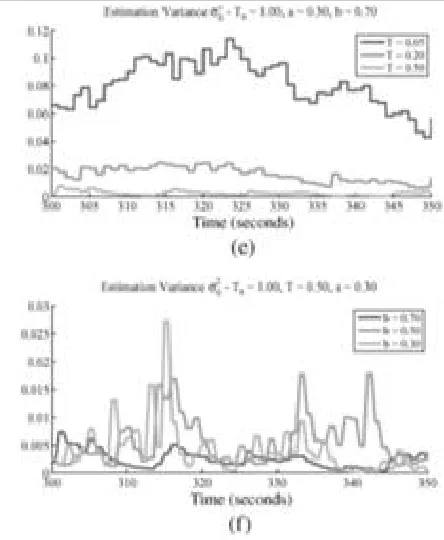
Figure 1 The estimate µij (t) is simulated and compared to the packet success rate xij (t) for varying values of the (a) update relay period Ts, (b) update period T, (c)
EWMA coefficient α, The estimation variance σ 2 ij (t) is
simulated for varying values of the (d) update relay period Ts, (e) update period T, and (f) EWMA coefficient
Volume: 02, Issue: 06
(NOVEMBER-DECEMBER, 2016)
Figure 2
Case I with µij (t) = 1 and σ 2 ij (t) = 0 for
all (i, j), case II with the estimated µij (t) and σ 2 ij
(t), and case IV with the true packet success rates
xij (t) are compared in terms of the (a) optimal
expected throughput γ T s φs and the (b) actual
a
chieved throughput y T s φs. The error bars in (a)
indicate one standard deviation σij (t) above and
below the mean, limited by the network capacity of
5000 pkts/s. Case II with ks = 0 is compared to case
III with ks > 0 using the estimated µij (t) and σ 2
ij
(t) in terms of the (c) expected throughput γ T s φs
and the (d) achieved throughput y T s φs. The error
bars in (a) indicate one standard deviation σij (t)
above and below the mean, bounded by the
network capacity of 5000 pkts/s.
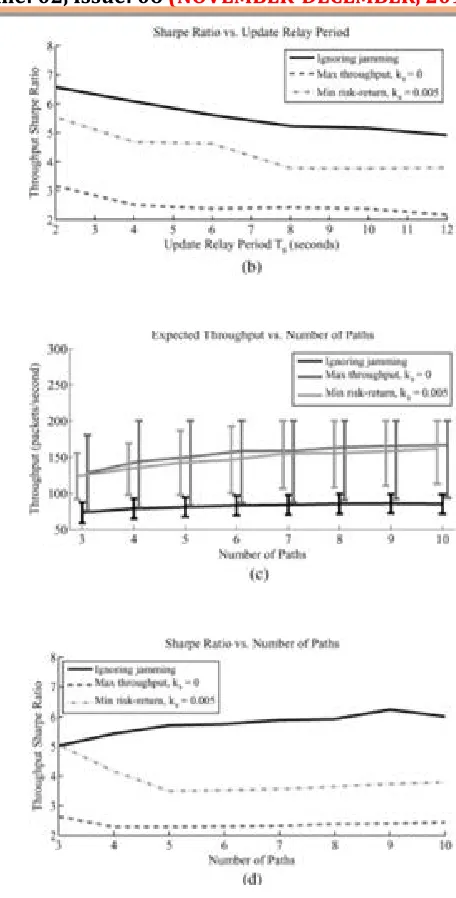
Figure 3
the expected throughput is computed for
Cases I, II, and III with varying update relay period
Ts. In (a), the expected throughput γ T s φs is illustrated with error bars to indicate one standard deviation p φT s Ωsφs around the mean, limited by the network capacity of 5000 pkts/s. In (b), the Sharpe ratio γ T s φs/ p φT s Ωsφs is illustrated. The expected throughput is
computed for Cases I, II, and III with varying number of
routing paths |Ps|. In (c), the expected throughput γ T s φs is illustrated with error bars to indicate one standard
deviation p φT s Ωsφs around the mean, limited by the
network capacity of 5000 pkts/s. In (d), the Sharpe ratio
γ T s φs/ p φT s Ωsφs is illustrated.
VI. CONCLUSION
Volume: 02, Issue: 06
(NOVEMBER-DECEMBER, 2016)
impact of a dynamic jamming attack and for datasources to incorporate this information into the routing algorithm. We formulated multiple-path traffic allocation in multisource networks as a lossy network flow optimization problem using an objective function based on portfolio selection theory from finance. We showed that this centralized optimization problem can be solved using a distributed algorithm based on decomposition in network utility maximization (NUM). We presented simulation results to illustrate the impact of jamming dynamics and mobility on network throughput and to demonstrate the efficacy of our traffic allocation algorithm. We have thus shown that multiple-path source routing algorithms can optimize the throughput performance by effectively incorporating the empirical jamming impact into the allocation of traffic to the set of paths.
REFERENCES
[1]. I. F. Akyildiz, X. Wang, and W. Wang, “Wireless mesh networks: A survey,” Computer Network, vol. 47, no. 4, pp. 445–487, Mar. 2005.
[2]. E. M. Sozer, M. Stojanovic, and J. G. Proakis,
“Underwater acoustic networks,” IEEE J. Ocean. Eng.,
vol. 25, no. 1, pp. 72–83, Jan. 2000.
[3]. R. Anderson, Security Engineering: A Guide to Building Dependable Distributed Systems. New York: Wiley, 2001.
[4]. J. Bellardo and S. Savage, “802.11 denial-of-service
attacks: Real vulnerabilities and practical solutions,”
in Proc. USENIX Security Symposium, Washington, DC, Aug. 2003, pp. 15–28.
[5]. D. J. Thuente and M. Acharya, “Intelligent jamming in
wireless networks with applications to 802.11 b and
other networks,” in Proc. 25th IEEE MILCOM, Washington, DC, Oct. 2006, pp. 1–7.
[6]. A. D. Wood and J. A. Stankovic, “Denial of service in
sensor networks, “Computer, vol. 35, no. 10, pp. 54–
62, Oct. 2002.
[7]. G. Lin and G. Noubir, “On link layer denial of service in data wireless LANs,” Wireless Communication Mobile Computer. vol. 5, no. 3, pp. 273–284, May 2005.
[8]. W. Xu, K. Ma, W. Trappe, and Y. Zhang, “Jamming
sensor networks: Attack and defense strategies,”
IEEE Network, vol. 20, no. 3, pp. 41–47, May/Jun. 2006.
[9]. D. B. Johnson, D. A. Maltz, and J. Broch, DSR: The Dynamic Source Routing Protocol for Multihop Wireless Ad Hoc Networks. Reading, MA: Addison-Wesley, 2001, ch. 5, pp. 139–172.
[10]. E. M. Royer and C. E. Perkins, “Ad hoc on-demand
distance vector routing,” in Proc. 2nd IEEE WMCSA,
New Orleans, LA, Feb. 1999, pp. 90–100.
[11]. R. Leung, J. Liu, E. Poon, A.-L. C. Chan, and B. Li, “MP -DSR: A QoS-aware multi-path dynamic source routing protocol for wireless ad-hoc networks,” in
Proc. 26th Ann. IEEE LCN, Tampa, FL, Nov. 2001, pp. 132–141.
[12]. H. Markowitz, “Portfolio selection,” J. Finance, vol. 7,