pp. 71-102
Task Condition and EFL Learners’ Individual Differences: The Mediation of Tolerance of Ambiguity
and Self-efficacy
Mahmoud Reza Atai Professor Kharazmi University
Alireza Zaré Alanagh PhD Student Kharazmi University [email protected]
Abstract
Drawing on Robinson’s cognition hypothesis, the study attempted to examine how task conditions influence EFL learners’ oral performance and whether learners’ individual differences in terms of tolerance of ambiguity and self-efficacy mediate the effects of such conditions. To this end, 62 Iranian intermediate EFL learners from private language institutes in Tehran performed four dyadic decision-making tasks manipulated along task conditions of information distribution and goal orientation. Their performance was measured through complexity, accuracy and fluency (CAF) indices. Their tolerance of ambiguity and self-efficacy were assessed using separate questionnaires. The results indicated that information distribution and goal orientation could significantly impact the participants’ performance on the tasks. As to the CAF indices, it seemed that Skehan’s (2016) trade-off hypothesis was a better fit than Robinson’s (2015) cognition hypothesis since trade-offs were found between complexity and accuracy/fluency. The results of the correlations revealed that there were a number of significant positive relationships between tolerance of ambiguity and the CAF indices on the one hand and self-efficacy and the CAF indices on the other. While the former relationships did not confirm the specific prediction of the cognition hypothesis, the latter relationships did. Overall, the findings contribute to Robinson’s hypothesis concerned with the effects of task conditions on oral performance and the mediating role of individual differences, and have implications for task sequencing and task-based teaching.
Keywords:task condition, individual differences, tolerance of ambiguity, self-efficacy, CAF
During the last three decades, task-based language teaching has gained in popularity because of its research bases from a variety of perspectives such as second language acquisition, pedagogy, education, and philosophy (Long, 2015). That being said, however, task sequencing continues to be a thorny issue (Skehan, 2016). It needs to be tackled in order for syllabus designers to develop syllabi that use tasks as their teaching units. Proposals have been made to operationalize task difficulty in order to sequence tasks based on their intrinsic difficulty, out of which Skehan’s (2016) trade-off hypothesis and Robinson’s (2015) cognition hypothesis have attracted a lot of research attention.
Skehan (2016), to tackle the issue of sequencing tasks, operationalizes task difficulty by putting more emphasis on attentional demands made by tasks with a variety of features. His hypothesis assumes that attentional resources are limited on the parts of learners and this limitation manifests itself in performance of the learners. Specifically, aspects of their performance are in competition for attentional resources and improvement in one aspect would be at the cost of deterioration in another.
contribution to between-learner language variation and to their influence on language learners’ success in performing complex tasks. This claim has recently been investigated by L2 task-based researchers (e.g., Kim & Tracy-Ventura, 2011; Kormos & Trebits, 2012; Trebits, 2016) and they have investigated a variety of ability and affective factors although studies focusing on the latter have been rather few and far between.
Taking up the legacy left by the researchers who have conducted studies under Robinson’s framework, the present study aims to investigate how two affective factors namely tolerance of ambiguity and self-efficacy mediate Iranian EFL learners’ oral performance on dyadic decision-making tasks manipulated along task conditions of information distribution and goal orientation. The novelty of the study is that the chosen affective factors have not been independently investigated with respect to EFL learners’ performance. Furthermore, the tasks adopted are dyadic decision-making tasks making the study different from the majority of similar studies which have almost exclusively used narrative tasks.
Literature Review Information Distribution and Goal Orientation
solutions, whereas closed goal orientation is when learners are notified that there is only one correct solution to complete the task.
Studies examining the effects of information distribution are small in number (e.g., Doughty & Pica, 1986; Foster, 1998; Gass & Varonis, 1985) and have produced mixed results mainly because they did not investigate its effects separately from the task types they used in their study designs. Lambert and Engler (2007) set out to conduct their study to go around this problem. They used six versions of three tasks manipulated by two variables one of which was information distribution. The collected oral data were measured against different indices of CAF per Analysis of Speech unit (AS-unit)1. The results indicated that while learners in a two-way condition could produce more complex language, in a one-two-way condition they would be more fluent and accurate. In discussing the findings, the researchers admitted that because the participants of the study had been sampled from highly motivated English learners, the results should be interpreted cautiously.
Results of the studies investigating goal orientation have not been conclusive enough either. The same problem inherent in the studies on information distribution seems to be present here, too (Lambert & Engler, 2007). Rankin (1990, 1995) conducted two studies on goal orientation. In the first study, 16 English learners performed closed and open selection tasks. Complexity as measured by relativization was found to improve as a result of performing closed task rather than open task. In the second study, a similar course of action was adopted with 30 German learners. In contrast to the first study, neither open nor closed tasks could result in any improvements on complexity or accuracy of the learners. Mannheimer (1993) set out to replicate Rankin’s (1990) study with Spanish learners and came up with similar findings.
Lambert and Engler (2007) built on the previous studies and especially designed their study to avoid the problem of misinterpretation because of task specificity. Since their study was from Skehan’s (1996)
perspective, they were looking for trade-off effects between complexity and fluency. However, they could find complexity effects on the performance of open tasks and except for one task, i.e., decision-making task, the other tasks could not lead learners to produce more fluent speech. Regarding accuracy, no effects were found for either closed or open versions of the tasks.
Affective Factors and Tasks
Task difficulty, as conceived by Robinson (2011), is composed of both cognitive ability and affective factors. Studies on these factors have been around in the L2 literature for quite a while now for they are concerned with individual differences (IDs) learners bring to learning contexts. Research into IDs has gained new momentum because of a prediction of the cognition hypothesis concerning the interaction of task difficulty variables with task complexity and task condition variables.
(2011) tried to use a pre-post-delayed posttest design to find out the effects of anxiety on the development of past tense. They made use of four communicative tasks varied in terms of complexity. The results indicated that although there were no interactions between task complexity and anxiety, the participants who were less anxious demonstrated more development.
Motivation is another affective factor that has been tapped in task-based research (e.g., Dörnyei & Kormos, 2000; Kormos & Dörnyei, 2004). The research value of motivational variables was first established by Dörnyei and Kormos (2000) in an exploratory study and then they were undergone systematic research by the two scholars. In a follow-up study Kormos and Dörnyei (2004) examined the effects of motivational variables on the dyadic task performance of L2 learners. Both quantity and quality of the learners’ speech were measured. The results indicated that the quantity of the speech produced was more affected by the motivational variables. The researchers concluded that motivation seemingly operated as “a driving force that made students actively engage in a task, but it played a limited role determining the quality of the outcome” (p. 15).
Willingness to communicate (WTC) is yet another affective factor that can be considered here. Two studies of relevance are Kormos and Dörnyei (2004) and Nourzadeh (2015). The former had motivational variables as its main focus and it included six items measuring WTC in the questionnaire used. The latter, however, used an exclusive questionnaire. The results of the two studies are in contrast. Whereas Kormos and Dörnyei (2004) did not find any relationship between WTC and linguistic measures, Nourzadeh (2015) found a positive relationship between WTC and complexity and a negative one between WTC and accuracy.
Tolerance of Ambiguity and Self-efficacy
to ambiguity: learning different linguistic – i.e., phonological, morphological, syntactic, semantic, and pragmatic – elements; learning and exercising language learning skills; and adopting such learned skills as learning strategies.
Ambiguity is inseparable from language learning situations and learners are very likely to experience different levels of ambiguity, hence their need to be tolerant in order to get the most of their learning experience. Although a level of tolerance of ambiguity that facilitates or debilitates the process of learning a new language is hard to define, tentative suggestions have been made based on research findings (El-Koumy, 2000; Ely, 1995, Kazamia, 1999). Ely (1995) argues that “the ideal case, of course, is that of the learner who is neither inhabited by low tolerance of ambiguity nor oblivious to linguistic subtleties” (p. 93).
Self-efficacy, an affective factor (Ehrman et al., 2003), is defined as “people’s beliefs about their capabilities to produce designated levels of performance that exercise influence over events that affect their lives” (Bandura, 1994, p.71). Self-efficacy beliefs toward performing a particular task are different in terms of three main dimensions (Bandura, 1997): magnitude, strength, and generality. Magnitude is related to the difficulty level of the task. That is, people may have different self-efficacy beliefs when it comes to performing simple, moderately difficult, and demanding tasks. Strength pertains to the extent to which a person feels confident when performing a task. Needless to say, strong self-efficacy beliefs are resilient in the face of demanding tasks and unlikely to change, whereas weak self-efficacy beliefs are very likely to change and even disappear. Generality is concerned with transferability of self-efficacy beliefs to other domains. Although some self-efficacy beliefs are confined to specific situations or tasks, others can be extended beyond and be the source of accomplishing tasks in different situations.
Purpose of the Study
that are relevant here are concerned with the effects of task conditions on oral performance and how IDs in terms of ability and affective factors mediate those effects.
Robinson (2015) speculates that both complexity and accuracy are bound to improve especially when learners perform complex tasks. In the present study, this is put to test by manipulating dyadic decision-making tasks along task conditions of information distribution and goal orientation. The goal is to see whether Robinson’s prediction can actually hold true or Skehan’s (2016) trade-off hypothesis is a better alternative.
Robinson (2011) also devotes a special attention to ability and affective factors grouped under the category of task difficulty in TCF since they differentiate learning and performance especially on complex tasks. The interaction of task complexity and task difficulty variables have received serious research attention in the field of task-based research. Nevertheless, there exist affective factors still in need of further research among which tolerance of ambiguity and self-efficacy are cases in point. The inclusion of tolerance of ambiguity in the present study is generally because of the prediction of Robinson’s (2011) hypothesis to the effect that affective factors may have a role to play when it comes to the learners’ performance on complex tasks. Specifically, it is because of the task conditions of information distribution and goal orientation. Robinson (2011) contends that “those learners who are more open to experience, and more tolerant of ambiguity may adapt better to participation in open tasks than those who are less open and less tolerant of ambiguity” (p.25). Further, the open tasks, due to having many possible solutions rather than one fixed solution, will create ambiguous situations of too many and/or contradictory information cues (Budner, 1962) in dealing with which learners of high tolerance of ambiguity are hypothesized to be at an advantage (McLain, 1993).
is argued by Robinson (2011) that the learners having higher self-efficacy “may make greater efforts to participate, and so benefit more from the L2 interaction” (p. 25). The greater effort made by such learners can also be hypothesized to have its effects on L2 performance.
Therefore, these affective factors and their interrelationships with oral task performance will be focused upon in the present study. To that end, task conditions of information distribution with two variables of one-way and two-way and goal orientation with two variables of open and closed will be manipulated to have simple and complex versions of the employed tasks. The reason is that the selected affective factors for the study are categorized under those IDs gauged by emotional control measures and to see their effects, tasks manipulated along task condition variables should be adopted (Robinson, 2011).
Hence, the present study poses the following research questions (RQs): 1. Is EFL learners’ oral performance on dyadic decision-making tasks
affected by information distribution and goal orientation?
2. Does EFL learners’ tolerance of ambiguity have any significant relationship with their oral performance on dyadic decision-making tasks?
3. Does EFL learners’ self-efficacy have any significant relationship with their oral performance on dyadic decision-making tasks?
Method Participants
assure this, two measures were taken systematically. First, the participants were sampled from intermediate classes based on the placement tests the institutes had already conducted. Second, Oxford Placement Test (Allan, 2004) was employed to retest their levels at the time of the study.
Instruments
Dyadic decision-making tasks. The tasks used in the study were adopted from Lambert and Engler (2007). They were dyadic decision-making tasks requiring the participants to decide which of the characters engaged in the scenarios of the tasks were responsible for unfortunate mishaps. There were four tasks with four scenarios each having four characters. Specifications of each character were given at the top. Information distribution of the tasks was handled in two ways. One-way versions included task information printed only for one of the participants in the dyads and they were informed that they could not show it to the other participants in the dyads but they could communicate the information. Two-way versions included task information printed for both of the participants in the dyads. Similarly, goal orientation was created in two ways. Closed versions engaged the participants in scenarios in which there were deliberate crimes and one person was directly responsible for them. Open versions had similar scenarios of deliberate crimes. However, here all the characters involved were partly responsible. The task rubrics pointed these out by providing the needed information. All in all, the four tasks were configured in the following task conditions: Task 1 (one-way, closed), Task 2 (one-way, open), Task 3 (two-way, closed) and Task 4 (two-way, open). Further, as part of a larger Ph.D. project, the participants perceived the difficulty of the tasks from the easiest to the most difficult according to the following order: Task 1 > Task 3 > Task 2 > Task 4.
indicated that the respondents were less tolerant of ambiguity in L2 learning contexts. Ely (1989) reported a reasonably high Cronbach alpha reliability coefficient, .82 for SLTAS. In this study, it was .85, which was similarly high.
Self-efficacy scale. Wang, Kim, Bai, and Hu’s (2014) adapted version of Wang’s (2004) Questionnaire of English Self-efficacy (QESE) was employed to measure self-efficacy of the participants. The scale consisted of 32 items rated on a seven-point Likert scale ranging from 1 (I cannot do it at all) to 7 (I can do it very well), which measured self-efficacy for reading, listening, speaking, and writing. Wang, Wang, and Li (2007) reported Cronbach alpha reliability coefficient, .96 for the version, which is quite high. In this study, it was .89, which was reasonably high as well.
Procedures
until the end of the assigned time. The procedure of performing the tasks and their outcomes, i.e., decisions made by the dyads, were checked to make sure the tasks were carried out as intended.
Data Analysis
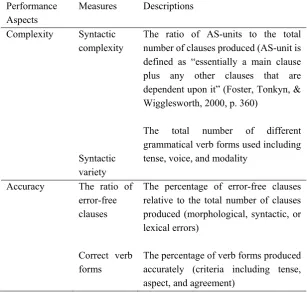
Oral performance indices. Oral performance has been conceptualized as having three main independent aspects namely complexity, accuracy, and fluency (Skehan, 2014). As to operationalizing these aspects of performance, a substantial number of indices have been offered to be utilized in task-based research. In the present study, we adopted some of these indices solely on a practical basis. Table 1 demonstrates the indices with their descriptions.
Table 1
Oral Performance Indices
Performance Aspects
Measures Descriptions
Complexity Syntactic complexity
Syntactic variety
The ratio of AS-units to the total number of clauses produced (AS-unit is defined as “essentially a main clause plus any other clauses that are dependent upon it” (Foster, Tonkyn, & Wigglesworth, 2000, p. 360)
The total number of different grammatical verb forms used including tense, voice, and modality
Accuracy The ratio of
error-free clauses
Correct verb forms
The percentage of error-free clauses relative to the total number of clauses produced (morphological, syntactic, or lexical errors)
Performance Aspects
Measures Descriptions
Fluency Speech rate The total number of syllables per minute (including hesitation and pause time) for a speech sample
Transcribing and coding. Having recorded the participants’ performances on the tasks, the oral data were transcribed and coded for each turn in the dyads using oral task performance transcription and coding traditions (Ellis & Barkhuizen, 2005). Also, 10% of the resulted coded data were re-coded by an external coder to examine them in terms of inter-coder reliability. Pearson correlation coefficients were used to obtain inter-coder reliability. The coefficients ranged from .87 to .93 on the CAF indices, which were reasonably high.
Results Multivariate and Univariate Analyses
Table 2
Univariate Repeated Measures ANOVA Tests
Measure Df Er. df F Sig.
Partial Eta Squared Task Syntactic
complexity
Greenhouse-Geisser 1.95 119.05 6.13 .003 .091
Syntactic variety
Sphericity
Assumed 3 183 2.49 .062 .039
The Ratio of Error-free clauses
Sphericity
Assumed 3 183 7.25 .000 .106
Correct verb forms
Greenhouse-Geisser
2.19 133.91 2.30 .099 .036
Speech rate Greenhouse-Geisser
1.86 113.52 119.56 .000 .662
There was a multivariate main effect for task, Wilks’ λ = .004, F (15,
47) = 833.52, p < .05, partial eta squared = .996. This revealed that the four
decision-making tasks manipulated along information distribution and goal orientation impacted the performance of the participants. Because of this significant multivariate main effect (i.e., task effect) and also because of the fact that there were not any intercorrelations between dependent variables, a series of univariate repeated measures ANOVAs were conducted to find univariate main effects for task. However, to avoid making Type I error, according to Bonferroni adjustment, p level was set
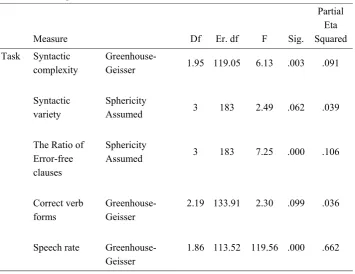
to .01 as there were five dependent variables (.05/5). Table 2 shows the results.
Significant univariate main effects for task were obtained for syntactic complexity under the Greenhouse-Geisser correction, F (1.95, 119.05) =
sphericity assumed, F (3, 183) = 7.25, p < .01, partial eta squared = .106;
and speech rate under the Greenhouse-Geisser correction, F (1.86, 113.52)
= 119.56, p < .01, partial eta squared = .662. However, no significant
univariate main effects for task were obtained for syntactic variety sphericity assumed, F (3, 183) = 2.49, p = .062, partial eta squared = .039;
and correct verb forms under the Greenhouse-Geisser correction, F (2.19,
133.91) = 2.30, p = .099, partial eta squared = .036. To see where these
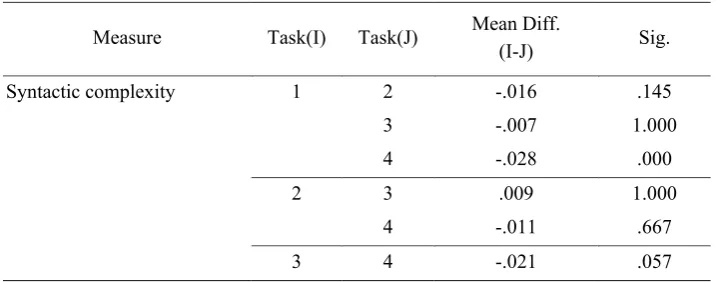
effects lie in terms of four tasks the participants performed, we conducted post-hoc means comparisons with Bonferroni test for the dependent variables (i.e., CAF indices) producing those results. Table 3 shows the results.
Table 3
Post-hoc Mean Comparisons
Measure Task(I) Task(J) Mean Diff.
(I-J) Sig.
Syntactic complexity 1 2 -.016 .145
3 -.007 1.000
4 -.028 .000
2 3 .009 1.000
4 -.011 .667
Ratio of Error-free clauses 1 2 .070 .000
3 .036 .131
4 .028 .353
2 3 -.033 .140
4 -.042 .066
3 4 -.008 1.000
Speech rate 1 2 6.352 .000
3 5.438 .000
4 7.699 .000
2 3 -.914 .008
4 1.347 .014
3 4 2.260 .000
speech rate for Task 4. To clarify, the participants were most fluent on the performance of Task 1 and least fluent on the performance of Task 4. In addition, they were more fluent on the performance of Task 3 than Task 2.
Correlation Analyses
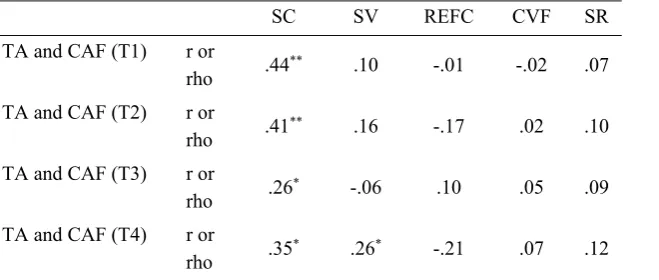
To answer RQ2 and RQ3, which investigated the relationship between EFL learners’ tolerance of ambiguity and self-efficacy with their oral performance on dyadic decision-making tasks, a series of correlation analyses was conducted. In order to carry out these analyses, the assumptions of parametric Pearson correlation coefficient were checked. The assumptions of linearity and homoscedasticity were met. However, the assumption of normality was met only for the participants’ overall scores of tolerance of ambiguity and self-efficacy and not for all their CAF scores. The CAF scores that violated the assumptions of normality included syntactic variety and the ratio of error-free clauses for all tasks and correct verb forms for Task 3. That being said, to investigate the possible interrelationships of the scores, it was decided that parametric Pearson correlation coefficient should be used for the scores that met the normality assumption and non-parametric Spearman correlation coefficient for those that did not.
Tolerance of Ambiguity and CAF Indices
Table 4
Correlations between Tolerance of Ambiguity and CAF Indices of Tasks
SC SV REFC CVF SR
TA and CAF (T1) r or
rho .44** .10 -.01 -.02 .07
TA and CAF (T2) r or
rho .41** .16 -.17 .02 .10
TA and CAF (T3) r or
rho .26* -.06 .10 .05 .09
TA and CAF (T4) r or
rho .35* .26* -.21 .07 .12
Note: TA = Tolerance of ambiguity; T = Task; SC = Syntactic complexity; SV = Syntactic
variety; REFC = Ratio of error-free clauses; CVF = Correct verb forms; SR = Speech Rate; * p < .05; ** p < .01
Five significant correlations were obtained using Pearson and Spearman correlation coefficients. Four of these correlations were clustered in the column pertaining to syntactic complexity. That is, there were a medium, positive correlation between tolerance of ambiguity and Task 1 syntactic complexity, r = .44, p < .01; a medium, positive
correlation between tolerance of ambiguity and Task 2 syntactic complexity, r = .41, p < .01; a small, positive correlation between tolerance
of ambiguity and Task 3 syntactic complexity, r = .26, p < .05; and a
medium, positive correlation between tolerance of ambiguity and Task 4 syntactic complexity, r = .35, p < .05. These positive correlations indicated
that high levels of tolerance of ambiguity on the part of the participants were associated with higher complexity on the performance of all the tasks as measured by syntactic complexity. In addition, there was a medium, positive correlation between tolerance of ambiguity and Task 4 syntactic variety, rho = .26, p < .05. This indicated that high levels of tolerance of
Self-efficacy and CAF Indices
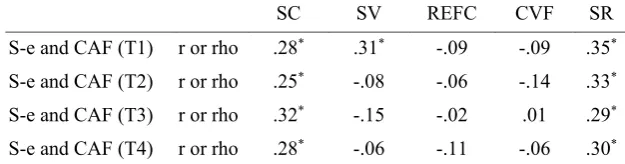
Table 5 shows the results of Pearson correlation coefficient (r) and Spearman’s correlation coefficient (rho) used to examine the relationships between the participants’ overall self-efficacy scores with their CAF scores.
Table 5
Correlations between Self-efficacy and CAF Indices of Tasks
SC SV REFC CVF SR
S-e and CAF (T1) r or rho .28* .31* -.09 -.09 .35* S-e and CAF (T2) r or rho .25* -.08 -.06 -.14 .33* S-e and CAF (T3) r or rho .32* -.15 -.02 .01 .29* S-e and CAF (T4) r or rho .28* -.06 -.11 -.06 .30*
Note: S-e = Self-efficacy; T = Task; SC = Syntactic complexity; SV = Syntactic variety;
REFC = Ratio of error-free clauses; CVF = Correct verb forms; SR = Speech Rate; * p <
.05
Nine significant correlations were resulted using Pearson and Spearman correlation coefficients. Four of these correlations were clustered in the column pertaining to syntactic complexity and four others in the column related to speech rate. That is, there were a small, positive correlation between self-efficacy and Task 1 syntactic complexity, r = .28,
p < .05; a small, positive correlation between self-efficacy and Task 2
syntactic complexity, r = .25, p < .05; a medium, positive correlation
between self-efficacy and Task 3 syntactic complexity, r = .32, p < .05;
and a small, positive correlation between self-efficacy and Task 4 syntactic complexity, r = .28, p < .05. These positive correlations indicated that high
levels of self-efficacy on the part of the participants were associated with higher complexity on the performance of all the decision-making tasks as measured by syntactic complexity. Furthermore, there were a medium, positive correlation between self-efficacy and Task 1 speech rate, r = .35,
p < .05; a medium, positive correlation between self-efficacy and Task 2
self-efficacy and Task 3 speech rate, r = .29, p < .05; and a medium, positive
correlation between self-efficacy and Task 4 speech rate, r = .30, p < .05.
These positive correlations indicated that high levels of self-efficacy on the part of the participants were associated with higher fluency on the performance of all the tasks as measured by speech rate. Finally, there was a medium, positive correlation between self-efficacy and Task 1 syntactic variety, rho = .31, p < .05. This indicated that high levels of self-efficacy
on the part of the participants were associated with higher variety on the performance of only Task 1 as measured by syntactic variety.
Discussion Task Effects on L2 Performance
The first finding of RQ1 was the main effect for task. The tasks were manipulated along two task conditions of information distribution having goal orientation. A Significant main effect was achieved for task in the repeated measures design of the study. This means that the task conditions adopted did have significant effects on the performance of L2 learners at least of those participating in the study. This particular finding confirms the results of similar studies (on information distribution e.g., Doughty & Pica, 1986; Foster, 1998; Gass & Varonis, 1985 and on goal orientation e.g., Lambert & Engler, 2007; Mannheimer, 1993; Rankin, 1995; Rahimpour, 2009). Further, the mere fact that tasks manipulated in this study produced different results in terms of EFL learners’ oral performance is an experimental back-up for their inclusion in a model such as TCF proposed by Robinson (2011).
were rather different in nature and task conditions rendering the comparisons crude to some extent. Two studies could be found in which similar decision-making tasks to the ones in the present study were used. The first is Lambert and Engler (2007). The tasks used entailed learners to determine who was most responsible in a set of scenarios involving crimes committed. They found that decision-making tasks resulted in complex production only and had no effects on other measures. The second is Gilabert, Barón, Levkina, (2011). The tasks used required learners to decide how to save people stuck in a building on fire. They found little or no impact on decision-making tasks.
This last finding is only partially in accord with Skehan’s (2016) hypothesis and needs further research.
The findings related to RQ1 can be looked upon from a different perspective. As it was mentioned, two task conditions of information distribution and goal orientation were used to manipulate the tasks of the present study. It seems that these variables had different effects when it came to L2 learners’ task performance. Task 4, which was two-way and open, could elicit more complex language. Although firm conclusions could not be drawn because of the interaction between the two variables, it was very likely that openness of Task 4 was the reason for complexity of the language produced by the participants. This has been attested in the literature (e.g., Lambert & Engler, 2007; Long, 2015; Rankin, 1995; Skehan, 1998). This argument becomes even more justified when Task 1, which was one-way and closed is considered. This task elicited significantly less complex language than Task 4. The closeness of Task 1 may have been the reason. The rationale behind this reason resonates with the observations made by Rankin (1995) and Lambert and Engler (2007). Rankin (1995) stated that closed tasks because of their very nature need little creativity on the parts of L2 learners as they focus on one problem and one solution in contrast to open tasks that entail considerable creativity since there is room for sharing, weighing, refining, and rejecting several solutions. Lambert and Engler (2007), in discussing their results, allude to the observation by Rankin (1995) and further argue that “open versions of tasks may allow more freedom to engage in different types of conversation based on individual needs and interests, make creative contributions, and arrive at original solutions” and as a result, learners on their performances on such tasks are likely “to take advantage of such opportunities to push their language abilities on their own initiative and produce more complex discourse” (p. 41).
lead to more accuracy (e.g., Brown, 1991; Long, 2015). Here, it seems that one-wayness of Task 1 had been more at work. Some studies (e.g., Iwashita, 2001; Shehadeh, 2001) have found evidence that one-way tasks enable L2 learners to modify their output when they speak. Therefore, it is very likely that the participants of this study when performing Task 1 could have modified their output and accordingly produced more accurate language. That being said, however, further research is needed to disentangle the interactive effects of the two variables used to manipulate the given tasks.
Probably the finding concerned with fluency was the most congruent with the findings in the literature. Fluency on the four tasks as measured by speech rate resulted in the following order from the most fluent to the least: Task 1 > Task 3 > Task 2 > Task 4. Here, it appears that closeness of Task 1 and Task 3 had been the reason for them to produce significantly more fluent language than Task 2 and Task 4 that were both open. This supports the findings in the literature (e.g., Julkunen, 1990; Manheimer, 1993; Rankin, 1990). It is interesting to note that Task 3, despite being two-way, could have led to significantly more fluent language than Task 2, which was one-way. Because participants on the performance of Task 3 had to share information in order to achieve the outcome of the task, it was expected that they fell short of producing fluent language. Although this calls for further research, it can be speculated that closeness of Task 3 had outweighed its one-wayness, hence more fluency.
ready to take risks when speaking for instance by trying out new and complex structures. In our case, the more tolerant the participants were of ambiguity, the more they could use complex structures on the performance of all four tasks. What is more, on the performance of Task 4, they could also go for a variety of syntactic structures about correctness of which they probably were not certain. Foster and Skehan (1996) had this in mind when they argued that out of three aspects of performance, complexity “is likely to be associated with greater risk-taking to the extent that actual performances may be exploited to use forms closer to the cutting edge of interlanguage development” (p. 289).
The Relationship between Self-efficacy and CAF Indices
learners are perhaps motivated enough to put their best efforts in performing different tasks.
To the best of our knowledge, no studies have specifically tapped the relationship between L2 task performance and learners’ self-efficacy. Only two studies, which come close to such an endeavor, are Dörnyei and Kormos (2000) and its follow-up Kormos and Dörnyei (2004). These two studies attempted to investigate the interaction between linguistic and motivational factors in L2 task performance. Included among the items of the questionnaire they employed were some items designed to measure linguistic self-confidence (i.e., self-efficacy). Our findings are partially similar to those of the two studies as they reported a significant positive correlation between self-efficacy and fluency as measured by the number of words produced by the speaker. However, our findings contradict the results of Kormos and Dörnyei (2004) as they could not find any correlations between complexity and self-efficacy. This can be accounted for by considering the type of task they used and the number of items measuring self-efficacy on their questionnaire. Although some parallels could be drawn between their and our tasks, their task was designed to elicit arguments concerning everyday school matters. In addition, they used only six items on their questionnaire to measure self-efficacy, whereas our questionnaire was specially developed for self-efficacy and included thirty-two items producing more reliable results.
Finally, it is worthwhile to point out that while no significant correlations were obtained between accuracy and self-efficacy, most of the non-significant correlations between the two were negative. This may imply that the participants with high self-efficacy were sometimes too confident about the structures they used, hence producing complex but inaccurate structures in their fluent flows of speech.
Conclusions
particular dyadic decision-making tasks employed in the study could differentially affect the performance of the learners. In accord with the common thread running through task-based research (e.g., Long, 2015, Robinson, 2011 Skehan, 2014), it can be said that different tasks manipulated along different features or conditions are bound to affect the performance of language learners differently. Second, examining the performances of the participants on the tasks in terms of the specific CAF indices adopted, it is probably safe to conclude that Skehan’s (2016) trade-off hypothesis is better suited than Robinson’s (2015) cognition hypothesis to account for the particular behavior of the CAF indices. Third, it is likely that while complexity and fluency are more susceptible to changes made in goal orientation, accuracy is more affected by the variations made in information distribution although for conclusive findings the interaction between these two task conditions needs to be taken into consideration. Last but not least, while tolerance of ambiguity may be related to L2 learners’ risk-taking abilities, self-efficacy may be concerned with their motivational factors. Thus, it can be concluded that examining the relationships between task performance and affective factors such as the ones included in the current study is likely to produce more viable results if other affective or cognitive factors are also taken into consideration. This has been actually attested in the L2 literature (e.g., Dörnyei, 2005; Skehan, 1991).
that L2 learners with low tolerance of ambiguity should be supported in using complex structures and be encouraged to take risks with using those structures even when they are not very certain. Also, the participants with high self-efficacy could produce more complex and fluent language. By the same token, L2 learners with low self-efficacy should be motivated and pushed to put greater efforts in performing tasks and using language for that matter.
References
Allan, D. (2004). Oxford Placement Test. Oxford: Oxford University Press.
Bandura, A. (1994). Self-efficacy. In V. S. Ramachaudran (Ed.),
Encyclopedia of human behavior (Vol. 4, pp. 71-81). New York:
Academic Press.
Bandura, A. (1997). Self-efficacy: The exercise of control. New York:
Freeman.
Bong, M., & Skaalvik, E. M. (2003). Academic concept and self-efficacy: How different are they really? Educational Psychology Review, 15, 1–40.
Brown, R. (1991). Group work, task difference, and second language acquisition. Applied Linguistics, 21, 1-12.
Budner, S. (1962). Intolerance of ambiguity as a personality variable.
Journal of Personality, 30, 29-50.
Chapelle, C. & Roberts, C. (1986). Ambiguity tolerance and field independence as predictors of proficiency in English as a second language. Language Learning, 36, 27-45.
Dörnyei, Z. (2005). The psychology of the language learner. Mahwah NJ:
Erlbaum.
Dörnyei, Z., & Kormos, J. (2000). The role of individual and social variables in oral task performance. Language Teaching Research, 4, (3), 275-300.
Doughty, C. and Pica, T. (1986) “Information gap” tasks: Do they facilitate second language acquisition? TESOL Quarterly, 20, 305-325.
Ehrman, M. E., Leaver, B. L., & Oxford, R. L. (2003). A brief overview of individual differences in second language learning. System, 31,
El-Koumy, A. S. A. (2000). Differences in FL reading comprehension among high-, middle-, and low-ambiguity tolerance students.
Paper presented at the National Symposium on English Language Teaching in Egypt, Cairo.
Ellis, R. (1994). The study of second language acquisition. Oxford: Oxford
University Press.
Ellis, R. & Barkhuizen, G. (2005). Analyzing learner language. Oxford:
Oxford University Press.
Ely, C. M. (1989). Tolerance of ambiguity and use of second language strategies. Foreign Language Annals, 22, 437-445.
Ely, C. M. (1995). Tolerance of ambiguity and the Teaching of ESL. In J. M. Reid (Ed.), Learning styles in the ESL/EFL classroom (pp.
87-95). Boston, MA: Heinle & Heinle Publishers.
Foster, P. (1998) A classroom perspective on the negotiation of meaning.
Applied Linguistics 19, 1-23.
Foster, P. & Skehan, P. (1996). The influence of planning and task type on second language performance. Studies in Second Language Acquisition, 18, 299-323.
Foster, P. & Skehan, P. (2013). Anticipating a post-task activity: The effects on accuracy, complexity, and fluency of second language performance. Canadian Modern Language Review, 69, 249-273.
Foster, P., Tonkyn, A., & Wigglesworth, G. (2000). Measuring spoken language: A unit for all reasons. Applied Linguistics, 21, 354-375.
Gass, S.M. and Varonis, M. (1985) Task variation and non-native/non-native negotiation of meaning. In S. M. Gass and C. G. Madden (Eds.), Input in Second Language Acquisition (pp. 149-161).
Boston, Heinle and Heinle.
Gilabert, R., Barón J. & Levkina, M. (2011). Manipulating task complexity across task types and modes. In P. Robinson (Ed.), Second language task complexity: Researchingthe Cognition Hypothesis of language learning and performance (pp. 105-138). Amsterdam:
John Benjamins.
Julkunen, K. (1990). Open and closed vocabulary tasks in foreign language learning. In Tommola, J. (Ed.), Foreign language comprehension and production (pp. 7-25). Turku, Finland: Finnish Association of
Applied Linguistics.
Kazamina, V. (1999). How tolerant are Greek EFL learners of foreign language ambiguities. Leeds Working Papers in Linguistics, 7,
69-78.
Kim, Y. & Tracy-Ventura, N. (2011). Task complexity, language anxiety, and the development of the simple past. In P. Robinson (Ed.),
Second language task complexity: Researching the Cognition Hypothesis of language learning and performance (pp. 287-306).
Philadelphia: John Benjamins.
Kormos, J. & Dörnyei, Z., (2004). The interaction of linguistic and motivational variables in second language task performance.
Zeitschrift für Interkulturellen Fremdsprachenunterricht. 9, (2),
19-40.
Kormos, J., & Trebits, A. (2012). The role of task complexity, modality and aptitude in narrative task performance. Language Learning, 62,
439-472.
Lambert, C. P. & Engler, S. (2007). Information distribution and goal orientation in second Language task design. In M. P. Garcia-Mayo (Ed.), Investigating tasks in formal language learning (pp. 27-43).
Clevedon, UK: Multilingual Matters.
Long, M. (2015). Second language acquisition and task-based language teaching. Malden, MA: Wiley Blackwell.
Long, M.H. (1989) Task, group and task-group interactions. In S. Anivan (Ed.) Language Teaching Methodology for the Nineties (pp.
31-50). Singapore: SEAMEO Regional Language Centre.
Mannheimer, R. (1993). Close the task, improve the discourse. Estudios de Linguistica Aplicada 17, 18-40.
McLain, D. L. (1993). The MSTAT-I: a new measure of an individual’s tolerance for ambiguity. Educational and Psychological Measurement, 53, 183-189.
and learner age. Unpublished doctoral dissertation. Allameh
Tabataba’i University, Tehran, Iran.
Oxford, R. (1992). Who are our students? A synthesis of foreign and second language research on individual differences with implications for instructional practice. TESL Canada, 9, 30-49.
Oxford, R. & Ehrman, M. (1992). Second language research on individual differences. Annual Review of Applied Linguistics, 13, 188-205.
Qian, L. (2014). Get it right in the end: The effects of post-task transcribing on learners’ oral performance. In P. Skehan (Ed.), Processing Perspectives on task performance (pp. 129-154). Amsterdam: John
Benjamins.
Rahimpour, M. (2009). Impact of task condition on L2 learners’ oral performance. Journal of Faculty of Letters & Humanities, 51,
13-23.
Rankin J. (1990).A case for close-mindedness: Complexity, accuracy and attention in closed vs. open tasks.University of Hawaii (mimeo). Rankin J. (1995). The effects of task design on accuracy and
self-monitoring. American Association of Applied Linguistics (mimeo).
Robinson, P. (2007). Task complexity, theory of mind, and intentional reasoning: Effects on L2 speech production, interaction, uptake and perceptions of task difficulty. International Review of Applied Linguistics, 45, 237-257.
Robinson, P. (2011). Second language task complexity, the Cognition Hypothesis, language learning, and performance. In P. Robinson (Ed.), Second language task complexity: Researching the Cognition Hypothesis of language learning and performance (pp.
3-37). Amsterdam: John Benjamins.
Robinson, P. (2015). The Cognition Hypothesis, second language task demands and the SSARC model of pedagogic task sequencing. In M. Bygate (Ed.), Domains and directions in TBLT: Plenaries from a decade of the international conference (pp. 87-122). Amsterdam:
JohnBenjamins.
Skehan, P. (1991). Individual differences in second language learning.
Studies in Second Language Acquisition, 13, 275-298.
Skehan, P. (1996). A framework for the implementation of task based instruction. Applied Linguistics 17, (1), 38-62.
Skehan, P. (1998). A cognitive approach to language learning. Oxford:
Oxford University Press.
Skehan, P. (2014). The context for researching a processing perspective on task performance. In P. Skehan (Ed.), Processing Perspectives on Task Performance (pp. 1-26). Amsterdam: John Benjamins.
Skehan, P. (2016). Tasks versus conditions: Two perspectives on task research and their implications for pedagogy. Annual Review of Applied Linguistics, 36, 34-49.
Skehan, P., & Foster, P. (1997). Task type and task processing conditions as influences on foreign language performance. Language Teaching Research,1, 185-211.
Trebits, A. (2016). Sources of individual differences in L2 narrative production: The contribution of input, processing, and output anxiety. Applied Linguistics, 37, 155-174.
Wang, C. (2004). Self-regulated leaning strategies and self-efficacy beliefs of children learning English as a second language. Unpublished
doctoral dissertation. Ohio State University. Ohio, USA.
Wang, C., Kim, D. H., Bai, R., & Hu, J. (2014). Psychometric properties of a self-efficacy scale for English language learners in China.
System, 44, 24-33.
Wang, C., Wang, L., & Li, Y. (2007). Chinese secondary school self-regulated learners of English. Paper presented at TESOL
(Teachers of English to Speakers of Other Languages) 2007 convention. Seattle, WA.
Zimmerman, B. J. (1995). Self-efficacy and educational development. In A. Bandura (Ed.), Self-efficacy in changing societies (pp. 202-231).