Arch. Anim. Breed., 62, 215–226, 2019 https://doi.org/10.5194/aab-62-215-2019 © Author(s) 2019. This work is distributed under the Creative Commons Attribution 4.0 License.
Open Access Archives Animal Breeding
iginal
study
Temporal variations of herbage production and nutritive
value of three grasslands at different elevation zones
regarding grazing needs and welfare of ruminants
Maria Koidou1, Ioannis Mountousis2, Vassilios Dotas3, Konstantinos Zagorakis1, and Maria Yiakoulaki4
1Department of Animal Production, School of Agriculture, Aristotle University of Thessaloniki,
Faculty of Agriculture, Forestry and Natural Environment, 54124 Thessaloniki, Greece
2Department of Animal Production, Faculty of Agriculture, Technological Educational Institute
of Western Macedonia, Terma Kontopoulou 53100 Florina, Greece
3Hellenic Agricultural Organization “Demeter”, Research Institute
of Animal Science, 58100 Giannitsa, Greece
4Department of Range and Wildlife Science, School of Forestry and Natural Environment,
Faculty of Agriculture, Forestry and Natural Environment, Aristotle University of Thessaloniki, 54124 Thessaloniki, Greece
Correspondence:Ioannis Mountousis ([email protected]) and Maria Yiakoulaki ([email protected])
Received: 29 August 2018 – Revised: 26 March 2019 – Accepted: 2 April 2019 – Published: 17 April 2019
Abstract. Interannual and monthly variations of herbage production and nutritive value regarding grazing ru-minants’ needs and welfare were evaluated in three grasslands (semi-mountainous, mountainous and sub-alpine) located at different altitudes (480–900, 901–1500 and 1501–2334 m, respectively) in northern Greece during 2015–2016. Herbage biomass was collected from 30 experimental cages (10 per grassland), weighed, dried at 65◦C, milled and analyzed for crude protein (CP), neutral detergent fiber (NDF), acid detergent fiber (ADF), lignin, calcium (Ca) and phosphorus (P) content and in vitro dry matter digestibility (IVDMD). The sub-alpine grassland was the most productive (1031 and 1231 kg DM ha−1) with the highest mean annual herbage CP
con-tent (93 and 87 g kg−1dry matter; DM) for 2015 and 2016, respectively. CP content was sufficient to meet small
ruminants’ and beef cattle maintenance requirements until April and May in the semi-mountainous and moun-tainous grasslands, respectively, while it could cover the above requirements in the sub-alpine grassland until June and August, respectively. The herbage Ca concentration was higher than the grazing ruminants’ needs, while the phosphorus concentration was insufficient. Protein and phosphorus supplementation should be pro-vided to animals to cover their maintenance requirements during the whole period and to reach high levels of welfare. Even though grazing is considered as a welfare-friendly procedure, it is uncertain whether all the wel-fare principals are satisfied in extensive production systems due to variations of forage availability and nutritive value as well as the lack of infrastructure in grasslands.
1 Introduction
Native grasslands in Greece occupy an area of 5.45 million ha corresponding to 41.3 % of the total rangelands in the coun-try (Hellenic Statistical Authority, 2000). They are multi-functional areas as they provide goods and ecosystem ser-vices, such as the maintenance of biodiversity, feed and shel-ter to the game animals, landscape–soil–air and washel-ter
allocated to the place where he resides (Yiakoulaki and Pa-panastasis, 2014).
Grasslands are characterized by spatial and temporal vari-ability of climatic conditions, variations in altitude, topogra-phy and soils, as well as high species richness (Papanastasis and Mansat, 1996; Karagiannakidou et al., 2001). Their pro-ductivity is relatively low and prone to seasonal variations, which results to the creation of two feed gaps: a short gap in winter (about 2 months) and a longer one (about 4 months) in the summer. Also, there is an interannual variability in the forage production of grasslands which could potentially increase up to 3 times in the wet years. The farmers de-pend greatly on these ecosystems to raise their animals. To counterbalance the sort feed gap, they utilize temporary pas-tures with annual winter cereals (e.g., barley, wheat, rye and oats; mainly as monocultures), while in order to fill the long feed shortage, they lead their livestock for grazing to sub-alpine grasslands, practicing transhumance. The latter is also a common strategy used by farmers in several areas of Eu-rope (Hopkins, 2011), so that animals can take advantage of the better quantity and quality of herbage during this period. However, due to socioeconomic reasons, transhumance has significantly declined over the last decades (Yiakoulaki and Papanastasis, 2014).
Every natural grassland has a unique composition of plant species differing in morphological characteristics and stage of development. This heterogeneity makes it difficult to char-acterize the seasonal dynamics of herbage production and nu-tritive value. The abovementioned variations are considered to be among the most important constraints of livestock pro-duction (Ngwa et al., 2000) and their evaluation is essential in extensive (grazing-based) production systems. Grazing af-fects the quantity and quality of herbage in grasslands (Zhai et al., 2018) and subsequently the behavior and welfare of free-ranging livestock (Kilgour et al., 2012). Animals during grazing are able to select the preferred forage species and to avoid the toxic ones, express their natural behavior and main-tain their health (Villalba et al., 2010; Charlton and Rutter, 2017). However, in extensive production systems, problems concerning the animals’ welfare maybe arise from several is-sues, such as decreased forage availability, forage nutrient deficiencies, lack of access to water and shelter, inappropri-ate stable installations, inadequinappropri-ate veterinarian care, etc. Re-search about the welfare of livestock has been mainly con-ducted to intensively farmed animals with or without access to pastures (Turner and Dwyer, 2007; Charlton and Rutter, 2017; Carcangiu et al., 2018) and to certain regions (Mikuš et al., 2018). For this reason, information concerning the wel-fare of grazing ruminants is quite restricted (Bojkovski et al., 2014; Topczewska, 2014; Antkowiak et al., 2012; Karasab-bidis et al., 2014; Gilhaus and Hölzel, 2016).
The objectives of this study were (a) to determine the inter-annual and monthly variations of forage production in three grasslands located at different altitudinal zones, (b) to esti-mate the interannual and monthly variations of herbage
nu-tritive value and to relate them to the nutritional needs of grazing ruminants and (c) to discuss issues regarding the an-imal’s welfare in extensive production systems.
2 Materials and methods
2.1 Study area
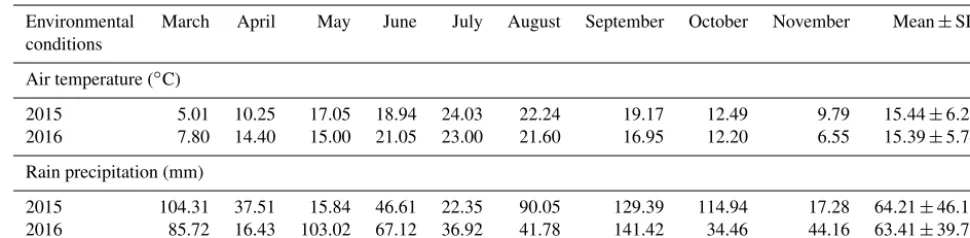
The study was conducted in three grasslands in the Florina Prefecture in Western Macedonia, Greece (latitude 40◦770 to 40◦890N, longitude 21◦700 to 21◦490E) from March to November 2015 and 2016. They are located in the same area but in different elevation zones, with an altitude ranging from 480 to 2334 m a.s.l.: semi-mountainous grassland (480– 900 m), mountainous grassland (901–1500 m) and sub-alpine grassland (1501–2334 m). Metamorphic rock textures (i.e., phyllites) of the Pelagonic geotectonic zone are the domi-nant geological substrates of the study area (Koroneos, 1991) and the soils were classified as acid sandy loam according to Bouyoucos (1962). The climate is not the typical Greek Mediterranean (Papanikolaou et al., 2002) but it approaches the middle-European type (Papanastasis, 1982), reaching in winter even−20◦C (H. N. M. S., 2017). The mean annual and monthly rainfall and air temperature during the experi-mental period (2015 and 2016) are shown in Table 1. Accord-ing to Flocas (1994), the average air temperature decreases about 0.6◦C per 100 m from the lower to the higher elevation zone. This reduction is more intensive in summer compared to winter.
The topography combined with the variable climatic con-ditions from the semi-mountainous to the sub-alpine area creates an impressive variety of flora to the grasslands. Flat areas and openings with a great variety of herba-ceous plants in oak forests (Ostryo-Carpinion orientalisand Quercion frainetto) form the semi-mountainous grassland. Dichanthium ischaemum, Dactylis glomerata, Festuca het-erophylla, Briza maxima, Agrostis tenuis, Cynodon dactylon, Poa nemoralis, Festuca rubra, Cynosurus echinatus, Bromus squarrosus, Poa bulbosa, Trifolium repens, Trifolium subter-raneum, Trifolium angustifolium, Medicago lupulina, Med-icago sativa, Anthyllis aurea, Astragalus glycyphyllos and Lathyrus laxifloruswere the main herbaceous species in this grassland.
The mountainous grassland is characterized by oak and mainly beech trees (Quercion frainetto andFagion moesi-acaezone) in the overstorey vegetation.Alopecurus praten-sis, Bromus benekenii, Festuca arundinacea, Poa nemoralis, Briza media, Dactylis glomerata, Melica ciliata, Anthoxan-thum odoratum, Poa compressa, Brachypodium sylvaticum, Trifolium alpestre, Trifolium repens, Trifolium subterra-neum, Medicago lupulina, Coronilla varia, Vicia grandiflora, Astragalus depressus and Teucrium chamaedrys were the dominant herbaceous species in the understory vegetation.
hor-Table 1.Mean annual and monthly values of rain precipitation (mm) and air temperature (◦C) during the experimental period.
Environmental March April May June July August September October November Mean±SD conditions
Air temperature (◦C)
2015 5.01 10.25 17.05 18.94 24.03 22.24 19.17 12.49 9.79 15.44±6.20 2016 7.80 14.40 15.00 21.05 23.00 21.60 16.95 12.20 6.55 15.39±5.74
Rain precipitation (mm)
2015 104.31 37.51 15.84 46.61 22.35 90.05 129.39 114.94 17.28 64.21±46.16 2016 85.72 16.43 103.02 67.12 36.92 41.78 141.42 34.46 44.16 63.41±39.79
Source: Florina and Amyntaio’s weather stations (H. N. M. S., 2017); SD: standard deviation.
vatiana, Poa media, Secale montanum, Avenula pubescens, Phleum hirsutum, Stipa epilosa, Avena pratensis, Bellar-diochloa violacea, Poa molineri, Trifolium pratense, Tri-folium alpestre, TriTri-folium badium, Vicia onobrychioides, Va-leriana officinalis, Thymus thracicus, Teucrium montanum, Veronica praecox, Potentilla micranthaandSaxifraga rotun-difolia.
2.2 Husbandry system
The husbandry system in the study area is mainly based on traditional grazing of communal grasslands which provide herbage to animals for 8–9 months of the year. During winter, due to the low temperatures, the animals are kept in the sta-bles, and feedstuffs (roughage and concentrates) are provided to them. The animals graze in the semi-mountainous and mountainous grasslands from spring to autumn while in sum-mer the grazing starts in the sub-alpine grasslands. The dom-inant livestock species in the study area were sheep (79 306) followed by goats (14 336) and cattle (13 181). Mean stock-ing density was 0.93, 0.08 and 0.30 LU ha−1in the mountain-ous, semi-mountainous and sub-alpine grasslands, respec-tively. The equivalent livestock units (LUs) were calculated as 1 LU: cows older than 24 months; 0.6 LU: cows between 6 and 24 months; and 0.2 LU: cows younger than 6 months. For sheep and goats, 1 LU is equivalent to 0.15 breeding fe-males and 0.12 adult fe-males. Flocks were pure or mixed and shepherded for the whole year. Sheep and goats are raised for milk and meat, while cattle are raised for meat.
2.3 Sampling and experimental analyses
A total of 10 experimental cages of 16 m2 were placed at selected points on each grassland (30 cages in total) before the beginning of the vegetation measurements in 2015. Each cage was fenced with a 1.5 m height metal mesh net in order to prevent the free grazing from livestock. The cages were di-vided into 16 equal plots of 1 m2. Herbage biomass was col-lected at the beginning of each month, from one plot of each cage every time. The herbage samples (the woody species
were excluded if present) were clipped at 2 cm above the soil surface using hand scissors. The harvested herbage sam-ples were handled in order to avoid soil contamination. Also, plant parts of previous years, that are not preferred by graz-ing animals, were removed. Samples were placed in paper bags, instantly weighed in the field to obtain the measure of fresh-cut herbage weight and expressed as kilograms of dry matter per hectare (kg DM ha−1). All samples were dried in the oven at 65◦C until constant weight and milled using the Cross Beater Mill SK 100 (Retsch, Germany, 1 mm screen). Then, they were divided into two subgroups and stored in glass vases.
Samples from each subgroup were used for the chemical analyses in triplicates. They were analyzed for neutral deter-gent fiber (NDF), acid deterdeter-gent fiber (ADF), lignin, crude protein (CP), calcium (Ca) and phosphorus (P) content as well as for in vitro dry matter digestibility (IVDMD). Neu-tral detergent fiber was determined according to the method of Van Soest et al. (1991). Samples were analyzed using heat-stable α-amylase (A3306, Sigma–Aldrich, St. Louis, MO, USA) without sodium sulfite in the neutral detergent reagent. Acid detergent fiber (ADF) was determined according to AOAC (2000a; method 973.18). Both NDF and ADF val-ues were expressed without residual ash. Lignin concentra-tion was determined by the sulfuric acid procedure (AOAC, 2000a; method 973.18) and ash was determined by the gravi-metric residue after heating to 550◦C for 8 h. Nitrogen (N) content was determined using copper as a catalyst according to the Kjeldahl method (AOAC, 2000b; method 984.13) and crude protein was calculated as N×6.25.
The IVDMD was determined according to the two-stage technique of Tilley and Terry (1963) using the following equation:
IVDMD=
1−w
d−wb
ws
×100, (1)
wherewdis the weight of dry plant sample residue,wbis the
weight of dry residues of blank, andws is the dry weight of
Concentrations of calcium (Ca) and phosphorus (P) in the herbage samples were measured by oxidizing each subsam-ple with a 2:1 nitric/perchloric acid mixture. In separate aliquots, Ca was determined by flame photometry and P by spectrophotometric methods (Khalil and Manan, 1990). All the presented values in the study were means of six mea-surements (three replicates×two subsamples=six measure-ments).
2.4 Statistical analysis
The data of herbage production, nutritive value (CP, NDF, ADF, acid detergent lignin (ADL) and IVDMD) and min-eral content (Ca and P) were analyzed with the least-squares method (LSM) analysis in SPSS v.23 software for Windows (SPSS Inc., Ill: Chicago, USA) (Kitikidou, 2005) according to the following model:
yij k=µ+ai+bj+ck+abcij k+eij km, (2)
where yij k is herbage production, CP, NDF, ADF, ADL,
IVDMD, Ca and P content, µis the overall mean,ai is the
constant effect of the altitudinal zone of the three grasslands (i=1,2,3), bj is the constant effect of the month (j=I,
II,. . .IX), ck is the constant effect of the sampling year
(k=1,2), abcij k is the constant effect of the i-altitudinal
zone of the three grasslands withj the month,kthe year and eij kmthe random residual effect.
The impact of altitudinal zone on herbage production and nutritive value was estimated using Fisher’s protected least significant difference (LSD) test (Fisher, 1966). The signifi-cance level was set atP <0.05.
3 Results
3.1 Herbage production
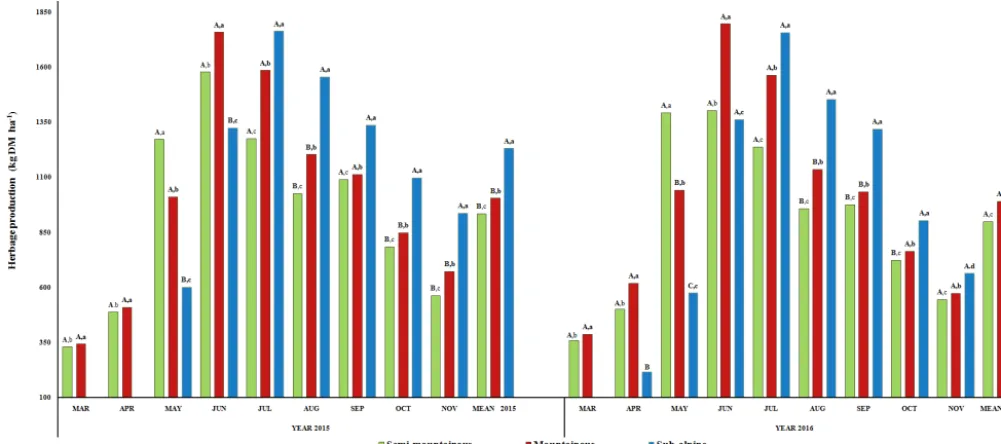
The mean annual production of herbaceous species was higher (P <0.05) in the sub-alpine grassland compared to the other two grasslands in 2015, while no significant dif-ferences (P >0.05) were detected between the mountainous and semi-mountainous grasslands (Fig. 1). In 2016, the mean annual herbage production of the sub-alpine grassland was greater than the other two grasslands but with no signifi-cant differences (P >0.05) between them. Also, there were no interannual differences (P >0.05) for the herbage pro-duction of each grassland. The herbage propro-duction of all grasslands followed the same trend throughout the growing period in both years. Specifically, it increased from spring to midsummer and then decreased until the end of autumn. Peak production was recorded in the semi-mountainous and mountainous grasslands during June, while in the sub-alpine grassland it occurred in July. The herbage production of the three grasslands was significantly affected (P <0.001) by the harvest month, the altitudinal zone (P <0.05) and by the
“monthx altitudinal zone” interaction (P <0.001), as pre-sented in Table 2.
3.2 Crude protein, cell wall contents and in vitro digestibility
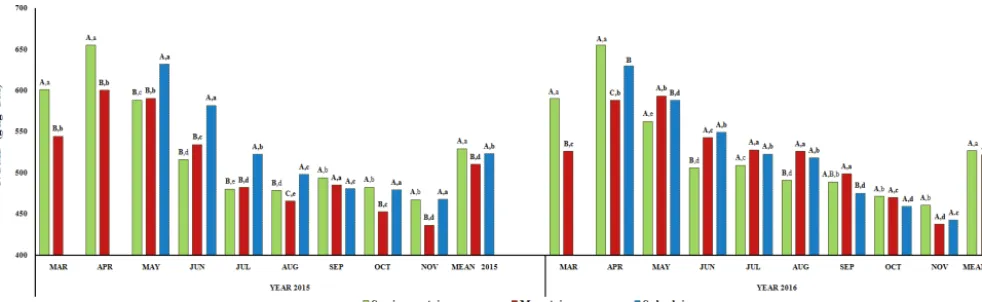
Over the 2-year study, the effects of month, altitudinal zone, year and “monthx zone” interaction (P <0.001;P <0.01) on herbage CP content were revealed (Table 2). The mean an-nual CP content of herbaceous species was higher (P <0.05) in the sub-alpine grassland compared to the two other grass-lands in both years, while there were no significant dif-ferences (P >0.05) between the mountainous and semi-mountainous grasslands (Fig. 2). Similarly, no interannual differences were detected (P >0.05) for the herbage CP con-tent of each grassland. Regarding the monthly variations of herbage CP content of semi-mountainous and mountain-ous grasslands, they increased from March to April and de-creased until August. A second increase of the CP content was observed during September, reaching its lower value in November of both years. On the other hand, the herbage of the sub-alpine grassland initiated growth during late spring when the CP content was high. Then, it decreased until the end of the growing season.
The herbage NDF content of the three grasslands was significantly affected (P <0.001) by month, zone, year and their interactions, while the ADF content was not affected by year (P >0.05). A significant effect of month and zone as well as of interactions of monthx zone (P <0.001) and month x zone x year (P <0.05) was found for the ADL content of herbage. The cell wall constituents increased as the growing season progressed, showing a peak value during November in both years (Fig. 3). The annual mean NDF con-centration of herbage was significantly different (P <0.05) among the three grasslands in 2015, but in 2016, it was higher (P <0.05) in the semi-mountainous grassland with no sig-nificant differences (P >0.05) between the two other grass-lands. Interannual differences were also detected (P <0.05) for the herbage NDF of the semi-mountainous and sub-alpine grasslands. The annual mean herbage ADF value of the sub-alpine grassland was higher (P <0.05) than the two other grasslands in both years. Interannual differences (P <0.05) for the herbage ADF content were detected only in the sub-alpine grassland. The annual mean ADL content was not sig-nificantly different (P >0.05) in the three grasslands in 2015, while it was lower (P <0.05) in the sub-alpine grassland in 2016. Interannual differences of the herbage ADL content were not detected (P >0.05) in each grassland, while the monthly ADL content of the three grasslands increased from the beginning to the end of the experimental period.
Figure 1.Interannual and monthly variation of herbage production (kg DM ha−1) of the semi-mountainous, mountainous and sub-alpine grasslands in the Florina Prefecture, northern Greece. Means of the three grasslands between the 2-year experimental period followed by different letters (a–d) along the corresponding bar differ atP <0.05. Means of the three grasslands in the same year of the experimental period followed by different capital letters (A–C) along the corresponding bar differ atP <0.05.
Table 2.Effect of harvest time (month and year) and altitudinal zone on herbage production and nutritive value.
Parameter Month Zone Year Month Month Zone Monthxzone
xzone xyear xyear xyear
Herbage production ∗∗∗ ∗ NS ∗∗∗ NS NS NS
CP ∗∗∗ ∗∗∗ ∗∗ ∗∗∗ NS NS NS
NDF ∗∗∗ ∗∗∗ ∗∗∗ ∗∗∗ ∗∗∗ ∗∗∗ ∗∗∗
ADF ∗∗∗ ∗∗∗ NS ∗∗∗ ∗∗∗ ∗∗ ∗∗
ADL ∗∗∗ ∗∗∗ NS ∗∗∗ NS NS ∗
IVDMD ∗∗∗ ∗∗∗ NS ∗∗∗ ∗∗∗ ∗∗∗ ∗
Ca ∗∗∗ ∗∗∗ ∗∗∗ ∗∗∗ ∗∗∗ ∗∗ ∗∗∗
P ∗∗ ∗∗∗ ∗∗∗ NS NS ∗ NS
CP: crude protein; NDF: neutral detergent fiber assayed with a heat-stable amylase and expressed free of residual ash; ADF: acid detergent fiber; ADL: acid detergent lignin; IVDMD: in vitro dry matter digestibility; Ca: calcium; P: phosphorus. Level of significance:∗∗∗:P <0.001;∗∗:P <0.01;∗:P <0.05; NS: not significant.
(P <0.05) for the herbage IVDMD were detected only for the mountainous grassland. In the semi-mountainous grass-land, the herbage IVDMD increased from March to April and then showed a progressive reduction until the end of the experimental period in both years. The herbage IVDMD of the mountainous grassland followed the same trend but its peak value was observed in May 2016. On the other hand, the herbage IVDMD of the sub-alpine grassland was slowly decreased from the beginning to the end of the experimental period by 26 % and 28 % in 2015 and 2016, respectively. Sta-tistical analyses showed that IVDMD of herbaceous species was significantly affected (Table 2) by harvest time (only by month), altitudinal zone and their interactions (P <0.001; P <0.05).
3.3 Mineral concentrations
The annual mean calcium concentration of the herbaceous species was significantly different (P <0.05) between the semi-mountainous and sub-alpine grasslands both in 2015 and 2016 (Fig. 5). Interannual differences (P <0.05) were detected only in the sub-alpine grassland. Monthly trends of herbage Ca concentration were also observed in all three grasslands with an increase during September. Herbage Ca concentration was affected significantly (P <0.001) by the harvest time (month and year) and altitude zone, as well as their interactions (P <0.001;P <0.01) (Table 2).
Figure 2.Interannual and monthly variation in herbage crude protein (CP; g kg−1DM) content of the semi-mountainous, mountainous and sub-alpine grasslands in the Florina Prefecture, northern Greece. Means of the three grasslands between the 2-year experimental period followed by different letters (a–d) along the corresponding bar differ atP <0.05. Means of the three grasslands in the same year of the experimental period followed by different capital letters (A–C) along the corresponding bar differ atP <0.05.
2016 significant differences (P <0.05) were found between the semi-mountainous and mountainous grasslands. Inter-annual differences were not found (P >0.05) among the three grasslands (Fig. 5). The P concentration in the semi-mountainous and semi-mountainous grasslands was higher in the summer months in both years, while in the sub-alpine grass-land the peak occurred in August and April of 2015 and 2016, respectively. The phosphorus concentration was affected sig-nificantly (P <0.001) by the altitudinal zone of grasslands and the sampling year (Table 2) as well as by the harvest month (P <0.01).
4 Discussion
Information about monthly and interannual variations of for-age production and nutritive value is needed in order to achieve a time-efficient utilization of forage in grasslands and to detect nutrient deficiencies of grazing animals. This will lead to the administration of the appropriate supplemen-tation and to high levels of grazing animals’ welfare. The discussion below follows this line of thought.
4.1 Herbage production
The herbage production in the mountainous grasslands varies greatly as it is affected by the climatic conditions (mainly temperature and precipitation), the altitudinal zone, the botanical composition of plant species, the livestock grazing and the management practices (Papanastasis, 1982; Smith et al., 2008; Mpokos et al., 2014). It has been reported by Papanastasis (1982) that, in dry and semi-dry areas of
Greece, annual herbage production of grasslands is usually below 1500 kg ha−1, while in subhumid and humid areas it may reach 3000–4000 kg ha−1. These differences are also
Figure 4.Interannual and monthly variation of herbage in vitro dry matter digestibility (IVDMD; g kg−1DM) of the semi-mountainous, mountainous and sub-alpine grasslands in the Florina Prefecture, northern Greece. Means of the three grasslands between the 2-year exper-imental period followed by different letters (a–d) along the corresponding bar differ atP <0.05. Means of the three grasslands in the same year of the experimental period followed by different capital letters (A–C) along the corresponding bar differ atP <0.05.
able to plants and consequently greater herbage production in mountainous and sub-alpine grasslands during the summer. Herbage production tended to increase until midsummer for the semi-mountainous and mountainous grasslands, and until the end of summer for the sub-alpine one, and then decreased as the growing period progressed in both years introducing, however, a sigmoid curve similar to the findings reported by Pearson and Ison (1987). A similar pattern for herbage pro-duction was also found by Mountousis et al. (2008) on moun-tainous and sub-alpine grasslands in NW Greece as well as by Stoliou (2011) in the sub-alpine pastures of Greek Voras and Olympus mountains.
4.2 Crude protein, cell wall contents and in vitro digestibility
The herbage crude protein concentration of all three grass-lands was higher at the beginning of the growth period (Fig. 2), as a result of the intense growth of plants (Ryan and Bormann, 1982). As the season progressed and plants matured, the CP content decreased due to the increased pro-portions of structural carbohydrates vs. cell contents and the accumulation of nutrients to flowers and seeds. Also, the oc-curred changes in the stem/leaf ratio contributed to the total CP reduction as stems contain less crude protein than leaves (Sheaffer et al., 1992). An increase in the herbage CP con-tent was observed in the semi-mountainous and mountainous grasslands during September. Rain and cooler temperatures during this month initiated a second growth cycle of plants, at which time the CP content was increased. However, this trend was not observed in the sub-alpine grassland, where the CP content steadily declined after May by 48 % and 41.5 % in 2015 and 2016, respectively. This probably indicates that the perennial plant species that compose the sub-alpine grass-land seem not to be responding enough to climatic changes for second growth cycle, and consequently an increment in
the CP content, but they go dormant in preparation for win-ter. In general, information concerning the regrowth cycle of herbaceous species is very limited (Michaud et al., 2011) and there are no published data to compare with our results. Mean CP content of herbage was higher in the sub-alpine grassland compared to the two other grasslands, thus reflecting the cli-matic conditions that occurred during the growth period of plants (Holecheck et al., 2010). Moreover, according to Han et al. (1997), plants growing at higher altitudes improve their resistance to cold environments by increasing the content of substances like CP, fat, starch and sugars (sucrose, fructose and glucose).
Crude protein is an essential dietary nutrient for animals’ maintenance, growth and reproduction. The CP requirements for maintenance of livestock range from 82 g kg−1DM for growing beef cattle (with a live weight of 300 kg and an av-erage daily gain of 0.22 kg) to 95 g kg−1DM for small
ru-minants (sheep and goats) with a live weight of 50 kg, ac-cording to NRC (1985, 1996). In the studied grasslands, beef cattle requirements for the CP could be adequately covered from April to May in the semi-mountainous and mountain-ous grasslands, while in the sub-alpine grassland they are covered from May to August. The CP requirements of small ruminants could be adequately satisfied only at the begin-ning of the grazing season (April) in the semi-mountainous and mountainous grasslands and from May to June in the sub-alpine grassland. For the rest period, additional protein sources should be supplied in order to meet the mainte-nance requirements of the animals. Additionally, Mountousis et al. (2011) suggested that the move of grazing animals from the lowlands to high-elevation grasslands during sum-mer seems to be a good practice in order to take advantage of herbage with a better crude protein content.
Figure 5.Interannual and monthly variation of herbage calcium and phosphorus contents (g kg−1DM) of the semi-mountainous, moun-tainous and sub-alpine grasslands in the Florina Prefecture, northern Greece. Means of the three grasslands between the 2-year experimental period followed by different letters (a–d) along the corresponding bar differ atP <0.05. Means of the three grasslands in the same year of the experimental period followed by different capital letters (A–C) along the corresponding bar differ atP <0.05.
value at the end of autumn. The fiber concentration increased and the nutrient content decreased with plants’ maturation, affecting their digestibility and nutritive value as well (Bux-ton and Redfearn, 1997; Feyissa et al., 2014). In our study, the fiber content of herbage in all grasslands followed almost this pattern, albeit with different intensities. The higher cell wall contents were found in the semi-mountainous grassland, as a result of the early maturation of plants due to the higher temperature and lower humidity, especially during summer. This is in accordance with the results of Roukos et al. (2011) for grasslands in northwestern Greece.
Dry matter digestibility of species-rich rangelands pro-vides a synthetic measure of the amount of energy in plant constituents available for ruminants and it is a crucial factor for the estimation of nutritive value of rangelands (Bruinen-berg et al., 2002). In vitro dry matter digestibility showed a trend to decrease progressively from spring to autumn in all three grasslands. As referred by Van Soest (1994), lignin
is a principal factor limiting digestibility. In addition, the low protein and the high fiber contents have negative ef-fects on digestibility (Minson, 1982). In all cases, the highest IVDMD value was reached when the fiber contents were the lowest (at the beginning of the growing season). These results are consistent with those of Mountousis et al. (2008), who in-dicated that monthly variations in dry matter digestibility are mainly related to those of crude protein and fiber contents. Additionally, according to Moreira et al. (2004), an increased leaf ratio in forage results in an increase in CP content and a reduction in cell wall content, which results in an increase in the digestibility of the forage.
4.3 Mineral concentrations
et al., 2017). Phosphorous and calcium are the most impor-tant nutrients (McDonald et al., 2010) due to their role in the metabolic functions of livestock (Underwood and Sut-tle, 1999). Calcium requirements for growing cattle of 200– 250 kg and small ruminants of 50 kg are in the range of 3.0 and 2.0 g kg−1DM, respectively (NRC, 1985, 1996). In our study, herbage Ca concentration was found to be ade-quate and sufficiently higher than those normally required by the ruminants in all three grasslands. Additionally, increased phosphorus availability in soil leads to higher grassland dry matter productivity (Melo et al., 2007). In accordance with Ndebele et al. (2005), the results of the present study revealed that the phosphorus concentration of herbaceous plants de-clines markedly with advancing maturity. Phosphorus is the most deficient mineral for grazing livestock throughout the world according to Greene (2000). The estimated mainte-nance requirements for beef cattle and small ruminants are 1.7 and 1.6 g kg−1DM, respectively (NRC, 1985, 1996). In
our study, phosphorus content was enough to cover the main-tenance requirements of small ruminants and beef cattle for the greater period only in the mountainous grasslands. How-ever, phosphorus supplements are necessary, especially after June.
4.4 Animals’ welfare
The welfare of animals is a quite new scientific multidi-mensional field which combines the practicing of animal husbandry with natural, social, ethical, cultural, economic and political issues (Mikuš et al., 2018). Even though there are common guidelines and directives for the animal wel-fare policy, little attention has been given to extensive pro-duction systems (Turner and Dwyer, 2007). An important aspect in the assessment of grazing ruminants’ welfare is the free selection of an adequate and nutritious amount of feed from pastures. In our study, the higher stocking density (0.92 LU ha−1) of the semi-mountainous grassland compared to the other two grasslands is not a restrictive parameter in animals’ welfare as it is beyond the appropriate limit (Na-tional Statistical Service of Greece, 2003). Generally, stock-ing density in Greece is not uniformly distributed over the country (Yiakoulaki and Papanastasis, 2014), but it is higher in the lower elevation zone, near the villages and in animal concentration points, such as watering troughs and sheds. Given the detected nutrient deficiencies, protein and phos-phorus supplementation should be provided to animals in or-der to cover their maintenance requirements during the whole period and reach high levels of welfare. Nutrient deficiencies in animals should be timely identified and prevented before the clinical signs appeared.
Good grazing animals’ welfare also requires free access to water, shelter for protection against the extreme climatic conditions, appropriate veterinary care, more human–animal contact and low-stress handling (Goddard et al., 2006; Turner and Dwyer, 2007). The studied grasslands as heterogeneous
landscapes with rough topography and steep slopes are usu-ally characterized by a lack of infrastructure, such as road networking, watering places, shelters, salt placement, strate-gic fencing, etc. Water, salt, mineral and protein supplements can be used by farmers as attractants to improve the live-stock distribution and grazing uniformity on grasslands and to achieve higher levels of welfare. To improve awareness of farmers for the grazing animals’ welfare problems, further studies are necessary to understand their knowledge and atti-tudes on this issue.
5 Conclusions
The determination of forage production and nutritive value in grasslands is important for achieving the optimum productiv-ity of grazing livestock and their welfare. The studied grass-lands provided to grazing animals high-quality feed during spring but their quality is declining steadily over time. The cell wall constituents generally increased, while the CP con-tent and IVDMD decreased, leading to a decline in the over-all nutritive value. From the mineral perspective, calcium was adequate to meet the grazing ruminants’ requirements during the whole study period, while, on the contrary, a phospho-rus supplementation is needed especially after June. More-over, considerable monthly and interannual variations in the herbage production and nutrient content of the three grass-lands were detected. The sub-alpine grassland was the most productive grassland with the highest mean CP content. Tak-ing into account that in this grassland, high herbage produc-tion and quality are available during summer, the moving of animals from the semi-mountainous and mountainous re-gions to the sub-alpine zone seemed to be a proper practice for the better and long-term utilization of the studied grass-lands. Monthly and interannual variations of forage availabil-ity and nutritive value in grasslands, as well as the lack of infrastructure, may have a negative effect on grazing rumi-nants’ welfare.
Data availability. The original data are available upon request from the corresponding authors.
Author contributions. MY designed and supervised the study and contributed equally with IM to the writing of the manuscript. MK, IM, VD and KZ performed the field work and the chemi-cal analyses, analyzed data and helped in the preparation of the manuscript.
Acknowledgements. This research was performed as part of the project 1770/95529/23-07-2014, entitled “Estimation of grazing ca-pacity in northern Greece grasslands by using Geoinformatics Tech-niques”, and was carried out within the framework of a pilot pro-gram for the estimation of pastoral grazing in northern Greece, funded by the Ministry of Rural Development and Food of the Hel-lenic Republic.
Review statement. This paper was edited by Manfred Mielenz and reviewed by Veronica Sarateanu and Manja Zupan.
References
Antkowiak, I., Pytlewski, J., Purczynska, A., and Skrzypek, R.: A preliminary study of the behaviour of water buffaloes (Bubalus bubalis) imported to Poland (Short Communication), Arch. Tierzucht, 55, 415–419, 2012.
AOAC: Official Methods of Analysis, 17th Edn., AOAC INTER-NATIONAL, Method 973.18, Gaithersburg, MD 20877-2417, USA, 2000a.
AOAC: Official Methods of Analysis, 17th Edn., AOAC INTER-NATIONAL, Method 984.13, Gaithersburg, MD 20877-2417, USA, 2000b.
Barnett, T. P., Adam, J. C., and Lettenmaier, D. P.: Potential impacts of a warming climate on water availability in snow-dominated regions, Nature, 438, 303–309, 2005.
Bojkovski, D., Štuhec, I., Kompan, D., and Zupan, M.: The behav-ior of sheep and goats co-grazing on pasture with different types of vegetation in the karst region, J. Anim. Sci., 92, 2752–2758, 2014.
Bouyoucos, G. J.: Hydrometer method improved for making particle-sized analysis of soils, Agron. J., 54, 464–465, 1962. Bruinenberg, M. H., Valk, H., Korevaar, H., and Struik, P. C.:
Fac-tors affecting digestibility of temperate forages from seminatural grasslands: A review, Grass and Forage Sci., 57, 292–301, 2002. Buxton, D. R. and Redfearn, D. D.: Plant limitations to fiber
diges-tion and utilizadiges-tion, J. Nutr., 127, 814–818, 1997.
Carcangiu, V., Arfuso, F., Luridiana, S., Giannetto, C., Rizzo, M., Bini, P., and Piccione, G.: Relationship between different live-stock managements and stress response in dairy ewes, Arch. Anim. Breed., 61, 37–41, 2018.
Charlton, L. G. and Rutter, S. M.: The behaviour of housed dairy cattle with and without pasture access: A review, Appl. Anim. Behav. Sci., 192, 2–9, 2017.
Feyissa, F., Prasad, S., Assefa, G., Bediye, S., Kitaw, G., Ke-haliew, A., and Kebede, G.: Dynamics in nutritional character-istics of natural pasture hay as affected by harvesting stage, stor-age method and storstor-age duration in the cooler tropical highlands, Afr. J. Agric. Res., 9, 3233–3244, 2014.
Fisher, R. A.: The Design of Experiments, 8th Edn., Hafner, New York, 1966.
Flocas, A. A.: Courses of Meteorology and Climatology, Ziti Press, Thessaloniki, Greece, 480 pp., 1994.
George, M., Bartolome, J. W., McDougald, N., Connor, M., Vaughn, C., and Markegard, G.: Annual range forage production, Rangeland Management Series, University of California,
Divi-sion of Agriculture and Natural Resources, Rangeland Manage-ment Series Pub 8018, Davis, California, 1–9, 2001.
Gilhaus, K. and Hölzel, N.: Seasonal variations of fodder quality and availability as constraints for stocking rates in year-round grazing schemes, Agr. Ecosyst. Environ., 234, 5–15, 2016. Goddard, P., Waterhouse, T., Dwyer, K., and Stott, A.: The
percep-tion of the welfare of sheep in extensive systems, Small Rumi-nant Res., 62, 215–225, 2006.
Greene, L. W.: Designing mineral supplementation of forage pro-grams for beef cattle, J. Anim. Sci., 77, 1–9, 2000.
Han, F., Ben, G. Y., and Shi, S. B.: Contents of protein, fat and starch of Kobresia humilis plants grown at different altitudes in Qinghai-Tibetan Plateau, Acta Phytoecol. Sin., 21, 97–104, 1997.
Hellenic Statistical Authority: Land use: Distribution of the Coun-try’s area by basic land cover – land use categories, by region and department, available at: http://www.statistics.gr/en/statistics/-/ publication/SPG51/2000 (last access: 15 August 2018), 2000. Holechek, J. L., Pieper, R. D., and Herbel, C. H.: Range
Manage-ment Principles and Practices, 6th Edn., Prentice-Hall Inc., Up-per Saddle River, NJ, 2010.
Hopkins, A.: Mountainous farming in Europe, Grassland Sci. Eur., 16, 3–12, 2011.
H. N. M. S.: Hellenic National Meteorological Service, Athens, Greece, 2017.
Karagiannakidou, V., Dimopoulos, P. D., and Papademetriou, K.: Phytosociological researches on the montane and high-altitude grasslands of North Eastern Greece: Mount Pangeon, Fitosoci-ologia, 38, 25–54, 2001.
Karasabbidis, K., Yiakoulaki, M., Papazafeiriou, A., Mountousis, I., and Papanikolaou, K.: A behavioral study of the greek “Thracean” sheep breed grazing on the rangelands of Rhodope, Greece, Arch. Tierzucht, 57, 1–10, 2014.
Khalil, I. A. and Manan, F.: Chemistry-One (Bio-Analytical Chem-istry), 2nd Edn., National Book Foundation, Islamabad, Pakistan, 1990.
Kilgour, R. J., Uetake, K., Ishiwata, T., and Melville, G. J.: The behaviour of beef cattle at pasture, Appl. Anim. Behav. Sci., 138, 12–17, 2012.
Kitikidou, K.: Applied Statistics Using SPSS, Tziolas Press, Thes-saloniki, Greece, 288 pp., 2005.
Koroneos, A. A.: Mineralogy, petrology and geochemistry of plou-tonite of East “Varnoudas” (NW Macedonia-Greece), PhD The-sis, Aristotle University of Thessaloniki, Thessaloniki, Greece, 451 pp., 1991.
Márquez-Madrid, M., Gutiérrez-Bañuelos, H., Bañuelos-Valenzuela, R., Muro-Reyes, A., and Valdez-Cepeda, R. D.: Macro-mineral concentrations in soil and forage in three grassland sites at Zacatecas, Rev. Mex. Cienc. Pecu, 8, 437–443, 2017.
McDonald, P., Edwards, R. A., Greenhalgh, J. F. D., Morgan, C. A., Sinclair, L. A., and Wilkinson, R. G.: Animal Nutrition, 7th Edn., Pearson Education Limited, Harlow, UK, 712 pp., 2010. Melo, S. P., Monteiro, F. A., and Manfredini, D.: Silicate and
phos-phate combinations for Marandu palisadegrass growing on an ox-isol, Rev. Sci. Agric., 64, 275–281, 2007.
quality of three grasslands with contrasting functional composi-tions, Grass and Forage Sci., 67, 64–76, 2011.
Mikuš, T., Radeski, M., Cziszter, T. L., Dimitrov, I., Jurkovich, V., Nenadovi´c, K., Ostovi´c, M., Zupan, M., and Kirchner, M. K.: The Danube Region – On Stream with Animal Welfare Assess-ment in the Last 35 Years: A Review of Research on Animal Welfare Assessment in a Multi-lingual Area in Europe, J. Agr. Environ. Ethic., 31, 511–526, 2018.
Minson, D. J.: Effect of chemical composition on feed digestibility and metabolizable energy, Nutr. Abstr. Rev. Ser., B52, 591–615, 1982.
Moreira, F. B., Prado, I. N., Cecato, U., Wada, F. Y., and Mizubuti, I. Y.: Forage evaluation, chemical composition, and in vitro di-gestibility of continuously grazed star grass, Anim. Feed Sci. Tech., 113, 239–249, 2004.
Mountousis, I., Papanikolaou, K., Stanogias, G., Chatzitheodoridis, F., and Roukos, C.: Seasonal variation of chemical composition and dry matter digestibility of rangelands in NW Greece, J. Cent. Eur. Agric., 9, 547–556, 2008.
Mountousis, I., Dotas, V., Stanogias, G., Papanikolaou, K., Roukos, C., and Liamadis, D.: Altitudinal and seasonal variation in herbage composition and energy and protein content of grass-lands on Mt Varnoudas, NW Greece, Anim. Feed Sci. Tech., 164, 174–183, 2011.
Mpokos, J. P., Yiakoulaki, D. M., Papazafeiriou, Z. A., Sgardelis, S., Alifragis, D., and Papanikolaou, K.: Herbage Production and Species Richness in Sub-alpine Grasslands of Different Soil Par-ent Material in Northern Greece, J. Mt. Sci., 11, 1579–1592, 2014.
National Statistical Service of Greece: Agriculture Statistics of Greece, Primary Sector Statistics, Athens, Greece, 2003. Ndebele, N., Mtimuni, J. P., Mpofu, I. D. T., Makuza, S., and
Mumba, P.: The status of selected minerals in soils, forage and Beef Cattle tissues in a semi-arid region of Zimbabwe, Trop. Anim. Health Pro., 37, 381–393, 2005.
Ngwa, A. T., Pone, D. K., and Mafeni, J. M.: Feed selection and dietary preferences of forage by small ruminants grazing natu-ral pastures in the Sahelian zone of Cameroon, Anim. Feed. Sci. Tech., 88, 253–266, 2000.
NRC: Nutrients Requirements of Sheep, 6th rev. Edn., National Academy Press, Washington, DC, USA, 1985.
NRC: Nutrients Requirements of Beef Cattle, 7th Edn., National Academy Press, Washington, DC, USA, 1996.
Papanastasis, V. P.: Production of grasslands in relation to air tem-perature and precipitation in Northern Greece, Dassiki Erevna, 3, 1–111, 1982 (in Greek with English summary).
Papanastasis, V. P. and Mansat, P.: Grasslands and related forage re-sources in Mediterranean areas, in: Grassland and land use sys-tems, edited by: Parente, G., Frame, J., and Orsi, S., Grassland Sci. Eur., Vol. 1., ERSA, Corizia, Italy, 47–57, 1996.
Papanastasis, V. P. and Ispikoudis, I.: Rangeland Ecology, 1st Edn., Giaxoudis Press, Thessaloniki, Greece, 2012 (in Greek). Papanikolaou, K., Nikolakakis, I., Imamidou, A., Pappa, V., and
Ntotas, V.: Botanical and chemical composition of grazable ma-terial in Florina – Greece rangelands and its role in developing of organic stock breeding, Anim. Sci. Rev., 27, 48–49, 2002.
Pearson, C. J and Ison, R. L.: Vegetative Growth, in: Agronomy of grassland systems, edited by: Pearson, C. J. and Ison, R. L., Cambridge Univ. Press, Cambridge, 28–47, 1987.
Pelto, M. S.: Impact of climate change on North Cascade alpine glaciers, and alpine runoff, Northwest Sci., 82, 65–75, 2008. Roukos, C., Papanikolaou, K., Karalazos, A., Chatzipanagiotou, A.,
Mountousis, I., and Mygdalia, A.: Changes in nutritional quality of herbage botanical components on a mountain side grassland in North-West Greece, Anim. Feed Sci. Tech., 169, 24–34, 2011. Ryan, D. F. and Bormann, F. H.: Nutrient resorption in Northern
hardwood forests, Bioscience, 32, 29–32, 1982.
Sheaffer, C. C., Peterson, P. R., Hall, M. H., and Stordahl, J. B.: Drought effects on yield and quality of perennial grasses in the north central United States, J. Prod. Agric., 5, 556–561, 1992. Smith, P., Fang, C. H., Dawson, J. C., and Moncrief, J. B.: Impact of
global warming on soil organic carbon, Adv. Agron., 97, 1–43, 2008.
Stoliou, P. G.: Comparative study of the flora and the chemical com-position of grazable material of the subalpine-alpine grasslands from two mountains with different geological substrates, Mas-ter Thesis, Aristotle University of Thessaloniki, Greece, 100 pp., 2011.
Tilley, J. M. A. and Terry, R. A.: A two stage technique for in vitro digestion of forage crops, J. Brit. Grassland Soc., 18, 104–111, 1963.
Topczewska, J.: An attempt to assess the welfare of horses main-tained in herd systems, Arch. Tierzucht, 57, 1–9, 2014.
Turner, S. P. and Dwyer, C. M.: Welfare assessment in extensive animal production systems: challenges and opportunities, Anim. Welfare, 16, 189–192, 2007.
Underwood, E. J. and Suttle, N. F.: The Trace Mineral Nutrition of Livestock, 3rd Edn., CABI Publishing, Oxon, UK, 1999. Van Soest, P. J., Robertson, J. B., and Lewis, B. A.: Methods for
dietary fiber, neutral detergent fiber, and non-starch polysaccha-rides in relation to animal nutrition, J. Dairy Sci., 74, 3583–3597, 1991.
Van Soest, P. J.: Nutritional Ecology of the Ruminant, Cornell Uni-versity, USA, 1994.
Villalba, J. J., Provenza, F. D., and Manteca, X.: Links between ru-minants’ food preference and their welfare, Animal, 4, 1240– 1247, 2010.
Yiakoulaki, M. D. and Papanastasis, V.: Grasslands and grazing sys-tems of Central Macedonia, in: Grasslands and herbivore pro-duction in Europe and effects of common policies, edited by: Huyghe, C., de Vliegher, A., van Gils, B., and Peeters, A., Edi-tions Quae, RD 10, 78026 Versailles CEDEX, France, ISBN 978-2-7592-2157-8, 168–172, 2014.