Volume 1, Issue 1, October 2013
Abstract— As the field of wireless communication is growing very rapidly in last ten years, the problem of bandwidth scarcity is also increasing and has become more hectic day by day. On the other hand, the studies made by Federal Communications Commission showed that large portion of the spectrum lies vacant most of the time and that portion is the licensed spectrum band; which is utilized by licensed users only. So, to solve this problem of spectrum under-utilization, Federal Communications Commission allowed secondary users to utilize the licensed band when it is not in use and named it as Cognitive Radio. To solve the spectrum overcrowding problem, cognitive radio (CR) has emerged as a leading technology because it can intelligently sense an unused spectrum and allocate it to the secondary users without creating any harm to authorized users.
Index Terms— Cognitive Radio Network, Architecture, wireless communication. I. INTRODUCTION
A Cognitive Radio having ability to suit multi-dimensionally intelligent wireless communication system that having an importance to fulfill the consumer needs. A Cognitive Radio is capable of: 1) sensing its environment 2) adapting its physical layer functionality. The two basic objectives of cognitive radio are: highly trusted communications whenever and wherever needed and utilization properly the radio spectrum. The cognitive radio is an approach that can be extended to cognitive networks. A cognitive radio network is intelligent multiuser wireless communication systems that believe the radio-scene, except the variations in the environment, provides communication between users by cooperation, and controls. The communication through proper allocation of resources. The cognitive network encompasses a cognitive process that can perceive current network conditions, and then plan, decide, and act on those conditions. Cognitive networks require a software adaptable network to implement the actual network functionality and allow the cognitive process to adapt the network. The most general theory in telecommunications is information theory which can be classified into syntactic, semantic, and pragmatic levels. Syntactic represents the lowest level which includes the study of relations of signs to other signs. Semantics is the study of the relations of signs to what they represent. This level thus considers the meaning of the signs. Pragmatics represents the highest level which includes the study of the interpretation of signs to their users. This level considers the value and utility of the signs.
II. CHARACTERISTICSOFCOGNITIVERADIONETWORKS
There are three main principal for cognitive radio operations:
Reconfigurability: This property of cognitive radios refers to their ability to dynamically modify their configuration to improve the offered Quality of Services. Reconfigurations are software-defined, that is, they are accomplished by activating the appropriate software at the transceiver. Reconfiguratability includes:
Frequency Agility: It is the ability of a radio to change its operating frequency.
Dynamic Frequency selection: It is the ability that dynamically detects signals from other radio frequency systems and avoids co-channel operation with those systems.
Adaptive Modulation/Coding: A cognitive radio could select the appropriate modulation type for use with a particular transmission between systems.
Transmit Power Control: it is a feature that enables cognitive radio to dynamically switch between several transmissions power levels in the data transmission process.
A Survey of Cognitive Radio Network
Techniques and Architecture
Sunil Raghuwanshi Chetan Barde
Volume 1, Issue 1, October 2013
Cognition: It having the capability which includes the features of spectrum sensing, spectrum sharing, location identification.
Self-management: It includes:
Spectrum/Radio Resource management: To efficiently manage and organize spectrum holes information among cognitive radios.
Mobility and Connection Management: Helps cognitive radio to select route and network because of heterogeneity of CRNs, routing and topology information is more and more complex.
Trust/Security Management: In CRNs trust is an important parameter because various heterogeneities introduce lots of security issues.
Functions of Cognitive Radio:
Cognitive Radio includes detecting the spectrum white space, selecting the best frequency bands, coordinating spectrum access with other users and vacating the frequency when a primary user appears.
Cognitive radio cycle has following function:
Spectrum sensing and analysis.
Spectrum management and handoff.
Spectrum allocation and sharing.
Spectrum sensing and analysis: Cognitive radio can detect the white space by using Spectrum sensing and analysis techniques. When primary user is not using a portion of frequency band then by using Spectrum sensing techniques it can found and can be allocated to the secondary user. On the other hand, when primary users start using the licensed spectrum again, CR can detect their activity through sensing, and inform the secondary user to stop using that particular band so that no harmful interference is generated to primary user due to secondary users transmission.
Spectrum management and handoff: After recognizing the spectrum white space by sensing, spectrum management and handoff function of CR enables secondary users to choose the best frequency band and hop among multiple bands according to the time varying channel characteristics to meet various Quality of Service (QoS) requirements. For instance, when a primary user reclaims his/her frequency band, the secondary user that is using the licensed band can direct his/her transmission to other available frequencies, according to the channel capacity determined by the noise and interference levels, path loss, channel error rate, holding time, and etc.
Spectrum allocation and sharing: In dynamic spectrum access, a secondary user may share the spectrum resources with primary users, other secondary users, or both. Hence, a good spectrum allocation and sharing mechanism is critical to achieve high spectrum efficiency. Since primary users own the spectrum rights, when secondary users co-exist in a licensed band with primary users, the interference level due to secondary spectrum usage should be limited by a certain threshold. When multiple secondary users share a frequency band, their access should be coordinated to alleviate collisions and interference.
Need of Cognitive Radio Technology:
Volume 1, Issue 1, October 2013
III. COGNITIVE RADIO ARCHITECTURE
It consists of three basic building blocks:
Digital Transceiver.
Channel monitoring and spectrum sensing module.
Communication management and control.
Fig. 1 Block Diagram
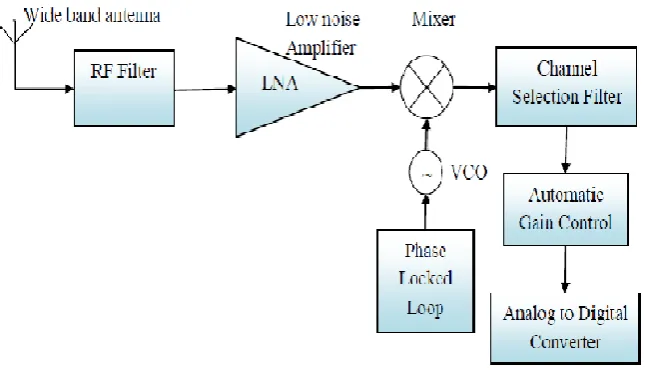
Digital Transceiver: The main components of a cognitive radio transceiver are: RF front-end and Baseband processing unit. In the RF front-end, the received signal is amplified, mixed and then converted from analog to digital by using A/D converter. In the baseband processing unit, the signal is modulated/demodulated and encoded/decoded. RF hardware for the cognitive radio should be capable of tuning to any part of a large range of frequency spectrum.
RF Front-End: It consists of following blocks:
RF filter: The RF filter selects the desired band from received RF signal by using band-pass filter.
Low noise amplifier (LNA):It amplifies the desired signal and at the same time it minimizes noise components. Mixer:It mixes, the received signal with locally generated RF frequency and converted to the baseband or the intermediate frequency (IF).
Fig. 2 RF Front End
Volume 1, Issue 1, October 2013
Phase locked loop (PLL): The PLL ensures that a signal is locked on a specific frequency and can also be used to generate precise frequencies with fine resolution.
Channel selection filter: It is used to select the desired and reject the adjacent unused channels.
Automatic gain control (AGC): The AGC maintains the gain or output power level of an amplifier. The conitive radio network can be used efficiently in network centric, distributed, adhoc, mesh architecture, and serve the needs of both licenced and unlicenced applications. The basic components of cognitive radio network are mobile station, base station and backbone networks depending on this there are three kinds of network architecture in cognitive radio i.e, Infrastructure, ad hoc and mesh architecture.
IV. COMPONENTS OF COGNITIVE RADIO NETWORK
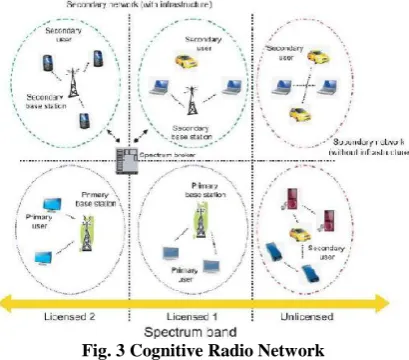
With the development of CR technologies, secondary users who are not authorized with spectrum usage rights can utilize the temporally unused licensed bands owned by the primary users. Therefore, in CR network architecture, the components include both a primary network and a secondary network.
Primary Network: The primary network (or licensed network) is referred to as an existing network, where the primary users have a license to operate in a certain spectrum band. If primary networks have an infrastructure, primary user activities are controlled through primary base stations. Due to their priority in spectrum access, the operations of primary users should not be affected by secondary users.
Secondary Network: The CR network (also called the dynamic spectrum access network, secondary network) does not have a license to operate in a desired band. Hence, additional functionality is required for CR users to share the licensed spectrum band. CR network also can be equipped with CR base stations that provide single-hop connection to CR users. Finally, CR networks may include spectrum brokers that play a role in distributing the spectrum resources among different CR networks.
Spectrum Broker: If several secondary networks share one common spectrum band, their spectrum usage may be coordinated by a central network entity, called spectrum broker. The spectrum broker collects operation information from each secondary network and allocates the network resources to achieve efficient and fair spectrum sharing.
Fig. 3 Cognitive Radio Network
Communication Layers in Cognitive Radio Network Architecture:
Physical Layer: The physical layer of a Cognitive Radio node should provide the capability of reconfiguring its operating frequency, modulation, channel coding and output power without hardware replacement.
Volume 1, Issue 1, October 2013
inhibiting transmission, the impracticality of broadcast over a network-wide common channel and the need for high-priority access mechanism for the distribution of spectrum sensing and decision results.
Network Layer: Due to spectrum mobility in Cognitive Radio Networks, hop-based channel characteristics like channel access delay, interference; operating frequency and bandwidth are new metrics to consider in the design of new routing techniques. Rerouting algorithms should also be highly energy-efficient in Cognitive Radio Networks.
Transport Layer: In cognitive layer network, the transport layer is mainly responsible for end-to-end reliable delivery of event readings and congestion control to preserve scarce network resources while considering application-based QoS requirements.
Application Layer: Application Layer algorithms in CR networks mainly deal with the generation of information and extracting the features of event signals being monitored to communicate to the sink. Other services provided by the application layer include methods to query sensors, interest and data dissemination, data aggregation and fusion.
V. CONCLUSION
This paper present the needs of Cognitive radio network techniques which can overcome the challenges faced by the present techniques used for wireless communication systems. Cognitive radio has a very useful techniques and it have several advantages like, Dynamic spectrum access, Opportunistic channel usage for bursty traffic, Adaptability for reducing power consumption, Overlaid deployment of multiple concurrent wireless Networks, Communication under different spectrum regulations.
REFERENCES
[1] S. Haykin, “Cognitive Radio: Brain-Empowered Wireless Communications”, IEEE Journal On Selected Areas In Communications, Vol. 23, No. 2, pp. 201-220, 2005.
[2] E. Adamopoulou, K. Demestichas, and M. Theologou, “Enhanced Estimation of Cognitive Capabilities in Cognitive Radio”, IEEE Communications Magazine, Vol. 46, No. 4, pp. 56-63, 2008.
[3] K. C. Chen, Y. J. Peng, N. Prasad, Y. C. Liang and S. Sun, “Cognitive Radio Network Architecture: Part I – General Structure,” 2nd International Conference on Ubiquitous Information Management and Communication, No.1, pp. 114-119, 2008.
[4] G. Vijay, E. Bdira, and M. Ibnkahla, “Cognition in Wireless Networks”, IEEE Sensors Journal, Vol. 11, No. 3, pp. 582-592, 2011.
[5] B. Wang and K. J. Ray Liu, “Advances in Cognitive Radio: A Survey”, IEEE Journals of Selected Topics in Signal Processing, Vol. 5, No. 1, pp. 5-23, 2011.
[6] J. Ma, G. Y. Li and B. H. Juang, “Signal Processing in Cognitive Radio”, Proceedings of IEEE , Vol.97, No. 5, pp.805-823, 2009.
[7] A. Ghasemi and E. S. Sousa, “Spectrum Sensing in Cognitive Radio Networks: Requirements, challenges and design-tradeoffs”, IEEE Communications Magazine, Vol. 46, No. 4, pp. 32-39, 2008.
[8] Z. Quan, S. Cui and A. H. Sayed, “Optimal Linear Cooperation for Spectrum Sensing in Cognitive Radio Networks”, IEEE Journal of Selected Topics in Signal Processing, Vol. 2, No. 1, pp. 28-40, 2008.
[9] I. F. Akyildiz, W.Y. Lee, M. C. Vuran and Shantidev Mohanty, “A Survey on Spectrum Management in Cognitive Radio Networks”, IEEE Communications Magazine, Vol. 46, No. 4, pp. 40-48, 2008.
[10]W. Y. Lee and I. F. Akyildiz, “A Spectrum Decision Framework for Cognitive Radio Networks”, IEEE Transactions on Mobile Computing, Vol. 10, No. 2, pp. 161-174, 2011.
[11]D. Niyato and E. Hossain, “Spectrum Trading in Cognitive Radio Networks: A Market-Equilibrium-Based Approach”, IEEE Wireless Communications, Vol. 15, No. 6, pp. 71-80, 2008.
[12]O. B. Akan, O. B. Karli, and O. Ergul, “Cognitive Radio Sensor Networks”, IEEE Network Magazine, Vol. 23, No. 4, pp.34-50, 2009.