ISSN: 2349-7300
ISO 9001:2008 Certified
International Journal of Innovative Research in Engineering & Multidisciplinary Physical Sciences (IJIRMPS)
Volume 1, Issue 2, December 2013
1
Efficient Utilization of the Spectrum through
Cognitive Radio Technology
Sunil Raghuwanshi
Abstract- Cognitive radio is a novel approach for improving the utilization of a precious natural resource: the radio electromagnetic spectrum. The cognitive radio, built on a software-defined radio (SDR), is defined as an intelligent wireless communication system that is aware of its environment and uses the methodology of understanding-by-building to learn from the environment and adapt to statistical variations in the input stimuli, with two primary objectives in mind: Highly reliable communication whenever and wherever needed; Efficient utilization of the radio spectrum. Cognitive radio is a particular extension of software radio that employs model-based reasoning about users, multimedia content, and communications context. This paper characterizes the potential contributions of cognitive radio to spectrum pooling and outlines an initial framework for formal radio-etiquette protocols.
Index Terms - Awareness, radio-scene analysis, rate feedback, spectrum analysis, spectrum holes, spectrum management, transmit-power control,software radio, cognitive radio, spectrum management, software agents.
I. INTRODUCTION
A. Background
The electromagnetic radio spectrum is a natural resource, the use of which by transmitters and receivers is licensed by governments. In November 2002, the Federal Communications Commission (FCC) published a report prepared by the Spectrum-Policy Task Force, aimed at improving the way in which this precious resource is managed in the United States [1].“In many bands, spectrum access is a more significant problem than physical scarcity of spectrum, in large part due to legacy command-and-control regulation that limits the ability of potential spectrum users to obtain such access.” Indeed, if we were to scan portions of the radio spectrum including the revenue-rich urban areas, we would find that [2]–[4]:
Some frequency bands in the spectrum are largely unoccupied most of the time; Some other frequency bands are only partially occupied;
The remaining frequency bands are heavily used.
The underutilization of the electromagnetic spectrum leads us to think in terms of spectrum holes, for which we offer the following dentition [2]: “A spectrum hole is a band of frequencies assigned to a primary user, but, at a particular time and specific geographic location, the band is not being utilized by that user”. Spectrum utilization can be improved significantly by making it possible for a secondary user (who is not being serviced) to access a spectrum hole unoccupied by the primary user at the right location and the time in question. Cognitive radio [5], [6], inclusive of software-defined radio, has been proposed as the means to promote the efficient use of the spectrum by exploiting the existence of spectrum holes. Cognitive radio is an intelligent wireless communication system that is aware of its surrounding environment (i.e., outside world), and uses the methodology of understanding-by-building to learn from the environment and adapt its internal states to statistical variations in the incoming RF stimuli by making corresponding changes in certain operating parameters (e.g., transmit-power, carrier-frequency, and modulation strategy) in real-time, with two primary objectives in mind:
• Highly reliable communications whenever and wherever needed; • Efficient utilization of the radio spectrum.
B. Cognitive Radio Cycle: An Overview
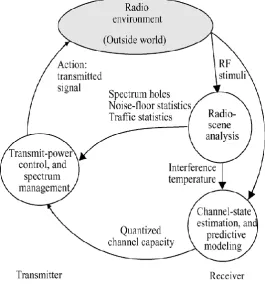
For reconfigurability, a cognitive radio looks naturally to software-defined radio to perform this task. For other tasks of a cognitive kind, the cognitive radio looks to signal-processing and machine-learning procedures for their implementation. The cognitive process starts with the passive sensing of RF stimuli and culminates with action. In this paper, we focus on three cognitive Radio tasks:
1) Radio-scene analysis, which encompasses the following:
• Estimation of interference temperature of the radio environment; • Detection of spectrum holes.
ISSN: 2349-7300
ISO 9001:2008 Certified
International Journal of Innovative Research in Engineering & Multidisciplinary Physical Sciences (IJIRMPS)
Volume 1, Issue 2, December 2013
2
• Estimation of channel-state information (CSI);• Prediction of channel capacity for use by the transmitter 3) Transmit-power control and dynamic spectrum management.
Tasks 1) and 2) are carried out in the receiver, and task 3) is carried out in the transmitter.
Fig. 1.Basic cognitive cycle
Through interaction with the RF environment, these three tasks form a cognitive cycle, which is pictured in its most basic form in Fig. 1.
II. ARCHITECTURE OF COGNITIVE RADIO NETWORK
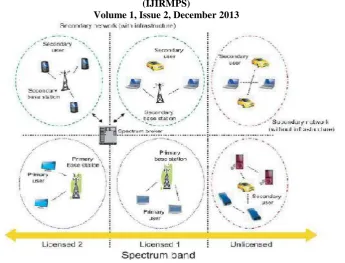
With the development of CR technologies, secondary users who are not authorized with spectrum usage rights can utilize the temporally unused licensed bands owned by the primary users. Therefore, in CR network architecture, the components include both a primary network and a secondary network in fig 2.
Primary Network: The primary network (or licensed network) is referred to as an existing network, where the primary users have a license to operate in a certain spectrum band. If primary networks have an infrastructure, primary user activities are controlled through primary base stations. Due to their priority in spectrum access, the operations of primary users should not be affected by secondary users.
Secondary Network: The CR network (also called the dynamic spectrum access network, secondary network) does not have a license to operate in a desired band. Hence, additional functionality is required for CR users to share the licensed spectrum band. CR network also can be equipped with CR base stations that provide single-hop connection to CR users. Finally, CR networks may include spectrum brokers that play a role in distributing the spectrum resources among different CR networks.
ISSN: 2349-7300
ISO 9001:2008 Certified
International Journal of Innovative Research in Engineering & Multidisciplinary Physical Sciences (IJIRMPS)
Volume 1, Issue 2, December 2013
3
Fig 2. The overview of Cognitive Radio Network architecture
III. FUNCTIONS OF COGNITIVE RADIO
Cognitive Radio includes detecting the spectrum white space, selecting the best frequency bands, coordinating spectrum access with other users and vacating the frequency when a primary user appears. Cognitive radio cycle has following function:
Spectrum sensing and analysis. Spectrum management and handoff. Spectrum allocation and sharing.
Spectrum sensing and analysis: Cognitive radio can detect the white space by using Spectrum sensing [3] and analysis techniques. When primary user is not using a portion of frequency band then by using Spectrum sensing techniques it can found and can be allocated to the secondary user. On the other hand, when primary users start using the licensed spectrum again, CR can detect their activity through sensing, and inform the secondary user to stop using that particular band so that no harmful interference is generated to primary user due to secondary users transmission.
Spectrum management and handoff: After recognizing the spectrum white space by sensing, spectrum management and handoff function of CR enables secondary users to choose the best frequency band and hop among multiple bands according to the time varying channel characteristics to meet various Quality of Service (QoS) requirements. For instance, when a primary user reclaims his/her frequency band, the secondary user that is using the licensed band can direct his/her transmission to other available frequencies, according to the channel capacity determined by the noise and interference levels, path loss, channel error rate, holding time, and etc.
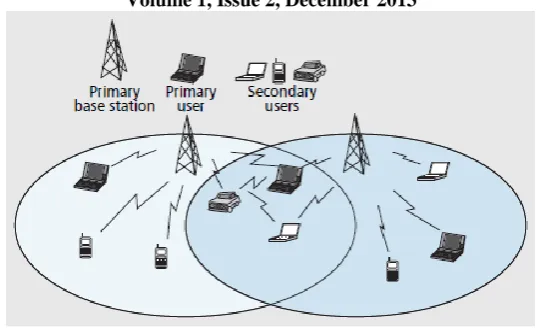
Spectrum allocation and sharing: In dynamic spectrum access, a secondary user may share the spectrum resources with primary users, other secondary users, or both. Hence, a good spectrum allocation and sharing mechanism is critical to achieve high spectrum efficiency. Since primary users own the spectrum rights, when secondary users co-exist in a licensed band with primary users, the interference level due to secondary spectrum usage should be limited by a certain threshold. When multiple secondary users share a frequency band, their access should be coordinated to alleviate collisions and interference.
IV. SPECTRUM SENSE ANALYSIS
ISSN: 2349-7300
ISO 9001:2008 Certified
International Journal of Innovative Research in Engineering & Multidisciplinary Physical Sciences (IJIRMPS)
Volume 1, Issue 2, December 2013
4
opportunities but also for the primary user, minimizing the interference due to secondary users. Conversely the complexity of spectrum sensing algorithm has to be kept to minimum in order to allow real time operation of cognitive radio. Energy detection [12] is a simple spectrum sensing technique. The received signal strength in a certain channel is compared against a carefully selected sensing threshold to ascertain the presence or absence of primary user in that channel. The sensing threshold [13] is defined on the basis of noise floor and is a critical challenge. This results in poor performance at low SNR and/or very small buffer sizes. Energy detection is desirable because of its simplicity and its non-parametric nature .i.e. it is independent of the type of primary user. The waveform based detection [11] is carried out by identifying the preambles and cyclic prefixes that are generally used with various types of transmissions. This approach outperforms energy detection in convergence time and accuracy, but is dependent on the type of primary user transmission. The major drawback of the algorithm is its parametric nature. Cyclostationary feature detectors [14] make use of the inherent periodicity in the radio signals. The correlation function is used to measure the periodicity of the received signal. The algorithm is computationally complex but the cyclic frequencies can also be used for signal classification. Improvement in energy detection performance based on Bayesian sequential testing considering previous spectrum states has been discussed in. The most elaborate survey of spectrum sensing techniques has been carried out in [5]. The broad categorization of these techniques is done and a comparison for varying condition of SNR, noise models and buffer size has been carried out. The various performance metrics that could be used for comparison have also been summarized. Haykin has advocated use of multi-taper method [4] for spectrum sensing considering spatial, temporal and spectral dimensions simultaneously. Radio mode identification [2], [20] enables the cognitive radio to identify various useful parameters of primary user transmission such as modulation scheme, transmission technology, frame size and multiplexing technique etc. This can be utilized by the cognitive radio for optimizing spectrum sensing. In [13] and [14] the radio mode identification approach has been explored. The papers suggest using the instantaneous frequency and delay spread obtained through time frequency analysis. Variable reduction is carried out and neural networks are used to predict which transmission scheme is present in the received signal. However the approach is limited only to identifying the modulation scheme of the primary user. In this paper we suggest a framework that in addition to identifying the modulation scheme may also be used to detect various features of the primary user transmission.
V. SPECTRUM MANAGEMENT AND HANDOFF
ISSN: 2349-7300
ISO 9001:2008 Certified
International Journal of Innovative Research in Engineering & Multidisciplinary Physical Sciences (IJIRMPS)
Volume 1, Issue 2, December 2013
5
Fig. 3: Cognition Cycle of Spectrum management
If there is no primary channel detected to be free then it will select unlicensed spectrum according to traditional CSMA/CA protocol. Due the dynamic nature of radio environment, the spectrum hole information or PU activities would be changed over time. Therefore, spectrum mobility is the processes which conveys this information from spectrum sensing process to spectrum classifier and relist the available channels in fig 3. Further classification has been done on available channel list to create candidate channel list through fine scanning on the channels listed in available channel list. In the next step a back up channel list will form so that any CR node will select the channel which could maximize the channel utilization and finally transmit on that particular channel. In this report, we subdivided the model in two steps where CR users firstly perform proactive channel prediction to create available channel list. The usability status of all the channels is varying over time due to licensed user activities. Therefore, in the second step, CR user will update the available channel list that created in step one to adapt the radio environment dynamics.
VI. SPECTRUM ALLOCATION & SHARING
ISSN: 2349-7300
ISO 9001:2008 Certified
International Journal of Innovative Research in Engineering & Multidisciplinary Physical Sciences (IJIRMPS)
Volume 1, Issue 2, December 2013
6
Fig 4. Dynamic Spectrum Access Networks
VII. CONCLUSION
The potential for cognitive radio to make a significant difference to wireless communications is immense, hence, the reference to it as a “disruptive, but unobtrusive technology.” In the final analysis, however, the key issue that will shape the evolution of cognitive radio in the course of time, be that for civilian or military applications, is trust, which is two-fold [9], [10]:
• Trust by the users of cognitive radio.
• Trust by all other users who might be interfered with.
REFERENCES
[1] Federal Communications Commission, “Spectrum Policy Task Force,” Rep. ET Docket no. 02-135, Nov. 2002.
[2] P. Kolodzy et al., “Next generation communications: Kickoff meeting,” in Proc. DARPA, Oct. 17, 2001.
[3] A. Ghasemi and E. S. Sousa, “Spectrum Sensing in Cognitive Radio Networks: Requirements, challenges and
design-tradeoffs”, IEEE Communications Magazine, Vol. 46, No. 4, pp. 32-39, 2008.
[4] G. Staple and K. Werbach, “The end of spectrum scarcity,” IEEE Spectrum, vol. 41, no. 3, pp. 48– 52, Mar. 2004.
[5] J. Mitola et al., “Cognitive radio: Making software radios more personal,” IEEE Pers. Commun., vol. 6, no. 4, pp. 13–
18, Aug. 1999.
[6] J. Mitola, “Cognitive radio: An integrated agent architecture for software defined radio,” Doctor of
Technology, Royal Inst. Technol. (KTH), Stockholm, Sweden, 2000.
[7] M. A. Fischler and O. Firschein, Intelligence: The Brain, and the Computer, ser. MA. Reading: Addison-Wesley, 1987,
p. 81.
[8] Software Defined Radio: Architectures, Systems and Functions, M. Milliger et al., Eds., Wiley, New York, 2003.
[9] J. D. Shilling, “FCC rulemaking proceeding on cognitive radio technologies,” presented at the Conf. Cogn. Radios,
Technol. Training Corp., Las Vegas, NV, Mar. 15–16, 2004.
[10]J. Powell, “Public safety perspectives on cognitive radio–Potential and pitfalls,” presented at the Conf. Cognitive
Radios, Technology Training Corporation, Las Vegas, NV, March 15–16, 2004.
[11]Ning Han, SungHwan Shon, Jae Hak Chung, Jae Moung Kim, “Spectral correlation based signal detection method for
spectrum sensing in IEEE 802.22 WRAN Systems”, ICACT 2006, The 8th International Conf. Advanced Communication Technology, pp. 1764 – 1770.
[12]Yucek and Arsalan, “A survey of spectrum sensing algorithms for cognitive radio applications”, IEEE Communication
Surveys & Tutorials, vol. 11, no. 1, pp. 117-122, first quarter, 2009.
[13]Haiyun Tang, “Some Physical layer issues of wide-band cognitive radio systems”, Dy SPAN, pp. 151-159, 2005.
[14]Paul D. Sutton, Keith E. Nolan and Linda E. Doyle, “Cyclostationary Signatures in Practical Cognitive Radio
Applications”, IEEE J. Selected Areas Communications, vol. 26, no. 1, pp. 13-23, Jan. 2005.
[15]Z. Ji and K. J. R. Liu, “Belief-Assisted Pricing for Dynamic Spectrum Allocation in Wireless Networks with Selfish