ISSN: 2349-7300
ISO 9001:2008 Certified
International Journal of Innovative Research in Engineering & Multidisciplinary Physical Sciences (IJIRMPS)
Volume 2, Issue 5, October 2014
19
A Novel Approach of Water Marking Using
Discrete Wavelet Packet Transform (DWPT)
Akhilesh Pathak
1, Rajesh kumar Rai
2Electronics & Communication, NRI Institute of Research and Technology
Abstract- Now a day’s internet plays a vital role in carrying information from one place to the other. This information which is transmitted is digital multimedia which includes images, audio and also video. Attacking of digital data is very easy and easily monitored by anyone through the internet. Therefore in order to protect these attacks digital watermarking is introduced. This survey paper describes digital watermarking in detail and explains theory, techniques and its application especially to digital libraries. This paper tells about digital image watermarking scheme with blind detection for copyright verification. The binary watermarks are embedded in the wavelet domain of an image using the wavelet domain of an image using the discrete wavelet packet transform (DWPT) and quantization of the selected dominant coefficient.
Keywords- Digital watermark, discrete wavelet transform, discrete wavelet packet transform, discrete cosine transform, watermarking techniques.
I. INTRODUCTION
Due to the appearance of Internet and the explosive growth of digital technologies, a large number of applications in the areas of the multimedia communications and multimedia networking have been enable over the past decade. It is an essential concern for the authentication and the copyright protection from unauthorized manipulation of digital image, audio and video data. Therefore, digital watermarking techniques has been proposed to add some water marks in the multimedia data that authenticates the legal copyright holder and that cannot be manipulated or removed without damage the multimedia data so that they are no commercial value any more . Digital watermarking has seen a large number of applications. Due to the impressive performance in transparency, robustness, sensitivity, and blind detection for the various applications, the wavelet based watermarking schemes and image-adaptive watermarking schemes become great interested schemes. In the proposed method, the watermark is placed in the discrete wavelet packet domain, which has both the spatial and frequency information. With this characteristic of discrete wavelet domain, it is possible for our proposed method to detect various modifications such as adding the Gaussian noise and JPEG compression. This proposed method is designed robust against these attacks and based on blind detection. Therefore, it can be used in copyright verification effectively.
II. DIGITAL WATERMARKING
Digital Watermarking is a technique which allows an individual to add hidden copyright notices or other verification messages to digital media. The message in this case is a group of bits describing information pertaining to the signal or its author. It can also be defined as the process of embedding of unobtrusive marks or labels that can be represented in bits in digital content. Embedded marks in the message are generally invisible but can be detected or extracted.
TYPES OF WATERMARKS
Visible Watermarks: A visible watermark is one where the signal changed completely. And the watermarked signal different from original.
Invisible Watermark: An invisible watermark is one where the signal is not changed to a large extent and minor variations exist in the output signal. The watermark cannot be seen externally.
III. STRUCTURE OF A TYPICAL WATERMARKING SYSTEM
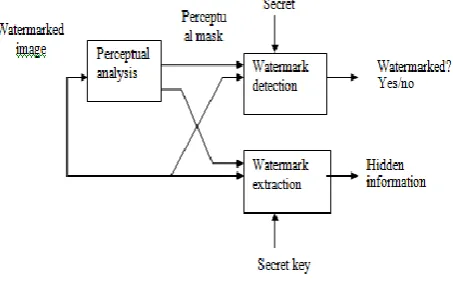
Every watermarking system consists at least of two different parts: watermark embedding unit and watermark detection and extraction unit.
ISSN: 2349-7300
ISO 9001:2008 Certified
International Journal of Innovative Research in Engineering & Multidisciplinary Physical Sciences (IJIRMPS)
Volume 2, Issue 5, October 2014
20
technique is similar to the interleaving used in other applications involving coding, such as compact disc storage, to prevent damage of the information caused by scratches or dust. In our case, the main reason for this spreading is to ensure that the hidden information survives cropping of the image. Moreover, the way this spreading is performed depends on the secret key, so it is difficult to recover the hidden information if one is not in possession of this key. In fact, a similar technique is used in spread spectrum systems (more precisely, in Code-Division Multiple Access) to extract the desired information from noise or other users. Additional key- dependent uncertainty can be introduced in pixel amplitudes (recall that the perceptual mask imposes only an upper limit). Finally, watermark is added to the original image.
Fig 1: Watermark embedding unit
IV. WATERMARKING TECHNIQUES
There are different techniques by which watermarking can be done. Each of these has their merits and demerits.
Choice of Watermark-Object: Embedded messages in watermarking or steganographic systems are generally text strings, allowing an image directly carry information such as author, title ,date etc.,, By compressing the watermark-object before insertion, robustness suffers. Due to the nature of ASCII codes, a single bit error due to an attack can entirely change the meaning of that character, and thus the message. It would be quite easy for even a simple task such as JPEG compression to reduce a copyright string to a random collection of characters. Rather than characters, why not embed the information in an already highly redundant form, such as a raster image? Not only do images lend themselves to image watermarking applications, but the properties of the HVS can easily be exploited in recognition of a degraded watermark.
Fig 2: Ideal Watermark-Object vs. Object with 25% Additive Gaussian
A. DISCRETE WAVELET PACKET TRANSFORM
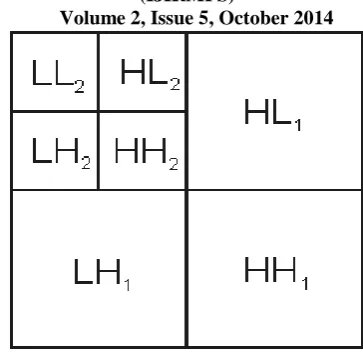
It is simply an extension to DWT which provides multi resolution. It can be achieved by increasing level of decomposition in dwt domain. Wavelets are powerful tool in image processing used extensively for image compression .the 2d wavelet transform is used to represent image in various resolutions. The image is decomposed into four bands LL, LH, HL, HH which give description of the image in these resolutions.
ISSN: 2349-7300
ISO 9001:2008 Certified
International Journal of Innovative Research in Engineering & Multidisciplinary Physical Sciences (IJIRMPS)
Volume 2, Issue 5, October 2014
21
Fig 3: 2-Scale 2-Dimensional Discrete Wavelet Transform
One of the many advantages over the wavelet transform is that that it is believed to more accurately model aspects of the HVS as compared to the FFT or DCT. This allows us to use higher energy watermarks in regions that the HVS is known to be less sensitive to, such as the high resolution detail bands {LH, HL, and HH). Embedding watermarks in these regions allow us to increase the robustness of our watermark, at little to no additional impact on image quality
V. PROPOSED ALGORITHM FOR DWPT
The main concept of digital watermark embedding process is shown below in the figure 4. The main concept of watermark embedding process .A watermark, which is random binary string, is embedded into discrete wavelet domain by using the discrete wavelet packet transform (DWPT) during the embedding process.
Fig 4. Watermark Embedding Procedure
ISSN: 2349-7300
ISO 9001:2008 Certified
International Journal of Innovative Research in Engineering & Multidisciplinary Physical Sciences (IJIRMPS)
Volume 2, Issue 5, October 2014
22
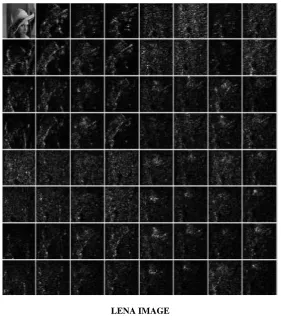
Discrete wavelet packet transform (DWPT) is applied. A fully wavelet packet structure, same as shown in Figure 4, is used in our proposed method. A m scale, full wavelet packet decomposition is applied thus 2 ^2m blocks appear during the embedding process.
The largest absolute value of coefficients will be selected. The amount of the selected coefficients is according to the row size of the selected blocks. In our method, one row of largest absolute value of coefficients will be selected. One block embeds one watermark bit. In this case, all m-level horizontal blocks are selected. The coefficients, which are embedded watermark bits, are selected among these blocks by using the quantization parameter Δ.
Each of the selected coefficients c will be divided by Δ. The equation is as follows:
Q(c)=
...
6
,
4
,
2
,
0
...
5
,
3
,
1
,
1
k
k
k
k
k
c
if
k
k
k
k
k
c
if
Compare each watermark bit m W with Q(c) of each selected coefficients in the corresponding block. If Q(c) = Wm, the coefficient c remains unchanged. If Q(c) ≠ Wm, the coefficient c = c + Δ.
Inverse discrete wavelet packet transform (IDWPT) is applied after all watermark bits are embedded. Finally, a watermarked image appears.
LENA IMAGE
Fig 5. Fully wavelet packet structure for 3 level decomposition
ISSN: 2349-7300
ISO 9001:2008 Certified
International Journal of Innovative Research in Engineering & Multidisciplinary Physical Sciences (IJIRMPS)
Volume 2, Issue 5, October 2014
23
COVER IMAGE WATERMARK SIZE: 512X512 SIZE: 32X32
EMBEDDED IMAGE EXTRACTED WATERMARK
Nc=1
GAUSSIAN NOISE EXTRACTED WATERMARK
ISSN: 2349-7300
ISO 9001:2008 Certified
International Journal of Innovative Research in Engineering & Multidisciplinary Physical Sciences (IJIRMPS)
Volume 2, Issue 5, October 2014
24
SALT & PEPPER NOISE EXTRACTED WATERMARK
NOISE DENSITY=0.01 PSNR=31.228 NC=0.8605
POISSON NOISE EXTRACTED WATERMARK
PSNR=26.21 NC=0.7372
SPECKLE NOISE EXTRACTED WATERMARK
ISSN: 2349-7300
ISO 9001:2008 Certified
International Journal of Innovative Research in Engineering & Multidisciplinary Physical Sciences (IJIRMPS)
Volume 2, Issue 5, October 2014
25
JPEG COMPRESSION EXTRACTED WATERMARK
PSNR=31.6079 NC=0.6572
VII. CONCLUSIONS
A blind digital image watermarking scheme, which embeds watermark in the wavelet domain of an image by using the discrete wavelet packet transform (DWPT) and quantization of the selected dominant coefficients, was proposed in this paper. In addition to this, blind detection of the watermark is applied in this method. It saves the time and space for transferring the original image and saving the original image, respectively. The results of experiments show that the proposed method is very robust against JPEG compression and Gaussian noise. The
algorithm is user-defined. It needs a large number of experiments to decide a proper value. Moreover, the capacity, which is an important part of digital watermarking, will also be developed in our future work.
REFERENCES
[1] Evelyn Brannock, Michael Weeks, Robert Harrison, Computer Science Department Georgia State University “Watermarking with Wavelets: Simplicity Leads to Robustness”, Southeast on, IEEE, pages 587 – 592, 3-6 April 2008.
[2] Baisa L. Gunjal, “Wavelet Based Color Image Watermarking Scheme Giving High Robustness and Exact Correlation”, ISSN 2248-9592, vol. I No. 1, 2011.
[3] D.S. Xiang, G.L.Yang, YS.Xiong, “Survey of Digital Watermarking," Computer Engineering and Design vol 2, pp.326-328, 2005.
[4] J. R. Kim, and Y. S. Moon, “A robust wavelet-based digital watermarking using level-adaptive thresholding,” in IEEE Proc. Int. Conf. Image Processing, Japan, 1999, pp. 226-230.
[5] G. Bouridane. A, M. K. Ibrahim, Digital Image Watermarking Using Balanced Multi wavelets, IEEE Transaction on Signal Processing 54(4), (2006), pp. 1519-1536.
[6] A. Bors and I. Pitas, Image watermarking using DCT domain constraints in Proc. IEEE. Int. Conf. Image Processing, Lausanne, Switzerland, Sept. 1996, pp. 231-234.
[7] KX. Yi, l Y Shi, X Sun, "Digital Water markinging Techniques an Introductory Review," Journal of Image and Graphics, vol. 6(A), pp.III-I17, 2001.
[8] F. Y. Shih and S. Y. T. Wu, Combinational image watermarking in the spatial and frequency domains, Pattern Recognition, vol. 36, no. 4, pp. 969975, 2002.
[9] W. Fu, YF. Li, lH. Sun. "An Algorithm of Digital Watermarkinging Based on Discrete Wavelet Transform," Natural Science Journal of Xiangtan University, vol. 33,pp. 104-107,2011.
[10]P. B. Khatkale, K. P. Jadhav and M.V. Khasne, “Digital Watermarking Technique for Authentication of Color Image”, International Journal of Emerging Technology and Advanced Engineering, ISSN 2250-2459, vol. 2, Issue 7, July 2012.
ISSN: 2349-7300
ISO 9001:2008 Certified
International Journal of Innovative Research in Engineering & Multidisciplinary Physical Sciences (IJIRMPS)
Volume 2, Issue 5, October 2014
26