Introduction
Platelets are anuclear cellular elements of the blood which are primarily involved in hemostasis. Platelet functions include adhesion, secretion of factors implicated in
aggrega-tion and vascular tone modificaaggrega-tions, thrombus formaaggrega-tion and, finally, uptake of serotonin and aminoacids from plas-ma. The principal products secreted from platelets are adenosine nucleotide, serotonin (stored in the dense bodies), β-thromboglobulin and platelet factor 4 (contained in the α -granules). These products, together with thromboxane A2,
Platelets in migraine
P. Sarchielli () •V. Gallai
Department of Neuroscience, University of Perugia, Policlinico Monteluce,
Via E. Dal Pozzo, I-06126 Perugia, Italy e-mail: [email protected] Tel.: +39-075-573871 Fax: +39-075-5783583
Paola Sarchielli Virgilio Gallai
Abstract Modification in platelet activation and aggregation has been demonstrated in migraine patients both during and between attacks. A different pattern in the secretion of platelet products has also been observed in patients affected by migraine compared with controls. The most important variation con-cerns a hyposecretion of dense body products. Platelets share structural and functional analogies with monoaminergic neurons, in particu-lar serotoninergic neurons, and have been used as a peripheral model to study monaminergic function in migraine patients. A reduced turno-ver of serotonin has been shown in migraine patients in the interictal period, whereas a reduced content of this monoamine was detected in patients with chronic daily headache (CDH), particularly in those with analgesic abuse. Nitric oxide meta-bolism was also studied in platelets of migraine patients between and during attacks. An increased activity of nitric oxide synthase (NOS),
which was more accentuated during attacks, was found in these patients compared to healthy individuals. The increase in platelet NOS activity was also confirmed in CDH patients in association with a reduction of sero-tonin content and increased calcium levels. Variations in aggregation to different agents and secretion may not, at the moment, be indicative of similar changes in cerebral circula-tion of migraine patients. Its occur-rence should be confirmed in sam-ples of jugular venous blood during attacks to establish a definite link with migraine pathogenesis. Moreover changes in serotonin and NO metabolism observed in platelets of migraine patients may only indi-rectly suggest similar modifications in the neuronal pathways involved in inducing and maintaining head pain in migraineurs.
synthesized from arachidonic acid, induce the secondary, irreversible aggregation of platelets which underlies throm-bus formation. These events occur when the vessel wall is damaged, also in the cerebral circulation. One of the first pathogenetic hypotheses formulated for migraine stated that an alteration of platelet function contributed to vascular changes observed during attacks. These changes can also be investigated in the peripheral blood and involve some aspects of platelet function, such as reactivity and aggrega-bility to stimulating agents, secretion from dense bodies and α-granules, as well as microaggregate formation.
Platelet activation and aggregation in migraine
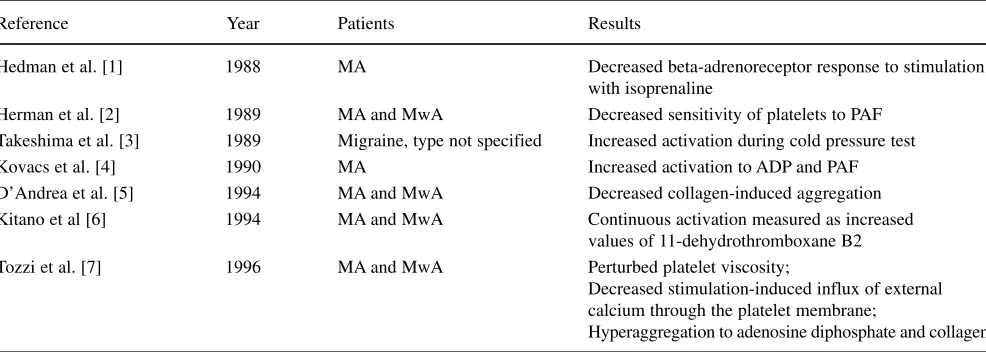
Although certain alterations in platelet function and secre-tion have been found in migraine patients, their role in the pathogenetic events of a migraine attack remains to be established. The extreme discrepancies among data in this regard should be mentioned. It is mandatory, more than in other cellular models, to define the variability of the tests used in the experimental setting. Some of the main findings on platelet activation and aggregation between attacks are reported in Table 1 [1–7].
Platelet function is influenced by several factors, such as age, sex and stress; stress in particular is believed to be a precipitating factor of migraine attacks. Biochemical modi-fications found during stressful conditions, such as the increase in catecholamines and free fatty acids in blood, may in fact trigger the activation of platelets.
Taking these considerations into account, the most con-stant finding in migraine which is more evident during attacks is the increased aggregability of platelets, both
spon-taneously and subsequent to stimulation by aggregating agents, such as epinephrine, adenosine diphosphate and thrombin. Accordingly, drugs which reduce platelet aggre-gability, in particular non-steroidal anti-inflammatory drugs, 5HT2antagonists and beta-blockers, have been proposed for migraine prophylaxis.
However, a recent study by Joseph [8] using impeden-tiometry on whole blood, which more faithfully explores platelet function in vivo, did not show significant variations in migraine patients outside attacks. The same author used the combined results of different tests exploring platelet function (e.g. adhesion, aggregation, secretion, plasma thromboxane levels and circulating microaggregates) to investigate the role of platelets during attacks. He found an increase in the index of platelet function only at the end of attacks, and challenged the hypothesis of platelet interven-tion as a primum movensof migraine attack [8].
Monamine metabolism in migraine: focus on serotonin
Platelets are structurally and functionally similar to monoaminergic neurons, in particular serotoninergic neurons. The two cell types have a common ectodermic origin. They use Ca2+, intracellular phosphoinositol and prostaglandin pathways for secretion. They bind 5-hydroxytryptamine (5HT2) and imipramine, and metabolize serotonin in a similar manner.
The majority of blood serotonin is localized in platelet dense bodies and is released from platelets after activation. There is a reduced turnover of this monoamine between attacks while it is released during migraine crises. The latter finding was supported by early studies which demonstrated
Table 1Aggregation and activation of platelets from migraine patients, during headache-free periods
Reference Year Patients Results
Hedman et al. [1] 1988 MA Decreased beta-adrenoreceptor response to stimulation with isoprenaline
Herman et al. [2] 1989 MA and MwA Decreased sensitivity of platelets to PAF Takeshima et al. [3] 1989 Migraine, type not specified Increased activation during cold pressure test Kovacs et al. [4] 1990 MA Increased activation to ADP and PAF D’Andrea et al. [5] 1994 MA and MwA Decreased collagen-induced aggregation Kitano et al [6] 1994 MA and MwA Continuous activation measured as increased
values of 11-dehydrothromboxane B2 Tozzi et al. [7] 1996 MA and MwA Perturbed platelet viscosity;
Decreased stimulation-induced influx of external calcium through the platelet membrane;
Hyperaggregation to adenosine diphosphate and collagen
a reduced platelet content of serotonin that was attributed to an unidentified plasma releasing factor. The principal data on serotonin metabolism in migraine outside the attacks are summarized in Table 2 [9–17].
Differences in platelet serotonin content have been observed between migraine with aura and migraine without aura patients assessed between attacks [15]. Changes in serotonin content were also noticed in women with men-strual migraine, in relation to the cyclic hormonal variations. In these women, platelet serotonin levels peaked in the fol-licular period and decreased in the luteal phase, when 5HIAA values were particularly increased [16, 17]. These data suggest an aberration in menstrual cycle-related changes of serotonin in women migraineurs, possibly due to increased catabolism or reduced synthesis which predispos-es thpredispos-ese patients to migraine attacks.
The decreased secretion from platelet dense bodies in migraine was suggested by the finding of higher norepi-nephine content [18]. This observation, together with adeno-sine triphosphate (ATP) hyposecretion, is evidence of sym-pathetic hypofunction in migraine.
The defective turnover of platelet serotonin between attacks may reflect a hyposerotoninergic status at the central level. This hyposertoninergic status is more accentuated in chronic daily headache, in particular when associated with analgesic abuse, as demonstrated by several recent studies [19–21].
Alterations in serotonin metabolism and turnover are reflected by the different patterns of expression of 5HT2 receptors. In migraine patients, particularly in those with aura, a down-regulation of these receptors was observed even in headache-free period, whereas in transformed migraine the most relevant finding was an up-regulation of the same receptors. These observations support the hypoth-esis of a derangement of the serotonin system related to the chonicization of headache in these patients [22, 23].
Other neurotransmitters in platelets of migraine patients
Variations in the levels of other neurotransmitters in platelets of migraine patients have also been observed. The most suggestive finding is the higher values of glutamate in platelets of migraine patients compared with controls, impli-cating an analogous alteration in the central nervous system. Increased platelet glutamate may underlie the NMDA-medi-ated events hypothesized to be involved in the aura patho-genesis [24, 25].
Elevated values of substance P were found in platelets of migraine patients during attacks, as were reduced lev-els of 5-HT; a negative correlation between the two neu-rotransmitters was noted. In migraine patients an uptake of substance P, released by trigeminal nerves, may explain
Table 2Serotonin metabolism in platelets from migraine subjects, during headache-free periods
Authors Year Patients Results
D’Andrea et al. [9] 1987 MA and MwA Decreased 5HT turnover
D’Andrea et al. [10] 1989 MA Increase in the content of serotonin, not evident in MA Decrease in 5-HIAA (also in MwA)
D’Andrea et al. [11] 1989 MA and MwA High NE levels and low 5-HT/NE ratio in platelets of patients with MwA; High 5-HT levels and high 5HT/NE ratio in platelet of patients with MA
Joseph et al. [12], 1989 Migraine patients Increased number of dense bodies; Altered coupling of (migraine form is 5HT secretion from dense bodies and ionised calcium; not specified) Decreased serotonin secretion
Riddle et al. [13] 1989 MA and MwA Increase in the number of dense bodies Joseph et al. [14] 1989 MA and MwA Abnormal sensitivity to PAF
D’Andrea et al. [15] 1994 MA Increased basal platelet 5HT and increased 5HT secretion induced by both collagen and PAF (not evident in MwA)
D’Andrea et al. [16] 1995 MM, TTH and controls Plasma and platelet 5HT peak in MM in ovulatory phase; 5HT peak evident in follicular phase in TTH and controls
Fioroni et al. [17] 1996 MM Reduced 5HT and increased 5HIAA in luteal phase, suggesting a greater susceptibility to attacks in this period
the increase of this neuropeptide in platelets. Substance P may contribute to trigger attacks by releasing 5-HT by platelets [26].
Another suggestive finding in migraine was the increased metenkephalin secretion from platelets during attacks, which has been interpreted as a compensatory mechanism antagonizing the serotonin release from platelets occurring ictally [27].
Platelets as a model for the study of NO metabolism
Platelets possess a constitutive form of nitric oxide synthase (NOS) which intervenes in the formation of NO from L -argi-nine [28]. The most specific agent able to activate NOS in platelets is collagen [29].
Our group found an increase in platelet NOS activity, both basal and collagen-stimulated, in migraine patients assessed between attacks [30]. This was accompanied by a significant rise in the intracellular messenger cyclic guano-sine monophosphate (cGMP) [30]. This increase may account for some alterations in platelet function observed in migraineurs, such as the increase in platelet content of
L-arginine and the reduced responsiveness to collagen; the latter finding was first shown by D’Andrea et al. [5] and later confirmed by our group [4, 30]. A recent study in migraine patients confirmed the activation of NOS in platelets, especially during attacks, by demonstrating increased NO end-products compared with headache-free period [31].
The significance of the previously described changes to migraine pathogenesis remains to be established. The increase in NO formation may represent a mechanism to compensate for the aggregation induced by unknown fac-tors, and therefore may be a short-acting feedback mecha-nism in peripheral and also cerebral circulation. On the other hand, the increase in NO synthase activity of platelets, which is present also in headache-free periods, could reflect a more generalized increase in NO synthesis, as suggested by Olesen et al. [32], who considered this messenger the “key molecule” of migraine.
Our group also found an increased activity in the L -argi-nine/NO pathway in the late luteal phase in women with menstrual migraine. This increase, together with neurotrans-mitter modifications and hormonal changes, may account for the greater susceptibility to attacks in the perimenstrual period [33].
The significant increase in NOS activity in patients with chronic daily headache, associated with reduced serotonin levels, suggests the failure of this pathway to antagonize the increase in cytosolic calcium [21]. This leads to the deple-tion of serotonin in the platelet dense bodies.
Considering platelets as a peripheral model of serotonin-ergic neurons, an analogous depletion at the central level may contribute to maintain attacks and lead to the chroni-cization of head pain [34]. As stated before, serotoninergic hypofunction could be accentuated by analgesic abuse.
Platelet enzymes in migraine
The first research carried out in platelets concerned the enzymes monoamine oxidase (MAO), present in platelets mainly in the B isoform which uses tyramine and tryptamine as substrates, and the enzyme phenol sulphatase, whose sub-strate is unknown. These studies found an altered activity of both enzymes, particularly in patients who reported certain foods as trigger factors [35–39].
The alteration of MAO-B activity in platelets was report-ed particularly during migraine attacks, and was more accentuated in women with migraine related to menstrual cycle; this change is not specific for migraine as it was also found in patients with tension-type headache [16].
An analogous alteration in the activity of phenolsulpho-transferase has been hypothesized to promote the absorption of toxic substances by intestinal tract and to trigger migraine attacks, at least in a subgroup of migraine patients [37, 38].
A defect of superoxide dismutase has also been observed in migraine [40] and suggests that patients with migraine (with or without aura) are vulnerable to oxidative stress. The role of the impairment of this radical-scavenging enzyme remains to be established [40].
Secretion products from platelets in migraine
Studies on the secretion products of platelets from migraine patients have given contrasting results. One showed an increased platelet adenosine content compared with control subjects, in agreement with the finding of a reduced adeno-sine release from dense bodies accompanied by the activa-tion of A2 receptors [41]. The inhibited adenosine release may participate in the rapid elimination of serotonin in migraine sufferers [41]. An increase in β-thromboglobulin, a 35 000 dalton protein, released from α-granules as a conse-quence of platelet activation has also been observed during migraine [15]. This increased secretion was accompanied by a similar increase in thromboxan and prostacyclin, evidence of a more generalized platelet activation [42].
References
1. Hedman C, Winther K, Knudsen JB (1988) Platelet function in classic migraine during attack-free periods. Acta Neurol Scand 78(4):271–277 2. Herman F, Magyar K, Kovacs K, Filep
J (1989) Decreased sensitivity of platelets to platelet-activating factor in migraine patients during the headache-free interval. Thromb Haemost 62(2):818
3. Takeshima T, Takao Y, Urakami K, Nishikawa S, Takahashi S (1989) Muscle contraction headache and migraine. Platelet activation and plas-ma norepinephrine during the cold pressor test. Cephalalgia 9(1):7–13 4. Kovacs K, Herman F, Filep J,
Jelencsik I, Magyar K, Csanda E (1990) Platelet aggregation of migraineurs during and between attacks. Cephalalgia 10(4):161–165 5. D’Andrea G, Cananzi AR, Perini F,
Alecci M, Zamberlan F, Hasselmark L, Welch KM (1994) Decreased collagen-induced platelet aggregation and increased platelet arginine levels in migraine: a possible link with the NO pathway. Cephalalgia 14(5):352–356 6. Kitano A, Shimomura T, Takeshima T,
Takahashi K (1994) Increased 11-dihy-drothromboxane B2 in migraine: platelet hyperfunction in patients with migraine during headache-free period. Headache 34(9):515–518
7. Tozzi E, Tozzi-Ciancarelli MG, Di Massimo C, Mascioli A, Angelini R, de Matteis F (1996) Platelet responsiveness in migrainous children during headache-free period. Headache 36(2):95–99 8. Joseph R (1991) The platelet theory of
migraine: a controlled clinical and lab-oratory evaluation. M. Phil. Thesis, Faculty of Medicine, University of London, London
9. D’Andrea G, Welch KM, Grunfeld S, Levine SR, Nagel-Leiby S, Joseph R (1987) Reduced platelet turnover of serotonin in diet restricted migraine patients. Cephalalgia 7[Suppl 6]:141–143
10. D’Andrea G, Welch KM, Riddle JM, Grunfeld S, Joseph R (1989) Platelet serotonin and ultrastructure in migraine. Arch Neurol 46(11):1187–1189
11. D’Andrea G, Welch KM, Grunfeld S, Joseph R, Nagel-Leiby S (1989) Platelet norepinephrine and serotonin balance in migraine. Headache 29(10):657–659
12. Joseph R, Welch KM, D’Andrea G (1989) Serotoninergic hypofunction in migraine: a synthesis of evidence based on platelet dense body dysfunc-tion. Cephalalgia 9(4):293-299
13. Riddle JM, D’Andrea G, Welch KM, Joseph R, McElroy HH, Grunfeld S, Christopherson TG (1989) Platelet activation and analysis of organelles in migraineurs. Headache 29(1):28–33 14. Joseph R, Welch KM, Grunfeld S,
Oster SB, D’Andrea G (1988) Cytosolic ionized calcium homeostasis in platelets: an abnormal sensitivity to PAF-activation in migraine. Headache 28(6):396–402
15. D’Andrea G, Hasselmark L, Alecci M, Cananzi A, Perini F, Welch KM (1994) Platelet secretion from dense and alpha-granules in vitro in migraine with or without aura. J Neurol Neurosurg Psychiatry 57(5):557–561 16. D’Andrea G, Hasselmark L, Cananzi AR, Alecci, M, Perini F, Zamberlan F, Welch KM (1995) Metabolism and menstrual cycle rhythmicity of sero-tonin in primary headaches. Headache 35(4):216–221
17. Fioroni L, Andrea GD, Alecci M, Cananzi A, Facchinetti F (1996) Platelet serotonin pathway in menstru-al migraine. Cephmenstru-almenstru-algia
16(6):427–430
18. Joseph R, Welch KM, D’Andrea G, Levine SR (1986) ATP hyposecretion from platelet dense bodies - evidence for the purinergic hypothesis and a marker of migraine. Headache 26(8):403–410
reduced PF4 secretion was coupled with an increased basal intraplatelet serotonin concentration and secretion induced by collagen, suggestive of a different serotonin turnover in this migraine subtype. However a similar trend in PF4 secre-tion induced by PAF was observed in the two migraine forms, but in migraine with aura patients the increased secretion observed was greater than that found in migraine without aura patients, reflecting an abnormal α-granule secretion [15].
Conclusions
Although data on platelets in migraine are contrasting and inconclusive, some important concepts can be derived from studies carried out in this regard. The findings of platelet dysfunctioning, as well as alterations in neurotransmitter content and secretion, all refer to the peripheral circulation.
The alterations detected, in particular those concerning serotonin, are nonetheless suggestive of analogous func-tional abnormalities in central pathways involved in head pain in migraine, given the analogies between platelets and monoaminergic neurons.
Variations in platelet aggregation and secretion to differ-ent agdiffer-ents cannot, at the momdiffer-ent, be assumed as indicative of similar changes in cerebral circulation in migraine. Experimental evidence from the neurogenic inflammation model suggests an activation of platelets, but this finding should be confirmed in samples of jugular blood of migraine patients assessed during attacks.
19. Srikiatkhachorn A, Maneesri S, Govitrapong P, Kasantikul V (1998) Derangement of serotonin system in migrainous patients with analgesic abuse headache: clues from platelets. Headache 38(1):43–49
20. Srikiatkhachorn A, Tarasub N, Govitrapong P (2000) Effect of chronic analgesic exposure on the central sero-tonin system: a possible mechanism of analgesic abuse headache. Headache 40(5):343–350
21. Sarchielli P, Alberti A, Russo S, Codini M, Panico R, Floridi A, Gallai V (1999) Nitric oxide pathway, Ca2+, and serotonin content in platelets from patients suffering from chronic daily headache. Cephalagia 19:810–816 22. Ribeiro CA, Cotrim MD, Morgadinho
MT, Ramos MI, Santos ES, De Macedo TD (1990) Migraine, serum serotonin and platelet 5-HT2 receptors. Cephalalgia 10(5):213–219
23. Srikiatkhachorn A, Govitrapong P, Limthavon C (1994) Up-regulation of 5-HT2 serotonin receptor: a possible mechanism of transformed migraine. Headache 34(1):8–11
24. Cananzi AR, D’Andrea G, Perini F, Zamberlan F, Welch KM (1995) Platelet and plasma levels of glutamate and glutamine in migraine with and without aura. Cephalalgia
15(2):132–135
25. D’Andrea G, Welch KM, Nagel-Leiby S, Grunfeld S, Joseph R (1989) Platelet catecholamines in migraine. Cephalalgia 9(1):3–5
26. Nakano T, Shimomura T, Takahashi K, Ikawa S (1993) Platelet substance P and 5-hydroxytryptamine in migraine and tension-type headache. Headache 33(10):528–532
27. Ferrari MD, Odink J, Frolich M, Tapparelli C, Portielje JE (1989) Release of platelet Met-enkephalin, but not serotonin, in migraine. A platelet response unique to migraine patients? J Neurol Sci 93(1):51–60
28. Radomski MW, Palmer RMJ, Moncada S (1990) L-Arginine/nitric oxide path-way present in human platelets regu-lates aggregation. Proc Natl Acad Sci U S A 87:5193–5197
29. D’Andrea G, Cananzi AR, Perini F, Hasselmark L (1995) Platelet models and their possible usefulness in the study of migraine pathogenesis. Cephalagia 15:265–271 30. Gallai V, Floridi A, Mazzotta G,
Codini M, Tognoloni M, Vulcano MR, Sartori M, Russo S, Alberti A, Michele F, Sarchielli P (1996) L-Arginine/nitric oxide pathway activation in platelets of migraine patients with and without aura. Acta Neurol Scand
94(2):151–160
31. Shimomura T, Murakami F, Kotani K, Ikawa S, Kono S (1999) Platelet nitric oxide metabolites in migraine. Cephalalgia 19(4):218–222 32. Olesen J, Thomsen LL, Iversen HK
(1994) Nitric oxide is a key molecule in migraine and other vascular headaches. Trends Pharmacol Sci 15:149–153
33. Sarchielli P, Tognoloni M, Russo S, Feleppa M, Malà M, Sartori M, Gallai V (1996) Variations in the platelet nitric oxide synthase pathway during the ovarian cycle in females affected by menstrual migraine. Cephalalgia 16:450–458
34. Malmgren R, Hasselmark L (1988) The platelet and the neuron: two cells in focus in migraine. Cephalalgia 8(1):7–24
35. Kovacs K, Jelencsik I, Csanda E, Magyar K (1990) Changes in
monoamine oxidase (MAO) activity in migraine. Acta Physiol Hung
75[Suppl]:181–182
36. Mosnaim AD, Huprikar S, Wolf ME, Diamond S (1990) Platelet monoamine oxidase activity in female migraine patients. Headache 30(8):488–490 37. Caramona MM, Cotrim MD, Ribeiro
CF, Macedo T (1990) Monoamine oxi-dase activity in blood platelets of migraine patients. J Neural Transm Suppl 32:161–164
38. Launay JM, Soliman H, Pradalier A, Dry J, Dreux C (1988) Platelet phenol sulfotransferase activities: a migraine marker? Theraphie 43(4):273–27 (in French)
39. Marazziti D, Bonuccelli U, Nuti A, Toni C, Pedri S, Palego L, Pavese N, Lucetti C, Muratorio A, Cassano GB (1994) Platelet 3H-imipramine binding and sulphotransferase activity in primary headache. Cephalalgia 14(3):210-214 40. Shimomura T, Kowa H, Nakano T,
Kitano A, Marukawa H, Urakami K, Takahashi K (1994) Platelet superoxide dismutase in migraine and tension-type headache. Cephalagia 14(3):215–218 41. Guieu R, Devaux c, Henry H, Bechis
G, Pouget J, Mallet D, Sampieri F, Juin M, Gola R, Rochat H (1998)
Adenosine and migraine. Can J Neurol Sci 25(1):55–58
42. Mezei Z, Kis B, Gecse A, Tajti J, Boda B, Telegdy G, Vecsei L (2000) Platelet arachidonate cascade of migraineurs in the interictal phase. Platelets