RISK MAPPING USING ERM APPROACH
Mochamad Aji Jaya Sakti
1, Noer Azam Achsani
2, Ferry Syarifuddin
31. School of Management and Business, Bogor Agricultural University, Indonesia.
2. Departement of Economics and School of Management and Business, Bogor
Agricultural University, Indonesia. E-mail: [email protected]
3. Senior Economic Researcher, Bank Indonesia Institute, Central Bank of Indonesia.
E-mail: [email protected]
The implementation of online banking in Indonesia is in line with the increasing
of mobile device users who have become a part of people’s lifestyle, hence online
banking offers easiness to access on banking services. This study is to examine risk
mapping on the implementation online banking using ERM approach, including risk
mitigation strategies for identified risks. This research was conducted at XYZ Bank
who has implemented online banking. The results of this study find 55 potential
risks. Some of it identified risks related to bank system security such as vulnerability
to viruses, malware, hacking, also access information by an unauthorized person.
Risk mitigation strategies applied by XYZ Bank is mostly done by managing the risk
because the implementation online banking is still on the development process, and
the Bank remains optimistic with the future prospect of online banking by staying with
government regulations.
Keywords: Risk, Banking, Online Banking, ERM
JEL Classification: D81, G21, O33, Q55
I. INTRODUCTION
Referring to Law Number 10 of 1998 regarding the amendment of Law Number
7 of 1992 concerning banking, the Bank is a business entity that collects funds
from the community and distributes it back to the community in other forms in
order to improve the living standard of the community. One part of the activities,
undertaken by the Bank, is to collect funds from the community and serve the
financial transactions of customers. However, the business activities undertaken
by the Bank cannot be separated from risks both calculated and unpredicted.
Based on the above phenomenon, it is necessary to manage risk in order to
anticipate potential risks in fund management and customer transaction services.
Referring to Bank Indonesia regulation Number 11/25/PBI/2010 amendment of
PBI Number 5/8/PBI/2003 on May 19, 2003, concerning the Application of Risk
Management for Commercial Banks, there are eight types of risks that must be
managed or considered by banks which are the credit risk, market risk, operational
risk, liquidity risk, compliance risk, legal risk, reputation risk, and strategic risk.
The phenomenon of the online banking application, in Indonesia, is in line
with the increase in mobile device users that have become part of people’s life.
The online banking offers an easy access to banking services such as account
opening, transfer, bill payment, or other financial planning. The emergence
of new companies, based on financial technology (fin-tech) in the financial
industry competition where they make technological innovations and products
very quickly, demand the banking industry to make adjustments in the business
processes and infrastructure that were originally processed manually or offline
into the automation process or online with the aim of speeding up services to
customers and surviving within the competition (Bank Indonesia, 2016). This
change in bank services will create good value and customer experience to the
eyes of the customers, and with the improvement of infrastructure can be utilized
as a supporting tool in online banking risk management.
Compared to the conventional banking services, where the customers or
potential customers must approach the Bank to conduct transactions, online
banking services are perceived to be easier and more flexible. Changing the
manual process to digital allows a more flexible process, where customers who
initially have to go to the Bank office, which provides more comfort through the
use of channels that work with the Bank (Eistert et al., 2013). The use of online
banking technology has potential risks that must be managed and considered by
the Bank. Bank Indonesia (BI) and the Financial Services Authority (OJK) acting
as regulators in the financial industry apply some rules regarding online banking
implementation. Some of these rules are as follows:
2) POJK Number 01/POJK.07/2013 on August 6, 2013, regarding Consumer
Financial Services Protection and SE OJK Number 12/SEOJK.07/2014 on
Information Submission in The Framework of Product and/or Financial
Services Marketing aims at Bank to deliver related information on the financial
services used by prospective customers in a transparent manner by explaining
the risks attached to each Bank product to be used by the customer.
The scope of this study covers the risk mapping of online banking application
with the Enterprise Risk Management (ERM) approach. Stages of the process were
undertaken following the eight ERM frameworks which are internal environment,
objective setting, event identification, risk assessment, risk response, control,
information and communication, and monitoring. The reason for using ERM
method in this research is to get a comprehensive picture of the integration process
between the Bank’s business objectives, the risks inherent in the business process,
as well as the risk mitigation strategy chosen to keep the business process running.
The expected output of this online banking risk mapping can be useful for the
Bank in managing the risk of online banking services.
The second part of this paper presents a literature review related to online
banking risks. The third section describes the data and methodology used.
The fourth section presents the results of the discussion on online banking risk
mapping, while the fifth section presents the conclusions of this study.
II. THEORY
2.1. The Linkage between Risks and Online Banking
The concept of online banking technology is not just a switch from an offline system
to an online system, but also provision of both added value and convenience to
the community as well as speed in terms of accessing banking services through
technology. The online banking combines two parts, namely the external part
associated with the customer experience and the internal part associated with
operational processes that are effective and efficient (Eistert et al., 2013).
The use of technology in business processes is closely related to risk. The ease of
accessing digital information and that of connections through mobile devices lead
to growing risks in the use of technology. The balance between risk management
and business processes is important where the use of technology should be an
opportunity for business growth, while failure in risk management will harm the
business (Baldwin & Shiu, 2010).
(Djohanputro, 2008). Risk management also has other objectives such as obtaining
greater effectiveness and efficiency by controlling risk in every company activity
(Darmawi, 2006).
The risk categories that exist in online banking include transaction risk,
compliance risk, reputation risk, and information security risk (Osunmuyiwa,
2013). While the adoption of e-banking will lead to potential operational and
reputation risks (Ndlovu & Sigola, 2013). In addition, the authors argue that the
potential for fraud and information security risk are some of the biggest challenges
in addition to investment costs for e-banking infrastructure that requires a high
cost.
One of the risks that arise from the implementation of online banking is the
information security. A common problem affecting information security is the
lack of a Bank in implementing controls that lead to a loss in terms of privacy,
causing misuse of client confidential information that may affect clients trust in
transactions using e-banking (Omariba, Masese, & Wanyembi, 2012). Customer
knowledge of security in IT is a factor affecting security in internet banking access.
The higher the customer knowledge about information security, the more diligent
they will be in conducting activities through the internet (Zanoon & Gharaibeh,
2013).
2.2. Online banking risk mapping using the Enterprise Risk Management
(ERM) method
Underlying the author’s thinking is that (COSO-ERM, 2004) any organization is
established to generate value for the stakeholders. All of the organizations face
uncertainty and challenges and the function of management is to determine how
much uncertainty is received as a compensation for increasing the value of the firm.
The framework of the ERM presents four-goal categories and eight components
related to corporate entities as the objects of ERM analysis. The four categories
of corporate objectives include strategic, operational, reporting, and compliance.
Meanwhile, the eight components related to the corporate entity include the
internal environment, objective setting, event identification, risk assessment, risk
response, control activities, information and communication, and monitoring - all
of the ERM activities must be monitored and evaluated as the basis of subsequent
development.
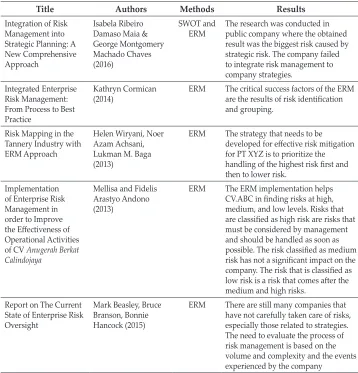
(Cormican, 2014) in his research on “Integrated Enterprise Risk Management:
From Process to Best Practice” stated that the critical success factor of the ERM is
the result of proper identification and risk grouping. This research used primary
data obtained through interview and questionnaire filling. The result of this
research is about the application of ERM, in theory, the practice of which has not
been applied to Industry.
Table 1.
Previous Research Related to Online Banking and ERM
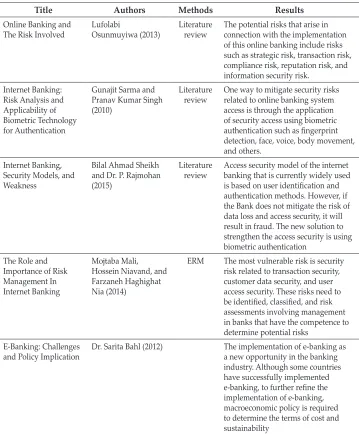
transaction risk, compliance risk, reputation risk, and information security risk.
(Sarma & Singh, 2010) in his journal about “Risk Analysis and Applicability of
Biometric Technology for Authentication”, one of the ways to mitigate risks is to
apply security access using biometric authentication such as fingerprint detection,
face, voice, body movement, and others. This study discusses how risk mitigation
uses biometrics without using the ERM.
(Bahl, 2012) in his paper on “E-Banking: Challenges and Policy Implication”
review the implementation of e-banking as a new opportunity for the banking
industry. Although some countries have successfully implemented e-banking, to
further refine the implementation of e-banking macroeconomic policy is required
to determine the terms of cost and sustainability. Table 1 presents some of the
previous research that has been done regarding the implementation of online
banking and ERM.
Title Authors Methods Results
Integration of Risk Management into
Strategic Planning: A
New Comprehensive Approach
Isabela Ribeiro
Damaso Maia & George Montgomery
Machado Chaves
(2016)
SWOT and
ERM The research was conducted in public company where the obtained result was the biggest risk caused by strategic risk. The company failed to integrate risk management to company strategies.
Integrated Enterprise Risk Management:
From Process to Best Practice
Kathryn Cormican
(2014) ERM The critical success factors of the ERM are the results of risk identification
and grouping.
Risk Mapping in the Tannery Industry with ERM Approach
Helen Wiryani, Noer
Azam Achsani, Lukman M. Baga
(2013)
ERM The strategy that needs to be
developed for effective risk mitigation for PT XYZ is to prioritize the handling of the highest risk first and
then to lower risk. Implementation
of Enterprise Risk Management in order to Improve
the Effectiveness of
Operational Activities of CV Anugerah Berkat Calindojaya
Mellisa and Fidelis Arastyo Andono
(2013)
ERM The ERM implementation helps
CV.ABC in finding risks at high,
medium, and low levels. Risks that
are classified as high risk are risks that
must be considered by management and should be handled as soon as
possible. The risk classified as medium risk has not a significant impact on the company. The risk that is classified as low risk is a risk that comes after the
medium and high risks. Report on The Current
State of Enterprise Risk Oversight
Mark Beasley, Bruce Branson, Bonnie
Hancock (2015)
ERM There are still many companies that have not carefully taken care of risks, especially those related to strategies. The need to evaluate the process of risk management is based on the
Table 1.
Previous Research Related to Online Banking and ERM - Continued
Title Authors Methods Results
Online Banking and
The Risk Involved Lufolabi Osunmuyiwa (2013) Literature review The potential risks that arise in connection with the implementation of this online banking include risks such as strategic risk, transaction risk, compliance risk, reputation risk, and information security risk.
Internet Banking: Risk Analysis and Applicability of Biometric Technology for Authentication
Gunajit Sarma and Pranav Kumar Singh (2010)
Literature
review One way to mitigate security risks related to online banking system access is through the application of security access using biometric
authentication such as fingerprint
detection, face, voice, body movement, and others.
Internet Banking, Security Models, and
Weakness
Bilal Ahmad Sheikh
and Dr. P. Rajmohan (2015)
Literature
review Access security model of the internet banking that is currently widely used
is based on user identification and authentication methods. However, if
the Bank does not mitigate the risk of data loss and access security, it will result in fraud. The new solution to strengthen the access security is using biometric authentication
The Role and Importance of Risk Management In Internet Banking
Mojtaba Mali,
Hossein Niavand, and Farzaneh Haghighat Nia (2014)
ERM The most vulnerable risk is security risk related to transaction security, customer data security, and user access security. These risks need to
be identified, classified, and risk
assessments involving management in banks that have the competence to determine potential risks
E-Banking: Challenges
and Policy Implication Dr. Sarita Bahl (2012) The implementation of e-banking as a new opportunity in the banking industry. Although some countries have successfully implemented
e-banking, to further refine the
implementation of e-banking, macroeconomic policy is required to determine the terms of cost and sustainability
III. METHODOLOGY
Sampling for primary data was done with a specific purpose (purposive
sampling) i.e. the sample taken with the purpose and certain considerations
addressed to the respondents who will be interviewed in depth. The respondents,
in this study, are internal Bank XYZ who have competency, capacity, and
experience in the field of operational and risk management processes including
risk management division, operational division, and business division. Each
division provided as much as two respondents at the managerial level and two
respondents at the head of unit level. Thus, a total of respondents 12 respondents
was used. The respondents were selected to represent their respective divisions
and directly involved in the creation of operational processes and online banking
risk assessment process at Bank XYZ.
Research stages started from the data collection through the questionnaire
filling which was done by conducting in-depth interviews to obtain information
about the potential risks and risk mitigation that will be done. This research
was conducted by using the descriptive approach in the form of the case study
which was a detailed study (and in-depth related) of the object to be studied. Risk
research carried out through the ERM (Enterprise Risk Management) method
adapts to the ERM framework for obtaining risk mapping of the implementation
of online banking.
IV. RESULTS AND ANALYSIS
The online banking risk mapping, at Bank XYZ, was conducted using the ERM
framework. The stages of the implementation in this research were conducted by
referring to the eight components of ERM, namely internal environment, objective
setting, event identification, risk assessment, risk response, control, information,
and communication, monitoring.
4.1. ERM 1
:
Internal Environment
The implementation of online banking services, at Bank XYZ, is done by focusing
on serving the smartphone user segment. This is in line with the company’s goal
of improving service to customer oriented and utilizing digital technology. Bank
XYZ’s governance is implemented by applying Good Corporate Governance
(GCG) which is to identify and control risk to improve the existing business
process and apply the four eyes principles in which every process is done by dual
control. Every business process, that is executed, must have standardized rules
set forth in the form of policies or procedures and set its periodic evaluation plan.
4.2. ERM 2
:
Objective Setting
XYZ continuously improves the Bank’s operational processes to enhance the
effectiveness and efficiency of work processes and costs, in addition to conducting
periodic evaluations of work processes that have been previously applied. In the
reporting objective provides transparent and accurate reports for both internal
and external parties. This is necessary so that the company can take appropriate
steps for decision making and as accountability to stakeholders. The compliance
objective complies with the regulations set by the government and regulator (BI
and OJK) as well as the rules applicable regionally and internationally to be in line
with the established Bank Business Plan.
4.3. ERM 3:
Event Identification
The risk identification process of the online banking application at Bank XYZ is
based on the deposition of risk categories based on BI and OJK rules covering
credit risk, market risk, operational risk, liquidity risk, compliance risk, legal risk,
reputation risk, and strategic risk. The risk identification process is conducted
through in-depth interviews with those who have competencies in the areas of risk
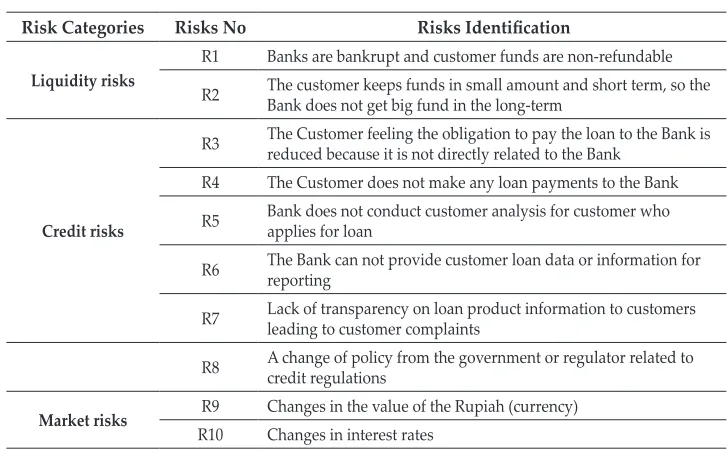
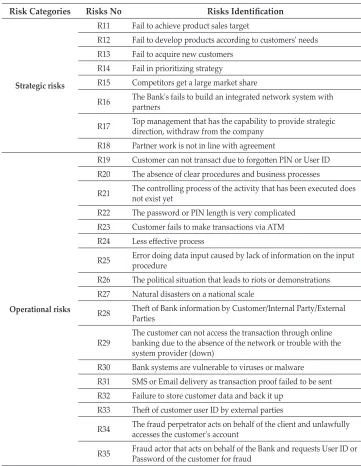
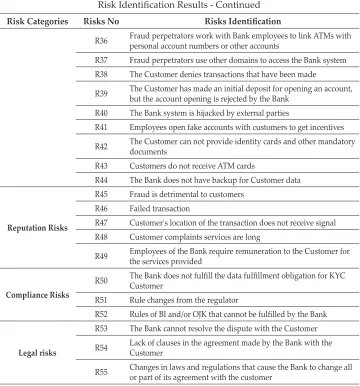
and operational processes. Based on the results of the identification, 55 potential
risks from the implementation of online banking at Bank XYZ were observed.
Table 2 presents potential risk obtained based on the identification results.
Table 2.
Risk Identification Results
Risk Categories Risks No Risks Identification
Liquidity risks
R1 Banks are bankrupt and customer funds are non-refundable
R2 The customer keeps funds in small amount and short term, so the Bank does not get big fund in the long-term
Credit risks
R3 The Customer feeling the obligation to pay the loan to the Bank is reduced because it is not directly related to the Bank
R4 The Customer does not make any loan payments to the Bank
R5 Bank does not conduct customer analysis for customer who applies for loan
R6 The Bank can not provide customer loan data or information for reporting
R7 Lack of transparency on loan product information to customers leading to customer complaints
R8 A change of policy from the government or regulator related to credit regulations
Market risks R9 Changes in the value of the Rupiah (currency)
Table 2.
Risk Identification Results - Continued
Risk Categories Risks No Risks Identification
Strategic risks
R11 Fail to achieve product sales target
R12 Fail to develop products according to customers' needs R13 Fail to acquire new customers
R14 Fail in prioritizing strategy
R15 Competitors get a large market share
R16 The Bank's fails to build an integrated network system with partners
R17 Top management that has the capability to provide strategic direction, withdraw from the company
R18 Partner work is not in line with agreement
Operational risks
R19 Customer can not transact due to forgotten PIN or User ID
R20 The absence of clear procedures and business processes
R21 The controlling process of the activity that has been executed does not exist yet
R22 The password or PIN length is very complicated
R23 Customer fails to make transactions via ATM
R24 Less effective process
R25 Error doing data input caused by lack of information on the input procedure
R26 The political situation that leads to riots or demonstrations R27 Natural disasters on a national scale
R28 Theft of Bank information by Customer/Internal Party/External Parties
R29 The customer can not access the transaction through online banking due to the absence of the network or trouble with the
system provider (down)
R30 Bank systems are vulnerable to viruses or malware R31 SMS or Email delivery as transaction proof failed to be sent R32 Failure to store customer data and back it up
R33 Theft of customer user ID by external parties
R34 The fraud perpetrator acts on behalf of the client and unlawfully accesses the customer's account
Table 2.
Risk Identification Results - Continued
Risk Categories Risks No Risks Identification
R36 Fraud perpetrators work with Bank employees to link ATMs with personal account numbers or other accounts
R37 Fraud perpetrators use other domains to access the Bank system R38 The Customer denies transactions that have been made
R39 The Customer has made an initial deposit for opening an account, but the account opening is rejected by the Bank
R40 The Bank system is hijacked by external parties
R41 Employees open fake accounts with customers to get incentives
R42 The Customer can not provide identity cards and other mandatory documents
R43 Customers do not receive ATM cards
R44 The Bank does not have backup for Customer data
Reputation Risks
R45 Fraud is detrimental to customers
R46 Failed transaction
R47 Customer's location of the transaction does not receive signal
R48 Customer complaints services are long
R49 Employees of the Bank require remuneration to the Customer for the services provided
Compliance Risks
R50 The Bank does not fulfill the data fulfillment obligation for KYC Customer
R51 Rule changes from the regulator
R52 Rules of BI and/or OJK that cannot be fulfilled by the Bank
Legal risks
R53 The Bank cannot resolve the dispute with the Customer
R54 Lack of clauses in the agreement made by the Bank with the Customer
R55 Changes in laws and regulations that cause the Bank to change all or part of its agreement with the customer
Source: Processed Data of Bank XYZ (2016)
4.4. ERM 4:
Risk Assessment
Table 3.
Risk Indicators based on Probability
Table 4.
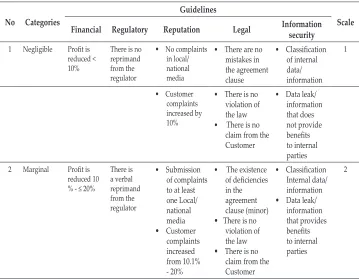
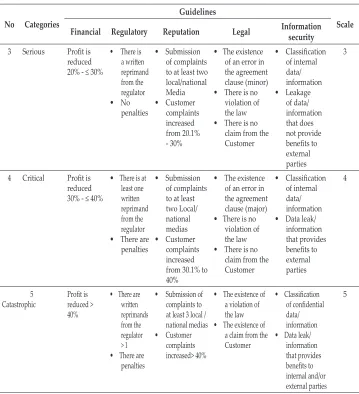
Risk Indicator based on Impacts
The classification of risk categories based on impact is divided into five scales:
neglected, small, medium, large, and very large (Godfrey, 1996). The risk impact
indicators used are sourced from the criteria indicated by Bank XYZ that are
financial, regulatory, reputation, legal, and information security impacts. Each of
these guidelines has its own risk impact weight in accordance with acceptable risk
acceptance by Bank XYZ. Table 4 presents an impact-based risk indicator.
No Categories Guidelines Scale
1 Very low (improbable) ≤ 10 incidences per year 1
2 Low (remote) 11 – ≤ 20 incidences per year 2
3 Medium (occasional) 21 – ≤ 30 incidences per year 3
4 High (probable) 31 – ≤ 40 incidences per year 4 5 Very high (frequent) > 41 incidences per year 5 Source: Processed Data of Bank XYZ (2016)
No Categories
Guidelines
Scale Financial Regulatory Reputation Legal Information security
1 Negligible Profit is
reduced < 10%
There is no reprimand from the regulator
• No complaints
in local/ national media
• There are no mistakes in the agreement clause
• Classification
of internal data/ information
1
• Customer
complaints increased by 10%
• There is no violation of the law
• There is no claim from the Customer
• Data leak/ information that does not provide benefits to internal parties 2 Marginal Profit is
reduced 10
% - ≤ 20%
There is a verbal reprimand from the regulator
• Submission of complaints to at least one Local/ national media
• Customer
complaints increased from 10.1% - 20%
• The existence of deficiencies
in the agreement
clause (minor) • There is no
violation of the law
• There is no
claim from the Customer
• Classification
Internal data/ information
• Data leak/
Table 4.
Risk Indicator based on Impacts - Continued
No Categories
Guidelines
Scale Financial Regulatory Reputation Legal Information security
3 Serious Profit is
reduced
20% - ≤ 30%
• There is a written
reprimand from the regulator
• No
penalties
• Submission
of complaints to at least two local/national Media
• Customer
complaints increased from 20.1% - 30%
• The existence
of an error in the agreement
clause (minor) • There is no
violation of the law
• There is no
claim from the Customer
• Classification
of internal data/ information
• Leakage
of data/ information that does not provide benefits to external parties 3
4 Critical Profit is
reduced
30% - ≤ 40%
• There is at least one
written
reprimand from the regulator
• There are
penalties
• Submission
of complaints to at least two Local/ national medias
• Customer
complaints increased from 30.1% to
40%
• The existence
of an error in the agreement
clause (major) • There is no
violation of the law
• There is no
claim from the Customer
• Classification
of internal data/ information
• Data leak/
information that provides benefits to external parties 4 5
Catastrophic Profit is reduced >
40%
• There are written
reprimands from the regulator > 1
• There are
penalties
• Submission of
complaints to at least 3 local / national medias
• Customer
complaints
increased> 40%
• The existence of
a violation of the law
• The existence of
a claim from the Customer
• Classification of confidential
data/ information
• Data leak/
information that provides benefits to internal and/or external parties 5
Source : Bank XYZ processed Data (2016)
Table 5.
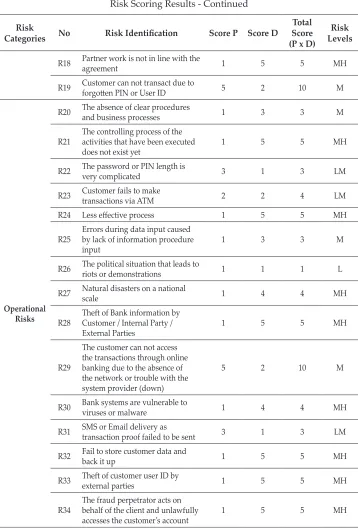
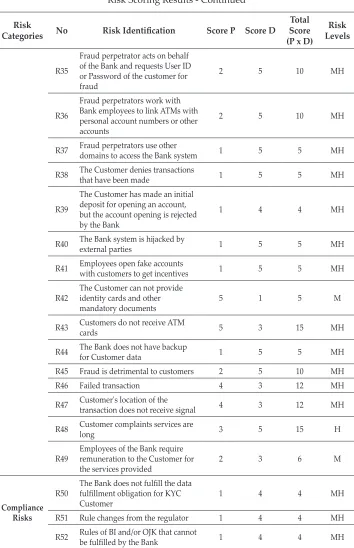
Risk Scoring Results
Risk
Categories No Risk Identification Score P Score D
Total Score (P x D)
Risk Levels
Liquidity Risks
R1 Banks are bankrupt and customer funds are non-refundable 1 5 5 MH
R2
The customer keeps funds in small amount and short term, so the Bank does not get big fund in the long-term
5 2 10 M
Credit Risks
R3
The Customer feeling the obligation to pay the loan to the Bank is reduced because it is not directly related to the Bank
3 2 6 M
R4 The Customer does not make any loan payments to the Bank 5 5 25 H
R5 Bank does not conduct customer analysis for customer who applies
for loan 3 4 12 H
R6 The Bank can not provide customer loan data or information
for reporting 1 4 4 MH
R7 Lack of transparency of loan product information to customers,
leading to customer complaints 2 5 10 MH
R8 Policy changes from government or regulators regarding credit
regulations 1 4 4 MH
Market Risks
R9 Changes in the value of the Rupiah (currency) 3 1 3 LM
R10 Changes in interest rates 1 2 2 LM
Strategic Risks
R11 Fail to achieve product sales target 2 4 8 MH
R12 Fail to develop products according to customers' needs 1 4 4 MH
R13 Fail to acquire new customers 5 4 20 H R14 Fail in prioritizing strategies 1 4 4 MH
R15 Competitors get a large market share 3 4 12 H
R16 The Bank fails to build an integrated network system with
partners 1 2 2 LM
R17
Top management, that has the capability to provide strategic direction, withdraw from the company
Table 5.
Risk Scoring Results - Continued
Risk
Categories No Risk Identification Score P Score D
Total Score (P x D)
Risk Levels
R18 Partner work is not in line with the agreement 1 5 5 MH
R19 Customer can not transact due to forgotten PIN or User ID 5 2 10 M
Operational Risks
R20 The absence of clear procedures and business processes 1 3 3 M
R21 The controlling process of the activities that have been executed
does not exist yet 1 5 5 MH
R22 The password or PIN length is very complicated 3 1 3 LM
R23 Customer fails to make transactions via ATM 2 2 4 LM
R24 Less effective process 1 5 5 MH
R25 Errors during data input caused by lack of information procedure
input 1 3 3 M
R26 The political situation that leads to riots or demonstrations 1 1 1 L
R27 Natural disasters on a national scale 1 4 4 MH
R28 Theft of Bank information by Customer / Internal Party /
External Parties 1 5 5 MH
R29
The customer can not access the transactions through online banking due to the absence of the network or trouble with the
system provider (down)
5 2 10 M
R30 Bank systems are vulnerable to viruses or malware 1 4 4 MH
R31 SMS or Email delivery as transaction proof failed to be sent 3 1 3 LM
R32 Fail to store customer data and back it up 1 5 5 MH
R33 Theft of customer user ID by external parties 1 5 5 MH
R34 The fraud perpetrator acts on behalf of the client and unlawfully
Table 5.
Risk Scoring Results - Continued
Risk
Categories No Risk Identification Score P Score D
Total Score (P x D)
Risk Levels
R35
Fraud perpetrator acts on behalf of the Bank and requests User ID
or Password of the customer for
fraud
2 5 10 MH
R36
Fraud perpetrators work with Bank employees to link ATMs with personal account numbers or other accounts
2 5 10 MH
R37 Fraud perpetrators use other domains to access the Bank system 1 5 5 MH
R38 The Customer denies transactions that have been made 1 5 5 MH
R39
The Customer has made an initial deposit for opening an account, but the account opening is rejected by the Bank
1 4 4 MH
R40 The Bank system is hijacked by external parties 1 5 5 MH
R41 Employees open fake accounts with customers to get incentives 1 5 5 MH
R42 The Customer can not provide identity cards and other
mandatory documents 5 1 5 M
R43 Customers do not receive ATM cards 5 3 15 MH
R44 The Bank does not have backup for Customer data 1 5 5 MH
R45 Fraud is detrimental to customers 2 5 10 MH R46 Failed transaction 4 3 12 MH
R47 Customer's location of the transaction does not receive signal 4 3 12 MH
R48 Customer complaints services are long 3 5 15 H
R49 Employees of the Bank require remuneration to the Customer for
the services provided 2 3 6 M
Compliance Risks
R50 The Bank does not fulfill the data fulfillment obligation for KYC
Customer 1 4 4 MH
R51 Rule changes from the regulator 1 4 4 MH
Table 5.
Risk Scoring Results - Continued
Risk
Categories No Risk Identification Score P Score D
Total Score (P x D)
Risk Levels
Legal Risks
R53 The Bank cannot resolve the dispute with the Customer 1 5 5 MH
R54 Lack of clauses in the agreement made by the Bank with the
Customer 1 4 4 MH
R55
Changes in the laws and regulations that cause the Bank to change all or part of its agreement with the customer
1 5 5 MH
Source: Bank XYZ processed Data (2016)
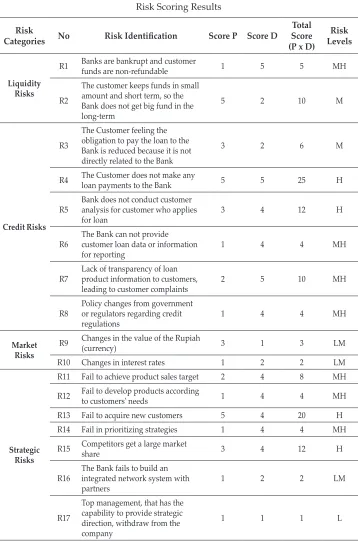
Once the risk score results are obtained, we can proceed to make the risk map
according to the five risk levels. To make the differentiation easier, the five levels of
risk were divided into several colors: High (H) red, Medium to High (MH) orange,
Medium (M) yellow, Low to Medium (LM) dark green, and Low (L) green. Figure
1 represents the results of the risk mapping that has been done.
Figure 1. Results of Risk Mapping prior to Mitigation
Negligble (1) Marginal (2) Serious (3) Critical (4) Catastrophic (5)
Frequent
(5) R42 R2, R19, R29 R43 R13 R4
Probable
(4) R46, R47
Occasional
(3) R9, R22, R31 R3 R5, R15 R48
Remote
(2) R23 R49 R11 R7, R35, R36,R45
Improbable
(1) R17, R26 R10, R16 R20, R25
R6, R8, R12, R14, R27, R30, R39, R50, R51, R52,
R54
R1, R18, R21, R24, R28, R32, R33, R34, R37, R38, R40, R41, R44, R53, R55
Source: Processed data of Bank XYZ (2016)
4.5. ERM 5:
Risk Response
Table 6.
Risk Response to the Identified Risks
level of risk. The main priority of the risk mitigation starts with the High-risk level,
followed by level Medium to High, Medium, Low to Medium, and finally low-risk
level. The risk response to the identified risks, at Bank XYZ, is shown in Table 6.
Risk Category Identified Risks Risk Responses
Liquidity Risks Banks are bankrupt and customer funds
are non-refundable 1. Apply the rules set by BI and OJK, in particular, the implementation of risk management for liquidity risk.
2. Socialize with the customer on the fact that the Bank's fund
is guaranteed by LPS with a maximum amount of 2 Billion
Rupiah per customer. The customer keeps funds in small
amount and short term, so the Bank does not get big fund in the long-term
1. Reward the customers who make deposits in certain nominal and a certain period of time.
2. Provide interest rates above the
average of the competitors.
Credit Risks The Customer feeling the obligation to pay the loan to the Bank is reduced because it is not directly related to the Bank
1. The Bank shall be required the
verification of the customer
upon the submission of the loan through a visit to the customer, by telephone, or other media in
accordance with BI and/or OJK rules related to KYC (know your customer).
2. Mandatory credit agreement on approved loan. Credit agreements may be sent by mail or email. The Customer does not make loan
payments to the Bank The Bank sets out the Client's criteria to be granted such as:
1. Customer's balance for 6
consecutive months amounts to
Rp. 500,000 and above.
2. Make transactions through online
banking each month, at least 5
times.
3. Establish the criteria for customer’s job that is eligible for a loan. Bank does not conduct customer analysis
for customer who applies for loan 1. Banks are required to establish rules or policies regarding credit processes that include credit required documents, credit application process, data
verification, credit limit, credit
Table 6.
Risk Response to the Identified Risks - Continued
Risk Category Identified Risks Risk Responses
2. Banks can collaborate with third parties to conduct credit score analysis process of the customers applying for loans.
The Bank can not provide customer loan
data/information for reporting 1. Fulfill all customer information required under SID rules (debtor information system) in online
banking system
2. Storage is required on server or cloud to store customer's data as the whole process is done online. 3. Set the retention period for
customer data storage. Lack of transparency of loan product
information to customers, leading to customer complaints
1. The Bank provides a special menu on the online banking display that contains product information in
the form of product specifications, costs, and the risks attached to the
product.
2. The existence of disclaimer-specific
pages prior to the submission of credit sent by the customer containing information that the customer has been given
explanation and understand the
product he selected. 3. Banks are required to submit
credit agreements on loans
approved by letter or email from
customers. There is a change of policy from the
government/regulator related to credit regulations.
1. The compliance working unit monitors every published
government, BI and/or OJK.
regulations and reviews the rules 2. Coordinate with work units
related to changes in rules such as business, operational, IT, and other units for action.
Market Risks Changes in the value of Rupiah
(currency) 1. The risk of changes in the value of Rupiah can be ignored because the current online banking implementation uses the Rupiah as currency.
Table 6.
Risk Response to the Identified Risks - Continued
Risk Category Identified Risks Risk Responses
Strategic Risks Fail to achieve product sales target 1. Determine realistic product sales target according to target market segment.
2. Create tools that contain information on the achievement of sales targets for each sale as material evaluation of target achievement.
Fail to develop products according to
customers' needs 1. Analyze the market to determine which market segments to target by utilizing market analytic divisions or using consultant services.
Fail to acquire new customers 1. Conduct promotion through various media, especially social media.
2. Provide promotion by cooperating with store/merchant to offer
discount on the purchase certain product.
Fail in prioritizing strategies 1. Set realistic target priorities to be achieved as directed by management. Target priority is
submitted along with the timeline/
date of its realization.
Competitors get a large market share 1. Provide customer services such as free transaction fee for 50
transactions every month.
2. Offer interest rates above the
average of the competitors. The Bank fails to build an integrated
network system with partners 1. Provides 2 network models namely online mode and offline
mode. So if the online mode of the system is not running, it will be
transferred automatically to offline
mode. Top management that has the capability
to provide strategic direction, withdraw from the company
1. Divide the tasks and responsibilities to some senior management. In addition to providing training to employees who are considered to have good potential.
Partner work is not in line with the
agreement 1. Make a cooperation agreement (MCC) that contains agreement on
Table 6.
Risk Response to the Identified Risks - Continued
Risk Category Identified Risks Risk Responses
Operational Risks Customer can not transact due to
forgotten PIN or User ID 1. Provide the User ID/Password forgot feature on the online banking application and connect it to the email/mobile phone number of the Customer.
The absence of clear procedures and
business processes 1. The working units, connected to the online banking process, work together to coordinate the formulation of policies or procedures to develop the operational processes and control those to be run.
The controlling Process of the activities, that have been executed, does not yet exist
1. Standardize rules in the form of
Policies or SOPs which contains
operational processes that run along with the control process that must be carried out.
Password length/PIN is very complicated 1. Provide PIN / Password reset
feature in the online banking application connected with customer's email/phone number. 2. Use biometric authentication in
the form of fingerprint scanning or
face recognition. Customer fails to make transactions via
ATM 1. Make transaction features, via smartphone, as a key feature in online banking services.
Less effective process 1. Evaluate the process that has been implemented by involving various related units so that more objective input and suggestions can be obtained.
Error in the input data caused by lack of
information in the input procedure 1. Create an input procedure that is poured in the form of user manual document.
2. Specify mandatory fields in accordance with BI and/or OJK
requirements to be adjusted in the online banking system.
Political situation that leads to riot/
demonstration 1. Make transaction features via smartphone as a key feature in online banking services. Natural disasters on a national scale 1. Make transaction features via
Table 6.
Risk Response to the Identified Risks - Continued
Risk Category Identified Risks Risk Responses
2. The security of server/IT devices/ network systems supporting the online banking implementation must be carried out through the
Business Continuity Plan (BCP) to
keep business processes running.
Theft of Bank information by Customer /
Internal Party / External Parties 1. Classify the data into 3 categories which are general, internal, and secret.
2. Restrictions on access to information according to
classification based on positions
and working units.
3. Standardization of the documents
or files naming according to classification.
4. Encrypt if documents or files are
sent via email. The customer can not access the
transaction through online banking due to the absence of the network or trouble
with the system provider (down)
1. Working with providers with a
wide internet network.
2. Provides information to the
Customer through display on the Customer's smartphone in relation to the constraints that are
being experienced, and directing
the Customer to transact through other channels such as ATM. Bank systems are vulnerable to viruses
or malware 1. Periodically update antivirus and firewall.
2. Restrict access to certain web via internet.
3. Restrict access to USB usage on a computer or laptop device. SMS/Email delivery as transaction proof
fails to send 1. Provide proof of transaction notification in online banking
feature in the form of transaction history information for the customer.
Fail to store customer data and back it up 1. The need for storage or special storage in the server or cloud to store Customer data in connection with all customer input data carried out online.
Table 6.
Risk Response to the Identified Risks - Continued
Risk Category Identified Risks Risk Responses Theft of customer user ID by external
parties 1. Include information related to the confidentiality of User ID and
password at the end of the online banking display when opening an account.
2. Set a password change so that the Customer has to change the password every 3 months.
3. Perform a periodical reminder
via SMS or email to the Customer on the need to maintain the
confidentiality of the User ID and
password. The fraud perpetrator acts on behalf of
the client and unlawfully accesses the customer's account
1. Submitting the authentication code
to the Customer's mobile phone for any transactions done by the Customer as a means of verifying the validity of the transaction. The fraud perpetrator acts on behalf of
the Bank and asks the User ID/Password
of the customer for fraud
1. Perform a periodical reminder
via SMS or email to the Customer on the need to maintain the
confidentiality of the User ID and
password.
2. Provide harsh sanctions to
employees who are proven of
committing fraud.
Fraud perpetrators work with Bank employees to link ATMs with personal account numbers or other accounts
1. Apply dual control process
(checker and maker) on the
linking ATM number process with Customer's account.
2. Provide harsh sanctions to
employees who are proven of
committing fraud.
Fraud perpetrators use other domains to
access the Bank system 1. Restricting system access using only the Bank's internal domains. The Customer denies transactions that
have been made 1. Send the authentication code to the Customer's mobile phone for any transactions done by the Customer as a means of verifying the validity of the transaction.
2. The delivery of transaction evidence by email or SMS. The Customer has made an initial deposit
for opening an account, but the account opening is rejected by the Bank
1. Information is provided that the account opening process, made by the Customer, is semi-active and the Customer will be able to use
the account on a regular basis after
Table 6.
Risk Response to the Identified Risks - Continued
Risk Category Identified Risks Risk Responses
2. Require the inclusion of column of account number of destination account for refund in case of account opening decline. 3. Rules are made regarding refund
of customer’s funds and their returning SLA to the Customer.
The Bank system is hijacked by external
parties 1. The IT Security working unit is required to monitor all system and network security used by the Bank such as performing the vulnerability assessment. Such monitoring shall be conducted periodically.
Employees open fake accounts with
customers to get incentives 1. The Bank is required to verify to the Customer upon opening of the proposed account through a visit to the Customer, by telephone, or other media in accordance with BI
and/or OJK rules related to KYC (know your customer).
2. Create a direct integration between the Bank system and the Dukcapil
system (Population and Civil Registry) to verify the customer
data. The Customer can not provide identity
cards and other mandatory documents 1. Create a mandatory document field for the customer so that
account opening cannot be processed further if the document is not provided.
Customers do not receive ATM cards 1. Make a notification to the system
that the customer has not received
yet the ATM card for H + 2 since
the opening of Customer's account was approved by Bank.
The Bank does not have backup for
Customer data 1. A special storage for customer data back up is required in the server or cloud separated from the core storage.
Reputational
Risks Fraud that is detrimental to customers 1. Provide harsh sanctions to employees who are proven of
committing fraud.
Table 6.
Risk Response to the Identified Risks - Continued
Risk Category Identified Risks Risk Responses
Failed transaction 1. Work with providers that have a
wide internet network.
2. Ensure that the infrastructure that supports online banking services runs well.
3. Compulsory rules must be made when receiving complaints from the Customer, such as the Customer is directed to transact through ATM.
Customer's location of the transaction
does not receive signal 1. Work with providers that have a wide internet network.
2. ATM Provides information to
the Customer through display on the Customer's smartphone in relation to the constraints that
are being experienced, and direct
the Customer to transact through other channels such as ATM. Customer complaints services are long 1. Create a special unit that handles
customer complaints.
2. Establish the SLA and inform the customer.
3. Inform the Customer that the complaint service can be reached through the contact center. Employees of the Bank require
remuneration to the Customer for the services provided
1. Provide an appeal to the Client
not to provide any kind of
compensation to Bank officers
through email or SMS media.
2. Provide strict sanctions to Bank officers who are proven to require
remuneration from the Customer.
Compliance Risks The Bank does not accomplish the data
fulfillment obligation for KYC Customer 1. Ensure that the Bank's system meets all Customer's required
information according to KYC (know your customer) rules at the
time of account opening.
2. The KYC process is recommended
to be performed by a third party with due regard to the rules of BI
and/or OJK.
3. The Compliance Work Unit has reviewed the KYC scheme by third
parties.
4. Socialization related to KYC
Table 6.
Risk Response to the Identified Risks - Continued
Risk Category Identified Risks Risk Responses
Rule changes from the regulator 1. The Compliance Work Unit
monitors every published
government, BI and/or OJK
regulations and reviews the rules. 2. Coordinate with work units
related to changes in rules such as business, operational, IT, and other units for action.
Rules of BI and/or OJK that cannot be
fulfilled by the Bank 1. The Compliance Work Unit reviews the rules of BI and/
or OJK and coordinates with
relevant work units regarding business process readiness, system readiness, rule readiness, and other infrastructure required to comply with these rules.
Legal Risks The Bank cannot resolve the dispute with
the Customer 1. List all of the terms of the relationship between the Bank and the Client including the
procedure of settlement in the
event of a dispute. All of which are contained in clauses/agreements and approved by the Customer at the opening of online banking. Lack of clauses in the agreement made by
the Bank with the Customer 1. The Legal Work Unit is obliged to review the entire clause of the agreement and ensure all aspects of the agreement have been met. Changes in laws and regulations that
cause the Bank to change all or part of its agreement with the customer
1. The Legal Work Unit monitors
every change in published legislation and reviews the rules. 2. Coordinate with work units in
relation to changes in rules such as business, operational, IT, and other units for action.
Source: Bank XYZ processed Data (2016)
Figure 2. Results of Risk Mapping Post Mitigation
Negligble (1) Marginal (2) Serious (3) Critical (4) Catastrophic (5)
Frequent
(5) R2, R42 R19, R29, R43
R46, R47
R13, R4
Probable
(4) R5, R15
Occasional
(3) R3, R22, R31
R9, R23
Remote
(2) R49 R11 R7, R35, R36, R45 R48
Improbable
(1) R17, R26, R10, R16 R20
R6, R8, R12, R14, R25, R27, R30, R32,
R33, R34, R37
R1, R18, R21, R24, R28, R38, R39, R50, R51, R52, R54
R40, R41, R44, R53, R55
Sumber: Data Bank XYZ (2016) diolah
Based on the results of risk mapping, after mitigation, it can be seen that there
are five potential risks, that previously included the High-risk level, have turned
into Medium to High-risk level. However, there are also potential risks that have
been mitigated but remain at the same level of risk as before, such as the risk of
partner or third party work not in accordance with the agreement. Based on the
results of the discussions with respondents, this is due to various factors such as
the condition of the partner company experiencing the problem, or the person
responsible in the process of withdrawing from the company who took the risk
despite mitigation but the risk level has not changed. This level of risk is mandatory
for periodic monitoring so that the risk level does not move into higher risk levels.
4.6. ERM 6:
Control Activities
Control measures are taken to minimize losses incurred by risk and ensure the
effectiveness of the responses to risk. Control can be done by Bank XYZ by giving
a clear job description for each employee covering specific responsibilities and
authorities in the work. The strict monitoring of the implementation of procedures
or policies through periodic inspections by the Internal Audit working unit
covering all processes should be undertaken along with periodic evaluations of
all performance executed in order to address issues or problems arising from the
process undertaken which become an important part of the control process.
4.7. ERM 7:
Information and Communication
to activities to be followed up so that the potential risk can be controlled. The
transmission to the related parties can be in the form of a document procedure or
policy or a Cooperation Agreement. In addition, the selection of the communication
methods is also important to ensure that the information is delivered. Internal
communication methods can be internal meetings using meeting minutes, special
portals commonly accessed by employees email. The method of information
transmission should also be easy to understand and adequately explained so that
each employee understands the information submitted.
4.8. ERM 8:
Monitoring
All identified risks must be periodically monitored to keep the risks under
control. The supervision can be done through the monitoring of ongoing activities
or processes or performing separate evaluations or a combination of both. In
addition, there is a need to hold the regular internal meeting to discuss issues
or problems arising from the process undertaken. In conducting the monitoring
activities, each working unit associated with the process, Internal Audit, along with
Risk Management, conducts assessments of various risks, monitors operational
activities, and reports the evaluation results to the senior management.
V. CONCLUSIONS
The potential risks identified in the implementation of online banking services
are reviewed through eight risk categories established by BI and OJK among as
many as 55 potential risks. Strategies applied for effective risk mitigation are more
often done for mitigating identified risks. This is done because the online banking
business is in the process of development, so the Bank is optimistic about the
prospect of online banking business which should still be guided by the rules that
apply.
The results of this study are intended to guide in minimizing the emergence
of risks through periodic risk control that involves working units related to the
online banking process. Furthermore, monitoring, based on the results of customer
complaints data and the internal audit of the process undertaken, can be used as
the basis for improvement and evaluation in order to monitor other risks that may
emerge in the process and were not previously identified.
REFERENCES
Bahl, S. (2012). E-Banking: Challenges & Policy Implications.
Proceedings of
“I-Society 2012” at GKU, 1–12.
Baldwin, A., Shiu, S. (2010). Managing Digital Risk Trends, Issues, and Implications
for Business. (n.d.).
Bank Indonesia. (2016). Financial Technology (FinTech) “Analisa Peluang Indonesia
dalam Era Ekonomi Digital dari Aspek Infrastruktur, Teknologi, SDM, dan
Regulasi Penyelenggara dan Pendukung Jasa Sistem Pembayaran. Temu Ilmiah
Nasional Peneliti 2016 – Kemenkominfo, 1–31
Godfrey. (1996). Control of Risk a Guide to The Systematic Management of Risk
from Construction1.pdf. (n.d.).
Cormican, K. (2014). Integrated Enterprise Risk Management : From Process to
Best Practice. Modern Economy, (April), 401–413.
COSO-ERM. (2004). Enterprise Risk Management — Integrated Framework,
3(September), 1–16. https://doi.org/10.1504/IJISM.2007.013372
Darmawi. (2006). Manajemen Risiko. Edisi ke-10. Jakarta : Bumi Aksara.
Djohanputro, B. (2008). Manajemen Risiko Korporat. Pendidikan dan
Pembinaan Manajemen. Jakarta.
Diversitas, K. I. (2008). Tinjauan pustaka, 5–20.
Eistert, T., Deighton, J., Marcu, S., Gordon, F., & Ullrich, M. (2013). Banking in a Digital
World.
AT Kearney, 23. Retrieved from
http://www.atkearney.de/financial-institutions/ideas-insights/featured-article/ /asset_publisher/4rTTGHNzeaaK/
content/banking-in-a-digital-world
Ndlovu, I., & Sigola, M. (2013). Benefits and Risks of E-Banking: Case of
Commercial Banking In Zimbabwe.
The International Journal Of Engineering
And Science, 2(4), 34–40. Retrieved from http://www.theijes.com/papers/v2-i4/
part. (2)/G0242034040.pdf
Omariba, Z. B., Masese, N. B., & Wanyembi, G. (2012). Security and Privacy of
Electronic Banking. International Journal of Computer Science Issues,
9(4), 432–
446. Retrieved from http://ijcsi.org/papers/IJCSI-9-4-3-432-446.pdf
Osunmuyiwa, O. (2013). Online Banking and the Risks Involved, 5(2), 50–54.
Sarma, G., & Singh, P. K. (2010). Internet Banking : Risk Analysis and Applicability
of Biometric Technology for Authentication. International Journal of Pure and
Applied Sciences and Technology, 1(2), 67–78.
Zanoon, N., & Gharaibeh, N. K. (2013). The Impact of Customer Knowledge on
the Security of E-Banking. International Journal of Computer Science and Security
(IJCSS)
,
7(2), 81–92. Retrieved from http://www.cscjournals.org/library/