Validation of the Persian Version of the Problematic Internet
Use Questionnaire (PIUQ)
HadiRanjbar, MSc1 Andrew Thatcher, PhD2 Michael Greyling, MSc2 Mansour Arab, MSc3 Nahid Nasri, MSc3
1 Critical Care Nursing
Department, Nursing and Midwifery School, Tehran University of Medical Sciences, Tehran, Iran
2 Psychology Department, University of the Witwatersrand, WITS, 2050, South Africa
3 School of Nursing, Kerman University of Medical Sciences, Kerman, Iran
Corresponding author:
Prof. Andrew Thatcher, Psychology Department School of Human & Community Development
University of the Witwatersrand WITS, 2050
South Africa
Tel: +27 11 717 4533 Fax: +27 86 553 4907 Email:
Objective: The most commonly used instrument for the research and treatment of excessive internet use is Young’s Internet Addiction Test (IAT). While the IAT has been translated to several languages (including Persian) and has demonstrated good psychometric properties across several independent studies, there is still a room for alternative assessment instruments. This study reports a validation of the Persian version of the Problematic Internet Use Questionnaire (PIUQ).
Method: A sample (n = 296) from Kerman, Iran was administered the translated Persian version of the PIUQ as well as the Persian version of the University of California, Los Angeles (UCLA) Loneliness scale, Satisfaction With Life scale, and questions related to use of technology and the internet.
Results: Analyses using confirmatory and exploratory factor analyses demonstrated that the Persian version of the PIUQ had good internal reliability and concurrent validity (with loneliness and satisfaction with life), but they also had an alternative factor structure that did not support the original factor structure.
Conclusion: The Persian version of the PIUQ produced adequate psychometric properties (internal reliability and concurrent validity), but care should be taken in the interpretation of the factor structure.
Keywords: Problematic Internet use, Problematic Internet Use Questionnaire (PIUQ), Internet Addiction Test (IAT).
D
espite the many benefits associated withaccessing the internet, evidence from around the world has shown that a considerable number of individuals (albeit still a minority) experience compulsive internet use behaviors more commonly referred to as “Internet Addiction”1 or “Problematic Internet Use”2. The most widely used and validated
assessment instrument for assessing internet
addiction is Young’s3 Internet Addiction Test which has now been translated to several languages. However, there are also several other assessment
instruments available including the Online
Cognitions Scale (OCS) 4 and the Problematic Internet Use Questionnaire (PIUQ) 5. In the initial development of the PIUQ5, the instrument was found to have good internal reliability (α = 0.90) and good concurrent validity (i.e., correlated r = 0.72 with Young’s6 eight criteria for internet addiction and with various measures of time spent online). The exploratory factor analysis of the PIUQ revealed three factors: “Online Preoccupation”, “Adverse
Effects” and “Social Interactions”, with
intercorrelations between these factors ranging from
r = .63 to r = .47. Internet World Stats7 gives the internet penetration rate in Iran as 53% of the population although the official Iranian figures put the penetration rate at a more modest rate of 11.1%8. Two studies have published findings on internet addiction in Iran9 10, on adolescent internet users using a translated Persian version of Young’s3 Internet Addiction Test (independently translated for each study). In an earlier study9, researchers found that internet addiction was predicted by loneliness, recalcitrance, dominance and low self-esteem. In the most recent Iranian study10, internet addiction was predicted by religiosity (i.e., higher religiosity leads to lower internet addiction) and family variables (particularly adolescents who had problems with their parents and the education level of the father). However, neither study reported the psychometric properties of the translated Persian version of Young’s3 Internet Addiction Test. The main goal of the present study was to investigate the psychometric properties of the Persian version of the PIUQ. This study therefore aimed to establish the reliability and factor structure of the PIUQ using exploratory factor analysis and test the existing factor structure of the
original PIUQ using confirmatory factor analysis. Relationships between PIUQ scores and the use of Facebook, Yahoo and mobile telephony were also investigated.
Material and Methods
Participants were sampled from the internet cafes in Kerman, Iran. All participants were volunteers and gave their informed consent to participate. Submitting a completed survey pack was considered as consent to participate. No identifying information was recorded and therefore all participants remained anonymous. A total of 296 participants (age: M = 26.89, SD = 7.49, range 12 to 53 years) responded to the survey (165 women and 128 men) although one participant did not complete the PIUQ. A large proportion (n = 203) were single and had a tertiary level education (n = 225). All participants were administered the Persian version of the PIUQ as well as the Persian version of the UCLA Loneliness Scale11 and the Persian version12 of the Satisfaction with Life scale11. The Persian adaptation of the PIUQ consisted of 20 original items5 translated to Persian using standard translation and back translation procedures. All items of the PIUQ were scored on a 5-point Likert scale (never, rarely, sometimes, often, always) corresponding to scores of 1 to 5. The maximum score is 100 and the minimum score 20. The original PIUQ5 was developed based on a South African sample and had good internal reliability (α = 0.90, with item–total correlations ranging from 0.38 to 0.72) and good concurrent validity (i.e., correlating r = 0.72 with Young’s6 eight criteria for internet addiction and with amount of time spent online per week r = 0.46 and specifically the amount of time spent online per week from 11pm to 8am r = 0.41, and the amount of time spent online per session r = 0.37). The exploratory factor analysis on the
original PIUQ revealed three factors (Online
Preoccupation, Adverse Effects and Social
Interactions) explaining 50% of the variance. Online preoccupation consisted of ten items, each of which referring to the respondents thinking about being online or wanting to spend more time online. Adverse effects consisted of seven items, each of which referring to the negative outcomes that respondents may experience as a result of their online activities. Social interactions consisted of three items referring to using the internet for social interaction activities. The PIUQ uses a diagnostic cut-off score of greater than 70, identical to Young5 cut-off score. It must be noted that this cut-off score has not been independently assessed clinically. Respondents also answered questions on their access to ADSL and the internet through mobile technology, and
their use of Facebook and Yahoo.
Confirmatory Factor Analysis (CFA) was performed with the CALIS procedure of SAS/STAT 12.1 using the Full Information Maximum Likelihood (FIML) estimation which converged satisfactorily. CFA reports a number of fit indexes which can be used to assess
whether the scale gives an absolute fit to the data or a comparative fit to the data. The goodness-of-fit chi-squared test was selected as the absolute fit index despite noting that the chi-square statistic is sensitive to sample size13. For the χ2 test, values closer to zero indicate a better fit. The other fit indexes that were considered were the Root Mean Square Error of Approximation (RMSEA, where values closer to zero indicate better fit), the Goodness of Fit Index (GFI, where values less than 0.90 indicate good fit), the Comparative Fit Index (CFI, where values greater than 0.90 indicate good fit) and the Tucker-Lewis Index (TLI, where values greater than 0.95 indicate a good fit). Akaike’s Information Criterion (AIC) was also calculated. The AIC gives a relative account of which model has the better fit to the data. The actual AIC value is not important, but smaller values indicate better fit. For the exploratory factor analysis (EFA), the number of factors to extract was determined by the scree-plot and Kaiser’s criterion of unity (i.e., Eigen values > 1). Principal component analysis with varimax rotation was used to maximize the amount of variance explained by the instrument items. Finally, t-tests were calculated to explore whether the PIUQ scores had any relationships with gender, Facebook use, Yahoo use, ADSL access and mobile telephony use.
Results
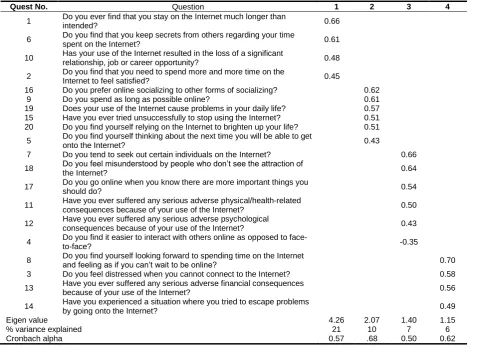
Table 1: Factor loadings for rotated exploratory factor analysis (varimax solution)
Quest No. Question 1 2 3 4
1 Do you ever find that you stay on the Internet much longer than
intended? 0.66 6 Do you find that you keep secrets from others regarding your time
spent on the Internet? 0.61 10 Has your use of the Internet resulted in the loss of a significant
relationship, job or career opportunity? 0.48 2 Do you find that you need to spend more and more time on the
Internet to feel satisfied? 0.45
16 Do you prefer online socializing to other forms of socializing? 0.62 9 Do you spend as long as possible online? 0.61 19 Does your use of the Internet cause problems in your daily life? 0.57 15 Have you ever tried unsuccessfully to stop using the Internet? 0.51 20 Do you find yourself relying on the Internet to brighten up your life? 0.51
5 Do you find yourself thinking about the next time you will be able to get
onto the Internet? 0.43
7 Do you tend to seek out certain individuals on the Internet? 0.66 18 Do you feel misunderstood by people who don’t see the attraction of
the Internet? 0.64 17 Do you go online when you know there are more important things you
should do? 0.54 11 Have you ever suffered any serious adverse physical/health-related
consequences because of your use of the Internet? 0.50 12 Have you ever suffered any serious adverse psychological
consequences because of your use of the Internet? 0.43 4 Do you find it easier to interact with others online as opposed to
face-to-face? -0.35
8 Do you find yourself looking forward to spending time on the Internet and feeling as if you can’t wait to be online? 0.70 3 Do you feel distressed when you cannot connect to the Internet? 0.58 13 Have you ever suffered any serious adverse financial consequences because of your use of the Internet? 0.56 14 Have you experienced a situation where you tried to escape problems
by going onto the Internet? 0.49 Eigen value 4.26 2.07 1.40 1.15 % variance explained 21 10 7 6 Cronbach alpha 0.57 .68 0.50 0.62
Table 2: Fit indices for the competing CFA models
Model χ2 df GFI CFI RMSEA TLI AIC
Original 3-factor model 623.10 167 0.82 0.61 0.1 0.56 18809.36 1-factor model 639.37 170 0.82 0.60 0.1 0.55 18819.72 1-factor model (drop item 17) 639.37 170 0.82 0.60 0.1 0.55 18819.72 4-factor model 541.02 164 0.85 0.68 0.09 0.63 18733.36 4-factor model (drop item 4) 553.01 164 0.85 0.67 0.09 0.61 18745.35
Table 3: Prevalence rates of Internet addiction according to PIUQ scores
Model High risk group Moderate risk group No-risk group
N 9 225 61
% 3.05 76.27 20.68
The average score for the PIUQ was 52.07 (SD = 11.77), with a range between 22 and 76. A total of 3.05% (n =9) of the participants demonstrated significant problems in their internet use following the original
cut-PIUQ5 (Table 3). Of the participants, 76.27%
developing problems related to their use of the internet and 20.68% demonstrated no-risk (PIUQ scores ≤ 39). For concurrent validity, the correlation of the PIUQ with the UCLA Loneliness scale was statistically significant (r = 0.35; p < 0.01). Additionally, the
Discussion
This study found that the Persian version of the PIUQ had good psychometric properties (internal reliability and concurrent validity) for the instrument as a whole. While the CFA did not confirm the original structure of the PIUQ5, this should not be seen as unusual as one would expect factor patterns to differ by sample type (e.g., age) and cultural norms. Indeed, factor analytic studies of the IAT have also found alternate factor structures from UK17, French18, German19 and Italian20 validation studies. The factor structure of the Persian version of the PIUQ suggested that adverse social consequences were less problematic as a consequence of the internet use (probably because internet use led to the establishment of new social relationships outside of the family 8) and that social withdrawal symptoms were more problematic. These are probably the symptomatic of different socio-cultural dynamics within the Iranian context. The lack of a “social interactions” factor was predicted by previous studies in Iran9 and instead the social questions from the original South African version of the PIUQ were evenly distributed across the factors, and two new factors of “Withdrawal Behaviours” and
“Escapism” emerged.
In this study, 3.05% of the participants who demonstrated a high propensity to be internet addicts were similar to the 3.79%9 and 1.1%10 of the internet addicts in other studies of adolescents in Iran using the Internet Addiction Test6. This might be an indication that the two instruments (the Internet Addiction Test and the PIUQ) are measuring Internet addiction in a consistent fashion. The internet addiction rate as determined by the PIUQ (3.05%) was found to be higher than that of the previous studies in Iran10 and slightly lower than another study9 although the sample in this study was, on average, older meaning that disruptions to work, finance and familial relationships might be expected to be more prevalent with more women in the sample. In the other analyses that assessed the concurrent validity of the Persian version of the PIUQ, the significant relationship between internet addiction and loneliness was supported by previous research7 15 that had also found similar statistically significant relationships between these variables. The correlation between the PIUQ and life satisfaction was statistically significant, similar to previous studies16, but the correlation was quite weak. The correlation in the previous study16 was not reported, so it is difficult to make a direct comparison. In any case, the assessment of internet addiction (the
Internet Addiction Test) and life satisfaction
(Multidimensional Students’ Life Satisfaction Scale)
were different from those used in this study.
Internet addiction was more observed in Facebook and Yahoo users. More recent researches on internet addiction 21 22 suggest that online social media websites are more likely to lead to internet addiction symptoms than more general use of the internet (e.g.,
web searching and accessing news and information websites). This study did not specifically look at other potential uses of the internet that have also been shown to be related to internet addiction such as online
gaming, online gambling and online pornography.
There are a number of limitations to this study that are worth mentioning. First, the sample size was relatively small and geographically restricted compared to the internet user population in Iran. It is possible that larger and different sample groups produce different results. Second, given the study design, respondents were all volunteers. The issue of volunteer samples not being representative of the general population is accepted as possibly problematic. Third, the criterion cut-off scores used in this study were based on studies, in which the predictive validity had not been established. One should therefore use extreme caution when diagnosing someone using the PIUQ. The PIUQ may be used as a screening tool but should always be used in conjunction with a clinical interview.
References
1. Young KS, Case CJ. Internet abuse in the workplace: new trends in risk management. Cyberpsychol Behav 2004; 7: 105-111. 2. Shapira NA, Goldsmith TD, Keck PE, Jr.,
Khosla UM , McElroy SL. Psychiatric features of individuals with problematic internet use. J Affect Disord 2000; 57: 267-272.
3. Young K.S. Caught in the Net. New York: John Wiley & Sons; 1998.
4. Davis RA, Flett GL , Besser A. Validation of a new scale for measuring problematic internet use: implications for pre-employment screening. Cyberpsychol Behav 2002; 5: 331-345.
5. Thatcher A, Goolam S. Development and psychometric properties of the Problematic Internet Use Questionnaire. South African Journal of Psychology 2005; 35: 793-809. 6. 6-Young KS. Internet addiction: the
emergence of a new clinical disorder. Toronto, Canada: The 104th Annual Meeting of the American Psychological Association; 1996. 7. Internet World Stats. Internet usage in the
middle East. Retrieved 18 June 2013 from the: http://www.internetworldstats.com/stats5.htm. 2012.
8. Internet Usage Statistics (2010). Tehran: Iranian Statistic Organization. Retrieved 11 March 2013 from the:http://ww.amar.org.ir/Portals/0/Files/abstra ct/1389/n_IT_89.pdf.2010.
9. Ghassemzadeh L, Shahraray M , Moradi A. Prevalence of internet addiction and comparison of internet addicts and non-addicts in Iranian high schools. Cyberpsychol Behav 2008; 11: 731-733.
11. Russell D. UCLA Loneliness Scale (Version 3): reliability, validity, and factor structure. Journal of Personality Assessment 1996; 66: 20-40. 12. Bayani AA, Koocheky AM, Goodarzi H. [The
reliability and validity of satisfaction with life scale (Persian)]. Journal of Iranian Psychologists 2007; 3: 259-265.
13. Diener E, Emmons RA, Larsen RJ, Griffin S. The Satisfaction With Life Scale. J Pers Assess 1985; 49: 71-75.
14. Iacobucci D. Structural equations modelling: fit indices, sample size and advanced topics. Journal of Consumer Psychology 2010; 20: 90-98.
15. Morahan-Martin J, Schumacher P. Incidence and correlates of pathological Internet use among college students. Computers in Human Behavior 2000; 17: 187-195.
16. Cao H, Sun Y, Wan Y, Hao J , Tao F. Problematic Internet use in Chinese adolescents and its relation to psychosomatic symptoms and life satisfaction. BMC Public Health 2011; 11: 802.
17. Widyanto L, McMurran M. The psychometric properties of the internet addiction test. Cyberpsychol Behav 2004; 7: 443-450. 18. Khazaal Y, Billieux J, Thorens G, Khan R,
Louati Y, Scarlatti E, et al. French validation of the internet addiction test. Cyberpsychol Behav 2008; 11: 703-706.
19. Barke A, Nyenhuis N, Kroner-Herwig B. The German version of the internet addiction test: a validation study. Cyberpsychol Behav Soc Netw 2012; 15: 534-542.
20. Ferraro G, Caci B, D'Amico A, Di Blasi M. Internet addiction disorder: an Italian study. Cyberpsychol Behav 2007; 10: 170-175. 21. Wilson K, Fornasier S, White KM.
Psychological predictors of young adults' use of social networking sites. Cyberpsychol Behav Soc Netw 2010; 13: 173-177.