Please cite this article as: B. Kuldeep, K. P. Ravikumar, S. Pradeep, Effect of h-Boron Nitrate on Microstructure and Mechanical Behavior of Al7075 Metal Matrix Composite Producing by Stir Casting Technique, International Journal of Engineering (IJE), IJE TRANSACTIONS A: Basics Vol. 32, No. 7, (July 2019) 1017-1022
International Journal of Engineering
J o u r n a l H o m e p a g e : w w w . i j e . i rEffect of Hexagonal Boron Nitrate on Microstructure and Mechanical Behavior of
Al7075 Metal Matrix Composite Producing by Stir Casting Technique
B. Kuldeep*a, K. P. Ravikumarb, S. Pradeepc
a Department of Mechanical Engineering, Malnad College of Engineering, VTU, India b Department of Automobile Engineering, Malnad College of Engineering, VTU, India c Department of Mechanical Engineering, Rajeev institute of Technology, VTU, India
P A P E R I N F O
Paper history: Received 03 March 2019
Received in revised form 9 March 2019 Accepted 03 May 2019
Keywords:
Metal Matrix Composites Microstructure Wear Stir Casting
A B S T R A C T
Al7075 alloy reinforced with h-Boron Nitrate (BN) composites were processed by stir casting technique. The produced composite was subjected to microstructural studies using OLYMPUS -BX51M, tensile, hardness, density and wear tests. Tensile strength and hardness were found to increase by 12.8% and 20% respectively due to increased dislocation density with the addition of reinforcement. Microstructure showed grain refinement with reinforcement addition and reinforcement acts as nucleating sites with an approximately uniform distribution of reinforcements. Wear test was conducted with different loads 10, 20 and 30N for a sliding distance of 1500 m. Wear mass loss of composites showed improved wear resistance with variation in reinforcements. Worn surfaces were examined using SEM, which showed the presence of delamination, plough and debris on the surface. Due to the addition of low-density h-BN, the density of composites decreases with increase in reinforcement content.
doi: 10.5829/ije.2019.32.07a.15
1. INTRODUCTION1
Aluminium metal matrix composites (AMMCs) are most preferred material in aerospace and automobile sectors owing to their benefits over conventional alloys [1]. In aluminium composites, strength to weight ratio and toughness nature of aluminium are merged with the high strength and hard nature of ceramics [2]. Among various available methods, liquid metallurgy route are more preferred because of cost effectiveness and ease of adoption and simplicity [3]. With few drawbacks like poor wettability, porosity and possible interfacial reaction, stir-casting is popular and low cost method, the problem with wettability can be overcome by heat treatment of reinforcements prior to dispersion in melt, by the addition of alloying elements [4].
Many researchers had attempted to improve the behavior of Al7075 by addition of additives [4]. Baradeshwaran and Perumal [5] studied the effect of
*Corresponding Author’s Email: [email protected] (B. Kuldeep)
alumina and graphite on Al7075 composites and concluded that the mechanical strength increased with addition of reinforcement.
and the attractive properties of BN demands more investigation. Based on the above literature, the present work on h-BN reinforced Al7075 composites were fabricated using stir-casting technique and evaluated the mechanical and wear properties.
2. MATERIAL AND METHODS
2. 1. Materials Al7075 alloy is selected as base metal and the chemical composition is shown in Table 1.
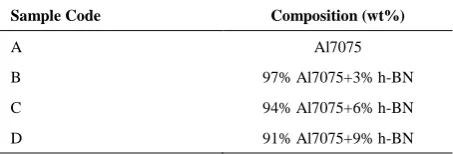
Boron nitride (h-BN) of grain size >150µm is used as reinforcement; it possesses lamellar crystalline structure with excellent lubricious property [11]. h-BN with its low density (2.28 gm/cc), high hardness, good wear resistance and chemical stability makes it a suitable ceramic reinforcement [8]. Different compositions fabricated are given in Table 2.
2. 2. Composite Fabrication Stir-casting technique was employed for composite fabrication (Figure 1). Electric furnace of capacity 7.5 KW is used for melting. Desirable quantity of Al7075 is weighed and placed inside crucible, which was preset to the temperature of 800oC. Corresponding quantity of h-BN is weighed and
pre-heated to 450oC to remove any moisture content
present and also to improve wettability [4] using muffle furnace with PID controller.
After complete melting of Al7075,
hexacholoroethene tablets were immersed in molten metal that acts as degassing agent. To deal with wettability, 1% magnesium (Mg) is added as an alloying element [4]. Coverall was added to decrease the surface tension between matrix and reinforcement and hence to improve wettability. Also coverall helps to control oxidation and absorption of hydrogen gas by continuously forming a layer on top of the melt. To create vortex, the melt is stirred continuously at 400 RPM, using pre-heated [400oC] zirconium coated stirrer and having
TABLE 1. Chemical Composition of Al7075 in Wt%
Element
s Zn
M
g Cu Cr Fe M
n Ti Si Al
wt% 5.
5 2.3 1. 6
0. 2
0. 2 0.2
0. 1
0. 1
Balanc e
TABLE 2. Composition of Composites in Wt%
Sample Code Composition (wt%)
A Al7075
B 97% Al7075+3% h-BN C 94% Al7075+6% h-BN D 91% Al7075+9% h-BN
Figure 1. Casting Setup
two sets of blade in anti-parallel manner. The blades are of 18 mm width and 25 mm breadth and twisted 25o to
shaft axis and immersed to a depth of 2/3 of the melt [4]. While stirring, h-BN is added to the periphery of vortex at a slower rate. Further, the molten metal was poured into pre-heated (350-400oC) mould as shown in Figure.1.
The mould was pre-heated to avoid temperature gradient between mould and molten metal [12].
accuracy 10-3mg to measure the mass of specimen and
Vernier caliper with least count of 0.001 mm was utilized to measure the dimensions of specimen for volume calculation. Theoretical density was found using rule of mixture. The porosity was calculated after finding theoretical and experimental densities. XRD technique was employed to study the phase present in prepared samples.
3. RESULTS AND DISCUSSION
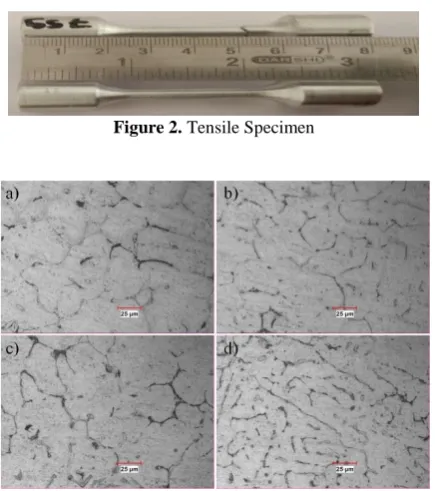
3. 1. Microstructure The microstructure of the samples A, B, C and D are shown in Figure 3. With the addition of reinforcement, the grain size is reduced, as the reinforcement acts as nucleating sites [12]. Reduction in grain size is observed with variation in percentage of reinforcement in Figure. 3. Higher incidence of grain boundary pinning resists grain growth [13] and the h-BN particles resists the grain growth of aluminium. The temperature around the h-BN drops resulting in an under cooling effect, creating more number of nucleation sites ensuing in grain refinement.
Microstructure consists of fine particles distributed partially along the grain boundaries along with pores. At higher percentage of reinforcement more pores are observed comparatively due to introduction of gases during stirring and pouring.
3. 2.Tensile Test The ultimate tensile strength (UTS) of samples are given in Figure 4. The UTS was maximum (154MPa) for the addition of 3% h-BN
Figure 2. Tensile Specimen
Figure 3. Microstructure of different composition a) A, b)
B, c) C and d) D (at 25 µm)
reinforcement. Whereas, for the other two combination (6% and 9% h-BN), UTS decreased gradually but still it is more comparable to base metal alloy. The improvement in UTS is due to transfer of load from Al7075 matrix to the h-BN reinforcement and it is also attributed to grain refinement according to Hall-Petch theory [13]. Thermal mismatch between h-BN and Al7075 matrix has increased the dislocation density and increased the strength of composite [14].
At higher percentage of reinforcement, viscosity of melt increases [15], which caused particle agglomeration and porosity and the tendency of crack initiation and propagation increased. Increased brittleness was observed, due to which the strength decreased (139 MPa) as observed in Figure 4. Also, with increase in reinforcement content the elongation has decreased [8].
3. 3. Hardness Test The hardness increases with the addition of reinforcement as shown in Figure 5. Maximum hardness was observed at 3% of h-BN composition. Reinforcement acts as obstacles, resisting the movement of dislocation [16]. In addition, presence of high-density dislocation accelerates aging kinetics of the composite matrix thereby improving the hardness [17].
Hard h-BN particles lead to dispersion hardening and act as a secondary phase resisting dislocation and harden the composites, similar nature were reported in previous
Figure 4. Variation of UTS for different composition
Figure 5. Variation of Hardness for different composition
0 40 80 120 160 200
A B C D
U
lt
im
at
e T
en
si
le
S
tr
en
gt
h
(
M
P
a)
Composition Code
0 20 40 60 80
A B C D
H
ar
d
n
e
ss
(
B
H
N
)
works [8]. Whereas at higher percentage of reinforcement, due to agglomeration of reinforcement, the hardness suffers for 6% and 9%. But still the hardness of the composite remains higher than the base metal.
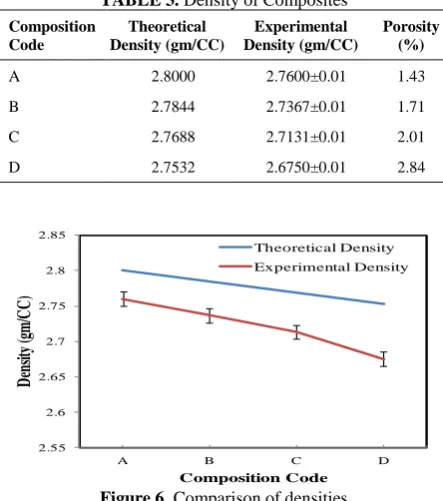
3. 4. Density The density decreases with h-BN addition because of inherent low density of h-BN, compared to base alloy Al7075 as represented in Figure 6.
Al7075 was having density of 2.76 gm/CC whereas the density falls to 2.73 gm/CC for composition of 3% h-BN and 2.71 gm/CC for 9% h-h-BN. Experimental values were in close range to theoretical values, indicated sound casting as shown in Table 3. Maximum porosity was observed at 1.31%. Generally, the presence of porosity leads to decreases in density [18]. Increase in porosity may be due to stirring process which facilitates gas entrapment, it depends on the duration of stirring. Longer stirring leads to higher porosity [13].
3. 5. Wear Test The wear characteristics of prepared composites are shown in Figure 7. Abrasive kind of wear mechanism is observed, and appears that the incorporated h-BN particles acts as a lubricant during the abrasion process and hence reducing the wear mass loss. The material loss decreases by 24.5% for 3% h-BN addition compared to base metal and increases with further increase in reinforcement percentage. Compared to base metal, 3% h-BN reinforced sample performs better at all the loads.
TABLE 3. Density of Composites
Composition Code
Theoretical Density (gm/CC)
Experimental Density (gm/CC)
Porosity (%)
A 2.8000 2.7600±0.01 1.43 B 2.7844 2.7367±0.01 1.71 C 2.7688 2.7131±0.01 2.01 D 2.7532 2.6750±0.01 2.84
Figure 6. Comparison of densities
Figure 7. Wear rate for different compositions
At higher percentages the increase in mass loss can be due to agglomeration and due to mechanism of micro cracking of h-BN. With increase in load the wear loss increases due to particle pull out but still the reinforced material remains comparatively better than base metal alone, Similar trends was observed [19]. The reinforcements benefit the wear behavior delaying the transition of higher normal loads [20]. The higher wear loss at higher load are due to temperature build up, increased plastic deformation and friction at such loads. When the load increases, the abrading action of the ceramic particles increases leading to increased mass loss of the specimen [6].
The improvement in wear resistance can be reasoned to the lubricious nature of h-BN and to the resistance offered by h-BN to plastic deformation. However, at higher percentage of reinforcement due to agglomeration and porosity the wear resistance decreases, which is in line with the hardness nature of the prepared composites. The SEM micrographs of worn surfaces are shown in Figure 8. The worn surfaces showed patches caused due to loss of material and some areas with delamination and wear debris, indicating abrasion and delamination wear mechanisms. Cavities formed due to delaminating and tearing of surface materials and grooves are visible on the surface. Grooves are formed due to ploughing action of wear debris. Ploughs are smaller in size as observed on the sample surfaces of B, C and D in comparison to base alloy Al7075. Figure 8(a) showed deep abrasion grooves, caused due to plastic deformation [21]. Figure 8(b) showed the worn surface of Al7075+ 3% h-BN reinforced composite with surface damage in the form of detachments were observed. EDS analysis of worn surface is shown in Figures 8(e) and (f).
3. 6. XRD Result XRD Patterns of Al7075 and 9% h-BN samples is shown in Figure 9. The intensity peaks of aluminium corresponding to (111), (222), (200), and (220), h-BN peaks corresponding to (002), AlB2 peaks
corresponding to (100) and AlN peaks corresponding to (103), (100) can be seen. Using XRD technique detection 2.55
2.6 2.65 2.7 2.75 2.8 2.85
A B C D
D
en
sit
y (
gm
/C
C
)
Composition Code
Theoretical Density
Experimental Density
0.2 0.25 0.3 0.35 0.4 0.45
A B C D
W
ea
rat
e
( x 1
0-3 m
m
3/
N
m
)
Composition Code
10N
Figure 8. SEM of wear surfaces a) A, b) B, c) C and d) D e) EDS of Region-1 and f) EDS of Region-2
Figure 9. XRD profile of a) Al7075, b) Al7075 + 9% h-BN
of small amount of phases is difficult [22]. Boron nitride’s oxidation temperature is very high compared to aluminium melting point, hence favors the melt processing of Al7075 and h-BN composites. Lahiri [22] stated in his research that aluminium and boron nitride react to form aluminium nitride (AlN) and aluminium
diboride (AlB2). AlN fraction is larger than AlB2 and is
more thermodynamically feasible than AlB2 and helps in
bonding of reinforcement.
4. CONCLUSION
The effect of h-BN on microstructure and mechanical properties were studied and the results are concluded below.
• Hardness increased to 68 BHN by addition of 3% reinforcement and decreases with further increase in reinforcement percentage.
• Ultimate tensile strength increased to 154 MPa at 3% h-BN reinforcement.
• Increase in percentage of reinforcement contents lead to increased porosity. Porosity and brittleness increased with increase in h-BN.
• Wear resistance showed maximum value for the sample of 3% h-BN composition and material loss increased with increased load application.
5. REFERENCES
1. Kaushik, N. and Singhal, S., “Experimental investigation on microstructural and mechanical behavior of friction stir welded aluminium matrix composite”, International Journal of Engineering-Transactions A: Basics,Vol. 32, No. 1, (2019), 162-170.
2. Bhushan, R.K., Kumar, S., and Das, S., “Fabrication and characterization of 7075 Al alloy reinforced with SiC particulates”, The International Journal of Advanced Manufacturing Technology, Vol. 65, No. 5-8, (2013), 611-624. 3. Rosso, M., “Ceramic and metal matrix composites: Route and Properties”, Journal of Mater Processing Technology, Vol. 175, No. 1, (2006), 364-375.
4. Kuldeep, B., Ravikumar, K.P., Pradeep, S., and Gopi, K.R., “Effect of boron nitride and zirconium dioxide on mechanical behavior of Al7075 metal matrix hybrid composite”, Materials Research Express, Vol. 6, No. 3, (2018).
5. Baradeswaran, A., and Perumal, A.E., “Study on mechanical and wear properties of Al 7075/Al2O3/graphite hybrid composites”,
Composites Part B: Engineering, Vol. 56, (2014), 464-471. 6. Lakshmipathy, J., and Kulendran, B., “Reciprocating wear
behavior of 7075Al/SiC in comparison with 6061Al/Al2O3 composites”, International Journal of Refractory Metals and Hard Materials, Vol. 46, (2014), 137-144.
7. Chen, C., Guo, L., Luo, J., Hao, J., Guo, Z., and Volinsky, A.A., “Aluminum powder size and microstructure effects on properties of boron nitride reinforced aluminum matrix composites fabricated by semi-solid powder metallurgy”, Materials Science and Engineering: A, Vol. 646, (2015), 306-314.
8. Reddy, M.P, Manakari, V., Parande, G., Ubaid, F., Shakoor, R.A., Mohamed, A.M., and Gupta, M., “Enhancing compressive, tensile, thermal and damping response of pure Al using BN nanoparticles”, Journal of Alloys and Compounds, Vol. 762, (2018), 398-408.
varying reinforced with graphite and bagasse-ash composites”,
Resource-Efficient Technologies, Vol. 2, No. 2, (2016), 81-88. 10. Dursun, T., and Soutis, C., “Recent developments in advanced
aircraft aluminium alloys”, Materials & Design, Vol. 56, (2014), 862-871.
11. Podgornik, B., Kosec, T., Kocijan, A., and Donik, C., “Tribological behaviour and lubrication performance of hexagonal boron nitride (h-BN) as a replacement for graphite in aluminium forming”, Tribology International, Vol. 81, (2015), 267-275.
12. Verma, N., and Vettivel, S.C., “Characterization and experimental analysis of boron carbide and rice husk ash reinforced AA7075 aluminium alloy hybrid composite”, Journal of Alloys and Compounds, Vol. 741, (2018), 981-998. 13. Ezatpour, H.R., Parizi, M.T., Sajjadi, S.A., Ebrahimi, G.R., and
Chaichi, A., “Microstructure, mechanical analysis and optimal selection of 7075 aluminum alloy based composite reinforced with alumina nanoparticles”, Materials Chemistry and Physics, Vol. 178, (2016), 119-127.
14. Kok, M., and Ozdin, K., “Wear resistance of aluminum alloy and its composites reinforced by Al2O3 particles”, Journal of
Material Processing Technology, Vol. 183, (2007), 301–309. 15. Raturi, A., Mer, K.K., and Pant, P.K., “Synthesis and
characterization of mechanical, tribological and micro structural behaviour of Al 7075 matrix reinforced with nano Al2O3
particles”, Materials Today: Proceedings, Vol. 4, No. 2, (2017), 2645-2658.
16. Rahimian, M., Parvin, N.,and Ehsani, N., “Investigation of particle size and amount of alumina on microstructure and
mechanical properties of Al matrix composite made by powder metallurgy”, Material Science Engineering A, Vol. 527, (2010), 1031–1038.
17. Xiu, Z., Yang, W., Dong, R., Hussain, M., Jiang, L., Liu, Y., and Wu, G., “Microstructure and mechanical properties of 45 vol.% SiCp/7075Al composite”, Journal of Materials Science & Technology, Vol. 31, No. 9, (2015), 930-934.
18. Kumar, K.R., Pridhar, T., and Balaji, V.S., “Mechanical properties and characterization of zirconium oxide (ZrO2) and
coconut shell ash (CSA) reinforced aluminium (Al 6082) matrix hybrid composite”, Journal of Alloys and Compounds, Vol. 765, (2018), 171-179.
19. Sun, Y, “The Effect of Ti Addition and Aging on Wear Behavior of AlMgSi Alloys Reinforced with In Situ Al3Ti Particles”,
Journal of Materials Engineering and Performance, Vol. 22, No. 1, (2013), 162-169.
20. Gomez-del Río, T., Rico, A., Garrido, M.A., Poza, P., and Rodríguez, J., “Temperature and velocity transitions in dry sliding wear of Al–Li/SiC composites”, Wear, Vol. 268, No. 5-6, (2010), 700-707.
21. Rosenberger, M.R., Florlerer, E., and Schvezov, C.E., “Wear behavior of AA1060 reinforced with alumina under different loads”, Wear, Vol. 266, (2009), 356–359.
22. Lahiri, D., Singh, V., Li, L.H., Xing, T., Seal, S., Chen, Y., and Agarwal, A., “Insight into reactions and interface between boron nitride nanotube and aluminum”, Journal of Materials Research, Vol. 27, No. 21, (2012), 2760-2770.
Effect of Hexagonal Boron Nitrate on Microstructure and Mechanical Behavior of
Al7075 Metal Matrix Composite Producing by Stir Casting Technique
B. Kuldeepa, K. P. Ravikumarb, S. Pradeepc
a,c Department of Mechanical Engineering, Malnad College of Engineering, VTU, India b Department of Automobile Engineering, Malnad College of Engineering, VTU, India c Department of Mechanical Engineering, Rajeev institute of Technology, VTU, India
P A P E R I N F O
Paper history: Received 03 March 2019
Received in revised form 9 March 2019 Accepted 03 May 2019
Keywords:
Metal Matrix Composites Microstructure Wear Stir Casting
هدیکچ
ژایلآ
Al7075
تیوقت تابیکرت اب هدش
h-BN
هتخیر شور هب مه یرگ
تاعلاطم تحت هدشدیلوت تیزوپماک .دش دیلوت یندز
شیامزآ زا هدافتسا اب یراتخاسزیر
OLYMPUS-BX51M
یششک ماکحتسا .تفرگ رارق شیاس و یلاگچ ،یتخس ،ششک ،
ییاجبان یلاگچ شیازفا لیلد هب یتخس و هب هدننک تیوقت ندوزفا اب اه
بیترت 12.8
٪
و 20
٪
یسررب .دنتفای شیازفا یاه
راتخاسزیر هناد شیلااپ ی تیوقت ندوزفا رثا رد اه
تیوقت .دنداد ناشن ار هدننک هتسه یاهزکرم ناونع هب هدننک
عیزوت اب یراذگ
یم لمع هدننک تیوقت تخاونکی ًابیرقت فلتخم یاهراب ریز نزو شهاک شیامزآ .دنک
10 ، 20 و 30 هلصاف یارب نوتوین ی
شیامیپ 1500 مک نزو نداد تسد زا .دش ماجنا رتم تیزوپماک
هدننک تیوقت رییغت اب یشیاس تمواقم ،اه .تفای شیازفا اه
هدییاس حوطس زا هدافتسا اب هدش
SEM
ناشن هک ،دندش یسررب هدنهد
مخش ،قروت روضح ی .دوب حطس یور رب هشارت و یگدز
ندش هفاضا هب هجوت اب
h-BN
مک تیزوپماک یلاگچ ،یلاگچ تیوقت رادقم شیازفا اب اه
شهاک هدننک یم
.دبای
doi: 10.5829/ije.2019.32.07a.15