
Technological and Environmental Parameters of Helicopter Timber Extraction in Slovakia
12
0
0
Full text
(2) V. MESSINGEROVÁ and J. TAJBO[. Technological and Environmental Parameters of Helicopter ... (123–133). 2. Research methods – Metode istra`ivanja. not been used in any known literature so far nor has the noise spreading model in the nature during helicopter timber extraction.. Methodology was elaborated in several areas: A) Assessment of technical possibilities and properties of various types of helicopters used for timber extraction Based on studied literary resources, a review was prepared of helicopters used in timber extraction, and a list of technical parameters was prepared for better orientation focusing on the most important parameters such as performance, useful load, speed, and other design characteristics of individual helicopters during timber extraction. For clarifying the technical scope, the basic helicopter flight operation was elaborated and lifting capacity of Mil Mi-8 helicopter used in Slovakian conditions was determined. B) Designing a technological procedure according to the type of felling Based on the results gained from the use of helicopter in timber extraction at several sites in the forests of the Slovak Republic and especially based on results and experience in organising helicopter timber extraction in the intended regeneration felling, a technological procedure was designed with the emphasis on improving overall efficiency while observing and adhering to safety at work regulations. The technological procedure was designed for the preparation and organisation of work in key stages of the working cycle (stand, landing, air operations). C) Assessment of efficiency characteristics of Mil Mi-8 helicopter The efficiency of helicopter timber extraction was evaluated by chronometric measurements of Mill Mi-8 helicopter used in the mountain areas of the Slovak Republic. During processing of the salvage timber (Belianske Tatry mountains, Javorina mountain range, Srdie~ko mountain area of Ru`omberok), time consumption was evaluated for a working cycle and for individual work operations, as well as shift efficiency, size of load, number of logs in a load and the same parameters indicating efficiency of Mil Mi-8 helicopter during regeneration felling in the protected area of Po¾ana. D) Helicopter noise stress of forest and work environment In particular conditions at several sites (Belianske Tatry, Po¾ana, Muráò), measurements were carried out of noise affecting workers and the surrounding nature. The methodology of processing by DTM has. 124. 3. Results – Rezultati 3.1 Evaluation of technical possibilities and properties of various helicopters used in timber extraction – Procjena tehni~kih mogu}nosti i zna~ajki razli~itih helikoptera kori{tenih za izno{enje drva Regarding the properties of helicopters they present a practical and irreplaceable means of transportation. The possibility of vertical flight and flight down without dependence on long take-off and flight down runway gives incredibly wide operational space to helicopters, because flight down and taking-off do not need large and especially designed area. Another important quality – »hanging« – (possibility to remain in the air at one place for a necessary time) enables the transportation of a load in the areas with low bearing capacity or at places which are not accessible by other means of land transportation. Untraditional manoeuvring properties enable helicopters to fly at a distance very close to land. Lower speed, compared to other means of air transport, is an advantage in case of timber extraction. Due to these properties, their use is the most common technology in air extraction. Table 1 shows some selected types and selected technical characteristics of helicopters used in timber extraction.. 3.2 The design of technological procedures in accordance with the type of felling – Oblikovanje tehnolo{kih postupaka prema vrsti sje~e The choice of technological procedure should be adapted to technical equipment, terrain and climatic conditions, type of felling, volume of extracted logs. It is possible to extract whole trees, logs, or assortments by helicopter. The transportation of logs is the most profitable; if the weight is exceeded, they must be shortened to assortments. Trees are extracted in case of e.g. bark-beetle salvages when stand sanitation is required. Highly effective technology of helicopter timber extraction requires thorough technological preparation of a workplace and perfect team work of all involved partners. Technological procedure can be divided into several work stages which can be prepared individually and however they must be compiled into one harmonious corpus. Croatian Journal of Forest Engineering 27(2006)2.
(3) Technological and Environmental Parameters of Helicopter ... (123–133). V. MESSINGEROVÁ and J. TAJBO[. Table 1 The review of parameters of selected helicopters used in wood extraction Tablica 1. Pregled zna~ajki odabranih helikoptera za izno{enje drva. Croatian Journal of Forest Engineering 27(2006)2. 125.
(4) V. MESSINGEROVÁ and J. TAJBO[. Technological and Environmental Parameters of Helicopter ... (123–133). From the viewpoint of work management it is necessary to plan in detail as follows: Þ preparation and work in a stand, Þ establishment of sufficient number and suitable position of landings, Þ meeting technical requirements of helicopter operation. The efficiency of helicopter technology for timber extraction is significantly influenced by quality and extent of preparation work in a stand. Due attention must be given to this stage as this might be the stage to decide on the result of the whole operation and namely on economic parameters and occupational safety. Different approach to preparation work is influenced by the type of felling. Work in a stand during salvage cutting requires preparation according to the type of salvage (storm, insect) and if required initial work shall include debranching and bucking of tree trunks from the root system. Processing of salvage proceeds from the upper part of a hill slope and preparation work should be carried out before the beginning of timber extraction. Small sized logs should be piled at the sites meeting the requirements of safe log fastening and take-off of a helicopter. Referring to a strewed salvage mass in a standing stand, this means that a helicopter can easily manage to lift the logs even in this stand. Technological work progress in the stand will significantly influence the technology of helicopter transportation of cut timber (intended regeneration cutting). When directional felling is provided, it is possible to achieve an optimal load weight for a helicopter according to useful load. Compared to processing of salvage timber, in most cases it is not necessary to pile logs in a stand. For logs of higher volume, it is necessary to shorten them because of allowed loading of a helicopter. The length of assortment is influenced by timber species, volume weight of timber, moisture contents and type of assortments. The preparation of loads for a helicopter during felling influences the time consumption needed for fastening the load as well as the time of the whole working cycle. Compiling the load and fastening the burdens as well as unfastening the loads at the landing is carried out by workers (fasteners), who are trained specifically for working with loads under a helicopter. The efficiency of a helicopter depends on the time of a return, on the size of a load per cycle and on compulsory idle time. The time of a working cycle depends on the efficiency of fasteners working in a. 126. stand, who if they manage to assess the load weight correctly and fasten logs quickly can avoid repeated unfastening for overweight. To check the correct load weight, every helicopter is equipped with a weighting gauge for measuring the weight. A helicopter can extract timber from any place. It is better if timber is in an open area, e.g. at the edge of a stand, but it can also easily manage to lift a load above a stand from among the trees. From the technological point of view the most demanding part is fastening loads in a stand. This operation must be carried out quickly and at the same time safely. The conditions of fastening are demanding especially in processing salvage timber. It is advisable to have at least two workplaces with two fasteners at the stand being processed, thus creating conditions for the preparation of further loads. The load size depends mainly on the carrying capacity of a helicopter, season of the year, and time of the day in dependence on temperature conditions. It is more profitable if the load consists of fewer logs as this shortens the time of fastening up. The load is fastened to a helicopter either by a winch rope or more often by a helicopter fixed rope because lifting the load by winch is slower than by lifting via fixed rope. Work procedures and technical devices common in industry dealing with load transportation are applied. Coordination of the whole working team is managed by using transmitters. The form of forest management is not a limiting factor for using this technology. From the point of view of technical and technological managing it is possible to take into account the use of this method not only in clear cutting and partial felling but in selective cutting shelterwood system if the economic conditions are acceptable for both contractual parties. Regarding time consumption per cycle, a larger freely accessible area or a kettle-shaped area is better than a selective cutting method. The best option is if the area has been prepared and branches cut off, but if necessary it is possible to extract the trees. The hill slope enables the pilot better orientation in hanging against a hill. If the crew has a possibility to fly over the area from the bottom part, the pilot has a perfect picture of the prepared timber. Lowering down of underslung equipment hooks is done quickly, the fasteners are in an visual contact with the crew, so as to move off at a safe distance from the timber. Lifting the timber and its taking off can be performed without avoiding obstacles and the departure can be made without rising which is made possible by the hill slope. The departure is possible in every azimuth from a slope. When applying a selection method, all Croatian Journal of Forest Engineering 27(2006)2.
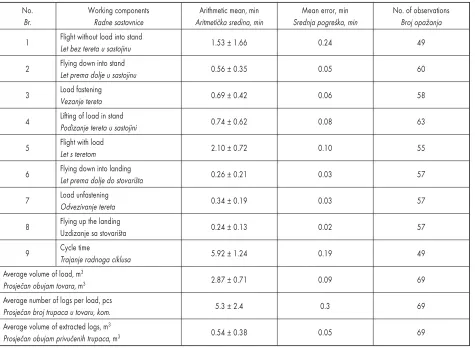
(5) Technological and Environmental Parameters of Helicopter ... (123–133). V. MESSINGEROVÁ and J. TAJBO[. Table 2 Time consumption per working components and basic data about timber extracted by helicopter in Belianske Tatry for an average extraction distance of 700 m (Messingerová 1994) Tablica 2. Utro{ak vremena sastavnica rada i osnovni podaci o izne{enom drvu helikopterom u Belianskim Tatrama pri srednjoj udaljenosti privla~enja drva od 700 m (Messingerová 1994) No. Br.. Working components Radne sastavnice Flight without load into stand 1 Let bez tereta u sastojinu Flying down into stand 2 Let prema dolje u sastojinu Load fastening 3 Vezanje tereta Lifting of load in stand 4 Podizanje tereta u sastojini Flight with load 5 Let s teretom Flying down into landing 6 Let prema dolje do stovari{ta Load unfastening 7 Odvezivanje tereta Flying up the landing 8 Uzdizanje sa stovari{ta Cycle time 9 Trajanje radnoga ciklusa Average volume of load, m3 Prosje~an obujam tovara, m3 Average number of logs per load, pcs Prosje~an broj trupaca u tovaru, kom. Average volume of extracted logs, m3 Prosje~an obujam privu~enih trupaca, m3. Arithmetic mean, min Aritmeti~ka sredina, min. Mean error, min Srednja pogre{ka, min. No. of observations Broj opa`anja. 1.53 ± 1.66. 0.24. 49. 0.56 ± 0.35. 0.05. 60. 0.69 ± 0.42. 0.06. 58. 0.74 ± 0.62. 0.08. 63. 2.10 ± 0.72. 0.10. 55. 0.26 ± 0.21. 0.03. 57. 0.34 ± 0.19. 0.03. 57. 0.24 ± 0.13. 0.02. 57. 5.92 ± 1.24. 0.19. 49. 2.87 ± 0.71. 0.09. 69. 5.3 ± 2.4. 0.3. 69. 0.54 ± 0.38. 0.05. 69. these positive circumstances do not appear because it is necessary to push hooks into a stand. The most demanding situation is at the flat surface, where there is no advantage of a contra-hill and it is necessary to look for fasteners in a stand. Yet, an advantage of this method is that a helicopter can work effectively also in selection felling although the time consumption for the working cycle of this method is a bit higher. In the technological preparation of the workplace, the selection of sufficient time and accessibility of landings play an important role. Unfastening a load can be done at roadside landing manually, mechanically, automatically. Manual unfastening increases time requirements because workers can approach the load after its stabilisation on the ground. Automatic unfastening shortens the length of the whole cycle. Croatian Journal of Forest Engineering 27(2006)2. The place of unfastening, landing, must be chosen so that the load can be put down without time and space limitations. The size of landing depends on the amount of timber and the requirement of timber sorting, e.g. according to timber species or assortments. The storage area must provide the conditions for a continuous work operation in terms of its size and position. Inappropriate landings are those which are small and have uneven surface, large obstacles or »untouchable« obstacles at the edge. During processing salvage timber, it is difficult to carry out the requirement for sorting timber, and however, when the work of timber extraction from the intended felling is well organised, it is possible to sort out the timber into piles by requirements. Regarding the fact that in Slovakia there are no generally applicable safety laws for the technology of helicopter timber extraction compared to ground. 127.
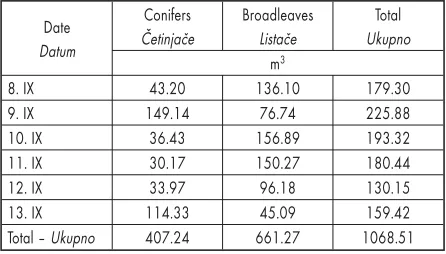
(6) V. MESSINGEROVÁ and J. TAJBO[. Technological and Environmental Parameters of Helicopter ... (123–133). Table 3 Quantity of timber extracted by helicopter in the Pol'ana protected area Tablica 3. Koli~ina iznesenoga drva helikopterom u za{ti}enom podru~ju Polana Date Datum 8. IX 9. IX 10. IX 11. IX 12. IX 13. IX Total – Ukupno. Conifers ^etinja~e 43.20 149.14 36.43 30.17 33.97 114.33 407.24. Broadleaves Lista~e m3 136.10 76.74 156.89 150.27 96.18 45.09 661.27. Total Ukupno 179.30 225.88 193.32 180.44 130.15 159.42 1068.51. Table 4 Time consumption per working components in timber extraction by helicopter in Pol'ana protected area for an average extraction distance of 800 m Tablica 4. Utro{ak vremena sastavnica rada pri izno{enju drva helikopterom u za{ti}enom podru~ju Polana pri srednjoj udaljenosti privla~enja drva od 800 m No. Br.. Working components Radne sastavnice. Flight without load into stand Let bez tereta u sastojinu Flying down into stand 2 Let prema dolje u sastojinu Load fastening 3 Vezanje tereta Lifting of load in stand 4 Podizanje tereta u sastojini Flight with load 5 Let s teretom Flying down into landing 6 Let prema dolje do stovari{ta Load unfastening 7 Odvezivanje tereta Flying up the landing 8 Uzdizanje sa stovari{ta Cycle time 9 Trajanje radnoga ciklusa Number of flights per day Broj letova dnevno Time consumption per fuelling Utro{ak vremena pri to~enju goriva Time consumption per daily maintenance of helicopter Utro{ak vremena dnevnoga odr`avanja helikoptera 1. 128. Time consumption Utro{ak vremena min. Percentage Postotni udio %. 1.16. 23. 0.29. 6. 0.62. 13. 0.38. 8. 1.61. 33. 0,33. 7. 0.29. 6. 0.18. 4. 4.83. 100. 72 11.23. 45.20. based timber extraction technologies and the requirements in this area are higher, a design of safety principles has been drawn. The design is based on safety in flight operations and considers specific conditions of helicopter use in forestry.. 3.3 Performance characteristics for helicopter Mil Mi-8 – Radne zna~ajke helikoptera Mil Mi-8 The most important parameters in timber extraction at various sites in the mountain forests in Slovakia are shown in Tables 2, 3, 4 and 5.. 3.4 Effects of helicopter noise stress on forest and working environment – Optere}enje {umskoga i radnoga okoli{a bukom helikoptera The intensity of outer noise was not only measured directly at the workplace but also in the surrounding area in a hectare network at a 2 km distance. The measuring equipment of the firm Bruel and Kjaer was used with a built-in A weight filter. The noise level was measured at a different distance from the helicopter during hanging and during the flight. The level of the machine noise is assessed in accordance with the relative directives from two viewpoints. For people directly involved in the work with the machine, the noise at the workplace is relevant and for the others the outside noise is relevant. In the first case, the highest possible level accounts for LP = 80 dB(A), and as the work of fasteners can be considered physically demanding in terms of accuracy and concentration, the correction of the basic level –5dB will be applied. In the second case the value of 55 dB(A) is applied as the highest accepted value for the air operation noise (Konrád 1973, Kon-. Table 5 Indicators of efficiency in timber extraction by helicopter Tablica 5. Pokazatelji djelotvornosti pri izno{enju drva helikopterom Efficiency indicator Pokazatelj djelotvornosti Average daily volume of extracted timber, m3 Prosje~an dnevni obujam privu~enoga drva, m3 Average number of logs per load, pcs Prosje~an broj trupaca u tovaru, kom. Average volume of load, m3 Prosje~an obujam tovara, m3 Average volume of extracted logs, m3 Prosje~an obujam privu~enih trupaca, m3 Time consumption per 1 m3 of timber, min Utro{ak vremena po 1 m3 drva, min. Average value Srednje vrijednosti 178.08 1.61 2.10 1.38 2.48. Croatian Journal of Forest Engineering 27(2006)2.
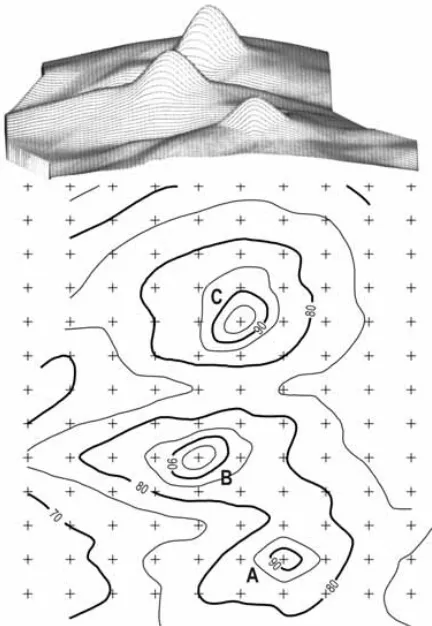
(7) Technological and Environmental Parameters of Helicopter ... (123–133). Table 6 Noisy and silent intervals during helicopter’s operation Tablica 6. Bu~ni i tihi intervali rada helikoptera Working components Radne sastavnice. %. Helicopter operation: 100 Rad helikoptera: Above a fastening place 32.2 Iznad mjesta vezanja tereta Above an unfastening place 14.4 Iznad mjesta odvezivanja tereta. Cycle Shift Ciklus Smjena intervala Noise Silence Noise Silence Buka Ti{ina Buka Ti{ina min 5.92. –. 300.0. –. 1.91. 4.01. 96.6. 203.4. 0.85. 5.07. 43.2. 256.8. rád 1993, Konrád et al. 1993, Messingerová et al. 2000). The measurements were processed into noise maps. In this paper, the results are presented from the High Tatra – The TANAP report, LS Javorina, Pod Muráòom locality. The model of noise propagation was developed from 180 values measured at 35 spots. For comparison, the results of measurements in Pol'ana, prepared in the environment of a digital terrain model, are also presented. The helicopter timber extraction is 8–10 times more effective than ground based skidding technologies and as much as 20 times more efficient than cable yarding. This is the result of the fact that the forest environment and workers are exposed to the noise produced by helicopter for a much shorter time, which is particularly important in protected areas. During the research the noise was measured in the most severe conditions, at minimum distance from the helicopter (under the helicopter, or at the helicopter’s level on the slope). During a routine operation the noise values at the ground are usually lower. The analysis was carried out of time consumption of individual operations and time of exposure to direct noise of the workers on the ground (Konrád and Messingerová 1993), and noisy and silent intervals were calculated for the staff working on the ground (Table 6). The load fasteners and unfasteners are exposed to an excessive noise only during a short part of a working cycle. During a shift a fastener is exposed in total to the noise for 97 minutes and an un-fastener for only for 43 minutes. The measurements were evaluated by a topographic programme ATLAS. On the noise map (Fig. 1 – one square represents dimensions: 100 ´ 100 m) the three significant peaks stand out: Croatian Journal of Forest Engineering 27(2006)2. V. MESSINGEROVÁ and J. TAJBO[. Þ A – the place of fastening logs in a stand, Þ B – the place of fastening logs in free space (salvage place), Þ C – the landing where the load was unfastened. The map was produced by synthesis of noise fields and it is not real, because a helicopter cannot appear at three different places at the same time. This procedure was established to identify the area where the highest noise values at the workplace are exceeded. The results show that the noise shortly exceeds the allowed limits, but they are likewise exceeded by tractors used for skidding timber. The excess is less significant, the changes of the level are not so rapid and the mentioned noise was only found in the vicinity of the tractor. However, it is present during the whole time of the tractor’s operation. At the distance of 2 m from the tractor the noise is 90–95 dB(A), at the distance of 20 m it is approximately 75 dB(A) (Konrád 1973). Fig. 1 The map of noise intesity in the immediate helicopter’s surrounding in dB(A) Slika 1. Karta intenziteta buke u neposrednoj okolici helikoptera u dB(A) 129.
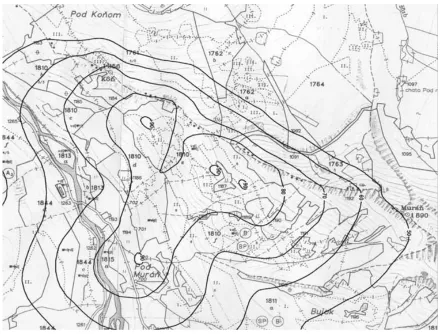
(8) V. MESSINGEROVÁ and J. TAJBO[. Technological and Environmental Parameters of Helicopter ... (123–133). Fig. 2 The map of helicopter’s noise intensity isolines Slika 2. Karta izolinija intenziteta buke helikoptera u dB(A) If the helicopter is »hanging« above a working place (rope length: 30–50 m) the noise below it is 93–100 dB(A). The acceptable level of 80 dB(A) is at the distance ranging between 100 and 200 m depending on the terrain configuration. This is why the workers must use hearing protectors. The noise layout in a broken terrain has better spreading than in an open area due to the formation of noise traps (behind the ridge, in thick vegetation). In Figure 2 it can be seen that the noise is spreading over a wider area around Ke`marský {tít – a peak, Muráò – a mountain area, and in the Belianske Tatry – a mountain range. The last measurements were carried out in the High Tatra, locality Javorina – Muráò. They were used to determine the noise model depending on the distance and elevation of helicopter’s flight. The results of regression analysis in the following gradients of decreasing noise intensity are shown in Figures 3 and 4. The significance of distance, flight height and terrain configuration was analyzed by the method of. 130. Fig. 3 Linear model of helicopter's noise intensity Slika 3. Linearni model intenziteta buke helikoptera Croatian Journal of Forest Engineering 27(2006)2.
(9) Technological and Environmental Parameters of Helicopter ... (123–133). V. MESSINGEROVÁ and J. TAJBO[. Table 8 Average values of intensity noise at different factor levels Tablica 8. Srednje vrijednosti intenziteta buke pri razli~itim razinama ~imbenika Distance – Udaljenost. Fig. 4 Power model of helicopter's noise intensity Slika 4. Eksponencijalni model intenziteta buke helikoptera Table 7 Factors significance Tablica 7. Zna~ajnost razlika ~imbenika Factor – ^imbenik Distance – Udaljenost Flight height – Visina leta Terrain configuration – Konfiguracija terena Total – Ukupno. F a P1 – a 66.812 0.000 00 1.000 00 11.866 0.000 00 1.000 00. b –0.64 –0.41. 5.9585 0.003 38 0.996 62. –0.12. 20.581 0.000 00 1.000 00 R = 0.87. one- and multi-factor analysis. The following classification was used for a terrain: Þ 1 – open terrain, plain Þ 2 – broken terrain in a slope Þ 3 – a valley off the flight route. Table 7 shows that the distance influence and flight height are significant practically with a 100% probability and the influence of terrain brokenness has likewise a 99.62% probability. Where: F – calculated value of F–division, a – significance level, P1-a – reliability degree, ß – partial coefficients of correlation (calculated by the method of multiple regressions), R – coefficient of multiple correlation. (For the number of measurements n = 122, Ftab,0,05 ≈ 3.08) Croatian Journal of Forest Engineering 27(2006)2. Factor – ^imbenik Flight height – Visina leta. m. dB(A). m. dB(A). 0 100 200 300 400 1200. 95 81 74 69 65 50. 0 35 40 45 50 60. 112 83 80 78 77 71. Terrain configuration – Konfiguracija terena Class – dB(A) Razred 1 80 2 74 3 70. The values of b coefficients can be interpreted as the intensity of impact of individual factors within their synergic effect. Table 8 presents the average values of noise intensity at various factor levels. The average noise intensity during measuring was 77 dB(A). To get a general perception of noise, several criteria must be taken into consideration, similarly to other physiological perception, resulting from physiology of perception organs. Various subjective noise perceptions depending on sound frequency of oscillation are processed into standardized curves of identical loudness levels – Fletcher-Munson curves (Smetana 1987).. 4. Conclusion – Zaklju~ci The air transportation of timber is the most environmentally friendly technology of all current extraction technologies. The advantages of helicopter technology can be summarized as follows: Þ possibility to decrease requirements for making access into complicated terrain conditions of mountain stands, Þ possibility to improve the structure of mountainous forests, Þ fast processing of salvage felling requiring an immediate solution, Þ prevention of salvages in stands which are not considered accessible by traditional technologies, Þ minimum damage to soil by minimisation of the contact between the load and soil, Þ inhibition of consequential rainfall erosion, Þ no soil disturbances compared to ground based technologies,. 131.
(10) V. MESSINGEROVÁ and J. TAJBO[. Technological and Environmental Parameters of Helicopter ... (123–133). Þ as a result of avoiding ground based technologies, better hydrological conditions in mountain terrains, Þ minimised damage to remaining trees, Assuming that good planning and work organization are provided, taking into consideration safety and noise impact on the environment, it is possible to obtain good results in spite of the fact that compared to traditional technologies helicopter logging is the most risky one.. 5. References – Literatura Abel, P., Sauloquin, S., 1991: Perestroika forestière: Les hélicoptères soviétiques se recyclent dans le débardage du bois, Arborenscences, No 31 – Janvier-Fevrier, Office National des Forêts, 14–16. Dykstra, D. P.; 1976: Production rates and costs for yarding by cable, balloon, and helicopter compared for clearcuttings and partial cuttings. Forest Research Laboratory, School of Forestry, Oregon State Univ. Res. Bull. 22. Corvallis. 44 pp. Dykstra, D. P., Heinrich, R., 1996: FAO model code of harvesting practice. FAO, Rome, 1–85. Gordijenko, V., A., 1986: Helicopter timber logging. 18th IUFRO world congress, Division 3, 190–201. Heinemann, H. R., 1995: Schreittechnologie – Perspektiven für die Forsttechnik. Oesterrreichische Forstzeitung 106(9): 56–59. Heinimann, H. R., 1998: Holzrücken mit Helikoptern [Timber extraction with helicopters]. Wald und Holz 79(3): 7–10. Heinemann, H. R., Caminada, L., 1996: Helicopter Logging in Switzerland, Analysis of Selective Logging Operations. In Proceedings of IUFRO 3.06 Forest Operations under. Mountainous Conditions and the 9th Pacific Northwest Skyline Symposium (ed. I. B. Hedin), FERIC SR 116, 1–6. Kaluckij, K. K., Lekarkin, I. J., D`aparidze, T. M., 1988: Technologija gornych lesozagotovok s primenenijem na transportirovke drevesiny vertoletov, Les. Choz. 61(6): 45–47. Konrád, V., 1993: Za a`enie lesného prostredia hlukom vrtu¾níka (Charging the forest environment by helicopter noise). In: Zborník Jubilejná konferencia LVÚ, 2. sekcia ekológia pestovania lesa a lesná technika, 118–124. Konrád, V., 1973: Vplyv hluku a vibrácií na pracujúcich pri sústreïovaní dreva traktormi (Noise and vibrations impact on workers at wood skidding by tractors). Referát ku skú{ke z a{pirantského minima, Zvolen, 71 pp. Konrád, V., Messingerová, V., 1993: Rozbor technológie, spotreby ~asu a hluku pri pribli`ovaní dreva vrtu¾níkom (Analysis of the technology, time consumption, and noise during helicopter wood logging). AFF, TU Zvolen, 321– 333. Kostroò, L., 1972: Výsledky ovìøení vrtu¾níku MI-8 pøi dopravì døeva v ^SSR. Lesnictví 18(2): 101–115. Lambert, M. B., 1995: Computer supported planning for helicopter logging, USDA, Forest Service Paciffic Northwest Research Station, Portland, Oregon, USA, 1–10. Messingerová, V., 1994: Sústreïovanie dreva vrtu¾níkom (Helicopter wood logging). Vedecko-pedagogická aktualita ~. 6, 1–50. Messingerová, V., Tajbo{, J., 2000: Za a`enie pracovného a prírodného prostredia hlukom pri doprave dreva vrtu¾níkom Mi-8. (Charging the working and natural environment by noise during the Mi- 8 helicopter wood transportation) AFF, 42, TU Zvolen, 309–322. Smetana, C., 1987: Ozvu~ování. SNTL Praha, 1–215. Stampfer, K., Gridling, H., Visser, R., 2002: Analyses of Parameters Affecting Helicopter Timber Extraction. International Journal of Forest Engineering 13(2): 61–68.. Sa`etak. Tehnolo{ki i okoli{ni parametri izno{enja drva helikopterima u Slova~koj Rad prikazuje rezultate istra`ivanja tehni~kih, tehnolo{kih, ergonomskih i okoli{nih zna~ajki primjene helikoptera na izno{enju drva iz brdsko-planinskih {uma u Slova~koj. Pregled najva`nijih tehni~kih zna~ajki helikoptera koji se upotrebljavaju za izno{enje drva dan je u tablici 1. Cilj je rada utvrditi tehnolo{ke postupke, pravila sigurnosti rada te okoli{ne uvjete koji }e osigurati pravilnu primjenu i u~inkovitost postupaka izno{enja drva helikopterom. Stru~no izvo|enje izno{enja zahtijeva visoku kakvo}u tehnolo{ke pripreme radnoga mjesta i savr{enu organizaciju rada. Tehnolo{ke postupke valja prilagoditi tehni~kim sredstvima, terenskim i klimatskim uvjetima, vrsti sje~e i obujmu drva za izno{enje. ^itava stabla, debla ili trupci mogu se iznositi helikopterima. Dulji se trupci moraju skratiti kako bi bili sukladni dopu{tenomu optere}enju helikoptera. Duljina je trupaca uvjetovana vrstom i specifi~nom te`inom drva, sadr`ajem vlage u drvu i vrstom sortimenta. Priprema tovara u sastojini utje~e na smanjenje utro{ka vremena za vezanje tovara i time na trajanje cijeloga radnoga turnusa. Uvjeti za vezivanje osobito su zahtjevni i te{ki pri izvla~enju drva dobivenoga sanitarnim sje~ama. Racionalnije je na odre|enoj ~estici postaviti dva radili{ta (s po dva radnika koji ve`u teret na svakom. 132. Croatian Journal of Forest Engineering 27(2006)2.
(11) Technological and Environmental Parameters of Helicopter ... (123–133). V. MESSINGEROVÁ and J. TAJBO[. radili{tu). Time se u{tedi vrijeme za pripremu sljede}ega tereta. Koordinacija ~itavoga tima obavlja se uz pomo} prijenosnika. Pripremu tovara u sastojini, njegovo vezanje na vu~no u`e helikoptera te odvezivanje tovara na stovari{tu obavljaju radnici kop~a{i posebno pripremljeni za siguran rad u blizini helikoptera. Trajanje radnoga ciklusa ovisi o spretnosti radnika koji ve`u tovar, njihovoj sposobnosti da odrede te`inu tovara, da brzo ve`u trupce i sprije~e odvezivanje u slu~aju prevelikoga optere}enja. Svaki je helikopter opremljen dinamometrom, ure|ajem za mjerenje te`ine tereta. Teret se mo`e odvezivati ru~no, mehani~ki ili automatski. Veli~ina tereta ovisi o kapacitetu nosivosti helikoptera, godi{njem dobu i dobu dana s obzirom na vremenske uvjete. Teret je uz helikopter privezan u`etom preko vitla ili ~e{}e pri~vr{}enim u`etom jer je podizanje tereta vitlom sporije nego fiksiranim u`etom. [tovi{e, vitlo smanjuje korisnu nosivost helikoptera. Fiksirano je u`e duga~ko 30 – 50 m. Izbor dovoljno prostranoga stovari{ta i njegov smje{taj igra va`nu ulogu u tehnolo{koj pripremi radili{ta. Lokacija stovari{ta mora omogu}iti spu{tanje tereta bez pote{ko}a. Veli~ina stovari{ta ovisi o koli~ini drva i zahtjevima razvrstavanja, npr. po vrstama ili sortimentima. U slova~kom se {umarstvu za privla~enje drva koristi helikopter Mill MI-8 te su u tablicama 2, 3, 4 i 5 prikazni utro{ci vremena sastavnica rada i osnovni podaci o iznesenom drvu na dva mjesta istra`ivanja. Izno{enje je drva helikopterima u~inkovitije 8 – 10 puta od privla~enja drva traktorima i do 20 puta od izno{enja drva `i~arama. Iz toga slijedi da je {umski ekosustav izlo`en buci za vrijeme rada helikoptera znatno kra}e vrijeme. Ta je ~injenica posebno zna~ajna u za{ti}enim podru~jima. Mjerenja razine buke koja djeluje na radnike i okoli{ provedena su izravno na radili{tu te okolnom podru~ju u krugu 2 km. Buka je mjerena Bruelovom i Kjaerovom opremom s filterom »A« pri razli~itim udaljenostima od helikoptera pri njegovu letu i lebdenju. Promatran je utjecaj buke na radnike (buka na radnom mjestu) i na ostale (buka izvan radnoga mjesta). U prvom je slu~aju najvi{a dopu{tena razina buke Lp = 80 dB(A) s ispravkom temeljne razine 5 dB jer je rad koji obavljaju radnici ve`u}i tovar naporan i zahtijeva visoku koncentraciju. U drugom slu~aju mo`emo govoriti o vrijednosti od 55 dB(A) kao najvi{oj dopu{tenoj razini buke (Konrad i Messingerová 1993). Ra{~lanjen je utro{ak vremena za pojedine radne zahvate i izra~unati su intervali buke i ti{ine kojima su izlo`eni radnici na tlu. Rezultati prikazani u tablici 6 pokazuju kako su radnici samo kratko vrijeme radnoga ciklusa, dok ve`u i odvezuju teret, izlo`eni prekomjernoj buci. Na karti intenziteta buke (slika 1) nazna~ena su mjesta vezanja tovara u sastojini (A), na otvorenoj povr{ini (B) i odvezivanja tovara na stovari{tu (C) te je vidljivo da buka samo kratkotrajno prekora~uje dopu{teno ograni~enje. Buka na radnom mjestu iznad kojega je helikopter iznosi 93 – 100 dB(A). Dopu{tena razina od 80 dB(A) na udaljenosti je od 100 do 200 m u skladu s konfiguracijom terena. Raspodjela buke na razvedenom terenu sa zvu~nim preprekama (iza brda, u gustoj sastojini) druga~ija je nego na otvorenom prostoru (slika 2). Stoga u tom prostoru radnici moraju nositi {titnike za u{i. Linearni i eksponencijalni model razine buke, dobiven iz rezultata u ovisnosti o udaljenosti i visini helikoptera, odre|en je regresijskom analizom (slika 3 i 4). U tablici 8 prikazane su srednje vrijednosti intenziteta buke pri razli~itim radnim ~imbenicima: udaljenost od helikoptera, visina leta i konfiguracija terena. Konfiguracija je terena razdijeljena na ravni otvoreni teren (1), brdoviti teren (2) i doline izvan linije leta helikoptera (3). Prednosti izno{enja drva helikopterima vidljive su u mogu}nosti rada na te{ko pristupnim terenima, u visokoj u~inkovitosti na sanitarnim sje~ama, smanjenju o{te}enja tla, dube}ih stabala, one~i{}enja vodotokova i opasnosti od erozija tla. Klju~ne rije~i: izno{enje drva, helikopter, planinske {ume. Authors' address – Adresa autorâ:. Received (Primljeno): September 13, 2006 Accepted (Prihva}eno): December 4, 2006 Croatian Journal of Forest Engineering 27(2006)2. Assoc. Prof. Valéria Messingerová, PhD. e-mail: [email protected] Jozef Tajbos, PhD. e-mail: [email protected] Department of Forest exploatation and Mechanization Tehnical University in Zvolen, Faculty of Forestry T. G. Masaryka 24 960 53 Zvolen SLOVAKIA. 133.
(12) 146. Croatian Journal of Forest Engineering 27(2006)2.
(13)
Figure

+3

Related documents