A EAR AND TONGUE BASED MULTIMODAL ACCESS CONTROL SYSTEM
Adebayo Y.
Olajide, Adigun A. Adepeju, Isola E. Oluwaseun
Department of Information and Communication Technology, Osun State University, Osogbo, Osun State
Corresponding Author: Adebayo Y. Olajide, [email protected]
ABSTRACT: Multimodal biometrics has attracted lot of attention in recent days as it provides more reliable scheme for person verification. Multimodal biometrics includes the fusion of information from different biometric modalities. This research work presents a novel method for access control system using ear and tongue images. PCA was employed for feature extraction of ear and tongue images and SOFM was used for training and testing of the system. The proposed method is evaluated using 5000 ear images and tongue images. The images were collected using a digital camera and were fused at the feature extraction level. The fusion results of ear and tongue images showed an improved performance and a huge step closer for user access control.
KEYWORDS: Multimodal, PCA, SOFM, Fusion, Digital Camera.
1. INTRODUCTION
Biometrics is the safest method to meet the digitization necessities of identity and virtualization in the field of information society. It refers to the automated authentication of a person through the use of physiological or behavioral traits [JBP01]. Practically, no modality is best as each modality has its own merits and demerits. Biometric systems are used in authentication to reduce financial fraud and increase security in various fields. In the field of biometrics recognition, ear recognition is drawing more and more consideration. Since, the ear of human beings ha special characteristics such as stability and uniqueness, several researches are implementing based on ear modality [YZ09]. The ear does not undergo from changes in facial expression and is rigidly set in the middle of the side of the head so that the immediate background is knowable [H+14]. As a result to non-contact biometric recognition, ear recognition has turn out to be an efficient and appealing strategy [DS04]. Also, tongue print is the information carried on the exposed portion of the tongue that is the shape and texture put together. The geometric shape of the tongue is usually constant, and the physiological surface texture does not vary a lot. Tongue is an organ that can be easily exposed for inspection but at the same time well protected from environmental influences and therefore very difficult to manipulate
or forge unlike other identification systems. The uniqueness of the tongue print is that no two tongues are the same, and studies have found that the tongue of identical twins also does not resemble each other [MEH14]. The tongue provides both static and dynamic features for authentication. [S+11] Therefore, the use of tongue prints as a biometric authentication system is gaining a lot of momentum. In the past 10 years, research has been targeted towards developing a tongue print recognition system, and the first of its kind was proposed by [L+07]. Recently, tongue recognition systems based on 2D dual-tree complex wavelet transform have been proposed by [BAM99] Tongue scanners are under research and being tested.
Biometric systems based on single source of information are called unimodal systems. Multimodal biometric systems, combine information from multiple modalities (like face, fingerprint and iris). Multimodal biometric systems can achieve better performance compared with unimodal systems. The information from the multiple sources are integrated either in the earlier stage of the process or in the later stage of the process. This has achieved high performance and high security and is considered more reliable due to multiple biometric modalities [GD15].
[RRH09] fused face, speech and palm print modalities from three different databases; [DDR10] fused gait and fingerprint; [VY13] evaluated three normalization and four fusion techniques for multimodal biometric fusion using fingerprint and iris biometrics; [P+14] used triangular norm technique to fuse four biometric characteristics, such as finger vein, fingerprint, finger shape and finger knuckle print. However, based on the available literatures, tongue and ear multimodal based system is still an unexplored area, hence this study.
2.
LITERATURE REVIEWenvironment. [A+14] Developed a face and hand gesture recognition system for controlling computer media player. Hand gesture and human face are the key element to interact with the smart system. Face recognition scheme was used for verification and the hand gesture recognition in mechanism like volume down/up, next music and etc. The hand gesture and face location was extracted from the captured image by combination of skin and cascade detector and then is sent to recognition stage. The developed technique was applied on video dataset and achieved proximally 99.20% accuracy rate. The algorithm was applied on static American Sign Language (ASL) database and 99.40% correctness ratio was obtained.
Today an extensive range of systems requires sophisticated identification to verify or determine the identity of a person. The principle of these systems is to make sure that the services provided are accessible by a genuine user only. In this research work, an efficient and robust multi-modal biometric system was proposed that used Finger Knuckle Print (FKP) and iris as input biometric modalities for verification. Features were extracted from FKP using scale invariant feature transform (SIFT) and speeded up robust features (SURF) methods respectively. Log-Gabor Wavelet was used to extract iris feature set. The proposed method was implemented using MATLAB R2009a software and tested with PolyU FKP database and CASIA iris database is used in recognition method.
The user confirmation systems witch using a biometric method are mostly encounter noisy data and infinite orders of error. To improve special matching in such situations, hybrid biometric systems are utilized. In this research work, a multimodal biometric authentication system is proposed which use ear and face features to recognize people. The features of ear and face were extracted separately and wavelet probability neural network is exploited for multi factor decision making. Three face databases Cohen-Canada, Indian Institute of Technology and FEI with PNU ear database to generate an experimental biometric database. These databases were used to investigate reliability of proposed method and performance of multimodal biometric systems. For each person 6 photos are randomly selected as training samples and 8 remained photos are considered as test sample and 100 ear of subject were chosen. Four images are selected as training samples and four remained ones are considered as test samples. Each person in ear database was randomly paired with one person in face database. This procedure was repeated 100 times and the experiment results showed 0.01% EER which revealed that multimodal biometric authentication system is much more reliable and
precise than single mode biometric systems [MAM18].
Human Recognition is one of the admired tasks over the world for recognizing a person using biometrics. In this work, ear and fingerprint modalities were used for personal authentication. The stages in proposed recognition system were; Pre-processing; Feature Extraction; Grouped feature vector creation and Fusion and Recognition. The proposed multimodal biometric recognition system with fingerprint and ear modalities was effectively implemented in Matlab. Evaluation metrics employed were false acceptance rate, false rejection rate; GAR and Accuracy were measured by changing the secret key size at each time. The results of our proposed work facilitated better accuracy value of 98.8166% on average, for the recognition of persons with the fingerprint and ear modalities [VA14].
Biometrics identification using multiple modalities has attracted the attention of many researchers as it produces more robust and trustworthy results than single modality biometrics. A novel multimodal recognition system that trains a Deep Learning Network to automatically learn features after extracting multiple biometric modalities from a single data source, i.e., facial video clips was presented. Utilizing different modalities such left ear, left profile face, frontal face, right profile face, and right ear, present in the facial video clips, and train supervised denosing auto encoders to automatically extract robust and non-redundant features. The automatically learned features are then used to train modality specific sparse classifiers to perform the multimodal recognition. Experiments conducted on the constrained facial video dataset (WVU) and the unconstrained facial video dataset (HONDA/UCSD), resulted in 99.17% and 97.14% rank-1 recognition rates, respectively. The multimodal recognition accuracy demonstrated the superiority and robustness of the proposed approach irrespective of the illumination, non-planar movement, and pose variations present in the video clips [SMS17].
tangent score normalization technique and subjective logic fusion approach gives an EER of 0.00011%. Specifically, the work achieved an improvement of 99.98% recognition accuracy compared to other classical fusion methods. The experimental results showed that the proposed score level fusion approach (subjective logic) give the best authentication accuracy even when particular biometric classifiers give distinct comparison scores. Furthermore, it demonstrated quality of images (acquisition unit) has an important role in biometric systems; and recognition performance of the multimodal biometric system is better than unimodal biometrics [KA17].
3. MULTIMODAL BIOMETRICS
Since most of biometric systems utilized in real life are single mode ones, they rely on information achieved from one source to authenticate people. Consequently, they might encounter several problems including noise in received data, variation of data classes, similarity between classes, and lack of comprehensiveness and manipulation attacks. One of the solutions to address these problems is using more than one source to perform authentication. In such systems two or more biometric systems are employed. Using multiple biometric systems considerably increase performance of authentication system [KA17].
Table 1: Multimodal Based Systems
S. No Year Author Traits
1 2014 Hiew [H+14] Face and Iris 2 2016 Ahmed [AWS16] Face and
Palmprint 3 2017 Sayan [SMS17] Iris and
Fingerprint 4 2017 Mansouri [MMY17] Gait Fusion 5 2017 Kamer and Audun
[KA17]
Iris and Fingerprint 6 2018 Mostafa [MAM18] Ear and Face 7 2018 Sukhdev and Chander
[SC18]
Finger Knuckle Print and Iris
4. METHODOLOGY
4.1. Data Acquisition
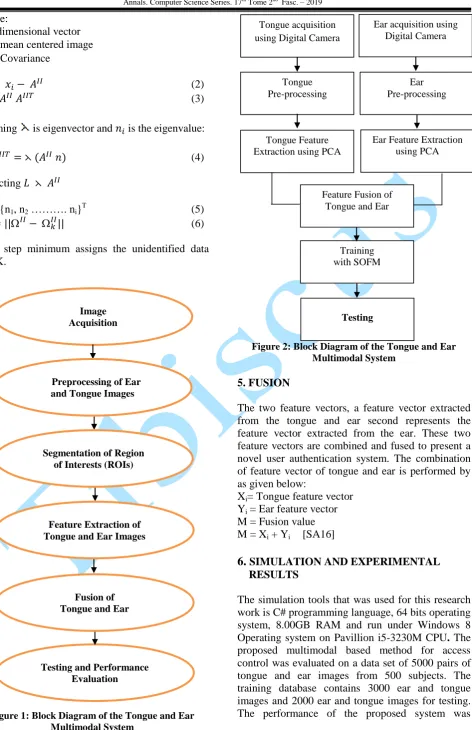
Data acquisition is the first stage of any pattern recognition process as shown in Figure 1. It is the process that involves the sampling of biometric feature and the conversion of these features into the form that can be manipulated by the computer. The data that were used in this research work was acquired using a digital camera. A programming
interface will be developed to acquire 3,000 ear and 2,000 tongue images of 500 subjects or volunteers (i.e. 500 * 6 for Ear and 500* 4 Tongue = 5,000). All these images will be stored and were used as training and testing datasets.
4.2. Data Preprocessing
The tongue and ear images acquired were fed as input to the preprocessing stage. The raw data collected were subjected to a number of preliminary steps to make it usable in the identification and verification stages. Feature extraction stage relied on the output of this preprocessing. The following preprocessing steps will be carried out in this research work:
Step 1: Resizing of Tongue and Ear Images
The acquired ear and tongue images were resized from the original dimension of 480×640 to 200×200 pixels.
Step 2: Extraction of Region of Interest (ROI)
A tongue and ear ROI extracting scheme must be extremely effective and efficient. As depicted in Figure 1, five stages will be followed in the extraction of ROI of resized ear and tongue images adopted from the work of [AA16]. The stages are as follows:
i. Median filter will be used to denoise the ear and tongue images.
ii. Binarizing the ear and tongue images by using Ostu thresholding algorithm.
iii. Apply edge detection algorithm to detect the boundary.
iv. Determine two important reference points and rotate image
v. Draw rectangle or square around the ROI
Step 3: Histogram Equalization (HE)
Histogram Equalization (HE) is a technique used to enhance quality of images for achieving more image information. This is a process of adjusting intensity values and transforming intensity value so that HE of the output image approximately matches a specified histogram. HE will be used in this research work to adjust the intensity of the binarized palm vein images. Also, it will improve the visual quality of the palm vein image and it will normalize it.
4.3. Feature Extraction
In principal component analysis, every eigenvalue and eigenvector are computed and arranged. Then, eigenvectors occurring at the topmost are selected to project the input data. Projecting the input into the selected eigenvectors, the size of the input data significantly decreased.
Where:
= dimensional vector = mean centered image C = Covariance
(2)
(3)
assuming is eigenvector and is the eigenvalue:
(4)
Projecting
II
= {n1, n2 ………. ni}T (5)
(6)
Final step minimum assigns the unidentified data into K.
Figure 1: Block Diagram of the Tongue and Ear Multimodal System
Figure 2: Block Diagram of the Tongue and Ear Multimodal System
5.FUSION
The two feature vectors, a feature vector extracted from the tongue and ear second represents the feature vector extracted from the ear. These two feature vectors are combined and fused to present a novel user authentication system. The combination of feature vector of tongue and ear is performed by as given below:
Xi= Tongue feature vector Yi = Ear feature vector M = Fusion value M = Xi + Yi [SA16]
6.
SIMULATION AND EXPERIMENTALRESULTS
The simulation tools that was used for this research work is C# programming language, 64 bits operating system, 8.00GB RAM and run under Windows 8 Operating system on Pavillion i5-3230M CPU. The proposed multimodal based method for access control was evaluated on a data set of 5000 pairs of tongue and ear images from 500 subjects. The training database contains 3000 ear and tongue images and 2000 ear and tongue images for testing. The performance of the proposed system was Image
Acquisition
Testing and Performance Evaluation Feature Extraction of Tongue and Ear Images
Fusion of Tongue and Ear Segmentation of Region
of Interests (ROIs) Preprocessing of Ear
and Tongue Images
Testing Training with SOFM Tongue acquisition
using Digital Camera
Tongue Pre-processing
Tongue Feature Extraction using PCA
Ear acquisition using Digital Camera
Ear Pre-processing
Ear Feature Extraction using PCA
evaluated based on recognition accuracy and Equal Error Rate (EER).
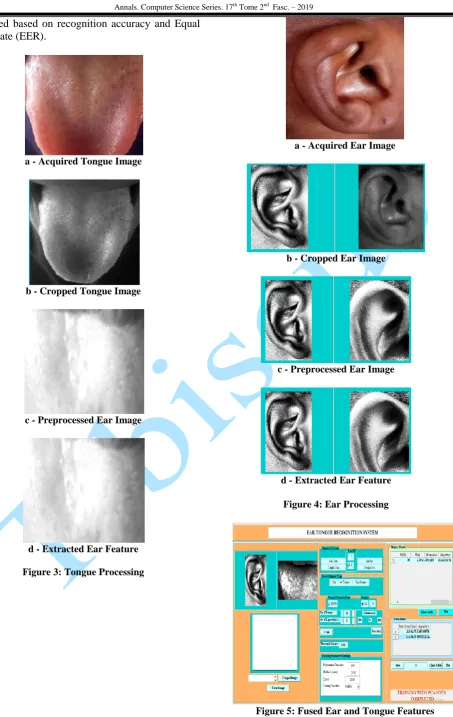
a - Acquired Tongue Image
b - Cropped Tongue Image
c - Preprocessed Ear Image
d - Extracted Ear Feature
Figure 3: Tongue Processing
a - Acquired Ear Image
b - Cropped Ear Image
c - Preprocessed Ear Image
d - Extracted Ear Feature
Figure 4: Ear Processing
Table 2: Comparison of Results with Different Multimodal biometric Systems
Author Traits Eer
%
Accuracy % Mansouri
[MMY17]
Gait Fusion 77.47
Kamer and Audun [KA17]
Iris and Fingerprint
0.00011 99.98
Mostafa [MAM18]
Ear and Face 0.5900
Sukhdev and Chander [SC18]
Finger Knuckle Print and Iris
99.58
Proposed Method
Ear and Tongue 0.003 99.73
The accuracy and performance of proposed method is measured by plotting False Acceptance Rate (FAR) and False Rejection Rate (FRR). It is impeccable that the performance of proposed multimodal method (Ear and Tongue) is better than individual biometric i.e. Ear and Tongue. As denoted in the Table 2 overhead, the projected method has 99.78% performance recognition and 0.003% error rate than appraised multimodal methods.
7. CONCLUSION
In this work, a multimodal biometric authentication system is proposed which uses ear and tongue features for access control. In this work, ear and tongue images were acquired by a digital camera and these images were stored in the database which form the data set used for both training and testing of the proposed system. The features of ear and face are extracted separately using PCA and Self Organizing Feature Map Neural Network (SOFM) is exploited for training and tasting of the proposed system. Using the databases, the research investigated reliability of proposed method and performance of multimodal biometric systems. The experimental results have revealed that multimodal biometric authentication system is much more reliable and it might be used in real-time authentication systems. The projected method has higher performance and low error rates other than appraised multimodal methods. Future work will take account of learning the effect on some optimization algorithms on the performance of the projected multimodal method and the taking on of more biometric traits.
REFERENCES
[AA16] L. J. Alwan, H. A. Alani - Region of
Interest Extraction of Palm Vein Image,
International Journal of Scientific &
Engineering Research, 7(12): 850-854, 2016.
[AKH15] S. A. Asmaa, K. G. Kareem, E. Hesham - Human Ear Recognition
Using Geometrical Features
Extraction, International Conference on
Communication, Management and Information Technology (ICCMIT), Procedia Computer Science (65): Pp. 529 – 537, 2015. Available from: https://www.prezi.com/0o1lr5lssutc/ton gue-scanner. [Last accessed on 2013 Oct 21]. Available from: http://www.dentistryiq.com/articles/201 4/01/new-oral-features-can-be-consider ed-unique-as-a-fingerprint.html. [Last accessed on 2015 Jun 24].
[AWS16] M. I. Ahmad, L. W. Wai, D. Satnam -
Non-Stationary Feature Fusion of Face
And Palmprint Multimodal Biometrics,
Journal Neuro-Computing, Volume 177 Issue C 2016 Pages 49-61.
[A+14] R. Azad, B. Azad, B. K. Nabil, J.
Shahram - Real-Time
Human-Computer Interaction Based on Face
and Hand Gesture Recognition,
International Journal in Foundations of Computer Science & Technology (IJFCST), Vol.4, No.4, Pp. 37-48, 2014.
[BAM99] S. Ben-Yacoub, Y. Abdeljaoued, E. Mayoraz - Fusion of Face and Speech
Data for Person Identity Verification,
IEEE Transaction on Neural Networks, Vol. 10, Pp. 1065–1074, 1999.
[B+15] A. Bade, K. Chavan, P. Admaner, R. Komatwar - Tongue Recognition
System for Authentication. Int J Res
Appl Sci Eng Technology; 3: 76-80, 2015.
[DS04] M. P. Down, R. J. Sands - Biometrics: An Overview of the Technology,
Challenges and Control
Considerations, Information Systems
Control Journal 4: 53-56, 2004.
[DDR10] M. Derawi, G. Davrondzhon, L. Rasmus - Fusion of Gait and Fingerprint for User Authentication on
[GD15] K. Gaganpreet, S. Dheerendra - A Novel Biometric System based on Hybrid
Fusion Speech, Signature and Tongue.
International Journal of Computer Applications; 119:30-39, 2015.
[HNC05] D. Hurley, M. Nixon, J. Carter -
Force Field Feature Extraction for Ear
Biometrics, Computer Vision Image
Understanding, Vol. 98, No.3, Pp. 491– 512, 2005.
[H+14] M.S Hiew, A. Hishammuddin, H. Rohayanti, M. O. Razib – Multimodal biometrics: Weighted score level fusion based on non-ideal iris and face
images, Expert Systems with
Applications (41): 5390– 5404, 2014.
[JBP01] A. K. Jain, R. Bolle, S. Pankanti -
Biometrics: Personal Identification in
Networked Society, Kluwer Academic
Publishers, 2001.
[JWM11] A. A. Jarjes, K. Wang, G. J. Mohammed - Improved Greed Snake Model for Detecting Accurate Pupil
Contour, In Proceedings of 3rd
International Conference on Advanced Computer Control (ICACC); pp. 515-519, 2011.
[Kav18] N. D. Kavitha - Authentication using
Multimodal Biometric Features,
International Journal of Computer Science and Mobile Computing, IJCSMC, Vol. 7, Issue 1, Pp.1– 8 2018.
[KA17] V. Kamer, J. Audun - A New Approach for Multi-Biometric Fusion
Based on Subjective Logic, Proceedings
of the International Conference on Internet of Things and Machine Learning ACM Digital Library. DOI:10.1145/3109761.3158409, 2017.
[L+07] Z. Liu , J. Q. Yan, D. Zhang, Q. L.
Tang - A Tongue-Print Image
Database for Recognition, Proceedings
of the Sixth International Conference on Machine Learning and Cybernetics, Hong Kong; August, Pp. 19-22, 2007.
[MAM18] A. Mostafa, N. Ali, M. A. Mostafa - A Multimodal Biometric Authentication
System Using Ear and Face, Journal of
Computers, Volume 13, Number 7, Pp. 876-888, 2018.
[MEH14] O. A. Musa, T. E. Elsheikh, M. E. Hassona - Tongues: Could They Also
Be Another Fingerprint, Indian J
Forensic Med Toxicol; 8:1171, 2014.
[MMY17] N. Mansouri, A. I. Mohammed, B. J. Yousra - Gait Features Fusion for
Efficient Automatic Age Classification,
Journal Institute of Engineering and Technology, Pp 1-7, 2017.
[P+14] J. Peng, A. Ahmed, L. Qiong, N.
Xiamu - Multimodal Biometric
Authentication Based on Score Level
Fusion of Finger Biometrics, Optik-
International Journal for Light and Electron Optics, 125(23): pp. 6891– 6897, 2014.
[RN05] J. Ruiz-Del-Solar, P. Navarrete -
Eigen Space Based Face Recognition: A Comparative Study of Different
Approaches, IEEE Transactions on
Systems, Man and Cybernetics, Part C, 35(3), pp. 315-325, 2005.
[RRH09] R. Raghavendra, A. Rao, K. G. Hemantha - A Novel Approach for Multimodal Biometric Score Fusion Using Gaussian Mixture Model and
Monte Carlo Method, International
Conference on Advances in Recent Technologies in Communication and Computing, 2009.
[SA16] K. Sujata, K. G. Ashok - A Hybrid Approach for Biometric Authentication using Fusion of Fingerprint and
Signature, International Journal of
Scientific Research Engineering & Technology (IJSRET), Volume 5, Issue 1, pp. 35-38, 2016.
[SC18] S. Sukhdev, K. Chander - An Efficient
Multimodal Biometric Verification
System using FKP and Iris,
International organization of Scientific Research, pp. 28-35, 2018.
[SJ16] G. Sanchita, S. Jayant - Multimodal Biometric System Using Finger Vein
and Ear Biometric, Journal of
Research (JETIR) Volume 3, Issue 7, 98-100, 2016.
[ST15] S. Sakshi, S. Tanvi - Speech and Iris
based Multimodal Biometric System,
International Journal of Engineering Development and Research Volume 3, Issue 3 Pp. 1-7, 2015.
[SMS17] M. Sayan, A. Mohamed, S. Shihab -
Multimodal Biometrics Recognition
from Facial Video via Deep Learning,
CS & IT-CSCP, pp. 67– 75, 2017.
[SZS14] B. Snehlata, A. S. Zadgaonkar, G. R. Sinha - PCA based Multimodal
Biometrics using Ear and Face
Modalities, I. J. Information
Technology and Computer Science, 05, 43-49, 2014.
[S+11] S. Suryadevara, R. Naaz, S. Kapoor, A. Sharma - Visual Cryptography Improvises the Security of Tongue as A
Biometric in Banking System, Computer
and Communication Technology (ICCCT), 2011 2nd International Conference; 1: 5, 2011.
[VA14] R. Vinothkanna, W. Amitabh - Fuzzy
Vault Fusion Based Multimodal
Biometric Human Recognition System
with Fingerprint and Ear, Journal of
Theoretical and Applied Information Technology Vol. 59 No.2 pp. 304-316, 2014.
[VY13] K. Vishi, S. Y. Yayilgan - Multimodal
Biometric Authentication Using
Fingerprint and Iris Recognition in
Identity Management, In Proceedings of
the 9th International Conference on Intelligent Information Hiding and Multimedia Signal Processing (IIH-MSP), pp. 334–341, 2013.
[YZ09] L. Yuan, F. Zhang - Ear detection
based on improved algorithm, In
Proceedings of International Conference on Machine Learning and Cybernetics, Vol. 4, pp. 2414–2417, 2009.
[Zui94] K. Zuiderveld - Contrast limited
adaptive histogram equalization,