SUMMER 2017, Vol 3, No 1, JOURNAL OF HYDRAULIC STRUCTURES Shahid Chamran University of Ahvaz
Journal of Hydraulic Structures J. Hydraul. Struct., 2017; 3(1):35-48
DOI: 10.22055/jhs.2017.13282
Developing Self-adaptive Melody Search Algorithm for
Optimal Operation of Multi-reservoir Systems
Seyed Mohammad Ashrafi*1 Seyedeh Fatemeh Ashrafi2 Saber Moazami3
Abstract
Operation of multi-reservoir systems is known as complicated and often large-scale optimization problems. The problems, because of broad search space, nonlinear relationships, correlation of several variables, as well as problem uncertainty, are difficult requiring powerful algorithms with specific capabilities to be solved. In the present study a Self-adaptive version of Melody Search algorithm is presented and applied to obtain Operating Rule Curves for multi-reservoir systems. The self-adaptive mechanism is implemented to satisfy problems constraints and perform algorithm parameters evolution going through different iterations. The research initially evaluates capability of extended algorithm using eight benchmark problems comparing other well-known metaheuristic algorithms, and verifies its effectiveness. Then, the algorithm is adopted for optimal operation of a four-reservoir system located in Karkheh river basin to properly meet agricultural requirements and to decrease the probability of major failures; and finally, the results are provided.
Keywords: Multi-reservoir operation; Melody Search Algorithm; Self-adaptive method; Operating rule curve; Demand deficit.
Received: 05 January 2017; Accepted: 22 June 2017
1. Introduction
Due to large number of decision variables, several multiple purposes, and uncertainty and risk ruling over multi-reservoir systems, these problems are considered as complex difficult problems of planning and decision-making area [1]. Since problems’ coordinated operation policies are hardly found due to the problem high dimensions, they are often termed as large
1 Department of Civil Engineering, Faculty of Engineering, Shahid Chamran University of Ahvaz, Ahvaz,
Iran. (*Corresponding author, [email protected])
2 Master graduated, Department of Irrigation and Drainage, Faculty of Water Sciences Engineering,
Shahid Chamran University of Ahvaz, Ahvaz, Iran.
3 Environmental Sciences Research Center, Department of Civil Engineering, Islamshahr Branch, Islamic
SUMMER 2017, Vol 3, No 1, JOURNAL OF HYDRAULIC STRUCTURES Shahid Chamran University of Ahvaz
scale problems [2]. Effective coordinated management of operating such systems implies a policy implementation leading to maximum benefits and or minimum costs for the whole system through controlling storage values and reservoir releases [3]. To attain the purpose, system operators and managers often prefer using operation rule curves based on system extant conditions. The operating rule curves are often hybrid simulation-optimization model outputs utilizing efficient search algorithms. In this case, the simulator model simulates system reaction using a particular operating rule curve; while, optimization algorithm tries to find optimal operation policy from all existing alternatives.
According to complex nature of multi-reservoir systems and regarding technical difficulties of the system management, search algorithms used in the models must be highly capable so that system simplicity assumptions are less used as much as possible and the considered system can be analyzed in much real conditions. Therefore, researchers have been always trying to find more capable efficient optimization approaches. In recent decades, different artificial intelligence-based approaches including evolutionary computation, metaheuristic algorithms, artificial neural networks, as well as fuzzy theory computation have substituted classic methods such as linear programing and dynamic programing in solving multi-reservoir management problems [4]. However, despite high-speed solution and great coordination of linear and dynamic programing approaches, respectively, in multi-reservoir operation problems; applying these approaches, due to functional constraints and computational difficulties, is neither possible nor cost-effective for any problem.
Although, using metaheuristic algorithms may never ensure attaining global optimal solutions; in practice, the algorithms have largely been succeeded in finding optimal solutions to unsolved problems through classic methods [5]. Of various metaheuristic algorithms, in the past years, genetic algorithms were widely used for reservoir optimization problem solving. Oliveira and Loucks, [1], presented an approach using a real-coded genetic algorithm to define reservoirs’ optimal operation curves. Wardlaw and Sharif, [6], employed and recommended genetic algorithm for definitive optimization of reservoir system operation as an effective approach. Sharif and Wardlaw [7], also, developed GA model for multi-reservoir system optimal operation and compared the results with policies of various DP-based models. Moreover, genetic algorithm was also used in a simulation-optimization model to determine a single-reservoir minimum and maximum operating optimal curves [8]. Dariane and Momtahen, [9], benefited a typical genetic algorithm model to specify operating rule curve parameters from a single purpose multi-reservoir system. The results were compared to the results obtained from popular optimization models such as SDP and DPR.
three-SUMMER 2017, Vol 3, No 1, JOURNAL OF HYDRAULIC STRUCTURES Shahid Chamran University of Ahvaz
reservoir system through using a multi-swarm optimization algorithm, MSPSO, and the popular simulator model HEC-ResPRM.
Fang et al., [15], proposed joint operating rules including; water diversion rule, hedging rule, and storage allocation rule to optimal operate of a multi-reservoir system. The predefined rules determined the amount of diverted water in a current period, the total release from the system, and the reservoirs’ releases, respectively. A modified version of Particle Swarm Optimization (PSO) algorithm implemented within a simulation-optimization approach to optimize the key points of the water diversion curves, the hedging rule curves, and the target storage curves. Ashrafi, [16], applied an Efficient Adaptive version of Melody Search (EAMS) algorithm to find optimal operation policy of multi-reservoir systems. EAMS was adopted within a simulation-optimization framework to derive optimal operating rule curves for a multi-reservoir system in Iran. The obtained results showed the superiority of the developed approach in comparison with other conventional methods. A combined water and hydropower operating rule was introduced by Zhou et al., [17], to enhance the efficiency of multi-reservoir system operation. Three modules formed the main framework. A deterministic module derived the optimal reservoir storage policy a fitting module determined the optimal releases of the reservoirs and finally, a testing module was utilized to test the derived operating rules with observed inflows. Ashrafi and Dariane, [18], proposed Coupled Operating Rules (COR) to optimally operate multi-reservoir systems with distributed local demands. They defined some decision points within the considered system and suggested application of two types of linear rules to determine total releases and local water allocations in decision points. The main objective of the study was reducing the intensity of the local demand shortages throughout the system. The proposed algorithm was more effective in achieving precise solutions over a long-term period, compared to other conventional algorithms. Ak et al., [19], developed a non-linear programming model to obtain optimal operating policies for hydropower plants in single-reservoir systems. Maximization of the average annual energy generation was assumed as the main objective of the study where the short term electricity price variations were considered and be incorporated into the long-term plan.
Bozorg-Haddad et al., [20], applied conflict resolution methods to extract compromise solutions for water resources management problems. The Genetic Programing approach was utilized to calculate monthly, real-time, water allocation rule curves regarding the urban-industrial, agricultural, and environmental water uses downstream of the Zarrineh-roud River basin. Despite many studies conducted on the area of multi-reservoir systems operation optimization, scholars are still determined to come across algorithms and solutions leading to better solutions with cost-effective computational expenses. The present paper has attempted to extract an optimal operation policy from a four-reservoir system with scattered requirements through establishing a new powerful Self-adaptive Melody Search (SaMeS) optimization algorithm. The problem purpose is to properly supply agricultural demands in the whole system and to enhance reliability and decrease system failures.
SUMMER 2017, Vol 3, No 1, JOURNAL OF HYDRAULIC STRUCTURES Shahid Chamran University of Ahvaz
Generally, MeS is more powerful in solving continuous problems with broad search space and high dimensions than other variants of HS. The algorithm was later explained in more details by scholars and more extensive experiments were carried out through introducing an adaptive version of MeS [25]. Most recently, the MeS algorithm was adopted in different researches as a powerful optimization algorithm to prove the capabilities of innovative metaheuristic methods (e.g. [26]; [27]; [28]). Moreover, some novel hybrid optimization algorithms were introduced based on the MeS algorithm to solve different real-word engineering problems efficiently (e.g. [29]; [30]).
2. Multi-reservoir system operation
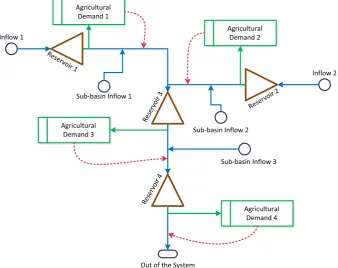
The research objective is achieving an optimal operation policy of a four-reservoir system located in Karkheh River basin for a long-term period (47 years). Karkheh River, situated in southwest, carries the third volume of water in Iran and is critical respecting surface water resources. Understudied system includes four reservoirs of Sazbon, Tang mashoureh, Pa Alam and Karkheh (which are schematically shown in Figure 1 as Reservoir 1 to 4, respectively), and four agricultural areas. Figure 1 schematically shows the system. System main purposes are agricultural land development, region flood control, as well as supplying environmental requirements. The modelled agricultural demands at Karkheh reservoir downstream is considered as total agricultural needs of Dasht-e Abbas, Avan, Dousalgh, Arayez, Bagheh, and lower Karkheh area.
Agricultural Demand 1
Agricultural Demand 2
Agricultural Demand 3
Agricultural Demand 4
Out of the System Inflow 1
Inflow 2
Sub-basin Inflow 1
Sub-basin Inflow 2
Sub-basin Inflow 3
Rese rvoir 1
Reser voir 2
Rese rvoi
r 3
Rese rvoi
r 4
Figure 1. Schematic illustration of considered multi-reservoir system
SUMMER 2017, Vol 3, No 1, JOURNAL OF HYDRAULIC STRUCTURES Shahid Chamran University of Ahvaz
Table 1. Characteristics of reservoirs and agricultural demands
Reservoir: 1 2 3 4
Total Storage Capacity (mcm) 1608 950 3127 7600
Dead Storage Capacity (mcm) 957 352 1842 433
Active Storage Capacity (mcm) 650 598 1285 7167
Average Annual Net Evaporation (mm) 1334 1252 1580 2079
Annual agricultural demand
Agricultural area: 1 2 3 4
Annual Demand (mcm) 400 300 307 3700
Distributed multiple demand areas and how they are localized in the system have made a complicated problem, optimization of which requires using a capable and adaptable optimization method.
3. Optimization problem
Meeting environmental requirements and agricultural demands were considered as system main objectives for modeling. In this context, environmental requirements at different river tributaries were modeled as the model constraints and meeting agricultural demands as problem objective function. As a result, the problem objective function to minimize shortage values of agricultural areas in a long-term period is assumed as follows.
(1)
T t nj t j
j t j t D TD RD TD OF Min 1 1 2 , , ,
Where, TDt,j and RDt,jstand for demand and release to j th
agricultural area in tth time period, respectively. The nD indicates total number of agricultural areas and T is the last period of time
horizon. The advantage of applying this particular form of objective function is that it tries to equally distribute system deficiencies, as much as possible, depending on the amount of defined demand in different regions and at different periods. Model constraints including mass continuity equation in reservoirs, reservoir storage limits, flow rate limits for meeting agricultural demands, limits of minimum flows at river various tributaries and final storage constraints are defined as follows:
(2) R j t j t j t j t j t j t j t n j T t for Spill Eva RD RR Inflow S S ,..., 2 , 1 ..., , 2 , 1 : , , , , , , , 1 (3) R j j t j n j T t for S S S ,..., 2 , 1 ..., , 2 , 1 : max min , (4) D j t j t n j T t for TD RD ,..., 2 , 1 ..., , 2 , 1 :
0 , ,
(5) j
t j
t MFR
RR, ,
(6)
j T j S
S1, 1,
SUMMER 2017, Vol 3, No 1, JOURNAL OF HYDRAULIC STRUCTURES Shahid Chamran University of Ahvaz
jth reservoir in month t, for satisfying local agriculture demand. Inflowt,j, Evat,j, Spillt,j are the
amount of total inflows, net evaporation loss and amount of spilled water for jth reservoir during
tth time period, respectively. Sminj and Smaxj are minimum and maximum storage volumes for
the jth reservoir, respectively, and MFRt,j is the minimum flow requirement in month t
downstream jth reservoir.
4. The proposed optimization algorithm
In the present study a modified version of Melody Search algorithm is proposed to find optimal operating rule curves of multi-reservoir systems. In order to enhance the MeS algorithm ability in a long-term multi-reservoir system optimization, a Self-adaptive adjusted scheme is implemented requiring no predetermined algorithm parameter values. Despite the obvious superiority of MeS algorithm to HS and other its variants, the algorithm suffers from large numbers of parameters. Number of algorithm parameters is decreased in the new released versions of MeS and the accuracy is intensified [25]. To increase algorithm efficiency, three parallel linear equations are applied in Player Memory Consideration (PMC) operator of the proposed algorithm (SaMeS). These equations determine the variables value for new melody improvisation in each memory, as follows:
(7)
Xk
i, new= X k
i,L ± rand ( ) × bw(k) where L U(1, …, PMS)
(8)
Xk
i, new= X h
i,L ± rand ( ) × bw(k) where L U(1, …, PMS) and h U(1, …, D)
(9)
Xk
i, new= X k
g, best where g U(1, …, PMN) and best: the best melody form the specified PM
To obtain the current variable value, for the first equation, a linear relationship is set with one of corresponding variables selected from the player memory. Respecting the second equation, the linear relationship is established with a non-corresponding variable randomly selected from the extant melody variables in memory. Value of the considered variable, in the third equation, equals corresponding variables in the best existing melody in one of the memories. Aforementioned relationships are utilized relying on how well they succeeded in producing top melodies through using success rate parameter (SPα). At onset, success rate value is assumed
equal for all three relationships; then, it is measured and upgraded following a series of given iterations (Lp) based upon produced top melodies.
Algorithm 1. Determining the possible variable ranges
For each k ∈ [1,…, D] do LBk = min (x
k
i, best , i=1,…, PMN) – [max (x k
i, best , i=1,…, PMN) – x k
Group-Best]
UBk = max (x k
i, best , i=1,…, PMN) + [x k
Group-Best– min (x k
i, best , i=1,…, PMN)]
Done
Parameter values of Player Memory Consideration Rate (PMCR), Pitch Adjusting Rate (PAR), and Bandwidth Distance (bw) for each top melody successfully entered memory are stored; and mean values, at a given number of iteration, are recognized as the relevant parameter values for further iterations.
The calculation of random possible variable ranges in the proposed algorithm are demonstrated in Algorithm 1 where, best subscript indicates the best found solution in each melody memory, xki,best is the kth variable of the best solution stored in ith memory, Group-Best
SUMMER 2017, Vol 3, No 1, JOURNAL OF HYDRAULIC STRUCTURES Shahid Chamran University of Ahvaz
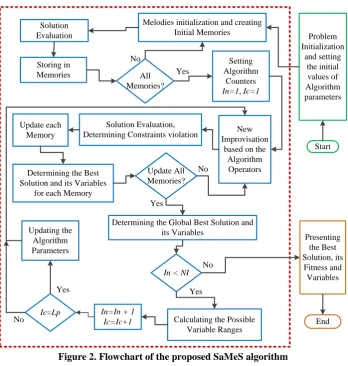
subscript stands for the best found solution throughout all memories, and xkGroup-Best is the kth variable of the Global-Best solution. Hence, the permissible search space for randomization is symmetrically determined around the Global-Best solution of Melody Memory (MM) in each iteration. Figure 2 represents the flowchart of the proposed algorithm for solving constrained multi-reservoir optimization problem.
Start Problem Initialization
and setting the initial values of Algorithm parameters Melodies initialization and creating
Initial Memories Solution
Evaluation
Storing in
Memories All
Memories?
New Improvisation
based on the Algorithm
Operators Update each
Memory
Yes No
Yes Yes
No
In=In + 1 Ic=Ic+1
No
Setting Algorithm
Counters
In=1, Ic=1
Determining the Best Solution and its Variables
for each Memory
Update All Memories?
Determining the Global Best Solution and its Variables
In < NI
Calculating the Possible Variable Ranges
Ic=Lp
Updating the Algorithm Parameters
Presenting the Best Solution, its Fitness and
Variables
End Yes
No
Solution Evaluation, Determining Constraints violation
Figure 2. Flowchart of the proposed SaMeS algorithm
SUMMER 2017, Vol 3, No 1, JOURNAL OF HYDRAULIC STRUCTURES Shahid Chamran University of Ahvaz
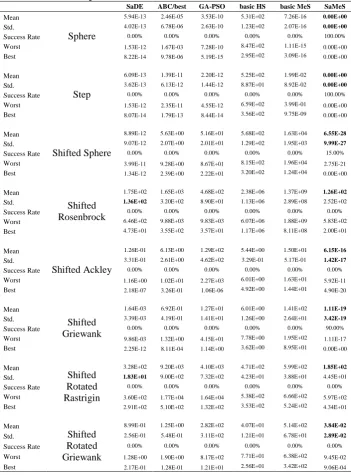
Table 2. Results for problems with 50 dimensions (D=50) and NoFE=50,000
SaDE ABC/best GA-PSO basic HS basic MeS SaMeS
Mean
Sphere
5.94E-13 2.46E-05 3.53E-10 5.31E+02 7.26E-16 0.00E+00
Std. 4.02E-13 6.78E-06 2.63E-10 1.23E+02 2.07E-16 0.00E+00
Success Rate 0.00% 0.00% 0.00% 0.00% 0.00% 100.00%
Worst 1.53E-12 1.67E-03 7.28E-10 8.47E+02 1.11E-15 0.00E+00
Best 8.22E-14 9.78E-06 5.19E-15 2.95E+02 3.09E-16 0.00E+00
Mean
Step
6.09E-13 1.39E-11 2.20E-12 5.25E+02 1.99E-02 0.00E+00
Std. 3.62E-13 6.13E-12 1.44E-12 8.87E+01 8.92E-02 0.00E+00
Success Rate 0.00% 0.00% 0.00% 0.00% 0.00% 100.00%
Worst 1.53E-12 2.35E-11 4.55E-12 6.59E+02 3.99E-01 0.00E+00
Best 8.07E-14 1.79E-13 8.44E-14 3.56E+02 9.75E-09 0.00E+00
Mean
Shifted Sphere
8.89E-12 5.63E+00 5.16E+01 5.68E+02 1.63E+04 6.55E-28
Std. 9.07E-12 2.07E+00 2.01E+01 1.29E+02 1.95E+03 9.99E-27
Success Rate 0.00% 0.00% 0.00% 0.00% 0.00% 15.00%
Worst 3.99E-11 9.28E+00 8.67E+01 8.15E+02 1.96E+04 2.75E-21
Best 1.34E-12 2.39E+00 2.22E+01 3.20E+02 1.24E+04 0.00E+00
Mean
Shifted Rosenbrock
1.75E+02 1.65E+03 4.68E+02 2.38E+06 1.37E+09 1.26E+02
Std. 1.36E+02 3.20E+02 8.90E+01 1.13E+06 2.89E+08 2.52E+02
Success Rate 0.00% 0.00% 0.00% 0.00% 0.00% 0.00%
Worst 6.46E+02 9.88E+03 9.83E+03 6.07E+06 1.88E+09 5.83E+02
Best 4.73E+01 3.55E+02 3.57E+01 1.17E+06 8.11E+08 2.00E+01
Mean
Shifted Ackley
1.26E-01 6.13E+00 1.29E+02 5.44E+00 1.50E+01 6.15E-16
Std. 3.31E-01 2.61E+00 4.62E+02 3.29E-01 5.17E-01 1.42E-17
Success Rate 0.00% 0.00% 0.00% 0.00% 0.00% 0.00%
Worst 1.16E+00 1.02E+01 2.27E+03 6.01E+00 1.63E+01 5.92E-11
Best 2.18E-07 3.26E-01 1.06E-06 4.92E+00 1.44E+01 4.90E-20
Mean
Shifted Griewank
1.64E-03 6.92E-01 1.27E+01 6.01E+00 1.41E+02 1.11E-19
Std. 3.39E-03 4.19E-01 1.41E+01 1.26E+00 2.64E+01 3.42E-19
Success Rate 0.00% 0.00% 0.00% 0.00% 0.00% 90.00%
Worst 9.86E-03 1.32E+00 4.15E+01 7.78E+00 1.95E+02 1.11E-17
Best 2.25E-12 8.11E-04 1.14E+00 3.62E+00 8.95E+01 0.00E+00
Mean
Shifted Rotated Rastrigin
3.28E+02 9.20E+03 4.10E+03 4.71E+02 5.99E+02 1.85E+02
Std. 1.83E+01 9.00E+02 7.32E+02 4.23E+01 3.88E+01 4.45E+01
Success Rate 0.00% 0.00% 0.00% 0.00% 0.00% 0.00%
Worst 3.60E+02 1.77E+04 1.64E+04 5.38E+02 6.66E+02 5.97E+02
Best 2.91E+02 5.10E+02 1.32E+02 3.53E+02 5.24E+02 4.34E+01
Mean
Shifted Rotated Griewank
8.99E-01 1.25E+00 2.82E+02 4.07E+01 5.14E+02 3.84E-02
Std. 2.56E-01 5.48E-01 3.11E+02 1.21E+01 6.78E+01 2.89E-02
Success Rate 0.00% 0.00% 0.00% 0.00% 0.00% 0.00%
Worst 1.28E+00 1.90E+00 8.17E+02 7.71E+01 6.38E+02 9.45E-02
Best 2.17E-01 1.28E-01 1.21E+01 2.56E+01 3.42E+02 9.06E-04
SUMMER 2017, Vol 3, No 1, JOURNAL OF HYDRAULIC STRUCTURES Shahid Chamran University of Ahvaz
dimensioned broad continuous search space.
5. Results
As earlier explained, a metaheuristic simulation-optimization model is developed to determine the best operation policy of a four-reservoir water resources system. Reservoirs’ monthly releases are estimated according to reservoir monthly mean storage volume and predefined operating rule curves. The simulator, models system details per optimization algorithm solution and computes objective function value and problem constraints violation. Decision variables considered in optimization model determine specified reservoirs’ rule curves. To eliminate non-feasible solutions, dominance feasible solutions method was applied using values of constraints violation.
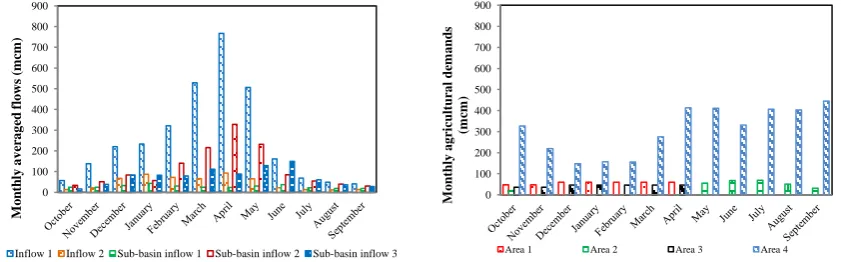
Two operation rule curves are defined for each reservoir including, Upper and Lower rules. The predefined rules determine the wet, normal and dry conditions for reservoir operators. In a case that reservoir storage per given month is higher than the upper operation curve level, discharge would be equal to total local agricultural demand of the reservoir plus reservoir storage difference to the upper operation curve level. This additional volume supplies downstream reservoirs and other regional needs, when the reservoir monthly storage indicates wet condition. If reservoir storage volume is between two operation curves, reservoir release would just equal to local demands (normal condition). When reservoir storage volume is less than the lower curve, only 70% of local agricultural demand, which is not smaller than minimum environmental flow would be released (dry condition). Figure 3 illustrates mean monthly inflows and monthly demands defined in the system. As illustrated in Figure 1, return flows of agricultural areas supply downstream local demands and reservoirs, even in dry condition.
Figure 3. Averaged monthly inflows and agricultural demands
According to inflow statistics and system requirements in a long-term 47-year period, reservoirs operation rule curves are determined in a way that the lowest distributed deficiency in the whole system is obtained. To solve the considered problem, SaMeS algorithm with 5 player memories and 5 melodies in each memory was provided. Maximum iteration number for optimal solution was set 50,000. Respecting 30 independent executions, mean solutions obtained 91.04 for objective function at standard deviation 90.23. Of these, the best and worst solutions were 25.7 and 324.87, respectively for objective function revealing that the algorithm is well converged to the problem optimum solution.
0 100 200 300 400 500 600 700 800 900
M
o
n
th
ly
a
v
er
a
g
ed
f
lo
ws
(m
cm
)
Inflow 1 Inflow 2 Sub-basin inflow 1 Sub-basin inflow 2 Sub-basin inflow 3
0 100 200 300 400 500 600 700 800 900
M
ont
hl
y
agri
cul
tural
dem
and
s
(m
cm
)
SUMMER 2017, Vol 3, No 1, JOURNAL OF HYDRAULIC STRUCTURES Shahid Chamran University of Ahvaz
600 800 1000 1200 1400 1600 1800
1 3 5 7 9 11
S to ra g e v o lu m e ( m c m ) Months Reservoir 1
Smin Lower RC Upper RC Smax
Dry Zone
Normal Zone Wet Zone 600 800 1000 1200 1400 1600 1800
0 100 200 300 400 500 600
Re se rv o ir s to ra g e ( m c m ) Monts Reservoir 1
200 300 400 500 600 700 800 900 1000
1 3 5 7 9 11
S to ra g e v o lu m e (m cm ) Months Reservoir 2
Smin Lower RC Upper RC Smax
Normal Zone Wet Zone
Dry Zone
200 300 400 500 600 700 800 900 1000
0 100 200 300 400 500 600
Re se rv o ir s to ra g e Months Reservoir 2
1000 1500 2000 2500 3000 3500
1 3 5 7 9 11
S to ra g e v o lu m e (m cm ) Months Reservoir 3
Smin Lower RC Upper RC Smax
Dry Zone Normal Zone
Wet Zone 1000 1500 2000 2500 3000 3500
0 100 200 300 400 500 600
Re se rv o ir s to ra g e Months Reservoir 3
0 1000 2000 3000 4000 5000 6000 7000 8000
1 3 5 7 9 11
St o ra g e v o lu m e (m cm ) Months Reservoir 4
Smin Lower RC Upper RC Smax
Dry Zone Normal Zone
Wet Zone 0 1000 2000 3000 4000 5000 6000 7000 8000 9000
0 100 200 300 400 500 600
Re se rv o ir s to ra g e Months Reservoir 4
Figure 4. Operation rule curves and simulated storage variation of reservoirs
SUMMER 2017, Vol 3, No 1, JOURNAL OF HYDRAULIC STRUCTURES Shahid Chamran University of Ahvaz
such that downstream released flow would be maximized in most months due to low local agricultural demands.
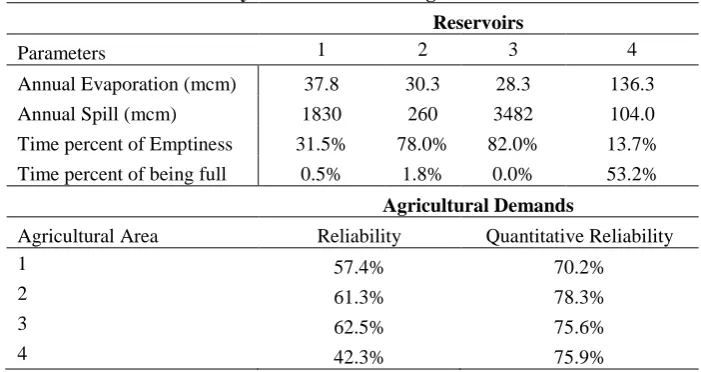
Moreover, Reservoir 3, which contributes as additional storage supplying downstream requirements, has rule curves tending to release flow and supply Reservoir 4. Optimal operating rule curves of Reservoir 2 and Reservoir 4 are set such that the maximum possible values of reservoirs volume are attributed to supply their local requirements. The results are consistent with systemic optimization concepts demonstrating optimization of operation process. Table 3 summarizes simulated results of all four reservoirs through using optimum systemic operation curves for a long-term 47-year period.
According to the achieved results related to the best solution, all demands showed approximately close quantitative reliability, which was the purpose sought for in the model objective function definition. Thus, the model tries to distribute the deficits for different periods respecting basin requirements and to prevent great failures; while, demands time reliability was different. Moreover, it is observed that Reservoir 3 plays the supportive role for Reservoir 4; further, it was full overflowing during the long-term period supplying downstream demands. The reservoir empty percentage is zero.
Table 3. Results of system simulation using the best obtained rules
Reservoirs
Parameters 1 2 3 4
Annual Evaporation (mcm) 37.8 30.3 28.3 136.3
Annual Spill (mcm) 1830 260 3482 104.0
Time percent of Emptiness 31.5% 78.0% 82.0% 13.7%
Time percent of being full 0.5% 1.8% 0.0% 53.2%
Agricultural Demands
Agricultural Area Reliability Quantitative Reliability
1 57.4% 70.2%
2 61.3% 78.3%
3 62.5% 75.6%
4 42.3% 75.9%
SUMMER 2017, Vol 3, No 1, JOURNAL OF HYDRAULIC STRUCTURES Shahid Chamran University of Ahvaz
0.00 10.00 20.00 30.00 40.00 50.00 60.00 70.00
Averaged monthly deficits (mcm)
Demand 1 Demand 2 Demand 3 Demand 4
0.00 100.00 200.00 300.00 400.00 500.00 600.00 700.00 800.00
Averaged monthly spill of Reservoirs (mcm)
Reservoir 1 Reservoir 2 Reservoir 3 Reservoir 4
Figure 5. Averaged monthly demands’ deficits and reservoirs’ spills
6. Conclusion
The present research attempted to determine a four-reservoir system operation, located in Karkheh River, through developing a capable optimization-simulation model. The optimization algorithm was an improved Self-adaptive Melody Search algorithm. According to research findings, it may be concluded that the proposed algorithm is highly competent and efficient for solving complicated continuous problems in comparison to the well-known optimization algorithms. The proposed algorithm outperformed other well-known algorithms in statistical comparisons and attained the best solution. The proposed SaMeS algorithm benefits from the multi-memories structure and utilizing a self-adaptive mechanism. The cooperative rule curves for a multi-reservoir system achieved by the proposed simulation-optimization approach is able to manage the diversity of demand deficits in a long-term period. The Quantitative Reliability of different local demands are determined as close as possible where the optimal rule curves reduce the total losses of reservoirs such as spill and net evaporation. In general, each agricultural area encounters the least failure probability. This is the best policy to deal with systemic water resources problems, which would never be achieved in individual reservoir analysis.
7. References
1. Oliveira R., and Loucks D.P. (1997). Operating Rules for Multi-reservoir Systems. Water Resources Res., 33, 839-852.
2. Wang KW, Chang LC, Chang FJ, (2011). Multi-tier interactive genetic algorithms for the optimization of long-term reservoir operation. Adv Water Resour; 34(10):1343-1351. 3. Mahootchi M, Ponnambalam K, Tizhoosh H. (2010). Operations optimization of
multireservoir systems using storage moments equation. Adv Water Resour; 33(9):1150-1163.
4. Chaves P, Chang FJ, (2008). Intelligent reservoir operation system based on evolving artificial neural networks. Adv Water Resour; 31(6):926-936.
5. Moazami, S., Abdollahipour, A., Zakeri Niri, M., & Ashrafi, S. M. (2016). Hydrological Assessment of Daily Satellite Precipitation Products over a Basin in Iran. Journal of Hydraulic Structures, 2(2), 35-45.
6. Wardlaw R, Sharif M, (1999). Evaluation of Genetic Algorithms for Optimal Reservoir System Operation. Journal of Water Resources Planning and Management 125(1): 25-33. 7. Sharif M, Wardlaw R, (2000). Multireservoir systems optimization using genetic algorithms:
SUMMER 2017, Vol 3, No 1, JOURNAL OF HYDRAULIC STRUCTURES Shahid Chamran University of Ahvaz
8. Suiadee W, Tingsanchali T, (2007). A combined simulation–genetic algorithm optimization model for optimal rule curves of a reservoir: a case study of the Nam Oon Irrigation Project, Thailand. Hydrol. Process 2007; 21(23): 3211–3225.
9. Dariane AB, Momtahen Sh, (2009), “Optimization of multireservoir systems operation using modified direct search genetic algorithm”, J. Water Resour Plann Manage; 135(3): 141– 148.
10. Jalali MR, Afshar A, Marino MA, (2003), “Reservoir Operation by Ant Colony Optimization Algorithms”, online paper; http://www.optimizationonline.org/DB FILE/2003/07/696.pdf, (accessed on 10/12/2004).
11. Kumar D. N., Reddy M. J. (2006). Ant colony optimization for multi-purpose reservoir operation. Water Resour Manage; 20(6): 879-898.
12. Kumar D. N., Reddy M. J. (2007). Multipurpose reservoir operation using particle swarm optimization. J. Water Resour Plann Manage. 133(3): 192-201.
13. Fu X, Li A, Wang L, Ji C. (2011). Short-term scheduling of cascade reservoirs using an immune algorithm-based particle swarm optimization. Computers and Mathematics with Applications; 62 (6): 2463–2471.
14. Ostadrahimi L, Mariño MA, Afshar A, (2012). reservoir Operation Rules: Multi-swarm PSO-based Optimization Approach. Water Resour Manage; 26:407–427.
15. Fang, H. B., Hu, T. S., Zeng, X., & Wu, F. Y. (2014). Simulation-optimization model of reservoir operation based on target storage curves. Water Science and Engineering, 7(4), 433-445.
16. Ashrafi S. M. (2015). Multi-reservoir Optimal Operation using Efficient Adaptive Melody Search Algorithm (EAMS). Proceeding of 10th International Congress on Civil Engineering, University of Tabriz, Tabriz, Iran.
17. Zhou, Y., Guo, S., Liu, P., Xu, C. Y., & Zhao, X. (2016). Derivation of water and power operating rules for multi-reservoirs. Hydrological Sciences Journal, 61(2), 359-370. 18. Ashrafi, S. M., & Dariane, A. B. (2017). Coupled Operating Rules for Optimal Operation of
Multi-Reservoir Systems. Water Resources Management, 31(14), 4505-4520.
19. Ak, M., Kentel, E., & Savasaneril, S. (2017). Operating policies for energy generation and revenue management in single-reservoir hydropower systems. Renewable and Sustainable Energy Reviews, 78, 1253-1261.
20. Bozorg-Haddad, O., Athari, E., Fallah-Mehdipour, E., & Loáiciga, H. A. (2017). Real-time water allocation policies calculated with bankruptcy games and genetic programing. Water Science and Technology: Water Supply, ws2017102.
21. Ashrafi, S. M., & Dariane, A. B. (2011). A novel and effective algorithm for numerical optimization: melody search (MS). In Hybrid Intelligent Systems (HIS), 2011 11th International Conference on (pp. 109-114). IEEE.
22. Ashrafi, S. M., & Dariane, A. B. (2012). Application of Improved Harmony Search Algorithm in Optimal Operation of Multi-purpose Reservoirs. Proceeding of 9th International Congress on Civil Engineering, Isfahan, Iran.
23. Ashrafi, S. M., & Dariane, A. B. (2013). Performance evaluation of an improved harmony search algorithm for numerical optimization: Melody Search (MS). Engineering applications of artificial intelligence, 26(4), 1301-1321.
SUMMER 2017, Vol 3, No 1, JOURNAL OF HYDRAULIC STRUCTURES Shahid Chamran University of Ahvaz
Search Algorithm. International Journal of Applied Metaheuristic Computing (IJAMC), 6(3), 1-37.
26. Xiang, W. L., An, M. Q., Li, Y. Z., He, R. C., & Zhang, J. F. (2014). An improved global-best harmony search algorithm for faster optimization. Expert Systems with Applications, 41(13), 5788-5803.
27. Zhao, F., Liu, Y., Zhang, C., & Wang, J. (2015). A self-adaptive harmony PSO search algorithm and its performance analysis. Expert Systems with Applications, 42(21), 7436-7455.
28. Koupaei, J. A., Hosseini, S. M. M., & Ghaini, F. M. (2016). A new optimization algorithm based on chaotic maps and golden section search method. Engineering Applications of Artificial Intelligence, 50, 201-214.
29. Shivaie, M., & Ameli, M. T. (2016). Strategic multiyear transmission expansion planning under severe uncertainties by a combination of melody search algorithm and Powell heuristic method. Energy, 115, 338-352.
30. Kiani-Moghaddam, M., & Shivaie, M. (2017). An Innovative Stage Multi-Dimensional Multiple-Inhomogeneous Melody Search Algorithm: Symphony Orchestra Search. In Bio-Inspired Computing for Information Retrieval Applications (pp. 1-40). IGI Global.
31. Lee, K. S., & Geem, Z. W. (2005). A new meta-heuristic algorithm for continuous engineering optimization: harmony search theory and practice. Computer methods in applied mechanics and engineering, 194(36), 3902-3933.
32. Qin AK, Huang VL and Suganthan PN, (2009), Differential Evolution Algorithm With Strategy Adaptation for Global Numerical Optimization. IEEE transaction on evolutionary computation, Vol. 13, No. 2, April 2009, pp. 398-417.
33. Gao W., Liu S., Huang L., (2012), “A global best artificial bee colony algorithm for global optimization”, Journal of Computational and Applied Mathematics 236, 2741–2753. 34. Kao YT, Zahara E, (2008), “A hybrid genetic algorithm and particle swarm optimization for