Http://www.ijetmr.com©International Journal of Engineering Technologies and Management Research [123]
DYNAMIC SIMULATION AND TEST ANALYSIS OF SPACE TRUSS AND
LOAD STRUCTURE
Haitao Luo 1, Peng Wang 2, Tingke Wu 3, Haonan Wang 2
1
Shenyang Institute of Automation Chinese Academy of Sciences, P.R. China
2
Northeastern University, P.R. China
3
Shenyang Ligong University, P.R.China
Abstract:
The dynamic characteristics of aerospace products play a decisive role in environmental adaptability of products, because aerospace products are subjected to vibration environment during launching process. This paper describes the design of a space truss and the load structure, in order to get the dynamic characteristics, finite element modal analysis and modal test is done on the structural model, through correlation analysis to determine the degree of conformity of the finite element model with the experimental model. It is determined that the finite element mode of truss and load structure is similar to the test mode, the finite element model is acceptable; The dynamic simulation of the structure is carried out by the qualified finite element model, and the dynamic simulation results are verified by the vibration test; The method for obtaining the dynamic characteristics of aerospace products and the way of dynamic simulation for launching process is of great reference value for the design of aerospace products.
Keywords: Space Truss and Load; Dynamic Simulation; Vibration Test; Modal Test; Correlation Analysis.
Cite This Article: Haitao Luo, Peng Wang, Tingke Wu, and Haonan Wang. (2018). “DYNAMIC SIMULATION AND TEST ANALYSIS OF SPACE TRUSS AND LOAD STRUCTURE.” International Journal of Engineering Technologies and Management Research, 5(3), 123-133. DOI: https://doi.org/10.29121/ijetmr.v5.i3.2018.183.
1. Introduction
As the spacecraft moves towards a larger, more complicated direction. The space truss [1] is widely used because of its easy disassembly, good technology and light quality, and it can be adjusted according to specific needs. It is also an important part of the international space station. The application of space truss in space was first launched on August 20 and September 5, 1977 by Voyager 2 and 1[2].
DOI: 10.5281/zenodo.1216829
Http://www.ijetmr.com©International Journal of Engineering Technologies and Management Research [124]
aerodynamic noise of the transonic flight section and the pressure pulsation in the engine combustion chamber. The low-frequency sinusoidal vibration [3] is primarily a free oscillation of the low order mode of the elastomers caused by pogo vibration and engine start, ignition quenching and the stage separation; the turbulence caused by the shock wave of the wind and transonic flight segments, and the low-order longitudinal oscillation caused by incomplete combustion of the engine. This kind of low frequency vibration environment [4-5] can make the space truss structure damaged, loose connections, structural deformation, the phenomenon of performance degradation, and the vibration can reduce photoelectric instrument accuracy, mechanical fatigue, circuit instantaneous short circuit, open circuit, even function failure [6].
Therefore, in space product design, it is particularly important to obtain the accurate dynamic characteristics of the product, and the product dynamic characteristics are obtained mainly through the finite element simulation and test method, while the advantages of the finite element simulation are emerging. At present, there are many methods for judging the degree of conformity of the experimental model and the finite element model, mainly including correlation analysis of frequency and vibration type, direct orthogonal correlation analysis, cross-orthogonal correlation analysis and frequency response function correlation analysis[7]. If we can establish a benchmark finite element model that meets the requirements of engineering precision and can accurately reflect the dynamic characteristics of the space test device, it will undoubtedly play an important role in mastering the anti-vibration performance of the space products in the launch section, as well as the research on the effective load test conditions[8].
2. Design of Truss and Load Structure
For space truss structure modeling and space load, as shown in Fig.1, Fig.2, the whole structure is made up of long tube, before and after the short tube, cover up and down, left and right sides cover plate, plate, connecting block many parts, fixtures and fittings, standard screw, weighs 15.848 kg, the material for AL7075.
Http://www.ijetmr.com©International Journal of Engineering Technologies and Management Research [125] The connection of connecting block
The structure of the space load box is made of a plate-like structure, with a hollow structure inside, and a screw is used to connect the various surfaces. In addition to the eight faces of the structure of the box structure, the center of the other surfaces has a circular groove with a diameter of 18mm and a depth of 2mm. It is used for connecting pieces, connecting the long pipe, short pipe and connecting block through the connecting piece.
3. Dynamic Characteristics of Truss and Load
3.1.Finite Element Modal Analysis
Modal analysis is a prerequisite for kinetic analysis, because the natural frequency and the modality are the essential parameters of kinetic analysis, reflecting the vibrational properties of the structure. Modal analysis is divided into theoretical modal analysis and experimental modal analysis. In the finite element software, the theoretical modal analysis is carried out, which is also called computational modal analysis. The principle is to use the finite element method to discrete the structure, and then establish the vibration differential equation to solve the eigenvalue and eigenvector of the equation, namely the natural frequency and modal mode of the structure. The basic equation of modal analysis is:
K i = i
M i (1)In this case,
M and
K are the mass matrix and the stiffness matrix, and iand i are the natural frequencies and modalities of the first model of the structure. Modal analysis is to solve the equation (1) and obtain the natural frequency and modal mode of the structure.DOI: 10.5281/zenodo.1216829
Http://www.ijetmr.com©International Journal of Engineering Technologies and Management Research [126]
Connecting block and adapting piece
The finite element modal analysis of space truss and space load structure is carried out, and their natural frequencies are obtained, and the vibration mode of space truss and space load structure can be observed intuitively by the mode cloud graph. In this paper, we give the first four order modal type cloud image, as shown in Fig.4.
a) first order mode of vibration b) second order mode of vibration
Http://www.ijetmr.com©International Journal of Engineering Technologies and Management Research [127]
3.2.The Modal Test
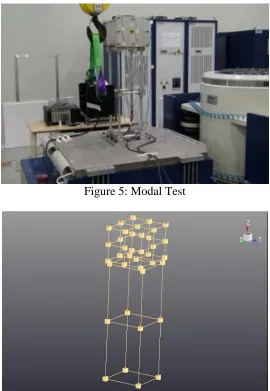
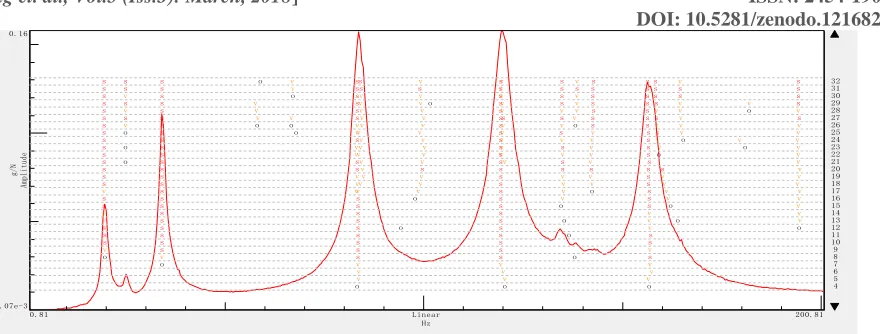
The modal test of truss and load structure is carried out, and the truss structure is fixed to the vibration table. The constraint boundary of the simulated truss structure is shown in Fig.5. The test point layout is shown in Fig.6, with a total of 38 measurement points, and the excitation method is used to stimulate. The minimum elastic frequency of the clamping device used for support is much higher than the maximum analysis frequency of the specimen structure. Generally speaking, it is easy to realize the constraint boundary of small and medium structures, but it is difficult to realize the constraint boundary of large structures [8]. The quality of the truss structure in this paper is 15.85kg, the analysis frequency is 200Hz, the vibration table is 4500kg, and the first-order resonant frequency is 2200Hz, which satisfies the requirements of the truss structure constraint boundary.
Figure 5: Modal Test
Figure 6: Geometric Model
DOI: 10.5281/zenodo.1216829
Http://www.ijetmr.com©International Journal of Engineering Technologies and Management Research [128]
Figure 7: Steady state diagram of frequency response function
According to the modal test results, the first four modal modes of space truss and space load structure are shown in Figure 8.
a) first order mode of vibrate b) second order mode of vibration
c) Third order mode of vibration d) fourth order mode of vibration Figure 8: Modal mode of vibration
3.3.Modal Correlation Analysis
In this paper, modal confidence criterion (MAC) in formula (2) is used as quantitative evaluation index.
2
,
T Test FE
Test FE T T
Test test FE FE
V V
MAC
V V V V
(2) 200.81 0.81 Linear Hz 0.16 0.07e-3 Amplitude g/N
o o o
v v v
v v v
o v v v
o v s s o s
v s s s v
s s s s s
s s s s o s
s s s o s v o
v s s s o v o v
v s s s v v
s s s s o s o v
s s s o s v s v v
v s vv v s v o s v v
s s vv v s v v s v v
s s v v v s v v s v v
s s sv s s s s s s v
s o s sv v sv s v s v
s s vv v vs v v so v
s o s vv v sv s v sv o v
s s sv v sv v v sv o v v
s o s o vv v sv s v s s v v
s v s o o vv v sv v o s sv v v
s s s v v sv v ss s v s s s v s
s v s v sv v sv v v s sv v o v
s s s v sv vo sv s v s s s v v s
s v s o sv v sv s v s s s s s
s s s v ss s sv s s s s s s s
s s s o v ss v sv s v s s s v s
Http://www.ijetmr.com©International Journal of Engineering Technologies and Management Research [129] In the formula, Vtest and VFE are the modal vectors of test mode and finite element modal; the elements in MACTest FE, matrix represent the cosine Angle between two modes, reflecting the relative degree of two modes. The MAC value should be between 0 and 1. When the MAC value is greater than 0.8, it can be considered that the vibration mode Vtest of the test mode is similar to
the mode VFE of the finite element calculation mode; When the MAC value is less than 0.2, it can be considered that the vibration mode of the test mode and the mode of finite element calculation are orthogonal.
In this paper, LMS Virtual Lab software is used to conduct correlation analysis based on the results of finite element modal analysis of truss and load structure and modal experimental results. As shown in TABLE.1, The finite element modal is similar to the experimental mode, and the first two order MAC values are all around 0.9, and the finite element model is acceptable.
Table 1: Modal Mac Values and Frequency differences of similar Modes
Experimental modal
The simulation mode MAC value The frequency difference (Hz)
Order Frequency(Hz) frequency (Hz)
1 19.7 25.5 0.819 -5.75
2 24.9 25.5 0.924 -0.51
3 34.1 32.3 0.669 1.83
4 83.6 99.9 0.519 -16.3
4. Dynamic Simulation and Experiment
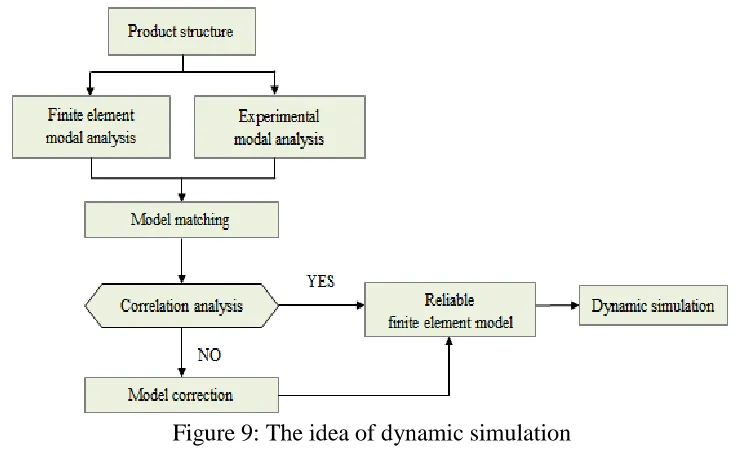
The premise of space product dynamics simulation is to obtain an accurate and reliable finite element model, and the dynamic simulation is generally carried out according to Fig.9.
DOI: 10.5281/zenodo.1216829
Http://www.ijetmr.com©International Journal of Engineering Technologies and Management Research [130]
4.1.Dynamic Simulation
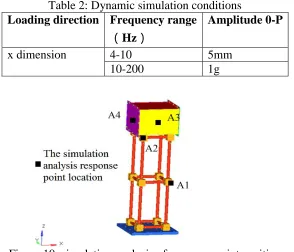
The finite element model of the truss and the load structure has been proved to be acceptable. The finite element model is used to carry out the dynamic simulation analysis of the truss and the load structure X to the harmonic response dynamics, to simulate the low-frequency sinusoidal vibration of the rocket in the process of the rocket, and the conditions of the analysis are shown in TABLE.2 below, and the response measurement points are shown in Fig.10 below.
Table 2: Dynamic simulation conditions
Loading direction Frequency range
(Hz)
Amplitude 0-P
x dimension 4-10 5mm
10-200 1g
Figure 10: simulation analysis of response point position
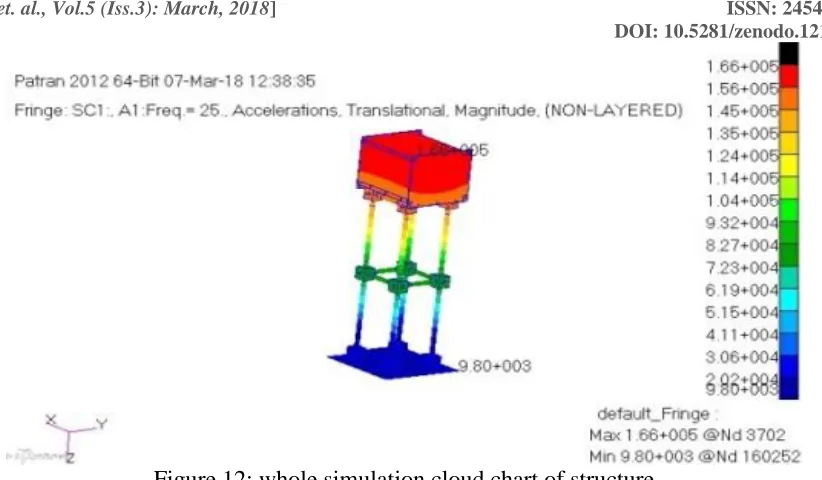
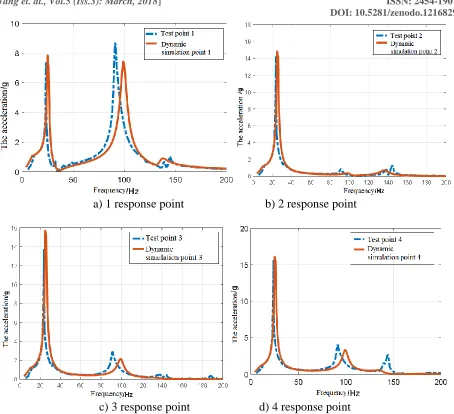
The simulation results of the four response points are shown in figure 11, and the structure is most responsive at 25Hz. The overall response of the structure at 25Hz is shown in Fig.12 below. The maximum response of the structure is 16.6g, which occurs at the top of the load.
Http://www.ijetmr.com©International Journal of Engineering Technologies and Management Research [131] Figure 12: whole simulation cloud chart of structure
4.2.Dynamic Test
The simulation results were verified by X - directional sinusoidal sweep vibration test of the space truss and load structure (as shown in Fig.13). The test conditions were consistent with the dynamic simulation conditions (shown in TABLE.2), and the sweep rate was 4oct/min. The experiment uses two control points on the average control, and the position of the control points is located in the work and the truss structure, and the response point is consistent with the dynamics simulation response point.
Figure 13: sinusoidal sweep vibration test
DOI: 10.5281/zenodo.1216829
Http://www.ijetmr.com©International Journal of Engineering Technologies and Management Research [132]
a) 1 response point b) 2 response point
c) 3 response point d) 4 response point
Figure 14: comparison of dynamic simulation results and vibration test results
Table 3: first order peak comparison of x direction and test
Measurement point
A first order frequency The first-order peak
The simulation (Hz)
Test (Hz)
Error The simulation
(g)
Test
(g)
Error
1 25 23.7 5.4% 7.86 7.53 4.3%
2 25 23.7 5.4% 14.83 14.53 2%
3 25 23.7 5.4% 15.8 14.3 10%
4 25 23.7 5.4% 16.1 15.6 3.8%
5. Conclusions
Http://www.ijetmr.com©International Journal of Engineering Technologies and Management Research [133] MAC values are around 0.9, finite element model is acceptable; using the finite element model to perform the dynamic simulation of the structure, and using the vibration test to test the dynamics simulation results, the empirical evidence dynamics simulation results are less than the test results.
Acknowledgements
This research is supported by the National Natural Science Foundation of China (Grant No.51505470 and No.11602283) and Youth Innovation Promotion Association, CAS.
References
[1] Yuntao Zhang, Design and simulation analysis of the deployable structure of fixed truss, Doctoral dissertation, xi 'an university of electronic science and technology, Xi 'an, China, 2014.
[2] Hongfa Li, Analysis of mechanical properties and passive vibration control of large flexible space truss, Doctoral dissertation, National University of Defense Technology, Changsha, China, 2007. [3] XiandongBao, Analysis of low-frequency vibration environment conditions of foreign carrier
rocket. Missile and space vehicle technology, Vol 4, 1982,0-6.
[4] Qizheng Wang; Liu Bin. Research on prediction and control technology of space accident and dynamics environment. Environment technology,Vol 4, 1995,1-6.
[5] Yilin Xia; Jiju Wu. Low-frequency vibration environment of space launch and its simulation. Intensity and environment, Vol 1, 1998, 1-8.
[6] JunhuiXu; Fan Bin, HuadongLian. The application of viscoelastic constrained damping in large aperture reflector. Space return and remote sensing, Vol 2, 2015, 32-38.
[7] Chen J C; Garbat J A. Analytical Model Improvement Using Modal Test Results. Aiaa Journal, Vol 18, 2012, 684-690.
[8] Anping Wang; Libin Shang. Analysis of modal analysis and model optimization of space science test device, Engineering and experiment, Vol 3, 2017.
[9] Zhixin Li; Xiaoqing Li; Xuedong Chen. Study on the influence of boundary conditions on modal influence in finite element analysis. Chinese mechanical engineering, Vol 19, 2008, 1083-1086.
*Corresponding author.