
chap19.pdf
18
0
0
Full text
(2) Build a Model House At the end of the chapter, you will be asked to design and build a model of a house. Get a head start by using this checklist to prepare for the Technology Lab.. PROJECT CHECKLIST. ✓ Do research on the Internet or go to a local hobby store to find examples of miniature model houses. ✓ Begin to collect materials you will need to do the project, such as marking pens, white glue, and wax paper. ✓ Ask your teacher to review the safety reminder for this lab. 403 Bill Frymire/Masterfile.
(3) 19.1 Homes for People. Connect What are some different types of homes?. Content Vocabulary residential building building site. Academic Vocabulary You will see these words in your reading and on your tests. Find their meanings at the back of this book. community associate. Graphic Organizer Draw the section diagram. Use it to organize and write down information as you read. Advantages of Prefabriated Houses Requires less labor 1. ______________________________________ 2. ______________________________________ 3. ______________________________________ 4. ______________________________________. TECHNOLOGY STANDARDS. Go to glencoe.com to this book’s OLC for a downloadable graphic organizer and more. STL. STL 12 Use & Maintenance STL 20 Construction Technologies. ACADEMIC STANDARDS Science NSES Content Standard F Science and technology in society. Mathematics. National Standards for Technological Literacy NCTM National Council of Teachers of Mathematics NCTE National Council of Teachers of English NSES National Science Education Standards NCSS National Council for the Social Studies. NCTM Algebra Use mathematical models to represent and understand quantitative relationships.. The Structure of Homes What covers the insides and outsides of homes?. Connect Have you ever seen the inside of an attic or a basement of a house or apartment? What did you notice there? 404. Look at your arm. You can see your skin—the outer covering of your arm—but you do not see the bone that is part of its internal support. You see only what is on the outside, not what is inside. A house is similar. The outside of a house may be covered with materials such as brick or wood. The walls inside may be covered with paneling, wallpaper, or paint. The floors may be covered with carpeting, wood or wood laminate, tile, or other materials. They make the rooms appear pleasant and comfortable. They also hide the inner structure of the house.. Unit 6 Construction Technologies.
(4) Jeff Greenberg/PhotoEdit. The inner structure holds up the walls, the ceilings, the roof, and all the other parts of a house. It has to be strong enough to support the loads the house must carry, but lightweight enough to be easy to construct and maintain.. Environmentally Friendly Bricks. Basic Types of Homes What are the most lived-in types of homes in the United States? There are three basic types of buildings: commercial, public, and residential. Commercial buildings are used by businesses, such as stores. Public buildings, such as a city hall, are for public use. Residential buildings are the buildings in which people live. This chapter is about the different kinds of housing and how a house is built. They include multiple-family housing and singlefamily housing. Single-family homes make up about two-thirds of the households in the United States. Name What are the basic types of buildings?. Multiple-Family Housing What is multiple-family housing? The cost of land in some communities is quite high. Large buildings that can house many families require a smaller area of land per person than single-family homes. They include apartments, townhouses, and condominiums. Buildings with ten or more housing units in them provide about 13 million units in the United States. They are often built using techniques similar to those used for commercial buildings.. Often red in color, clay bricks are used on the outside of brick houses and other buildings. They are baked in ovens that use a lot of fuel. But there is a new brick made from power-plant ashes and water that uses much less energy. The bricks are formed under high pressure in a low-temperature steam bath. They are smoother and more uniform, which makes them easier for workers to use at the construction site. Plus they cost less to make. Explain why these new bricks are considered “green.” Go to glencoe.com to this book’s OLC for answers and to learn more about new materials for building.. Describe What is multi-family housing?. Modern Living In large cities, many people live in high-rise apartment buildings. Why are such tall buildings more popular in large cities than in smaller communities? Chapter 19 Building a House. 405.
(5) What kind of construction is used for most single-family homes? This Old House Many communities seek to preserve old buildings with historical value. Historical societies, museums, and community Web sites often feature them. Apply Identify an old, historical house in your community. Find out when it was built and who the owners have been. Research interesting events or history regarding the house. Share your information with interested neighbors and classmates.. A single-family house is free standing and designed for the members of one family. The property on which it is built is called the building site, or construction site. Stick-built construction is used for most single-family homes. Workers assemble pieces of lumber resembling sticks over a foundation (base) of some kind. However, other styles and methods are also used to build single-family houses. Define What is stick-built construction?. Log Houses Many people associate log houses with the American pioneers. However, they were originally designed for the forests of Switzerland, Germany, and Scandinavia. Immigrants from those countries brought this construction knowledge with them to the United States. Their links to the past and pleasing appearance have made log homes popular again. Today log houses are usually sold in kits, and the owner can hire a builder to assemble the house.. Rustic Trends Many people like the appearance of a log house. Designs for these homes are more elaborate than designs for the original log cabins. Why do you think there is there no bark on the logs? 406. Unit 6 Construction Technologies. Geoerg Hunter/Getty Images. Single-Family Housing.
(6) vario images GmbH & Co. KG/Alamy, Peter Widmann/Alamy. Manufactured Houses Most stick-built houses are built on the site where they will be located. Manufactured houses, or parts of these houses, are made in factories. They are also called “prefabricated houses.” Factory production of houses uses less energy, less raw material, and less labor than building them on the site. Factories also can make more houses in less time. The houses are made in sections and are delivered by trucks to the site where a concrete foundation has been installed. Large cranes position them on the foundation, and everything is bolted together. Mobile homes and trailers are also manufactured houses. They have their own wheels and can be easily moved. Some New Orleans-area families who were displaced by the 2005 Katrina hurricane were housed in trailers. Including all types, there are about 9 million manufactured homes in the United States.. Site-Built or Manufactured? When a manufactured house is completed, it is almost impossible to tell it from a conventionally built house. What are some advantages of a manufactured house?. 19.1 Self-Check 1. Name the three basic types of buildings. 2. List three examples of multiple-family housing. 3. Think of three possible advantages and three disadvantages of living in an apartment as compared to a single-family home.. Think 4. How could you tell the difference between a manufactured and a site-built house?. Practice Academic Skills Social Studies/History 5. Research and write a one-page report on the history of the log cabin, tracing it from Europe to the United States.. Mathematics 6. Madison lives in a high-rise apartment building with her father. Her father told her that he hid something for her on a certain floor. The number of the floor is three times her age, minus half of his age, plus the difference in their ages. Madison is nine, and her father is 38. On what floor will she find what he hid?. Writing Equations Writing equations can help you solve problems with many different values. 1. Write out in word form the operations that need to be performed. 2. Replace the word form of the quantities with their numerical values and solve. For help, go to glencoe.com to this book’s OLC and find the Math Handbook.. Chapter 19 Building a House. 407.
(7) 19.2 House Construction. Preview Is it difficult to build a house? Why or why not?. Content Vocabulary foundation footing mortar subfloor stud. gable roof sheathing insulation drywall truss. Graphic Organizer Draw the section diagram. Use it to organize and write down information as you read. Questions When Choosing a Location 1.. 2. How much is property tax?. 3.. 4.. Academic Vocabulary Go to glencoe.com to this book’s OLC for a downloadable graphic organizer and more.. restrict secure. TECHNOLOGY STANDARDS. STL. STL 20 Construction Technologies. ACADEMIC STANDARDS Science NSES Content Standard E Understandings about science and technology. Social Studies NCSS 8 Science, technology, and society. National Standards for Technological Literacy NCTM National Council of Teachers of Mathematics NCTE National Council of Teachers of English NSES National Science Education Standards NCSS National Council for the Social Studies. Early Housing How did the pioneers build their homes? During the 1800s, there were no construction companies in many regions. Pioneer farmers constructed shelters for themselves and their animals. Neighbors helped, and everyone worked together. They had no power tools, few metal nails, and no printed building plans. However, many of their buildings are still standing. Their basic construction techniques are still used today.. Connect If you could build your own house anywhere, what location would you choose and why? 408. Choosing a Location Can you build a house anywhere? Some building sites are better than others. Before choosing one, there are some questions that need to be answered.. Unit 6 Construction Technologies.
(8) Are electricity lines nearby? How about city water, natural gas for heating, telephone lines, and sewers? Without sewers, the house must have a septic tank. How much will property taxes cost? How much dirt will have to be moved? Houses on hillsides are more expensive to build than houses that are located on level land. Identify What services should be available to build a house?. Selecting a House Design Why do we have different house designs? Selecting a house design depends on several factors besides personal preferences. These factors include building laws and codes, cost, and climate. Other factors may include the way in which the house will function. For example, will it be used for a growing family or a retired couple? Some local laws restrict the type of houses that can be constructed in areas. These laws protect the homeowners already there. They can be sure the neighborhood will appear about the same. After choosing the general design, the next step is to determine the size of the house. House size is calculated by its floor area. Small houses have about 1,000 square feet of living area. An average-size house might have 1,400 to 1,600 square feet.. Sustainable Flooring The trees used to make traditional hardwood flooring can take 30 to 100 years to grow, and are not sustainable. In contrast, bamboo is a grass that can be used after five to seven years of growth. Also, it regrows after being cut. Try This Use the Internet or your local library to find out about other sustainable flooring materials and how and where they are being used. Make a poster using this information, and then share it with your class.. Recall How do you choose a house design?. Urban Sprawl In many cities it is getting harder to buy a house. Buyers have to look further away from cities to find homes they can afford. New housing developments bring more freeways, shopping malls, and traffic. This is called “urban sprawl.” Urban sprawl can have a negative impact on the environment. It can also affect the quality of life. People might have to spend more time in traffic and less time at home.. English Language Arts/Writing Smart Growth Drive Time One alternative to urban sprawl is “smart growth” communities that are designed to be compact, so it is easier to go places by walking, riding a bike, or taking public transportation. 1. You are a real estate agent. Do online research on smart growth. 2. Write an advertisement for a house in a smart growth community.. Chapter 19 Building a House. 409.
(9) Building on a Strong Foundation Wet concrete is poured into forms. When it hardens, the concrete will make a strong foundation for the house that will be built on top of it. What makes up a concrete mixture?. The Foundation How is a foundation constructed? Buildings contain a variety of subsystems. The foundation is the part of the house that rests on the ground and supports the structure. The foundation starts with a trench dug where the outside walls will be located. Its depth depends on the local building code. Concrete is poured into the trench to create footings. The foundation usually includes a low wall, sized for a full basement or a crawl space. The foundation wall is made from poured concrete or pre-cast concrete blocks with large holes to reduce weight. The blocks are positioned on the footing and fastened together with mortar, which is similar to concrete but lacking stones. Describe What is the foundation?. 19.1. Floor Joists Floor joist. Sill plate. Floor Construction Floor joists usually rest on a sill plate and girder on the foundation of a house. Where would you go to inspect the floor joists in a house? 410. Unit 6 Construction Technologies. Girder Foundation wall Post.
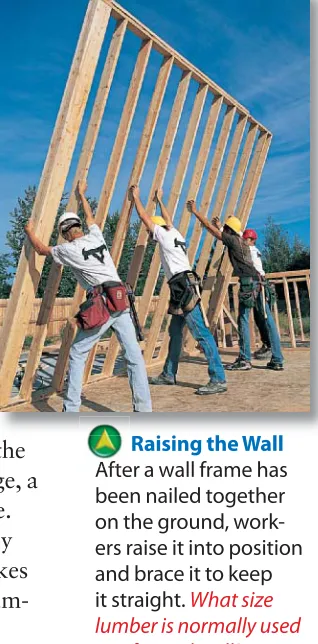
(10) Eranian Philippe/Corbis Sygma. The Basic Structure What holds up the house? Wooden supports in the walls, floor, and roof make up the inner structure of a house. Large lumber is used because it must hold the structure’s weight.. The Floor After the foundation is completed, the floor is built. (See Figure 19.1.) Bolts are placed in the top of a poured foundation wall. In a concrete block wall, holes in the blocks are filled with mortar, and the bolts are placed in the wet mortar. After the mortar hardens, a piece of lumber is bolted to the foundation. Floor supports are nailed to this lumber, which is the sill plate. The floor is supported underneath by floor joists. Joists are boards that extend from the front of the house to the rear. When the foundation area is large, a wooden or steel center beam, a girder, is installed in the middle. A subfloor is nailed to the floor joists. The subfloor is usually made of plywood sheets. During construction, the subfloor takes a great deal of abuse. Tools are dropped on it, and nails are hammered into it. Later a finished floor will be installed over it.. Raising the Wall After a wall frame has been nailed together on the ground, workers raise it into position and brace it to keep it straight. What size lumber is normally used in a framed wall?. Walls Next the wall framework is put together on the subfloor, with openings for windows and doors. The vertical wall supports are called studs. When the framework is finished, it is raised into position by two or more people and nailed to the floor. Each wall is nailed at the corners to walls that are already up. The walls are strengthened by ceiling joists connecting the top of the front wall to the top of the back wall. Then sheathing, made of engineered wood material, encloses the structure. Inside walls dividing the house into rooms are assembled and nailed in place.. The Roof The roof must keep water out when it rains. It also must be strong enough to support heavy snow loads in cold climates. Most roofs have two sloping sides that meet at the center board, or ridge. This style is called a gable roof. The shape makes a strong and secure cover for the house. Long pieces of lumber called “rafters” are nailed to the top of the walls and meet at a peak. The ridge board at the peak acts like a central support for the rafters. The rafters are covered with sheets called “roof decking or sheathing.” Many roofs are prefabricated triangular frameworks called trusses. Trusses include the rafters and ceiling joists. Chapter 19 Building a House. 411.
(11) 19.2. The House Structure with Gable Roof Rafter. Tail. Whole House This drawing shows the major structural elements of a house. Why might a house with framed rafters have more useful attic storage than a house with roof trusses?. Wall and Roof Coverings The external appearance of a house is what gives it character. Some houses just seem to look better than others. It might be because the builders or owners carefully picked siding and roofing material. Siding covers the walls. Roofing covers the roof. Many different kinds of siding material can be fastened to the outside walls of a house. Wood, plastic, metal, and brick are only a few types. They are attached to the sheathing. On many houses, asphalt shingles are nailed to the roof decking over a layer of heavy asphalt paper called “underlayment,” or “roofing felt.” The two layers provide a seal against rain and snow. After the windows and doors are installed, the outside is almost completed. A person walking by might think the house could be occupied. (See Figure 19.2.) List What are the basic components of a roof?. The Interior How is the interior of a house completed? The interior of a house is completed after the exterior is finished. Workers have the advantage of being protected from bad weather. They install things such as insulation, utilities, and interior wall coverings. Recall When is a house interior completed? 412. Unit 6 Construction Technologies.
(12) Stockbyte/SuperStock, Aardvard/Alamy. Insulation Insulation is like a blanket tucked inside the walls and ceilings. It helps keep a house warm in the winter. A popular insulation is a fluffy type of fiberglass made in long rolls that fit between floor joists, ceiling joists, and wall studs. Cracks appear in a house during its construction. They can let in cold air. Caulking is used to seal them up. Caulking looks like toothpaste and is applied with a caulking gun.. Utilities Buildings contain a variety of subsystems referred to as utilities: electricity, natural gas, water, and sewage disposal. These services are provided by businesses called “public utilities.” Electricity is used for heating, lighting, cooking, air conditioning, and other purposes. Natural gas is used for heating and cooking. Water is used for drinking and cleaning. Sewage disposal removes wastes from the house. Subcontractors install these subsystems.. Safety First A worker must always use the proper safety equipment when installing insulation. Why is this worker wearing a breathing mask?. Electric Systems Electricians install wiring, outlets, and light fixtures in the house. Electricity enters the house through a heavy insulated wire. A meter located outside measures how much electrical power is used.. Heating and Cooling Systems Heating and cooling systems require furnaces, air conditioners, pipes, and ducts. Heating systems usually use natural gas, electricity, or fuel oil. Air conditioning is usually powered by electricity.. Michael Sykes Inventor of Enertia Building System Michael Sykes created the Enertia Building System. This system uses the warmth of the sun and the cooling effects of the ground to regulate indoor temperatures in a home. The technology behind the Enertia home turns the wood used to build a house into a thermal battery. Zeolitic seed crystals are injected into the wood. This changes the wood’s molecular structure. The wood becomes a solar energy-storing device! Enertia homes trap carbon in the wood and reduce carbon pollution from burning fossil fuels. Just Rewards Syke’s hard work led to a U.S. patent and a first place prize of $25,000 in the “ 2007 History Channel Modern Marvels Invent Now ” contest. English Language Arts/Writing Write a few paragraphs describing ways you can protect the environment within your own home. Go to glencoe.com in this book’s OLC to learn about young innovators in technology.. Chapter 19 Building a House. 413.
(13) Water and Sewage Systems These systems are installed by plumbing subcontractors. They are responsible for the network of pipes that carry water to the kitchen, laundry room, and bathrooms, and sewer pipes that carry wastes out of the house. Water and sewage services are usually provided by the same public utility company. Pressurized water is delivered to the house through underground pipes. Inside the house, pipes branch out to where water is used. Some houses have a water well. Those houses might also have a septic system. The waste water is treated in a large underground tank and slowly returns to the ground. The main water shutoff valve is on the water line where it enters the house. You should know where it is located.. Inside Wall Coverings Drywall Specialist Drywall can be screwed to the walls and ceilings with a screw gun. Why is this worker wearing stilts?. Drywall, or sheetrock, is made of plaster sandwiched between two layers of sturdy paper. The drywall sheets are nailed or screwed to the walls and ceiling as covering. A plaster-like material fills in the cracks between the sheets and covers the nail heads.. Finishing Touches After the walls and ceilings are finished, the floor is completed. Floors can be finished with wood or wood laminate, stone, tile, or carpeting. Trim is installed around the edges of floors, around doors and windows, and sometimes where ceilings and walls meet. Interior doors are then hung, and kitchen and bathroom cabinets are added. Shelves and countertops are also installed. Landscaping—planting trees, grass, and bushes—is done as the house is finished. After work is completed, the contractor checks everything. The house is then ready for a new owner.. 19.2 Self-Check 1. Define the word truss. 2. Explain why roof shingles cover asphalt paper. 3. List some advantages of wood siding.. Think 4. Explain why a wall requires only 2 × 4 lumber.. Practice Academic Skills English Language Arts 6. If a home buyer is concerned about heating costs, the seller might mention the home’s insulation and. 414. Unit 6 Construction Technologies. efficient heating. Imagine you are selling your house. Write a mock advertisement for your home, describing all the benefits to a potential buyer. Science 5. Conduct an experiment with different types of insulation. Paint three or more boxes black on the outside. Leave one box empty; line the walls of each remaining box with a different type of insulation. Put thermometers inside each box and place the boxes in the sun. Record the results and analyze your findings..
(14) Tiffanie Turner ARCHITECT Q: What do you do? A: During the last 14 years, I’ve worked on large train stations, schools, and a high-tech “green” house. I am now working on renovations and additions to Victorian and mid-century homes in San Francisco and Marin County, California. I like the challenge of modernizing older buildings while respecting the Victorian style. Q: What kind of training and education did you need? A: I attended a 5-year bachelor of architecture program, followed by many years of interning at different architecture firms. I then took the licensing exam. Q: What do you enjoy most about your job? A: My favorite part of the job comes after I meet with a client, understand what he or she wants, and start to design. The process takes months and months. My second favorite part is construction administration, which happens when the construction really gets moving. Q: How did you become interested in your field? A: I took a high school design course. It was a great opportunity to use my love of art and drawing in a more technical, professional field. But I realized I had already been interested in architecture: I used to wish the world would stop so I could go exploring other people’s houses!. Speaking, listening, interpersonal, problem-solving. Mathematics, English language arts, marketing. English Language Arts/Writing Write a Proposal Choose a building that you would like to renovate or add on to. Then write a proposal. 1. Using a word-processing document, describe how you would like to renovate or what you would like to add to an existing building. 2. Using a spreadsheet program, create a table and estimate the costs for the project. Include expenses such as materials, labor, and licenses. 3. Using a presentation program or visual aids that you create, present and explain your ideas to the class.. Go to glencoe.com to this book’s OLC to learn more about this career.. Growth as fast as average for the next ten years Source: Occupational Outlook Handbook. Chapter 19 Building a House. 415. Getty Images/Photodisc.
(15) 19 Review and Assessment Section 19.1 Apartments, townhouses, and condominiums house many families. Most houses are built at a specific location or site. Parts for manufactured houses are prefabricated in a factory. Log houses are usually sold in kits, and the owner hires a builder. Houses that face south are sometimes less expensive to heat than houses facing north.. Section 19.2 The foundation walls of a house are made from poured concrete or concrete blocks. The floor is supported by joists that rest on the foundation. The subfloor absorbs wear during construction and supports a finished floor. The walls are nailed together on the floor and raised into place. Ceiling joists help hold them in position. The roof structure can be made with rafters or trusses and is covered with shingles. Inside walls are covered with drywall. The utilities in a house can include electricity, natural gas, and water. Subcontractors install pipes, wires, and duct work. The finished floor, trim, cabinets, and landscaping are done last.. 1. On a sheet of paper, use each of these terms and words in a written sentence. Content Vocabulary Academic Vocabulary residential building building site foundation footing mortar subfloor. stud sheathing gable roof truss insulation drywall. 2. Identify different residential dwellings. 3. Explain how manufactured houses and site-built houses differ. 4. Explain multiple-family housing. 5. Describe the type of construction used for most single-family homes. 6. Discuss how log houses are sold. 7. Describe how a building site is chosen. 8. Explain how a house is assembled. 9. Discuss the reasons for different house designs. 10. Describe how the interior of a house is completed.. 416. Unit 6 Construction Technologies. Bill Frymire/Masterfile. community associate restrict secure.
(16) 11. Disaster Relief When a disaster such as an earthquake or hurricane strikes, homes can be destroyed. Some companies make portable homes that can be used after a disaster. Research the different types of modular homes that could be used. Write a few paragraphs on what you find. Technology Skill 12. Floor Plan A floor plan is an illustration showing the layout of a structure. A floor plan should indicate where all the important places, such as electrical boxes and gas lines, are located. a. Find the main water valve and electrical breaker switch in your home. b. Use a computer illustration program, CAD software, or hand sketching to draw the floor plan of your home.. Landscape Architect Situation Your team will design and build an area at school where students can sit during breaks. The area must be functional, inviting, beautiful, and compatible with the environment and architecture. Activity Develop a series of sketches. Make a three-dimensional model of your proposal. Include models of benches. Landscape the area and build and place the seating. Evaluation Your project will be evaluated by these criteria: Landscape Seating • Functional • Functional • Attractive • Attractive • Appropriate • Well made Go to glencoe.com to this book’s OLC for information about TSA events.. Science. 13. Research different geodesic domes and their uses. Write a paragraph about the pros and cons of different domes. Mathematics 14. The average price of homes in a suburb of Chicago rose by 18.3 percent in a year. If the average price of homes in this area was $93,150 at the beginning of the year, what is the average price after the increase? Percents A percent represents a part of a whole. When determining the nominal value of a percent, convert the percent to a decimal by dividing by 100. If you are figuring a percentage increase of something, add 1 to the decimal equivalent and multiply.. Directions Choose the letter of the best answer. Write the letter on a separate piece of paper. 1. What percentage of 245 is 98? A 52% C 0.40% B 46% D 40% 2. The truss is a layer of material between house framing and the outer covering. T F. Test-Taking Tip If you encounter a question that you think you cannot answer, leave it and answer it last—but do answer it. Chapter 19 Building a House. 417.
(17) 19 Build a Model House Many different house designs exist because people have different needs and like different designs. When architects design a house, they often will build a model of it first. The model helps people visualize what the house will look like when it is built.. Tools and Materials ✓ ✓ ✓ ✓ ✓ ✓ ✓. Poster board White glue Marking pens Waxed paper Razor knife Metal ruler Wooden cutting surface ✓ House floor plan. Set Your Goal Your goal for this lab is to make a model of a house that you think is interesting or attractive.. Know the Criteria and Constraints In this lab, you will: 1. Make a model out of poster board. 2. Choose a fairly simple house design. 3. Create a gable roof for your house. 4. Use a scale of ½ inch equals 1 foot. 5. Label the rooms and any special features of the house. 6. Submit your sketches along with your model.. Design Your Project Follow these steps to design your project and complete this lab. 1. Do some research on house plans. Sunday editions of newspapers may show plans for houses. Some magazines also include plans. 2. Select a house design that interests you. A single-story house will be easier to construct than one with two stories. 3. Make sketches of your model’s floor plan and outer walls. Use a scale of ½ inch equals 1 foot. If a dimension on the original plan is 10 feet, it will be 5 inches on your model.. Reminder In this lab, you will be using cutting tools. Be sure to always follow appropriate safety procedures and rules so you and your classmates do not get hurt.. 418 D. Hurst/Alamy.
(18) 4. Place your drawings on the poster board. Use a razor knife to cut out the front wall. Draw the windows and doors with your marker. Also, draw any desired details. 5. Repeat for the other three walls. Make one wall at a time. 6. Place a small piece of waxed paper on your work surface to protect it. Hold the front wall against one of the side walls and glue the corners together along the inside of the walls. Repeat for all the other walls. 7. After the glue has dried, glue the four walls onto another piece of poster board. 8. Draw the entire roof on poster board. Cut it out. Draw a line down the middle. Use razor knife and metal ruler to score a line down the middle of the roof. Then fold it in the middle. Place the roof on the walls but do not glue it. 9. Remove the roof and add interior walls. Place labels in the rooms. 10. You can add a porch or a deck if you want. 11. Add landscaping like bushes and trees cut from poster board. 12. Label the features of your house that you especially like.. Evaluate Your Results After you complete the lab, answer these questions on a separate piece of paper. 1. Write a paragraph explaining why you chose this house design. 2. Discuss whether the models helped you visualize the house.. Academic Skills Required to Complete Lab Tasks Research house plans.. English Language Arts. ✓. Science. Social Studies. ✓ ✓ ✓. Draw model to scale. Build outside of house model and attach to poster board floor.. ✓. Add interior walls. Label house model.. Math. ✓ Chapter 19 Building a House. 419.
(19)
Figure
Related documents