Maricheda V., Rozhkovskaya N., Sitnik P. Clinical outcomes in the surgical treatment of pyoinflammatory diseases of pelvic organs: the possibility of predication. Journal of Education, Health and Sport. 2018;8(6):399-405. eISNN 2391-8306. DOI
http://dx.doi.org/10.5281/zenodo.1412428
http://ojs.ukw.edu.pl/index.php/johs/article/view/5957
The journal has had 7 points in Ministry of Science and Higher Education parametric evaluation. Part b item 1223 (26/01/2017). 1223 Journal of Education, Health and Sport eISSN 2391-8306 7
© The Author(s) 2018;
This article is published with open access at Licensee Open Journal Systems of Kazimierz Wielki University in Bydgoszcz, Poland
Open Access. This article is distributed under the terms of the Creative Commons Attribution Noncommercial License which perm its any noncommercial use, distribution, and reproduction in any medium, provided the original author (s) and source are credited. This is an open access article licensed under the terms of the Creative Commons Attribution Non commercial license
(http://creativecommons.org/licenses/by-nc/4.0/) which permits unrestricted, non commercial use, distribution and reproduction in any medium, provided the work is properly cited. This is an open access article licensed under the terms of the Creative Commons Attribution Non commercial License (http://creativecommons.org/licenses/by-nc/4.0/) which permits unrestricted, non commercial
use, distribution and reproduction in any medium, provided the work is properly cited. The authors declare that there is no conflict of interests regarding the publication of this paper.
Received: 02.06.2018. Revised: 12.06.2018. Accepted: 29.06.2018.
Clinical outcomes in the surgical treatment of pyoinflammatory diseases of pelvic organs: the
possibility of predication
1V. Maricheda, 1N. Rozhkovskaya, 2P. Sitnik
1Odessa National Medical University, Ukraine
2Municipal Clinical Hospital No.1, Odessa, Ukraine
Abstract
Among inflammatory processes of female genital more than 80% account for the pathology
of uterine appendages and the share of complicated forms of purulent inflammatory diseases
accounts 4 - 10%. Diagnosis and prediction of PID are based on clinical, laboratory, biochemical,
immunological parameters and data of instrumental research methods which are often cumbersome
and not always available in most surgical hospitals. The objective: to identify significant predictors
of clinical outcomes in the surgical treatment of pyoinflammatory diseases of the pelvic organs. 108
women of fertile age with PID were examined. 73 of them were treated conservatively (group I,
comparison). Group II (main) consisted of 35 women who underwent surgery according to vital
indications. Results. The main group patients were operated on with laparotomy access,
adnexectomies (right-sided - 27.8%, left-sided - 22.2%) constituted a considerable number. In
22.2% of cases, total hysterectomy was performed, and the same number of patients abdominal
cavities were drained in the postoperative period. A telephone survey conducted showed that the
overall response rate decreased in proportion to the time elapsed since discharge from the hospi tal,
predictive value in the operative treatment of pyoinflammatory diseases of the pelvic organs has
TNF and procalcitonin (PPV = 0.77 and 0.81, respectively).
Key words: inflammatory process of female genital, outcome of surgical treatment,
TNF, procalcitonin.
Introduction. Inflammatory processes of female genital occupy one of the leading places in
the structure of gynecological diseases [1-3, 7, 9]. Among these diseases, about 80-82% account for
the pathology of the uterine appendages, and the share of complicated forms of purulent
inflammatory diseases accounts, according to different authors, from 4 to 10% [4, 5].
Pelvic inflammatory disease (PID) is characterized by various manifestations, depending on
the level of damage and the strength of the inflammatory reaction. The disease occurs as a result of
pathogens (enterococci, bacteroides, chlamydia, mycoplasmas, ureaplasma, trichomonads)
penetration into the genital tract in the presence of favorable conditions for their development and
reproduction [3, 7].
Existing natural defense mechanisms, such as anatomical features, functional state of local
immunity, acidic environment of vaginal contents, absence of endocrine disorders or serious
extragenital diseases, are able in most cases to prevent the development of genital infection. On the
invasion of a particular microorganism there is a systemic inflammatory response of varying
intensity [1, 2, 8].
One of the leading factors in PID’s semiotics formation is the resistance of microorganisms
to the antibiotic therapy used, which causes high virulence of nosocomial infection, a change in the
etiological structure, the transformation of clinical symptoms towards eroded forms and atypical
course. This, in turn, leads to a belated diagnosis and a worsening of the clinical prognosis [9].
Difficulties in diagnosing and selecting the optimal treatment program for patients are largely due to
the variety of clinical symptomatology, late or non-core hospitalization of patients, the lack of a
unified classification and a systematic approach to assessing the severity of PID course [3, 8, 9].
In recent years, scientific research has been actively conducted for significant pr edictors of
purulent-inflammatory diseases search. Significant progress in the development of the problem of
optimizing the diagnosis and treatment of PID patients was achieved after the implementation of the
recommendations of the III International Consensus of the definitions of sepsis and septic shock
[10]. As a rule, diagnosis and prediction of PID are based on a number of clinical, laboratory,
the so-called integral scales of assessment and prognosis (Ranson, Osborne, APACHE-2, SAPS,
MEWS, etc.) which are often cumbersome and not always available in most surgical hospitals.
Using existing evaluation systems it is difficult to correctly predict the dynamics of the pathological
state [6, 8, 9].
The objective: to identify significant predictors of clinical outcomes in the surgical
treatment of pyoinflammatory diseases of the pelvic organs.
Material and methods. The study was carried out on the basis of State Clinical Hospital
No.1 (Odessa) in 2013-2018. 108 women of fertile age with PID participated in it. 73 women were
treated conservatively - they made up group I (comparison). The main group (II) consisted of 35
women who underwent surgery according to vital indications.
Clinical management of patients was conducted according to the current orders of Ukrainian
Ministry of Health Care.
All women underwent a bimanual gynecological examination, a study of general clinical and
biochemical indices, an ultrasound study of pelvic organs (Siemens Acuson X150, Germany) with
the use of standard methods. All patients signed an agreement to participate in the study in
accordance with the bioethical requirements of Helsinki Declaration. The follow-up period was 36
months. The original questionnaire in the format of a telephone interview was applied.
The cases of PID relapses, the features of the fertile function realization, the presence of
chronic pelvic pain manifestations were taken into account. The content of cytokines TNF and IL-6
was evaluated by ELISA methods, the content of procalcitonin - by ECLIA. The level of blood
lactate was determined spectrophotometrically.
The statistical processing was carried out by methods of dispersion and correlation analysis
using the software Statistica 13.0
Results. The main group patients mean age was 37.0 ± 0.7 years. The patients were in
hospital from 4 to 14 days, on average - 10.5 ± 0.5 days. An aggravated gynecological anamnesis
was defined in 56.7% of the patients.
Upon admission to the hospital, all patients complained of pain in abdomen. Only 9 (12.0%)
patients had normal body temperature, others had subfebrile symptoms or hyperpyrexia. In 45.3% of
the patients, the body temperature did not exceed 37.5 ° C, and the temperature wa s above 39.0 ° C
only in 6 (8.0%) patients. The average temperature was 37.3 ± 0.04 ° C. Against the background of
fever, tachycardia was observed, heart rate averaged 93.2 ± 1.6 bpm. There was a tachypnea (BR –
Practically all patients at the time of admission had signs of irritation of the peritoneum: in
72 (96.0%) - a positive symptom of Blumberg, in 14.7% - soreness of the posterior vaginal fornix.
Each fifth woman experienced hyperesthesia of the anterior abdominal wall. In 6.7% of cases there
was no muscle defensiveness. 93.3% of the patients had vaginal discharge, including purulent - in
4.0% of cases. In 96.7% of the women under examination menstrual irregularities occurred.
Signs of severe vaginal dysbiosis were observed in 72.0% of patients, with multicomponent
microbial associations (Staphylococcus spp., E. coli, Chlamidia trachomatis, Prevotella spp., etc) in
44.0% of cases, microbiocenosis formed only by Staphylococci spp. and E. coli was defined in
54.5% of cases.
The hemograms obtained in the main group patients under their admission to the hospital are
of considerable interest. A part of the patients showed moderate anemia (red cells content -
3.44±0.09 1012 / l, Hb - 113.5±3.2 g / l), hypovolemia (hematocrit 0.48±0.09). The average platelet
content was 153.7±22 109 / l. Characteristic phenomena were leukocytosis (total number of
leukocytes - 9.86±0.9 109 / l) with a left shift, relative monocytopenia and ESR accelerated to
31.3±3.4 mm / hr.
The cytokine profile was 24.4±1.1 pg / ml for IL-6, and 15.5±0.9 pg / ml for TNF, that is,
there was a significant activation of pro-inflammatory cytokines. At the same time, the degree of
cytokines levels growth closely correlated with the severity of symptoms of irritation of the
peritoneum and general intoxication.
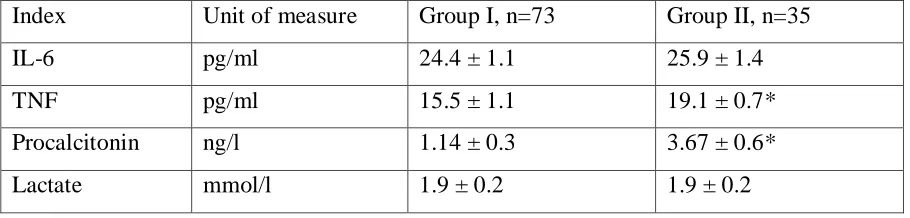
When comparing the indices obtained in patients operated on for PID and treated
conservatively (Table 1), it was found that the level of the main markers of inflammation was higher
in the II group, but the statistical significance was high only for the indicators of TNF and
[image:4.612.79.534.595.704.2]procalcitonin (p < 0.05).
Table 1
DYNAMICS OF INDICES OF THE MAIN MARKERS OF INFLAMMATION
IN THE GROUPS OF COMPARISON
Index Unit of measure Group I, n=73 Group II, n=35
IL-6 pg/ml 24.4 ± 1.1 25.9 ± 1.4
TNF pg/ml 15.5 ± 1.1 19.1 ± 0.7*
Procalcitonin ng/l 1.14 ± 0.3 3.67 ± 0.6*
Lactate mmol/l 1.9 ± 0.2 1.9 ± 0.2
Important are the results of procalcitonin level study in the patients of different groups. In
conservative treatment patients, the level of procalcitonin was 1.14±0.3 ng / l, whereas in patients
operated on according to vital signs it was 3.67±0.6 ng / l (p < 0.05). The concentration of lactate in
the clinical groups did not differ and amounted to 1.9±0.2 mmol / l.
In 53.3% of cases SAPS index did not exceed 4 points, which corresponds to a favorable
forecast for perioperative risk. In the rest of 46.7% patients, SAPS index was 5 - 7 points.
Subsequent analysis showed that the main risk factors for the clinical course of
purulent-inflammatory diseases of the uterine appendages determining the severity of the clinical course are
promiscuity (OR = 2.4), urogenital infections (OR = 2.5), endocrine disorders (OR = 2.2). The
severity of the systemic inflammatory response correlated with the severity of the syndrome of
endogenous intoxication (r = 0.83).
The highest predictive value has TNF and procalcitonin (PPV = 0.77 and 0.81, respectively).
Purulent tubo-ovarian inflammatory formations, such as mono- and bilateral tumors (9 cases
or 25.7%) and pirosalpinx with perforation (5 cases or 14.3%) prevailed in PID structure, detected in
the patients of the main group. Abscesses of the small pelvis (4 cases or 11.4%), cyst ruptures (2
cases or 5.7%) were registered less frequently.
The main group patients were operated on with laparotomy access, adnexectomies
(right-sided - 27.8%, left-(right-sided - 22.2%) constituted a considerable number. In 22.2% of cases, total
hysterectomy was performed, and the same number of patients abdominal cavities were drained in
the postoperative period.
A telephone survey conducted during the follow-up period showed that the overall response
rate decreased in proportion to the time elapsed since discharge from the hospital. If at the end of the
first year of observation it was possible to establish contact with 65.3% of patients, at the end of the
second year it was established with 34.7% of patients, and in three years only 13.2% of the former
patients had been in contact with us.
The most common symptoms in patients who underwent surgery were chronic pelvic pain
(24.4% in 12 months after treatment, 69.2% - in 24 months, and 80.0% - in 36 months). In the
patients of the main group 4 (11.4%) cases of ectopic pregnancy were registered, while 5 (14.3%)
had repeated episodes of PID. Pregnancy occurred in 7 (9.6%) patients of the first group and 5
(14.3%) patients of the second group. Given that a significant proportion of late reproductive age
Discussion. PID encapsulate a significant problem for women's health. These diseases have
both serious short-term and potentially destructive long-term complications. PID women are at risk
of infertility, ectopic pregnancy and chronic pelvic pain.
Unfortunately, most of the clinical and laboratory criteria traditionally used to assess the
clinical severity of acute PID are unreliable in assessing the future individual risk.
According to our data, the main factors that caused the development of long-term
consequences of PID were the severity of the disease, the presence of concomitant gynecological,
urological or gastroenterological pathology, delay in initiating therapy and re-infection. Thus, timely
diagnosis and initiation of treatment of PID patients are an essential element of the secondary
prevention of long-term effects, including infertility, ectopic pregnancy, chronic pelvic pain and
occasional PID.
The complex of clinical, clinical and laboratory and ultrasound methods for diagnosis of
acute inflammatory diseases of the uterine appendages is of the top diagnostic value.
We believe that the reasons of PID progression are primarily in the features of a woman's
immune system. Due to the influence of exogenous and endogenous factors against the backgr ound
of immunosuppression, the ability to resist decreases or a body’s response to the presence of an
inflammatory focus reduces.
Humoral and cellular factors play an important role in the formation of adhesions in the
inflammatory focus, including immunocompetent cells, proteins, inflammatory mediators and some
biologically active substances. Cytokines’ contribution to the induction of inflammation is the most
significant.These factors of intercellular interaction not only activate the inflammatory process
(pro-inflammatory cytokines), recruiting leukocytes from circulating blood to the inflammation focus, but
they are powerful stimulators of growth, proliferation and differentiation of new cells, which leads
to vascular remodeling and the formation of adhesions, and, accordingly, to the reduction of fertility
potential.
Conclusions.
1. The patients who underwent operative treatment for PID most often had the signs of
chronic pelvic pain (in 24.4% of cases in 12 moths; 69.2% in 24 months and 80.0% of cases in 36
months after treatment)
2. The main group patients had 4 (11.4%) cases of ectopic pregnancy, and 5 (14.3%)
had PID occasional episodes.
4. The highest predictive value in the operative treatment of pyoinflammatory diseases
of the pelvic organs has TNF and procalcitonin (PPV = 0.77 and 0.81, respectively).
5. With the combined use of clinical, clinical and laboratory and ultrasound methods for
diagnosing acute inflammatory diseases of the uterine appendages, the accuracy of the predictions
increases.
References:
1.Bugg CW, Taira T. Pelvic Inflammatory Disease: Diagnosis and Treatment in the
Emergency Department. Emerg Med Pract. 2016 Dec;18(12):1-24
2.Chayachinda C, Rekhawasin T. Reproductive outcomes of patients being hospitalised with
pelvic inflammatory disease. J Obstet Gynaecol. 2017 Feb; 37(2):228-232.
3.Das BB, Ronda J, Trent M. Pelvic inflammatory disease: improving awareness,
prevention, and treatment. Infect Drug Resist. 2016 Aug 19;9 :191-7.
4.Kreisel K, Flagg EW, Torrone E. Trends in pelvic inflammatory disease emergency
department visits, United States, 2006-2013. Am J Obstet Gynecol. 2018 Jan; 218(1):117.e1-117.
5.Kreisel K, Torrone E, Bernstein K, Hong J, Gorwitz R. Prevalence of Pelvic Inflammatory
Disease in Sexually Experienced Women of Reproductive Age – United States, 2013-2014. MMWR
Morb Mortal Wkly Rep. 2017 Jan 27;66(3):80-83.
6.Lee L. Pelvic inflammatory disease. JAAPA. 2017 Feb;30(2):47-48.
7.Long B, April MD. What Antibiotic Regimen is Most Efficacious in Treating Pelvic
Inflammatory Disease? Ann Emerg Med. 2017 Dec;70(6):840-842.
8.Revzin MV, Mathur M, Dave HB, Macer ML, Spektor M. Pelvic Inflammatory Disease:
Multimodality Imaging Approach with Clinical-Pathologic Correlation. Radiographics. 2016
Sep-Oct;36(5):1579-96.
9.Ross J, Guaschino S, Cusini M, Jensen J. 2017 European guideline for the management of
pelvic inflammatory disease. Int J STD AIDS. 2018 Feb;29(2):108-114.
10. Singer M, Deutschman CS, Seymour CW, Shankar-Hari M, Annane D, Bauer M,
Bellomo R, Bernard GR, Chiche JD, Coopersmith CM, Hotchkiss RS, Levy MM, Marshall JC,
Martin GS, Opal SM, Rubenfeld GD, van der Poll T, Vincent JL, Angus DC. The Third
International Consensus Definitions for Sepsis and Septic Shock (Sepsis-3). JAMA. 2016 Feb