Ames Laboratory Publications
Ames Laboratory
10-19-2007
Angular dependence of the spin-flop transition and
a possible structure of the spin-flop phase of
Gd5Ge4
Zhong W. Ouyang
Iowa State UniversityVitalij K. Pecharsky
Iowa State University, [email protected]
Karl A. Gschneidner Jr.
Iowa State University, [email protected]
Deborah L. Schlagel
Iowa State University, [email protected]
Thomas A. Lograsso
Iowa State University, [email protected]
Follow this and additional works at:
http://lib.dr.iastate.edu/ameslab_pubs
Part of the
Condensed Matter Physics Commons
, and the
Metallurgy Commons
The complete bibliographic information for this item can be found at
http://lib.dr.iastate.edu/
ameslab_pubs/80
. For information on how to cite this item, please visit
http://lib.dr.iastate.edu/
howtocite.html
.
Angular dependence of the spin-flop transition and a possible structure of
the spin-flop phase of Gd5Ge4
Abstract
The angular dependence of the spin-flop transition in Gd
5Ge
4has been examined by magnetization
measurements of a single crystal. When the magnetic field vector is tilted away from the antiferromagnetic
easy axis (c axis) toward the b axis, the spin-flop transition always remains first order in nature. However,
when the field vector is tilted away from the c axis toward the a axis, the first order spin-flop transition is only
observed over a narrow range of tilt angles (0<θ<20°), which serves as evidence that the Gd moments “flop”
from the c axis to the a axis during the spin-flop transformation.
Keywords
Materials Science and Engineering
Disciplines
Condensed Matter Physics | Metallurgy
Comments
This article is from
Physical Review B
76 (2007): 134415, doi:
10.1103/PhysRevB.76.134415
.
Angular dependence of the spin-flop transition and a possible structure of the spin-flop phase
of Gd
5Ge
4Z. W. Ouyang*
Materials and Engineering Physics Program, Ames Laboratory of the U.S. DOE, Iowa State University, Ames, Iowa 50011-3020, USA
V. K. Pecharsky†and K. A. Gschneidner, Jr.
Materials and Engineering Physics Program, Ames Laboratory of the U.S. DOE, Iowa State University, Ames, Iowa 50011-3020, USA and Department of Materials Science and Engineering, Iowa State University, Ames, Iowa 50011-2300, USA
D. L. Schlagel and T. A. Lograsso
Materials and Engineering Physics Program, Ames Laboratory of the U.S. DOE, Iowa State University, Ames, Iowa 50011-3020, USA
共Received 4 June 2007; published 19 October 2007兲
The angular dependence of the spin-flop transition in Gd5Ge4has been examined by magnetization
mea-surements of a single crystal. When the magnetic field vector is tilted away from the antiferromagnetic easy axis共caxis兲toward thebaxis, the spin-flop transition always remains first order in nature. However, when the field vector is tilted away from thecaxis toward theaaxis, the first order spin-flop transition is only observed over a narrow range of tilt angles共0⬍⬍20°兲, which serves as evidence that the Gd moments “flop” from the
caxis to theaaxis during the spin-flop transformation.
DOI:10.1103/PhysRevB.76.134415 PACS number共s兲: 75.30.Kz, 75.50.Ee, 75.50.Cc
INTRODUCTION
As early as 1936, Néel1predicted that in a uniaxial
aniso-tropic antiferromagnet where magnetic moments are coupled with the crystal lattice, a first order spin-flop transition should occur at a certain critical magnetic field, Hsf, when
the magnetic field is applied along the antiferromagnetic
共AFM兲coupling direction, i.e., along the AFM easy axis. As a result of the spin-flop transition, the directions of spin mo-ments of the two sublattices abruptly change from their an-tiparallel configuration in which the moments are collinear with the external field to a new spin-flop configuration in which the moments remain antiparallel but become perpen-dicular or nearly perpenperpen-dicular to the magnetic field vector. The spin-flop transition was later experimentally observed in CuCl2· 2H2O.2–5The phenomenon perhaps is best manifested
in several transition metal systems such as MnF2共Refs.6–8兲
and FeF2,9and current research activities on spin-flop
tran-sitions are extended toward many low dimensional systems.10–12As in the past, spin-flop transformations remain
an interesting subject for both theoretical and experimental research.
Gd5Ge4 is one of the two parent compounds of the
fun-damentally important and potentially useful pseudobinary magnetocaloric alloys Gd5共SixGe1−x兲4.13–15This binary
gado-linium germanide has been broadly studied because of its intriguing physical properties that are intimately related to a peculiar low dimensional crystallography. The distinctly lay-ered crystal structure that the system adopts in the paramag-netic state can be described as a stacking of weakly interact-ing identical slabs that are infinite in theacplane but are less than 1 nm thick along thebaxis.16–18In the original study by
Holtzberget al.,19the authors suggested that the ground state
of Gd5Ge4is AFM, although the positive Weiss temperature
determined from the Curie-Weiss behavior points to a ferro-magnetic ground state. Recently, this apparently
contradic-tory result has been explained by the fact that the Gd mo-ments are coupled ferromagnetically within the slabs, while the Gd moments between the slabs are coupled antiferromag-netically along thecaxis.20–25This AFM configuration was
identified both by macroscopic dc magnetization measurements26,27 and microscopic x-ray resonant magnetic scattering experiments,28thus showing that zero-field-cooled
Gd5Ge4is a uniaxial antiferromagnet. In the AFM state, the
compound preserves the same crystal structure as in the para-magnetic state.29,30However, when Gd
5Ge4is magnetized at
low temperatures by a magnetic field exceeding 12 kOe,20–24,26,27,29,30 or is exposed to a hydrostatic pressure
in excess of 10 kbar,31 it becomes ferromagnetic共FM兲. The
FM ordering is accompanied by a simultaneous martensitic-like change of its crystal structure. The latter occurs by shearing of the neighboring slabs along a in opposite directions,29,30hence creating a new layered crystal structure
where the slabs themselves remain unchanged but the inter-slab exchange interactions become much stronger.25 These
magnetic field and pressure induced transformations are un-usually sharp, which is related to the existence of a noner-godic kinetically retarded magnetic glassy state at low temperature.32
Unlike the interplay between the paramagnetic 共PM兲, AFM, and FM states of Gd5Ge4, which is relatively well
studied,20–32the nature of the spin-flop transition, which was
first reported by Levinet al.,26is much less understood. This
transition occurs in the AFM state only when the magnetic field is applied along thec axis. Interestingly, the spin-flop transformation remains completely unaffected by the kinetic retardation that affects the AFM-FM transition.27,33The
mag-netic phase diagram with the magmag-netic field vector parallel to thec axis共Fig.1兲shows that the PM phase orders into the normal AFM phase belowTN= 128 K in low magnetic fields,
but it is converted into a spin-flop AFM phase in fields higher than ⬃8 kOe. Levin et al.26 suggested that in the PHYSICAL REVIEW B76, 134415共2007兲
spin-flop state, the AFM coupling axis coincides with thea
axis, which was logical considering that the moments then have to rotate in the planes of the slabs rather than out of the planes of the slabs. The AFM coupling axis is perpendicular to the field vector in the sin-flop phase, but the magnetization of each sublattice is slightly tilted away from the spin cou-pling axis共a兲due to the application of the magnetic field. To date, this model has not been verified experimentally.
In a uniaxial antiferromagnet, where the anisotropy en-ergy is usually small compared to the generally isotropic exchange energy, the first order spin-flop transition can be observed only over a small range of tilt angles when the field vector remains perpendicular to the hard axis but is tilted away from the AFM easy axis toward the next easiest axis
共i.e., toward the spin-flop axis兲.4,5,7,34 Here, we investigate
angular dependence of the spin-flop transition in Gd5Ge4. In
addition, owing to the distinctly layered crystal structure of Gd5Ge4, a different behavior is expected when the magnetic
field is tilted away from thecaxis共AFM easy axis兲toward theb axis when compared to the magnetic field tilted away from thecaxis toward thea axis. These experiments should verify an earlier prediction共by Levinet al.26兲that the
micro-scopic magnetic structure of the spin-flop AFM phase is the result of rotating the AFM coupled moments in theacplane, as shown schematically in Fig.1, rather than in theabplane.
EXPERIMENTAL DETAILS
A cubelike single crystal of Gd5Ge4 共0.9⫻1.0
⫻1.0 mm3兲 with its faces normal to the principal
crystallo-graphic directions was extracted from a crystal grown using the tri-arc pulling technique.35 Details about the basic
char-acterization, orientation, and preparation of the specimen are given elsewhere.27 The magnetization measurements were
performed using a superconducting quantum interference de-vice magnetometer, MPMS-XL manufactured by Quantum Design, Inc. Before each measurement, the sample was zero-field cooled from the paramagnetic state at 300 K to the desired temperature. The misalignment between the crystal-lographic axes and directions of magnetic field vectors was estimated to be less than 5°.
EXPERIMENTAL RESULTS
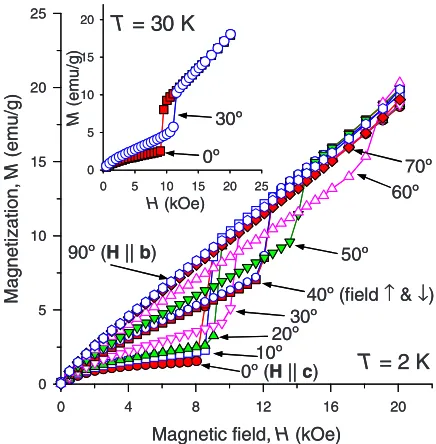
Figures2and3show the field dependencies of the mag-netization of a Gd5Ge4single crystal measured at 2 K when the field vector was gradually tilted away from the c axis toward thebaxis共thecbplane isotherms兲and away from the
c axis toward the a axis 共the ca plane isotherms兲, respec-tively. All of thecbplane M共H兲curves共Fig.2兲exhibit non-linearity in low fields共less than⬃4 kOe兲, revealing the pres-ence of a small amount of the FM Gd5Ge4 phase that precipitates in the AFM matrix during zero-field cooling.36
Around 20 kOe, the M共H兲curves show signs of an upturn, indicating the onset of the well-known and well-characterized field induced AFM→FM phase transforma-tion. For= 0, i.e., when the magnetic field vector is applied along thecaxis, a nearly discontinuous steplike transition is observed at Hsf⬵8.3 kOe, which is a signature of a first
order spin-flop transition26 and whose temperature behavior
was established in an earlier report27共also see Fig. 1兲. With
an increase of the tilt angle betweenHandc, the
magne-Temperature,T(K)
0 20 40 60 80 100 120 140
Mag net ic fi e ld, H (k O e ) 0 2 4 6 8 10 12 14 16 18
Normal AFM
FM
PM
Spin-flop AFM
H
||
c
H
||
c
a c b a c b
Temperature,T(K)
0 20 40 60 80 100 120 140
Mag net ic fi e ld, H (k O e ) 0 2 4 6 8 10 12 14 16 18
Normal AFM
FM
PM
Spin-flop AFM
H
||
c
H
||
c
[image:4.612.65.286.58.281.2]a c b a c b a c b a c b
FIG. 1. 共Color online兲The low temperature, low magnetic field corner of the magnetic phase diagram of Gd5Ge4taken from Ref. 27. This diagram is for the initial magnetization of the zero-field-cooled material with the magnetic field vector parallel to thecaxis. The microscopic magnetic structure of the normal AFM phase is illustrated schematically taking into account both the macroscopic and microscopic data of Refs. 26 and 28. The schematic of the spin-flop AFM phase is shown following an assumption of Ref.26.
Magnetic field,H(kOe)
0 4 8 12 16 20
M agnet iz at ion, M (emu/ g ) 0 5 10 15 20 25 H(kOe)
0 5 10 15 20 25
M (em u /g ) 0 5 10 15 20
0º (H||c) 10º
20º30º
40º (field↑&↓) 50º
60º 70º
90º (H||b)
T
= 2 K
30º0º
T
= 30 K
Magnetic field,H(kOe)
0 4 8 12 16 20
M agnet iz at ion, M (emu/ g ) 0 5 10 15 20 25 H(kOe)
0 5 10 15 20 25
M (em u /g ) 0 5 10 15 20
0º (H||c) 10º
20º30º
40º (field↑&↓) 50º
60º 70º
90º (H||b)
T
= 2 K
30º0º
T
= 30 K
FIG. 2.共Color online兲The magnetization isotherms of a Gd5Ge4 single crystal measured atT= 2 K with the magnetic field vector gradually tilted away from thecaxis toward thebaxis共thecbplane isotherms兲. The inset shows two isotherms measured atT= 30 K withH储cand withH⬔c= 30° in thecbplane.
OUYANGet al. PHYSICAL REVIEW B76, 134415共2007兲
[image:4.612.328.546.59.281.2]tization in the AFM state is increased, but in the spin-flop state, the magnetization remains nearly equal to that of = 0. This leads to a gradual reduction of the magnetization discontinuity atHsf. However, judging from the sharpness of the jump of the magnetization, the spin-flop transition main-tains its first order character. Regardless of the angle, the
H-decreasing M共H兲 curves nearly follow the H-increasing ones, showing the nearly complete reversibility of the spin-flop transition共see, for example, the two curves shown for
= 40°兲. We also note that the first order reversible spin-flop transition is observed at higher temperatures, as illustrated in the inset of Fig.2 forT= 30 K.
At 2 K, Hsf increases nonlinearly with as long as the
field vector is confined in thecbplane, as shown in Fig.4共a兲. Extrapolation of theHsfvs curve to 25 kOe, which is the critical field for the AFM→FM transition with the field vec-tor parallel to the b axis,27 leads to ⬵65°. This suggests
that the spin-flop transition should disappear when ⬎65°, which is consistent with the results shown in Fig. 2. The components of the vectorHsf are plotted in Fig.4共b兲,
indi-cating a weak and nearly linear 共from 8.3 kOe at ⬵0 to 9.8 kOe at⬵60°兲dependence of its projection along thec
axis.
When the magnetic field vector is tilted away from thec
axis toward the a axis, i.e., when it is confined in the ca
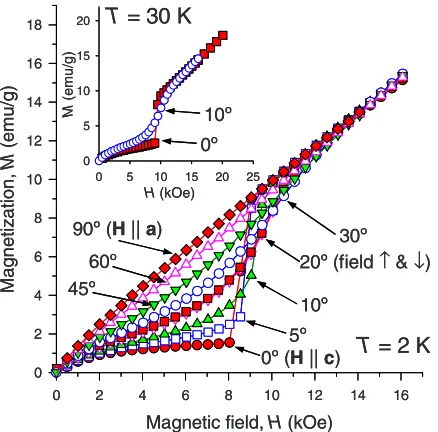
plane and therefore is coplanar with the slabs, a sharp spin-flop transition is only observed within a narrow range of the tilt angles, i.e., 0⬍⬍20°共Fig.3兲. Upon further increasing the tilt angle, the magnetization begins to exhibit a gradual and smooth transition from the normal AFM state to the spin-flop AFM state, i.e., the spin-flop transition becomes continuous and occurs over a relatively wide range of fields. Nearly the same behavior is observed at 30 K共see the inset
of Fig.3兲. All of these are consistent with a changeover from a first order transformation at lowto a second order trans-formation at large values of, which is quite different from the behavior observed when the field was applied in thecb
plane. When exceeds 60°, the spin-flop transition is no longer recognizable, and all magnetization curves merge into that of= 90° 共i.e., whenH储a兲 共see Fig. 3兲. Obviously, the second order spin-flop transition is also reversible, as shown in Fig.3 for⬵20°.
For a continuous spin-flop transition, we define the field where thedM/dHexhibits a maximum asHsf. A plot ofHsf
vsis shown in Fig.4共a兲. With increasing, the value ofHsf
initially increases slowly and then nearly saturates around 10 kOe 关Fig. 4共a兲兴, never approaching the critical field Hc
⬵31 kOe 共Ref. 27兲 for the AFM→FM transition with the magnetic field vector parallel to a. The projection of the vectorHsfalong thecaxis increases first for 0⬍⬍20° and
Magnetic field,H(kOe)
0 2 4 6 8 10 12 14 16
M agn etiz ation , M (em u/g) 0 2 4 6 8 10 12 14 16 18 H(kOe)
0 5 10 15 20 25
M (emu /g ) 0 5 10 15 20
0º (H||c) 5º
10º
20º (field↑&↓) 30º
45º 60º 90º (H||a)
T
= 2 K
10º
0º
T
= 30 K
Magnetic field,H(kOe)
0 2 4 6 8 10 12 14 16
M agn etiz ation , M (em u/g) 0 2 4 6 8 10 12 14 16 18 H(kOe)
0 5 10 15 20 25
M (emu /g ) 0 5 10 15 20
0º (H||c) 5º
10º
20º (field↑&↓) 30º
45º 60º 90º (H||a)
T
= 2 K
10º
0º
[image:5.612.323.548.56.493.2]T
= 30 K
FIG. 3. 共Color online兲The magnetization isotherms of Gd5Ge4
single crystal measured atT= 2 K with the magnetic field vector gradually tilted away from thecaxis toward theaaxis共thecaplane isotherms兲. The inset shows two isotherms measured at T= 30 K withH储cand withH⬔c= 10° in thecaplane.
H
sfcos
θ
(kOe)
0 2 4 6 8 10
H
sfsin
θ
(k
O
e)
0 2 4 6 8 10 12 14 16 18H
in
ca
plane
H
in
cb
pl
an
e
(b)
Angle
,
θ
(
Deg.)
0 10 20 30 40 50 60
H
sf(k
Oe)
4 8 12 16 20 24H
in
cb
plane
H
in
ca
plane
(a)
H
sfcos
θ
(kOe)
0 2 4 6 8 10
H
sfsin
θ
(k
Oe)
0 2 4 6 8 10 12 14 16 18H
in
ca
plane
H
in
cb
pl
an
e
(b)
H
sfcos
θ
(kOe)
0 2 4 6 8 10
H
sfsin
θ
(k
Oe)
0 2 4 6 8 10 12 14 16 18H
in
ca
plane
H
in
cb
pl
an
e
(b)
Angle
,
θ
(
Deg.)
0 10 20 30 40 50 60
H
sf(k
Oe)
4 8 12 16 20 24H
in
cb
plane
H
in
ca
plane
(a)
Angle
,
θ
(
Deg.)
0 10 20 30 40 50 60
H
sf(k
Oe)
4 8 12 16 20 24H
in
cb
plane
H
in
ca
plane
(a)
FIG. 4.共Color online兲 共a兲Angle dependencies ofHsfin Gd5Ge4
atT= 2 K and共b兲projections of theHsf vector along thecand b
axes and thecandaaxes.
ANGULAR DEPENDENCE OF THE SPIN-FLOP… PHYSICAL REVIEW B76, 134415共2007兲
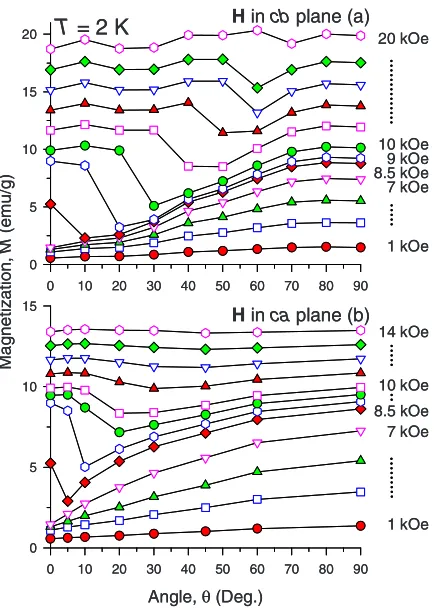
[image:5.612.66.285.58.274.2]then decreases rapidly when⬎20°关see Fig.4共b兲兴, which is quite different from thecbbehavior, also shown in Fig.4共b兲. A clear picture of the angular dependencies of the spin-flop transition may also be seen in Fig.5, where we plot the magnetization versus extracted at selected fields from the data shown in Figs. 2 and 3. In Fig. 5共a兲 共the cb curves兲, there are no anomalies forH⬍8.3 kOe, i.e., as long as the magnetic field remains below the critical spin-flop field for
⬵0. When the magnetic field increases to 8.5 kOe and higher, a plateau in magnetization develops starting from
⬵0 and the length of the plateau increases共in units兲as the field increases关Fig.5共a兲兴. The plateau is followed by a spin-flop transition, which is characterized by a sharp drop of the magnetization. The first order spin-flop transition is recog-nizable up to⬵65°. However, in thecacurves关Fig.5共b兲兴, the sharp spin-flop transition is observed only within 0⬍
⬍20°.
Based on the experimental results presented above, we conclude that the nature of the spin-flop transition in Gd5Ge4
is strongly dependent on the orientational relationships be-tween the direction of the magnetic field vector and the plane of the slabs. As long as the magnetic field vector is confined within thecb plane 共i.e., it is rotated in the plane normal to the slabs兲, the spin-flop transition always remains first order. However, in the ca plane 共the field vector is coplanar with the slabs兲, the spin-flop transition is only first order within a small range of angles between the magnetic field vector and the AFM easy共c兲axis共0⬍⬍20°兲. The data shown in Fig.
5compare well to that found in CuCl2· 2H2O, which also has
an orthorhombic structure.4In CuCl2· 2H2O, theaaxis is the
AFM easy axis, theb axis is the next easiest axis共spin-flop axis兲, and thec axis is the hard axis. The magnetization of CuCl2· 2H2O measured as a function of with the magnetic
field vector confined in theacplane exhibits a constant value at low共whenH储a兲followed by a sharp drop, whereas both of these features are absent in the ab plane measurements.3
Hence, our results for Gd5Ge4 are consistent with the AFM
easy axis being thecaxis, the next easiest axis共the spin-flop axis兲is theaaxis, and the hard axis is thebaxis. This means that with the occurrence of the spin-flop transition, the Gd moments that were coupled antiferromagnetically along thec
axis are rotated within the plane of the slab and become nearly collinear with the a axis. In the cb plane measure-ments, the spin rotation is discontinuous because the spin-flop axis is always perpendicular to the magnetic field vector, whereas in theca plane measurements, the spin rotation is continuous because the spin-flop axis is no longer perpen-dicular to the field vector.
Even though data about microscopic magnetism of
R5SixGe4−xcompounds with heavy lanthanides are limited to
only a few representatives withR= Gd, Tb, and Er,28,37–40the
spin-flop AFM configuration of Gd5Ge4 with the magnetic
moments coplanar with the slabs is quite reasonable. In all known cases, there is a clear tendency toward ferromag-netism of the individual slabs. Furthermore, the moments are coplanar or nearly coplanar with the slabs in compounds formed by heavy lanthanides with small orbital contribution to the total magnetic moment 共Gd and Tb兲, while the mo-ments become normal to the slabs in Er, where the orbital contribution dominates. We believe that this is related to a gradual reduction of the strength of the isotropic exchange interactions and to an increasing anisotropic contribution from the magnetoelastic coupling that arises from the com-petition between the anisotropy of the layered crystal struc-ture and single ion anisotropy. Thus, the prediction by Levin
et al.,26 which was made without direct evidence, was cor-rect, and the results presented above do confirm that the a
axis is indeed the spin-flop axis of Gd5Ge4.
It is worth noting that the theoretical treatment using the molecular field approximation34 of the phase transition
be-tween a normal AFM phase and a spin-flop AFM phase in a uniaxial antiferromagnet shows that the range of angles over which a first order spin-flop transition may be observed is quite small because the anisotropy energy is usually small compared to the isotropic exchange energy. This conclusion is in agreement with some other uniaxial antiferromagnets, where the maximum tilt angle at which a first order spin-flop transition between the AFM easy axis and the spin-flop axis can be observed共max兲has a magnitude of less than 1°.4,5,7,34
This is indeed much smaller than the value of max = 20° ± 5° seen in Gd5Ge4, especially considering the
pos-sible misalignment of the field vector with respect to the crystallographic direction共s兲. As pointed out by Rohrer and Thomas,34 the maximum tilt angle can be expressed as
max= 28.6°⫻Han/Hex when K1= 0. Here, K1 is the
aniso-tropy constant between the two sublattices, andHanandHex
are the anisotropy and exchange fields, respectively. This in-dicates that although the isotropic exchange interactions are
0 10 20 30 40 50 60 70 80 90
Mag
net
izat
ion
,
M
(e
mu/
g)
0 5 10 15 20
Angle,θ(Deg.)
0 10 20 30 40 50 60 70 80 90 0
5 10 15
14 kOe
10 kOe 8.5 kOe 7 kOe
1 kOe 20 kOe
10 kOe 9 kOe 7 kOe
1 kOe 8.5 kOe
T
= 2 K
Hincbplane (a)Hincaplane (b)
0 10 20 30 40 50 60 70 80 90
Mag
net
izat
ion
,
M
(e
mu/
g)
0 5 10 15 20
Angle,θ(Deg.)
0 10 20 30 40 50 60 70 80 90 0
5 10 15
14 kOe
10 kOe 8.5 kOe 7 kOe
1 kOe 20 kOe
10 kOe 9 kOe 7 kOe
1 kOe 8.5 kOe
T
= 2 K
Hincbplane (a) [image:6.612.67.284.56.361.2]Hincaplane (b)
FIG. 5.共Color online兲Angle dependencies of the magnetization of Gd5Ge4 at selected magnetic fields extracted from M共H兲
mea-surements in thecbplane共a兲and in thecaplane共b兲.
OUYANGet al. PHYSICAL REVIEW B76, 134415共2007兲
always dominant in uniaxial antiferromagnets, the value of
Han/Hex is large in Gd5Ge4 when compared to some other
transition metal systems, thus leading to a relatively large
max.
The unusually largeHan/Hexis a reflection of the fact that
anisotropic exchange interactions in Gd5Gd4 are stronger
than in many other Gd-based systems. The magnetic aniso-tropy of the title compound is probably dominated by the anisotropic exchange interactions due to its distinctly layered29 and, therefore, anisotropic orthorhombic crystal
structure. This behavior is similar to that observed in GdRu2Si2 and GdRu2Ge2,41 where the low temperature
an-isotropy may originate from anisotropic exchange interac-tions caused by the anisotropy of the tetragonal lattice. An-isotropic exchange interactions are also a likely origin of the anisotropy observed in GdCu2, where a model based on the
anisotropy of the classical dipole-dipole exchange fails to describe the easy magnetization direction in this noncollinear amplitude-modulated magnetic structure,42even though this
model works well for other Gd-based compounds, e.g., GdAg, GdAu2Si2, and GdCu2In.43
CONCLUSIONS
The angular dependence of the spin-flop transition in single crystal Gd5Ge4 has been investigated by
magnetiza-tion measurements. When the magnetic field vector is tilted away from the antiferromagnetic easy axis 共c axis兲 toward thebaxis, a first order spin-flop transition is observed over a wide range of tilt angles 0⬍⬍65°. However, when the field vector is tilted away from thecaxis toward thea axis, the first order spin-flop transition is only observed over a small range of tilt angles共0⬍⬍20°兲. Whenexceeds 20°, the spin-flop transition becomes a second order transforma-tion, suggesting that in the spin-flop AFM phase, the Gd moments are antiferromagnetically coupled along theaaxis.
ACKNOWLEDGMENTS
The Ames Laboratory is operated for the U.S. Department of Energy by Iowa State University of Science and Technol-ogy. This work was supported by the Department of Energy, Office of Basic Energy Sciences, Materials Sciences Divi-sion under Contract No. DE-AC02-07CH11358.
*Present address: Institute for Materials Research, Tohoku Univer-sity, 2-1-1 Katahira, Aoba-ku, Sendai 980-8577, Japan.
†Corresponding author; [email protected] 1L. Néel, Ann. Phys.共Paris兲 5, 232共1936兲.
2N. J. Poulis and G. E. G. Hardeman, Physica共Utrecht兲 18, 201 共1952兲; 18, 429共1952兲.
3C. J. Gorter, Rev. Mod. Phys. 25, 332共1953兲.
4J. W. Lynn, P. Heller, and N. A. Lurie, Phys. Rev. B 16, 5032 共1977兲.
5R. A. Butera, L. M. Corliss, J. M. Hastings, R. Thomas, and D.
Mukamel, Phys. Rev. B 24, 1244共1981兲.
6Y. Shapira and S. Foner, Phys. Rev. B 1, 3083共1970兲. 7G. P. Felcher and R. Kleb, Europhys. Lett. 36, 455共1996兲. 8W. Schweika, S. V. Maleyev, Th. Brückel, and V. P. Plakhty,
Europhys. Lett. 60, 446共2002兲.
9R. J. Birgeneau, G. Shirane, M. Blumet, and W. C. Koehler, Phys.
Rev. Lett. 33, 1098共1974兲.
10I. Tsukada, J. Takeya, T. Masuda, and K. Uchinokura, Phys. Rev.
Lett. 87, 127203共2001兲.
11A. N. Bogdanov and U. K. Rößler, Phys. Rev. B 68, 012407 共2003兲.
12J. Meersschaut, C. L’abbé, F. M. Almeida, J. S. Jiang, J. Pearson,
U. Welp, M. Gierlings, H. Maletta, and S. D. Bader, Phys. Rev. B 73, 144428共2006兲.
13V. K. Pecharsky and K. A. Gschneidner, Jr., Phys. Rev. Lett. 78,
4494共1997兲.
14V. K. Pecharsky and K. A. Gschneidner, Jr., Appl. Phys. Lett. 70,
3299共1997兲.
15L. Morellon, P. A. Algarabel, M. R. Ibarra, J. Blasco, B.
García-Landa, Z. Arnold, and F. Albertini, Phys. Rev. B 58, R14721
共1998兲.
16V. K. Pecharsky and K. A. Gschneidner, Jr., J. Alloys Compd.
260, 98共1997兲.
17L. Morellon, J. Blasco, P. A. Algarabel, and M. R. Ibarra, Phys.
Rev. B 62, 1022共2000兲.
18V. K. Pecharsky and K. A. Gschneidner, Jr., Adv. Mater.共
Wein-heim, Ger.兲 13, 683共2001兲.
19F. Holtzberg, R. J. Gambino, and T. R. McGuire, J. Phys. Chem.
Solids 28, 2283共1967兲.
20E. M. Levin, V. K. Pecharsky, K. A. Gschneidner, Jr., and G. J.
Miller, Phys. Rev. B 64, 235103共2001兲.
21E. M. Levin, K. A. Gschneidner, Jr., and V. K. Pecharsky, Phys.
Rev. B 65, 214427共2002兲.
22C. Magen, L. Morellon, P. A. Algarabel, C. Marquina, and M. R.
Ibarra, J. Phys.: Condens. Matter 15, 2389共2003兲.
23F. Casanova, A. Labarta, X. Batlle, J. Marcos, L. Mañosa, A.
Planes, and S. de Brion, Phys. Rev. B 69, 104416共2004兲.
24V. Hardyet al., Phys. Rev. B 69, 020407共R兲 共2004兲.
25D. Paudyal, V. K. Pecharsky, K. A. Gschneidner, Jr., and B. N.
Harmon, Phys. Rev. B 75, 094427共2007兲.
26E. M. Levin, K. A. Gschneidner, Jr., T. A. Lograsso, D. L.
Schla-gel, and V. K. Pecharsky, Phys. Rev. B 69, 144428共2004兲.
27Z. W. Ouyang, V. K. Pecharsky, K. A. Gschneidner, Jr., D. L.
Schlagel, and T. A. Lograsso, Phys. Rev. B 74, 024401共2006兲.
28L. Tanet al., Phys. Rev. B 71, 214408共2005兲.
29V. K. Pecharsky, A. P. Holm, K. A. Gschneidner, Jr., and R. Rink,
Phys. Rev. Lett. 91, 197204共2003兲.
30Ya. Mudryk, A. P. Holm, K. A. Gschneidner, Jr., and V. K.
Pe-charsky, Phys. Rev. B 72, 064442共2005兲.
31C. Magen, Z. Arnold, L. Morellon, Y. Skorokhod, P. A. Algarabel,
M. R. Ibarra, and J. Kamarad, Phys. Rev. Lett. 91, 207202
共2003兲.
32S. B. Roy, M. K. Chattopadhyay, P. Chaddah, J. D. Moore, G. K.
Perkins, L. F. Cohen, K. A. Gschneidner, Jr., and V. K. Pechar-sky, Phys. Rev. B 74, 012403共2006兲.
33S. B. Roy, M. K. Chattopadhyay, A. Bannerjee, P. Chaddah, J. D.
Moore, G. K. Perkins, L. F. Cohen, K. A. Gschneidner, Jr., and V. K. Pecharsky, Phys. Rev. B 75, 184410共2007兲.
ANGULAR DEPENDENCE OF THE SPIN-FLOP… PHYSICAL REVIEW B76, 134415共2007兲
34H. Rohrer and H. Thomas, J. Appl. Phys. 40, 1025共1969兲. 35D. L. Schlagel, T. A. Lograsso, A. O. Pecharsky, and J. A.
Sam-paio, inLight Metals 2005, edited by H. Kvande共The Minerals, Metals and Materials Society, Warrendale, PA, 2005兲, p. 1177.
36Z. W. Ouyang, V. K. Pecharsky, K. A. Gschneidner, Jr., D. L.
Schlagel, and T. A. Lograsso, Phys. Rev. B 74, 094404共2006兲.
37C. Ritter, L. Morellon, P. A. Algarabel, C. Magen, and M. R.
Ibarra, Phys. Rev. B 65, 094405共2002兲.
38J. M. Cadogan, D. H. Ryan, Z. Altounian, X. Liu, and I. P.
Swain-son, J. Appl. Phys. 95, 7076共2004兲.
39V. O. Garlea, J. L. Zarestky, C. Y. Jones, L.-L. Lin, D. L.
Schla-gel, T. A. Lograsso, A. O. Tsokol, V. K. Pecharsky, K. A.
Gschneidner, Jr., and C. Stassis, Phys. Rev. B 72, 104431
共2005兲.
40C. Ritter, C. Magen, L. Morellon, P. A. Algarabel, M. R. Ibarra, V.
K. Pecharsky, A. O. Tsokol, and K. A. Gschneidner, Jr., J. Phys.: Condens. Matter 18, 3937共2006兲.
41A. Garnier, D. Gignoux, D. Schmitt, and T. Shigeoka, Physica B
222, 80共1996兲.
42M. Rotter, M. Loewenhaupt, M. Doerr, A. Lindbaum, and H.
Michor, Phys. Rev. B 64, 014402共2001兲.
43M. Rotter, M. Loewenhaupt, M. Doerr, A. Lindbaum, H. Sassik,
K. Ziebeck, and B. Beuneu, Phys. Rev. B 68, 144418共2003兲.
OUYANGet al. PHYSICAL REVIEW B76, 134415共2007兲