Identifying Factors affecting the Phenomenon of Organizational loafing; Using Structural Equation Modeling & Delphi Techniques
Saeed Abesi1 Ali Samani2
Abstract
Organizational loafing is the phenomenon of a person exerting less effort to achieve a goal when they work in an organizational group than when they work alone.This phenomenon is a serious problem in today's organizations.The research seeks to explain factors affecting the phenomenon of organizational loafing. First, the elites’ opinion through Delphi technique about the indicators influencing the organizational loafing including environment, human, technology, aims and structure was collected. After designing the model, the fitting as well as editing questionnaire were measured. This research which is both quantitative and qualitative designed the final model. 180 employees of the Ministry of Communications and Information Technology were randomly selected as the sample of study. Statistical analysis of research data was performed with the help of structural equation. In so doing, the questionnaire, whose validity and reliability with Cronbach's alpha equal to 834% were confirmed, was utilized to collect data. And after confirmation of normal distribution of data with the help of Smart PLS software and confirmatory factor analysis, eventually proposed model with 5 criteria and 25 indicators was approved. The results showed that the most influential factors affecting organization loafing is organization environment, followed by other indexes including aims, structure, and human factors and technology. So the managers were recommended to turn to the most important indicators affecting organizational loafing such as satisfaction, commitment and organizational culture so as to achieve efficient organizational loafing management.
Key words: Organizational loafing, participation, organizational culture, environment.
1. Introduction
Certainly, organizational life without the participation and collective actionis is completely meaningless. One of the main concerns of organizations is to attract the participation of majority of staff to achieve their organizational goals. The researchers of organization and
1. Assistant Professor , Department of Management, Payame Noor University(PNU), P.O.BOX, 19395-3697, Tehran, Iran(corresponding author).Email: [email protected]
management argue that without referring to concepts including satisfaction, justice, commitment, and motivation, it is impossible to present feasible and new model to increase participation in achieving organizational aims. It is obvious that attracting participation of staff is a strategic action causing worthiness of individual, improvement and progress of organization and increase in productivity in an individual, national and transnational levels respectively. One of the most infrastructural measures causing productivity of organizations is providing suitable condition in which staff collectively tries to achieve organizational aims with satisfaction and motivation.In a dynamic, competitive and risky atmosphere and also in such an environment, success is not feasible without the help of employees (Brickner& Harkins, 2014). So one of the big concerns that organizations face is to achieve maximum participation of workers to achieve common visions and goals)Liden &Waynem, 2014). Today, researchers have found that without relying on concepts such as job satisfaction, justice, commitment and motivation, one cannot create a new and efficient model to increase the participation of employees (Karau &Williams, 2014(. Obviously, the participation of employees is a strategic action that at the individual level leads to personal wealth, at the organizational level leads to improvement and development and at the national level, leads to increased productivity; so one of the underlying causes of organizational efficiency is creating favorable conditions where employees with job satisfaction, motivation and commitment strive to achieve the organization's goals(Karra, 2014). This topic in the road map of administrative reform is presented as a strategic issue. In the fourth program of administrative reform has been paying special attention to this matter. So that the strategic goal of the Fourth Development Plan of this road map is management of human capital in theadministrative system, with an emphasis on active participation of employees and modifying impediments such as lack of motivation, long, resignation and loafing.
requires a team effort) like: assessment, policy, oversight and governance ICT sector, are not doing well. Therefore, these tasks are carried out at their lowest levels or things are done in incomplete and inaccurate manner. Of course, this can have various causes but on the evidence and the statements and opinions can be received that it is rooted in issues such as feeling unmotivated,-long, frustration, injustice, declining work ethic, low loyalty of their employees and dissatisfaction with the state organization. However, it would cause interruptions in achieving the objectives of this Ministry.
Unfortunately, the evidence suggests that employees of the Ministry do not want to participate in teamwork and those are not interested in active participation in teamwork and collective actions. Actually, various excuses, escape from engaging in team work, shirk work, view apparent effort rather than doing actual work during teamwork, low work participation of people on the team and ets are the manifestations of this problem. All this can be summed in the category of organizational loafing, because the staff despite having outstanding merit and abilities, knowledge and higher education, do not actively participate in collective activities. Therefore, a comprehensive model that can represent different aspects of organizational loafing and provide a way to manage it, can be a vital step towards eliminating the root cause of the problem in the organization.
Scott believes that the organization is a human association, structured, high-technology, targeted and enclosed environment. The main elements of this definition, includes: individuals (employees) - technology, objectives, structure and environment. This study sought to identify the impact of each element of the organization and their respective index on loafing on organizational loafing management. According to this view, this research is faced with the fundamental question:
What organizational factors lead to organizational loafing in ICT ministry and how we can manage this issue?
So the aim of this study is to identify the dimensions and indicators of management of organizational loafing.
2. Research Literature
synergy of group activities. Organizational loafing is a phenomenon that has been discussed and researched since 1913. Maximilien Ringelmann, a French agricultural engineer, observed that when a group of people collectively pulled on a rope, the output was less than when group members individually pulled on the rope )Wallace.2014(. The results of this finding were not considered further until 1974 when Ingham, Levinger, Graves, and Peckham recreated the experiment. The term “organizational loafing” was coined for the discovery that participants working in groups exert less effort than participants working individually. It was described as having a detrimental effect on individuals and the institutions associated with them )Kaufmann &Schneider, 2014).
The origins of organizational loafing begin with “The Ringelmann Effect,”which describes the tendency forindividuals to lower their productivity when in a group ) Harkins& Petty,2014(; Ingham, Levinger, Graves and Peckham relabeled this effect “organizational loafing” when they were successful in demonstrating individual effort declines in a curvilinear fashion when people work as a group or only believe they are working in a group (Karau &Williams, 2014). Organizational loafing literature blossomed as these findings gave way to more questions:
Is the problem coordination and not motivation? Since the experiment involved groups created for the experiment, would established groups have the same results? What exactly causes organizational loafing? Is it because group dynamics give an individual the ability to “hide in the crowd”? Does organizational loafing only exist in physical activities? Or does it also happen when groups are performing cognitive tasks? These questions paved the way for much more research over the years.
having rewards and feedback help prevent organizational loafing from occurring?
Five years after the landmark study, Latane, Williams, and Harkins replicated the experiment with cheering and clapping (Forsyth, 2014). This research contributed two important advances: they demonstrated Ringelmann’s results were replicable, and because of the simplistic nature of yelling and clapping, they also made clear that the results of decreased efforts were not simply because of coordination problems between group members or difficulty of the task. Support of the effect only led to more questions: when and why does organizational loafing take place? Because groups are such a huge part of everyone’s life, what can be done to prevent it from happening? Realizing the far-reaching implications of these findings, they famously came to the conclusion that organizational loafing is “a kind of social disease“.
Although the researchers described organizational loafing in such harsh terms, they did mention in their discussion that people may have decided to loaf in groups because they wanted to save their energy for times when they would need to work as an individual, and would be able to earn rewards (George,2014(. This adaptive look at organizational loafing was not fully explored until thirty years later.
Organizational loafing is positively related to performance and endurance on later tasks (Noruzy, 2014(. Social compensation allows each group member to conserve energy for their own individual tasks, while still maintaining solid results of the group task. In this competitive environment, organizations need to have efficiently working employees. Also, these employees should go beyond their traditional job descriptions or formal duties. In order to increase efficiency, organizations should lead the citizenship process. The reason for this attitude can be that employees exhibit higher levels of performance and act more than their job descriptions when they believe they are treated fairly at their workplaces. In other words, employee’s job performance may increase or decrease in relation to perceptions of inequitable outcomes (Noruzy, 2014(
brought up together through the work groups, occur as a great synergy for organizations although there can be the negative effects of these types of group work.
Organizational loafing is a phenomenon in which group membership degrades individual motivation and it occurs as the tendency of individuals in order to expend less effort while working collectively rather than working individually.
A widely accepted explanation for productivity losses has been the organizational loafing phenomenon (George, 2013). Organizational loafing is based on the de-individuation that can occur when people work in groups as opposed to working alone. As Liden et al (2004) indicated in their research that researchers have grounded their study of organizational loafing in motivation theories, and have identified a wide variety of potential antecedents. Also, it is expressed that although there are many antecedents, the term organizational loafing has the motivational background.
The literature on organizational loafing field includes theoretical and empirical evidence that provides some insight into the nature and possible causes of organizational loafing. To conclude, the tendency to engage in organizational loafing is influenced by a large number of variables, highlighting a number of conditions under which organizational loafing would be more or less likely to occur. These factors are:
Group size
Task difficulty
Identifiability of individual performance (task visibility)
Evaluation potential with an objective standard
Dispensability of effort
Coworker performance expectations
Value of outcomes
Personal Involvement (task meaningfulness and task importance)
Group cohesiveness and Individual differences.
motivation, job satisfaction and commitment causes withdrawal behavior in them.
Sometimes using individuals with introverted personality type in teamwork increases this loafing in the organization. People to find enough motivation to participate in group activities, must feel that their opinion is effective in group decisions and work process; otherwise a resignation occurs in them. People in group activities need attention. People in group activities like to be praised and encouraged and considered. Managers should pay attention to the needs of individuals and rewards commensurate with their efforts. In this kind of circumstances, Employees avoid of withdrawal and resignation and shirk. Organizational goals can also cause Organizational loafing.
Coherent and consistent goals can reduce the level of loafing. Motivating and usefulness of goals, realistic goals, visible and quantifiable goals, and clarity and transparency purposes can reduce the level of organizational loafing (Forsyth.2014). The technology can affect in various forms on organizational loafing. Techniques and tools and technologies can eliminate people from your organization, and this could be a prelude to withdrawal and isolation of staff. Cultural environment that encourages social participation discourages people from loafing. Economic pressures or mature and stable economy could reduce or increase the level of Organizational loafing (Forsyth.2014). Structural dimensions can also be effective on Organizational loafing. Centralized organization allowed to express opinions and ideas and limit the spirit of participation in the organization.Formalized structure also reduces employees' activities.
Figure1. Initial research model
3. Research Methodology
In Delphi technique, data were collected from 15 experts in ICT ministry and sample size were 180 employees in this ministry. Various methods were used through the data collection in which an interview was carried out firstly and then by using a questionnaire data were collected. Also a deep research was carried out via universities, digital libraries and databases.
The data collection tool consisted of three parts. The first part of the tool included the demographical questions determining employees' profile that is age, gender, position, salary, marital status and how long they are experiencing this proficiency. In the second section, 95 questions which were designed to measure the organizational loafing tendency were used. Participants were instructed to indicate how characteristic each item was. The answers were placed with a rating scale system ranging from 1, "not at all characteristic," to 5, "very characteristic" and responses to these items were summed. The number of the participants included in this study was 350 personsin ICT ministries; so by using cochran’s formula 180 persons were selectedas sample size.
While collecting the data, participants were informed about the reasons
for data collection and the required information about
participants’anonymity about their responses were given. The research deals with organizational loafing attitudes of managers of ICT ministry. Although it is an explanatory research, it compares the responses of different work groupsand their level of perceptions about organizational
Organizational loafing management
goals technology environment
structure
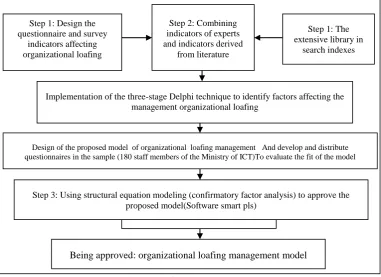
loafing tendency. The study has three main steps. Research operational steps shown in the figure 2
Findings
Step 1: Researchers designed an open questionnaire and survey
indicators affecting organizational loafing. Then they used an extensive library for search indexes to survey indicators affecting organizational loafing.
In table1 all indicators affecting organizational loafing that found from openquestionnaire have shown.
Figure 2. Operational model
4. Findings
Step 1: Researchers designed an open questionnaire and survey indicators
affecting organizational loafing. Then they used an extensive library for search indexes to survey indicators affecting organizational loafing. In table 1 all indicators affecting organizational loafing that found from openquestionnaire has shown.
Step 1: Design the questionnaire and survey
indicators affecting organizational loafing
Step 2: Combining indicators of experts and indicators derived
from literature
Step 1: The extensive library in
search indexes
Implementation of the three-stage Delphi technique to identify factors affecting the management organizational loafing
Step 3: Using structural equation modeling (confirmatory factor analysis) to approve the proposed model(Software smart pls)
Being approved: organizational loafing management model
Table 1. Indicators of organizational loafing
Organizational aspects indicators of organizational loafing
human
Commitment- satisfaction- self-esteem - job satisfaction- the type of personality- Work engagement - the motivation- Talent - motivation
structure Focus - complexity- formality technology Complexity - Extensive - Simplicity goals Cohesion objectives - quantifiable environment internal Style of supervision - Organizational Culture
external Political - economic and social - cultural
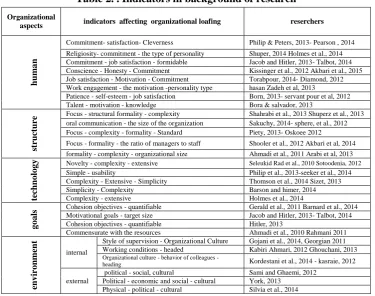
In table 2 all indicators affecting organizational loafing that found from extensive library and background of the research have shown.
Table 2. . Indicators in background of research
Organizational
aspects indicators affecting organizational loafing reserchers
h
u
m
a
n
Commitment- satisfaction- Cleverness Philip & Peters, 2013- Pearson , 2014 Religiosity- commitment - the type of personality Shuper, 2014 Holmes et al., 2014 Commitment - job satisfaction - formidable Jacob and Hitler, 2013- Talbot, 2014 Conscience - Honesty - Commitment Kissinger et al., 2012 Akbari et al., 2015 Job satisfaction - Motivation - Commitment Torabpour, 2014- Diamond, 2012 Work engagement - the motivation -personality type hasan Zadeh et al, 2013
Patience - self-esteem - job satisfaction Born, 2013- servant pour et al, 2012 Talent - motivation - knowledge Bora & salvador, 2013
str
u
ctu
re
Focus - structural formality - complexity Shahrabi et al., 2013 Shuperz et al., 2013 oral communication - the size of the organization Sakuchy, 2014- sphere, et al., 2012 Focus - complexity - formality - Standard Piety, 2013- Oskoee 2012
Focus - formality - the ratio of managers to staff Shooler et al., 2012 Akbari et al, 2014 formality - complexity - organizational size Ahmadi et al., 2011 Arabi et al, 2013
te ch n o lo g
y Novelty - complexity - extensive Seleukid Rad et al., 2010 Sotoodenia, 2012
Simple - usability Philip et al., 2013-seeker et al., 2014 Complexity - Extensive - Simplicity Thomson et al., 2014 Sizet, 2013 Simplicity - Complexity Barson and himer, 2014 Complexity - extensive Holmes et al., 2014
g
o
a
ls Cohesion objectives - quantifiable Motivational goals - target size Gerald et al., 2011 Barnard et al., 2014 Jacob and Hitler, 2013- Talbot, 2014 Cohesion objectives - quantifiable Hitler, 2013
Commensurate with the resources Ahmadi et al., 2010 Rahmani 2011
en v iro n m en t internal
Style of supervision - Organizational Culture Gojani et al., 2014, Georgian 2011 Working conditions - headed Kabiri Ahmari, 2012 Ghouchani, 2013
Organizational culture - behavior of colleagues -
heading Kordestani et al., 2014 - kasraie, 2012
external
political - social, cultural Sami and Ghaemi, 2012 Political - economic and social - cultural York, 2013
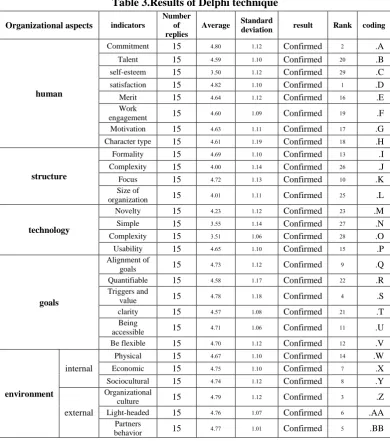
Step 2: Combining indicators of experts and indicators derived from literature and implementation of the three-stage Delphi technique to identify factors affecting the management organizational loafing.
Table 3.Results of Delphi technique
Organizational aspects indicators
Number of replies
Average Standard
deviation result Rank coding
human
Commitment 15 4.80 1.12 Confirmed 2 .A
Talent 15 4.59 1.10 Confirmed 20 .B
self-esteem 15 3.50 1.12 Confirmed 29 .C
satisfaction 15 4.82 1.10 Confirmed 1 .D
Merit 15 4.64 1.12 Confirmed 16 .E
Work
engagement 15 4.60 1.09 Confirmed 19 .F
Motivation 15 4.63 1.11 Confirmed 17 .G
Character type 15 4.61 1.19 Confirmed 18 .H
structure
Formality 15 4.69 1.10 Confirmed 13 .I
Complexity 15 4.00 1.14 Confirmed 26 .J
Focus 15 4.72 1.13 Confirmed 10 .K
Size of
organization 15 4.01 1.11 Confirmed 25 .L
technology
Novelty 15 4.23 1.12 Confirmed 23 .M
Simple 15 3.55 1.14 Confirmed 27 .N
Complexity 15 3.51 1.06 Confirmed 28 .O
Usability 15 4.65 1.10 Confirmed 15 .P
goals
Alignment of
goals 15 4.73 1.12 Confirmed 9 .Q
Quantifiable 15 4.58 1.17 Confirmed 22 .R
Triggers and
value 15 4.78 1.18 Confirmed 4 .S
clarity 15 4.57 1.08 Confirmed 21 .T
Being
accessible 15 4.71 1.06 Confirmed 11 .U
Be flexible 15 4.70 1.12 Confirmed 12 .V
environment
internal
Physical 15 4.67 1.10 Confirmed 14 .W
Economic 15 4.75 1.10 Confirmed 7 .X
Sociocultural 15 4.74 1.12 Confirmed 8 .Y
external
Organizational
culture 15 4.79 1 .12 Confirmed 3 .Z
Light-headed 15 4.76 1.07 Confirmed 6 .AA
Partners
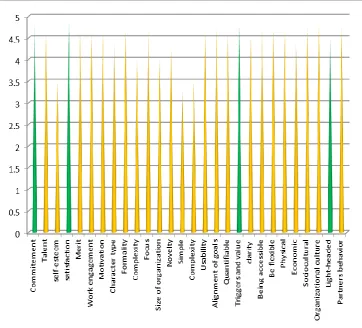
Finally, the effect of the 5 components of the organization on organizational loafing in the form of 29 indicators was approved. Among the factors affecting the management of the organizational loafing, indicators ranked first to third respectively: job satisfaction (mean 4.82), commitment (mean 4.8) and organizational culture (mean 4.79) were awarded (Figure.3).
Figure3. Results of Delphi technique (indicators)
4.74
4.58
3.98
4.43 4.52
envieronment goals tecnolegy stracture human
Figure 4. Results of Delphi technique (factors)
Step 3: This step is step of designing the proposed model of
organizational loafing management and develop and distribute questionnaires in the sample (180 staff members of Ministry of ICT) to evaluate the fit of the model. In this study to examine the reliability of the criteria used Cronbach's alpha and composite reliability and for validity, construct validity were used.Content validity (that was used to determine the validity of the questionnaire) was confirmed by experts. About the validity of the method Smart PLS (structural equation model) was used.Construct validity is divided into two types (convergent validity and divergent validity) AVE criteria were used for convergent validity (Table 4).
Table 4. AVE test
environment goals
technology structure
human
.595 .598
.685 .754
.675
AVE
Table 5. Divergent validity test
To measure the reliability of the study, Cronbach's alpha and composite reliability were used. According to the results we can say that reliability is at an acceptable level (table 6).
Table 6.Reliability test
environment goals technology structure human .873 .850 .841 .843 .751 alpha .898 .897 .901 .892 .855 CR
In the inferred part of this researchthe normal distribution of data need to be tested. In so doing, the Kolmogorov-Smirnov test (K-S) and Shapiro Wilk (S-W) were used. Table 7 shows the test results (K-S and Shapiro Wilk).
Table 7. K-S and Shapiro wilk tests
Significance level K-S K-S Statistics Significance level S-W S-W Statistics .003 .076 .002 .979 human .000 .093 .000 .974 structure .000 .101 .000 .962 technology .000 .112 .000 .949 goals .000 .101 .000 .973 environment
In this study the process of confirmatory factor analysis was in this way: that the model was implemented and the model was significant in terms of significance of 5 factors and 29 indicators. Smart PLS software result has been shown in Figure 5. Results show all dimensions are meaningful. So there is no need to remove any question to get a better fit.
indicators environment goals tecnolegy structure human .748 human ind ica to
rs structure .624 .773
Figure5. Reserch model
5. Conclusions
the impact of the five aspects of organization and 29 related indicators on organizational loafing management.
In this section, a brief discussion of the most important and influential aspects will be discussed. Job satisfaction is the most significant impact on organizational loafing management known. Certainly, any organization considering the issue of job satisfaction may increase the level of positive organizational variables. The desire to use less energy or low level of energy in the collective effort of the organization may be derived from low level of job satisfaction.
When employees are not satisfied whitpayment level, distribution of rights and benefits, how to behave and interact, how to manage and chief executives, physical conditions of work, the nature of the job, the imbalance between performance and payment, without a doubt, they will respond to the organization.
One of the manifestations of this feedback will appear in the form of hypothyroidism, withdrawal from social activities, and the lack of a high level of energy utilization in organizational activities.
Commitment is the second element that has been identified as a key factor in the management of organizational loafing. When a person is committed and responsible, he tries to carry out his duties with more energy and be more involved in the organizational collective activities.
According to the passage, given the results of the study, the following suggestions are presented:
Create logical balance between individual and organizational objectives
for most motivatedpeople to participate in achieving the objectives.
Through fair and equitable compensation, try to gain your employee
satisfaction.
Try to gain the trust of employees, so they will be hopeful and being
more interested to increase the level of the collective effort and reduce level of organizational loafing.
Emphasize continually the culture of participation and teamwork in the
affairs and decisions.
Avoid the centralized structureand formalized structure and try to add
the flexibility and dynamism.
In recruiting and hiring staff in team activities try to match jobs and
References
1- Babakus.E & Karatepe,O.M. (2014).The effect of management commirment to service quality on employees affective and performance outcomes.Journal of Academy of Marketing Science , 19(3): 2-8.
2- Bamberger, p. & mashloom, E. (2014). Human resource strategy (plan & performance& effects) ,(translaters:ali parsaeyan &seyed mohammad arabi),tehran, Universityof Tehran press(UTP).(in persian).
3- Brickner, M. A.& Harkins, S.(2014). Social loafing A field investigation. Journal of management, 30(2): 285-304.
4- Druskat, V. U., & Wolff, S. B., (2014). Effects and timing of
developmental peer appraisals in self-managing work groups. Journal of
Applied Psychology, 84: 58 .
5- Forsyth, D.R., (2014). Groupdynamics (5th ed.). Pacific Grove, CA:
Brooks/Cole, http://books.google.com.
6- George, J. M., (2014). Extrinsic and intrinsic origins of perceived social loafing in organizations. Academy of Management Journal, 35,191-202. 7- Goll, P.C & Lim, K.P. “Disclosing intellectual capital in company
annual reports Evidence from Malaysia”, Journal of Intellectual Capital,
2014, Vol. 5, No. 3, pp. 5-8.
8- Harkins, S. G., & Petty, R. E., (2014). The effect of task difficulty and task uniqueness on social loafing. Journal of Personality and Social Psychology, 43: 12141229.
9-Kardal.H.&saydin.M .(2013). The Relationship between Social Loafing and Organizational Citizenship among School Managers, The 2nd International Conference on the Reform of Curriculum and Teaching and Teacher Development, 22-24March 2013, Hangzhou Normal University, Zhejiang, China.
10- Karau, S. J. & Williams, K. D., (2014). The effects of group cohesiveness on social loafing and social compensation. Group Dynamics, 1: 156168. pp.19-22.
11-Karra, o. J. (2014). Social loafing: A meta-analytic review and
theoretical integration. Journal of Personality and Social Psychology,
(65),681-706.
14- Liden, RC.& Wayne, S.J., Jaworski, R.A. and Bennett, N., (2014).
Social Loafing: A Field Investigation, Journal of Management, (30)
2,191-202
15-Rahimi, M. (2014). Measuring role of human resources management in organizations. . Journal of human resources management, 1(2): , 17 (2): 19–20.
16- Noruzy, A .(2014). Investigation the relationship between organizational justice and organizational citizenship behavior: The
mediating role of perceived organizational support, Indian Journal of