Discovery and development of metallocene-based
polyolefins with special properties
Walter Kaminsky
*and Mercia Fernandes
Institute for Technical and Macromolecular Chemistry, University of Hamburg Bundesstr. 45, 20146 Hamburg, Germany
Received: 24 September 2014, Accepted: 18 November 2014
ABSTRACT
B
eside Ziegler-Natta and Phillips catalysts the development of methylaluminoxane (MAO) as cocatalyst in combination with metallocenes or other transition metal complexes for the polymerization of olefins has widely increased the possibilities in controlling the polymer composition, polymer structure, tacticity and special properties with high precision. These catalysts allow the synthesis of isotactic, isoblock, syndiotactic, stereoblock or atactic polymers, as well as polyolefin composite materials with superior properties such as film clarity, tensile strength and lower content of extractables. Metallocene and other single site catalysts are able to copolymerize ethene and propene with short and long chained a-olefins, cyclic olefins, or polar vinyl monomers such as ethers, alcohols or esters, especially, if the polar monomers are protected by aluminum alkyls. Different vinyl ethers such as vinyl-ethyl ether, vinyl-propyl ether, vinyl-hexyl ether, and 2,7-octadienyl methyl ether (MODE) were copolymerized with olefins using triisobutyl aluminum as protecting agents. Polar monomers could be incorporated into the polymer chain by up to 16 mol%. Such copolymers show better gas barrier and surface properties, as well as solvent resistance and they are suitable for blends of polyolefins with polyethers and other polar polymers because of an excellent adhesion of the two polymers. Polyolefins J (2015) 2: 1-16Keywords: methylaluminoxane; metallocene catalysts; olefin copolymerization; polar monomers; vinyl ethers
* Corresponding Author - E-mail: [email protected]
REVEIW PAPER
CONTENT
INTRODUCTION 1
Homo-polyolefins 3
Polyethylenes 4
Polypropylenes 5
Polyolefin nanocomposites 6
Copolymers 7
Polyolefins with polar comonomers 9
EXPERIMENTAL 9
RESULTS AND DISCUSSION 10
CONCLUSION 13
REFERENCES 14
INTRODUCTION
In comparison to Ziegler-Natta systems, metallocene catalysts are soluble in hydrocarbons; show only one
type of active site and their chemical structure can be
easily changed. These qualities would allow to predict the properties of the resulting polyolefins accurately by
conditions. In addition, their catalytic activity is about 100 times higher than the classical Ziegler-Natta sys
-tems. Metallocenes in combination with conventional
aluminum alkyl cocatalysts, are indeed capable of
polymerizing ethene, but only at a very low activity.
With the discovery and application of
methylalumi-noxane (MAO) it was possible to enhance the activity, surprisingly, by a factor of 10,000. Therefore, MAO
plays a crucial part in the catalysis with metallocenes
[1].
The discovery of MAO has been more or less an accident. In the Institute of Technical and Macromo
-lecular Chemistry at the University of Hamburg we
have been investigating on side reactions, especially
the hydrogen transfer in homogeneous Ziegler-Natta systems [2]. To lower the reduction rate of the tita -nium system, we have been investigating on the reac-tion between biscyclopentadienyl-titanium dimethyl and trimethylaluminum, instead of a titanium-diethyl and triethyaluminum containing system mainly by
NMR analysis at low temperatures. The formation of new CH2-bridged titanium aluminum complexes is observed by a slow a-hydrogen transfer (Equation 1).
(1)
Cp2Ti(CH3)2 + Al(CH3)3 → Cp2(CH3)Ti-CH2-Al(CH3)2 + CH4
This slow reaction and the complexation by ethene has been analyzed by NMR measurements, that there is no reduction of titanium (IV) and no polymeriza
-tion take place. In an incident in 1975 the uninten
-tional condensation of water into the NMR tube led to the astonishing formation of polyethylene [3]. This unexpected observation confirmed in a larger scale experiment in a 1 L autoclave [4]. More details of this discovery can be found in published reports [5, 6]. The polymerization rate in a halogen free Cp2Ti(CH3)2/ Al(CH3)3 /H2O-catalyst reached a maximum, when a high amount of water with its maximum ratio of 1:1 with trimethylaluminum was added. It was clear that trimethyaluminum (TMA) reacted rapidly with water in toluene. The next step was therefore to isolate the product, formed in a 1:1 mixture of water and trimeth
-ylaluminum in solvents, in order to avoid explosions. The general reaction followed as in Equation 2.
(2)
nH2O + (n + 1) Al(CH3)3 → (H3C)2Al-[O–AlCH3]n –CH3 + 2n CH4
After 20 hours, the reaction mixture was filtrated and the solvent evaporated. The white powder ob
-tained was dried and analyzed. The compound was named methylaluminoxane. MAO was investigated by elementary analysis, cryoscopic and NMR mea
-surements, and decomposition with HCl. It was found that MAO was a mixture of different oligomers, in
-cluding some ring structures (Figure 1).
Even today the exact structure is not known, be-cause there are equilibria with the oligomers, com-plexation of the oligomers towards each other and
the unreacted TMA. MAO is a compound in which
aluminum and oxygen atoms are arranged alternately
and free valences are saturated by methyl substituents. Sinn [7], Eilertsen, Rytter, and Ystenes [8] and others calculated a ratio CH3/Al = 1.5 for MAO.
As the aluminum atoms in the unit structures of MAO are coordinatively unsaturated, the units join together forming clusters and cages. These have mo
-lecular weights from 1200 to 1600, measured by cry
-oscopy in benzene and are soluble in hydrocarbons es
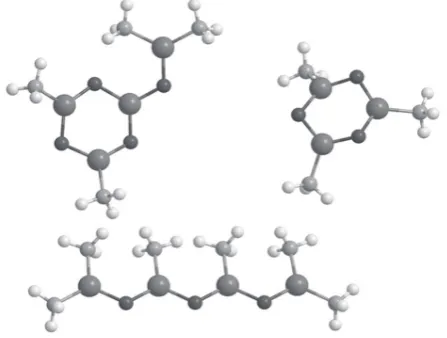
-pecially in aromatic solvents. A probable association and cage like structure of four [Al4O3Me6] units are
shown in Figure 2.
The nature of the polymerization active site of metallocene/MAO catalysts and the role of MAO are not fully understood. One function of MAO is the
alkylation of the metallocene complex in case that a
dichloride is used. The other is the formation of an ion-pair. Marks [9], and Bochmann [10], showed that
the activity of metallocene catalysts depends on the
formation of cationic species. Today, most research groups agree with this statement. The bulky MAO
Polyolefins Journal, Vol. 2, No. 1 (2015) cluster takes a chlorine-atom or a methyl-group from
the metallocene together with an electron forming a
cationic metallocene and an anionic MAO complex (Equation 3)
Cp2Zr(CH3)Cl + MAO → [Cp2Zr(CH3)]+ + [MAO-Cl]¯ (3)
Essential to polymerization activity would be the
formation of bulky anions with a weak bonding to the
metallocene cations. Knowing that the bulky structure of MAO could be necessary for the activation of metal -locene catalysts, the bulky and weakly coordinating
cocatalysts such as tris(pentafluorophenyl)borane or organic salts of the tetrakis (pentafluorophenyl) borate [(C6F5)4B]¯, and aluminum fluorides were introduced [9, 10]. With these cocatalysts a metallocene/cocata
-lysts ratio of 1:1 was used but only when a high excess of an aluminum alkyl as scavenger was present.
The polyolefin industries have used MAO contain
-ing catalysts in a large scale. Currently, companies such as Albermale, Akzo, Chemtura, and Mitsui pro
-duce hundreds of tons of MAO by reaction of water
or ice with trimethylaluminum and in some cases add
other aluminum alkyls to increase their solubility.
Homo-polyolefins
Metallocenes, especially zirconocenes and also titano
-cenes, hafno-cenes, and MAO treated transition metal complexes are highly active for the polymerization of olefins, diolefins, and styrene and have motivated
worldwide research groups to thousands of patents
and publications in the last 20 years. An overview can
be found in selected review articles and books
[11-20]. It could be shown that a soluble catalyst, such
as Cp2ZrCl2/MAO is able to produce polyethylene
with high molecular weights and a narrow molecular
weight distribution of approximately two. All active
sites are similar and form polymers with the same
average chain length (single site catalysts). Only traces of low molecular weight oligomers are formed. Zir -conocenes with different symmetries and
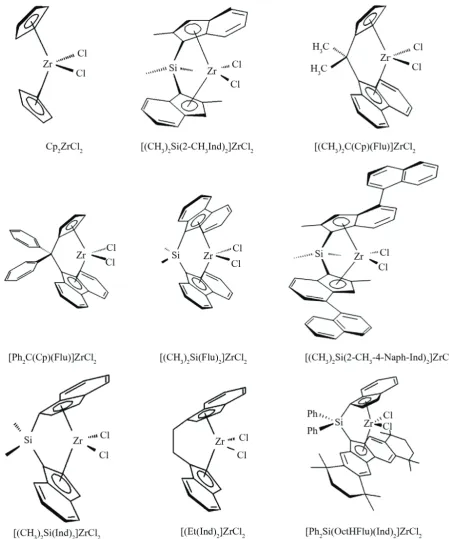
substitu-tions are shown in Figure 3. There is a great variety of
the structure of metallocenes, which can be used for
the polymerization. The cyclopentadienyl-, indenyl-, fluorenyl- ligands could be hydrated or substituted by alkyl, aryl, methoxy, siloxy or other groups. Eth
-anediyl (C2H4), dimethylsilandiyl ((CH3)2Si), or iso
-propandiyl ((CH3)2C) are mainly used as interannular bridges between the rings [21]. Central metals could be Ti, Zr, Hf. Such and similar metallocenes are used for the polymerization of ethene, propene, and other olefins [22].
Figure 2. a: Unit structure of MAO, b: cage formed by four linear unit structures with four and six- membered rings
Table 1. Comparison of ethene polymerization (a) with different metallocene/methylaluminoxane catalysts at same polymerization conditions
Metallocene(b) (Met) Activity [kg PE/
(mol Met×h×cE)]
Molecular weight (g/mol)
Cp2TiCl2 Cp2ZrCl2 Cp2HfCl2 Cp*2ZrCl2 En(IndH4)2]ZrCl2 [En(Ind)2]ZrCl2 [En(Ind)2]HfCl2
[En(2,4,7-Me3Ind)2]ZrCl2 [Me2Si(Ind)2]ZrCl2 [Ph2Si(Ind)2]ZrCl2 [Me2Si(2,4,7-Me3Ind)2]ZrCl2 [Me2Si(2Me-4Ph-Ind)2]ZrCl2 [Me2C(Ind)(Cp)]ZrCl2 [Ph2C(Ind)(Cp)]ZrCl2 [Me2C(Flu)(Cp)]ZrCl2 [Ph2C(Flu)(Cp)]ZrCl2 [Me2C(Flu)(Cp)]HfCl2
34200 60900 4200 1300 22200 12000 2900 78000 36900 20200 111900
16600 15500 3300 2000 2800 890
Polyethylenes
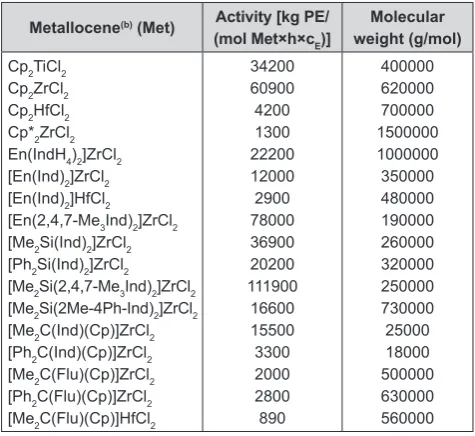
Table 1 compares the polymerization of ethene by select
-ed metallocene/methylaluminoxane catalysts [23, 24]. Generally zirconium catalysts are more active than hafnium or titanium systems. Especially, trimethyl
substituted bisindenyl systems show very high activities, exceeding those of sterically less hindered Cp2ZrCl2. When pentamethyl cyclopenta - dienyl - zirconium di
-chloride (Cp*
2ZrCl2/MAO) is used instead of Cp2Z
-rCl2/MAO, a polyethylene of much higher molecular weight, though a lower activity is formed. This means
that chain transfer reactions are much slower in this
substituted zirconocene complex. The molecular
weight of metallocene polyethylenes varies in a wide
range between 18 000 and 1.5 million and can be eas -ily lowered by increasing the temperature, raising the
Polyolefins Journal, Vol. 2, No. 1 (2015)
metallocene/ethene ratio, or by adding small amounts of hydrogen (0.1-2 mol%). Other zirconium com
-plexes have linked amidofluorenyl ligands [25]. The
molecular weight distribution can be lowered down
to 1.1 by living polymerization using bis(phenoxy-imine)titanium complexes (FI-catalysts) or other half sandwich complexes [26, 27].
For an industrial use it can be necessary to support the MAO cocatalyst on silica or alumina. Silica with a high quantity of MAO, up to 30 wt%, can be obtained.
In such a case a heterogeneous catalyst is formed by adding the metallocene, adopting the same technical
process as for heterogeneous Ziegler-Natta catalysts (drop-in technology) [28]. By this procedure a better
particle morphology control is possible and there is
less reactor walling.
Polypropylenes
By metallocene/MAO catalysts it is possible to pro -duce different kinds of microstructures such as iso-tactic, isoblock, stereoblock, syndioiso-tactic, and atactic
polypropylenes in high purity (Figure 4). It was shown in 1984 that with chiral ansa-metallocenes, firstly iso
-lated by Brintzinger [29], that a highly isotactic poly
-propylene in combination with MAO in toluene solu
-tion [30] was produced.
In 1987 Ewen, Jones, and Razavi [31] obtained pure
syndiotactic polypropylene using a Cs-symmetric
[Me2C(Flu)(Cp)]ZrCl2 complex with a bridged
cyclopentadienyl and a fluorenyl ring. This and other
Cs-symmetric metallocenes offer two different bond-ing positions for the inserted propylene and form an
alternating structure with methyl groups [32]. The selectivity in propene polymerization is an interesting task [33].
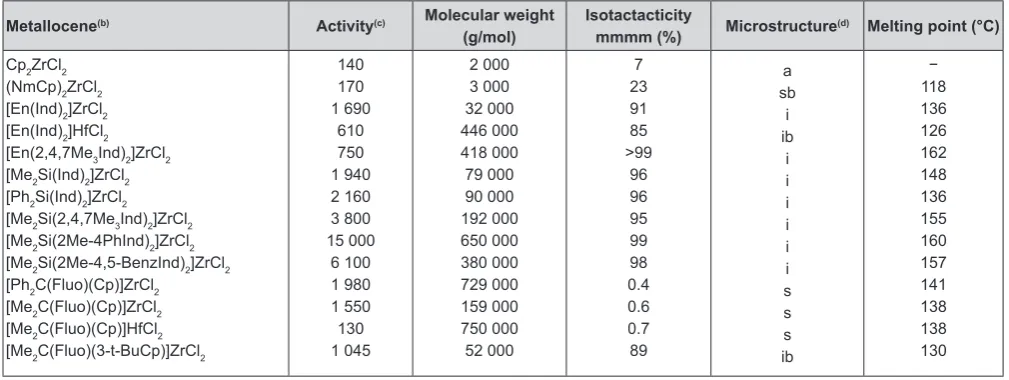
In Table 2 comparisons are made with the activi
-ties of the propene polymerization by different metal
-locene/MAO catalysts, the molecular weights, the
isotacticities calculated from the 13C-NMR measured
mesopentades (mmmm), the microstructure, and the melting points of the obtained polypropylenes. The activities vary between 130 and 15000 kg PP/mol Zr•h
at 30°C and the molecular weights between 2.000 and 750.000 g/mol. Highest isotacticity of 99 % was obtained using [En(2,4,7-Me3Ind)2]ZrCl2 as catalyst
Figure 4. Microstructures of polypropylenes obtained by various metallocene catalysts ( hydrogen atoms of the back-bone chain are not shown)
Table 2. Comparison of propene polymerization(a) with different metallocene/methylaluminoxane catalysts at same polymeriza-tion condipolymeriza-tions
Metallocene(b) Activity(c) Molecular weight
(g/mol) Isotactacticity mmmm (%) Microstructure(d) Melting point (°C)
Cp2ZrCl2
(NmCp)2ZrCl2 [En(Ind)2]ZrCl2 [En(Ind)2]HfCl2 [En(2,4,7Me3Ind)2]ZrCl2 [Me2Si(Ind)2]ZrCl2 [Ph2Si(Ind)2]ZrCl2 [Me2Si(2,4,7Me3Ind)2]ZrCl2 [Me2Si(2Me-4PhInd)2]ZrCl2 [Me2Si(2Me-4,5-BenzInd)2]ZrCl2 [Ph2C(Fluo)(Cp)]ZrCl2
[Me2C(Fluo)(Cp)]ZrCl2 [Me2C(Fluo)(Cp)]HfCl2 [Me2C(Fluo)(3-t-BuCp)]ZrCl2
140 170 1 690 610 750 1 940 2 160 3 800 15 000 6 100 1 980 1 550 130 1 045 2 000 3 000 32 000 446 000 418 000 79 000 90 000 192 000 650 000 380 000 729 000 159 000 750 000 52 000 7 23 91 85 >99 96 96 95 99 98 0.4 0.6 0.7 89 a sb i ib i i i i i i s s s ib − 118 136 126 162 148 136 155 160 157 141 138 138 130
(a) Propene pressure = 2 bar; temperature = 30°C; metallocene = 6.25x10⁻⁶ mol, metallocene/MAO = 250; solvent = 200 mL toluene; (b) Cp =
component. Non-chiral ansa-metallocenes such as
[(CH3)2Si(Flu)2]ZrCl2 (Figure 3) produce atactic poly
-propylene.
Polyolefin nanocomposites
Polyolefin nanocomposites are of great interest be -cause of their high potential as materials with novel
properties [34]. The properties of the nanocompos
-ites are not only influenced by the kind of fillers but also by the microstructure of the polyolefins and the preparation process. Metallocene catalysts are soluble
in hydrocarbons and can be adsorbed or anchored on
the surface of the nanofillers such as particles, fibers, layered silica, carbon nanofiber (CNF), multi-walled carbon nanotubes (MWCNT), changing the surface to a hydrophobic one [35, 36]. The MAO reacts, for ex
-ample, with the OH-groups of silica or with carboxy groups of oxidized carbon nanotubes or is physically absorbed at the surface (Figure 5). Methane is formed by the chemical reaction of MAO with polar groups. Excess MAO is washed out. In a second step, the
metallocene is added forming catalytically active
polymerization sites on the nanosurface. The thickness of the polymer films, formed by addition of ethene or propene, depends on the polymerization conditions, especially the polymerization time, the kind of metal
-locene catalyst, and the pressure of the monomer. The in-situ polymerization leads to composite materials where the particles or fibers are intensively covered with the polymer.
The composite materials show, for example, an
improved stiffness with a negligible loss of impact
strength, high gas barrier properties, significant flame
retardant, better clarity, and gloss as well as high
crys-tallization rates. Even low nanoparticle contents are
already sufficient to obtain new or modified material characteristics, especially a faster crystallization rate and a higher crystallization temperature.
Carbon nanofibers (CNF) or multiwalled carbon nanotubes (MWCNT) are an especially attractive class of fillers for polymers because of their intriguing mechanical and thermal properties [37].
Multi-walled carbon nanotubes (MWCNT) were sonicated in a toluene suspension, treated by MAO stirred for 24 hours, filtrated, and washed with hot toluene [38]. After adding the chiral ansa-zirconocene [(CH3)2Si(2-CH3-4-Nap-Ind)2]ZrCl2 and propene,
iso-tactic high molecular weight polypropylene iPP/MW
-CNT composites with 0.9 – 50 wt% filler content were obtained. The molecular weights of the polypropylene matrix in the nanocomposites were in the range of Mw = 1,200,000 – 1,700,000. The polymerization activity reached 5000 kg PP/mol Zr.h.[propene]. It was inde
-pendent of the filler content. As expected for in-situ polymerization, the polymer grew directly on the fiber surface and covered them with a thin PP layer. The
dried polypropylene nanocomposites were obtained
in powder form. By longer polymerization times, the thickness of the polyolefin covering the fiber in
-creased. The fiber/MAO/zirconocene system worked like a supported catalyst. Filler contents between 0.5 up to 50 wt% were possible.
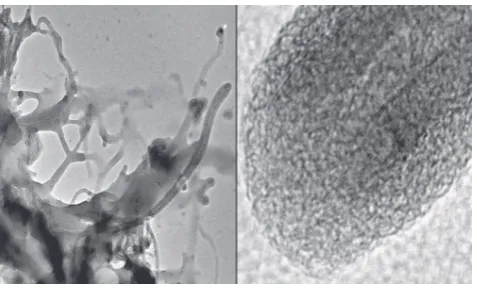
The morphology of the isotactic PP/CNF nanocom -posites was investigated by using transmission
elec-tron microscopy (TEM). It can be seen from Figure 6 that the nanotubes are coated by a thin film of iPP. The diameter of the MWCNT used (about 20 layers) is 20nm and the thickness of the iPP coat is about 8nm.
Even the loose network of polymer layered nanotubes on the lower left side, which are partially
conglomer-Figure 5. Formation of polymerization active sites by ab-sorption of MAO on oxidized multiwall carbon nanotubes
(MWCNT) followed by adding a zirconocene
Polyolefins Journal, Vol. 2, No. 1 (2015) ated by PP but still mostly separated from each other
is permeated with polymer and seems to be widening
by the growth of the polymer chains.
The main advantage of CNF or MWCNT filled PP is the change of mechanical properties. High molecular weight isotactic polypropylene filled with MWCNT is an exceptionally strong composite material. The ten
-sile strength of a composite film increases by 20 % if only 1 wt% of MWCNT is incorporated but also the form stability and the crystallization rate from a melt
increase strongly and make this composite material suitable for new applications such as in the
automo-tive plastic industries [39].
Copolymers
Metallocene/MAO catalysts are not only suitable for the homopolymerization of ethene and propene but also for copolymerization with different comonomers [25, 40, 41]. Copolymers with new microstructures and properties are:
ethene – propene (EP)
ethene – propene, diene (EPDM))
ethene – 1-butene, hexene (LLDPE)
ethene – 1-octene (LLDPE)
ethene – 1,5-hexadiene (elastomer)
ethene – cyclopentene (COC)
ethene – norbornene (COC)
ethene – 1,3-butadiene (elastomer)
ethene – styrene (elastomer)
EP, EPDM (ethene propene diene monomers), LL
-DPE (linear low density polyethylene) are of high in
-terest for polymer industries. All copolymers produced by metallocene catalysts are characterized by a narrow molecular weight distribution of 2 and a uniform mi
-crostructure. While the comonomers are distributed
randomly in the polymer chain, only low amounts are needed to decrease the density and the melting point
of ethene copolymers. The low amount of oligomers compared to copolymers produced by Ziegler-Natta
catalysts is responsible for a high tensile strength
and other mechanical properties of the obtained LL
-DPE. Mechanical properties can be increased if there are some long chain branches in the polymer chain. Long-chain branched polyethylenes can be obtained by copolymerization of ethene with ethene oligomers by tandem polymerization in one step [42] or with ethene/propene oligomers in two steps [43]. In the
last case there are obtained polymers with crystalline
polyethylene backbone chains and amorphic ethene/ propene copolymer side chains.
Figure 7 shows a scheme for the preparation of
long-chain branched polyethylene by using two
dif-ferent metallocene catalysts in two steps. In a first step ethene/propene macromers were produced by a [(C5(CH3)5]2ZrCl2/MAO catalyst with molecu
-lar weights of 8 000 to 25 000 g.mol-1 (Step A). The
propene content varied from 13 to 23 wt%. The mac -romers obtained were amorphic, soluble in toluene,
and show a high content of vinyl end-groups. In the following copolymerization of the ethene/propene
macromers with ethene, a different metallocene [Ph2C(2,7-di-tert-Bu2Flu)(Cp)]ZrCl2 was used to
cata-lyze the copolymerization (Step B). Small amounts of
hydrogen were added to reduce the molecular weight
for easier rheological measurements.
By the copolymerization of cyclic olefins such as
cyclopentene or norbornene with ethene and other
a-olefins are obtained cycloolefin copolymers (COC)
representing a new class of thermoplastic, amorphous
materials [44, 45]. Cyclopentene, norbornene or other cyclic olefins are incorporated exclusively by 1,2-
insertion into the growing copolymer chain, no ring
opening occurs. The insertion of the huge norbornene monomer is very fast by metallocene/MAO catalysts. Table 3 compares the activities and incorporation of norbornene by different catalysts. By special condi
-tions the polymerization rate of a 1:1 molar mixture of
ethene and norbornene is higher than the
homopoly-merization of ethene (comonomer effect).
The [Ph2C(Ind)(Cp)]ZrCl2/MAO catalyst shows not only high activities for the copolymerization of ethene
Table 3. Copolymerization (a) of norbornene (N) and ethene by different metallocene/MAO-catalysts
Metallocene (b) t
(min) (kg/mol h)Activity
Incorp of norbornene
(weight %)
Cp2ZrCl2 [En(Ind)2]ZrCl2 [Me2Si(Ind)2]ZrCl2 [En(IndH4)2]ZrCl2 [Me2C(Flu)(Cp)]ZrCl2 [Ph2C(Flu)(Cp)]ZrCl2 [Ph2C(Ind)(Cp)]ZrCl2
30 10 15 40 10 10 15
1200 9120 2320 480 7200 6000 2950
21.4 26.1 28.4 28.1 28.9 27.3 33.3
Ethene pressure = 2 bar, [N] = 0.05 mol/L, temperature. = 30°C,
with norbornene, but gives an alternating structure,
too.
Most metallocenes produce polymers with a statis -tical structure, few others produce polymers with an
alternating structure. Statistical copolymers are amor
-phous if more than 10-15 mol% of cycloolefins are incorporated in the polymer chain. The glass transi -tion temperature can be varied over a wide range by
selection of norbornene as cycloolefin and variation
of the amount of norbornene incorporated into the
polymer chain. Cycloolefin copolymers are character
-ized by excellent transparency, high glass transition temperatures of up to 200°C and excellent long-life service temperatures. They are resistant to polar sol
-vents and chemicals and can be melt-processed. Due to their high carbon/hydrogen ratio, these polymers have a high refractive index (1.53 for an ethene/nor
-bornene copolymer at 50 mol% incorporation). Their
stability against hydrolysis and chemical
degrada-tion, in combination with their stiffness makes them interesting materials for optical applications, for
ex-ample in compact discs, lenses, optical fibers, or films [46]. Meanwhile, ethene-norbornene COC-materials are commercially produced.
Polyolefins with polar comonomers
The introduction of polar groups into polyolefins to
improve processing characteristics and other prop-erties of the polymers is nowadays one of the most important areas for both academic and industrial
re-search[47, 48]. It is one way to modify the properties
of a polymer, because these functional groups control important polymer properties such as adhesion, bar-rier and surface properties, solvent resistance,
misci-bility with other polymers, and rheological properties. The functionalization of polyolefins offers a possibil
-ity to broad applications in areas, less explored before. Only few functionalization processes are available
and the obtained copolymers have not a uniform
Polyolefins Journal, Vol. 2, No. 1 (2015)
ture. Metallocene and other single site catalysts are able to polymerize ethene and polar vinyl monomers,
such as, ethers, alcohols, and esters with high activi-ties after protection of the functional groups and these
copolymers have a uniform structure [49]. Among all functional groups, oxygen-substituted olefins are the most studied for copolymerization with ethene and propene. These groups are of interest, because of their possibility to be a precursor for potential polyolefin
elastomers, since both ionic and chemical cross links
may be introduced. Additionally, these types of copo -lymers have excellent dyeing properties, good perme-ability of gaseous materials and weather-proof
func-tions with high chemical reactivity.
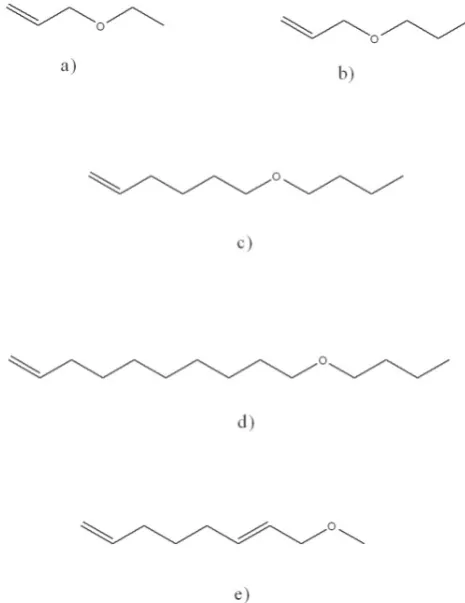
For the copolymerization of ethene with polar monomers in this work are used:
Allyl ethyl ether (AEE) Allyl propyl ether (APE) 5-Hexenyl butyl ether (HBE) 9-Decenyl butyl ether DBE)
2,7-Octadienyl methyl ether (MODE)
These ethers are available by organic synthesis or
metathesis of oleic acid methyl ester. The structures are shown in Figure 8.
ExPERImENTAl
The polymerization experiments were performed us
-ing standard Schlenk, syr-inge, and glovebox tech
-nique. Argon was purchased from Linde and puri
-fied by passing through an Oxisorp cartridge. Ethene (Linde) and toluene were purified by passing through columns with BASF R3-11 catalyst and a 3Å molecu
-lar sieve. A solution in toluene (1mol/L) of the differ
-ent vinyl ethers was dried over molecular sieves for 48
h and stored under argon atmosphere and then it was
stirred for 3 h with triiso-butylaluminium (TIBA) fol
-lowed by a distillation under vacuum at 100°C. All polymerization runs were performed in a Bü
-chi BEP 280 laboratory autoclave with a Type I glass pressure vessel. Temperature was adjusted with a heat jacket connected to a thermostat allowing adjustment of the polymerization temperature with an accuracy of ± 0.5°C. During the polymerization runs, the ethene pressure was kept constant. The ethene consumption was monitored with a Brooks 5850 TR mass flow me
-ter. For a typical polymerization experiment, the reac
-tor was evacuated at 95°C for 1 h and then cooled down to the desired temperature. Subsequently, the reactor was charged with 400 mg MAO, comonomer solution and toluene up to a volume of 200 mL followed by ethene to the desired feed composition. The polymer
-ization was started by injection of the catalyst solution with a metallocene concentration of 1-5x10⁻⁶mol/L.
The reaction was quenched by addition of 5 mL HCl/ ethanol. The obtained polymer was stirred over night with diluted hydrochloric acid. After phase separation,
the organic phase was washed three times with water
and reduced to 50-70 mL at the rotary evaporator. The polymer was precipitated using ethanol, filtered off, washed with ethanol, and dried under vacuum at 40°C until the polymer weight became constant.
The obtained copolymers were characterized by 13
C-NMR recorded on a Bruker Avance 400 Ultrashield spectrometer. Polymer samples were measured at 100.62 MHz and 100°C using 200 mg of polymer in 2.3 mL of 1,2,4-trichlorobenzene (TCB) and 0.5 ml of 1,1,2,2-tetrachloroethane-d2. Chemical shifts are re -ported referenced to C2D2Cl4 (d 74.24 ppm ).
For 1H-NMR, the samples were prepared by dissolv
ing the polymer (10-20 mg) in a mixture of 1,2,4-tri
-chlorobenzene (TCB) and of 1,1,2,2-tetrachloro
-ethane-d2 (TCE-d2) and measured at 120°C. All chemical shifts were referred to the solvent of TCE-d2 at 5.94 ppm.
Differential scanning calorimetry measurements were performed on a Mettler Toledo DSC 821 instru
-ment under a nitrogen atmosphere. All samples were prepared in hermetically sealed pans (5-8 mg/sample), and were measured using an empty pan as reference.
Calibration was made using indium for the enthalpy standards and n-octane as a standard for peak
tem-perature transition. Samples were melted at 200°C, quenched from 200°C until -200°C, and heated from -200°C to 200°C, at heating rate of 20°C per min. The melting temperature (Tm) was taken from the second thermal cycle exclusively.
High-temperature gel permeation chromatography (GPC) measurements were performed in 1,2,4-tri
-chlorobenzene at 140°C using a Waters GPCV 2000 instrument with HT 106, 104, and 103 Å columns. The
instrument operated with a combined refractive index and viscosity detector unit, which allowed the
calcula-tion of appropriate Mark-Houwink constants for each polymer. Calibration was applied using polystyrene standards (PSS).
The samples were placed in an elemental analyzer connected to a mass spectrometer. Subsequently, they were combusted at 1040°C and the gas was pushed through an oxidation core. The gas resulting after
combustion yielded ions that in a step further, were
analyzed using an IRMS mass spectrometer. The ions
were separated based on their charge and compared
against mass.
RESUlTS AND DISCUSSIONS
For the polymerization of ethene and allyl ethyl ether the zirconocene [(CH3)2Si(Ind)2]ZrCl2 and MAO were used. Table 4 shows the polymerization results.
Table 4 shows that it is possible to copolymerize
allyl ethers with good activities by metallocene
cata-lysts. The activities are very high for low ether con
-centration (79,300 kg copolymer/mol zirconocene in 1 hour) in the starting phase but decreases hardly if the
concentration decreases although the polar monomer
was treated with triisobutyl aluminum (TIBA) as a complexation agent. The molecular weights of the co -polymers decrease with an increasing concentration,
too. Allyl ethyl ether was incorporated with the high
-est value of 3.2 mol% which are about 9 wt%. The
incorporation increased when the pressure of ethene
was droped to 1 bar. A copolymer with 16 mol% of AEE was obtained by using [(CH3)2Si(2-CH3 -4-Naph-Ind)2]ZrCl2 as zirconocene. As expected, the melting points of the copolymers decreased strongly from 140 °C for pure polyethylene to 108°C for a copolymer with 3.2 mol% of AEE. By the same polymerization conditions, it is more difficult to incorporate the longer chained allyl ethers HBE and DBE. Very high activi
-ties of 54,000 or 79,000 kg copolymer/g Zr.h were ob
-tained by the copolymerization of HBE or DBE (0.01 mol/L) in the feed with ethene. This value decreased to only 540 kg copolymer/g Zr.h by a concentration of 0.05 mol/L of DBE. The decrease was not so strong for HBE.
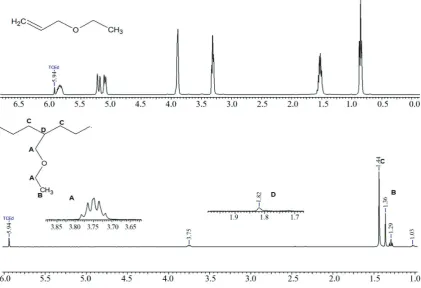
The solubility of the obtained copolymers was poor and made a structure characterization difficult. A typi
-cal H-NMR- spectrum is shown in Figure 9.
A significant observation is the complete absence of
a signal referent to the vinyl group of the polar
mono-Table 4. Copolymerization of ethene with AEE, HBE, and DBE by 4 bar ethene pressure, 60°C, 400 mg MAO, 200 ml toluene, [Me2Si(Ind)2]ZrCl2 = 5x10⁻⁶mol/L, Al/Zr = 2 500, activity: kgPE/molZr.h
Comonomer Concentration
(mol/L) Activity Molecular weight (g/mol) Incorporation (mol%) Melting point (°C)
AEE 0.02 5 000 530 000 1.1 123
AEE 0.04 3 500 450 000 2.0 110
AEE 0.05 1 600 420 000 3.2 108
HBE 0.01 54 600 194 000 0.14 139
HBE 0.025 1 400 105 000 0.60 132
DBE 0.01 79 300 117 000 0.1 137
DBE 0.02 3 760 125 000 0.3 131
DBE 0.03 2 440 130 000 0.3 132
Polyolefins Journal, Vol. 2, No. 1 (2015)
mer between 5.48 and 5.07 ppm, suggesting a com
-plete conversion of the polar monomer. To determine
the temperature effect, experiments by temperatures of
30°C, 45°C, and 60°C were studied. The polymeriza -tion rate was the highest by the highest temperature, but the incorporation of the polar monomer was less,
especially if the amount of MAO had an influence on the polymerization activity, which was varied between 200 and 400 mg. With an increase in the MAO con -centration, the catalytic activity rapidly reached
ap-proximately twofold of its initial activity. This result was also observed for the copolymerization of ethene and HBE and DBE.
Incorporation rates, melting points and molecu-lar weights strongly depended on the temperature of
the reaction. The molecular weights varied between 530,000 and 125,000. With an increase of the como
-nomer the molecular weight decreased. The same
trend was observed with an increasing length of the
alkyl group of the vinyl ether. In general, at 45 °C the incorporation of AEE shows a maximum.
In order to investigate the rule of an ether with an additional methylene group after the oxygen atom,
al-lyl propyl ether (APE) was copolymerized with eth
-ene and compared with the results for AEE. For this
comparison a more bulky zirconocene such as (rac-[Me2Si(2-Me-4-(1-Naph)Ind)2]ZrCl2) was used.
Surprisingly, the activities for the copolymerization with APE were higher than those for AEE. At an ether concentration of 0.05 mol/L in the feed for APP were obtained 12,000 kg copolymer/g Zr h, while this was only 6,500 for APP. The decrease of the activity with the ether concentration in the feed was higher for APE than that for AEE. This result suggested that the pres -ence of one more methylene group in the ether
struc-ture of APE could reduce the negative influence on the polar group on the catalytic activity. If, however, more
methylene groups were present in the ether structure
like in HBE or DBE the activities dropped again com
-pared to AEE (see Table 4).
Figure 10 shows the dependence of the incorpora -tion rate of the ether with its dependence the ether
concentration for AEE and APE. The incorporation increased as expected for APE with an increasing APE concentration in the feed and reaches 8.2 mol% at 0.1 mol/L APE concentration. For AEE there appeared a
maximum of the incorporation rate at an ether
concen-tration of 0.04 mol/L. The molecular weights of APE/
ethene copolymers decreased with the incorporation
rate of APE and are 132°C by 2 mol%, 110 by 4.5
mol% and 95 by 8.2 mol% of APE in the copolymer. To widen up the possibility of functionalization of
copolymers, especially to have a double bonds for other reactions in the copolymer, ethene was
copo-lymerized with 2,7-octadienyl methyl ether (MODE) by different metallocene/MAO catalysts. In this case
again triisobutylaluminium was used to protect the functional ether group by insulating the functional
group from the active site during the copolymeriza
-tion reac-tion. The obtained polymers were character
-ized by GPC, elemental analysis, DSC, NMR (13C and
1H) and FT-IR.
The yields and activities of the copolymerization of MODE with the catalyst Me2SiInd2ZrCl2/MAO are shown in Table 5.
Under the investigated experimental conditions, the catalytic activity was greatly influenced by the pres
-ence of the comonomer. The effect of the reaction
temperature was also observed using the same catalyst
system. An increase in the polymerization temperature caused a decrease in the catalytic activity. The catalyst activity at 45°C, at the same MODE concentration in feed (runs 1 and 2), was 1 order of magnitude higher than the catalyst activity of the reaction at 60°C. How -ever, in both temperatures studied, it was observed a decrease in the catalytic activity with the presence of
the protected functional monomer. The catalytic activ -ity depended extremely on the presence and
concen-tration of the polar monomer. The higher the concen -tration of the polar monomer in the feed, the lower
was the catalyst activity. The highest level of incor
-poration was 7.3 (wt %) in the presence of the cata -lyst system [Ph2Si(OctHFlu)(Ind)]ZrCl2/MAO, fol
-lowed by the catalyst system [(CH3)2Si(Ind)2]ZrCl2/ MAO with 7.1 (wt %).
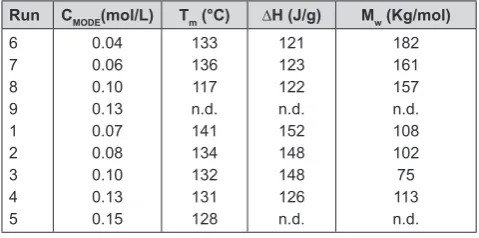
The physical properties (melting point, molecular weight and polydispersity index) of the obtained poly
-mers are summarized in the Table 6.
The physical properties of the copolymers seem to be temperature dependent. At 45°C, it is clearly ob -served a decrease trend in both molecular weight and
melting point with increase in comonomer in feed. Comparing the results with the reaction at 60°C, the
copolymer displayed the same melting point behavior
as at 45°C with systematically lower Tm with increase
in polar monomer feed. The polydispersity index was about 3 with an increase in the concentration of feed polar group.
Additionally, it was observed that there was not
strong dependence on the melting point of the
ob-tained polymer with the polymerization tempera
-ture. However, at the same concentration of the polar
Figure 10. AEE and APE incorporation (wt %) into the copo-lymer in dependence of the ether concentration in the feed
Table 5. Ethene polymerization with Me2SiInd2ZrCl2/MAO in
the presence of MODEx
Run CMODE
(mol/L) Temperature(°C) Yields (g) molActivity (kgcat.h.CmonomersPol/) 1 2 3 4 5 6 7 8 9 0.025 0.03 0.04 0.05 0.06 0.015 0.025 0.04 0.05 45 45 45 45 60 60 60 60 60 2.9 1.7 1.6 0.97 0.59 0.79 0.86 0.34 0.28 509 313 304 182 114 1000 1060 406 326 xPolymerization conditions: ethene pressure 4bar, toluene volume 200mL, polymerization time 1h, [Me2Si(Ind)2]ZrCl2 = 3x10⁻⁶mol/L, co-catalyst 400 mg MAO; MODE/TIBA = 1:1, precontacted for 30 min.
Table 6 .Characterization of MODE/ethene copolymer of dif-ferent polymerization runs (see Table 5)
Run CMODE(mol/L) Tm (°C) ∆H (J/g) Mw (Kg/mol) 6 7 8 9 1 2 3 4 5 0.04 0.06 0.10 0.13 0.07 0.08 0.10 0.13 0.15 133 136 117 n.d. 141 134 132 131 128 121 123 122 n.d. 152 148 148 126 n.d. 182 161 157 n.d. 108 102 75 113 n.d. Polymerization conditions: ethene pressure 4bar, toluene volume 200mL, polymerization time 1h, cocatalyst MAO; MODE/TIBA pre-contacted for 30 min. CMODE: concentration in feed, Tm = melting
Polyolefins Journal, Vol. 2, No. 1 (2015) monomer in the feed, the melting point was higher at
higher polymerization temperatures. A decrease in the
molecular weight of the obtained copolymers was
ob-served at the same time.
A preliminary 1H NMR of the obtained polymer,
Figure 11, shows a presence of peaks that are con sistent with MODE incorporation δ=3,37ppm (CH3-; methyl group) and δ=3,93ppm (CH2-O; methylene group) , this effect was confirmed by 13C NMR.
The incorporated functional group contents were de
-termined by elemental analysis. The concentration for MODE in the copolymer was 1.4wt% (run 1), 4.3wt% (run 2), 6 wt% (run 3), and 7.1wt% (run 4, in Table 6). This high incorporation rate of a bulky polar monomer
with a middle standing double bond was considered a
key for further investigations with such a copolymer.
CONClUSION
The development of metallocene/methylaluminoxane
catalysts have strongly increased the knowledge of
the olefin polymerization catalysis. This knowledge has made it possible to find new bulky and weakly co
-ordinating cocatalysts such as perfluorophenyl-borate anions and boranes. The developement is not com -pleted for new transition metal complexes activated
by MAO or other cocatalysts. It would be an impor
-tant step to decrease the amount of MAO, needed for the activation. Supporting the methylaluminoxane on
silica, alumina or on new organic polymers could be
one way for this.
Metallocene/MAO and other single site catalysts al
-low the synthesis of tailored polyolefin structures in a way that was impossible in the years before. The
known dependence of metallocene based polymers from the catalyst structure allows the modeling of
their reaction kinetics and the polymerization process [50]. Reactor models could be developed using mass
and energy balances and they describe the polymer composition as well as reactor operating conditions,
required for a given polymer architectures. It would be possible to design polyolefins with tailored molecu -lar weight, comonomer content, long and short chain
branching [51], and comonomer distribution indepen
-dent and controlled. Morphology control is possible by suspension, cascade or multizone reactors improv
-ing melt viscosity and process-ing.
Polyolefin nanocomposites open up the approach to
new classes of materials with great property
combina-tions. A soft polyolefin matrix can be combined with
hard inorganic particles or strong layers of silicates
or graphene or with fibers of extreme high tensile strength, such as carbon fibers, carbon nanotubes or polymer fibers. An easy way for the preparation of such polyolefin nanocomposites is the in-situ polym
-erization using nanoparticles or fibers activated by metallocene/MAO or other single site catalysts. Mate -rials with high gas barrier resistance, high thermal and electric conductivity, and high form stability can be
obtained as well as a good dispersion of the nanofillers in the polymer matrix.
A lot can be done to tailor the microstructure of co
polymers. To design three dimensional crystallizing polyolefins for materials with special properties such
as cages for catalysts or membranes, elastomeric and
adhesion properties, the controlled self-organization by polar groups could be one way. Important for this and for polymer blends of polyolefins with other poly -mers such as polyamides or polyesters, is the easier
synthesis of polyolefins with polar comonomers [52, 53]. Polar monomers incorporated can contain hy
-droxyl, carboxyl, ether, ester, siloxy, or amino groups.
In this work could be shown that it is possible to
co-polymerize different vinyl ethers such as allyl ethyl
or propyl ether, hexenyl or decenyl butyl ether, and
octadienylmethyl ether with ethene. The incorporation
of the comonomer into the polymer chain depends on
the polymerization temperature, the comonomer con
-centration and the used metallocene complex. Blends
containing small amounts of such functional metallo-cene based copolymers are tougher and stiffer than not
compatibilized polymers [54, 55].
The development and commercialization of metal
-locene/MAO and other single site catalysts have just started and have already expanded the polyolefins range of products. New designed catalysts will en
-large the polyolefin industries and the applications of polymers.
REfERENCES
1.
Kaminsky W (2008) Trends in polyolefin chemistry. Macromol Chem Phys 209: 459-4662.
Kaminsky W, Vollmer H-J, Heins E, Sinn H (1970) The formation of dimetalloalkylene, a unavoidable Side Reaction in homogeneous Ziegler-Catalysts Makromol Chem 175: 443-4563.
Mottweiler R (1975) Investigation of the reactionof biscylopentadienyl titanium compounds and
aluminum alkyls, in the presents of ethylene. Thesis, University of Hamburg
4.
Andresen A, Cordes H-G, Herwig J, Kaminsky W, Merck A, Mottweiler R, Pein J, Sinn H, Vollmer H-J, (1976) Halogen-free soluble Ziegler catalysts for the polymerization of ethylene.Control of molecular weight by choice of
temperature. Angew Chem Int Ed Engl 15: 630-631
5.
Kaminsky W (2004) The discovery of metallocene catalysts and their present state of the art. J PolymSci Part A: Polym Chem 42: 3911-3921
6.
Kaminsky W (2012) Discovery ofmethylaluminoxane as cocatalyst for olefin polymerization. Macromolecules 45: 3289-3297
7.
Bliemeister J, Hagendorf W, Harder A, Heitmann B, Schimmel I, Schmedt E, Schnuchel W, Sinn H, Tikwe L, vThienen N, Urlass K, Winter H, Zarncke O (1995) The role of MAO activators. In: Ziegler catalysts, Fink G, Mülhaupt P, Brintzinger HH (eds), Springer, Berlin, 57-828.
Eilertsen JL, Rytter E, Ystenes (1999) In situ FTIR spectroscopy shows no evidence of reaction between MAO and TMA. In: metalorganic catalysts for synthesis and polymerization, Kaminsky W (ed), Springer, Berlin, 136-1419.
Yang X, Stern CL, Marks TJ (1991) Models for organometallic molecule-support complexes. Very large counterion modulation of cationic actinide alkyl reactivity. Organometallics 10: 840-84210.
Bochmann M (2010) The chemistry of catalyst activation: The case of group 4 polymerization catalysts. Organometallics 29: 4711-474011.
Scheirs J, Kaminsky W (eds.) (2000) Metallocene-based polyolefins: Preparation, properties, and technology, Wiley, Chichester, UK, Vols. 1 and 212.
Zhang J, Wang X, Jin G-X (2006) Polymerizedmetallocene catalysts and late transition
metal catalysts for ethylene polymerization. Coordination Chem Rev 250: 95-109
13.
Coates GW (2000) Precise control of polyolefin stereochemistry using single-site metal catalysts. Chem Rev 100: 1223-125214.
Rieger B, Baugh LS, Kacker S, Striegler S (eds) (2003) Late transition metal polymerization catalysis, Wiley-VCH, Weinheim15.
Razavi A, Thewalt U (2006) Site selective ligand modification and tactic variation in polypropylene chains produced with metallocene catalysts. Coordination Chem Rev 250: 155-16916.
Kaminsky W (ed.) (2005) Olefin polymerization. Macromol Symp 23617.
Kaminsky W, Luinstra GA (2010) Olefin polymerization by metallocene catalysis. Edition Ostwald: On Catalysis. Reschetilowski W, Hönle (eds) VWB-press, Berlin Vol 2, 186-214Polyolefins Journal, Vol. 2, No. 1 (2015)
Dalton Trans 40: 7666-7682
19.
Kaminsky W (Ed) (2013) Polyolefins: 50 years after Ziegler and Natta. Vol I and II, Advances in Polymer Science 257 and 258, Springer, Heidelberg20.
Delferro M, Marks TJ (2011) Multinuclear olefin polymerization catalysts. Chem Rev 111: 2450-248521.
Brintzinger HH, Fischer D, Mülhaupt R, Waymouth RM (1995) Stereospecific olefin polymerization with chiral metallocene catalysts. Angew Chem Int Ed Engl 34:1143-117022.
Alt GH, Milius W, Palackal SJ (1994) Bridgedbis(fluorenyl) complexes of zirconium
and hafnium as highly reactive catalysts in
homogeneous olefin polymerization. J Organomet Chem 472: 113-118
23.
Kaminsky W, Engehausen R, Zoumis K,Spaleck W, Rohrmann J (1992) Standardized polymerization of ethylene and propene with bridged and unbridged metallocene derivates: A comparism. Makromol Chem 193: 1643-1651
24.
Kaminsky W (1996) New polymers bymetallocene catalysis. Macromol Chem Phys 197: 3907-3945
25.
Okuda J, Schattenmann FJ, Wocadlo S, Massa W (1995) Synthesis and characterization of zirconium complexes containing a linked amido fluorenyl ligand. Organometallics 14: 789-79526.
Kawai K, Fujita T (2009) Metal catalysts in olefin polymerization. Top Organomet Chem 26: 3-4627.
Damavandi S, Zohuri GH, Ahmadjo S, Sandaroos R, Shamekhi MA (2014) Synthesis of high molecular weight polyethylene using FI catalysts. Polyolefins J 1: 25-3228.
Hlatky GG (2000) Heterogeneous single-site catalysts for olefin polymerization. Chem Rev 100: 1347-137629.
Wild FR, Zsolnai L, Huttner G, Brintzinger HH (1982) ansa-metallocene derivates. IV. Synthesisand molecular structure of chiral ansa-titanocene
derivates with bridged tetrahydroindenyl ligands. J Organomet Chem 232: 233-247
30.
Kaminsky W, Külper K, Brintzinger HH, Wild FR (1985) Polymerization of propene and butene with a chiral zirconocene and methylalumoxane as cocatalyst. Angew Chem Int Ed Engl 24: 507-50831.
Ewen JA, Jones RL, Razavi A, Ferrara JP (1988)Syndiospecific propylene polymerization with group IVB metallocenes. J Am Chem Soc 110: 6255-6256
32.
Razavi A (2013) Syndiotactic polypropylene: Discovery, development, and industrialization via bridged metallocene catalysts. Adv Polym Sci 258: 43-11633.
Resconi l, Cavallo L, Fait A, Piemontesi F (2000) Selectivity in propene polymerization with metallocene catalysts. Chem Rev 100: 1253-134534.
McNally T, Poetschke P Eds. (2011) Polymer-carbon nanotube composites: Preparation,properties, and applications. Woodhead
Publishing, Cambridge, UK
35.
Alexandre M, Martin E, Dubois P, Marti MG, Jerome R (2001) Polymerization filling technique: an efficient way to improve the mechanical properties of polyethylene composites. Chem Mater 13: 236-23736.
Kaminsky W (2014) Metallocene based polyolefin nanocomposites. Materials 7: 5069-510837.
Kaminsky W, Funck A, Klinke C (2008) In-situ polymerization of olefins on nanoparticles or fibers by metallocene catalysts. Top Catal 48: 84-9038.
Funck A, Kaminsky W (2007) Polypropylenecarbon nanotube composites by in-situ
polymerization with metallocene/MAO catalysts. Composites Sci and Technol 67: 906-915
39.
Lozano K, Bonilla-Rios J, Barrera EV (2001) Nanofiber reinforced thermoplastic composites: Thermoanalytic and mechanical analysis. J Appl Polym Sci 80: 1162-117240.
Stadler FJ, Arikan-Conley B, Kaschta J, Kaminsky W, Münstedt H (2011) Synthesis and characterization of novel ethylene-graft-ethylene/ propylene copolymers. Macromolecules 44: 5053-506341.
Kaminsky W, Boggioni L, Tritto I (2012) Cycloolefin polymerization. Polym Sci A comp Ref 3: 843-87342.
Frediani M, Bianchini C, Kaminsky W (2006) Low density polyethylene by tandem catalysis with single site Ti(IV)/Co(II) catalysts. Kinet Catal 47: 207-21228: 1472-1478
44.
Kaminsky W, Spiehl R (1989) Copolymerizationof cycloalkenes with ethylene in presence of
chiral zirconocene catalysts. Makromol Chem 190: 515-526
45.
Boggioni L, Tritto I (2014) Propene- cycloolefin polymerization. Polyolefins J 1:61-7546.
Kaminsky W, Tran PD, Werner R (2004) New polymers by copolymerization of ethylene and norbornene with metallocene catalysts. Macromol Symp 213: 101-10847.
Seppälä J, Kokko E, Lehmus P, Malmberg AP, Hakala K, Lipponen S, Löfgren B (2013) Funktional polyolefins through polymerization by using bis(indenyl)zirkonium catalysts. Adv Polym Sci 2013: 179-23248.
Kesti MR, Coates GW, Waymouth RM, (1992) Homogeneous Ziegler-Natta polymerization of functionalized monomers catalyzed by cationic Group IV metallocenes. J Am Chem Soc 114: 9679-968049.
Kaminsky W, Fernandez M (2008) New polymers by copolymerization of olefins with bio oil components. Eur J Lipid Sci Technol 110: 841-84550.
Busico V, Cipullo R, Corradini P (1993) Macromol Chem Rapid Commun 117: 195.51.
Stadler FJ, Arikan B, Kaschta J, Kaminsky W (2010) Long-chain branches in syndiotactic polypropene induced by vinyl chloride. Macromol Chem Phys 211: 1472-148152.
Kaminsky W, Funck A, Hähnsen H (2009) New application for metallocene catalysts in olefin polymerization. J Chem Soc Dalton Trans 2009: 8803-881053.
Imuta J, Kashiwa N, Toda Y (2002) Catalyticregioselective introduction of allyl alcohol into
the nonpolar polyolefins: Development of one-pot synthesis of hydroxyl-capped polyolefins mediated by a new FI catalyst. J Am Chem Soc 124: 1176-1177
54.
Lipponen S, Seppälä J (2011)Ethylene-bis(indenyl)zirconium
dichlo-ride/Methyl-aluminoxane catalyzed copolymerization of ethylene and 1- alkenen-trimethylsilanes. Organometallics 30: 528-533

![Table 4. Copolymerization of ethene with AEE, HBE, and DBE by 4 bar ethene pressure, 60°C, 400 mg MAO, 200 ml toluene, [Me2Si(Ind)2]ZrCl2 = 5x10⁻⁶mol/L, Al/Zr = 2 500, activity: kgPE/molZr.h](https://thumb-us.123doks.com/thumbv2/123dok_us/8948111.1857479/10.595.39.545.616.768/table-copolymerization-ethene-ethene-pressure-toluene-zrcl-activity.webp)