Tanaffos (2011) 10(3), 24-31
©2011 NRITLD, National Research Institute of Tuberculosis and Lung Disease, Iran
Effects of Aerobic Exercise on Lung Function in
Overweight and Obese Students
Ahmad Azad 1, Reza Gharakhanlou 2, Alireza Niknam 3, Amir Ghanbari 4
1 Department of Physical Education, Faculty of Humanities, Zanjan University, Zanjan, Iran, 2 Department of Physical Education, Faculty of Humanities, Tarbiat Modares University, Tehran, Iran, 3 St. George Hospital, Kogarah, Australia, 4 Department of Respiratory Medicine, Prince of Wales Hospital, Randwick, Australia
ABSTRACT
Background: In healthy teenagers, obesity and physical inactivity are the two main factors that affect respiratory function. The aim of this study was to evaluate the effect of aerobic exercise training on improving lung function in overweight and
obese students.
Materials and Methods: Thirty overweight or obese subjects with poor endurance performance and mild deterioration of respiratory indices (forced expiratory volume and forced expiratory volume in 1 second < 90% predicted) were randomly
assigned into control (age: 16.6±0.83 years, height: 167±5.05 cm, weight: 80.44±7.65 kg) and intervention groups (age:
16.5±0.83 years, height: 166±6.7 cm, weight: 79.62±9.33 kg) .The intervention group preformed 24 weeks of continuous
treadmill running (3 days a week). Respiratory indices were measured pre, mid and post exercise. Independent t test, paired
t test, Pearson's correlation test and repeated measure were used for analyzing the data.
Results: In the intervention group, post exercise respiratory indices were significantly higher than the pre exercise values, and did not reach the predicted values. No significant differences were found in pre, mid and post exercise respiratory indices
in the control group. In the intervention group, improvements in respiratory indices were positively correlated with maximum
voluntary ventilation (MVV) improvement but not with BMI reduction. No significant differences were detected between the 2
groups in terms of pre, mid and post exercise measures of BMI, weight, height, and respiratory indices.
Conclusion: In overweight and obese teenagers, appropriate aerobic exercise training can partly improve lung function by strengthening the muscles of respiration. However, in order to achieve the predicted values of lung function, a further
increase in activity duration and decrease in BMI is necessary. (Tanaffos2011; 10(3): 24-31)
Key words: Continuous treadmill running, FVC, FEV1, MVV, Overweight teenagers, Aerobic exercise, BMI Abbreviations: FVC: Forced vital capacity; FEV1: Forced expiratory volume in 1 second; MVV: Maximum voluntary ventilation; BMI: Body
mass index
INTRODUCTION
Obesity is a major health issue around the world (1). In healthy teenagers obesity and physical
Correspondence to: Azad A
Address: Department of Physical Education, Faculty of Humunities, Zanjan University, Zanjan, Iran.
Email address: [email protected] Received: 5 January 2011 Accepted: 26 June 2011
of physical activity and respiratory function (7). Forced vital capacity (FVC) and forced expiratory volume in 1 second (FEV1) are strong indicators of lung function, which decline due to obesity and sedentary life style (6, 8). Research indicates that men who remained in the active life style during the follow-up (19 months) showed 50 ml improvement in their FEV1 and 70 ml in their FVC, whereas subjects who remained in sedentary life style had 30 and 20 ml reduction in their FEV1 and FVC, respectively (9).
These observations suggest that young overweight and obese subjects with sedentary life style are at a higher risk for deterioration of their respiratory indices and may be at risk for developing chronic obstructive pulmonary disease in adulthood. Hence, appropriate interventions, such as prescribed physical activity programs, may prevent lung function deterioration in these young subjects.
Previous studies provide conclusive evidence that supervised physical activity like yoga and Tai Chi Chuan exercise can improve lung function in men and asthmatic children (10, 11). Radovanovic et al. reported FVC and FEV1 enhancement after
programmed physical activity in preadolescents (12). Courteix et al. found that intensive swimming pre-puberty enhances static and dynamic lung volumes (13). Khalili et al. showed that an 8-week program of aerobic exercise can improve lung function in children with intellectual disability (14).
On the other hand, among obese males and females, a reduction in fat mass has been found to be associated with an increased lung volume (15). It is unclear, whether aerobic exercise can improve lung function in obese and overweight subjects with normal respirometry measures, but FVC and FEV1 significantly lower than the predicted values.
This study aimed to determine the effect of continuous treadmill running on lung function (FVC and FEV1) in overweight and obese students whose
FVC and FEV1 were significantly lower than the predicted values.
MATERIALS AND METHODS
Subjects
A total of 560 male high school students from Zanjan (Iran) were initially assessed by participating in 1 km run/walk test. According to the results of the test 128 participants had poor endurance performance (run time >7minutes) out of which, 47 were overweight (BMI>25) or obese (BMI>30). A subgroup of 30 out of these 47 overweight or obese students was selected as under study subjects and written informed consent was obtained from them. Inclusion criteria were FEV1 and FVC significantly
(p<0.05) lower than the predicted values, FEV1 >90%
predicted and FVC>80% predicted, physical inactivity at least for two years before this study, no lung infection or smoking history. The exclusion criterion was presence of airway hyper-responsiveness.
These 30 students were divided into 2 equal groups and were matched for age, height, BMI, FVC, FEV1 and maximum voluntary ventilation (MVV).
FEV1values and mean FEV1 to FVC ratios were
more than 90% of the predicted values.
1Km Run/Walk Test
After 5 minutes of stretching exercise, the subjects were required to perform 1 km Run/Walk test in the fastest time possible, on a 400-meter track. Total time taken to complete the distance was recorded in minutes and seconds (16). Walking was permitted but not encouraged in this study. Participants with run time more than 7 minutes were considered to have poor endurance (16).
Modified exercise test
In this study, using a motorized treadmill (COSMED, Italy) a modified exercise test was carried out by the intervention group to exclude airway hyper-responsiveness (17). Heart rate was monitored with a Polar heart rate device. The subjects ran continuously for 15 minutes on the treadmill (%0 incline) and at a minimum speed required to achieve / maintain 75-85% of predicted maximum heart rate (max HR=220-age [year]). Post exercise FEV1 was measured 1, 7, and 15 minutes after the exercise and the percentage of changes from baseline was calculated. Measurements were considered abnormal, if FEV1 decreased 10% or more from the baseline value (17). No significant change was observed in subjects of the intervention group.
Exercise training protocol
The intervention group participated in the exercise training program which was composed of 24 weeks (3 days a week) of continuous treadmill running (grade=0%), at a minimum speed required to achieve / maintain 75-85% of predicted maximum heart rate. The running time was 15 minutes at the first session, increasing by one minute every 2 sessions up to a maximum of 30 minutes. Once the running time reached 30 minutes, it was maintained till the final session. The speed of running was adjusted according to target heart rate zone (75-85% HR max). A warm
up period of 10 minutes was allocated prior to the start of each exercise session.
Anthropometric and spirometric measurements
In this study, weight was measured using a digital scale (kg), height was measured by stadiometer (cm) and adiposity was assessed by calculating body mass index (BMI=weight/height2 [kg/m2]).
Respiratory function parameters were measured by experienced technicians using the SpirolabIII Spirometer (MIR, Roma, Italy) in accordance with the recommendations of the SpirolabIII user manual (18). Subjects rested for 15 minutes before measurements and were informed about the procedure. After appropriate placement of mouthpiece and nose clip, each subject was asked to do a forced quick expiration after maximum inhalation. After doing at least three acceptable and repeatable FVC maneuvers, the largest FVC, MVV and FEV1 were recorded after examining the data
from all of these attempts (19). FVC, FEV1, MVV,
height, weight and BMI were measured pre, mid (12th
week) and post (24th week) exercise in both groups. Measurement of FEV1 reflects conductive / resistive
properties of the large airways (20), FVC is related to the contractility of the expiratory muscles and MVV is correlated with the respiratory muscle performance (20). All the volumes were reported in BTPS (Body Temperature and Pressure Saturated (21). ECCS set of equations were used by Spirolab III to calculate the predicted / reference values according to the ERS guidelines (21).
Statistical analysis
In this study, the values are reported as mean ± standard deviations. Statistical analysis was conducted using SPSS software version 15. Independent t test, paired t test, Repeated Measure and post hoc tests of Least Significant Difference (LSD) were also used. In both groups association of BMI and MVV changes with FVC and FEV1 changes
Normality of distributions of all variables was verified by Kolmogorov-Smirnov test, and differences were considered significant at p<0.05.
RESULTS
Table 1 shows the anthropometric characteristics and baseline respirometry data of the control and intervention groups at the beginning of the study. Data showed that the 2 groups had no significant difference in any measurement.
Table 1. Anthropometric characteristics and baseline spirometric data
(m ± SD) of students in the control and intervention groups
Variable Control Intervention P
Height(m) 1.67±5.05 1.66±6.7 0.59
Weight(kg) 80.44±7.6 79.62±9.3 0.63
Age(yr) 16.6±0.81 16.53±0.83 0.59
FVC baseline(liter) 3.69±0.47 3.67±0.43 0.83
FVC predicted (liter) 4.39±0.66 4.13±0.53 0.21
FEV1baseline (liter) 3.27±0.28 3.19±0.36 0.52
FEV1 predicted(liter) 3.71±0.56 3.56±0.44 0.12
FEV1%predicted 0.88±0.03 0.89±0.01 0.31
FEV1/FVC 0.86±0.02 0.87±0.02 0.83
MVV 127.6±12.1 129.2±21.7 0.41
BMI 28.77±1.8 28.833±1.7 0.95
FVC: forced expiratory volume, FEV1: forced expiratory volume in one second. MVV: maximum voluntary ventilation.
Independent t test showed that the pre exercise FVC, and FEV1 were significantly (p<0.05) lower
than the predicted values in both groups (control: p=0.00 for FVC and P=0.03 for FEV1, intervention:
p=0.00 for FVC and p=0.00 for FEV1) (Table 2).
Table 2. Comparison of the lung function with predicted value in the
control and intervention groups
Control (n=15) Intervention (n=15) Variable
Baseline Predicted Baseline Predicted
FVC(liter) 3.67±0.43* 4.13±0.51 3.69±0.47* 4.39±0.66
FEV1(liter) 3.27±0.28* 3.71±0.56 3.19±0.36* 3.56±0.44
* Significantly different from the predicted value. FVC: forced expiratory volume, FEV1: forced expiratory volume in one second. p<0.05
But all participants achieved predicted FEV1%
and FEV1 to FVC ratio of less than 90% predicted. In
the intervention group, repeated measure analyses showed significant differences between pre, mid (12th week) and post exercise (24th week) values of
FVC , FEV1, MVV, and weight, and BMI (Table 3).
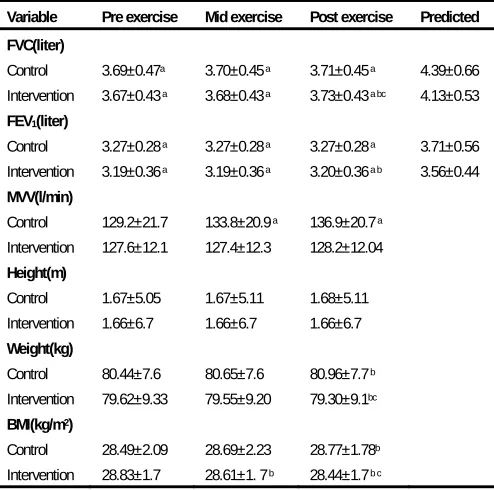
Post hoc analyses revealed that post exercise FVC, FEV1 and MVV were significantly higher than the
pre exercise values (FVC: P=0.00, FEV1: P=0.01,
MVV: P= 0.00), while post exercise BMI and weight were significantly lower than the pre exercise values (BMI: P=0.00, weight: p=0.003) (Table3).
No significant differences were found between pre, mid (12th week) and post exercise (24th week)
FVC, FEV1 and MVV in the control group (Table3).
Post exercise BMI and weight were significantly higher than pre exercise values in the control group (BMI: p=0.01, and weight: p=0.00) (Table3).
Table 3. Pre, mid and post exercise respiratory function and
anthropometric characteristics of the control and intervention groups
Variable Pre exercise Mid exercise Post exercise Predicted FVC(liter)
Control 3.69±0.47a 3.70±0.45 a 3.71±0.45 a 4.39±0.66
Intervention 3.67±0.43 a 3.68±0.43 a 3.73±0.43 a bc 4.13±0.53
FEV1(liter)
Control 3.27±0.28 a 3.27±0.28 a 3.27±0.28 a 3.71±0.56
Intervention 3.19±0.36 a 3.19±0.36 a 3.20±0.36 a b 3.56±0.44
MVV(l/min)
Control 129.2±21.7 133.8±20.9 a 136.9±20.7 a
Intervention 127.6±12.1 127.4±12.3 128.2±12.04
Height(m)
Control 1.67±5.05 1.67±5.11 1.68±5.11
Intervention 1.66±6.7 1.66±6.7 1.66±6.7
Weight(kg)
Control 80.44±7.6 80.65±7.6 80.96±7.7 b
Intervention 79.62±9.33 79.55±9.20 79.30±9.1bc
BMI(kg/m2)
Control 28.49±2.09 28.69±2.23 28.77±1.78b
Intervention 28.83±1.7 28.61±1. 7 b 28.44±1.7 b c
a significantly different from the predicted value. b significantly different from the pre
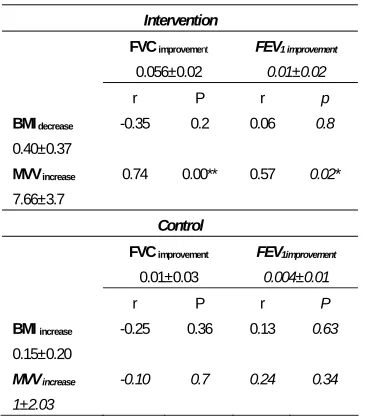
In the intervention group, FVC (FVCpost- FVCpre)
and FEV1 (FEV1post-FEV1pre) improvements were
positively and significantly associated with MVV improvement (MVVpost-MVVpre) but not with BMI
change (Table 4).
Table 4. Associations of BMI and MVV changes with FVC and FEV1
improvements in the control (n=15) and intervention (n=15) groups.
Intervention
FVC improvement
0.056±0.02
FEV1 improvement
0.01±0.02
r P r p
BMI decrease
0.40±0.37
-0.35 0.2 0.06 0.8
MVV increase
7.66±3.7
0.74 0.00** 0.57 0.02*
Control
FVC improvement
0.01±0.03
FEV1improvement
0.004±0.01
r P r P
BMI increase
0.15±0.20
-0.25 0.36 0.13 0.63
MVV increase
1±2.03
-0.10 0.7 0.24 0.34
FVCimprovement=FVCpost-FVCpre: FEV1 improvement=FEV1post-FEV1pre: BMI decrease=BMIpre
-BMIpost: BMIincrease=BMIpost-BMIpre:MVVincrease=MVVpost-MVVpre: ** significant at
p<0.01: * significant at p<0.05.
As shown in Table 3, there were no significant differences between groups in the pre, mid and post exercise FVC, FEV1, BMI, height and weight .In
both groups, the post exercise FVC and FEV1 were
significantly lower than the predicted values (control: p=0.00 for FVC and p=0.00 for FEV1, intervention:
p=0.00 for FVC and p=0.00 for FEV1).
DISCUSSION
In this study, we investigated the effect of 24 weeks of continuous treadmill running (3 days a week) on FVC and FEV1 values of the inactive,
overweight or obsess students.
In the intervention group, we found significant improvements in FVC , FEV1 and MVV compared
with participants’ pre-exercise values by continuing exercise training for up to 24weeks (p=0.00, P=0.01, and P=0.00 respectively). By contrast, there were insignificant improvements in FVC, FEV1 and MVV of the control group at the 24th week.
Obesity is expected to alter respiratory function, because it alters the relationship between the lungs, chest wall, and diaphragm, decreases lung volumes and increases airway resistance (5, 22).
Inselma et al. claimed that obese children have altered pulmonary function, which is characterized by reductions in lung diffusion capacity, ventilatory
muscle endurance and airway narrowing (6). Some studies have reported a positive association
between physical activity, physical fitness and lung capacity (16, 20). Cross-sectional studies have reported that regular physical activity and good physical fitness have been related to better pulmonary function (22, 23).
Jakes et al. reported that those who participated in vigorous physical activity showed a slower rate of decline in FEV1 during 3.7years of follow-up (8).
Holmen et al. found smaller lung capacity (FVC and FEV1) independent of age and height in never smokers with lower levels of physical exercise (24). In a prospective study, very young female competitive swimmers were found to have an increase in their vital capacity and total lung capacity during one-year of training (13), suggesting that larger lung volumes in swimmers may be due to the impact of training on lung growth. The mechanisms by which physical inactivity might influence FVC and FEV1 are unclear. The relationship of muscular
force with FVC and FEV1 is established (25). Simões
lifestyle on obesity (8). Obesity decreases the mobility of the thorax (25). It seems likely that reduced FVC and FEV1 in the present study are
results of respiratory muscle weakness due to sedentary lifestyle and increased BMI in our subjects.
In the present study, it seems that FVC and FEV1
of the intervention group were positively affected by physical activity, BMI reduction and the lung growth during the study course. However, participants in the control group had experienced negative effects of physical inactivity and high BMI, and positive effect of lung growth which may account for insignificant improvements in post exercise FVC and FEV1(p=0.17 and p=0.25, respectively).
Height has been established as the best predictor of lung function (20, 21). Cross-sectional and longitudinal studies have shown that height increment stops between the age 16 and 17(27). Xuan et al. found that pulmonary function (FVC and FEV1) continued to grow after the cessation of height
growth (27). For example, the change in expected FEV1 after age 17 is reported to be about 200 ml/yr
(27).
Our subjects were in the age range of 16 to 18 in the control and intervention groups. We found an insignificant increase in the post exercise height (p=0.16) and respiratory function (FVC: p=0.17, and FEV1: p=0.25, respectively) of the control group.
Therefore, we postulated that this insignificant increase in FVC and FEV1 had been resulted from
normal growth processes or from repeated respiratory testing effects in the control group. By contrast, in the intervention group, the changes in the post exercise height was insignificant (p=0.08), while these changes were significant in respiratory function (FVC: p=0.00 and FEV1: p=0.01), in comparison
with pre exercise values (Table 3). This enhancement, most probably, was the result of exercise training in the intervention group.
Concerning the significant increase in post exercise FVC and FEV1 in the intervention group
(and not in the control group), similar observations were reported by Courteix et al., in girls. They found that FVC and FEV1 values significantly improved after 1 year of swimming training (13). Ghosh et al. observed higher values of FVC and FEV1 in
physically trained cases compared to sedentary control individuals which confirms our findings (28). The findings of this study are also in consistent with the results of a study by Farrell et al. (19), who found that FVC and FEV1 increased after 8 weeks of
aerobic training in adults and attributed this finding to the improved contractility of the expiratory muscles as a result of endurance training. The exact mechanism of the FVC improvement in this study is unknown, but respiratory muscles function, fat mass reduction and weight loss possibly play roles in this improvement. Repeated exercise may result in respiratory muscle hypertrophy, and it is obvious that respiratory indices are related partly to respiratory muscles power (19). We found significant weight loss (p=0.003) and BMI reduction (p= 0.001) after 24 weeks of the continuous treadmill running in the intervention group (Table3). There were no significant relation between FVC and FEV1
improvements and BMI reduction, while FVC and FEV1 improvements were positivity and significantly
correlated with MVV improvement (Table 4). MVV is the measure of respiratory muscle performance (19). Positive relation of MVV improvement with FVC and FEV1 improvements showed that the
respiratory muscle performance enhancement due to aerobic exercise can improve FVC and FEV1 in the
intervention group.
values (post exercise FVC and FEV1 were significantly lower than the predicted values, FVC: p=0.00, FEV1: P=0.00; Table 2) and there were no
significant differences between the intervention and the control groups in terms of post exercise FVC and FEV1 (FVC: P=0.87, FEV1: P=0.53; Table 3).
Pervious studies have reported larger respiratory function in the intervention group compared to the control group (13). This discrepancy can be attributed to the lack of larger change in the post exercise BMI and short exercise training course in the intervention group. In a study by Lazarus et al, adjusted FVC and FEV1 values in children had
indirect correlation with total body fat percentage (5). Gonzalez-Barcala et al. observed the negative effect of body fat on the pulmonary function of children and adolescents (25).It is established that excessive fat mass decreases the mobility of the thorax (25).Other authors suggest that leptin, which is correlated with BMI is negatively associated with respiratory indices (FEV1) (25). On the other hand,
researchers reported FVC and FEV1 improvements
after prolonged (1-3 years) exercise training (13). In the present study post exercise BMI was 28.42±1.59 kg/m2 in the intervention group (Table3) which may
result in serum leptin elevation. It seems that excessive fat mass and short duration of the exercise training are probable mechanisms for insufficient FVC and FEV1 improvements in the intervention
group.
CONCLUSION
This study demonstrated that physical inactivity and obesity can impair FVC and FEV1, while
appropriate aerobic exercise training can partly improve FVC and FEV1 due to the respiratory muscle
performance enhancement. However, participation in regular prolonged (>24 weeks) physical activity and reachinganormalBMI (BMI <25) are two important
factors that yield sufficient improvements in FVC and FEV1 in overweight and sedentary patients.
Small sample size and being unable to use Body Box for respiratory measurements were the limitations of this study. Our study results need to be confirmed in a larger group in future studies using a Body Box.
Conflict of interest
The authors have no conflict of interest.
REFERENCES
1. World Health Organization. Fact about Overweight and Obesity. Available at:
http://www.who.int/mediacentre/factsheets/fs311/en/index.ht ml. Accessed 21March 2009.
2. Australian Institute of Health and Welfare (AIHW), Australia's Health 2008. Available at:
http://www.aihw.gov.au/publications/aus/ah08/ah08.pdf. Accessed 21 March 2009.
3. De Lorenzo A, Petrone-De Luca P, Sasso GF, Carbonelli MG, Rossi P, Brancati A. Effects of weight loss on body composition and pulmonary function. Respiration 1999; 66 (5): 407- 12.
4. Bottai M, Pistelli F, Di Pede F, Carrozzi L, Baldacci S, Matteelli G, et al. Longitudinal changes of body mass index, spirometry and diffusion in a general population. Eur Respir J 2002; 20 (3): 665- 73.
5. Lazarus R, Colditz G, Berkey CS, Speizer FE. Effects of body fat on ventilatory function in children and adolescents: cross-sectional findings from a random population sample of school children. Pediatr Pulmonol 1997; 24 (3): 187- 94. 6. Inselma LS, Milanese A, Deurloo A. Effect of obesity on
pulmonary function in children. Pediatr Pulmonol 1993; 16 (2): 130- 7.
7. Pelkonen M, Notkola IL, Lakka T, Tukiainen HO, Kivinen P, Nissinen A. Delaying decline in pulmonary function with physical activity: a 25-year follow-up. Am J Respir Crit Care Med 2003; 168 (4): 494- 9.
Investigation into Cancer-Norfolk Prospective Population Study. Am J Epidemiol 2002; 156 (2): 139- 47.
9. Garcia-Aymerich J, Lange P, Benet M, Schnohr P, Antó JM. Regular physical activity modifies smoking-related lung function decline and reduces risk of chronic obstructive pulmonary disease: a population-based cohort study. Am J Respir Crit Care Med 2007; 175 (5): 458- 63.
10.Chanavirut R, Khaidjapho K, Jaree P, and Pongnaratorn P. Yoga exercise increases chest wall expansion and lung volumes in young healthy Thais. Thai Journal of physiological sciences 2006; 19 (1): 1-7.
11.Chang YF, Yang YH, Chen CC, Chiang BL. Tai Chi Chuan training improves the pulmonary function of asthmatic children. J Microbiol Immunol Infect 2008; 41 (1): 88- 95. 12.Radovanovic D, Aleksandrovic M, Stojiljkovic NDJ,
Ignjatovic A, Popovic T, Marinkovic M. Influence of physical training on cardiorespiratory endurance in preadolescent age. Acta Medica Medianae 2009; (48): 37- 40.
13.Courteix D, Obert P, Lecoq AM, Guenon P, Koch G. Effect of intensive swimming training on lung volumes, airway resistance and on the maximal expiratory flow-volume relationship in prepubertal girls. Eur J Appl Physiol Occup Physiol 1997; 76 (3): 264- 9.
14.Khalili MA, Elkins MR. Aerobic exercise improves lung function in children with intellectual disability: a randomised trial. Aust J Physiother 2009; 55 (3): 171- 5.
15.Sue DY. Obesity and pulmonary function: more or less? Chest 1997; 111 (4): 844- 5.
16.Fitness Testing. 1000 meter Run Test. Available at: http://www.topendsports.com/testing/tests/1000m-run.htm. Accessed 11 July 2008.
17.Ulger Z, Demir E, Tanaç R, Gökşen D, Gülen F, Darcan S, et al. The effect of childhood obesity on respiratory function tests and airway hyperresponsiveness. Turk J Pediatr 2006; 48 (1): 43- 50.
18.Medical International Research (MIR). Spirolab III User Manual. 2007: 1-77. Available at: http://www.zonemedical.com.au/product_files/SpiroLab3Use rManual.pdf Accessed 08 July 2008.
19.Farrell PA. Maximal expiratory flow-volume relationships before and after eight weeks of endurance training. J Sports Med Phys Fitness 1981; 21 (2): 145- 9.
20.Courteix D, Obert P, Lecoq AM, Guenon P, Koch G. Effect of intensive swimming training on lung volumes, airway resistance and on the maximal expiratory flow-volume relationship in prepubertal girls. Eur J Appl Physiol Occup Physiol 1997; 76 (3): 264- 9.
21.Kaplan TA, Montana E. Exercise-induced bronchospasm in nonasthmatic obese children. Clin Pediatr (Phila) 1993; 32 (4): 220- 5.
22.Thomas PS, Cowen ER, Hulands G, Milledge JS. Respiratory function in the morbidly obese before and after weight loss. Thorax 1989; 44 (5): 382- 6.
23.Rochester DF, Enson Y. Current concepts in the pathogenesis of the obesity-hypoventilation syndrome. Mechanical and circulatory factors. Am J Med 1974; 57 (3): 402- 20.
24.Holmen TL, Barrett-Connor E, Clausen J, Holmen J, Bjermer L. Physical exercise, sports, and lung function in smoking versus nonsmoking adolescents. Eur Respir J 2002; 19 (1): 8- 15.
25.Gonzalez-Barcala FJ, Takkouche B, Valdes L, Leis R, Alvarez-Calderon P, Cabanas R, et al. Body composition and respiratory function in healthy non-obese children. Pediatr Int 2007; 49 (5): 553- 7.
26.Simões RP, Deus AP, Auad MA, Dionísio J, Mazzonetto M, Borghi-Silva A. Maximal respiratory pressure in healthy 20 to 89 year-old sedentary individuals of central São Paulo State. Rev Bras Fisioter 2010; 14 (1): 60- 7.
27.Xuan W, Peat JK, Toelle BG, Marks GB, Berry G, Woolcock AJ. Lung function growth and its relation to airway hyperresponsiveness and recent wheeze. Results from a longitudinal population study. Am J Respir Crit Care Med 2000; 161 (6): 1820- 4.