The Effectiveness of Neurofeedback in Selective-Divided Attention
and Behavioral Disorders in Children with Hyperactivity
Omid Isanejad
1,
Somaie Rashidi
2, Neda Rashidi
31Ph. D in Family Counseling, Head of Department of Counseling, Faculty of Humanities and
Social Sciences, University of Kurdistan, Kurdistan, Iran
2M.A in School Counseling, Department of Counseling, Faculty of Humanities and Social
Sciences, University of Kurdistan, Kurdistan, Iran
3M.A in counseling, Department of Counseling, Faculty of Education and Social Sciences, Razi
University
Submitted: 21 June 2018
Accepted: 26 July 2018
Int J Behav Sci. 2018; 12(2): 53-58
Corresponding Author: Omid Isanejad,
Ph.D in Family Counseling, Head of Department of Counseling, Faculty of Humanities and Social Sciences, University of Kurdistan, Kurdistan,
Iran
E-mail: [email protected]
Abstract
Introduction: The aim of this study was to investigate the effectiveness of neurofeedback on selective-divided attention and behavioral disorders in children with hyperactivity.
Methods: The semi-experimental method with pretest-posttest and follow up design and a control group was applied. Thirty children with ADHD symptoms were selected among the girls and boys with the age range of 8-12 years old. Participants were randomly divided into two experimental and control groups. Data collection was done using Selective Attention and divided Stroop task and Rutter's Behavioral Problems Questionnaire (RBPQ).
Results: The results obtained from frequent measure analysis showed that the selective attention of the group receiving neurofeedback has been increased, although the divided attention has been decreased. Moreover, overall behavioral disorders and components showed significant reduction in two steps of pretest, posttest and follow up. However, it showed no significant reduction in eating and sleeping disorders.
Conclusion: Neurofeedback can improve selective attention among hyperactive children and can also reduce scattered attention and behavioral disorders. Therefore, it is an effective method to enhance attention and decrease behavioral disorders in children with ADHD.
Keywords: Selective Attention, Divided Attention, Behavioral Disorders, Hyperactivity
Introduction
One of the most common disorders in children is attention deficit hyperactivity disorder (ADHD) (1). This disorder includes 3 groups: 1) Attention Deficit Disorder (Actually, some children just suffer from attention deficit and some others are only impulsive. However, some of these children have both symptoms at the same time. To diagnose ADHD based on DSM-V criteria, 6-9 symptoms of ADHD should exist and it is required to have a clear function disorder at least in two places (home and school) (2). The main problem with ADHD children is their inability to preserve and regulate attention and behavior. As a result, they are mostly unable to show good behavior adjusted with environmental conditions moment by moment (3). According to Berkeley, ADD is a cognitive neural disorder specified through inadequate attention skills in terms of growth, impulsion and hyperactivity in some cases. The terms "attention deficit" and "hyperactivity with attention deficit" refer to same conditions; although they can be used by two different groups of experts (4).
gets environmental information more than the required level; meaning that they have weakness in terms of paying attention selectively to underlying information and eliminating inessential information (6).
Attention can be classified in two groups of selective and divided (scattered) attention (7). Divided attention means that the person is mostly capable to take more than one task at the same time and transmit attention carefully from one activity to another if needed (8). Selective attention is that the person makes choice that which stimulant should be considered and which one should be neglected (9). With negligence or at least emphasis on some stimulants, desired stimulants specially gain attention. The attention focused on some informative stimulants can empower the ability of manipulating the stimuli for other cognitive processes such as verbal perception or problem solving (10). As people can't process all types of information, they should be able to select the information with the highest significance. This kind of choice can be called as selective attention or attention control (11). Attention control refers to the ability of conscious suppression of automated responses to provide reasonable and purposeful responses (12). Neurofeedback is an educational process, in which the brain learns self-regulation. Its infrastructural mechanism includes improvement of mechanism to control required attention for effective function (13).
Brain controls receiving required blood through expansion or contraction of blood vessels and the blood flow in brain is conducted to special areas active in self-regulation (14). Dagenais et al. [15] studied the effectiveness of neurofeedback in attention and academically proved that this method can be significantly effective in the improvement of attention. Additional experiments during 21 months after the before mentioned study also proved the effectiveness (15)]. Arns and Kenemans used neurofeedback to improve sleep
quality [16)]. Mann et al. also used neurofeedback to
decrease inattentiveness in children with attention deficit. However, none of these studies have investigated behavioral problems comprehensively (14). Therefore, according to the difference of relevant studies and the limitations in the selection of dependent variables such as behavioral problems caused by neurofeedback, this study has been conducted on ADHD children.
Method
The research method is semi-empirical pretest-posttest and follow-up plan with a control group. Participants consisted of 30 children (girls and boys in age range of 8-12 years old) with ADHD who were randomly selected from 73 children with ADHD based on diagnosis interview of a physician and were randomly divided in 3 experimental and control groups. Inclusion criteria was living in Tehran, literacy of parents to answer the items of the questionnaire, participation of one of the parents in the sessions with the child, and agreement to participate in free sessions of training neurofeedback. The exclusion criteria also included absence in neurofeedback sessions, moving from one place to another or travelling to another
place and diseases causing hospitalization. Data collection
instruments included Stroop's Selective-Divided
Attention Test and Rutter's Behavioral Problems Questionnaire (RBPQ).
Stroop test has been made by John Ridley Stroop to measure selective and divided attention and it is a common neuropsychological assessment method for selective and focused attention (17). In this test, the trials should select geometric and numerical stimulants and
letters for 56 stimulants for each step (3 steps) from 8
geometric shapes, numbers 1-8 and 8 letters (18). In this study, a computerized type of Stroop Test was used. In Iran, validity and reliability of the test has been confirmed by Malek and Amiri on bilingual adolescents and the coefficient of consistency between all the variables forming the Stroop test were reported significant (17). The maximum and minimum correlation coefficient on reaction time to letter stimulant and the deviation of numerical stimulants has been reported to 0.93% and 0.37% respectively. The results of the validity test of the Stroop test have been also analyzed for all test stimulants among children with hyperactivity and normal children and the highest validity was reported for letter stimulants at 0.54 for hyperactive children. Moreover, according to the obtained mean value from the groups, children with ADHD showed the weakest performance in regards to time of response and error (17).
Rutter's Behavioral Problems Questionnaire (RBPQ) was made by Rutter for assessment of behavioral problems of school age children(19). The parent form of this questionnaire contains 31 items on a 3-point scale (totally false, relatively true and totally true) providing 7 components and 1 overall value. In Iran, Khoddam et al. (20) conducted a study on 60 girls and boys and compared the findings of Rutter's parent form with psychiatric assessment. The test sensitivity was reported to be 0.7 and diagnosis feature of test was reported to be 0.88. The validity of the test was also assessed with the agreement of the questionnaire and diagnosis of psychiatrist in the mentioned study. Moreover, the reliability of the test on 36 people was reported to be 0.92 (20).
computer game was conducted without using hands and only with the child's brain waves. In this way, children find out about the desirable or undesirable conditions of brain waves based on the progress or stop of game and getting bonus or lose points or changes made in the sound or video display and try to correct brain waves through conducting the video or game (for example, if the person is going to reduce alpha wave, the game is progressed in such way that alpha wave is lower than certain level). During training time, brain activity can be controlled with conscious and unconscious attention control and needs no external drug to encounter new problems and to exit from its regulation. This is because; it can obtain new regulation through the self-regulation process. After several sessions of practice and iteration, brain trains the tasks and copes with them. At the end of session, electrodes were separated from the person and some tasks were given as homework.
Results
The findings of the demographic information of the sample group and their mothers showed that the mean
age of children was 10 ± 1.29 and the minimum and
maximum were between 8-12 years. The mean age of the
mothers was 40 ± 1.75 with a minimum and maximum
age of 38-42 years. Also, information about the gender of children revealed that 50% of the children were girls.
The descriptive findings related to the means of the two experimental and control groups at the post-test and follow-up stage compared to the pre-test showed that the average selective attention of the experimental group had increased from pre-test to post-test and follow-up, but the mean of the divided attention in the experimental group had decreased. Also, the mean of behavioral problems decreased from pre-test to post-test. This decrease was observed in all the components of behavioral problems such as physical pain problems, difficulty in controlling urine and feces, problems with school attendance, stuttering and linguistic problems, stealing problems, eating and sleeping problems. Although the decrease in the follow-up phase was lower than the post-test, however, there was a decline in all the components of the behavioral problems of the experimental group. Therefore, repeated measures were used to compare the above values in three stages: pre-test, post-test and follow-up. Before using repeated measure analysis, assumptions were considered.
Since the Mauchly index was very low (μ = 0.001) and
the high ratio of Chi-square 1447.62 was significant for the difference of variances at the level of 0.001, it can be said that the homogeneous assumption of the variance-covariance matrix is not observed. Therefore, considering
the meaningful results of Mauchly’s test, we can assume that the spatial and homogeneous assumption of the data covariance matrix is not observed between the groups.
As a consequence of the fact that the Mauchly's sphericity hypothesis was not provided for repeated measures, it was necessary to take into account the other assumptions of repeated measure analysis, such as the equality of data variance of the Levine test. According to the results of the research which shows that Levin's test results were significant for most variables other than eating problems (F = 0.622, df1 = 5, df2 = 84, sig = 0.684), it can be concluded that the equality condition for the variances of the two groups are not met. Therefore, it is necessary to consider multi-dimensional tests of repeated measurement analysis. Also, the results of the Greenhouse-Geisser test as one of the multivariate tests for the effect of the group for intervention were F = 159/60, Eta = 0/655 and Sig <0.001, respectively. Also, the time effect of intervention was F = 45.12, Eta = 0/518 and Sig <0.001 was also significant. Finally, the effect of interaction between group and time was also significant (intervention F = 37.72, Eta = 0.471 and Sig <0/001). According to these results, it can be said that the effect of intervention, time passage and the interaction between intervention and time are significant.
Since the interactive effect of group and time was significant, it was necessary to adopt a solution for the separation of each one’s effect. Based on this, through the separate analysis of the test and control groups, the intergroup effect was eliminated and repeated measurements were analyzed based on the effect of time. The values of assumptions of repeated measures were obtained for the experimental group as follows. Mauchly's
index was equal to (μ = 0/001) and the high ratio of
Chi-square 851/99 was significant for the difference of variances at the level of 0/001. Accordingly, we can say that the homogeneity assumption of variance-covariance matrix of experiment group is not met. Also, the results of Levin test showed homogeneity of variances. Values of Levin was F = 0.499, df1 = 2, df2 = 42, sig = 0/61 for selective focus, F = 1/50, df1 = 2, df2 = 42, sig = 234 for difficulty in going to school and F = 0 927, df1 = 2, df2 = 42, sig = 0/40 for sleeping problems. In addition, the results of Greenhouse - Geisser test as one of the multivariate tests for group and time effects which were
F = 60.65, Partial Eta2 = 0.75 and Sig <0.001, show its
significance. Finally, it was determined that the F-statistic of the Mbox test was significant (M= 277.77, F = 1/62, p <0/001). As a result, the covariance matrix of the dependent variables in the experimental group was unequal. Therefore, it can be said that neurofeedback training has a significant effect on variables.
Table 1. Results obtained from repeated measures analysis to compare effect of intervention and time effect independently and interactively
Group Source SS Df MS F Sig. Eta Power
Experiment Total effect 454867.220 1 454867.220 17781.040 .000 .998 1.000
effect of time 374.253 2 187.127 7.315 .002 .258 .921
According to the results of mean repeated measurements of experimental group in Table 1, it can be concluded that the effect of intervention on dependent variables in the experimental group is significant. This finding implies that the effect of neurofeedback training is significant on at least some of the dependent variables, which has been investigated for the study of each dependent variable in order to discover this difference.
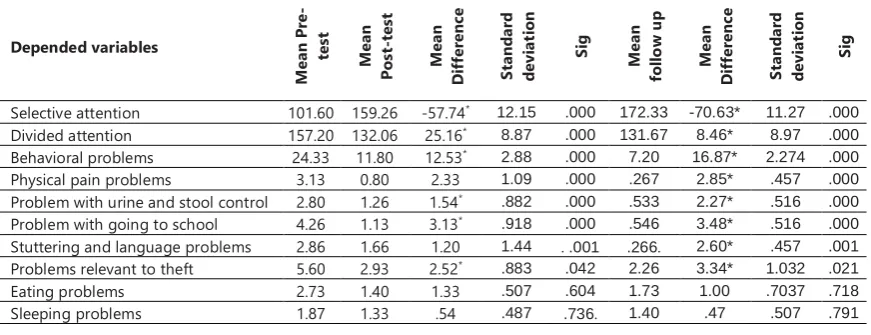
According to the results of the analysis of variance, we can say that the effect of intervention on selected and distributed attention was significant (p <0/001). It should be noted that the coefficient of intervention on the selected attention of the experimental group was 0.69 and for the divided attention was 0.70 with the test power of 1. Also, the specific effect of intervention on the total score of behavioral problems was significant with a coefficient of 0.86 at test level (p <0.001). In addition, the specific effect of intervention on most components was significant, with the exception of eating and sleeping difficulties. The highest effect factor was 0.89 with test power of 1 for physical pain problems, and the lowest effect factor was 0.01 with the test power of 0.9 for sleep problems and eating problems (with coefficient effect of 0.02 , which the test power was 0.13 at a significant level (p <0/604). However, despite a non-significant decrease in the two components of sleeping and eating problems, the total findings revealed the role of intervention in overcoming most behavioral problems or the effectiveness of neurofeedback on reducing problems in both phases.
According to the results of the Bonferroni test on comparing the average of the experimental group variables from pre-test to post-test, it can be said that the mean selective attention of the experimental group was 57 scores higher. Also, this increased to 71 points in the follow-up phase. While scattered attention in the post-test stage was reduced by 25, this decrease was reduced to 8/46 at the follow-up stage, which was significant at the level of 0/001. In addition, the mean of behavioral
problems was decreased in the experimental group at the post-test and follow-up. There was a significant decrease in the components of behavioral problems. This decreasing in means of scattered attention, behavioral problems, and some components of behavioral problems indicate the effectiveness of neurofeedback training.
Therefore, the paired comparison of the pre-test and post-test means and the pre-test mean with the follow-up stage in the experimental grofollow-up using the Bonferroni test showed that there was a significant difference in the mean post-test and the follow-up of the test group compared to the pre-test. This finding shows the effectiveness of neurofeedback training on some variables. Accordingly, the research hypothesis was confirmed.
On the other hand, the separate analysis of repeated measures based on the effect of time in the control group was performed by removing the intergroup effects.
Regarding the repeated analysis of the results of the control group in Table 3, it can be said that the effect of time on dependent variables was not significant. This finding means that there is no significant effect on the dependent variables among the control group members. As a result, due to insignificant changes, a paired comparison is not necessary between the pre-test with post-test and follow-up.
Discussion
The aim of this study was to evaluate the effectiveness of neurofeedback on selective / distributed attention and behavioral problems in children with hyperactivity in Tehran in two stages after intervention and follow up. The results of the analysis of the repeated measures of the mean of the experimental group in Table 2 showed that there was a significant increase in the post-test and follow-up stages of the mean selective attention of the experimental group with a coefficient of 0.69 and test power of 1. However, there was no significant change in the control group. This finding means that neurofeedback
Table 2. Bonferroni test results to compare the mean of the experimental group from pre-test to post-test and follow-up
Depended variables
M
ea
n P
re
-
te
st
M
ea
n
Po
st
-t
es
t
M
ea
n
D
if
fe
re
nc
e
St
and
ar
d
de
vi
at
io
n
Si
g
M
ea
n
fo
llo
w
u
p
M
ea
n
D
if
fe
re
nc
e
St
and
ar
d
de
vi
at
io
n
Si
g
Selective attention 101.60 159.26 -57.74* 12.15 .000 172.33 -70.63* 11.27 .000
Divided attention 157.20 132.06 25.16* 8.87 .000 131.67 8.46* 8.97 .000
Behavioral problems 24.33 11.80 12.53* 2.88 .000 7.20 16.87* 2.274 .000
Physical pain problems 3.13 0.80 2.33 1.09 .000 .267 2.85* .457 .000
Problem with urine and stool control 2.80 1.26 1.54* .882 .000 .533 2.27* .516 .000
Problem with going to school 4.26 1.13 3.13* .918 .000 .546 3.48* .516 .000
Stuttering and language problems 2.86 1.66 1.20 1.44 . .001 .266. 2.60* .457 .001
Problems relevant to theft 5.60 2.93 2.52* .883 .042 2.26 3.34* 1.032 .021
Eating problems 2.73 1.40 1.33 .507 .604 1.73 1.00 .7037 .718
Sleeping problems 1.87 1.33 .54 .487 .736. 1.40 .47 .507 .791
Table 3. Results obtained from repeated measures analysis to compare effect of intervention and time effect in the control group
Group Source SS Df MS F Sig. Eta Power
Control
Total effect 394508.836 1 394508.836 21804.482 .000 .998 1.000
effect of time 116.858 2 58.429 3.229 .050 .133 .585
training has increased the selective focus of the experimental group. This finding is consistent with the results of other studies, such as Dagnies et al. who reported the efficacy of neurofeedback on selective attention. In fact, neurofeedback has been shown to be effective in improving targeted attention (15). Also, in line with the effectiveness of neurofeedback, Liu et al. believe that neurofeedback is one of the special interventions for hyperactivity in children with hyperactivity / deficiency (21). In explaining the effectiveness of neurofeedback on selective attention, it can be said that its underlying mechanism strengthens the control mechanism of attention by increasing self-control and self-regulation to control the attention and ability to suppress or silence consciousness of non-radical responses in order to provide more appropriate and targeted responses. This is because neurofeedback is in fact an educational process in which the brain draws attention (13).
Considering the divided attention based on the results of the comparison of the means of divided attention of the pre-test, post-test and follow-up of the test group in Table 2, it was determined that the effect of intervention with a coefficient of 0.70 and test power of 1 significantly reduced the divided attention. However, there was no significant change in the control group. The findings of this study are in line with research results, such as Mann et al. and Linden (14, 22), which used neurofeedback to reduce the severity of children with poor concentrations and learning disabilities. Results showed that an effective mechanism in neurofeedback, is the ability of this method to inhibit automatic and distracting responses. As a result, due to decreased distraction and forgetfulness, scattered attention is also affected by neurofeedback (23).
In addition to changes in selective and divided attention, according to the findings of the present study, Table 3 showed a significant difference in the behavioral problems of the experimental group in the post-test and follow-up stages. Thus, neurofeedback training with a coefficient of 0.86 reduced the behavioral problems of the experimental group. This finding is consistent with the results of Mattio et al. (24).
In addition to the mean of the total behavioral problems, the results of repeated measurement analysis showed that in most of the components of behavioral problems (such as stomach ache or asthma problems with a coefficient of 89, bladder control 0.79, escape from school 0.64, stuttering with a coefficient of 0.29, and robbery with a coefficient of 0.14), apart from the two components of eating and sleeping difficulties, there was a significant difference in post-test and follow-up compared to the pre-test. This finding is in line with previous studies on the efficacy of neurofeedback on behavioral problems such as Liu et al., Rastgar et al., and Dajinas et al. (25-27), .It is also in line with the study on the effectiveness of neurofeedback on behavioral bladder problem control, and the treatment of urinary incontinence caused by anxiety in children(28).
Based on these results, it can be said that in general, children who were educated on the basis of neurofeedback were more consistent in terms of behavior.
Regarding the results obtained in this study, two main hypotheses of the research were based on the effectiveness of neurofeedback on selective / divided attention and behavioral problems in the post-test and follow-up stages. The components of behavioral
problems (such as physical problems, bladder control
problems, escape from school, stuttering) were significantly influenced by neurofeedback education in children with hyperactivity. As a result, the hypotheses of the study were confirmed. It can be concluded that neurofeedback improved selective attention, and reduced components of behavioral problems such as dyslexia, bathroom care, escape from school, robbery and stuttering in hyperactive children.
Conclusion
In the conclusion of the research findings, the results of this study show that high selective attention and low behavioral problems are considered as supportive factors in children with hyperactivity, which is better to be considered in treating this group of children. According to the results, neurofeedback training are considered to be effective interventions for children with hyperactivity, helping to improve the group through enhancing selective attention and reducing behavioral problems. In the present study, the effectiveness of neurofeedback training on increasing selective attention and reducing divided attention and behavioral problems in children with hyperactivity were tested and confirmed. As a result, it can be used as an effective way to help treat ADHD and increase selective attention and reduce attention and behavioral problems in children with hyperactivity.
Acknowledgement:
The authors thank all participants and their families for their kind cooperation in this study.
References
1. Thomas R, Sanders S, Doust J, Beller E, Glasziou P. Prevalence of attention-deficit/hyperactivity disorder: a systematic review and meta-analysis. Pediatrics. 2015;135(4):e994-1001. 2. Association AP. Diagnostic and Statistical Manual of Mental
Disorder, 5th ed (DSM-5). American Psychiatric Association. 2013.
3. Osunsanmi S, Turk J. Influence of Age, Gender, and Living Circumstances on Patterns of Attention-Deficit/Hyperactivity Disorder Medication Use in Children and Adolescents With or Without Intellectual Disabilities. Journal of child and adolescent psychopharmacology. 2016;26(9):828-34.
4. Berkeley RA. Attention-deficit hyperactivity disorder: A handbook for diagnosis and treatment: Guilford Publications; 2014.
5. Northover C, Thapar A, Langley K, Fairchild G, van Goozen SHM. Cortisol levels at baseline and under stress in adolescent males with attention-deficit hyperactivity disorder, with or without comorbid conduct disorder. Psychiatry research. 2016;242:130-6.
6. Salomone S, Fleming GR, Bramham J, O'Connell RG, Robertson IH. Neuropsychological Deficits in Adult ADHD: Evidence for Differential Attentional Impairments, Deficient Executive Functions, and High Self-Reported Functional Impairments. Journal of attention disorders. 2016.
journal on normal and abnormal development in childhood and adolescence. 2017;23(5):510-22.
8. Gadea M, Alino M, Garijo E, Espert R, Salvador A. Testing the Benefits of Neurofeedback on Selective Attention Measured Through Dichotic Listening. Applied psychophysiology and biofeedback. 2016;41(2):157-64.
9. Dye MW, Hauser PC. Sustained attention, selective attention and cognitive control in deaf and hearing children. Hearing research. 2014;309:94-102.
10. Rapport MD, Orban SA, Kofler MJ, Friedman LM. Do programs designed to train working memory, other executive functions, and attention benefit children with ADHD? A meta-analytic review of cognitive, academic, and behavioral outcomes. Clinical psychology review. 2013;33(8):1237-52.
11. Zare H, Moradi K, Ghazi S, Safari N, Lotfi R. A comparison of selective attention among depressed patients, obsessive anxious and normal individuals. Scientific Magazine Yafte. 2015;16(3):62-9.
12. Rostami S, Pourbakht A, Kamali M, Jalaee B. The effects of auditory selective attention on contralateral suppression of stimulus-frequency otoacoustic emissions. Audit Vesitibu Resea. 2011;20(2):63-71.
13. Kouijzer ME, van Schie HT, Gerrits BJ, Buitelaar JK, de Moor JM. Is EEG-biofeedback an effective treatment in autism spectrum disorders? A randomized controlled trial. Applied psychophysiology and biofeedback. 2013;38(1):17-28. 14. Mann CA, Lubar JF, Zimmerman AW, Miller CA, Muenchen
RA. Quantitative analysis of EEG in boys with attention-deficit-hyperactivity disorder: controlled study with clinical implications. Pediatric neurology. 1992;8(1):30-6.
15. Dagenais E, Leroux-Boudreault A, El-Baalbaki G, Begin J. Doubting the efficacy/effectiveness of electroencephalographic neurofeedback in treating children with attention-deficit/hyperactivity disorder is as yet unjustified. The Journal of clinical psychiatry. 2014;75(7):778-9.
16. Arns M, Kenemans JL. Neurofeedback in ADHD and insomnia: Vigilance stabilization through sleep spindles and circadian networks. Neuroscience & Biobehavioral Reviews. 2014;44:183-94.
17. Malek A, Hekmati I, Amiri S, Pirzadeh J, Gholizadeh H. The standardization of Victoria Stroop Color-Word Test among Iranian bilingual adolescents. Archives of Iranian medicine. 2013;16(7):380-4.
18. Coderre E, Conklin K, van Heuven WJ. Electrophysiological measures of conflict detection and resolution in the Stroop task. Brain research. 2011;1413:51-9.
19. Ekblad S. The children's behaviour questionnaire for completion by parents and teachers in a Chinese sample. Journal of Child Psychology and Psychiatry. 1990;31(5):775-91.
20. Khoddam H, Modanlo M, Ziaee T, Keshtkar AA. Behavioral disorders and related factors in school age children of Gorgan. Iranian Journal of Nursing Research. 2009;4(14):29-37. 21. Liu T, Wang J, Chen Y, Wang R, Song M, editors.
Neurofeedback Treatment Experimental Study for ADHD by Using the Brain-Computer Interface neurofeedback system2013; Berlin, Heidelberg: Springer Berlin Heidelberg.
22. Linden D. The Brain Controls Itself: From Brain Reading to Brain Modulation via Neurofeedback. Brain Control: Developments in Therapy and Implications for Society. London: Palgrave Macmillan UK; 2014. p. 102-30.
23. Best M, Williams JM, Coccaro EF. Evidence for a dysfunctional prefrontal circuit in patients with an impulsive aggressive disorder. Proc Natl Acad Sci U S A. 2002;99(12):8448-53. 24. Kelley MJ. “Native Americans, Neurofeedback, and Substance
Abuse Theory”. Three Year Outcome of Alpha/theta Neurofeedback Training in the Treatment of Problem Drinking among Dine' (Navajo) People. Journal of Neurotherapy. 1997;2(3):24-60.
25. Pan CY, Chu CH, Tsai CL, Lo SY, Cheng YW, Liu YJ. A racket-sport intervention improves behavioral and cognitive performance in children with attention-deficit/hyperactivity disorder. Research in developmental disabilities. 2016;57:1-10. 26. Subcommittee on Attention-Deficit/Hyperactivity D, Steering
Committee on Quality I, Management, Wolraich M, Brown L, Brown RT, et al. ADHD: clinical practice guideline for the diagnosis, evaluation, and treatment of attention-deficit/hyperactivity disorder in children and adolescents. Pediatrics. 2011;128(5):1007-22.
27. Rastegar N, Dolatshahi B, Rezaee Dogahe E. The Effect of Neurofeedback Training on Increasing Sustained Attention in Veterans with Posttraumatic Stress Disorder. PCP. 2016;4(2):97-104.