Tanaffos (2003) 2(8), 31-39
2003 NRITLD, National Research Institute of Tuberculosis and Lung Disease, Iran
The Effect of Interpleural Morphine on
Post-Thoracotomy Pain Management
Shideh Dabir, Badiolzaman Radpay, Tahereh Parsa, Mehdi Kazempour Dizaji, Leila Salimi Nezhad
Department of Anesthesiology, NRITLD, Shaheed Beheshti University of Medical Sciences and Health Services, TEHRAN-IRAN
ABSTRACT
Background: Pain after thoracotomy is one of the most severe surgical pains, being the most fundamental inhibitor factor in chest wall movement after surgery.The effect of interpleural morphine on pain after thoracotomy was evaluated in a double-blind and randomized study.
Materials and Methods: In 16 patients, morphine sulfate 0.2 mg/Kg in 40 ml of 0.9% normal saline (N/S) was injected via interpleural (ip) catheter at the end of surgery. Meanwhile, 10 ml of 0.9% normal saline IV was administered [ipm group]. In 15 patients, 40cc of 0.9% N/S ip and concurrently morphine sulfate 0.05 mg/kg in 10cc of N/S IV were injected [ips group]. After first injection in the operating room, infusion of aforementioned solutions was continued every 4-hour, for 24 hours in ICU.
The patients received supplementary doses of morphine IV in necessity to relief pain. By using facial pain scale (FPS), the degree of pain before and 30 min after drug injection was evaluated. The amount of supplementary morphine, side effects, sedation rate, and drainage of chest tubes were recorded over 24 hours.
Results: In ipm group, FPS was significantly lower than that of ips group over 24 hours postoperatively (p<0.0.5). Mean of the required supplementary morphine in ipm group over 24 hours, was significantly less than that of ips group. Sedation rate in ips group was significantly higher than that of ipm group (p<0.05)
Conclusion: Based on this study, we concluded that administration of adequate dose of interpleural morphine can cause effective and favorable analgesia after thoracotomy. Furthermore, it does not have a common systemic side effect.
(Tanaffos 2003; 2(8): 31-39)
Key Words: Thoracotomy, Analgesia, Interpleural morphine
INTRODUCTION
Pain after thoracotomy is one of the most severe surgical pains, being the most fundamental inhibitor factor in chest wall movement after surgery. It aggravates with respiratory movements and has a
Correspondence to: Dabir Sh Tel.: +98-21-2280500
E-mail address: Shdabir@ yahoo.com
normal and deep breathing, effective coughs and physiotherapy and moves as soon as possible. Making adequate analgesia along with minimal respiratory depression and reduced level of consciousness is the principal aims for managing these patients after surgery.
To date, various methods of regional anesthesia are used broadly after thoracic surgery. Interpleural anesthesia procedure is effective and simple with low side effects producing analgesia after surgery in most procedures including thoracotomy (4,5,6,7).
Recent studies have shown that opium has peripheral analgesic effects, by activating opioid receptors located on peripheral nerves without producing significant systemic side effects. Therefore, interpleural morphine injection may also induce analgesia directly via activation of opioid receptors on intercostal nerves (8,9,10). Different results have been obtained in different studies about the analgesic effect of interpleural morphine and its side effects. Some of researchers doubt the efficacy of this method (9,10, 11,12).
In this study, we evaluated the effect of interpleural morphine on pain observed after thoracotomy along with its systemic side effects.
MATERIALS AND METHODS
This study was designed as a double-blind and randomized trail. This study was attested by the ethical committee of the hospital. After being interviewed the procedure of post-thoracotomy analgesic induction and its possible complications were explained to each patient. After showing their approval, a written consent was obtained from each case. The study group consisted of 36 patients, being candidate for anterolateral and posterolateral thoracotomy for various selective intrathoracic surgical procedures with ASA class I-II. They were randomly divided into two groups of 18 each using random number table. Patients <12 years of age
weighting <30kg, mental retarded patients, alcoholics and drug abusers, psychotic and depressive patients, pleural diseases (inflammation, fibrosis, destructive lesions, bronchopleural fistula, bullous emphysema, empyema and pleural adhesion), and coagulopathies were excluded (4,7). There were no limitations in gender, height, weight, duration and type of surgery, lung pathology, location, and type of thoracotomy incision. Anesthesia induction was performed with midazolam 1-2mg, fentanyl 2-3 ml, thiopental 4-5mg/kg followed by succinylcholine 1mg/kg in order to facilitate intratracheal intubation with “Robert Shaw” double lumen tube. Anesthesia was continued with O2, halothane, bolus doses of fentanyl and atracurium 0.3 mg/kg so that the last opium dose was injected 30-45 min before the end of surgery. The patients ventilation was controlled through out the surgery.
At the end of surgery prior to closure of chest incision, an 18-gauge “Tuohy” epidural needle was passed percutaneously from one intercostal space above incision and an epidural catheter No.20 having a bacterial filter (Portex; Td, Hythe, UK-Epidural minipack system 2) was inserted into pleural space through it. About 15cm of catheter tip was placed in paravertebral groove in the interpleural space under direct observation and fixed to parietal pleura and externally to skin with small suture.
One or two chest tubes, depending on the kind of surgery, were inserted anteriorly or posteriorly into the pleural space.
administered. The dose of administered morphine was calculated on the basis of earlier studies (10). The patients then remained in supine position for 15 min, after which clumps of the chest tubes were removed.
Then, after reversing muscle relaxant with atropine 0.03 mg/kg and neostigmine 0.07 mg/kg, all the patients, recovered from anesthesia, were extubated and transferred first to recovery room and then to ICU.
Drug syringes were prepared by a technician who didn’t participate in this study. Drugs were injected by personnel who were not aware of the kind of the drugs used. Throughout the study, only one fixed nurse who did not have any information about drug interactions participated in the evaluation of pain severity and side effects of drugs in patients. She completed the questionnaires. The study patients and attending nurses did not know the kind of drugs used in ICU.
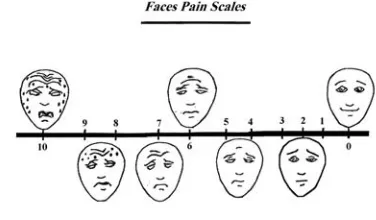
After first ip injection (hour zero), the following injections were carried out every 4 hr. for 24h in ipm and ips groups through aforementioned method without considering the pain severity (at postoperative hours 4,8,12,16,20 and 24). The pain was postoperatively evaluated in two positions of resting and deep breathing as follows: first 30 min after first ip injection (hour zero) in recovery room, then every 4 h in resting and deep breathing position before and 30 min after interpleural injection (in hours 4,8,12,16,20 and 24 postoperatively) in ICU using faces pain scale (FPS) with score of 0-10 (13,14). If patient complained of pain during 24h, IV supplementary morphine injection 0.02 mg/kg was repeated until relief of pain, but not so much to cause respiratory depression and sedation. Total dose of supplementary morphine and total amount of chest tube drainages were recorded for each patient during
24h. FPS was used as a linear scale in this study with 7 facial feature for expression of various pain scales with score of 0-10. Each face feature was shown by a specific number (Figure 1).
Figure 1. Seven different facial expressions with grading from “0” to “10” indicating various intensities of pain (FPS)
The FPS was designed in anesthesia department of this center for evaluation of pain in illiterate patients including low socioeconomic status having significant percentage of patients in this center, some of them were immigrants and refugees of neighboring countries like Afghanistan. The FPS was prepared as published pages and shown to patient by the researcher in two positions: resting and deep breathing, before and 30min afer interpleural injection. Then the patient was evaluated for pain severity by pointing to one of the face features, and the pain score was recorded on the basis of linear scale (figure 1).
Score 4: arousable upon painful stimuli Score 5: not arousable
When complications appeared, the ICU attending nurse informed the evaluator nurse for assessing the patient
The interpleural catheter was pulled out after 24h and the location was dressed, and the evaluation stopped. Data analyses were performed by SPSS and Excel software using t-test, Wilcoxon signed Rank test, and U test (Mann-Whitney). Data were demonstrated as mean (SD). The difference between two groups was considered statistically significant (P<0.05).
RESULTS
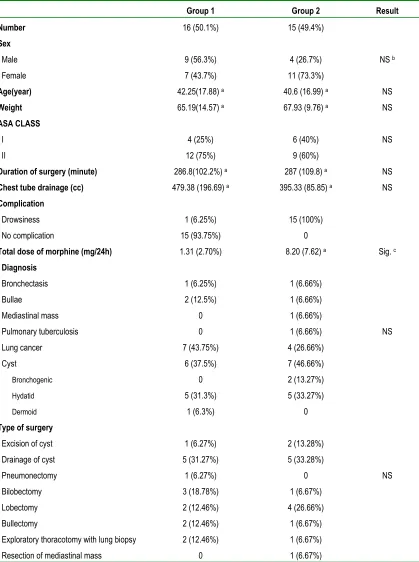
Two patients from of ipm group and 3 of ips group (totally 5) were excluded. In 3 patients (1 in ipm group and 2 in ips group), the cause was the increased air leakage from alveoli at the end of surgery which made chest tube clamping impossible. In addition, 2 patients (1 in ipm group and 1 in ips group) had tachypnea and dyspnea at 4th hour postoperatively in whom clamps were removed immediately and excluded. No complication at the entrance site of interpleural catheter was detected, and all catheters were pulled out without any problem. Of the remaining 31 patients, 16 were in ipm group and 15 in ips group. Also 13 patients were male and 18 were female. Age range was 12-72 years and mean age was 42.25 yr. and 40.6 years in ipm and ips group, respectively. The diagnoses included:-lung cancer (35.48%, n=11), included:-lung cyst (41.93%, n=13), bronchiectasis (6.47%, n=2), bullae (9.67%, n=3), mediastinal mass (3.2%, n= 1), and pulmonary TB (3.2%, n=1) (table 1).
The two groups were similar in age, ASA class, gender, weight, mean duration of surgery, 24h drainage of chest tubes, diagnosis, and kind of surgery. No significant difference was noted between
two groups (table 1). Thoracotomy was performed in one patient in ipm group with anterolateral incision and in the remaining 30 in each group with posterolateral incision.
In ips group, during 24h, mean FPS scores at rest, before and 30 min after ip injection were 45 (5.14) and 32.07(10.51), respectively. In deep breath before and 30 min after ip injection mean FPS scores were 51.73 (4.53) and 38.57 (9.32), respectively. In other words, mean FPS scores in comparing the two aforementioned positions were significantly reduced. (Wilcoxon Signed Rank Test, p< 0.05).
In ipm group, mean FPS scores at rest, before and 30 min after ip injection were 20.56 (10.71) and 3.63 (2.47) respectively. While in deep breath before ip injection the FPS scores were 22.25(9.98) and 10.38 (4.47), respectively. Regarding these data, mean FPS score in ipm group was significantly reduced after drug administration. (Wilcoxon signed Rank Test, p< 0.05). In all postoperative hours, a significant difference was detected between ipm and ips groups for mean scores at rest and in deep breath position before and 30 min after ip injection (figure 2 and 3) (U test, p<0.05).
Comparison of mean FPS scores between the both groups showed that this index in the two rest and deep breath positions, before and 30 min after injection in ipm group is less than ips group during 24h. Furthermore, a significant difference was seen between them (U Test, p<0.05) (figure 4).
Table 1. Characteristics of patients
Group 1 Group 2 Result
Number 16 (50.1%) 15 (49.4%)
Sex
Male 9 (56.3%) 4 (26.7%) NS b
Female 7 (43.7%) 11 (73.3%)
Age(year) 42.25(17.88) a 40.6 (16.99) a NS
Weight 65.19(14.57) a 67.93 (9.76) a NS
ASA CLASS
I 4 (25%) 6 (40%) NS
II 12 (75%) 9 (60%)
Duration of surgery (minute) 286.8(102.2%) a 287 (109.8) a NS Chest tube drainage (cc) 479.38 (196.69) a 395.33 (85.85) a NS Complication
Drowsiness 1 (6.25%) 15 (100%)
No complication 15 (93.75%) 0
Total dose of morphine (mg/24h) 1.31 (2.70%) 8.20 (7.62) a Sig. c Diagnosis
Bronchectasis 1 (6.25%) 1 (6.66%)
Bullae 2 (12.5%) 1 (6.66%)
Mediastinal mass 0 1 (6.66%)
Pulmonary tuberculosis 0 1 (6.66%) NS
Lung cancer 7 (43.75%) 4 (26.66%)
Cyst 6 (37.5%) 7 (46.66%)
Bronchogenic 0 2 (13.27%)
Hydatid 5 (31.3%) 5 (33.27%)
Dermoid 1 (6.3%) 0
Type of surgery
Excision of cyst 1 (6.27%) 2 (13.28%)
Drainage of cyst 5 (31.27%) 5 (33.28%)
Pneumonectomy 1 (6.27%) 0 NS
Bilobectomy 3 (18.78%) 1 (6.67%)
Lobectomy 2 (12.46%) 4 (26.66%)
Bullectomy 2 (12.46%) 1 (6.67%)
Exploratory thoracotomy with lung biopsy 2 (12.46%) 1 (6.67%)
Resection of mediastinal mass 0 1 (6.67%)
a. Figures in brackets denote mean (SD) b. Non significant (p>0.05)
Figure 2. Comparison of mean FPS scores after surgery (during resting state), before and 30 min. after IP injection in both the groups: the mean FPS score of ipm group is significantly lower than ips group (p<0.05). A: 30 min after IP injection
B: Before IP injection
Figure 3. Mean FPS score after surgery (in deep breating), before and 30 min. after IP injection in the two groups: mean FPS score in ipm group was significantly lower than ips group (p<0.05)
A: 30 min. after ip injection B:- before ip injection
A significant difference regarding the incidence of sedation, between the two groups was detected.
Sedation in ips group was more seen commonly as compared to ipm group (χ2-test, p<0.05) (figure 6).
Figure 4. Comparison of mean FPS score in both the groups; mean FPS score of ipm group after surgery was significantly lower than ips group (p<0.05)
B1= Before ip injection in the resting state A1= 30 min after ip injection in the resting state B2= Before ip injection in deep breathing phase A2= 30 min. after ip injection in deep breathing phase
Figure 5. Comparing the prevalence of morphine side- effects in both the groups: drowsiness was observed in 100% of the cases in ips group. Meanwhile in 93.75% of the ipm group no complication was detected. Drowsiness was significantly higher in the ips as compared to ipm group (p<0.05).
0 1 2 3 4 5 6 7 8
0 4 8 12 16 20 24
Hours Postoperatively
Mean FPS Scores
ipm-A ipm-B ips-A ips-B
0 1 2 3 4 5 6 7 8
0 4 8 12 16 20 24
Hours Postoperatively
Mean FPS Scores
ipm-A ipm-B ips-A ips-B
0 10 20 30 40 50 60
B1 A1 B2 A2
FPS Scores
ipm ips
ipm ips
0 10 20 30 40 50 60 70 80 90 100
FPS Scores
Figure 6. Number of drowsy patients observed postoperatively in both of the groups: the number of drowsy patients was significantly higher in the ips as compored to ipm group (p<0.05).
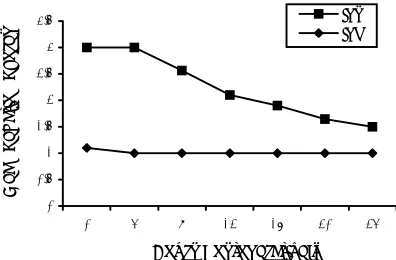
In addition, there was a significant difference for mean sedation score between ips and ipm groups. Sedation score in ips group was more than ipm group. (U test, p<0.05) (figure 7). It was only a little more than sedation score 1 in one patient in ipm group. In ips group, sedation score was significantly reduced from 8th hour postoperatively, reaching its lowest score after 24 hrs (SS=1.5) (figure 7). However the number of patients with sedation in ips group was not significantly decreased over 24h (figure 6).
Figure 7. Comparison of mean sedation score in both the groups: the mean sedation score of ips group was significantly higher than ipm group (p<0.05). after the 8th post operative hour, the sedation score of
ips group showed a significant decrease.
DISCUSSION
To date, study of perineural opiate injection has shown that these materials can induce analgesia via occupying opioid receptors located on peripheral nerves without having common systemic side effects. In interpleural morphine injection, the drug is diffused from pleural space into intercostal space causing intercostal nerves blockage and analgesia by activating opioid receptors located on intercostal nerves (12). Its activation mechanism is different from systemic morphine and local anesthetics. In our opinion, induction of ip analgesia after thoracotomy was an effective method and FPS in both resting and deep breathing was maintained ≤ 3. However, repeated IM and IV opium injections used for relieving pain after surgery in most cases may not maintain the FPS at a desirable level, specially in severe pains like in thorax and upper abdomen.
On the other hand, risks of respiratory depression as well as low level of consciousness are increased with required doses of IV and IM opiates which are important specially in the first hours after anesthesia. For this reason, regional anesthetic procedures have been noticed.
Based on recent study, interpleural morphine can cause effective analgesia after thoracotomy, maintain FPS ≤3 in both resting and deep breathing, and decrease required IV supplementary morphine doses without having significant systemic side effects particularly hypoventilation and sedation.
Since postoperative hemorrhage and secretions can results in dilution of morphine solution and also interpleural cavity would not be a closed space after thoracotomy, 30-40% of drug may leak through chest tube (9,15). These factors may decrease morphine solution concentration in the opioid receptors located on intercostal nerves. Thus, it appears that the cause of unsuccessfulness of interpleural morphine in inducing analgesic effect after thoracotomy in some 0
2 4 6 8 10 12 14 16
0 4 8 12 20 24
Hours Postoperatively
patients
ipm ips
0 0.5 1 1.5 2 2.5 3 3.5
0 4 8 12 16 20 24
Hours Postoperatively
Mean Sedation Scores
of the previously conducted studies, is its inadequate dose. Furthermore, low doses of interpleural morphine do not have significant effect in reducing severity of pain after surgery (9,15). Results obtained in this study suggest that appropriate dose administration of interpleural morphine can be an effective and simple with low side effect method in relieving pain after thoracotomy.
Based on this study, although we can guess that administration of interpleural morphine 4 hourly can maintain analgesia at a favorable level, further investigations must be performed on studying the duration of analgesia of interpleural morphine. On the other hand, clumping of chest tubes before interpleural injection can result in potential risks in the patient, limiting the usage of this technique in some of the patients. Thus, we suggest that the clamping effect of chest tubes on the analgesic effect of interpleural morphine with dose of 0.2 mg/kg should be evaluated in further studies.
REFERENCES
1. Benumof Jl, Alfery DD. Anesthesia for thoracic surgery. In:Miller RD. editor, Anesthesia. Philadelphia, Pennsylvania: Churchill Livingston, 2000. P.1722-4. 2. Hardy, Ahmed S. Pain control following thoracic surgery.
In :Ghosh S, Latimer RD editors, Thoracic anesthesia : principles and practice .England, Oxford : Butterworth – Heinemann, 1999. P 255-8.
3. Management of postoperative pain. In: Benumof JL editor. Anesthesia for thoracic surgery. Philadelphia, Pennsylvania: W.B. Saunders company, 1995. P.757-77.
4. Khor KE, Josephson MA. Blood stained pleural effusion complicating interpleural analgesia. Acta Anaesthesiol Scand 1995; 39(2): 270-2.
5. Stromskag KE, Minor B, Steen PA. Side effects and complications related to interpleural analgesia: an update.
Acta Anaesthesiol Scand 1990; 34(6): 473-7.
6. Covino BG. Interpleural regional analgesia. Anesth Analg
1988; 67(5): 427-9.
7. McIlvaine WB. Pro: Intrapleural anesthesia is useful for thoracic analgesia. J Cardiothorac Vasc Anesth 1996; 10(3): 425-8.
8. SchulteSteinberg H, Weninger E, Jokisch D, Hofstetter B, Misera A, Lange V, et al. Intraperitoneal versus interpleural morphine or bupivacaine for pain after laparoscopic cholecystectomy. Anesthesiology 1995; 82(3): 634-40. 9. Welte M, Haimerl E, Groh J , Briegel J, Sunder-Plassmann
L, Herz A, et al . Effect of interpleural morphine on postoperative pain and pulmonary function after thoracotomy. Br J Anaesth 1992; 69(6): 637-9.
10. Aykac B, Erolcay H, Dikmen Y, Oz H, Yillar O. Comparison of intrapleural versus intravenous morphine for post-thoracotomy painmanagement. J Cardiothorac Vasc Anesth 1995; 9(5): 538- 40.
11. Dhokarikar P, Caywood DD, Stobie D, Raffe MR, Albrecht M, Kannan M, et al. Effects of intramuscular or interpleural administration of morphine and interpleural administration of bupivacaine on pulmonary function in dogs that have undergone median sternotomy. Am J Vet Res 1996; 57(3): 375-80.
12. Stobie D, Caywood DD, Rozanski EA, Bing DR, Dhokarikar P, Raffe MR, et al. Evaluation of Pulmonary function and analgesia in dogs after intercostal thoracotomy and use of morphine administered intramuscularly or intrapleurally and bupivacaine administered intrapleurally.
Am J Vet Res 1995; 56(8): 1098-109.
13. Chapman CR, Syryata KL. Measurment of pain .In: Loeser JD, editor. Bonica, Management of pain. Philadelphia: Lippincott -Williams & Wilkins, 2001. P.311.
14. EI-Baz NM, Faber LP, Jensik RJ. Continuous epidural infusion of morphine for treatment of pain after thoracic surgery: A new technique. Anesth Analg 1984; 63(8): 757-64.