ISSN 1392–124X INFORMATION TECHNOLOGY AND CONTROL, 2010 Vol. 38, No. 1, 1–6
Nonlinear Phenomena in Digital Networks
Saulius Minkeviˇcius* Institute of Mathematics and Informatics,
Akademijos 4, 08663 Vilnius, Lithuania e-mail:[email protected]
Leonidas Sakalauskas Institute of Mathematics and Informatics,
Akademijos 4, 08663 Vilnius, Lithuania
Abstract. The paper is devoted to the analysis of queueing systems in the context of the network and communications theory. We investigate a theorem on the law of the iterated logarithm for a queue of customers in an open queueing network and its applications to the mathematical models of the Negative ACKnowledgement and Internet systems.
Key words:Models of information systems, open queueing network, queue of customers, law of the iterated logarithm.
1. STATEMENT OF THE PROBLEM
The paper is devoted to the analysis of queue-ing systems in the context of the network and com-munications theory. We investigate a theorem on the law of the iterated logarithm (LIL) for the queue of customers in an open queueing network and its appli-cations to the mathematical models of the Negative ACKnowledgement (NACK) and Internet systems.
Now we try to outline the research of the LIL in queueing systems. In [2], Bingham familiarizes with the general theory on the LIL and its numerous ap-plications in various fields of probability theory. The main part in the development of the theory on the LIL was played by Strassen [24], where the functional variant of the LIL for a Wiener process was proved. The paper of Iglehart [9] can be considered as the first work on the LIL in the queueing theory. Applying the approach of Strassen [24], Iglehart proved the LIL in [9] under the conditions of heavy traffic for the queue of customers, waiting time of a customer, a virtual waiting time of a customer, and other important prob-ability characteristics of the classical queueing sys-temG1/G/1and more general systems (e.g., a mul-tiple queueing system). Also, a functional variant of the LIL for a renewal process was proved in his work [9]. Using the results of Iglehart [10] and [11], the survey of Whitt [25] presents the proof of theorems on the LIL for the waiting time of a customer, the oc-cupation time process, and the extreme value of the waiting time of a customer in the queueing system G1/G/1. The works of Glynn and Whitt [7, 8] pre-——————————————
* Corresponding author
sent the proof of theorems on the LIL for a cumula-tive process associated with the queue of customers and waiting time of a customer in an ordinary queue-ing systemG1/G/1.
We note that the research of the LIL in more general systems than the queueing system G1/G/1
or multiphase queueing systems has just started (see the article of Asmussen [1]). In the papers of Minke-viˇcius [15] and [16] the LIL is proved for the queue of customers, the waiting time of a customer, a virtual waiting time of a customer in heavy traffic in a multi-phase queueing system. The work of Sakalauskas and Minkeviˇcius [23] also gives the proof of the theorem on the LIL under the conditions of heavy traffic for a virtual waiting time of a customer in the open Jackson network.
Now we try to consider the papers on a queue in heavy traffic conditions. In the paper of Chen, Xinyang and Yao [5] a semi-martingale reflected Brownian motion approximation is developed for the performance processes such as workload, queue, and sojourn time. In the paper of Massey and Srinivasan [14], the steady-state distribution of the queue pro-cess, using tensor and Kronecker products, shows that it is of the matrix-geometric structure. Dai and Dai in [6] proved that an appropriately normalized queue process converges in distribution to a d-dimensional reflecting Brownian motion under the heavy traffic condition. Puhalskii in [20] established moderate-deviation principles for the queue, virtual waiting time and sojourn processes. In [12], Yamada has showed that the normalized queue processes at the nodes converge in distribution to a reflected, multi-ISSN 1392 – 124X INFORMATION TECHNOLOGY AND CONTROL, 2010, Vol. 39, No. 3
NONLINEAR PHENOMENA IN DIGITAL NETWORKS
Saulius Minkevi
č
ius*, Leonidas Sakalauskas
Institute of Mathematics and Informatics Akademijos St. 50, LT−08663 Vilnius, Lithuania
e-mail: [email protected]
variate diffusion process whose drift and diffusion coefficients are state dependent and nonsingular. In the article of Kushner and Martins [13], the authors study the pathwise average cost per unit time prob-lems for controlled and uncontrolled open queueing networks in heavy traffic. In the paper of Zhang Han-qin and Xu Guang-hui [26] strong approximations for an open queueing network in heavy traffic are proved. Peterson [19] has proved that, under heavy traffic conditions, the vector processes of total unfin-ished workloads converge to a multidimensional reg-ulated Brownian motion. In the article of Reiman and Simon [22], the authors consider an open queueing network with multiple classes, priorities, "arbitrary" routing, and general service time distribution. Using a heavy traffic limit theorem for open queueing net-works, Reiman in [21] found the correct diffusion ap-proximation for sojourn times in Jackson networks with a single-server station. As one can see, there are only several works designed to explore a queue in a more complicated than the classical single- server queue: tandem, multiphase queue, open queueing net-work (see the articles of Boxma [3, 4], Zhang Hanqin and Xu Guang-hui [26], Massey and Srinivasan [14], and Sakalauskas and Minkeviˇcius [23]).
In this paper, we investigate an open queueing network model in heavy traffic. We present the LIL for the queue of customers in an open queueing net-work. The main tool for the analysis of these queue-ing systems in heavy traffic is a functional LIL for the renewal process (the proof can be found in [24] and [9]).
The service discipline is “first come, first served” (FCFS). We consider open queueing networks with the FCFS service discipline at each station and gen-eral distributions of interarrival and service times. We study the queueing network withksingle server sta-tions, each of which has an associated infinite capac-ity waiting room. Every station has an arrival stream from outside the network, and the arrival streams are assumed to be mutually independent renewal pro-cesses. Customers are served in the order of arrival and after service they are randomly routed to either another station in the network, or out of the network entirely. Service times and routing decisions form mutually independent sequences of independent iden-tically distributed random variables.
The basic components of the queueing network are arrival processes, service processes, and routing processes. In particular, there are mutually indepen-dent sequences of indepenindepen-dent iindepen-dentically distributed random variablesnzn(j), n≥1
o
,nSn(j), n≥1 o
and n
Φ(nj), n≥1 o
forj = 1,2, . . . , k. The random
vari-ables zn(j) and Sn(j) are strictly positive, and Φ(nj) has support in {0,1,2, . . . , k}. We define µj = ³
M h
Sn(j) i´−1
> 0, σj = D ³
S(nj) ´
> 0,λj = ³
Mhzn(j) i´−1
> 0, and aj = D ³
z(nj) ´
>
0, j = 1,2, ..., k; all of these sequences are as-sumed to be finite. We denotepij =P
³
Φ(ni)=j ´
>
0, i, j = 1,2, . . . , k. In the context of the queue-ing network, the random variables zn(j) function as interarrival times (from outside the network) at the station j, while Sn(j) is the nth service time at sta-tion j, and Φ(nj) is a routing indicator for the nth customer served at the station j. If Φ(ni) = j (which occurs with probabilitypij), then thenth cus-tomer served at the station i is routed to the sta-tion j. When Φ(ni) = 0, the associated customer leaves the network. To construct renewal processes generated by the interarrival and service times, we assume zj(0) = 0, zj(l) =
l P
m=1
z(mj), Sj(0) =
0, Sj(l) = l P
m=1
Sm(j), l ≥ 1, j = 1,2, . . . , k. We now defineaj(t) = max (l≥0 :zj(l)≤t),xj(t) =
max (l≥0 :Sj(l)≤t),τ˜j(t)as the total number of customers routed to thejth station of the network un-til timet,τj(t)as the total number of customers af-ter service departure from thejth station of the net-work until timet,τij(t)as the total number of cus-tomers after service departure from theith station of the network and routed to thejth station of network until time t, pt
ij = τij(t)
τi(t) as part of the total
num-ber of customers which, after service at the ith sta-tion of the network, are routed to the jth station of the network, i, j = 1,2, . . . , kandt > 0. Note that this system is quite general, encompassing the tan-dem system, acyclic networks of GI/G/1 queues, networks of GI/G/1queues with feedback, and an open queueing network.
First, let us denote byQj(t)the queue of cus-tomers at the jth station of the queueing network at time t; βj = λj +
k P
i=1
µi·pij−µj >0, σˆ2j =
(λj)3·aj+ k P
i=1
(µi)3·σi·(pij)2+ (µj)3·σj >0,
j = 1,2, . . . , k.
Suppose that the queue of customers in each sta-tion of the open queueing network is unlimited. All random variables are defined on one common proba-bility space (Ω,F,P).
We assume that the following conditions are
Nonlinear Phenomena in Digital Networks 3
filled:
λj+ k X
i=1
µi·pij > µj, j= 1,2, . . . , k. (1)
Note that these conditions quarantee that there exists a queue of customers and it is constantly grow-ing.
2. The Main Result
One of the results of the paper is the following theorem on the LIL for the queue of customers in an open queueing network.
Theorem 1. If conditions (1) are fulfilled, then
P µ
lim
t→∞
Qj(t)−βj·t
ˆ
σj·a(t)
= 1

= 1, j= 1,2, . . . , k
and a(t) =√2tln lnt.
Proof. First definexˆj(t) = k P
i=1
xi(t)·pij +aj(t)−
xj(t), wj(t) = xj(t)·
½ k
P
i=1
¯ ¯pt
ij−pij ¯ ¯ ¾
, γj(t) =
sup 0≤s≤t
(xj(s)−τj(s)), j= 1,2, . . . , kandt >0. By definition of the queue of customers at the stations of the network, we get that
Qj(t) = ˜τj(t)−τj(t) = ˜τj(t)−xj(t) +xj(t) −τj(t)≤˜τj(t)−xj(t) + sup
0≤s≤t(xj(s)−τj(s))
=
k X
i=1
τi(t)·ptij+aj(t)−xj(t) + sup
0≤s≤t
(xj(s)−τj(s))
≤ k X
i=1
xi(t)· |ptij−pij|+ sup
0≤s≤t(xj(s)−τj(s))
≤xˆj(t) + k X
i=1
wi(t) + sup
0≤s≤t
(xj(s)−τj(s)),
j= 1,2, . . . , kandt >0.
(2) This implies that
Qj(t)≤xˆj(t) +γj(t) + k X
i=1
wi(t), (3)
j= 1,2, . . . , kandt >0.
Also, note that
Qj(t)≥τ˜j(t)−xj(t) = k X
i=1
τi(t)·ptij
+aj(t)−xj(t) = k X
i=1
xi(t)·ptij+aj(t)
−xj(t) + k X
i=1
(τi(t)−xi(t))·ptij
=
k X
i=1
xi(t)·pij+aj(t)−xj(t)
+
k X
i=1
xi(t)·(ptij−pij)
= ˆxj(t) + k X
i=1
xi(t)·(ptij−pij)
+
k X
i=1
(τi(t)−xi(t))·ptij
≥xˆj(t)− k X
i=1
xi(t)· |ptij−pij|
− k X
i=1
(xi(t)−τi(t))·ptij≥xˆj(t)
− k X
i=1
wi(t)− k X
i=1
(xi(t)−τi(t))
≥xˆj(t)− k X
i=1
wi(t)
− sup
0≤s≤t k X
i=1
(xi(t)−τi(t))
≥xˆj(t)− k X
i=1
wi(t)− k X
i=1
γi(t),
(4)
j = 1,2, . . . , kandt >0. Hence it follows that
Qj(t)≥xˆj(t)− k X
i=1
wi(t)− k X
i=1
γi(t), (5)
j = 1,2, . . . , kandt >0.By combining (3) and (5), we can write
|Qj(t)−xˆj(t)| ≤ k X
i=1
wi(t) + k X
i=1
γi(t), (6)
Nonlinear Phenomena in Digital Networks
t
j = 1,2, . . . , k and t > 0.The further proof is the same as in [18]. The proof of the theorem is complete.
Note that inequality (6) is the key inequality to prove several laws (fluid approximations, functional limit theorems and LIL) for a queue of customers in open queueing networks in heavy traffic conditions.
3. On the model of the NACK-type switching fa-cility
In this section, we consider a switching facility that transmits packages of data to a required destina-tion (see Figure 1). A NACK is sent to the destinadestina-tion when a package has not been properly transmitted. In this case, the package in error is retransmitted as soon as the NACK has been received. We assume that the switching facility is composed ofk nodes in series, each modelled as a G/GI/1 queue with the com-mon service rateµ. In other words, we now have an open Jackson network withk G/GI/1queues where λj = 0 for j = 1,2,3, . . . , k (no external arrivals at nodes2,3, . . . , k), µi = µ for i = 2,3, . . . , k,
pii+1 = 1 for i = 1,2, . . . , k −1, pk0 = p and
pk1= 1−p(usuallyp= 0.9).
Thus, we investigate a NACK-type switching system which consists of k service nodes and in whichSn(j) = Sn, j = 1,2, . . . , k (the service pro-cess is identical in the phases of the system). We de-note byQ¯j(t)the queue of packages in thejth phase of the NACK-type switching system at the time mo-mentt, j= 1,2, . . . , kandt >0.
Let us defineβ¯1=λ1−µ·(1−pk1)>0, σ¯12= (λ1)3·a1+(µ)3·DS
n·((pk1)2+1)>0, β¯j =λj−µ·
(1−pj−1j) = 0, σ¯2j = (µ)3·DSn·((pj−1j)2+ 1) =
2·(µ)3·DSn>0, j= 2,3, . . . , k.
Applying Theorem 2.1, we present a theorem and corollary about the queue of packages in the NACK-type switching system.
Theorem 2. If conditions (1) are fulfilled, then
P ³
lim
t→∞ ¯
Qj(t)−β¯j·t
¯
σj·a(t) = 1 ´
= 1, j= 1,2, . . . , k.
Corollary 1. If conditions (1) are fulfilled, then, for fixedε >0, there existst(ε)such that for everyt ≥
19
0
Figure 1. NACK-type switching system
Figure 2. Values for MQ t1( )
t
Nonlinear Phenomena in Digital Networks 5
t , j = 2,3, . . . , k
t(ε)
(1−ε)·σ¯j·a(t)+ ¯βj·t≤Q¯j(t)≤(1+ε)·σ¯j·a(t)+ ¯βj·t
j= 1,2, . . . , k.
Evidently, Corollary 1 implies that, for fixedε >
0, there existst(ε)such that for everyt≥t(ε),
(1−ε)·σ¯j·a(t)+ ¯βj·t≤Q¯j(t)≤(1+ε)·σ¯j·a(t)+ ¯βj·t,
whereε >0, t >0, j= 1,2, . . . , k. Hence we can derive
(1−ε)·σ¯j·a(t)+ ¯βj·t≤MQ¯j(t)≤(1+ε)·σ¯j·a(t)
+ ¯βj·t, |M( ¯Qj(t)−β¯j·t)−(1−ε)·¯σj·a(t)| ≤2·ε·σ¯j·a(t),
¯ ¯ ¯ ¯M
µ¯
Qj(t)−β¯j·t)
¯
σj·a(t) 
−(1−ε)
¯ ¯ ¯
¯≤2·ε, (7)
j= 1,2, . . . , k.
Thus, it follows from (7) that
MQ¯j(t)∼β¯j·t+ (1−ε)·σ¯j·a(t), (8) j = 1,2, . . . , k. MQ¯j(t) is the average queue of packages in the NACK-type switching system at the time momentt, j = 1,2, . . . , kandt > 0.We see from (8) thatMQ¯j(t), j = 1,2, . . . , k, t > 0 con-sists of the linear functionβ¯j·tand a nonlinear slowly increasing function(1−ε)·σ¯j·a(t).
Now we present an example from the network practice. Assume that packages of data (queries or messages) routed to the first deviceV1at the rateλ1
of 21 per second during business hours. These pack-ages are served at the rateµof 20 per second at the deviceV1. After they have been served at the device
V1, the packages are routed to the second deviceV2.
Also, note that the packages are served at the rateµof 20 per second at the deviceV2.So, the packages are
served in the devices V1, V2, . . . , Vk, and after they have been served at the deviceVk,with the probabil-ity p = 0.9 (probability that a package is received correctly) they leave the NACK-type system and are sent to the deviceV1with probability1−p= 0.1.
Thus,DSn = µ1 = 201, λ1 = (M(zn(1)))−1 =
21, D(zn(1)) = λ11 = 211, β¯1 = 3, σ¯21 = 845, σ¯1 = 29.0688, β¯j= 0, σ¯2j = 800,¯σj = 28.2843, j = 2,3, . . . , k, ε= 0.001, t≥10.
Consequently,
MQ¯1(t)∼β¯1·t+ (1−ε)·σ¯1·a(t) = (3)·t+ (29.0688)·a(t). (9) From (9) we get (see Figure 2)
MQ¯1(t)
t = (3) + (29.0688)· r
2 ln lnt
t . (10)
Similarly as in (10), we can obtain (see Figure 3)
MQ¯j(t)
t = (28.2843)· r
2 ln lnt
t , (11)
j = 2,3, . . . , k.
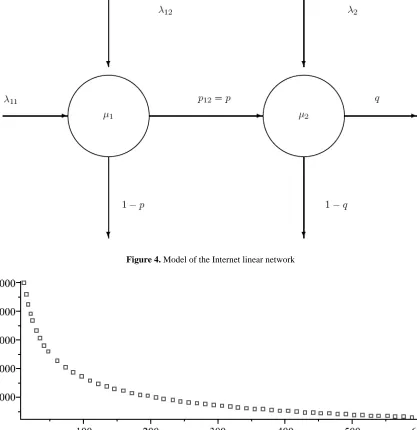
4. On the model of the Internet linear network In this section, we consider an Internet linear net-work with two resources and three routes (see Figure 4). We now assume that the linear network is com-posed of two nodes, each modelled as a G/GI/1
queue. In other words, we have an open Jackson net-work with two G/GI/1 queues where external ar-rivals at the first node areλ11andλ12. The packages
are served in the first node with the rateµ1, afterwards
Internet packages of data (queries or messages) with probabilityp12=p(usuallyp= 0.1) are sent to the
Nonlinear Phenomena in Digital Networks
19
1
Figure 3. Values for MQ tj( ) t
t
second node and with probabilityp10 = 1−pleave
the system, an external route to the second node is λ2. The packages are served in the second node with
the rateµ2, then Internet packages, with probability
p20 = q(usuallyq = 0.1), leave the system in one
direction, and with probability1−qthey leave the system in another direction. Next, denote byQ˜j(t) the queue of Internet packages in thejth node of the Internet-type network at the time momentt, j= 1,2
andt > 0. Define β˜1 = λ11 +λ12 −µ1 > 0, ˜
σ2
1 = a1·(λ11 +λ12)3+ (µ1)3·σ1 > 0, β˜2 =
λ2+µ1·p12−µ2>0,σ˜22= (λ2)3·a2+ (µ1)3·σ1·
(p12)2+ (µ2)3·σ2>0.
Applying Theorem 2.1, we obtain the following theorem and corollary on the queue of packages in the Internet linear network system.
Theorem 3. If conditions (1) are fulfilled, then
P ³
lim
t→∞ ˜
Qj(t)−β¯j·t
¯
σj·a(t) = 1 ´
= 1, j= 1,2.
Corollary 1. If conditions (1) are fulfilled, then, for fixedε >0, there existst(ε)such that for everyt ≥
19
2
Figure 4. Model of the Internet linear network
Figure 5. Values for MQ t1( )
t
Nonlinear Phenomena in Digital Networks 7
t
t(ε)
(1−ε)·˜σj·a(t) + ˜βj·t≤Q˜j(t)
≤(1 +ε)·σ˜j·a(t) + ˜βj·t, j= 1,2.
Similarly as in (8) we can obtain
MQ˜j(t)∼β˜j·t+ (1−ε)·σ˜j·a(t), j= 1,2. (12) MQ˜j(t)is the average queue of packages in the Internet linear network at the time momentt, j = 1,2andt > 0.We see from (12) thatMQ˜j(t) con-sists of the linear functionβ˜j·tand a nonlinear slowly increasing function(1−ε)·σ˜j·a(t), j = 1,2and t >0.
Now we give an example from the Internet net-work practice. Assume that packages are routed to the first nodeW1at the rateλ11of 5200 andλ12of 5000
per second during business hours. These packages are served at the rateµ1of 10000 per second in the first
nodeW1. After service in the nodeW1packages are
routed to the second node W2 at the rates λ12 ·p
of 1000 andλ2of 9300 per second during business
hours. Also note that the packages are served at the rateµ2of 10000 per second in the nodeW2. After the
packages have been served in the nodeW2, they leave
the system.
So, β˜1 = 200, σ˜21 = 204040, σ˜1 = 14284.2, β˜2 = 300, σ˜22 = 187430, σ˜2 = 13690.5.
Thus,
MQ˜1(t)∼β˜1·t+ (1−ε)·σ˜1·a(t)
= (200)·t+ (14284.2)·a(t). (13) From (13) we get (see Figure 5)
MQ˜1(t)
t = (200) + (14284.2)· r
2 ln lnt t . (14) Similarly as in (14) we can obtain (see Figure 6) MQ˜2(t)
t = (300) + (13690.5)· r
2 ln lnt t . (15) Remark1. When modelling an Internet network sys-tem, we apply an heuristic argument, - in real condi-tions, an average Internet network system receives 10 Mg data per second. An average IP package of data is about 1100 bytes. Thus, the average number of pack-ages of data in a system is about 10000 packpack-ages per second.
References
[1] S. Asmussen.Extreme value theory for queues via cy-cle maxima. Extremes, 1998, 1(2), 137- 168.
[2] N. H. Bingham.Variants of the law of the iterated log-arithm. Bulletin London Mathematical Society. 1986, 18, 433-467.
[3] O. Boxma.On a tandem queueing model with identical service times at both counters. I. Advances in Applied Probability.1979, 11(3), 616-643.
[4] O. Boxma.On a tandem queueing model with identical service times at both counters. II. Advances in Applied Probability.1979, 11(3), 644-659.
[5] H. Chen, X. Shen and D. Yao.Brownian approxi-mations of multiclass open-queueing networks. Oper-ations Research.2002, 50(6), 1032-1049.
[6] J. G. Dai and W. Dai.A heavy traffic limit theorem for a class of open queueing networks with finite buffers.
Queueing Systems. 1999, 32(1-3), 5-40.
Nonlinear Phenomena in Digital Networks
193
Figure 6. Values for MQ t2( )
t
[7] P. W. Glynn and W. Whitt. Sufficient conditions for functional-limit-theorem versions of L = λW.
Queueing Systems.1987, 1, 279-287.
[8] P. W. Glynn and W. Whitt.An LIL version ofL =
λW. Mathematics of Operations Research. 1988, 13(4), 693-710.
[9] D. L. Iglehart. Multiple channel queues in heavy traffic. IV. Law of the iterated logarithm. Zeitschrift für Wahrscheinlichkeitstheorie und Verwandte Gebiete.
1971, 17, 168-180.
[10] D. L. Iglehart. Functional limit theorems for the queueGI/G/1in light traffic. Advances in Applied Probability.1971, 3, 269-281.
[11] D. L. Iglehart.Extreme values in theGI/G/1queue.
Annals of Mathematical Statistics.1972, 43, 627-635. [12] K. Yamada.Diffusion approximation for open
state-dependent queueing networks in the heavy traffic situ-ation. Annals of Applied Probability.1995, 5(4), 958-982.
[13] H. J. Kushner and L. F. Martins. Limit theorems for pathwise average cost per unit time problems for controlled queues in heavy traffic.Stochastics Reports.
1993, 42(1), 25-51.
[14] W. A. Massey and R. Srinivasan.Steady state anal-ysis with heavy traffic limits for semi-open networks.
Stochastic models(Ottawa, ON, 1998), 331-352, CMS Conf. Proc., 26, Amer. Math. Soc., Providence, RI, 2000.
[15] S. Minkeviˇcius.On the law of the iterated logarithm in multiphase queueing systems. Lietuvos Matem-atikos Rinkinys.1995, 35(3), 360-366.
[16] S. Minkeviˇcius.On the law of the iterated logarithm in multiphase queueing systems. II.Informatica.1997, 8(3), 367-376.
[17] S. Minkeviˇcius.Complex transient processes in mul-tiphase queueing systems. II. Lietuvos Matematikos Rinkinys.1999, 39(3), 343-356.
[18] S. Minkeviˇcius and G. Kulvietis.Application of the law of the iterated logarithm in open queueing net-works.WSEAS Transactions on Systems.2007, 6, 643-651.
[19] W. P. Peterson.A heavy traffic limit theorem for net-works of queues with multiple customer types. Math-ematics of Operations Research.1991, 16(1), 90-118. [20] A. A. Puhalskii. Moderate deviations for queues in
critical loading.Queueing Systems. 1999, 31(3-4), 359-392.
[21] M. I. Reiman. The heavy traffic diffusion approxi-mation for sojourn times in Jackson networks.Applied probability – computer science: the interface. Vol. II, 3, 409-423, Birkhauser, Boston, MA, 1982.
[22] M. I. Reiman and B. Simon.A network of priority queues in heavy traffic: one bottleneck station. Queue-ing Systems.1990, 6(1), 33-58.
[23] L. L. Sakalauskas and S. Minkeviˇcius.On the law of the iterated logarithm in open queueing networks.
European Journal of Operational Research.2000, 120, 632-640.
[24] V. Strassen.An invariance principle for the law of the
iterated logarithm. Zeitschrift für Wahrscheinlichkeits-theorie und Verwandte Gebiete.1964, 3, 211-226. [25] W. Whitt.Heavy traffic limit theorems for queues: a
survey. Lecture Notes in Economics and Mathematical Systems.1974, 98, 307-350. Springer-Verlag, Berlin, Heidelberg, New York.
[26] Zhang Hanqin and Xu Guang-hui.Strong approxi-mations for the open queueing network in heavy traffic.
Sci. China Ser. A.1992, 35(5), 521-535.
Received February 2010.