• No results found

Volume 2 | Issue 3 - 2012

N/A
N/A
Protected

Academic year: 2020

Share "Volume 2 | Issue 3 - 2012"

Copied!
8
0
0

Loading.... (view fulltext now)

Full text

(1)

93

Development and validation of a HPLC analytical assay method for amlodipine

besylate tablets: A Potent Ca

+2

channel blocker

Richa Sah* and Saahil Arora

1.

ISF College of Pharmacy, Moga, Punjab, India

*Corresponding author: [email protected]

ABSTRACT

Amlodipine besylate is a potent calcium channel blocker used for the treatment of

hypertension, congestive heart failure and angina pectoris. Amlodipine besylate avoids

the adverse effect of amlodipine in racemic mixtures. A highly precise and cost effective

RP-HPLC method with retention time of 2.60 minutes was developed for the estimation of

amlodipine besylate in tablet dosage form, by fixing the parameters as WATERS C18

column 250 mm × 4.6 mm (5µm), with mobile phase as acetonitrile: 70mM potassium

dihydrogen orthophosphate buffer: methanol (15:30:55) and pH adjusted to 3.0 using OPA.

Mobile phase flow rate was maintained at 1.0 ml/min and detected at 240nm.

Keyword

: RP-

HPLC, amlodipine besylate, diode array detector (DAD).

INTRODUCTION

Amlodipine besylate belongs to the third generation antagonists which retain tissue

selectivity and show favourable pharmacokinetic data [1]. The drug does not appear to

cause postural hypotension, reflex tachycardia or cardiac conduction disturbances.

Thus, amlodipine besylate provides an attractive therapeutic option for the treatment of

hypertension, and offers potential for patients with angina pectoris [2]. Literature survey

reveals few analytical methods for the determination of amlodipine alone and in

combination with other drugs in pharmaceutical preparations and biological fluids

(2)

94

MATERIALS AND METHODS

WATERS (Milford, USA) with DAD detector, S(-) amlodipine (Akums Drugs Ltd., Haridwar,

India), Acetonitrile, buffer (70mM potassium dihydrogen orthophosphate) and 85%

ortho-phosphoric acid (H

3

PO

4

), Methanol were purchased from Finar chemical ltd, Ahmadabad

and di sodium hydrogen ortho phosphate dehydrate was purchased from CDH, New Delhi.

Preparation of mobile phase

Several mobile phases at different ratios were used but no favourable results were

obtained except for acetonitrile: potassium dihydrogen orthophosphate buffer: methanol

(15:30:55), which gave an acceptable peak. 70 mM was selected as ionic strength for buffer

solution at pH 3.0 to get a sharp symmetrical peak with good resolution.

Chromatographic conditions

WATERS C18 column 250 mm × 4.6 mm (5µm) with mobile phase as acetonitrile: 70mM

potassium dihydrogen orthophosphate buffer: methanol (15:30:55) adjusted to pH 3 was

used. Mobile phase flow rate was maintained at 1.0ml/min and detected at 240nm. The

retention time was 2.60 minutes.

Analysis of formulation

i)

Preparation of buffer

The freshly prepared buffer was used every day by dissolving 2.381 gm of di-sodium

hydrogen ortho phosphate dihydrate in 250 ml of HPLC grade water. Then filtered through

a 0.2 µm membrane filter to remove any particulate matter and degassed by sonication

before use.

ii)

Sample preparation

Stock solution of amlodipine besylate (1 mg/ml) was prepared in methanol and stored at 2–

8 °C until used. Aliquots were diluted stepwise with the mobile phase to obtain 10 µg/ml.

This solution was used for the optimization of the proposed method. Marketed formulation

was prepared as similar to pure amlodipine besylate and diluted accordingly after proper

(3)

95

Fig. 1: Chromatographic peak of amlodipine besylate

iii)

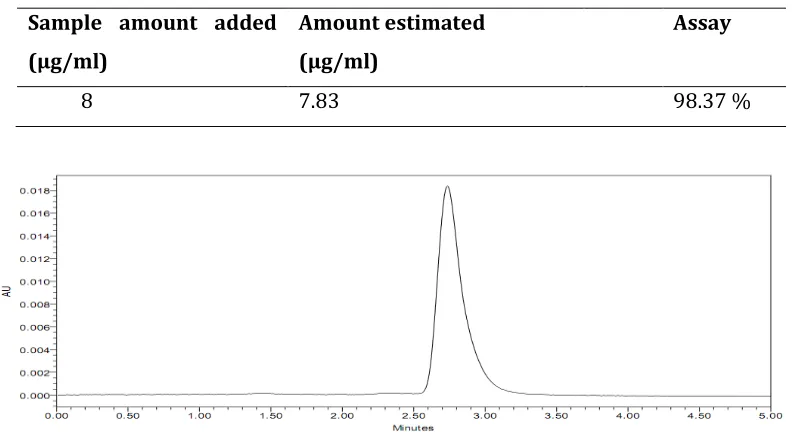
Assay of optimized FDT formulation of Amlodipine besylate using HPLC method

Assay for the tablet dosage form was done with validated chromatographic RP-HPLC

method and it was found to be 98.37% w/w S.D. ± 1.27%. Figure 2 explained the selective

and specific estimation of amlodipine besylate in presence of excipients of tablet dosage

form and percentage purity was found to be 98.37 % w/w. There was no interference of

excipients in amlodipine besylate determination from its fast dissolving tablet formulated

Table 1.

Table 1: Assay of the prepared formulation

Sample amount added

(µg/ml)

Amount estimated

(µg/ml)

Assay

8

7.83

98.37 %

Fig. 2: Chromatographic peak of amlodipine besylate in presence of excipients in

(4)

96

Validation of the Developed Method

After chromatographic method development and optimization it was validated. The

validation of an analytical method verifies that characteristics of the method satisfy the

requirements of application domain. Proposed method was validated according to ICH

guidelines for linearity, precision, accuracy sensitivity, and recovery (ICH Q2A, 2005).

a)

Calibration curve (linearity)

The method was found to be linear in the range of 0.5-8 μg/ml (Figure 3) with correlation

coefficient r

2

=0.990. The overlay of peaks is shown in figure 4. Validation parameters are

given in table 2.

Fig. 3: Calibration curve of amlodipine besylate

Fig. 4: Overlay peaks of amlodipine besylate found in RP-HPLC method

b)

Precision

The intra-day and inter-day variations of the method were determined using three replicate

(5)

97

intervals and at three different days. The result revealed the precision with % RSD (0.025 %

and 0.022 %) respectively for intra-day and inter-day.

Table 2: Validation Parameters of RP-HPLC Method for amlodipine besylate

S. No.

Regression Analysis

Parameters

Results

1

Linearity range (µg/ml)

0.5-8 μg/ml

2

Coefficient of determination (r

2

)

0.99

4

Regression equation (Y

a

)

y = 3003.x + 274.2

4

Slope (b)

3003

5

Intercept (a)

274.2

c)

Accuracy

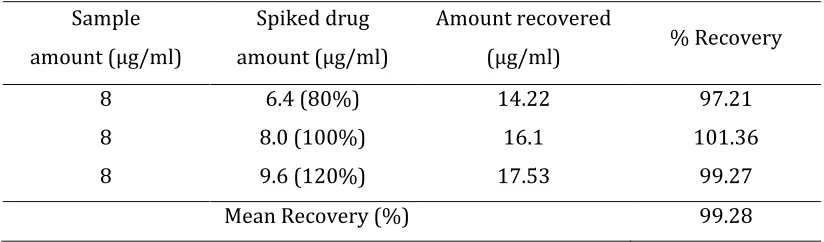
To examine the accuracy of the method, recovery studies were carried out by standard

addition method. Accuracy was found to be 104.7 ±1.82. The recovery results are described

in table 3.

Table 3: Accuracy data of RP-HPLC method for amlodipine besylate

Sample

amount (µg/ml)

Spiked drug

amount (µg/ml)

Amount recovered

(µg/ml)

% Recovery

8

6.4 (80%)

14.22

97.21

8

8.0 (100%)

16.1

101.36

8

9.6 (120%)

17.53

99.27

Mean Recovery (%)

99.28

d) Detection and quantitation limits (LOD & LOQ)

The LOD and LOQ were calculated and were found to be 0.0204496µg/ml and 0.0674µg/ml

respectively.

The validation data so obtained indicated that the developed method is simple, sensitive,

specific, and accurate. So far, reported methods have been time (retention time more than

10 min) consuming for they use higher proportion of buffer in mobile phase, pre column

(6)

98

(Shriram M. Pathak et al., 2008, Tsukasa Uno et al., 2004, M. Saeed Arayne et al., 2011).

However the developed and validated method is not only more precise, accurate but also

less time consuming making its useful for routine determination of amlodipine besylate in

bulk drug and pharmaceutical formulation.

System suitability parameters

To know reproducibility of the method system suitability tests were performed such as

asymmetric factor, tailing factor, theoretical plates and plate numbers. The values found for

these parameters are described in table 4. All the system suitability parameters found to be

according to the acceptable limits of the analytical methods.

Table 4: System Suitability Parameters of amlodipine besylate for RP-HPLC Method

System suitability

parameters

Results

Acceptable limits

Asymmetric factor

0.8

< 1.5

Tailing factor

1.57

< 2

Plate No.

3024.2

> 2000

Capacity Factor

2.67

Resolution

12.21

Peak purity

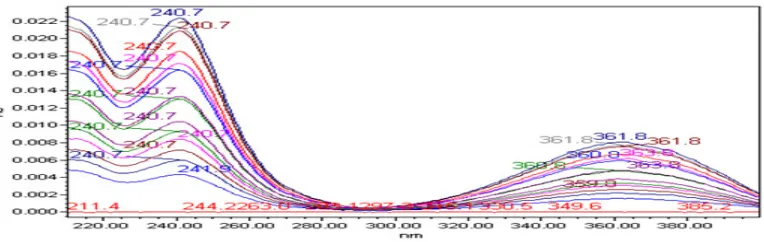
The result of peak purity revealed that the chromatogram obtained of the drug was found to

be pure. As peak purity was checked at different point of chromatogram and the spectrum

of the sample corresponding to these points of the chromatogram (Figure 5) showed that

the spectra were same and overlaid at same wavelength, this showed the purity of the

chromatogram.

(7)

99

RESULTS AND DISCUSSION

The RP-HPLC method developed for the estimation of s (-) amlodipine in tablet

dosage form was done by fixing the parameters as WATERS C18 column 250 mm × 4.6

mm (5µm), with mobile phase as acetonitrile: 70mM potassium dihydrogen

orthophosphate buffer: methanol (15:30:55) adjusted to pH 3 using OPA. Mobile phase flow

rate was maintained at 1.0 ml/min and detected at 240nm. The retention time was 2.60

minutes.

Validation parameters like accuracy, precision, linearity showed low %RSD values which

indicates that the method is precise and sensitive. The linearity range for S(-) amlodipine

was found to be 0.5-8 μg/ml with r

2

value of 0.99. The LOD and LOQ of the s (-) amlodipine

was found to be 0.0674µg/ml and 0.0204496µg/ml respectively. The accuracy for

Amlodipine besylate was found to be 104.7 ±1.82%. Intra-day precision and inter-day

precision were found to be 0.025 % and 0.022 % RSD respectively.

CONCLUSION

RP-HPLC method for the estimation of Amlodipine besylate in tablet dosage form was found

to be within the limits. Validation parameters like accuracy, precision and linearity showed

low %RSD values which indicates that the method is precise and sensitive. Hence this

method can be employed for laboratory works.

ACKNOWLEDGMENTS

The authors thank Akums Drugs Ltd., Haridwar, India for kind donation of Amlodipine

besylate. The authors appreciate kind and supportive spirit of Mr. Praveen Garg, the

honorable Chairman of I.S.F. College of Pharmacy, Moga, Punjab, India.

REFERENCES

1.

Szabo L., Chis V., Pirnau A., Leopold N., Cozor O., S Orosz. Spectroscopic theoretical study

(8)

100

2.

Haria M., Wagstaff A.J. Amlodipine: a reappraisal of its pharmacological properties and

therapeutic use in cardiovascular disease. UKpubmed central. 1995; 50(3): 560-586.

3.

Bahrami G., Mirzaeei S.H. J Pharm Biomed Anal. 2004; 36(l):163-8.

4.

Hashem M., Walker R.B. J Chromatogr B Analyt Technol Biomed Life Sci. 2006;

27:334-38.

5.

Malesuik M.D., Cardoso S.G., Bajerski L., Lanzanova F.A. J AOAC Int. 2006; 89(2):

359-64.

6.

Nirogi R.V., Kandikere V.N., Mudigonda K., Shukla M., Maurya S. Biomed Chromatogr.

Figure

Table 1: Assay of the prepared formulation
Fig. 3: Calibration curve of amlodipine besylate
Table 2: Validation Parameters of RP-HPLC Method for amlodipine besylate
Table 4: System Suitability Parameters of amlodipine besylate for RP-HPLC Method

References

Related documents

Overland flow generation and infiltration in water-repellent soils may exhibit an even stronger threshold character, be- cause the process threshold itself exhibits soil moisture

In summary, we have demonstrated that tiotropium reduced exacerbations and hospitalizations in a large number of COPD patients, regardless of whether or not they discontinued

Inhibition of P-glycoprotein (P-gp) efflux pumps Cells were first incubated with 100 mM verapamil for 1 hour at 37 ° C, 15,16 and then the transport experiment was performed with

A novel method of data processing – a structural functions curvature analysis method – was applied to the time series of seismodeformation monitoring of Baikal rift zone from April

Conclusions: As the size of the subscapularis tendon tear increased, the passive ranges of horizontal abduction and external rotation of the glenohumeral joint after repair

Since the correlation coef- ficient for folate and vitamin B 12 was 0.725 and 0.512, respectively, in the present study, the intakes estimated from the two-time DHQ showed

Deletion of the promoter region containing the NF- κ B site inhibited the effect of bFGF and EMSA suggested that fenofibric acid did not inhibit nuclear translocation or DNA binding

Bubenik P (2015) Statistical topological data analysis using persistence landscapes. Reininghaus J, Huber S, Bauer U, Kwitt R (2015) A stable multi-scale kernel for topological