Stress level in dental students performing pedodontic procedure
A. S. Aishwarya
1, Deepa Gurunathan
21Department of pedodontics, Saveetha Dental College, Saveetha University, Poonamallee, Chennai, Tamil Nadu, India, 2Department of Pedodontics and Preventive Dentistry, Saveetha Dental College, Saveetha University, Chennai, Tamil Nadu
Correspondence: Dr. Deepa Gurunathan, Department of Pedodontics and Preventive Dentistry, Saveetha Dental College, Saveetha University, Chennai, Tamil Nadu, India. E-mail: [email protected]
Introduction
Stress is defined as pressure or worry caused by problems in somebody’s life.[1,2] The practice of dentistry is associated to one of
the high levels of occupational stress. Gorter et al. stated that stress encountered during dental education is more pronounced than during medical education.[3] Epidemiological studies demonstrated
that dental students experience considerable stress during their training and they are more anxious than the general population.[4,5]
Dental students have identified the development of stress due to many assignments, competition with other students, poor relationship with other students and teachers, anxious patients, fear of failure, complicated treatments and possible conflicts with patients, and limited time to perform and finish the planned treatment.[6] Stress gives a negative impact to the physical and mental
health of the dental students.
Kieser and Herbison found that 3rd-year dental students reported
being most anxious about surgical procedures.[7,8] In particular
ABSTRACT
Dental education has been asserted as one of the challenging and stressful fields of the study as dental students are expected to acquire diverse competencies such as academic and clinical competencies and interpersonal skills. Practitioners and students dealing with the field of pediatric dentistry have reported high-stress level on the basis of patient management. The aim of this study is to assess the level of stress among dental students and methods of managing children while performing pedodontic procedure. A self-designed questionnaire was given to 275 undergraduates and 21 postgraduates, the data obtained were analyzed using Chi-square test, and the stress levels were compared. Third-year students found it difficult to overcome the stress and were less confident while treating a child patient. Overall, 43% of students were more stressed while giving local anesthesia and 27.7% students were more stressed during extraction. Among students of all years, 50.3% of students preferred tell-show-do method for managing a child patient. Acceptance and spiritual methods were preferred by most of the students of all years as coping strategies to overcome stress. This study reveals that stress level was generally high among the beginners of clinical practice and decreased on continuous practice. Students who had knowledge on child’s psychology and behavioral management techniques agreed that it helped in reducing stress level.
Key words: Dental student’s anxiety, pedodontic procedure, stress
to pediatric dentistry, dental student’s anxiety and stress level is elevated to the peak as managing a child in the dental chair is a great challenge for any dentist. Pediatric dental care is influenced by pedodontic triangle which consists of parents, child patient, and the dental team. No part of this triad can be viewed in isolation. The relationship between child, parent, and the dentist is interrelated and their communication is reciprocal.[9] To develop a good rapport with
a child patient, the dental student must be equipped with confidence, knowledge of the treatment, and behavioral management methods before performing the treatment. Hence, the purpose of this study is to analyze and compare the prevalence of stress in dental students performing various pedodontic procedures as well as to evaluate the techniques used to manage child patients and methods to overcome the stress.
Materials and Methods
The study received the approval from university review board (STP/ SD12 BDS 081).
A pilot study was performed with a self-designed questionnaire regarding stress experienced by dental students while performing pediatric procedure with 20 students initially, and required modifications were made in the questionnaire. The modified questionnaire was then distributed among third, final year and interns of undergraduate dental course and master of dental surgery students at the university in Chennai. The questionnaire was verified by a senior academic faculty member.
How to cite this article: Aishwarya AS, Gurunathan D. Stress level in dental students performing pedodontic procedure. J Adv Pharm Edu Res 2017;7(1):34-38.
The questionnaire contained demographic details of the participants. Following it, the questionnaire was divided into four sections. Section A contained questions regarding preference of dental students in performing pedodontic procedure. Section B consisted of questions related to stress and anxiety faced by the students while treating pediatric patients. Section C included various behavioral management techniques implemented by dental students toward pediatric patients. Section D dealt with methods the students followed to cope up the stresses.
The completed questionnaires were collected back on the same day and the data were analyzed. The collected data were analyzed with IBM. SPSS statistics software 23.0 version. To describe about the data, descriptive statistics, frequency analysis, percentage analysis were used for categorical variables and the mean and standard deviation were used for continuous variables. To find the significance in categorical data, Chi-square test was used. In the above statistical tool, the P = 0.05 is considered as significant level.
Results
Among 296 dental students, 100 final year students, 95 3rd-year
students, 80 interns, and 16 postgraduates from various specialties participated in this study. The study sample consisted of 16.9% males and 83.1% females (Chart 1).
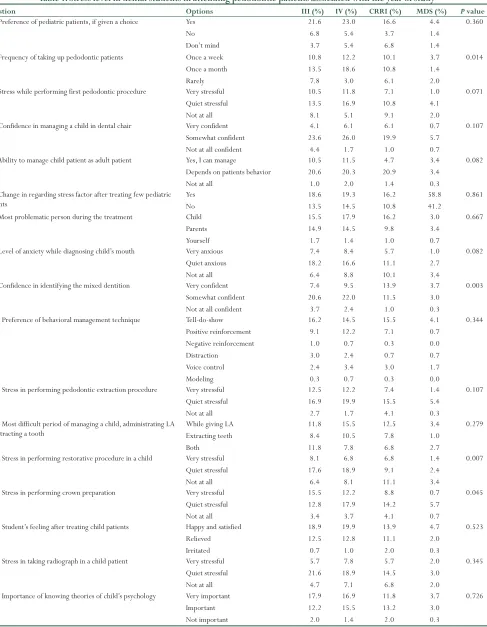
Stress level in dental students in attending pedodontic patients associated with the year of study (Table 1)
Among all students, 65.5% of students preferred child patients when given a choice. There was no significant difference when compared with the year of study and the preference of students attending pedodontic procedure. On average, students of all years of about 44.3% treated pedodontic patient once a week. Comprising all years, 45.3% students were quite stressful while performing their first
pediatric dental procedure. When enquired about the scale of stress level, 58.8% of students among all years felt that there was decrease in the stress level after treating few pediatric patients.
Stress level in dental students in performing various pedodontic procedures (Table 1)
Among all dental students, 34.5% of students were confident in identifying the teeth present in mixed dentition. There was a significant difference (P = 0.003) that 3rd-year students were less confident in
identifying mixed dentition.
Among all dental students, majority of 3rd-year students and few final
year students were stressful while performing extraction, in which 43.2% students were stressful while giving local anesthesia (LA) while 27.7% students were stressful while performing extraction. There was no significant difference when the extraction procedure was compared with the year of study.
When determining stress while performing restoration procedure, 48% of students in total felt less stressful with a significant difference of 0.007.
On average, students of all years of about 58% were less stressful while taking radiograph in a child patient.
Knowledge about child’s psychology and behavior management methods by dental students (Table 1)
Among all dental students, 50.3% students felt that knowing theories of child psychology was important. When asked about behavioral management technique, 50.3% of students preferred tell-show-do technique, 29.1% students preferred positive reinforcement, and 10.5% students preferred voice-control methods. 79.4% students agreed that knowing behavior management methods helps in reducing stress level while treating pediatric patients.
When enquired about coping methods to overcome stresses caused while performing pedodontic procedure, 44.9% students stated that acceptance was the best coping methods while 33.4% students felt that spiritual belief was best coping method.
Comparing the stress level of students while performing various procedures who prefer to attend pedodontic patients (Table 2)
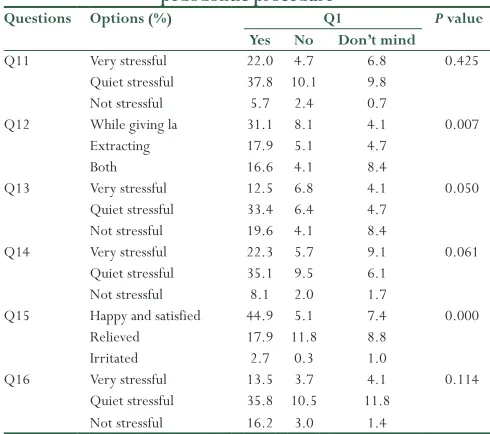
Among students who prefer a child patient, 31.1% students had difficulty in performing extraction procedure, especially while giving LA. Statistical value was significant which stated that students, irrespective of their preference of child patient, were stressed while giving LA than extracting.
When compared with students who preferred child patient, 12.5% students had less stress in performing restorative procedure. Statistically, significant difference was seen which stated that, irrespective of their preference of child patient, students had less Chart 1: Gender of the participants in percentage
Sex Males Females Total
Question Options III (%) IV (%) CRRI (%) MDS (%) P value
Q1. Preference of pediatric patients, if given a choice Yes 21.6 23.0 16.6 4.4 0.360
No 6.8 5.4 3.7 1.4
Don’t mind 3.7 5.4 6.8 1.4
Q2. Frequency of taking up pedodontic patients Once a week 10.8 12.2 10.1 3.7 0.014
Once a month 13.5 18.6 10.8 1.4
Rarely 7.8 3.0 6.1 2.0
Q3. Stress while performing first pedodontic procedure Very stressful 10.5 11.8 7.1 1.0 0.071
Quiet stressful 13.5 16.9 10.8 4.1
Not at all 8.1 5.1 9.1 2.0
Q4. Confidence in managing a child in dental chair Very confident 4.1 6.1 6.1 0.7 0.107
Somewhat confident 23.6 26.0 19.9 5.7
Not at all confident 4.4 1.7 1.0 0.7
Q5. Ability to manage child patient as adult patient Yes, I can manage 10.5 11.5 4.7 3.4 0.082
Depends on patients behavior 20.6 20.3 20.9 3.4
Not at all 1.0 2.0 1.4 0.3
Q6. Change in regarding stress factor after treating few pediatric
patients YesNo 18.613.5 19.314.5 16.210.8 58.841.2 0.861
Q7. Most problematic person during the treatment Child 15.5 17.9 16.2 3.0 0.667
Parents 14.9 14.5 9.8 3.4
Yourself 1.7 1.4 1.0 0.7
Q8. Level of anxiety while diagnosing child’s mouth Very anxious 7.4 8.4 5.7 1.0 0.082
Quiet anxious 18.2 16.6 11.1 2.7
Not at all 6.4 8.8 10.1 3.4
Q9. Confidence in identifying the mixed dentition Very confident 7.4 9.5 13.9 3.7 0.003
Somewhat confident 20.6 22.0 11.5 3.0
Not at all confident 3.7 2.4 1.0 0.3
Q10. Preference of behavioral management technique Tell-do-show 16.2 14.5 15.5 4.1 0.344
Positive reinforcement 9.1 12.2 7.1 0.7
Negative reinforcement 1.0 0.7 0.3 0.0
Distraction 3.0 2.4 0.7 0.7
Voice control 2.4 3.4 3.0 1.7
Modeling 0.3 0.7 0.3 0.0
Q11. Stress in performing pedodontic extraction procedure Very stressful 12.5 12.2 7.4 1.4 0.107
Quiet stressful 16.9 19.9 15.5 5.4
Not at all 2.7 1.7 4.1 0.3
Q12. Most difficult period of managing a child, administrating LA
or extracting a tooth While giving LAExtracting teeth 11.88.4 15.510.5 12.57.8 3.41.0 0.279
Both 11.8 7.8 6.8 2.7
Q13. Stress in performing restorative procedure in a child Very stressful 8.1 6.8 6.8 1.4 0.007
Quiet stressful 17.6 18.9 9.1 2.4
Not at all 6.4 8.1 11.1 3.4
Q14. Stress in performing crown preparation Very stressful 15.5 12.2 8.8 0.7 0.045
Quiet stressful 12.8 17.9 14.2 5.7
Not at all 3.4 3.7 4.1 0.7
Q15. Student’s feeling after treating child patients Happy and satisfied 18.9 19.9 13.9 4.7 0.523
Relieved 12.5 12.8 11.1 2.0
Irritated 0.7 1.0 2.0 0.3
Q16. Stress in taking radiograph in a child patient Very stressful 5.7 7.8 5.7 2.0 0.345
Quiet stressful 21.6 18.9 14.5 3.0
Not at all 4.7 7.1 6.8 2.0
Q17. Importance of knowing theories of child’s psychology Very important 17.9 16.9 11.8 3.7 0.726
Important 12.2 15.5 13.2 3.0
Not important 2.0 1.4 2.0 0.3
Table 1: Stress level in dental students in attending pedodontic patients associated with the year of study
Among students who preferred treating the child patient, 44.9% students were happy and satisfied after performing pedodontic procedure.
Discussion
Controlling patient’s anxiety adequately is an integral part in the practice of dentistry. Dental student’s anxiety aggravates patient’s distress during dental procedures.[7] This study was performed to assess
the stress level of students performing pedodontic procedure so that it could be possible to come up with various coping strategies to help the students deliver effective treatment. Stress has been described as a double-edged sword that can either inspire and trigger the students to their peak performance or reduce the students to ineffectiveness.[10]
A study conducted in the USA identified higher prevalence of stress among the dental undergraduates in clinical years as compared to non-clinical years.[11] This may be probably because the students had
to manage both theoretical and clinical part of curriculum. In our study, when compared to clinical years, 3rd-year students were more
In the present study, among all students, 30.4% students were more stressed while performing their first pedodontic procedure. When compared to all years, 3rd-year students were less confident and had
difficulty in treating child patients; this result was analogous to the study done by Ahmad et al.[1] and Tangade et al.,[10] which stated that
3rd-year students faced difficulty in learning clinical procedures both
theoretically and practically.
In the present study, majority of the students felt that the child was more troublesome and few students felt that parents were more problematic before starting the dental treatment. This could be probably due to the fact that children were already anxious to face the dentist, attributing to this are also parents who were highly demanding that the child should open their mouth wider to cooperate with the treatment. In some instances, parents even hit the child if they were highly uncooperative which made the child restless. All these situations could contribute to an increase in stress level for the dental students.
In the present study, most of the students were less confident in identifying the mixed dentition; this could be due to lack of experience in differentiating between primary and permanent dentition. Among all years, 57.8% students were more stressful while extracting child teeth, in that 43.2% student felt that giving LA was stressful. These results correlated with the study done by Rasmussen et al. and Dower et al., administering mandibular block to pre-school child being most stressful pain control method.[12,13] In the present study,
many students felt that giving LA was more stressful which could be attributed to the fact that children were deadly fearful for injections and the experience of vaccination would pop out and the child would become more anxious about the pain. In the current study, 48% dental students were less stressful while performing restorative procedure and this results correlated with the study by Rønneberg et al., which revealed that younger the child, the more frequently a dentist found it difficult to perform restorative procedures.[14]
In the present study, most of the students implemented behavior management techniques. In that, 79.4% students agreed knowledge of behavior management helped overcome stress and few students utilized other methods to manage a child such as play area in clinic, visual method of distraction, and favorite colors and gifts. Majority of the students in this study preferred tell-show-do technique, positive Table 2: Comparing the stress level of students while
performing various procedures who prefer to attend pedodontic procedure
Questions Options (%) Q1 P value
Yes No Don’t mind
Q11 Very stressful 22.0 4.7 6.8 0.425
Quiet stressful 37.8 10.1 9.8
Not stressful 5.7 2.4 0.7
Q12 While giving la 31.1 8.1 4.1 0.007
Extracting 17.9 5.1 4.7
Both 16.6 4.1 8.4
Q13 Very stressful 12.5 6.8 4.1 0.050
Quiet stressful 33.4 6.4 4.7
Not stressful 19.6 4.1 8.4
Q14 Very stressful 22.3 5.7 9.1 0.061
Quiet stressful 35.1 9.5 6.1
Not stressful 8.1 2.0 1.7
Q15 Happy and satisfied 44.9 5.1 7.4 0.000
Relieved 17.9 11.8 8.8
Irritated 2.7 0.3 1.0
Q16 Very stressful 13.5 3.7 4.1 0.114
Quiet stressful 35.8 10.5 11.8
Not stressful 16.2 3.0 1.4
Table 1: (Continued...)
Question Options III (%) IV (%) CRRI (%) MDS (%) P value
Q18. Methods of coping stresses Acceptance 12.2 16.2 12.8 3.7 0.071
Spiritual 14.5 9.8 7.4 1.7
Humor 3.0 3.0 4.4 1.0
Emotional support 2.0 2.4 2.4 0.3
Venting 0.3 2.4 0.0 0.3
Q19. Does behavioral management technique help in managing
stress YesNo 26.05.4 26.47.4 21.35.7 5.71.4 0.538
Q20. Do you opt any other methods to manage a child Yes 2.4 3.0 2.4 2.4 0.001
No 29.7 30.7 21.3 4.7
with the study done by Carr et al., and oliveria et al. which stated that 64% dentists opted behavioral management techniques such as tell-show-do, voice-control, and positive reinforcement.[15,16] Another
similar study by Manual S Abushaland Oredugbaand Sanu[17,18] stated
that most commonly followed behavioral management techniques were tell-show-do, positive reinforcement, and voice-control.[18]
Minimal amount of stress is always present while handling pediatric patients.[1,19] There are many coping methods to overcome stresses
to continue the dental practice effectively. In this study, majority of the dental students preferred acceptance and spiritual methods as the best coping methods to overcome stress. A similar study revealed that praying or performing spiritual activities was also a popular stress reducing technique as it produces calmness.[1] A study done in the
United States emphasized about yoga, meditation, listening to music as other coping methods that helped in reducing stress.[1]
Conclusion
The stress in dental students performing pedodontic procedure is quite higher. Particularly, the stress level is at peak at the initial days of practice and gradually reduced during the course. Knowledge about child’s psychology helped them in managing a child during treatment and knowledge about behavioral management technique helped reduce stress level in students better.
References
1. Ahmad MS, Md Yusoff MM, Abdul Razak I. Stress and its relief among undergraduate dental students in Malaysia. Southeast Asian J Trop Med Public Health 2011;42:996-1004.
2. Hornby AS. Oxford Advanced Learner’s Dictionary. Oxford: Oxford University Press; 2010. p. 1477.
3. Gorter R, Freeman R, Hammen S, Murtomaa H, Blinkhorn A, Humphris G. Psychological stress and health in undergraduate dental students: Fifth year outcomes compared with first year baseline results from five European dental schools. Eur J Dent Educ 2008;12:61-8.
4. Fairbrother K, Warn J. Workplace, dimensions, stress and job satisfaction. J Manag Psycho 2003;18:8-21.
5. Acharya S. Factors affecting stress among Indian dental students. J Dent Educ 2003;67:1140-8.
6. Samadani KH, Darrab AA. The perception of stress among clinical dental students. World J Dent 2013;4:24-8.
7. Waggoner CA, Cohen LL, Kohli K, Taylor BK. Stress management for dental students performing their first pediatric restorative procedure.JDent Educ 2003;67:543-8.
8. Kieser J, Herbison P. Clinical anxieties among dental students. N Z Dent J 2000;96:138-9.
9. Wright GZ, Starkey PE, Gardner DE. Parent child separation. In: Managing Children’s Behaviour in the Dental Office. St. Louis: CV Mosby Co.; 1983. p. 57-74.
10. Tangade PS, Mathur A, Gupta R, Chaudhary S. Assessment of stress level among dental school students: An Indian outlook. Dent Res J 2011;8:95-101. 11. Grandy TG, Westerman GH, Lupo JV, Combs CG. Stress symptoms among
third-year dental students. J Dent Educ 1988;52:245-9.
12. Rasmussen JK, Frederiksen JA, Hallonsten AL, Poulsen S. Danish dentists’ knowledge, attitudes and management of procedural dental pain in children: Association with demographic characteristics, structural factors, perceived stress during the administration of local analgesia and their tolerance towards pain. Int J Paediatr Dent 2005;15:159-68.
13. Dower JS Jr, Simon JF, Peltier B, Chambers D. Patients who make a dentist most anxious about giving injections. J Calif Dent Assoc 1995;23:35-40. 14. Rønneberg A, Strøm K, Skaare AB, Willumsen T, Espelid I. Dentists’
self-perceived stress and difficulties when performing restorative treatment in children. Eur Arch Paediatr Dent 2015;16:341-7.
15. Carr KR, Wilson S, Nimer S, Thornton JB. Behaviour management techniques among pediatric dentists practicing in the south eastern United States. Pediatr Dent 1999;21:347-53.
16. Oliveira RV, Ângelo AC, Brindeiro DD, Brito DB, Gomes RC, Delano F, et al. Student’s perceptions about pediatric dental behaviour guidance techniques throughout a five-year dental curriculum. Braz Res Pediatr Dent Integr Clin 2015;15:143-52.
17. Oredugba FA, Sanu OO. Behaviour management techniques employed by Nigerian dentists for their child patients. Pesqui Bras Odontopediatria Clín Integr 2009;9:271-6.
18. Abushal MS. The use of behaviour management techniques by dentists in Saudi Arabia. Saudi Dent J 2000;12:129-34.