487
Information Technology and Control 2019/3/48
The Analysis of Energy
Performance in Use Parallel
Merge Sort Algorithms
ITC 3/48
Journal of Information Technology and Control
Vol. 48 / No. 3 / 2019 pp. 487-498
DOI 10.5755/j01.itc.48.3.23696
The Analysis of Energy Performance in Use Parallel Merge Sort Algorithms
Received 2019/06/26 Accepted after revision 2019/08/30
http://dx.doi.org/10.5755/j01.itc.48.3.23696
Corresponding author: [email protected]
Zbigniew Marszałek
Institute of Mathematics, Silesian University of Technology, ul. Kaszubska 23, 44-100 Gliwice, Poland
The issue of productivity and energy is an important objective of the optimization of parallel applications. The size of the problem for a large number of data on multiprocessor platforms forces the use of parallel algorithms. Efficient management of large memories using modern processors in Big data processing requires innovative techniques and efficient algorithms. For years have found the results of tests conducted on methods for use in various computing environments and improvements. This article shows the energy consumption analysis by parallel sorting algorithms. Sort algorithms are used in information systems and databases, to select and organize the information. The subject of this article is research into energy consumption and computational complexity for parallel sorting methods by merging compared to classic methods. The tests carried out confirm the reduction of energy consumption by using parallel sorting algorithms. The presented parallel fast sort and parallel modified merge sort for large task dimensions have less power consumption than classic methods and can be used successfully in NoSQL databases.
KEYWORDS: power-aware testing, functional power component, parallel algorithm, data sorting, data min-ing, analysis of computer algorithms.
1. Introduction
Analysis of energy consumption by algorithms is an important element taken into account in the design of computer systems. Power analysis can be performed by using the measurement methods or based on sim-ulation. In the case of computer algorithms it is more convenient to perform a simulation of energy
con-sumption. Simulators processor down-level and esti-mated average power consumption were presented in [4, 5, 10].
con-Information Technology and Control 2019/3/48 488
sumption. Basic sorting algorithms, such as quick sort, sorting through packing and sorting by merging have been described in many works, among other things in [3, 13, 19]. Parallelized algorithm for fast sort [16] and parallelized merge sort algorithm [17] play a special role in increasing the efficiency of the orde-ring data sets, and reducing the energy consumed by the processors. Most of the work on energy efficiency [1, 9, 12, 18] assumes that energy consumption is inde-pendent of the size of the problem. In [15], an analysis of the memory impact on the energy efficiency of par-allel computation is presented. This article attempts to determine the power consumption of parallel sort-ing methods by mergsort-ing. The analysis carried out shows the cost-effectiveness of using parallel sorting methods for large task dimensions.
To compare the energy efficiency of the parallel sor-ting methods, a classic fast sorsor-ting algorithm, a tri-geminal heap algorithm, and a non-recursive merge sorting algorithm were taken. The quick sort algori-thm divides the sorted string into two substrings and moves the elements of the string so that the first subs-tring is less than or equal to the middle element and the elements in the second substring are larger than the midpoint. The recursive split process is executed for the ordering of the string. The introduction of a median value for divisions exchange was presented in [21]. This method was tested on various architectu-res in [22]. Heap sort uses the three level structure of data storage, where introduced relations between the following levels influence the speed of sorting. Each change in the structure requires the procedure to insert elements into the heap. Mathematical models of the relations between levels of the heap were dis-cussed in [2, 8]. The non-recursive version of the sort algorithm iterates through the string elements, enlar-ges the size of the merged string in each iteration twi-ce. Sublinear merging was presented in [3]. Parallel computing issues and their use are described in [20]. The Parallel Fast Sort Algorithms and Parallel Modi-fied Merge Sort Algorithm [16, 17] methods are shown to reduce the energy consumption of large data sets.
2. Materials and Methods
Work on reducing the power consumption of micro-processors has been carried out for many years [4, 5,
10]. Gupta [10] shows a method of measuring the power consumption by means of voltage measurement during instructions by the microprocessor and defines the en-ergy usage in the clock cycle by
. In this method, the voltage is measured on the resi-stors in the power circuit. Similarly, Chen [4] determi-nes the maximum energy consumption of a processor in a measurement cycle. To improve performance and to reduce power consumption in cloud computing in-frastructures at work, [18] apples the parallel bi-ob-jective genetic algorithm. The computation cost of a task and the parameter decision-making that spec-ifies the processor power consumption is a function of the . The optimization of scientific workflows in heterogeneous computing environments and energy consumption is subject to study at work [9]. The ener-gy consumption model used the clock frequency of the main module. Heuristic algorithm [1] in the calculation of energy efficiency in the data center resources reallo-cated to Quality of Service (QoS) takes into account the number of virtual machines and clock frequency. This work in the energy consumption model of data colla-tions using the described algorithms assumes the fre-quency of the main processor and the number of cycles needed to complete the task. Research on the relation-ship between memory accesses, bank conflicts, thread multiplicity, and instruction-level parallelism in com-parison-based sorting algorithms for Graphics Pro-cessing Units (GPUs) are described in [11]. In [6], the implementation of image transformation algorithm on mobile devices using the approximate computation methods is described. The proposed algorithm allows to save 6% of energy when transforming the greyscale images using the Twirl effect. The efficiency of ener-gy consumption function hash is the subject of tests [7]. Research shows that the most efficient algorithm for cryptographic applications is SVI and crc16 for non-cryptographic applications. The proposed solu-tions allow to save up to 29% of energy on hashing op-erations.
489
Information Technology and Control 2019/3/48
classic sorting methods: quick sort, trigeminal heap sort and merge sort with parallel methods: fast sort [16] and modified merge sort [17].
2.1. Parallel Random Access Machine
For the analysis of parallel sorting algorithm it is con-venient to use the parallel machine model the PRAM (parallel random access machine) as shown in Figure 1.
cient details to allow others to observe some features of A, and let a– be arithmetic mean of these results
Depending on the processor's access method, four types of PRAM machines are specified in memory:
1. Exclusive read exclusive write (EREW) 2. Concurrent read exclusive write (CREW) 3. Exclusive read concurrent write (ERCW) 4. Concurrent read concurrent write (CRCW) The first type of machine the PRAM allows to read write memory only one processor. The second type provides reading memory through any processor, but wringing at the same time can run only one processor. The third type allows to read every memory cell by only one processor and multiple processors can read a memory cell at the same time. The third type of PRAM machine is not intended to be practical and is not considered in theory.The fourth type allows to access memory using any processor. The second of the presented models reflects the architecture of the modern computer and is practically possible to implement.
2.2 Statistical Research on Algorithm
Performance
Let denote disordered number of
distributed results of methods should be described with sufficient details to allow others to observe some features of , and let be arithmetic mean of these results
Standard deviation describes the formula
where is the number of elements in the sample, are values of the random variable in the sample and is the arithmetic mean of the sample. In order to find the most efficient algorithm is an analysis of average time for sufficiently large set of data. The analysis for sorting time was carried out in 100 benchmark tests for each of the fixed dimension of the task on the input. The stability of the algorithm is best described on the basis of the coefficient of variation. The coefficient of variation is a measure that allows to determine value of diversity in the examined population. It is determined by the formula
where is the arithmetic mean (1) and is the standard deviation (2). The coefficient of variation reflects the stability of the method in a statistical sense. Benchmark tests of the newly proposed method for sorting sets were taken for 100, 1.000, 10.000, 100.000, 1.000.000, 10.000.000 and 100.000.000 elements on the input. The
results are presented in graphs and discussed in the following sections.
3.
Parallel Fast Sort Algorithm
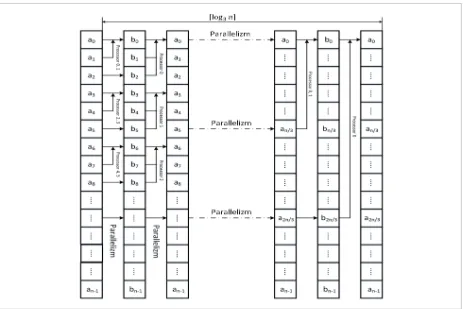
Sorting large data sets requires high-speed parallel methods of low complexity. In [16], the parallel sorting method that allows the use of high-capacity modern processors is described. Consider parallelization of the fast sort algorithm. Each string sort step merges all three ordered numeric strings into one sorted numeral string in Figure 2. In the first stage, the first two pairs of strings are merged into the temporary array, and then the string stored in the temporary array with the third string written to the input array is merged. In the first step, independently working processors merge each pair of strings, where is the dimension of the sort tasks. In the next steps, the number of independently working processors decreases three times, and only one processor is involved in the last step.
Theorem 1. Parallel Fast Sort Algorithm using processors has time complexity
PROOF
The proof is conducted for the , where
.
Due to the fact that three ordered t-elements can merge into one sorted string by doing no more
than comparisons, then for in the
first step each processors will perform no
more than comparisons. All string
merge time is a single processor operation time. In each step , the algorithm using processors will merge the three element strings by doing no more than than
comparisons. The sum of all comparisons performed by the algorithm is
(1)
Standard deviation describes the formula
Depending on the processor's access method, four types of PRAM machines are specified in memory:
1. Exclusive read exclusive write (EREW) 2. Concurrent read exclusive write (CREW) 3. Exclusive read concurrent write (ERCW) 4. Concurrent read concurrent write (CRCW) The first type of machine the PRAM allows to read write memory only one processor. The second type provides reading memory through any processor, but wringing at the same time can run only one processor. The third type allows to read every memory cell by only one processor and multiple processors can read a memory cell at the same time. The third type of PRAM machine is not intended to be practical and is not considered in theory.The fourth type allows to access memory using any processor. The second of the presented models reflects the architecture of the modern computer and is practically possible to implement.
2.2 Statistical Research on Algorithm
Performance
Let denote disordered number of
distributed results of methods should be described with sufficient details to allow others to observe some features of , and let be arithmetic mean of these results
Standard deviation describes the formula
where is the number of elements in the sample, are values of the random variable in the sample and is the arithmetic mean of the sample. In order to find the most efficient algorithm is an analysis of average time for sufficiently large set of data. The analysis for sorting time was carried out in 100 benchmark tests for each of the fixed dimension of the task on the input. The stability of the algorithm is best described on the basis of the coefficient of variation. The coefficient of variation is a measure that allows to determine value of diversity in the examined population. It is determined by the formula
where is the arithmetic mean (1) and is the standard deviation (2). The coefficient of variation reflects the stability of the method in a statistical sense. Benchmark tests of the newly proposed method for sorting sets were taken for 100, 1.000, 10.000, 100.000, 1.000.000, 10.000.000 and 100.000.000 elements on the input. The
results are presented in graphs and discussed in the following sections.
3.
Parallel Fast Sort Algorithm
Sorting large data sets requires high-speed parallel methods of low complexity. In [16], the parallel sorting method that allows the use of high-capacity modern processors is described. Consider parallelization of the fast sort algorithm. Each string sort step merges all three ordered numeric strings into one sorted numeral string in Figure 2. In the first stage, the first two pairs of strings are merged into the temporary array, and then the string stored in the temporary array with the third string written to the input array is merged. In the first step, independently working processors merge each pair of strings, where is the dimension of the sort tasks. In the next steps, the number of independently working processors decreases three times, and only one processor is involved in the last step.
Theorem 1. Parallel Fast Sort Algorithm using processors has time complexity
PROOF
The proof is conducted for the , where
.
Due to the fact that three ordered t-elements can merge into one sorted string by doing no more
than comparisons, then for in the
first step each processors will perform no
more than comparisons. All string
merge time is a single processor operation time. In each step , the algorithm using processors will merge the three element strings by doing no more than than
comparisons. The sum of all comparisons performed by the algorithm is
(2)
where n is the number of elements in the sample,
a1, a2, ..., an are values of the random variable in the sample and a– is the arithmetic mean of the sample. In
order to find the most efficient algorithm is an anal-ysis of average time for sufficiently large set of data. The analysis for sorting time was carried out in 100 benchmark tests for each of the fixed dimension of the task on the input. The stability of the algorithm is best described on the basis of the coefficient of variation. The coefficient of variation is a measure that allows to determine value of diversity in the examined popu-lation. It is determined by the formula
(3)
where a– is the arithmetic mean (1) and σ is the stan-dard deviation (2). The coefficient of variation re-flects the stability of the method in a statistical sense. Benchmark tests of the newly proposed method for sorting sets were taken for 100, 1.000, 10.000, 100.000, 1.000.000, 10.000.000 and 100.000.000 elements on the input. The results are presented in graphs and dis-cussed in the following sections.
3. Parallel Fast Sort Algorithm
Sorting large data sets requires high-speed parallel methods of low complexity. In [16], the parallel sorting method that allows the use of high-capacity modern processors is described. Consider parallelization of the fast sort algorithm. Each string sort step merges all three ordered numeric strings into one sorted nu-meral string in Figure 2. In the first stage, the first two pairs of strings are merged into the temporary array, and then the string stored in the temporary array with the third string written to the input array is merged. In
Figure 1
A sample schema of the Parallel Random Access Machine
Figure 1
A sample schema of the Parallel Random Access Machine
Figure 2
Parallel fast sort algorithm
Figure 3
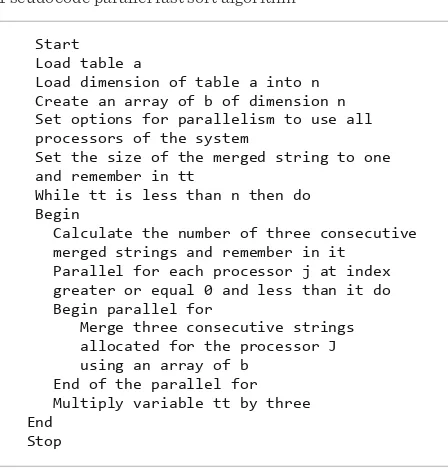
Pseudocode parallel fast sort algorithm
Start
Load table a
Load dimension of table a into n Create an array of b of dimension n Set options for parallelism to use all processors of the system
Set the size of the merged string to one and remember in tt
While tt is less than n then do Begin
Calculate the number of three consecutive merged strings and remember in it
Parallel for each processor j at index greater or equal 0 and less than it do Begin parallel for
Merge three consecutive strings allocated for the processor J using an array of b
End of the parallel for
Multiply variable tt by three End
Stop
Depending on the processor’s access method, four types of PRAM machines are specified in memory:
1 Exclusive read exclusive write (EREW)
2 Concurrent read exclusive write (CREW)
3 Exclusive read concurrent write (ERCW)
4 Concurrent read concurrent write (CRCW)
The first type of machine the PRAM allows to read wri-te memory only one processor. The second type provi-des reading memory through any processor, but wrin-ging at the same time can run only one processor. The third type allows to read every memory cell by only one processor and multiple processors can read a memory cell at the same time. The third type of PRAM machine is not intended to be practical and is not considered in theory.The fourth type allows to access memory using any processor. The second of the presented models re-flects the architecture of the modern computer and is practically possible to implement.
2.2. Statistical Research on Algorithm Performance
suffi-Information Technology and Control 2019/3/48 490
the first step, n/3 independently working processors
merge each pair of strings, where n is the dimension of the sort tasks. In the next steps, the number of inde-pendently working processors decreases three times, and only one processor is involved in the last step.
Theorem 1. Parallel Fast Sort Algorithm using n/3
processors has time complexity
(4)
PROOF
The proof is conducted for the n = 3k, where k = 1, 2, ... . Due to the fact that three ordered t-elements can merge into one sorted string by doing no more than 5t – 2 comparisons, then for t = 1 in the first step each n/3 processors will perform no more than 5 ⋅ 1 – 2 = 3 comparisons. All string merge time is a single proces-sor operation time. In each step t, the algorithm using
n/3t processors will merge the three 3t–1 element
strings by doing no more than than 5 ⋅ 3t–1–2
compar-isons. The sum of all comparisons performed by the algorithm is
(5)
(6)
(7)
(8)
(9)
(10)
Figure 2
Parallel fast sort algorithm
Figure 1
A sample schema of the Parallel Random Access Machine
Figure 2
Parallel fast sort a
Figure 3
Pseudocode parallel fast sort algorithm
Start
Load table a
Load dimension of table a into n
Create an array of b of dimension n
Set options for parallelism to use all
processors of the system
Set the size of the merged string to one
and remember in tt
While tt is less than n then do
Begin
Calculate the number of three consecutive
merged strings and remember in it
Parallel for each processor j at index
greater or equal 0 and less than it do
Begin parallel for
Merge three consecutive strings
allocated for the processor J
using an array of b
End of the parallel for
Multiply variable tt by three
End
491
Information Technology and Control 2019/3/48
Linear time complexity of the algorithm is the re-sult of separate work processors in each iteration of the merge strings. The number of possible to use processors merging strings reduces in each iteration and only one processor can be used in the last step. To increase the number of processors participating in the calculation would use a parallel merge algori-thm, which is the subject of research. The algorithm presented in Figure 3 uses the maximum number of processors available on the system.
The presented method was implemented in C# Vi-sual Studio Ultimate 2013. The algorithm uses a par-allel loop, which reduces the created program code, because there is no need to create separate tasks, run them, and wait for them to finish. The study was con-ducted on 100 input samples randomly generated for each dimension of the task. Tests were carried out on Intel i7-7700HQ as describes in Table 1.
The purpose of analysis and comparison is to reveal how the parallel calculations affect the CPU power consumption of sorting large data sets. For the bench-mark, input samples of 100, 1.000, 10.000, 100.000, 1.000.000, 10.000.000 and 100.000.000 elements were applied.
Two types of energy consumption are distinguished, namely, static and dynamic energy consumption. Figure 3
Pseudocode parallel fast sort algorithm
Figure 1
A sample schema of the Parallel Random Access Machine
Figure 2
Parallel fast sort algorithm
Figure 3
Pseudocode parallel fast sort algorithm Start
Load table a
Load dimension of table a into n Create an array of b of dimension n Set options for parallelism to use all processors of the system
Set the size of the merged string to one and remember in tt
While tt is less than n then do Begin
Calculate the number of three consecutive merged strings and remember in it
Parallel for each processor j at index greater or equal 0 and less than it do Begin parallel for
Merge three consecutive strings allocated for the processor J using an array of b
End of the parallel for Multiply variable tt by three End
Stop
Linear time complexity of the algorithm is the result of separate work processors in each iteration of the merge strings. The number of possible to use processors merging strings reduces in each iteration and only one processor can be used in the last step. To increase the number of processors participating in the calculation would use a parallel merge algorithm, which is the subject of research. The algorithm presented in Figure 3 uses the maximum number of processors available on the systemǤ
The presented method was implemented in C# Visual Studio Ultimate 2013. The algorithm uses a parallel loop, which reduces the created program code, because there is no need to create separate tasks, run them, and wait for them to finish. The study was conducted on 100 input samples randomly generated for each dimension of the task. Tests were carried out on Intel i7-7700HQ as describes in Table 1.
Table 1.Thespecification of the Intel Core i7-7700HQ Processor
The purpose of analysis and comparison is to reveal how the parallel calculations affect the CPU power consumption of sorting large data sets. For the benchmark, input samples of 100, 1.000, 10.000, 100.000, 1.000.000, 10.000.000 and 100.000.000 elements were applied.
Two types of energy consumption are distinguished, namely, static and dynamic energy consumption. Static power consumption is the result of Microsoft optimizing the application. Dynamic energy consumption is calculated by subtracting from the total energy consumption of the static energy processor. It is noted that the total power consumption of the processor reflects the energy consumption of the constant and can be taken to compare algorithms.
The sorting algorithms have a time complexity of
or , where is the number of
algorithm runs with linear time complexity. For a linear algorithm, the power consumption of the processor is constant and the number of CPU cycles needed to perform Algorithm determines energy consumption.
Each sorting operation by examined methods was measured in time [ms]. The average power dissipated in the high complexity workload of all cores (Thermal Design Power) for the i7-7700HQ processor is 45W. The Configurable TDP-down power dissipation for processor i7-7700HQ defined by Intel is 35 W. The use of Configurable TDP-down is typically executed by the system Microsoft to optimize power and performance, and TPD-down has been accepted for calculation. These results are averaged for 100 sorting samples. The benchmark comparison for parallel fast sort algorithm is described in Table 2, and Figures 4 and 6. The analysis of the results confirms the hypothesis that adding each successive processor reduces energy consumption. More visible changes are seen between 2 and 4 processors usage. With each processor added to the system, the power consumption decreases. This confirms the theoretical time complexity of the algorithm in Theorem 1.
An analysis of the variation coefficients shows the stability of the parallel method of fast sort for large data sets. Some variations in stability of the algorithm for small inputs are due to the fact that the system exceed sorting algorithm.
4.
Parallel Modified Merge Sort
Algorithm
A parallel modified sorting algorithm by merging four strings is presented in [17]. To merge four strings, logical indexing of the processors participating in the sort has been applied. In each step, sorting methods that independently operate the processors merge all ordered pairs of strings saved from the input array and write the result into a temporary array. It then merged all ordered pairs from the temporary array into the input array. The index of merged string shall be the same as the index of the first element of the first string. The entire proses merge all pairs of numeric strings by the parallel loop by independently working processors is the end of the merge cycle both in a temporary array and in the input array. The duration of the parallel loop Table 1
The specification of the Intel Core i7-7700HQ Processor
Static power consumption is the result of Microsoft optimizing the application. Dynamic energy con-sumption is calculated by subtracting from the total energy consumption of the static energy processor. It is noted that the total power consumption of the processor reflects the energy consumption of the con-stant and can be taken to compare algorithms.
The sorting algorithms have a time complexity of 0(n)or 0(n log2 n), where log2 n is the number of
algo-rithm runs with linear time complexity. For a linear algorithm, the power consumption of the processor is constant and the number of CPU cycles needed to perform Algorithm determines energy consumption. Each sorting operation by examined methods was measured in time [ms]. The average power dissipated in the high complexity workload of all cores (Thermal Design Power) for the i7-7700HQ processor is 45W. The Configurable TDP-down power dissipation for processor i7-7700HQ defined by Intel is 35 W. The use of Configurable TDP-down is typically executed by the system Microsoft to optimize power and per-formance, and TPD-down has been accepted for cal-culation.
These results are averaged for 100 sorting samples. The benchmark comparison for parallel fast sort al-gorithm is described in Table 2, and Figures 4 and 6. The analysis of the results confirms the hypothesis that adding each successive processor reduces energy consumption. More visible changes are seen between 2 and 4 processors usage. With each processor add-ed to the system, the power consumption decreases. This confirms the theoretical time complexity of the algorithm in Theorem 1.
Information Technology and Control 2019/3/48 492
data sets. Some variations in stability of the algorithm for small inputs are due to the fact that the system ex-ceed sorting algorithm.
4. Parallel Modified Merge Sort
Algorithm
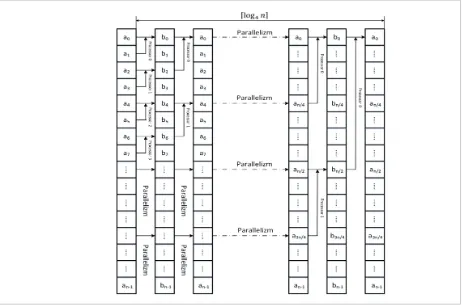
A parallel modified sorting algorithm by merging four strings is presented in [17]. To merge four strings, logical indexing of the processors participating in the sort has been applied. In each step, sorting methods that independently operate the processors merge all ordered pairs of strings saved from the input array and write the result into a temporary array. It then Table 2
Energy consumption parallel fast sort algorithm in [Ws]
Figure 4
Comparison of energy consumption for parallel fast sort algorithms [Ws]
Figure 5
A comparison of the efficiency of the method in power consumption, using multiple
Table 2.Energy consumption parallel fast sort algorithm in [Ws]
Figure 4
Comparison of energy consumption for parallel fast sort algorithms [Ws]
Table 2.Energy consumption parallel fast sort algorithm in [Ws]
Figure 4
Comparison of energy consumption for parallel fast sort algorithms [Ws]
Table 2.Energy consumption parallel fast sort algorithm in [Ws]
Figure 4
Comparison of energy consumption for parallel fast sort algorithms [Ws]
Figure 5
A comparison of the efficiency of the method in power consumption, using multiple processors in [%]
Figure 6
Parallel modified merge sort algorithms
Figure 5
A comparison of the efficiency of the method in power consumption, using multiple processors in [%]
Figure 6
Parallel modified merge sort algorithms
Figure 5
A comparison of the efficiency of the method in power consumption, using multiple processors in [%]
Figure 6
Parallel modified merge sort algorithms
Figure 5
A comparison of the efficiency of the method in power consumption, using multiple processors in [%]
Figure 6
493
Information Technology and Control 2019/3/48
Figure 6
Parallel modified merge sort algorithms
merged all ordered pairs from the temporary array into the input array. The index of merged string shall be the same as the index of the first element of the first string. The entire proses merge all pairs of numeric strings by the parallel loop by independently working processors is the end of the merge cycle both in a tem-porary array and in the input array. The duration of the parallel loop can be defined as the time the longest working processor which is involved in the merging of strings. The way that strings are merged by indepen-dent processors is shown in Figure 6.
Theorem 2. Parallel Modified Merge Sort Algorithm using n/2 processors has time complexity:
(11)
PROOF
The proof is conducted for the n = 4k, where k = 1, 2, ... . Due to the fact that two ordered t - elements can mer-ge into one sorted string by doing no more than 2t –1
Figure 5
A comparison of the efficiency of the method in power consumption, using multiple processors in [%]
comparisons, then for t = 1 in the first step each n/2 processors will perform no more than 2 ⋅ 1 – 1 = 1 com-parisons. All string merge time is a single processor operation time. In each step of t, the algorithm first merges the n/22t–1-element strings into a temporary
array, and then merge the n/22t element strings from
the temporary array into the input array by doing no more than 2 ⋅ 22t–2 + 2 ⋅ 22t–1–2 comparisons. The sum
of all comparisons performed by the algorithm is
(12)
Information Technology and Control 2019/3/48 494
(14)
(15)
(16)
given that
(17)
and
(18)
As a result of substitution
(19)
The presented method was implemented in C# Vi-sual Studio Ultimate 2013. Statistical surveys for samples range from 100 to 100 million elements, in-creasing the dimension 10 times for each subsequent. Each sorting operation by examined methods was measured in time [ms]. The average power dissipated in the high complexity workload of all cores (Thermal Design Power) for the i7-7700HQ and TPD-down has been accepted for calculation energy consumption. The algorithm presented in Figure 7 uses the maxi-mum number of processors available on the system. Statistical surveys are averaged for 100 sorting sam-ples. The benchmark comparison for parallel modified merge sort algorithm is described in Table 3, and Fig-ures 8-9. As with the parallel fast sort algorithm, the analysis of the parallel results of the modified sorting algorithm by merging shows that each processor add-ed radd-educes power consumption. By adding a larger number of processors, the changes are clearly visible. With each processor added, the efficiency of the algo-rithm increases, which confirms the theoretical com-plexity of the algorithm contained in Theorem 2. An analysis of the variation coefficients shows the stability of parallel modified merge sort, which im-proves sorting for large data sets.
Figure 7
Pseudocode parallel modified merge sort algorithms
Start Load table a
Load dimension of table a into n Create an array of b of dimension n Set options for parallelism to use all processors of the system
Set the size of the merged string to one and remember in tt
While tt is less than n then do Begin
Calculate the number of consecutive pairs of strings to merge in array a and remember in it1 Parallel for each processor jj at index greater or equal 0 and less than it1 do Begin parallel for
Merge pairs of strings from array a allocated for the processor jj
by saving the merged strings in array b End of the parallel for
Multiply variable tt by two If tt greater than n then do Remember n in tt
Calculate the number of consecutive pairs of strings to merge in array b and remember in it1 Parallel for each processor jj at index greater or equal 0 and less than it1 do Begin parallel for
Merge pairs of strings from array b allocated for the processor jj
by saving the merged strings in array a End of the parallel for
Multiply variable tt by two End
Stop
NOTE: If there is only one string to merge it, it is rewritten to the second array. Figure 7
Pseudocode parallel modified merge sort algorithms
NOTE: If there is only one string to merge it, it is rewritten to the second array.
Table 3.Energy consumption parallel modified merge sort algorithm in [Ws]
Figure 8
A comparison of energy consumption for parallel modified merge sort [Ws] Table 3
495
Information Technology and Control 2019/3/48
Figure 8
A comparison of energy consumption for parallel modified merge sort [Ws]
Table 3.Energy consumption parallel modified merge sort algorithm in [Ws]
Figure 8
A comparison of energy consumption for parallel modified merge sort [Ws]
Table 3.Energy consumption parallel modified merge sort algorithm in [Ws]
Figure 8
A comparison of energy consumption for parallel modified merge sort [Ws]
Figure 9
A comparison of the efficiency of the method in power consumption, using multiple processors in [%]
Figure 9
A comparison of the efficiency of the method in power consumption, using multiple processors in [%]
Figure 10
A comparison of sorting time for trigeminal heap sort, quick sort, merge sort on 1 processor with parallel fast sort and parallel modified merge sort on 8 processors
Figure 9
A comparison of the efficiency of the method in power consumption, using multiple processors in [%]
Figure 10
A comparison of sorting time for trigeminal heap sort, quick sort, merge sort on 1 processor with parallel fast sort and parallel modified merge sort on 8 processors
Figure 9
A comparison of the efficiency of the method in power consumption, using multiple processors in [%]
Figure 10
A comparison of sorting time for trigeminal heap sort, quick sort, merge sort on 1 processor with parallel fast sort and parallel modified merge sort on 8 processors
Figure 9
A comparison of the efficiency of the method in power consumption, using multiple processors in [%]
Figure 10
A comparison of sorting time for trigeminal heap sort, quick sort, merge sort on 1 processor with parallel fast sort and parallel modified merge sort on 8 processors
5. Analysis and Compression of
Energy Consumption
An analysis of energy consumption is an important element in determining the efficiency of algorithms
Information Technology and Control 2019/3/48 496
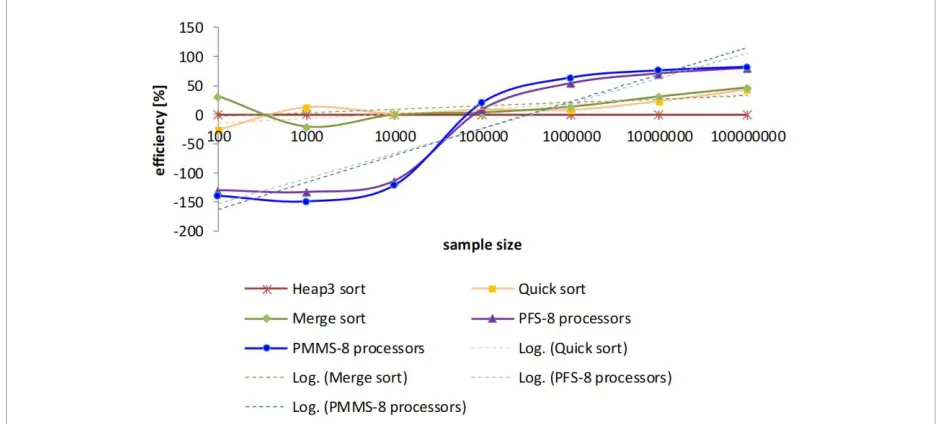
Figure 10
A comparison of sorting time for trigeminal heap sort, quick sort, merge sort on 1 processor with parallel fast sort and parallel modified merge sort on 8 processors
by parallel fast sorting and parallel modified merge sorting algorithms running on 8 processors with algorithms running on a single processor such as quicksort, merge sort, trigeminal heap sort is prefer-able for Parallel algorithms and is shown in Figure 10. The comparison based on trigeminal heap sort algorithm and received a percentage difference in energy consumption [Ws] compared to other algo-rithms. Efficiency means reducing the percentage of energy consumption in Figure 10.
The static analysis carried out in Figure 10 shows that the parallel methods running on multiple processors are more efficient than classical sorting methods and have less power consumption in sorting large data sets. The results obtained show that when sorting small data sets, it is better to use classical sorting methods that run on a single processor than the par-allel sorting methods. This is because parpar-allel meth-ods that run on multiple processors require that the program is loaded into memory. They also require memory reservations for the processors to be used, and that processor activity synchronization actions are performed to prevent deadlock. The advantage of parallel methods is only visible for the day dimension greater than 100000. Time complexity of the parallel
Figure 9
A comparison of the efficiency of the method in power consumption, using multiple processors in [%]
Figure 10
A comparison of sorting time for trigeminal heap sort, quick sort, merge sort on 1 processor with parallel fast sort and parallel modified merge sort on 8 processors
merge sorting methods is 0(n) and cannot be reduced by simply adding processors to the sorting algorithm. Reducing the time complexity of parallel sorting al-gorithms by merging is possible by applying a parallel method to merge numeric strings. However, it should be expected that the use of more processors in the string merging process will degrade energy consump-tion and such algorithms would be less efficient in terms of energy consumption [16, 17].
6. Final Remarks
497
Information Technology and Control 2019/3/48
The tests demonstrate stability of the methods and confirm theoretical time complexity. Comparison tests have shown that a parallel fast sort and a paral-lel modified merge sort are more efficient than other sorting methods, especially for big data sets. The pre-sented methods for large task dimensions have less power consumption than classic methods and can be used successfully in NoSQL databases.
In the future research is planned a further devel-opment in sorting performance. The research will
involve developing the power consumption parallel merge string algorithm.
Acknowledgement
The author would like to acknowledge the contribu-tion to this project from the Rector of the Silesian University of Technology under the grant for perspec-tive professors no. 09/RGH18/0035 and pro-quality grant no. 09/010/RGJ19/0042
References
1. Beloglazov, A., Abawajy, J., Buyya, R. Energy-Aware Re-source Allocation Heuristics for Efficient Management of Data Centers for Cloud Computing. Future Genera-tion Computer Systems, 28(5), 2012, 755-768. https:// doi.org/10.1016/j.future.2011.04.017
2. Ben-Or, M. Lower Bounds for Algebraic Computation Trees. In Proceedings of 15th ACM Symposium. Theory of Computing; ACM Press: New York, NY, USA, 1983, 80-86. https://doi.org/10.1145/800061.808735
3. Carlsson, S., Levcopoulos, C., Petersson, O. Sublinear Merging and Natural Merge Sort. International Sympo-sium on Algorithms, Springer, Berlin, Heidelberg, 1990, 251-260. https://doi.org/10.1007/3-540-52921-7_74 4. Chen, R., Y., Owens, R., M., Irwin, M., J., Bajway, R., D.,
S. Validation of an Architectural Level Power Analysis Technique. Proceedings of the 35th Annual Design Au-tomation Conference, ACM, 1998, 242-245. https://doi. org/10.1145/277044.277106
5. Chang, N., Kim, K., Lee, H., G. Cycle-Accurate En-ergy Measurement and Characterization with a Case Study of the ARM7TDMI [Microprocessors]. IEEE Transactions on Very Large Scale Integration (VLSI) Systems, 2002, 10(2), 146-154. https://doi. org/10.1109/92.994992
6. Damasevicius, R., Ziberkas, G. Energy Consumption and Quality of Approximate Mage Transformation. Elektronika ir Elektrotechnika, 2012, 120, 4, 79-82. https://doi.org/10.5755/j01.eee.120.4.1459
7. Damasevicius, R., Ziberkas, G., Stuikys, V., Toldinas, J. Energy Consumption of Hash Functions. Elektronika ir Elektrotechnika, 18, 10, 81-84. https://doi.org/10.5755/ j01.eee.18.10.3069
8. Doberkat, E.-E. Inserting a New Element Into a Heap. Numerical Mathematics, 1981, 21(3), 255-269. https:// doi.org/10.1007/BF01941462
9. Fard, H., M., Prodan, R., Barrionuevo, J., J., D., Fahring-er, T. A Multi-Objective Approach for Workflow Sched-uling in Heterogeneous Environments. 12th IEEE/ ACM International Symposium on Cluster, Cloud and Grid Computing, IEEE, 2012, 300-309. https://doi. org/10.1109/CCGrid.2012.114
10. Gupta, S., Najm, F., N. Energy-Per-Cycle Estima-tion at RTL. IEEE Proceedings, 1999 InternaEstima-tion- Internation-al Symposium on Low Power Electronics and De-sign (Cat. No. 99TH8477), 1999, 121-126. https://doi. org/10.1145/313817.313894
11. Karsin, B., Weichert, V., Casanova, H., Iacono, J., Sitchinava, N. Analysis-Driven Engineering of Com-parison-Based Sorting Algorithms on GPUs. Pro-ceedings of the 2018 International Conference on Supercomputing, ACM, 2018, 86-95. https://doi. org/10.1145/3205289.3205298
12. Kessaci, Y., Melab, N., Talbi, E., G., A. Pareto-Based Metaheuristic for Scheduling HPC Applications on a Geographically Distributed Cloud Federation. Clus-ter Computing, 2013, 16(3), 451-468. https://doi. org/10.1007/s10586-012-0210-2
13. Kushagra, S., López-Ortiz, A., Munro, J., Qiao, A. Multi-Pivot Quicksort: Theory and Experiments. Pro-ceedings of the Meeting on Algorithm Engineering & Experiments, Society for Industrial and Applied Math-ematics, Philadelphia, PA, USA, 2016, 47-60. https://doi. org/10.1137/1.9781611973198.6
14. Manumachu, R. R., Lastovetsky, A. Bi-Objective Op-timization of Data-Parallel Applications on Homoge-neous Multicore Clusters for Performance and Energy. IEEE Transactions on Computers, 2017, 67(2), 160-177. https://doi.org/10.1109/TC.2017.2742513
Information Technology and Control 2019/3/48 498
with Hierarchical Memory. Journal of Grid Computing, 2016, 14(1), 153-170. https://doi.org/10.1007/s10723-015-9345-8
16. Marszałek Z. Parallelization of Fast Sort Algorithm. In-ternational Conference on Information and Software Technologies, Springer, Cham, 2017, 408-421. https:// doi.org/10.1007/978-3-319-67642-5_34
17. Marszałek, Z. Parallelization of Modified Merge Sort Algorithm. Symmetry, 2017, 9(9), 176. https://doi. org/10.3390/sym9090176
18. Mezmaz, M., Melab, N., Kessaci, Y., Lee, Y., C., Talbi, E., G., Zomaya, A., Y., Tuyttens, D. A Parallel Bi-Objective Hybrid Metaheuristic for Energy-Aware Scheduling for Cloud Computing Systems. Journal of Parallel and Dis-tributed Computing, 2011, 71(11), 1497-1508. https:// doi.org/10.1016/j.jpdc.2011.04.007
19. Paira, S., Chandra, S., Alam, S. K. S. Enhanced Merge Sort-A New Approach to the Merging Process.
Proce-dia Computer Science, 2016, 93, 982-987. https://doi. org/10.1016/j.procs.2016.07.292
20. Połap, D., Kęsik, K., Woźniak, M., Damaševičius, R. Par-allel Technique for the Metaheuristic Algorithms Using Devoted Local Search and Manipulating the Solutions Space. Applied Sciences, 2018, 8(2), 293. https://doi. org/10.3390/app8020293
21. Rauh, A., Arce, G., A Fast Weighted Median Algorithm Based on Quick Select. Proceedings of the IEEE 17th International Conference on Image Processing, Hong Kong, China, 2010, 105-108. https://doi.org/10.1109/ ICIP.2010.5651855