Commun
icatt
ion
Populatt
ion
dynam
ics
of
med
ium
and
large
mammals
in
a
Westt
Afr
ican
gallery
forestt
area
and
tthe
pottentt
ial
effectts
of
poach
ing
Emmanue
l
M
.
Hema
,
Yaya
Ouattara
,
Mamadou
Karama
,
Fab
io
Pettrozz
i
,
Mass
im
i
l
iano
D
i
V
ittor
io
,
Wendengoud
i
Guenda
&
Luca
Lu
ise
l
l
i
26 May 2017 | Vol. 9| No. 5 | Pp. 10151-10157 10.11609/jott.3212.9.5.10151-10157
Threattened Taxa TheJournal of Threattened Taxais dedicattedtto building evidencefor conservaion globally by publishing peer-reviewed aricles online every montth att a reasonably rapid ratte att www.tthreattenedttaxa.org.All aricles publishedin JoTT are registtered under Creaive Commons Attribuion 4.0IntternaionalLicense unless ottherwise menioned.JoTT allows unresttrictted use of aricles inany medium, reproducion, and disttribuion by providing adequatte creditt tto tthe autthors and tthe source of publicaion.
OPEN
ACCESS
Parttner
www
.
tthrea
ttenedttaxa
.org
ISSN 0974-7907(Online) |ISSN 0974-7893(Printt) Building evidencefor conservaion globally
Journa
l
o
f
Threattened
Taxa
Pub
l
isher/Hostt
For Focus, Scope, Aims, Policies and Guidelines visitt http://tthreattenedttaxa.org/Aboutt_JoTTFor Aricle Submission Guidelines visitt http://tthreattenedttaxa.org/Submission_Guidelines
10151
Communica
tion
LOGOs
DOI: http://doi.org/10.11609/jott.3212.9.5.10151-10157 | ZooBank: urn:lsid:zoobank.org:pub:8F6D747C-F441-4DD6-9B1F-C086F5FDA1DB
Editor: Mewa Singh, University of Mysore, Mysuru, India. Date of publication: 26 May 2017 (online & print)
Manuscript details: Ms # 3212 | Received 19 December 2016 | Final received 28 April 2017 | Finally accepted 01 May 2017
Citation: Hema, E.M., Y. Ouattara, M. Karama, F. Petrozzi, M.D. Vittorio, W. Guenda & L. Luiselli (2017). Population dynamics of medium and large mammals in a West African gallery forest area and the potential effects of poaching. Journal of Threatened Taxa 9(5): 10151–10157; http://doi.org/10.11609/jott.3212.9.5.10151-10157
Copyright: © Hema et al. 2017. Creative Commons Attribution 4.0 International License. JoTT allows unrestricted use of this article in any medium, reproduction and distribution by providing adequate credit to the authors and the source of publication.
Funding: None.
Competing interests: The authors declare no competing interests.
Author Details: Emmanuel M. Hema, is Assistant Professor at the University Ouaga 1 Pr Joseph KI-ZERBO of Ouagadougou (Burkina Faso) and works on the ecology and conservation of savannah mammals; Yaya Ouattara and Mamadou Karama work for the AGEREF/CL at the management of the Comoé Léraba National Park (Burkina Faso); Fabio Petrozzi and Massimiliano Di Vittorio work for the company Ecologia Applicata Italia on the conservation of European birds of prey and West African savannah fauna; Wendengoudi Guenda is a professor of zoology at the University Ouaga 1 Pr Joseph KI-ZERBO of Ouagadougou (Burkina Faso); Luca Luiselli is the president of IDECC and teaches Ecological Statistics at the University Roma Three (Rome, Italy) and a visiting professor at the Rivers State University of Science and Technology, Port Harcourt (Nigeria) and works on the ecology and conservation of West African reptile and mammal communities.
Author Contribution: EMH and LL designed the study; YO, MM, EMH performed the field study, WG coordinated the field staff; LL, FP, MDV performed the statisti-cal analyses; EMH, LL, FP drafted the paper; all authors read and approved the written draft.
Acknowledgements: Field works were financed by the PAGEN (Projet de Partenariat pour l’Amélioration de la Gestion des Ecosystèmes Naturels), PAPSA (Projet d’Appui à la Productivité agricole et à la Sécurité Alimentaire) and the Netherland IUCN Projects, Ecosystems Grants Programme (EGP). Thanks to the Minister in charge of wildlife and forests of Burkina Faso for extending support towards these studies. In particular, we thank the former Director of the Faunal Office, Urbain Belemsobgo, for his substantial contributions to the study. We are mostly grateful to the ecological monitoring teams of PAGEN and AGEREF/CL especially M. Celestin Poda for his contribution to earlier surveys and reports, the communities of the villages of Folonzo and Massadeyirikoro and the staff of the Executive Secretariat of AGEREF / CL especially M. Lacina Koné and M. Ismael Tou for their contribution to the smooth running of the field operations.
Population dynamics of medium and large mammals
in a West African gallery forest area and
the potential effects of poaching
Emmanuel M. Hema 1, Yaya Ouattara 2, Mamadou Karama 3, Fabio Petrozzi 4,
Massimiliano Di Vittorio 5, Wendengoudi Guenda 6 & Luca Luiselli 7
1,6 Université Ouaga 1 Prof Joseph Ki Zerbo, CUPD, laboratoire de Biologie et Ecologie Animales, 09 B.P. 848
Ouagadougou 09 - Burkina Faso
2,3 Secrétariat Exécutif, AGEREF/CL, BP 223, Banfora, Burkina Faso 4,5 Ecologia Applicata Italia S.r.l., via Edoardo Jenner 70, Rome, Italy
7 Department of Applied and Environmental Biology, Rivers State University of Science and Technology, P.M.B. 5080,
Port Harcourt, Nigeria
7 IDECC - Institute for Development, Ecology, Conservation and Cooperation, via G. Tomasi di Lampedusa 33, I-00144
Rome, Italy
1 [email protected] (corresponding author), 2 [email protected], 3 [email protected],
4 [email protected], 5 [email protected], 6[email protected], 7 [email protected]
ISSN 0974-7907 (Online) ISSN 0974-7893 (Print)
OPEN ACCESS
Journal of Threatened Taxa | www.threatenedtaxa.org | 26 May 2017 | 9(5): 10151–10157
Abstract: Few studies are available on the population dynamics of medium and large mammals in gallery forests of the Sudan and Sahel
re-gions of West Africa. Line-transect studies of the abundance (estimated by KIA) of nine species of ungulates and three species of primates were carried out between 2004 and 2013 in the Comoé-Leraba protected area of Burkina Faso, West Africa. No peer-reviewed study of population sizes of mammals in this protected area has been published, making the data presented of special relevance. Population size trends varied significantly across years in both primates and ungulates, with some species (Papio anubis, Phacochoerus africanus,
Alcela-phus busephalus and TragelaAlcela-phus scriptus) decreasing consistently. Significant relationships were observed between poaching intensity
and population oscillations in Erythrocebus patas, Kobus ellipsiprymnus, Kobus kob, Ourebia ourebi and Cephalophus rufilatus.
Journal of Threatened Taxa | www.threatenedtaxa.org | 26 May 2017 | 9(5): 10151–10157 10152
Population dynamics of mammals in a West African gallery forest Hema et al.
INTRODUCTION
Guineo-Congolian lowland rain forest and secondary grasslands give way in northern latitudes to isolated pockets of riparian or gallery forests following the course of large rivers such as the Niger, Comoé and Leraba, which are surrounded by undifferentiated Sudanian woodlands and savannahs (White 1983). These gallery forests are crucial landscape elements in Sudan and Sahel regions because they carry typical rainforest faunal elements inhabiting the Gulf of Guinea region up to the otherwise dry regions of Burkina Faso, Niger and Mali (e.g., Böhme et al. 1996; Joger & Lambert 2002). Despite their importance for the ecology of the region, the gallery forests have been poorly studied in terms of their faunal composition and inter-species interactions (Craigie et al. 2010). In particular, very little information is available on mammal populations and their ecological dynamics in any gallery forest area of West Africa (Craigie et al. 2010).
The Comoé-Leraba area in southwestern Burkina Faso (western Africa) represents an unique opportunity for studying the composition and population dynamics of the mammal populations of gallery forest areas, because it is a protected area that has been regularly monitored by the NGO Association Inter Villageois de GEstion des REssources Naturelles et de la Faune Comoé-Leraba (AGEREF/CL) and governmental agencies across the years. This provides opportunities to monitor species composition, population trends and the threats that mammals face in this type of habitat. Here we analyze several years of population data (2004–2013) for medium-sized and large mammals (ungulates and primates) in the Comoé-Leraba area, with emphasis on decreasing trends. In addition, we compare year-by-year population size patterns with indices of poaching in order to establish whether illegal hunting in this habitat type as well as in other savannah habitats (e.g., Caughley et al. 1990; Krebs 2009) may be a main factor conditioning the population dynamics of ungulates and primates.
MATERIALS AND METHODS
Study area
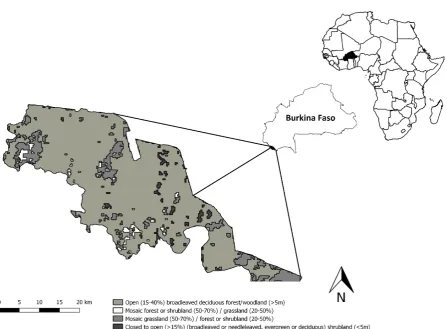
The present study was carried out between 2004 and 2013 in the Forest Classée et Reserve Partiel de Faune / Comoé-Leraba (FCRPF / CL), a protected area located south-west of Burkina Faso in the region of Cascades in the province of Comoé within the departments
of Mangodara and Niangoloko (Fig. 1). The area is located at about 100km south of Banfora, capital city of the Cascades region. The protected area is about 1245.1km2. The southern limit is about 150km along the
international boundary of Burkina with Côte d’Ivoire. The climate is similar to that of southern Sudan with a rainy season of six months (May to October) and a dry season for the rest of the time (Guinko 1984). It is a transition zone between the dry tropical climates of the Sahelian north and the humid ones of southern Guinea. During the dry season, the prevailing winds are harmattan and during the rainy season a humid warm monsoon wind blows from the southwest. An average rainfall ranging between 950mm and 200mm characterizes the pluviometric regime of the study area. The Comoé and the Léraba rivers are the two most important rivers in the area. They are perennial and cross the zone from north to south by the Comoé and from the west to the east by the Leraba. The plains are traversed by important rivers, which cause flooding during the rainy season in some places.
The vegetation is characterized by semi-deciduous forest galleries and clear forests. The dominant natural vegetation consists of numerous Guinean species including Daniellia oliveri, Isoberlinia doka, Pterocarpus erinaceus, Khaya senegalensis, Detarium microcarpum, Burkea africana and Vitellaria paradoxa. The FCRPF/CL is an important wildlife reservoir for Burkina Faso; the fauna here presents an enormous diversity integrating Sahelian with Guinean species.
Field protocol
All data were collected by the line transect data collection method. The transects (61 portions) were systematically arranged at an average equidistance of 1.7km and with a north-south and east-west orientation depending on the major drainage line of the major rivers in the census zone (Fig. 1). All transects were carried out in the dry season (February–May). Transects were walked by 13 teams of three people in each team. Every team consisted of an experienced warden (team leader) and two observers (one from the riverine villages and one field tracker). The teams walked along strictly straight lines using a compass that indicated the centres of the transects. The teams were equipped with GPS, compasses, binoculars, rangefinders, maps and field-books to record data on the observed species, their numbers, sex, age, apparent activity, and eventual notes on the presence of signs of illegal activities along the transect, etc.
Journal of Threatened Taxa | www.threatenedtaxa.org | 26 May 2017 | 9(5): 10151–10157 10153
Population dynamics of mammals in a West African gallery forest Hema et al.
morning as soon as daylight made it possible to distinguish objects precisely (6:00 am). All the data on the signs of poacher activities were collected from within the transects. The types of illegal activities recorded by the team include: (i) poacher hunting lodges; (ii) poacher camping sites; (iii) animal carcasses; (iv) gun shots heard; (v) empty cartridges; (vi) traps for animals; (vii) poacher trails inside gallery forest vegetation; (viii) signs of bicycles and food prints of poachers; (ix) tree cuts; (x) unauthorized trespassing; and (xi) seized goods (vehicles, guns, etc).
Statistical analyses
The data were entered in an Excel spreadsheet and a kilometric abundance index (KA) for each species in each year of the study was calculated (Vincent et al. 1991; Maillard et al. 2001; Barrio et al. 2010). The inter-annual trends in KA abundances of the various species were determined by linear models with Past 3.0 statistical software. A heterogeneity of slopes test (one-way ANCOVA) for the general regressions of year of study versus yearly KA of each species was used to determine whether the inter-annual trends differed significantly
among the various species of ungulates and primates. Ungulates and primates were analyzed separately because of their obvious ecological differences.
In the text, the means are followed by ±1 standard deviation. All tests were two-tailed and alpha was set at 5%. Non-normally distributed variables (Shapiro-Wilk W normality text, P<0.05) were log transformed to achieve normality.
RESULTS
Primates
Journal of Threatened Taxa | www.threatenedtaxa.org | 26 May 2017 | 9(5): 10151–10157 10154
Population dynamics of mammals in a West African gallery forest Hema et al.
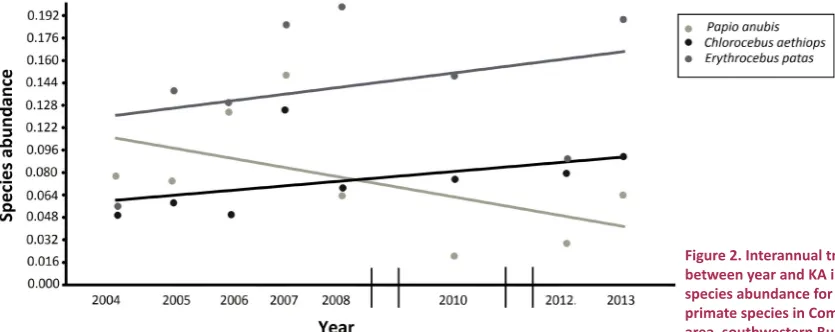
of the three primate species varied significantly across years (one-way ANCOVA, F2,20=6.786, P<0.01), with the KA of Papio anubis decreasing remarkably, and the KA density of the other two species slightly increasing (Fig. 2).
Ungulates
Nine species of ungulates were regularly observed along the surveyed transects, while two additional species: the Bohor Reedbuck Redunca redunca and Cape Buffalo Syncerus caffer, were observed outside transects. The mean KA densities varied remarkably among the species (Table 1) and across the years (Fig. 3). Overall, the two large-sized gregarious species Hartebeest Alcelaphus busephalus and Roan Antelope Hippotragus equinus were the two most common species, whereas the small-sized solitary species the Red-flanked Duiker Cephalophus rufilatus and Oribi Ourebia ourebi were the least common (Table 1). A heterogeneity of slopes test revealed that the trends of
the various ungulate species varied significantly across years (one-way ANCOVA, F8,62=22.8, P<0.0001), with the KAs of the Common Warthog Phacochoerus africanus, Alcelaphus busephalus and the Kewel Bushbuck Tragelaphus scriptus decreasing remarkably, and the KA density of the other two species showing no remarkable fluctuations over the years (Fig. 3).
Hunting pressure
The synopsis of the data collected on hunting pressure throughout the study period is presented in Table 2. (Log) Annual KA estimates statistically decreased with increases of (log) number of signs of hunting activities in Erythrocebus patas (r=-0.177, P<0.05), Waterbuck Kobus ellipsiprymnus 0.674, P<0.001), Kob Kobus kob (r=-0.779, P<0.001), Ourebia ourebi (r=-0.452, P<0.01), and Cephalophus rufilatus (r=-0.299, P<0.05). On the other hand, there was no significant relationship between (log) number of signs of hunting activities and (log) year-by-year KAs for any of the other species (at least, P=0,1299).
Figure 2. Interannual trends between year and KA index of species abundance for the three primate species in Comoé-Léraba area, southwestern Burkina Faso.
Table 1. Descriptive statistics for the KA estimates of the various species of ungulates along eight years of study, in Komoé-Leraba area, southwestern Burkina Faso.
Species Min Max Mean errorStd. Variance Stand. dev Median prcntil25 prcntil75 Coeff. var
Alcelaphus busephalus 0.056 0.447 0.216 0.044 0.016 0.125 0.176 0.140 0.309 57.575
Sylvicapra grimmia 0.002 0.044 0.017 0.005 0.000 0.013 0.015 0.007 0.023 76.409
Kobus ellipsiprymnus 0.012 0.039 0.022 0.004 0.000 0.011 0.017 0.013 0.035 50.503
Kobus kob 0.011 0.062 0.027 0.006 0.000 0.016 0.026 0.015 0.031 58.561
Tragelaphus scriptus 0.009 0.053 0.034 0.005 0.000 0.014 0.033 0.026 0.047 41.935
Hippotragus equinus 0.118 0.392 0.250 0.037 0.011 0.106 0.275 0.132 0.346 42.321
Ourebia ourebi 0.004 0.017 0.013 0.002 0.000 0.005 0.015 0.010 0.017 35.642
Cephalophus rufilatus 0.000 0.015 0.006 0.002 0.000 0.006 0.006 0.001 0.012 90.799
Journal of Threatened Taxa | www.threatenedtaxa.org | 26 May 2017 | 9(5): 10151–10157 10155
Population dynamics of mammals in a West African gallery forest Hema et al.
Figure 3. Year-by-year fluctuations of the KIA indices of the various ungulate species at the Comoé-Léraba area, southwestern Burkina Faso. For the statistical results on these yearly fluctuations, see the text.
Year
Kia inde
x
DISCUSSION
The data on the year-by-year fluctuations in population sizes should be interpreted with caution when considering the smaller and more elusive species, such as Cephalophus rufilatus, Sylvicapra grimmia and Ourebia ourebi, as may or may not be encountered while walking the transect by the surveyors. Indeed, for instance, Cephalophus rufilatus was never observed in 2010 but was later observed again, and both Cephalophus rufilatus and Ourebia ourebi showed high fluctuations across years, but without any long-term trend. Instead, the inter-annual trends for Sylvicapra grimmia were more consistent with a declining pattern over time, and since this species inhabits more open habitats than Cephalophus rufilatus (Hema 1998; Oualiou et al. 2007), it was likely least exposed to observation biases than the latter. The decline of population size of Phacochoerus africanus across years was also consistent with a similar trend observed in another Burkina Faso protected area (Nazinga Game Ranch) where poaching and relative mismanagement by the responsible authorities may be considered the main cause (Hema et al. 2017). Also,
the absence of buffalos (Syncerus caffer) from the transects was certainly due to suboptimal searching methodology for this species, which was encountered on some occasions by wardens and local people. Buffalo live in thick forests where detectability is low (Eniang et al. 2016) and they tend to move away before teams walking along a transect arrive owing to their keen sense of smell. Since the thicker forest patches are situated at the confluence between the rivers Comoé and Leraba and along the main tracts of these two rivers, the line transects were not laid in this type of thick riverine forest. Thus, there was a low probability of detecting buffalos using the field methodology employed in the present study.
Journal of Threatened Taxa | www.threatenedtaxa.org | 26 May 2017 | 9(5): 10151–10157 10156
Population dynamics of mammals in a West African gallery forest Hema et al.
We speculate that small and medium sized species are preferred targets by poachers because (i) they are easier to hide and smuggle outside the boundaries of the protected area, and (ii) they are easy to approach and shoot for the poachers. Indeed, both Erythrocebus patas and the four above-mentioned ungulate species live in small groups (Hall 1966; Wirtz & Loerscher 1983; East 1991; Corson 2004; Fischer & Linsenmair 2007), and thus may be least prone to be able to detect, and escape from, approaching poachers (Fischer & Linsenmair 2007; Yaokokore-Beibro et al. 2010). Poachers possibly prefer smaller species as they are more likely to be sold in comparison to large species. Hence making it a better investment in terms of time for the poachers (Ntiamoa-Baidu 1997; Kümpel 2006; Wright & Priston 2010). In this regard, it should be mentioned that Kobus kob was also the target of heavy overhunting in the Comoé National Park in Côte d’Ivoire (Fischer & Linsenmair 2007), i.e., in an environment that is very similar, and geographically adjacent, to that of Comoé-Leraba in Burkina Faso.
REFERENCES
Barrio, I.C., P. Acevedo & F.S. Tortosa (2010). Assessment of methods
for estimating wild rabbit population abundance in agricultural landscapes. European Journal of Wildlife Research 56: 335–340.
Böhme, W., H. Meinig & M.O. Rödel (1996). New records of amphibians
and reptiles from Burkina Faso and Mali. British Herpetological
Society Bulletin 56: 7–26.
Caughley, G., H. Dublin & I. Parker (1990). Projected decline of the
African elephant. Biological Conservation 54: 157–164.
Corson, P.J. (2004). Les antelopes d’Afrique. Editions du Gerfaut,
Barcelona, Spain.
Craigie, I.D., J.E. Baillie, A. Balmford, C. Carbone, B. Collen, R.E. Green
& J.M. Hutto (2010). Large mammal population declines in Africa’s
protected areas. Biological Conservation 143(9): 2221–2228.
East, R.D. (1991). The behavior guide to African mammals including
hoofed mammals, carnivores, Primates. IUCN, Gland.
Eniang, E.A., C.O. Ebin, A.A. Nchor, G.I. Agba, I.K. Gideon, G. Amori & L. Luiselli (2016). Distribution and status of the African Forest
Buffalo Syncerus caffer nanus in south-eastern Nigeria. Oryx http:// doi.org/10.1017/S0030605315001507
Fischer, F. & K.E. Linsenmaier (2007). Changing social organization in
an ungulate population subject to poaching and predation - the Kob antelope (Kobus kob kob) in the Comoé National Park, Côte d’Ivoire.
African Journal of Ecology 45: 285–292.
Guinko, S. (1984). Végétation de la Haute-Volta. Thèse d’Etat, Sciences
Naturelles ; Université de Bordeaux, 318pp.
Hall, K.R.L. (1966). Behaviour and ecology of the wild patas monkey,
Erythrocebus patas, in Uganda. Journal of Zoology 148: 15–87.
Hema, E.M. (1998). Contribution à la connaissance des céphalophes
(sous-famille des céphalophinae), dans les forêts classées de Logoniégué et de Diéfoula; Comoé, Burkina Faso. Mémoire I.D.R.
E&F; U.P. Bobo-Dsso 89pp+Annexes.
Hema, E.M., B. Douamba, M. Di Vittorio, D. Dendi, W. Guenda, F. Petrozzi, B. Ouédraogo & L. Luiselli (2017). Long-term (1985-2012)
population fluctuations of Warthog (Phacochoerus africanus) in Nazinga Game Ranch (Burkina Faso). African Journal of Ecology
http://doi.org/10.1111/aje.12402
Krebs, C.J. (2009). Population dynamics of large and small mammals:
Graeme Caughley’s grand vision. Wildlife Research 36: 1–7.
Kümpel, N.F. (2006). Incentives for sustainable hunting of bushmeat in
Rio Muni. PhD Thesis, Imperial College London.
Joger, U. & M.R.K. Lambert (2002). Inventory of amphibians and
reptiles in SE Senegal, including the Niokola-Koba National Park, with observations on factors influencing diversity. Tropical Zoology 15(2): 165–185.
Maillard, D., C. Calenge, T. Jacobs, J.M. Gaillard & L. Merlot (2001).
The Kilometric Index as a monitoring tool for populations of large terrestrial animals: a feasibility test at Zakouma National Park, Chad.
African Journal of Ecology 39: 306–309.
Ntiamoa-Baidu, Y. (1997). Wildlife and food security in Africa. No. 33.
Food & Agriculture Organization of the United Nations, Rome, Italy.
Oualiou, A.R., J.T.C. Codjia & G.A. Mensah (2007). Régime alimentaire
et habitat du céphalophe de Grimm, Sylvicapra grimmia, au Bénin, pp. 272–282. In: Fournier A., B. Sinsin, G.A. Mensah & E. Wangari (eds.). Quelles aires protégées pour l’Afrique de l’Ouest ?:
Illegal activities May 2004 May 2005 Feb 2006 Feb 2007 May 2010 May 2011 Apr 2012
No. hunting lodges 6 1 2 4 2 1 0
No. camping sites of poachers 3 3 3 3 3 5 5
No. of carcasses 13 3 5 8 6 0 0
No. of gun shots 14 0 1 2 5 4 0
No. of cartridges 2 1 1 3 1 2 0
No. of traps for animals 0 0 1 4 1 0 0
No. of poachers' trails inside vegetation 0 0 34 11 29 0 28
No. of signs of bicicles 27 9 20 20 2 26 0
No. of livestock 0 0 0 0 3 3 7
No. of trees cut 0 0 0 2 1 3 7
Unauthorized human presence 3 0 0 1 0 7 0
No. of seized goods (vehicles, guns, etc) 3 0 0 1 0 0 0
Total 71 17 67 59 53 51 47
Journal of Threatened Taxa | www.threatenedtaxa.org | 26 May 2017 | 9(5): 10151–10157 10157
Population dynamics of mammals in a West African gallery forest Hema et al.
conservation de la biodiversité et développement. Paris: IRD, 2007
(Colloques et Séminaires). Séminaire de Parakou : Quelles Aires Protégées pour l’Afrique de l’Ouest : Conservation de la Biodiversité et Développement, Parakou (BEN), 2003/04/14-19.
Vincent, J.P., J.M. Gaillard & E. Bideau (1991). Kilometric index as
biological indicator for monitoring forest roe deer populations. Acta
Theriologica 36: 315–328.
Wirtz, P. & J. Loerscher (1983). Group sizes of antelopes in an east
African national park. Behaviour 84: 135–156.
White, F. (1983). The vegetation of Africa. Paris: UNESCO, 356pp. Wright, J.H. & N.E.C. Priston (2010). Hunting and trapping in Lebialem
Division, Cameroon: bushmeat harvesting practices and human reliance. Endangered species research 11: 1–12.
Yaokokore-Beibro, H.K., B.K. Kasse, O. Soulemane, M.T. Koue-Bi, P.K. Kouassi & K. Foua-Bi (2010). Ethnozoologie de la faune
mammalogique de la Foret Classée de Badenou (Korhogo, Côte d’Ivoire). Agronomie Africaine 22: 185–193.
The Journal of Threatened Taxa is dedicated to building evidence for conservation globally by publishing peer-reviewed articles online every month at a reasonably rapid rate at www.threatenedtaxa.org. All articles published in JoTT are registered under Creative Commons Attribution 4.0 International License unless otherwise mentioned. JoTT allows unrestricted use of articles in any medium, reproduction, and distribution by providing adequate credit to the authors and the source of publication.
May 2017 | Vol. 9 | No. 5 | Pages: 10141–10248
Date of Publication: 26 May 2017 (Online & Print)
DOI: 10.11609/jott.2017.9.5.10141-10248
www.threatenedtaxa.org
ISSN 0974-7907 (Online); ISSN 0974-7893 (Print)
OPEN ACCESS
Threatened Taxa
Article
Dna barcoding, population genetics, and phylogenetics of
the illegally hunted Philippine Duck Anas luzonica (Aves:
Anseriformes: Anatidae)
-- Ardea Mingoa Licuanan, Mariano Roy Martin Duya, Perry Sim Ong & Ian Kendrich Carandang Fontanilla, Pp. 10141–10150
Communications
Population dynamics of medium and large mammals in a West African gallery forest area and the potential effects of poaching
-- Emmanuel M. Hema, Yaya Ouattara, Mamadou Karama, Fabio Petrozzi, Massimiliano Di Vittorio, Wendengoudi Guenda & Luca Luiselli, Pp. 10151–10157
A comparative study of avian diversity in Teknaf Wildlife Sanctuary, Inani Reserve Forest and Chittagong University campus
in Bangladesh
-- M. Farid Ahsan & Ibrahim Khalil Al Haidar, Pp. 10158–10170
On two little-known terrestrial South Asian geckoes Hemidactylus
reticulatus and Hemidactylus scabriceps (Reptilia: Gekkonidae)
-- S.R. Ganesh, M. Rameshwaran, Naveen A. Joseph & Ahamed M. Jerith, Pp. 10171–10177
Freshwater fish fauna of Hiranyakeshi River, the northern Western
Ghats, India
-- Pradeep Kumkar, Sanjay S. Kharat, Nitin S. Sawant, Unmesh Katwate & Neelesh Dahanukar, Pp. 10178–10186
Short Communications
A new species of sea squirt Rhopalaea bilobata (Ascidiacea:
Diazonidae) from the Andaman Islands, India
-- Jhimli Mondal, C. Raghunathan & Tamal Mondal, Pp. 10187– 10193
Observations on the association of Scaphula deltae Blanford
(Mollusca: Bivalvia) in Garanga Wetland of Pobitora Wildlife
Sanctuary, Assam, India
-- Girindra Kalita, Pp. 10194–10197
Butterfly fauna of Baghmundi, Purulia, West Bengal, India:
a preliminary checklist
-- Supriya Samanta, Dipanwita Das & Sudipta Mandal, Pp. 10198– 10207
Butterflies of the Kole Wetlands, a Ramsar Site in Kerala, India
-- S. Sarath, E.R. Sreekumar & P.O. Nameer, Pp. 10208–10215
A first record of three hitherto unreported species of bats from Kerala, India with a note on Myotis peytoni (Mammalia: Chiroptera: Vespertilionidae)
-- Bhargavi Srinivasulu & Chelmala Srinivasulu, Pp. 10216–10222
Notes
New distribution records of some wild crop relatives from India
-- K. Pradheep, R.S. Rathi, K. Joseph John, S.M. Sultan, B. Abraham, Anjula Pandey, E. Roshini Nayar, S.P. Ahlawat & Rita Gupta, Pp. 10223–10228
Ixora polyantha Wight (Rubiaceae) a new record for northeastern India
-- Deiji Narah, Nazir Ahmad Bhat & Yogendra Kumar, Pp. 10229– 10232
Euphorbia royleana Boiss., (Euphorbiaceae) a new record for the Eastern Ghats, India
-- N. Sarojinidevi & Rudraraju Reddi Venkataraju, Pp. 10233–10235
Notes on the extended distribution of two threatened species of
Strobilanthes Blume (Acanthaceae) in Kerala, India
-- E.J. Josekutty, P. Biju & Jomy Augustine, Pp. 10236–10239
A first report of the Broad-Tail Royal Creon cleobis Godart,
1824 (Insecta: Lepidoptera: Lycaenidae) and its host plant from
Agasthyamalai Biosphere Reserve of the southern Western Ghats, India
-- Raveendran Lekshmi, Pp. 10240–10241
A photographic record of the Rusty-spotted Cat Prionailurus
rubiginosus (Mammalia: Carnivora: Felidae) in a forest plantation on the east coast of Tamil Nadu, India
-- M. Bubesh Guptha & M. Eric Ramanujam, Pp. 10242–10245
Stomach contents of the Indian Pangolin Manis crassicaudata
(Mammalia: Pholidota: Manidae) in tropical forests of southern
India