Turkish Journal of Fisheries and Aquatic Sciences 17:1333-1346(2017)
www.trjfas.org ISSN 1303-2712 DOI: 10.4194/1303-2712-v17_6_40
RESEARCH PAPER
© Published by Central Fisheries Research Institute (CFRI) Trabzon, Turkey in cooperation w ith Japan International Cooperation Agency (JICA), Japan
On the Relationship of Ostracod Species (Crustacea) to Shallow Water Ion
and Sediment Phosphate Concentration Across Different Elevational Range
(Sinop, Turkey)
Introduction
Until an equilib riu m is reached, e xchange of gases and ions among air, water and sediments are known to continue (Boyd, 2000). Of which, sediments act as a sink or source for a variety of che mica l and pollutants in aquatic systems (Adams, Kimerle, & Barnett, 1992). The contaminants enter the water body via the disposal of liquid effluents, runoff and leachates carrying chemicals fro m urban, industrial and agricultural act ivities and fro m at mospheric deposition (Mucha, Vasconcelos, & Borda lo, 2003). For e xa mp le, the key co mponent of fertilizer “phosphorous (P)” is generally bound in sediment in various forms with iron, alu miniu m and as calciu m phosphates (Boyd, 2000), and then it is transferred fro m sediment to water v ia mob ilization (physical, chemical and biologica l) and transport processes (Boström, Andersen, Fleischer, & Jansson, 1988). Besides, ionic co mposition (an ion and cations) of surface waters is also controlled by rock dominance, atmospheric prec ipitation, and evaporationprecipitation process (Wetzel, 2001). Hence, physico -chemical characteristics of waters to wh ich organis ms depend on can be affected by such changes (Boyd, 2000). However, most organisms s how diffe rent
levels of responses to such changes. Species with h igh tolerance levels can tolerate and survive in such habitats but others with no or low tolerances either migrate to nearby habitats or e liminated. If we know or estimate response levels of particular (aquatic) organisms to such changes, those organisms can be used as bio-indicator o f water quality (Friedrich, Chapman, & Beim, 1996).
Ostracods are small b ivalved aquatic invertebrates (0.3-5 mm long) (Meisch, 2000). They are very co mmon in a variety of ma rine and non-ma rine environ ments such as deep bottom of seas, lagoons, estuaries, la kes, ponds, thermal waters, creeks, and troughs (Delorme, 1991; Külköylüoğlu, 2013), and they can be swimme r or non -swimme r benthic and planktonic in these habitats (Delorme, 1991). Also, they show species specific response and tolerances to different physico-chemica l variables of aquatic bodies (Benson, 1990). Recent rev iew of Ruiz et al. (2013) stated the importance of using freshwater ostracods as indicative of d ifferent environ mental conditions (e.g., anthropogenic impacts, to xicity tests). Besides, ostracods are important me mbe rs of benthic food web since they have similar food sources (e.g., algae, organic detritus, dead and living p lant parts, body of dead anima ls) with a mphipods and
Mehmet Yavuzatmaca
1,*, Okan Kulkoyluoglu
1, Ozan Yilmaz
1, Derya Akdemir
21
Abant İzzet Baysal University, Faculty of Arts and Science, Bolu, Turkey .
2Marmara University, Faculty of Arts and Science, İstanbul, Turkey .
* Corresponding Author: Tel.: +90.374 2541000/1348; Fax: ; E-mail: [email protected]
Received 04 January 2017 Accepted 27 February 2017
Abstract
In order to investigate the relationship of freshwater ostracods with some of those physico-chemicals and sediment phosphate concentrations, 97 shallow aquatic bodies were sampled during July 2014 in the Sinop province (Turkey). A total of 3083 individuals belonging to 28 ostracod taxa are reported from 76 of 97 sites. While 24 of these taxa were firstly reported from the province, Bradleytr iebella tuberculata is a newly reported species for Turkish Ostracoda fauna. Species diversity (H'=1.87) increased around the middle elevations (601-750 m) whereas it was decreased in low and high elevations. Results of ANOSIM analyses exhibited no significant difference among species composition of eight groups with 150 m elevational range (P>0.05). Cosmoecious species occurred in almost all elevational ranges whereas others seemed to prefer low to middle elevational ranges. A significant effect of water temperature, magnesium content of water, and total organic phosphate of sediments (P<0.05) were observed on ostracod assemblages. It appears that rather than number of sampling sites, habitat quality and spatial differences played critical roles on the species diversity.
1334 M. Yavuzatmaca et al. / Turk. J. Fish. Aquat. Sci. 17:1333-1346 (2017)
oligochaetes but are also the prey of other species (e.g., fish) (Modig, Van de Bund, & Ola fsson, 2000; Karanovic, 2012). Additionally, benthic organisms consume and b io-accu mulate the che micals bonded to sediment (may be harmful) in their body that allow the transfer of chemicals fro m sediment to the higher organisms (Adams et al., 1992). This reveals the importance of using both sediment and benthic organisms for water quality assessments (Mucha et al., 2003). As can be unders tood from the informat ion described above, ostracods can be one of the best organisms for water quality and biologica l monitoring studies.
Up to the present study, there has been no comprehensive and extensive field study dealing with freshwater ostracods in the Sinop province. The species reported (see Discussion) in the literature fro m the province are the outcome of samples collected by chance (Ghetti, 1973; Ka leli, 1993; Kılıç, 2001). Therefore, the present study is the first comprehensive field study in the Sinop province dealing with distribution and ecology of freshwater ostracods. Thus, the goals of the present study were i) to investigate the relationships of ostracod species with different physico-chemical, ion and sediment phosphate concentration of shallow waters in Sinop, ii) to determine species distribution and dis/similarities of species composition between diffe rent elevational ranges, and iii) to assess which ecological variables best e xpla in the local ostracod species composition.
Materials and Methods
Study Site
The province of Sinop (5862 km2 o f surface area) has been constructed on the Boztepe Cape and
Peninsula which is the most northern geographical point located on the north coast of the Black Sea (Turkey) between 41°12′ - 42°06′ N and 34°14′ - 35°26′ E. In the region, mountains are stretched paralle l to the Blac k Sea. As a result, Sinop province has a humid and semi-hu mid climate where winter is cool and summer is warm. The seasonal variation in temperature throughout the province is limited and thus mean te mperature of the coastal and inland towns are 13-15 and 12-14°C, respectively (Sinop Va liliğ i, 2016).
Sampling and Measurements
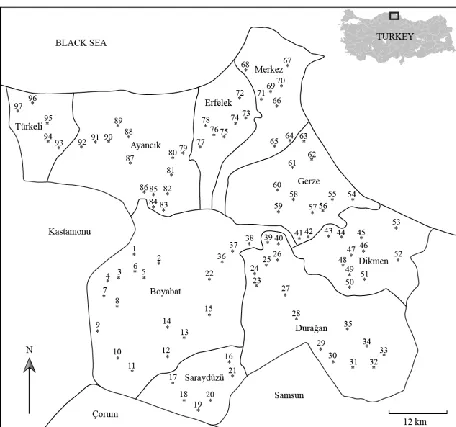
A total of 97 sa mpling sites with 11 different aquatic habitats (trough, creek, water body, pool, pond, reservoir, rice paddy, spring, stream, water fall and wetland) was randomly visited and sampled between 12-15 July, 2014 (Figure 1). All environmental variab les and basic geographical data were recorded before sampling in situ to prevent water d isturbance. Dissolved o xygen concentration (DO, mg L-1), percent o xygen saturation (%sat.), water te mperature (Tw, °C), electrical conductivity (EC, µS cm-1
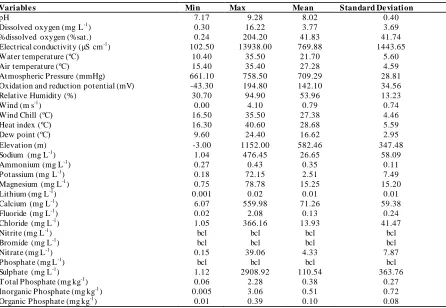
), pH, at mospheric pressure (mmHg ), oxidation-reduction potential (ORP, mV) were recorded by using a YSI-Professional Plus. A Kestrel-3000 model ane mo meter was used to obtain air temperature (Ta , °C), wind speed (m s-1), wind chill (w. chill, °C), heat inde x (HI, °C), dew point (Dp, °C) and relative humidity (%) while geographical data (elevation, coordinates) were recorded with a geographical positioning system (GA RM IN etre x Vista H GPS) (Table 1).
Then after, 100 ml of water for cation and anion (sodium (Na+1), a mmoniu m (NH4+1), potassium (K+1),
magnesiu m (Mg+2), lithiu m (Li+1), calc iu m (Ca+2), fluoride (F-1), chloride (CI-1), nitrite (NO2-1), bro mide
M. Yavuzatmaca et al. / Turk. J. Fish. Aquat. Sci. 17:1333-1346 (2017) 1335
(Br-1), nit rate (NO3-2), phosphate (PO4-3) and sulphate
(SO4-2) analyses was collected fro m each samp ling
site in plastic bottles and preserved in about 4ºC of container. Simila r to water samp les, sediment fro m each sampling site was gathered in Eppendorf to analyse amount of in/organic phosphate (phosphorous) and total phosphate (mg kg-1). Ostracod samples we re co mpiled with a standard sized hand net (200 µm in mesh size) fro m ca 4 cm over sediment and fixed with 70% of ethanol in 250 ml plastic bottles.
In the laboratory, water sa mples were firstly filtered through syringe-type me mbrane filter (0.45 µm) for cation and anions analyses that are performed with the direct ions in the standard method no: 4110 using Ion Chro matography (Dione x 1100) in Depart ment of Environ mental Engineering, Abant İzzet Baysal University (Bolu, Turkey). Dionex IonPac AS9-HC an ion colu mn (4x250 mm), Dione x IonPac AG9-SC (4x50 mm) pre-colu mn and Dione x ASRS-300 4 mm suppressor were used for an ion analyses along with the applicat ion of 9 mm Na2CO3
solution as a carrier phase at a flo w rate of 1.0 ml min
-1. In cation analyses, Dione x IonPac CS12A cation
column, Dione x IonPac CG12A (4x50 mm) p re-column and Dione x CSRS-300 4 mm suppressor were used. 10 ml of 1M meta sulfonic acid (MSA) were received as a carrier phase to prepare 1 litre solution. Flow rate o f prepared solution was 1.0 ml min.-1
during analys is. Sediment samples were firstly dried in drying oven at 40ºC (at least 24 hours), and then sequential e xtract ion procedure provided in Ruban et al. (1999) was used for determination of phosphorous forms (inorganic, organic and total) in sediment.
Each ostracod sample was filtered through four standardized sieves (0.5, 1.0, 1.5 and 2.0 mm mesh size) under tap water and then specimens were sorted fro m sediments under a stereomic roscope (Oly mpus ACH 1X). Subsequently, we dissected their soft body parts in lacto-phenol solution for ta xonomic identification. A light microscope (Oly mpus BX-51) was used for taxono mic identification. We used taxono mic keys of Meisch (2000) and Karanovic (2012) fo r species identificat ion. Va lves of some species were kept in mic ropaleontological slides for Scanning Electron Microscope (JEOL JSM-6390LV SEM) photography at Abant İzzet Baysal University. All o f the ostracod samples we re kept at the Limnology Laboratory of Abant İzzet Baysal University, Bo lu, Turkey and are available upon request.
Statistical Analyses
We determined eight groups (ranges) with 150 m of elevational intervals fro m 0 to 1152 m a.s.l. Analysis of similarity (ANOSIM ) was conducted to compare d is/simila rit ies in ostracod communit ies Table 1. M inimum, maximum, average and standard deviation of environmental variables were recorded in the Sinop province. bcl means below critical level.
Variable s Min Max Me an Standard De viation
pH 7.17 9.28 8.02 0.40
Dissolved oxygen (mg L-1) 0.30 16.22 3.77 3.69
%dissolved oxygen (%sat.) 0.24 204.20 41.83 41.74
Electrical conductivit y (µS cm-1) 102.50 13938.00 769.88 1443.65
Water temperature (ºC) 10.40 35.50 21.70 5.60
Air temperature (ºC) 15.40 35.40 27.28 4.59
Atmospheric Pressure (mmHg) 661.10 758.50 709.29 28.81
Oxidation and reduction potential (mV) -43.30 194.80 142.10 34.56
Relative Humidity (%) 30.70 94.90 53.96 13.23
Wind (m s-1) 0.00 4.10 0.79 0.74
Wind Chill (ºC) 16.50 35.50 27.38 4.46
Heat index (ºC) 16.30 40.60 28.68 5.59
Dew point (ºC) 9.60 24.40 16.62 2.95
Elevation (m) -3.00 1152.00 582.46 347.48
Sodium (mg L-1) 1.04 476.45 26.65 58.09
Ammonium (mg L-1) 0.27 0.43 0.35 0.11
Potassium (mg L-1) 0.18 72.15 2.51 7.49
Magnesium (mg L-1) 0.75 78.78 15.25 15.20
Lithium (mg L-1) 0.001 0.02 0.01 0.01
Calcium (mg L-1) 6.07 559.98 71.26 59.38
Fluoride (mg L-1) 0.02 2.08 0.13 0.24
Chloride (mg L-1) 1.05 366.16 13.93 41.47
Nitrite (mg L-1) bcl bcl bcl bcl
Bromide (mg L-1) bcl bcl bcl bcl
Nitrate (mg L-1) 0.15 39.06 4.33 7.87
Phosphate (mg L-1) bcl bcl bcl bcl
Sulphate (mg L-1) 1.12 2908.92 110.54 363.76
T otal Phosphate (mg kg-1) 0.06 2.28 0.38 0.27
Inorganic Phosphate (mg kg-1) 0.005 3.06 0.51 0.72
13 36 M. Ya vu za tma ca e t a l. / T u rk. J. F ish . Aq u a t. Sci . 1 7 :1333 -1346 (2 0 17)
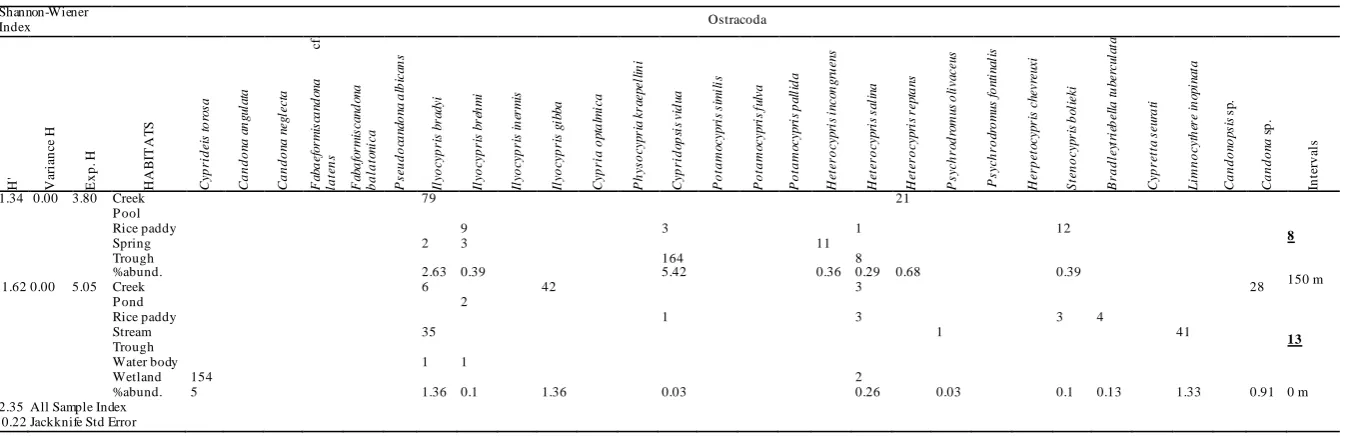
Table 2. Shannon-Wiener Index values (H', Variance H and Exp. H), habitat types, abundance and percent abundance (%abund.) of 28 taxa in eight groups 150 m elevational intervals in the Sinop province. Candonopsis sp. and Candona sp. were classified at genus level due to damaged soft body parts and the presence of only juveniles, respectively. Underlined bold numbers on the most right side show number of sampled sites in the concerned elevational intervals
Shannon-Wiener Index Ostracoda
H' Vari
an ce H E x p . H H A BIT A T S Cyp ri d ei s to ro sa Ca n d o na a n gu la ta Ca n d o na n eg lect a F a b a ef or m is ca n do na cf. la ten s F a b a fo rm is ca nd o na b a la to ni ca P seu d o ca nd o na a lb ica n s Il yo cyp ri s br ad yi Il yo cyp ri s br eh m i Il yo cyp ri s in er m is Il yo cyp ri s gi bb a Cyp ri a o pt a lm ica P h ys o cyp ri a kr aep el lin i Cyp ri d op si s vi d ua P o ta m ocyp ri s si m il is P o ta m ocyp ri s fu lva P o ta m ocyp ri s p al li d a H et er o cyp ri s in co n gr u en s He ter o cyp ri s sa li na H et er o cyp ri s rep ta ns P sych ro d ro m us o li va ceu s P sych ro dr o m us fo nt in al is H er p et ocyp ri s ch evr eu xi S ten o cyp ri s b ol ieki B ra d ley tr ie b el la tu ber cu la ta Cyp ret ta s eu ra ti Li m n o cyt h er e in op in at a Ca n d o no ps is s p. Ca n d o na s p . In terv al s
1.02 0.00 2.78 Creek 10 2 1 1200 m
P ool 1
P ond Spring 18 14
Trough 1 200 56 25 1 1
Water body 50 12
%abund. 0.03 8.47 0.65 1.85 0.81 0.03 0.42 1050 m 1.73 0.00 5.64 Reservoir P ond 4 58 10
Trough 60 7 3 62 23 17 9
%abund. 2.08 1.88 0.23 0.1 2.01 0.75 0.55 0.29 900 m 1.74 0.00 5.70 Creek 10 1
P ool 39 1 3
P ond 4
Stream 12
Trough 2 5 39 21
Water body 46
Water fall 22 64 3
Wetland 8 24 1 3 1 %abund. 2.53 1.59 0.13 2.89 0.16 1.27 0.78 0.03 0.1 0.16 750 m 1.87 0.00 6.50 Creek 7 11 2
Reservoir Spring 12 82 28 7 19 2 9
Trough 5 5 19 2 52 13 5
Wetland 1 1
%abund. 0.39 0.39 0.16 3.67 0.91 0.29 0.62 0.03 0.06 1.69 0.06 0.42 0.16 600 m 1.53 0.00 4.62 Creek 10 6 3 2
Reservoir 6 12
Stream 3
Trough 1 10 2 86 67 1 2 %abund. 0.03 0.42 0.26 0.19 0.1 0.1 2.85 2.17 0.03 0.71 450 m 1.75 0.00 5.75 Creek 215 2 1 1
Rice paddy 29 9 58 5 19
Spring 6
Stream 1 6 1 1
Trough 3 133 4 1 2 148 59 242 8
Water body 2
M. Ya vu za tma ca e t a l. / T u rk. J. F ish . Aq u a t. Sci . 17 :1333 -1 3 4 6 (2 0 1 7 ) 13 37
Table 2. Continued
Shannon-Wiener
Index Ostracoda
H' Vari
an ce H E x p . H H A BIT A T S Cyp ri d ei s to ro sa Ca n d o na a n gu la ta Ca n d o na n eg lect a F ab a ef or m is ca nd on a cf. la ten s F ab a fo rm is ca nd on a b a la to ni ca P seu d o ca nd o na a lb ica n s Il yo cyp ri s br ad yi Il yo cyp ri s br eh m i Il yo cyp ri s in er m is Il yo cyp ri s gi bb a Cyp ri a o pt a lm ica P h ys o cyp ri a kr aep el lin i Cyp ri d op si s vi d ua P o ta m ocyp ri s si m il is Potam ocyp ri s fu lva P o ta m ocyp ri s p al li d a H et er o cyp ri s in co n gr u en s H et er o cyp ri s sa li na H et er o cyp ri s rep ta ns P sych ro d ro m us o li va ceu s P sych ro dr o m us fo nt in al is H er p et ocyp ri s ch evr eu xi S ten o cyp ri s b ol ieki B ra d ley tr ie b el la tu ber cu la ta Cyp ret ta s eu ra ti Li m n o cyt h er e in op in at a Ca n d o no ps is s p. Ca n d o na s p . In terv al s
1.34 0.00 3.80 Creek 79 21 P ool
8
Rice paddy 9 3 1 12 Spring 2 3 11 Trough 164 8
%abund. 2.63 0.39 5.42 0.36 0.29 0.68 0.39 150 m 1.62 0.00 5.05 Creek 6 42 3 28
P ond 2
13
1338 M.Yavuzatmaca et al. / Turk. J. Fish. Aquat. Sci. 17:1333-1346(2017)
among these eight groups by means of using Co mmunity Analysis Package 4 software. The software Species Diversity & Richness 4 (Seaby & Henderson, 2006) was used to calculate Shannon -Wiener Inde x values for each group. An appreciable collinearity between the environmental variables used in Canonica l Correspondence Analysis (CCA) was tested by using Environmental Co mmunity Analysis II (ECOM II). When variab les had a Variat ion Inflat ion Factor > 10 and R-squared close to 1 indicative of mu ltico llinearity (ter Braak, 1995), we re moved those of highly correlated variables fro m the analysis. Prior to CCA, Detrended Correspond ence Analysis (DCA) was tested suitability of data for CCA. Accordingly, length of grad ient (>3) in DCA indicates that the data can be considered acceptable for CCA. Our DCA gradient length was calculated as 3.69 suggesting the suitability of data for CCA. All data were tested with Monte Carlo Pe rmutation tests (499 permutation) with a Forwa rd Se lection of Variables where rare species were re moved before analyses to reduce mult icollinearity and arc-effect (Birks, Line, Juggins, Stevenson, & ter Braak, 1990; ter Braa k, 1995). CCA was used to determine the relationships between ostracod species and environmental variables. DCA and CCA were performed with software package CANOCO for windows 4.5. A non-para metric Spearman Rank Corre lation ana lysis was performed to see possibilit ies of correlat ion between species and used environmental variables (IBM-SPSS Statistics Version 21). In all statistical analyses, adult individuals of the species with undamaged soft body parts and carapaces were used.
Results
A total of 3083 indiv iduals belonging to 28 ta xa (Table 2) were encountered fro m 76 of 97 samp ling
sites in the Sinop province. It is important to highlight the finding of nine bisexual populations of
Fabaeformiscandona balatonica (1♂), Ilyocypris
bradyi (3♂♂, 1022♀♀ ), I. inermis (2♂♂, 100♀♀ ),
Candona angulata (2♂♂, 11♀♀), C. neglecta (5♂♂, 7♀♀), Cyprideis torosa (86♂♂, 68♀♀),
Psychrodromus fontinalis (5♂♂, 109♀♀), Cypria
ophtalmica (2♂♂, 62♀♀) and Candonopsis sp.
(3♂♂). Species diversity fluctuated fro m sea level to 1152 m a .s.l. (Figure 2). A mong the sites, ma ximu m numbers of species reported fro m a spring (site 19; Figure 1) inc ludes six species (C. neglecta, I. bradyi,
I. inermis, P. fontinalis, Potamocypris similis and P.
fulva) at 645 m a.s.l.
ANOSIM results exhib ited no significant diffe rence in species composition a mong e ight groups with 150 m intervals (P>0.05). Of the species, I. bradyi was encountered in all elevational ranges when
Heterocypris incongruens, H. salina and
Psychrodromus olivaceus occurred in seven intervals (Table 2). However, nearly half (13) of the 28 ta xa (e.g., C. torosa, Bradleytriebella tuberculata, F. balatonica, Cypretta seurati) were discovered once in one of the eight elevational ranges. Overa ll, species diversity increased towards the middle e levational ranges (e.g., 301-450 m with 14 ta xa, 601-750 m with 13 ta xa) when percentage abundance and numbers of sampled sites showed variability (Tab le 2). The highest Shannon-Wiener diversity inde x value (H'=1.87) was reported for the range of 601-750 m while the lowest (H'=1.02) was found between 1051 and 1200 m (Table 2).
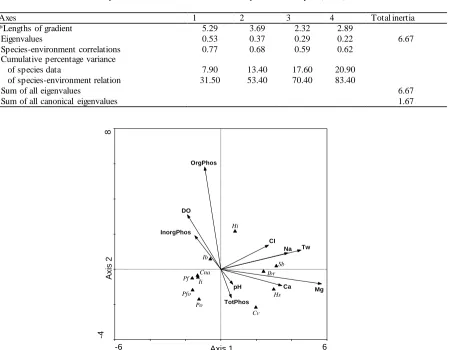
The first two a xes of CCA e xp la ined 53.40% o f relationships between 11 species and 10 environmental variables (water te mperature, organic, inorganic and total phosphates of sediment, p H, dissolved oxygen concentration, chloride, ca lciu m, magnesiu m and sodium) with a variance of 13.40 (Table 3).
Elevation (m a.s.l)
0 200 400 600 800 1000 1200
Num
be
r o
f
spe
cies
0 1 2 3 4 5 6 7
M. Yavuzatmaca et al. / Turk. J. Fish. Aquat. Sci. 17:1333-1346(2017) 1339
Three of the environ mental variables (magnesium (Mg+2, F=4.405, P=0.001), water temperature (Tw, F=3.099, P=0.011) and sediment organic phosphate (OrgPhos, F=3.278, P=0.027)) displayed strong effect on species distribution when the rest of them (p H (F=2.539, P=0.109), total phosphate (TotPhos, F=1.523, P=0.151), inorganic phosphates (InorgPhos, F=1.184, P=0.257), d issolved oxygen concentration (DO, F=1.305, P=0.263), chloride (CI-1, F=1.294, P=0.28), calc iu m (Ca+2, F=0.964, P=0.432) and sodiu m (Na+1, F=0.395, P=0.788)) did not show any significant effect. Eight species (C. angulata, Cypridopsis vidua, H. salina,
Ilyocypris brehmi, I. inermis, P. fulva, P. fontinalis
and P. olivaceus) located at the negative site of the
second axis when three species (H. incongruens, I.
bradyi and Stenocypris boliek i) were located on the
positive site. While two species (I. brehmi and H.
salina) showed close re lationships with Mg+2 and
Ca+2, respectively, I. bradyi displayed a close relationship with InorgPhos. Two other species (H.
incongruens and S. bolieki) are located on the site of CI-1, Na+1 and Tw but C. angulata, P. fulva, I.
inermis, P. fontinalis and P. olivaceus are placed on
the opposite site. Among the species, C. vidua did not show any close relationships with environ mental variables in spite of settled on the site of Ca+2, Mg+2, pH and TotPhos (Figure 3).
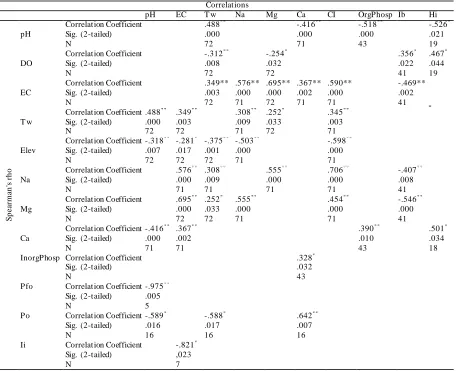
The species with cosmopolitan characteristics showed significant correlations with some of the used variables (Tab le 4). Of which, I. bradyi e xh ibited a positive significant correlation with dissolved oxygen concentration (P<0.05) when negatively corre lated with electrical conductivity (P<0.01), Na+2 and Mg+2 (P<0.01). Heterocypris incongruens and P. olivaceus were the only species with positive correlat ion to Ca+2. Also, P. fontinalis (P<0.01), H. incongruens and P. olivaceus (P<0.05) displayed negative correlations with water te mperature (Tw). Of the variables, elevation had a negative correlation with electrica l conductivity (P<0.05), p H, water te mperature, Na+2 and CI-1 (P<0.01). Inorganic (P<0.05) and organic
Table 3. Summary table of Canonical Correspondence Analysis (CCA) for 11 species (with three or more occurrences) and 10 environmental variables. * represents the result of Detrended Correspondence Analysis (DCA).
Axes 1 2 3 4 Total inertia
*Lengths of gradient 5.29 3.69 2.32 2.89
Eigenvalues 0.53 0.37 0.29 0.22 6.67
Species-environment correlations 0.77 0.68 0.59 0.62
Cumulative percentage variance
of species data 7.90 13.40 17.60 20.90
of species-environment relation 31.50 53.40 70.40 83.40
Sum of all eigenvalues 6.67
Sum of all canonical eigenvalues 1.67
-6 6
-4
8
Cna Ib
Ibr Ii
Cv Pf
Hi
Hs
Po Pfo
Sb
pH DO
Tw Na
Mg Ca CI
TotPhos InorgPhos
OrgPhos
Axis 1
A
x
is
2
Figure 3. CCA diagram indicating distribution of 11 species (triangles) according to the effect of 10 environmental variables (arrows)
from Sinop on the first and second axes. Abbreviations: C. angulata (Cna), Cypridopsis vidua (Cv), H. salina (Hs), H. incongruens (Hi),
1340 M. Yavuzatmaca et al. / Turk. J. Fish. Aquat. Sci. 17:1333-1346 (2017)
(P<0.01) phosphate concentrations of the sedimen ts and electrical conductivity (P<0.01) e xpressed a positive correlation with Ca+2 when pH (P<0.01) was negatively correlated (for more see Table 4).
Discussion
Before the present study, eight ostracod species (C. neglecta, Ilyocypris biplicata, I. inermis, I.
hartmanni C. torosa, Pseudocandona compressa,
Cyclocypris ovum and Dolerocypris pellucida) were
known fro m Sinop (Ghetti, 1973; Kale li, 1993; Kılıç, 2001). Of which, I. biplicata was accepted as a synonym of I. gibba in literature (Me isch, 2000). Therefore, the first four of these species were encountered in the present study and thus the re main ing 24 ta xa in the present study were firs tly reported for the Sinop province (Table 2). Now, the numbers of ostracod taxa in Sinop are increased to 32
(30 liv ing, 2 subfossils). Among the species, Bradleytriebella tuberculata is a new species (Figure 4) to Turkish Ostracoda fauna. Thus, the numbers of non-marine ostracod species in Turkey has increased to 144 species along with the recent checklist of Külköylüoğlu, Akdemir, Yavuzatmaca, and Yılmaz (2015).
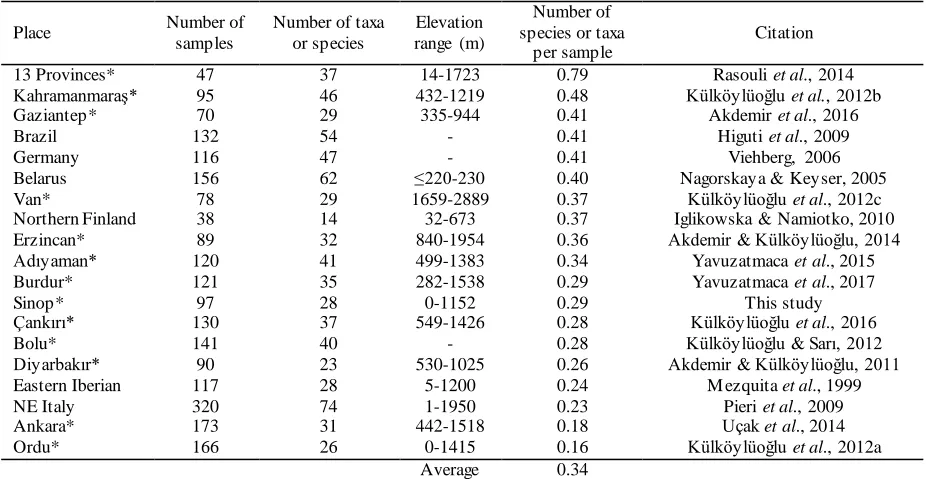
Nu mber o f ta xa per sa mple was lowe r in Sinop than the average numbers calculated fro m the previous studies in and out of Tu rkey (co mpare details in Tab le 5). Although increasing numbers of sampling sites tend to increase the numbers of species, we did not find such relationships. The number of ta xa per samp le can be elucidated by the quality of habitats, heterogeneity of geographical area and habitats types. For e xa mp le, Rasouli, Aygen, and Külköylüoğlu (2014) had the highest taxa per sample since they collected 47 sa mples fro m 13 provinces in Turkey but Kü lköylüoğlu, Sarı, Akdemir,
Table 4. Spearman Rank Correlation Analysis results among 11 variables and five species. Abbreviations: electrical conductivity (EC), water temperature (T w), dissolved oxygen concentration (DO), elevation (Elev), sodium (Na), magnesium (Mg), calcium ( Ca), chloride (CI),
organic phosphate (OrgPhosp), inorganic phosphate (InorgPhosp), Heterocypris incongruens (Hi), Ilyocypris bradyi (Ib), I. inerm is (Ii),
Psychrodromus fontinalis (Pfo) and P. olivaceus (Po). *Correlation is significant at the 0.05 level (2-tailed). **Correlation is significant at the 0.01 level (2-tailed).
Correlations
pH EC T w Na Mg Ca CI OrgPhosp Ib Hi
S
p
e
a
rm
a
n
's
r
h
o
pH
Correlation Coefficient .488** -.416** -.518** -.526*
Sig. (2-tailed) .000 .000 .000 .021
N 72 71 43 19
DO
Correlation Coefficient -.312** -.254* .356* .467*
Sig. (2-tailed) .008 .032 .022 .044
N 72 72 41 19
EC
Correlation Coefficient .349** .576** .695** .367** .590** -.469**
Sig. (2-tailed) .003 .000 .000 .002 .000 .002
N 72 71 72 71 71 41
T w
Correlation Coefficient .488** .349** .308** .252* .345**
Sig. (2-tailed) .000 .003 .009 .033 .003
N 72 72 71 72 71
Elev
Correlation Coefficient -.318** -.281* -.375** -.503** -.598**
Sig. (2-tailed) .007 .017 .001 .000 .000
N 72 72 72 71 71
Na
Correlation Coefficient .576** .308** .555** .706** -.407**
Sig. (2-tailed) .000 .009 .000 .000 .008
N 71 71 71 71 41
Mg
Correlation Coefficient .695** .252* .555** .454** -.546**
Sig. (2-tailed) .000 .033 .000 .000 .000
N 72 72 71 71 41
Ca
Correlation Coefficient -.416** .367** .390** .501*
Sig. (2-tailed) .000 .002 .010 .034
N 71 71 43 18
InorgPhosp Correlation Coefficient .328*
Sig. (2-tailed) .032
N 43
Pfo Correlation Coefficient -.975**
Sig. (2-tailed) .005
N 5
Po Correlation Coefficient -.589* -.588* .642**
Sig. (2-tailed) .016 .017 .007
N 16 16 16
Ii Correlation Coefficient -.821*
Sig. (2-tailed) ,023
M. Yavuzatmaca et al. / Turk. J. Fish. Aquat. Sci. 17:1333-1346(2017) 1341
Yavuzatmaca, and Altınbağ (2012a) had the lowest value where 166 samp les were collected fro m one province. So me of those s tudies in Table 5 had similar results but effect of some other te mporal (e .g., sampling season, time) and spatial factors (e .g.,
habitat conditions, disturbance, pollution, etc.) should also be considered critically.
The non-significant diffe rences among the species composition of e ight different e levational ranges are due to the common occurrences of Figure 4. Scanning Electron M icroscope images. A-C; Bradleytriebella tuberculata, A: anterior part of the left valve; B: outside view of left vale; C: outside view of right valve. D-E; Cypretta seurati, D: outside view of right valve; E: anterior part of right valve. F; Stenocypris bolieki, outside view of right valve. Arrows show the anterior side.
Table 5. Number of samples, taxa or species, and number of taxa or species per sample in some previous studies and their elevational ranges (as possible), and in the present study . * indicates studies in Turkey
Place Number of
samples
Number of taxa or species
Elevation range (m)
Number of species or taxa
per sample
Citation
13 Provinces* 47 37 14-1723 0.79 Rasouli et al., 2014
Kahramanmaraş* 95 46 432-1219 0.48 Külköylüoğlu et al., 2012b
Gaziantep* 70 29 335-944 0.41 Akdemir et al., 2016
Brazil 132 54 - 0.41 Higuti et al., 2009
Germany 116 47 - 0.41 Viehberg, 2006
Belarus 156 62 ≤220-230 0.40 Nagorskaya & Keyser, 2005
Van* 78 29 1659-2889 0.37 Külköylüoğlu et al., 2012c
Northern Finland 38 14 32-673 0.37 Iglikowska & Namiotko, 2010
Erzincan* 89 32 840-1954 0.36 Akdemir & Külköylüoğlu, 2014
Adıyaman* 120 41 499-1383 0.34 Yavuzatmaca et al., 2015
Burdur* 121 35 282-1538 0.29 Yavuzatmaca et al., 2017
Sinop* 97 28 0-1152 0.29 This study
Çankırı* 130 37 549-1426 0.28 Külköylüoğlu et al., 2016
Bolu* 141 40 - 0.28 Külköylüoğlu & Sarı, 2012
Diyarbakır* 90 23 530-1025 0.26 Akdemir & Külköylüoğlu, 2011
Eastern Iberian 117 28 5-1200 0.24 M ezquita et al., 1999
NE Italy 320 74 1-1950 0.23 Pieri et al., 2009
Ankara* 173 31 442-1518 0.18 Uçak et al., 2014
Ordu* 166 26 0-1415 0.16 Külköylüoğlu et al., 2012a
1342 M. Yavuzatmaca et al. / Turk. J. Fish. Aquat. Sci. 17:1333-1346 (2017)
“cosmoecious” species (e.g., I. bradyi, H. incongruens) almost in all ranges (Table 2). In addition, supportive approach of “Intermediate Disturbance Hypothes is” (Connell, 1978) was provided for the species diversity at diffe rent elevational ranges in the present study where the highest species diversity was reported progress to middle e levation when the diversity inde x values began to decrease at the low and high elevational ranges (Table 2). Our results coped with the results of some previous studies. For e xa mp le, Külköylüoğlu, Yavuzatmaca, A kdemir, and Sarı (2012b) reported highest species number (20 spp.) at 801-1000 m when the range is 432-1219, and Uçak, Külköylüoğlu, Akdemir, and Başak (2014) noted the highest species diversity (16 spp.) at 841-940 and 941-1040 m where the range is 442-1518 m. In this case, the sampling habitats at low a ltitude are c lose to residential areas where they are under the human influence and so the conditions in these kinds of habitats fluctuate due to rate of anthropogenic activities. Although samplings were conducted at high elevational ranges far fro m residential areas, physico-chemica l variables of water can be changed between the ranges. Since increase or decrease in elevation alters the temperature of surface water, any changes in te mperature can be effective on physical, che mical and bio logical processes in water bodies (Chapman & Kimstach, 1996; Reeves, De Decke r, & Ha lse, 2007). This is probably the case in the present study where water te mperature showed positively significant corre lations with pH, EC, Na+2, CI-1, and Mg+2 but correlation was negative with elevation and DO (Table 4). Co mparing to the conditions at low and high elevational ranges, conditions in mid e levations are re latively stable and can be considered better s uitable sites for non-cosmopolitan species and also for cos mopolitans. Therefore, species diversity at mid elevations are found higher than at low and high elevations.
Canonical correspondence analysis reveals that local ostracod species composition in th e Sinop province is significantly influenced by Mg+2, water temperature and sediment’s organic phosphate (Figure 3). Magnesiumis one of the main t race ele ment within the low magnesium calc iu m carbonated (in the form of calc ite) ca rapaces of ostracod (Engs trom & Ne lson, 1991; Anadón, Gliozzi, & Mazzini, 2002). Similar to our results, several prev ious studies pinpointed the effect of water temperature (Viehberg, 2006; Uçak et
al., 2014) and Mg+2 (Viehberg, 2006) on species
composition. Indeed, we found close relationship between Mg+2 and water te mperature (Table 4). Implication of this result can be associated to the calcificat ion process of ostracod carapaces during mo lting (Ch ivas, De Deckker, & Shelley, 1983; Carbonel & Tö ldener-Farmer, 1988). The effectiveness of sediment’s organic phosphate can be related to the availability of food. This is because dissolved inorganic phosphate is absorbed by plants and subsequently incorporated in their body (Boyd,
2000). If one recognizes the ro le o f ostracods in benthic food web and their feeding behaviour (e.g., dead and living plant parts, dead anima l body) that may e lucidate why organic phosphate concentration of sediments is important for the distribution of ostracods. Unfortunately, knowledge on the relationship between sediment and ostracods is scarce and further studies are necessary.
Ilyocypris bradyi is a well-known
“cosmoecious” species (Külköylüoğlu, 2013). The common occurrences of the species in a ll e levational ranges in the present study (Table 2) corresponds with the wide tolerance ranges of species across different elevational ranges (0-3194 m) (Yavuzat maca, Külköylüoğlu, & Yılmaz, 2017). Un like Uçak et al. (2014), the species e xhibited positive and negative correlations with DO and EC, respectively (Table 4, Figure 3). A lso, it showed a close re lationship with inorganic phosphate in CCA diagra m (Figure 3) and had negative correlations with Na+1 and Mg+2 (Table 4). Li, Liu, Zhang, and Sun (2010) co llected species fro m the La ke Qinghai water with Na+1 (0.003-2.662 g L-1) and Mg+2 (0.015-0.743 g L-1) contents and we collected species fro m waters with relat ively h igh Na+1 (1.09-237.43 mg L-1) and Mg+2 (0.75-60.23 mg L-1) contents. Ilyocypris inermis and I. brehmi had lower percent abundances than I. bradyi (Table 2). The ordination of I. inermis on the opposing site of Na+1, CI-1 and water temperature in CCA diagra m (Figure 3) support the previously noted negative correlation of species with electrical conductivity (Külköylüoğlu, Sarı & Akdemir, 2012c) and water temperature (Külköylüoğlu et al., 2013). The ecology
of I. brehmi is not well known. There fore, further
studies are needed to make better co mments about the ecological preferences of I. brehmi.
Another “cosmoecious” species, P. olivaceus, had the second highest abundance (Table 2). M ischke
et al. (2014) revea led that P. olivaceus prefers
habitats with lo w specific electrica l conductivity (EC) and stable ion compositions. This finding was supported within the present study that P. olivaceus was positioned on the opposite site of Na+1 and CI-1 contents in CCA diagra m (Figure 3). In contrast, Külköylüoğlu et al. (2013) found a positively significant corre lation of the species with EC. Un like P. olivaceus, P. fontinalis had a low abundance value. As found in the present study, Külköylüoğlu and Sarı (2012) reported a negative significant correlat ion of species with pH. A lthough the negative relationships
of P. fontinalis with water te mperature (Uçak et al.,
2014; the present study), wide range of water temperature (7.4-29.8 ºC) (Yavuzat maca et al., 2017) where species found in literature showed that it can tolerate moderately high temperature.
M. Yavuzatmaca et al. / Turk. J. Fish. Aquat. Sci. 17:1333-1346(2017) 1343
Table 4. Lo west and highest Ca+2 content values as 49.64-210.14 mg L-1 for species were noted in the present study when Li et al. (2010) and Van der Meeren et al. (2010) reported 0.452-0.615 g L-1 and 0.1-62.5%, respectively. A lso, Cusminsky, Pé re z, Schwalb, and Whatley (2005) revealed 8.67-27.97 mg L-1 range of Ca+2 content for the species. Close relationship of H. salina with Ca+2 content herein (Figure 3) support the presence of species in the high Ca+2 content (average = 30.4%) in western Mongolia (Van der Meeren et al., 2010). We encountered H.
salina in waters with 6.07-210.14 mg L-1 Ca+2 content
when Li et al. (2010) collected it in waters with 0.017-0.615 g L-1. Unlike Valls, Rueda, and Mesquita-Joanes (2014) and Yavu zat maca et al. (2017), we did not find any c lose relat ionships of H. salina with dissolved oxygen concentration (Figure 3). Ma zzin i et al. (2014) and Va lls et al. (2014) revealed the presence of species in waters with 2.38 -2.46 mg L-1 (but not specified) and 0.06±0.00-0.17±0.14 mg L-1 phosphate contents, respectively,
when we gathered H. salina from water with 0.14-2.48 mg kg-1 inorganic and 0.025-0.23 mg kg-1 organic phosphates contents of sediment.
Like to our finding, Akdemir and Külköylüoğlu (2014) p inpointed the opposing relationship of C. vidua with dissolved oxygen content but Hussein, Obuid-Allah, Mahmoud, and Fangary (2004) reported a positive correlat ion. Range of dissolved oxygen for the species in literature was e xpand with the present study (0.6-19 mg L-1 (the present study; Külköylüoğlu, 2013)). Additionally, Pieri, Vandekerkhove, and Goi (2012) and Mazzin i et al. (2014) encountered species in water with 0.08 -0.24 mg L-1 total phosphorus in Ledra River (not specified) and 0.48-2.55 mg L-1 phosphate in Caffare lla Va lley (Italy), respectively, while we collected it in waters with total phosphate (0.104-0.64 mg kg-1), inorganic phosphate (0.251-2.48 mg kg-1) and organic phosphate (0.022-0.23 mg kg-1) of sediments. Moreover, the range of Mg+2 (6.04-56 mg L-1 (the present study; Palacios -Fest and Dettman, 2001)) and Ca+2 (34.10-258 mg L- (the present study; Palac ios -Fest and Dettman, 2001)) for C . vidua was also enlarged.
Meisch (2000) stated that Candona angulata prefers slightly salty waters (0.2-14 ‰) and this statement was supported by the ordination of species on site of CI-1, Na+1 and water te mperature in the present study. We have poor information about the ecology of P. fulva. Although species located on the opposing site of water te mperature in the pres ent study (Figure 3), P. fulva has a wide range of water temperature in literature (1.56-27.40°C (Kü lköylüoğlu et al., 2007; Sarı, 2007)).
There is almost no any ecological and biological informat ion about Stenocypris bolieki. Minimu m and ma ximu m va lues of some variables of aquatic bodies where S. bolieki occurred in the present study were as followings water temperature (20.08-30°C), dissolved
oxygen (0.6-2.03 mg L-1), pH (7.71-8.25), e lectrica l conductivity (568-1050 µS c m-1), elevation (34-303 m), Na+1 (12.04-45.40 mg L-1), Mg+2 (6.07-28.72 mg L-1), Ca+2 (65.67-89.35 mg L-1) and CI-1 (4.31-24.97 mg L-1).
In conclusion, with the findings of the present study, numbers of ostracod taxa have been increased to 32 ta xa in Sinop. Nu mber of ta xa/species per sample and species diversity are inclined by habitat quality and geographical heterogeneity rather than the number o f sa mpling sites. Also, anthropogenic impact and physico-chemica l changes at low and high elevations, respectively, affect the species composition. This causes the common presence of cosmopolitans in almost all e levational ranges when non-cosmopolitans seem to be distributed in undisturbed low and middle e levational ranges. In contrast to the statement of Smith (1993) as sensitivity of ostracod’s distribution to anions not cations, we found the significant effect of Mg+2 along with water te mperature and total phosphate content of sediments. Accordingly, the nu mber of studies on ostracods coupling with water and sediment analyses should be increased to provide better understanding of their characteristic in future work.
Acknowledgement
We wish to thank Dr. Nusret Kara kaya (Abant İzzet Baysal Un iversity) and En is Akay (Uludağ University) for their help in sediment and cation/anions analyses, and field studies, respectively. Gü rkan Özcan and Filiz Batmaz (Abant İzzet Baysal University) were also thanked for their help in laboratory work. Besides, Mrs. Emine Demirtürk (Abant İzzet Baysal University) is kindly acknowledged for her help with SEM photography. This study was funded by The Scientific and Technological Research Council of Turkey (TUBITAK, Project no: 213O172).
References
Adams, W.J., Kimerle, R.A., & Barnett, JR J.W. (1992). Sediment quality and aquatic life assessment. Environmental Science & Technology, 26(10), 1865-1875. http://dx.doi.org/10.1021/es00034a001.
Akdemir, D., & Külköylüoğlu, O. (2011). Freshwater Ostracoda (Crustacea) of Diyarbakır Province, including a new report for Turkey. Turkish Journal of
Zoology, 35(5), 671-675.
http://dx.doi.org/10.3906/zoo-0912-32.
Akdemir, D., & Külköylüoğlu, O. (2014). Preliminary study on distribution, diversity, and ecological characteristics of non-marine Ostracoda (Crustacea) from the Erzincan region (Turkey). Turkish Journal of Zoology, 38, 421-431. http://dx.doi.org/10.3906/zoo-1301-16.
1344 M. Yavuzatmaca et al. / Turk. J. Fish. Aquat. Sci. 17:1333-1346 (2017)
Applied Limnology, 187(4), 307-314. http://dx.doi.org/10.1127/fal/2016/0665.
Anadón, P., Gliozzi, E., & Mazzini, I. (2002). Paleoenvironmental reconstruction of marginal marine environments from combined paleoecological and geochemical analyses on ostracods. In: J. Holmes & A. Chivas (Eds.), The Ostracoda: Applications in Quaternary Research. Geophysical Monograph, 131, 227-247. http://dx.doi.org/10.1029/131GM 12. Benson, R.H. (1990). Ostracoda and the discovery of global
Cainozoic palaeoceanographical events. In: R. Whatley & C. M aybury (Eds.), Ostracoda and Global events, (pp. 41-59). Chapman & Hall, London. Birks, H.J.B., Line, J.M ., Juggins, S., Stevenson, A.C., &
ter Braak, C.J.F. (1990). Diatoms and pH Reconstruction. Philosophical Transaction of the Royal Society London B, 327, 263-278. http://dx.doi.org/10.1098/rstb.1990.0062
Boström, B., Andersen, J.M., Fleischer, S., & Jansson, M. (1988). Exchange of phosphorus across the sediment -water interface. Hydrobiologia, 170, 229-244. http://dx.doi.org/10.1007/BF00024907
Boyd, C.E. (2000). Water Quality, an Introduction. Kluwer Academic Publishers, New York, 330 pp.
Carbonel, P., & Tölderer-Farmer, M . (1988). The ostracod carapace as a hydrochemical source of information at water/sediment interface. In: T. Hanai, N. Ikeya & K. Ishizaki (Eds.), Evolutionary biology of Ostracoda (pp. 341-351). Kodansha Ltd. Tokyo, 1356 pp. Chapman, D., & Kimstach, V. (1996). Selection of water
quality variables. In D. Chapman (Ed.), Water Quality Assessments - A Guide to Use of Biota, Sediments and Water in Environmental M onitoring - Second Edition. UNESCO/WHO/UNEP. ISBN 0 419 21590 5 (HB) 0 419 21600 6 (PB).
Chivas, A.R., De Deckker, P., & Shelley, J.M .G. (1983). M agnesium, strontium and barium partitioning in nonmarine ostracode shells and their use in paleoenvironmental reconstructions-a preliminary study. In: R.F. M addocks (Ed.), Applications of Ostracoda (pp. 238-249). University of Houston, Geoscience, Houston.
Connell, J.H. (1978). Diversity in Tropical Rain Forests and Coral Reefs. Science, 199(4335), 1302-1310. http://dx.doi.org/10.1126/science.199.4335.1302. Cusminsky, G.C., Pérez, P.A., Schwalb, A., & Whatley, R.
(2005). Recent Lacustrine Ostracods from Patagonia, Argentina. Revista Espanola de Micropaleontologia, 37(3), 431-450.
Delorme, L.D. (1991). Ostracoda. In J.H. Thorpe & A.P. Covich (Eds.), Ecology and Classification of North American Invertebrates (pp. 691-722). Academic Press, New York.
Engstrom, D.R., & Nelson, S.R. (1991). Paleosalinity from trace metals in fossil ostracodes compared with observational records at Devils Lake, North Dakota, USA. Palaeogeography, Palaeoclimatology, Palaeoecology, 83(4), 295-312.
http://dx.doi.org/10.1016/0031-0182(91)90057-X. Friedrich, G., Chapman, D., & Beim, A. (1996).The use of
biological material. In D. Chapman (Ed.), Water Quality Assessments - A Guide to Use of Biota, Sediments and Water in Environmental M onitoring. Second Edition,UNESCO/WHO/UNEP. ISBN 0 419 21590 5 (HB) 0 419 21600 6 (PB)
Ghetti, P.F. (1973). L’ostracodofauna di alcune risaie turche e persiana. – Estratto dall’Ateneo Parmense, 8 (Supp.
1), 117–147, Parma.
Higuti, J., Lansac-Tôha, F.A., Velho, L.F.M ., & M artens, K. (2009b). Biodiversity of Non-marine Ostracods (Crustacea, Ostracoda) in the Alluvial Valley of the Upper Paraná River, Brazil. Brazilian Journal of Biology, 69 (2. Suppl.), 661-668.
http://dx.doi.org/10.1590/S1519-69842009000300020.
Hussein, M .A., Obuid-Allah, A.H., M ahmoud, A.A., & Fangary, H.M . (2004). Ecology of Eight Species of Freshwater Ostracods (Crustacea) from Qena Governorate, Upper Egypt. Egyptian Journal of Aquatic Biology & Fisheries, 8(4), 107-122.
Iglikowska, A., & Namiotko, T. (2010). Freshwater Ostracoda (Crustacea) of Inari Lapland in northern Finland. Annales de Limnologie - International Journal of Limnology, 46, 199-206. http://dx.doi.org/10.1051/limn/2010016.
Iglikowska, A., & Namiotko, T. (2012). The impact of environmental factors on diversity of Ostracoda in freshwater habitats of subarctic and temperate Europe. Annales Zoologici Fennici, 49, 193-218. http://dx.doi.org/10.5735/086.049.0401.
Kaleli, A. (1993). Orta Karadeniz Sahil Ostrakod (Crustacea) Faunası ve Zoocoğrafik Yayılışı [The Ostracoda (Crustacea) fauna of the M iddle Black Sea Region coasts and their zoogeographical distribution] (M Sc Thesis). İstanbul University, İstanbul, Turkey. Karanovic, I. (2012). Recent Freshwater Ostracods of the
World. Springer-Verlag Berlin Heidelberg, 608 pp. Kılıç, M. (2001). Recent Ostracoda (Crustacea) fauna of the
Black Sea coasts of Turkey. Turkish Journal of Zoology, 25, 375–388.
Külköylüoğlu, O. (2013). Diversity, Distribution and Ecology of Non-marine Ostracoda (Crustacea) in Turkey: Application of Pseudorichness and Cosmoecious Species Concepts. Recent Research Development in Ecology, 4, 1-18. ISBN: 978-81-7895-585-8
Külköylüoğlu, O., Akdemir, D., Sarı, N., Yavuzatmaca, M., Oral, C., & Başak, E. (2013). Distribution and Ecology of Ostracoda (Crustacea) from Troughs in Turkey. Turkish Journal of Zoology, 37, 277-287. http://dx.doi.org/10.3906/zoo-1205-17.
Külköylüoğlu, O., Akdemir, D., Yavuzatmaca, M., & Yılmaz, O. (2015). A checklist of recent non-marine Ostracoda (Crustacea) of Turkey with three new records. Review of Hydrobiology, 8(2), 77-90. Külköylüoğlu, O., Dügel, M., & Kılıç, M. (2007).
Ecological requirements of Ostracoda (Crustacea) in a heavily polluted shallow lake, Lake Yeniçağa (Bolu, Turkey). Hydrobiologia, 585, 119-133. http://dx.doi.org/10.1007/s10750-007-0633-6. Külköylüoğlu, O., & Sarı, N. (2012). Ecological
characteristics of the freshwater Ostracoda in Bolu Region (Turkey). Hydrobiologia, 688, 37-46. http://dx.doi.org/10.1007/s10750-010-0585-0. Külköylüoğlu, O., Sarı, N., & Akdemir, D. (2012c).
Distribution and ecological requirements of ostracods (Crustacea) at high altitudinal ranges in Northeastern Van (Turkey). Annales de Limnologie – International Journal of Limnology, 48, 39-51.
http://dx.doi.org/10.1051/limn/2011060.
M. Yavuzatmaca et al. / Turk. J. Fish. Aquat. Sci. 17:1333-1346(2017) 1345
Testing the Rapoport Rule. High Altitude Medicine & Biology, 13(2), 126-136.
http://dx.doi.org/10.1089/ham.2011.1111.
Külköylüoğlu, O., Yavuzatmaca, M., Akdemir, D., & Sarı, N. (2012b). Distribution and Local Species Diversity of Freshwater Ostracoda in Relation to Habitat in the Kahramanmaraş Province of Turkey. International Review of Hydrobiology, 97(4), 247-261. http://dx.doi.org/10.1002/iroh.201111490.
Külköylüoğlu, O., Yavuzatmaca, M., Sarı, N., & Akdemir, D. (2016). Elevational distribution and species diversity of freshwater Ostracoda (Crustacea) in Çankırı region (Turkey). Journal of Freshwater Ecology, 31(2), 219-230.
http://dx.doi.org/10.1080/02705060.2015.1050467. Li, X., Liu, W., Zhang, L., & Sun, Z. (2010). Distribution of
Recent ostracod species in the Lake Qinghai area in northwestern China and its ecological significance. Ecological Indicators, 10, 880-890. http://dx.doi.org/10.1016/j.ecolind.2010.01.012. M azzini, I., Ceschin, S., Abati, S., Gliozzi, E., Piccari, F., &
Rossi, A. (2014). Ostracod communities associated to aquatic macrophytes in an urban park in Rome, Italy. International Review of Hydrobiology, 99, 1-10. http://dx.doi.org/10.1002/iroh.201301728.
M eisch, C. (2000). Freshwater Ostracoda of Western and Central Europe. Heidelberg: Spektrum Akademischer Verlag, Süßwasserfauna von Mitteleuropa, 8, I-xii, 522 pp.
M ezquita, F., Tapia, G., & Roca, J.R. (1999). Ostracoda from springs on the eastern Iberian Peninsula: ecology, biogeography and palaeolimnological implications. Palaeogeography, Palaeoclimatology, Palaeoecology, 148, 65–85.
http://dx.doi.org/10.1016/S0031-0182(98)00176-X. M ischke, S., Almogi-Labin, A., Al-Saqarat, B., Rosenfeld,
A., Elyashiv, H., Boomer, I., Stein, M ., Lev, L., & Ito, E. (2014). An expanded ostracod-based conductivity transfer function for climate reconstruction in the Levant. Quaternary Science Reviews, 93, 91-105. http://dx.doi.org/10.1016/j.quascirev.2014.04.004. M odig, H., Van de Bund, W.J., & Olafsson, E. (2000).
Uptake of phytodetritus by three ostracod species from the Baltic Sea: effects of amphipod disturbance and ostracod density. Marine Ecology Progress Series, 202, 125–134.
http://dx.doi.org/10.3354/meps202125.
M ucha, A.P., Vasconcelos, M .T.S.D., & Bordalo, A.A. (2003). M acrobenthic community in the Douroestuary: relations with trace metals and natural sediment characteristics. Environmental Pollution, 121, 169-80. http://dx.doi.org/10.1016/S0269-7491(02)00229-4.
Nagorskaya, L., & Keyser, D. (2005). Habitat diversity and ostracod distribution patterns in Belarus.
Hydrobiologia, 538, 167-178.
http://dx.doi.org/10.1007/s10750-004-4959-z. Palacios-Fest, M .R., & Dettman, D. (2001). Temperature
controls monthly variation in Ostracode valve M g/Ca: Cypridopsis vidua from a small lake in Sonora, M exico. Geochimica et Cosmochimica Acta, 65, 2499-2507. http://dx.doi.org/10.1016/S0016-7037(01) 00602-0.
Pieri, V., M artens, K., Stoch, F., & Rossetti, G. (2009). Distribution and ecology of non-marine ostracods (Crustacea, Ostracoda) from Friuli Venezia Giulia (Ne Italy). Journal of Limnology, 68(1), 1-15.
http://dx.doi.org/10.4081/jlimnol.2009.1.
Pieri, V., Vandekerkhove, J., & Goi, D. (2012). Ostracoda (Crustacea) as indicators for surface water quality: a case study from the Ledra River basin (NE Italy).
Hydrobiologia, 688(1), 25-35.
http://dx.doi.org/10.1007/s10750-010-0568-1. Rasouli, H., Aygen, C., & Külköylüoğlu, O. (2014).
Contribution to the Freshwater Ostracoda (Crustacea) Fauna of Turkey: Distribution and Ecological Notes. Turkish Journal of Fisheries and Aquatic Sciences, 20, 11-20. http://dx.doi.org/10.4194/1303-2712-v14_1_02.
Reeves, J.M ., De Deckker, P., & Halse, S.A. (2007). Groundwater Ostracods from the arid Pilbara region of northwestern Australia: Distribution and Water Chemistry. Hydrobiologia, 585, 99-118. http://dx.doi.org/10.1007/s10750-007-0632-7. Ruban, V., Lópes-Sánchez, J.F., Pardo, P., Rauret, G.,
M untau, H., & Quevauviller, Ph., (1999). Selection and evaluation of sequential extraction procedures for the determination of phosphorus forms in lake sediment. Journal of Environmental Monitoring, 1, 51-56. http://dx.doi.org/10.1039/A807778I.
Ruiz, F., Abad, M ., Bodergat, A.M ., Carbonel, P., Rodríguez-Lázaro, J., González-Regalado, M.L., Toscano, A., García, E.X., & Prenda, J. (2013). Freshwater ostracods as environmental tracers. International Journal of Environmental Science and Technology, 10, 1115-1128. http://dx.doi.org/10.1007/ s13762-013-0249-5.
Sarı, N. (2007). Determination of Ecological Features of the Freshwater Ostracoda (Crustacea) in Bolu Region (Turkey) (MSc Thesis). Abant İzzet Baysal University, Bolu, Turkey.
Seaby, R.M ., & Henderson, P.A. (2006). Species Diversity and Richness, Version 4. Pisces Conservation Ltd., Lymington, UK.
Sinop Valiliği (2016). Retrieved from http://www.sinop.gov.tr/cografya (Date: 30.09.2016). Smith, A.J. (1993). Lacustrine ostracodes as hydrochemical
indicators in lakes of the north-central United States. Journal of Paleolimnology, 8, 121-134. http://dx.doi.org/10.1007/BF00119785.
ter Braak, C.J.F. (1995). Ordination. In R.H.G. Jongman, C.J.F. ter Braak & O.F.R. Van Tongeren (Eds.), Data Analysis in community and landscape ecology (pp. 91-173). Cambridge University Press, Cambridge. Uçak, S., Külköylüoğlu, O., Akdemir, D., & Başak, E.
(2014). Distribution, Diversity and Ecological Characteristics of Freshwater Ostracoda (Crustacea) in Shallow Aquatic Bodies of the Ankara Region,
Turkey. Wetlands, 34, 309-324.
http://dx.doi.org/10.1007/s13157-013-0499-5. Valls, L., Rueda, J., & M esquita-Joanes, F. (2014). Rice
fields as facilitators of freshwater invasions in protected wetlands: the case of Ostracoda (Crustacea) in the Albufera Natural Park (E Spain). Zoological Studies, 53, 68-77. http://dx.doi.org/10.1186/s40555-014-0068-5.
Van der M eeren, T., Almendinger, J.E., Ito, E., & M artens, K. (2010). The ecology of ostracodes (Ostracoda, Crustacea) in western M ongolia. Hydrobiologia, 641, 253-273. http://dx.doi.org/10.1007/s10750-010-0089-y.
1346 M. Yavuzatmaca et al. / Turk. J. Fish. Aquat. Sci. 17:1333-1346 (2017)
213-224. http://dx.doi.org/10.1007/s10750-006-0241-x.
Wetzel, R.G. (2001). Limnology: Lake and River Ecosystems. Academic Press, Elsevier Science (USA), 1006 pp.
Yavuzatmaca, M., Külköylüoğlu, O., & Yılmaz, O. (2015). Distributional patterns of non-marine Ostracoda
(Crustacea) in Adiyaman Province (Turkey). Annales de Limnologie - International Journal of Limnology, 51, 101-113. http://dx.doi.org/10.1051/limn/2015005. Yavuzatmaca, M., Külköylüoğlu, O., & Yılmaz, O. (2017).