Journal of Information Technology and Computer Science Volume 4, Number 2, September 2019, pp. 193-201
Journal Homepage: www.jitecs.ub.ac.id
Modeling Agent-Oriented Methodologies for Landslide
Management
Very Sugiarto1, Fatwa Ramdani2, Fitra A. Bachtiar3
1,2,3Geoinformatics Research Group, Brawijaya University, Malang, Indonesia
{1[email protected], 2[email protected], 3[email protected]}
Received 19 July 2019; accepted 14 October 2019
Abstract. One of the most fatal natural disasters in Batu City was a landslide. The percentage of casualties if directly affected by landslides is 47%. This number is quite large when compared to other natural disasters. Even though the potential of the tsunami is the biggest, when compared to the intensity of the occurrence, landslides are the most common and most often cause fatalities. One of the causes of many fatalities in natural disasters is the lack of preparedness management. For that reason the need to develop a technology that can support to reduce fatalities in landslides is needed. One of the technologies used to prevent the number of fatalities caused by natural disasters is to use multi-agent system. One of the advantages of an agent is use Belief-Desire-Intention (BDI) models for building the Muiti-Agent Systems (MAS). The specific objective of this study was to model a simulated natural disaster landslide using the Prometheus Methodology. Evaluation is done by generating a model using jackCode and implementing it using the Java Agent Development Framework. The results of this study indicate that a model made using the Prometheus Methodology can be used as a simulation of natural disaster preparedness for landslides.
Introduction
Over the past decade the National Disaster Management Agency (BNPB) has recorded total natural disasters that have occurred in Indonesia reaching 19,245 times [1]. Of the many natural disasters that occur there are the top three are floods, tornadoes and landslides. The three natural disasters were 89.3% with 4,286 people killed. However, when viewed from the percentage comparison of the number of fatalities and injuries, landslides ranked the highest, namely 47% of the victims died and 53% of the victims injured. Whereas for floods and tornado the victims who died were 2% and 10%. Judging from the percentage above we can conclude if the potential for landslides has enormous potential to claim lives.
194 JITeCS Volume 4, Number 2, September 2019, pp 193-201
p-ISSN : 2540-9433; e-ISSN : 2450-9824
in 2018 there have been 27 landslides with 28 victims and 89 damage points. The number of fatalities due to landslides is a major concern of the BPBD of Batu City so that the following years of fatalities can be minimized.
One solution to reduce the number of fatalities due to landslides is to maximize the preparedness phase in handling disasters [3]. Because preparedness is the main key to public safety in anticipating disasters, namely through organizing and carrying out appropriate and efficient steps in order to anticipate the risk of natural disasters [4]. Preparedness activities basically aim to prevent situations that are worse than the disaster itself and also aim to save as much as possible a lot of life and ultimately to help victims return to normal life after a disaster in a short period of time. Because this preparedness phase plays a crucial role, the appropriate use of technology can help reduce the number of victims of this landslide.
One of the technologies that can be used in the preparedness phase above is to use multi-agent technology. Multi-agent is one of the strong technologies for the development of complex distributed systems. In addition, multi-agents are also able to carry out autonomous actions, namely deciding for themselves what they have to do in order to fulfill their goals, and they are able to interact with other agents by conducting social activities such as cooperation, coordination and negotiation [5].
Several multi-agent technologies are widely used to deal with natural disasters. Some of them are modeling multi-agents in areas of agricultural land aimed at managing plants in the event of runoff disasters [6]. The results of this study indicate that if the muti-agent technology can efficiently model the runoff stranded area, so that the selection of plants that are in accordance with the conditions of the affected area can minimize the damage caused by runoff. Multi-agent technology has also been used in modeling the process of saving victims of landslides [7]. In this study there are two types of agents, namely agents who act as rescue teams and information givers. The informing agent will provide information to all rescue agents on duty, then each rescue agent who has received information will negotiate with another rescue agent to take the job. Other research [8] creating a framework to inform the safest place when a hazard occurs. Recommended places are not centered at one point, but are spread over many points, allowing a greater number of survivors.
Study Area
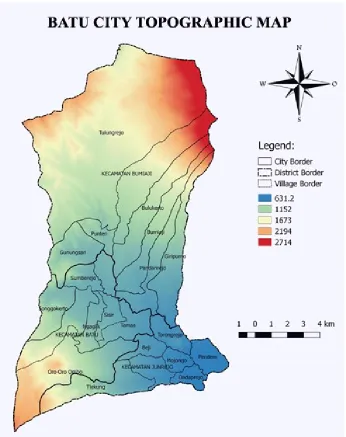
Based on the statistics of Batu City in 2016, Batu City is part of Malang Regency, which was later designated as an administrative city on March 6, 1993. On October 17, 2001, Batu was designated an autonomous city separate from Malang Regency. Based on astronomy, Batu City is located between 122 ° 17'-122 ° 57 'East Longitude, 7 ° 44'-8 ° 26' South Latitude with an area of 199.09 km2. Batu City is divided into 3 sub-districts (Bumiaji, Batu, Junrejo), 5 kelurahan, and 19 villages, with a population of 168,155 inhabitants.
3 Modelling Prometheus
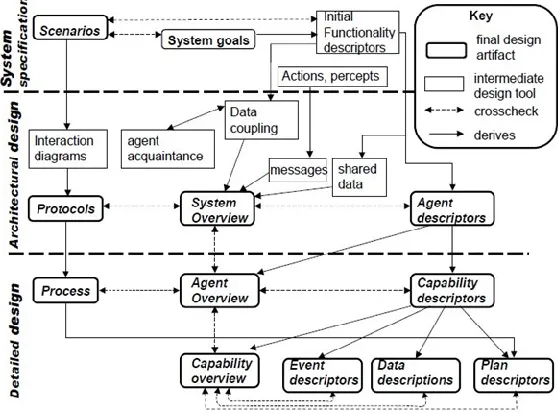
Prometheus Methodology is an agent-oriented software engineering development methodology that has three main phases (see fig.2), namely:
1. Specification System, which focuses on the basic functions of identifying the system with input (perception), output (action) and each data source.
2. Architectural Design, which focuses on agent interactions in the system and as the output of the first stage.
Very Sugiarto , Modeling Agent- Oriented Methodologies…195
p-ISSN : 2540-9433; e-ISSN : 2450-9824 agent's plan to complete the tasks in the system as a whole.
Prometheus has several notable differences with the previous methodology (Padgham et al., 2003). The difference between Prometheus from the existing methodology is:
1. Support the development of intelligent agents who use goals, percept, plants, and events.
2. Provides "start-to-end" support (from detailed design specifications and implementation) and detailed processes, along with design artifacts built and steps
196 JITeCS Volume 4, Number 2, September 2019, pp 193-201
p-ISSN : 2540-9433; e-ISSN : 2450-9824 Fig. 2. Overview of Prometheus Methodology and Design Artifacts to reduce artifacts.
3. Evolved from practical industrial and pedagogical experience, and has been used by industry practitioners and by students.
4. Provides a hierarchical structuring mechanism that allows designs to be carried out at various levels of abstraction.
5. Provides cross checking of design artifacts.
3.1 Evaluation Model
Each agent involved in simulation model will evaluate the internal properties of their characteristics. The following are the characteristics of the agents to be evaluated based on the results of the simulation model for handling landslides, namely:
1. Autonomous Agent Following criteria:
a) Does the agent have the ability to perform an action (functionality) based on the task (goals) that he has (hoa and winikoff., 2004)?
b) Does the agent have a decision-making mechanism independently (behavioral) without having to have direct orders from humans or other agents (Hoa and Winikoff., 2004)?
c) Can agents recognize the system environment and can take action based on information received (Percept) (Oskouei, R. J., et al., 2014)?
2. Mental attitude Agent Following criteria:
a) Does the agent have the ability to make decisions based on his ability (hoa and winikoff., 2004)?
b) Does the agent have the desire to complete a job (goal) (hoa and winikoff., 2004)?
Very Sugiarto , Modeling Agent- Oriented Methodologies…197
p-ISSN : 2540-9433; e-ISSN : 2450-9824 winikoff., 2004)?
d) Can agents recognize a rule (protocol) in the system environment (Fox, J., et al., 2014)?
3. Proactive Agent Following criteria:
a) Can individual agents send or receive a message from the agent or environment in the system (hoa and winikoff., 2004)?
b) Can individual agents send or receive messages specific to a particular agent (Hoa and Winikoff., 2004)?
c) Can individual agents receive or send more than one message to another agent or environment in the system (hoa and winikoff., 2004)?
4. Reactive Agent Following criteria:
a) Can agents respond if there is a change in the system environment (hoa and winikoff., 2004)?
b) Can the agent respond (do an action) if there is a change in the system that directly influences (percept) the goals that he has (Hoa and Winikoff., 2004)?
c) Can the agent anticipate if there is a change in the environment that indirectly affects the goals that he has (Berkowitz., 1993)?
5. Concurrency Agent Following criteria:
a) Does the agent have more than one goal and action while active in the system (hoa and winikoff., 2004)?
b) Are agents able to communicate (exchange messages) simultaneously with more than one agent (hoa and winikoff., 2004)?
c) Are agents able to complete more than one goal simultaneously (Hoa and Winikoff., 2004)?
6. Collaborative Agent Following criteria:
a) Can the agent communicate with other agents, related to goal completion (Hoa and Winoff., 2004)?
b) Can agents collaborate and coordinate to accomplish the same goals (Hoa and Winoff., 2004)?
c) Can the agent negotiate the acquisition of the same goal (Hoa and Winikoff., 2004)?
4 Design Model
198 JITeCS Volume 4, Number 2, September 2019, pp 193-201
p-ISSN : 2540-9433; e-ISSN : 2450-9824
to diagnose the victims of the landslide. If the victim's condition allows it to be moved to an evacuation site, the EVACUATOR agent will transfer the victim. Whereas if the victim is diagnosed critically, the EVACUATOR agent will ask for assistance from the RESCUER agent to move the victim to the nearest hospital.
Table 1. Evacuation Scenario
Name Evacuation scenario
Description Scenarios for evacuating victims of landslides
Trigger Disaster status information from the village head
Step
# Type Name Functionality Data
1 PERCEPT Information on victims'
data from the
BRANTAS RESCUE Village team
Informer
2 GOAL Coordination with
Main Post
Coordinator VictimDB(R)
3 GOAL Proposed evacuation
routes
Decider mapDB(R)
4 GOAL Coordination with the
Red Cross team Coordinator VictimDB(R)
5 GOAL Refer victim to the
hospital
Rescuer VictimDB(R)
6 GOAL Transferring victims to
the evacuation post
Rescuer VictimDB(R)
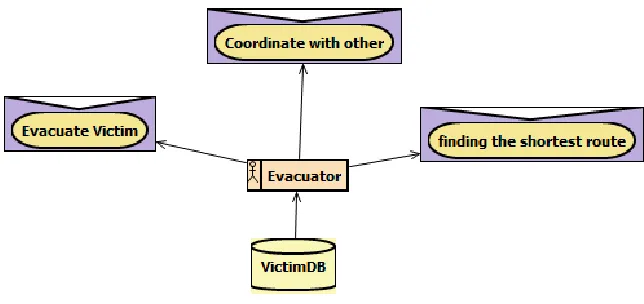
The main goal of the EVACUATOR agent is to move affected victims to evacuation sites (see fig.3). However, in the process of moving the victim there are several sub-goals that can be done if the main sub-goals cannot be immediately implemented. To move the victim to the evacuation site, the EVACUATOR agent must know the condition of the victim first. If the victim needs help, the EVACUATOR agent can coordinate with the RESCUE agent first. After the victim is in a safe location, the second step is to look at the physical condition of the victim. If the victim has a physical condition that is not possible, the EVACUATOR agent needs to coordinate with the Red Cross agent to diagnose the victim. After all handling is complete, the EVACUATOR agent can safely carry out the evacuation process.
Fig. 3. Evacuator behavioral
Very Sugiarto , Modeling Agent- Oriented Methodologies…199
p-ISSN : 2540-9433; e-ISSN : 2450-9824
system. The first behavioral is the EVACUATOR agent has the ability to evacuate victims affected by landslides. This capability can be used by the EVACUATOR agent only if the victim's condition allows it to be moved. The second Behavioral can be done by the EVACUATOR agent if the conditions in carrying out the first behavioral experience are a got a problem.
Fig. 4. Analysis Overview of Evacuation victim
4.1 Validation Model
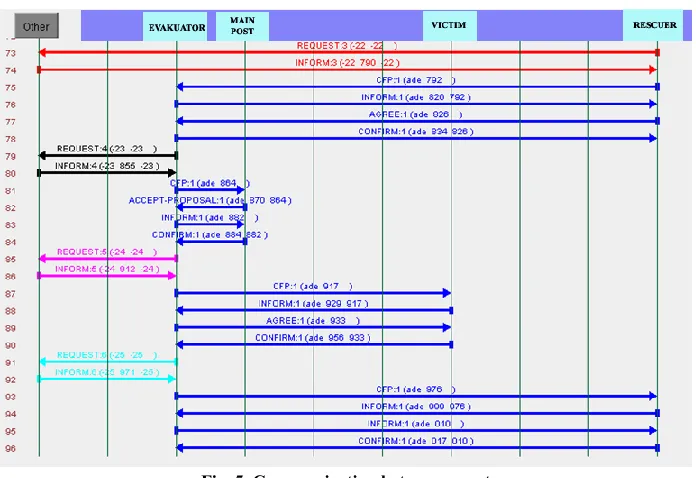
This simulation model will be validated using the Java Agent Development Framework (JADE). After making a model generating process using the jackCode, the agent automatically created on the Prometheus model will change to an object class. Each class of agents will automatically have BDI or behavioral each in accordance with the behavioral model that has been created. After the generate process is complete, each agent class will be run using JADE Remote Agent Management. After that communication between agents will be visible to the sniffer agent provided by JADE. The length of time the sniffing agent process will depend on how complex the behavior is instilled by the developer. The more complete behavioral created will also make the agent more complex in dealing with a problem that appears in the system.
4.2 Evaluation Model
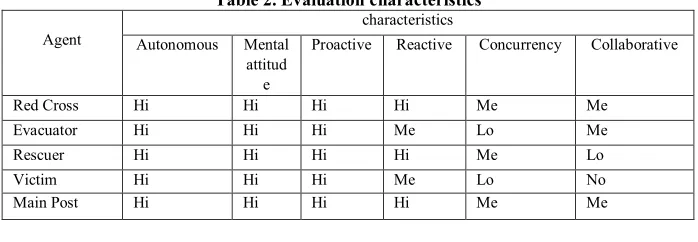
The evaluating results of internal properties on the characteristics of each individual agent involved in the evacuation scenario are shown in table 2.
Table 2. Evaluation characteristics
Agent
characteristics
Autonomous Mental
attitud e
Proactive Reactive Concurrency Collaborative
Red Cross Hi Hi Hi Hi Me Me
Evacuator Hi Hi Hi Me Lo Me
Rescuer Hi Hi Hi Hi Me Lo
Victim Hi Hi Hi Me Lo No
200 JITeCS Volume 4, Number 2, September 2019, pp 193-201
p-ISSN : 2540-9433; e-ISSN : 2450-9824
The assessment scale had four possible responses. “High” (Hi), “Medium” (Me), “Low” (Lo) and “None” (No) responses indicate the level of support of the methodology for a particular concept.
Fig. 5. Communication between agent
5 Result and Discussion
Evaluation results show that the autonomous, mental attitude and proactive characteristics of individual agents have a percentage of 100%. This shows that the model developed using the Prometheus methodology for landslides is very capable of being implemented using a technology or agent-based approach. However, for reactive, concurrency and collaborative, the value is not too high. This is because the individual agents modeled are indeed not designed for special cases such as negotiating between agents.
6 Conclusion
This paper proposed a multi-agent model using Prometheus methodology to manage landslide in preparedness phase in Batu city. Further development can add a GUI to the main layout to be able to display graphics that are more interesting and easier to understand by common user. In addition to using the GUI, adding indicators such as the distance of the incident location with the EVACUATOR agent, then adding a more complete diagnostic indicator will make this simulation better to use.
References
[1] Badan Penanggulangan Bencana Daerah.: Press Release Bencana Kota Batu Tahun 2018. [2] Berkowitz, L. Aggression: Its Causes, Consequences, and Control. McGraw-Hill, New
York. 1993.
Very Sugiarto , Modeling Agent- Oriented Methodologies…201
p-ISSN : 2540-9433; e-ISSN : 2450-9824
[4] Guidelines for BNPB Disaster Management Plan Preparation, 2017. [5] Head of the LIPI Oceanography Center, 2011.
[6] Jaziri, Wassim and Thierry Paquet. “A Multi-Agent Model and Tabu Search Optimization to Manage Agricultural Territories.” 337–57. 2006.
[7] Khanh Hoa Dam and Michael Winikoff. Comparing agent-oriented methodologies.2004. [8] Paimin, Sukresno dan Irfan budi pramono. Teknik mitigasi banjir dan tanah longsor.
Balikpapan : Tropenbos internasional Indonesia programe 2009.
[9] Rozita Jamili Oskouei, Hamidreza Naghizadeh Varzeghani and Zahra Samadyar. ‘Intelligent Agents: A Comprehensive Survey’, International Journal of Electronics Communication and Computer Engineering, 5(4), pp. 790–798. 2014.
[10] Tang, Jian, Chengzhu Gong, Kejun Zhu, Can Liao, and Shuwen Zhang. “Multi-Agent Simulation of Search and Rescue in Landslide Based on Auction Mechanism.” 2017. [11] Wooldridge, Michael J. An Introduction to Multi-agent Sistems. John Wiley & Sons Ltd
2002.