DEMOGRAPHIC RESEARCH
VOLUME 36, ARTICLE 29, PAGES 851
−
862
PUBLISHED 17 MARCH 2017
http://www.demographic-research.org/Volumes/Vol36/29/ DOI: 10.4054/DemRes.2017.36.29
Descriptive Finding
“Let’s talk about love”: An analysis of the
religious and economic factors determining the
choice of marital property regime in Italy
Gabriele Ruiu
Marco Breschi
© 2017 Gabriele Ruiu & Marco Breschi.
This open-access work is published under the terms of the Creative Commons Attribution NonCommercial License 2.0 Germany, which permits use, reproduction & distribution in any medium for non-commercial purposes, provided the original author(s) and source are given credit.
1 Introduction 852
2 Data and methodology 854
3 Empirical results 856
4 Conclusions 861
5 Acknowledgements 861
Demographic Research: Volume 36, Article 29
Descriptive Finding
“Let’s talk about love”:
An analysis of the religious and economic factors determining the
choice of marital property regime in Italy
Gabriele Ruiu1
Marco Breschi2
Abstract
BACKGROUND
In sociological literature, expectations about marriages’ duration are generally considered to be one of the main determinants in the pooling of economic resources between spouses. According to Catholic precepts, religious marriages are indissoluble, andItaly is characterized by a Catholic religious monopoly, with an anomalously high level of religious attendance for a developed country.
OBJECTIVE
It may therefore be surmised that religious marriages should be characterized by a high propensity for opting for a pooled patrimonial system. Is this hypothesis confirmed by data?
METHODS
We studied comprehensive data on all the marriages solemnized in Italy for the period 2007‒2009. We then use multivariate logistic regressions to assess which factors are associated with a greater propensity for opting for the pooled patrimonial system.
RESULTS
We find that religious marriages are not characterized by a higher probability of wealth pooling with respect to civil marriages.
CONTRIBUTION
To our knowledge, this is the first work to analyze the relationship between the choice of a religious marriage and the choice of the marital patrimonial system. We conclude that religious marriages in Italy do not reflect genuine adherence to the Catholic principle of the indissolubility of marriage.
1
Corresponding author: Department of Economics and Business, University of Sassari, Italy. E-Mail:[email protected].
1. Introduction
Up to 1975 in Italy, unless the spouses chose differently, the law automatically attributed to them a separated marital patrimonial system. In 1975 this legal convention was inverted, making the pooled property system the norm and separation the exception. In a pooled marital property system, all goods, assets, and property acquired after the date of the marriage, with the exception of those of strict personal use by one of the spouses, are considered joint property. Savings accumulated after the marriage, even if only one of the spouses has accumulated them, become common property. Even if an asset was possessed by one of the spouses well before the marriage, any greater value that this asset may have acquired during the marriage has to be divided equally between the parties.
Despite the emphasis given by the Italian law to the pooled system, this choice has declining appeal among Italian couples (see Figure 1A).
This decline may be attributed to the increasing rate of marriage disruption. Indeed, according to Treas (1993), when social and economic exchanges are expected to be complex, frequent, and long-term, as in the case of marriage, the choice of a common property system implies lower transaction costs than the separated regime, since in the latter case the spouses have to bargain each time on how to finance common expenditures, while in the pooled system savings are common property. However, a common-property system requires long-term trust between spouses. Thus, the perspective of marital continuity is crucial for determining the benefit of the common pot over individual holdings. See also Bayot and Voena (2015) for an alternative explanation of why the perspective of marital continuity is a prerequisite for the choice of the common property system.
The possible relationship between marriage instability and the decision to separate assets in advance seems to be consistent with the observed increasing trend in the divorce/separation rate in the last 20 years (see Figure 1A).
Demographic Research: Volume 36, Article 29
Figure 1: Percentage of religious marriages, divorce rates, and adoption of
pooled system
Note: Data on 1999 is unavailable.
Source: Our elaborations on data from http://demo.istat.it/altridati/matrimoni/
Italy is characterized by a Catholic religious monopoly with an anomalously high level of religious attendance for an advanced society, which is difficult to reconcile with either secularization theory or religious market theory (Diotallevi 2002). Thus, we should expect that those who opt for religious marriages have on average higher expectations regarding marriage duration. Furthermore, Lehrer and Chiswick (1993) argue that similarity in religious beliefs should produce positive effects on marriage stability thanks to shared views on the education and upbringing of children, on the allocation of time and money, and so forth. Figure 1B shows that the percentage of religious marriages is in fact steadily declining in Italy, suggesting an inverted relation with the increasing trend in the separated patrimonial regime. It must be said that the Catholic Church has recently made the procedure for the annulment of religious marriage faster and less complicated. But the cases in which spouses may demand annulment are still very stringent (e.g., external pressures have forced the spouses to marry but they lacked a genuine willingness to do so, concealed impossibility to procreate, lack of religious faith, etc.).
1998 2000 2001 2002 2003 2004 2005 2006 2007 2008 2009 2010 2011 3 5 4 0 4 5 5 0 5 5 % o f m a rr ia g e s w it h p o o le d s y s te m
0.6 0.7 0.8 0.9
Crude divorce rate (per 1,000 mid-year total population)
(A) 1998 2000 2001 2002 2003 2004 2005 2006 2007 2008 2009 2010 2011 3 5 4 0 4 5 5 0 5 5 % o f m a rr ia g e s w it h p o o le d sy s te m
60 65 70 75 80
% of religious marriages
Therefore, one should expect that couples who opt for a religious marriage will be more likely to opt for the pooled system. Yet this is confirmed only if the choice of religious rites reflects a genuine adherence to religious precepts, rather than only a tendency, perhaps due to social pressure, to respect the tradition of marrying in a church (Vignoli and Salvini 2014).
However, religious beliefs on marriage duration are not the only factor influencing the choice of the patrimonial system. For instance, when one of the spouses is the owner of an unlimited liability company the choice of a separated regime can be a way to protect the patrimony of his/her partner from creditors’ requests in the case of the firm’s insolvency.
This paper aims to test whether religious marriages are also those more likely to be characterized by the pooled property system. If this hypothesis turns out to be true, it will, for instance, enable us to offer suggestions for the construction of indicators of religious secularization.
The paper is structured as follows: In the second section we present our data source and the empirical methodology, in the third section we discuss our results, and the last section is devoted to concluding remarks.
2. Data and methodology
Our data source is the “Rilevazione dei matrimoni” for the period 2007‒2009. This is a collection of information about all the marriages that take place in Italy. Registrars of each municipality in which marriages are solemnized are required by law to fill out and send to the Italian National Institute of Statistics a form containing detailed information on each marriage (see Breschi and Ruiu 2016 for more details).
Obviously, the use of this data source means that couples who do not get married are omitted from the analysis. We believe that this does not represent a source of selection bias in our analysis, since couples who never marry are not forced by law to choose a patrimonial regime. So even if we select all those who have decided to get married, our aim is to test whether those opting for a religious marriage, who at least in principle believe in the indissolubility of marriage, are also more likely to opt for the common property system. Indeed, according to Treas’s theory, expected marriage duration is the key factor in this choice (see also Bayot and Voena 2015).
Demographic Research: Volume 36, Article 29
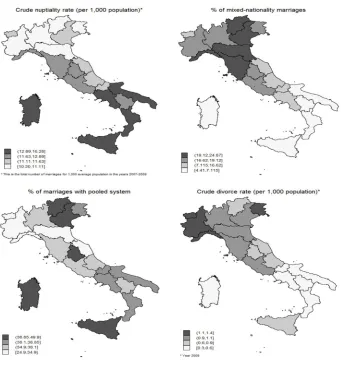
Figure 2: Some descriptive statistics on marriage at the regional level, 2007–
2009
We are working with a total of 727,586 marriages, of which about 36% were solemnized according to civil rites. In the southern regions the majority of marriages are solemnized according to religious rites (see Breschi and Ruiu 2016).
With regard to our empirical strategy, we created a dummy variable equal to 1 (named ‘pooled’), when the newlyweds opted for pooling their property, and used this variable as a dependent variable in a multivariate logistic regression aimed at investigating both its relation with the choice of marrying in church and which sociodemographic characteristics (age, education, nationality, etc.) are positively/negatively correlated with this choice.
We decided to include in our econometric specification the characteristics of both spouses. It may be argued that this could induce problems of collinearity due to the high degree of homogamy in Italian society. A very intuitive way to judge the severity of the collinearity problem is to assess jointly the value assumed by the R square and the statistical significance of the variables included in the model. In particular, if the R square in a regression is very near to 1 but few explanatory variables are significant in explaining the dependent variable, then this is an indication that multicollinearity is strongly affecting the estimation of standard errors.
Furthermore, we believe that not including the characteristics of both spouses would expose an even worse problem, i.e., the omitted variable bias. Suppose that the true determinant of the choice of the pooled regime is the level of education of the bride, but we do not insert this into the regression because it is correlated with the groom’s education, which instead is inserted into the regression. Then the estimated effect of the groom’s education will be biased because it is positively correlated with the error term. A similar argument may be formulated with regard to the inclusion of statistical controls for occupational types.
To capture territorial differences, we include in each model a dummy for all the 107 Italian provinces in which marriages were solemnized. The set of coefficients associated with provincial dummies is therefore interpreted as an indicator of the cultural tendency to pool resources in that territory. Note that this indicator is free of compositional effects due to the sociodemographic characteristics of the spouses and can capture possible cultural determinants that are different from those tied to the choice of religious rite (since we are directly controlling for that).
In each regression, we report standard errors that are corrected to account for within-cluster correlation at the provincial level.
3. Empirical results
Demographic Research: Volume 36, Article 29
instead of the logistic model. Presenting the results of both models allows us to exclude the chance that our results depend on assumptions made on the link function of the econometric model. The names given to the explanatory variables make clear their content.
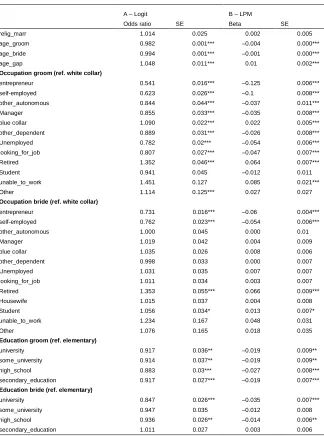
The surprising result is associated with religious marriages (‘relig_marr’). Contrary to our expectations, there is not any statistically significant difference in the tendency to pool properties between religious and civil marriages. In our opinion the most plausible explanation is that those who opt for a religious marriage do so only to respect tradition. This interpretation is consistent with the findings of Vignoli and Salvini (2014), who, having analyzed data obtained from focus groups among young newlyweds, conclude: “The widely prevailing pressure of parents and peers and the hedonistic aspects of the traditional Church wedding seem to be more important in partnership formation than Catholic prescripts” (2014: 1099). Furthermore, it may be surmised that those couples who opt for a church wedding because of social pressure may in similar fashion be conditioned to try to ‘save’ a marriage that is in any case doomed to fail. This may also help explain why religious marriages tend to survive for longer than civil ones.
An alternative explanation is that civil and religious marriages are characterized by the same underlying beliefs about marriage duration. However, it is possible to reconcile this explanation with the evidence showing that a genuine religious adherence sustains marital stability only if the choice of the religious rite, taken alone, does not reflect religiosity.
We focus next on some other interesting results. An increase in the likelihood of observing a pooled system is associated with the age gap. This variable is treated as the difference in absolute value between the ages of the spouses. We believe that a large age disparity between groom and bride may be indicative of a situation in which the younger and presumably poorer party has sought a partner who can provide for them, and this may explain the positive effect on the probability of choosing the pooled system.
Table 1: Sociodemographic characteristics associated with choice of the pooled system
A – Logit B – LPM
Odds ratio SE Beta SE
relig_marr 1.014 0.025 0.002 0.005
age_groom 0.982 0.001*** –0.004 0.000***
age_bride 0.994 0.001*** –0.001 0.000***
age_gap 1.048 0.011*** 0.01 0.002***
Occupation groom (ref. white collar)
entrepreneur 0.541 0.016*** –0.125 0.006***
self-employed 0.623 0.026*** –0.1 0.008***
other_autonomous 0.844 0.044*** –0.037 0.011***
Manager 0.855 0.033*** –0.035 0.008***
blue collar 1.090 0.022*** 0.022 0.005***
other_dependent 0.889 0.031*** –0.026 0.008***
Unemployed 0.782 0.02*** –0.054 0.006***
looking_for_job 0.807 0.027*** –0.047 0.007***
Retired 1.352 0.046*** 0.064 0.007***
Student 0.941 0.045 –0.012 0.011
unable_to_work 1.451 0.127 0.085 0.021***
Other 1.114 0.125*** 0.027 0.027
Occupation bride (ref. white collar)
entrepreneur 0.731 0.016*** –0.06 0.004***
self-employed 0.762 0.023*** –0.054 0.006***
other_autonomous 1.000 0.045 0.000 0.01
Manager 1.019 0.042 0.004 0.009
blue collar 1.035 0.026 0.008 0.006
other_dependent 0.998 0.033 0.000 0.007
Unemployed 1.031 0.035 0.007 0.007
looking_for_job 1.011 0.034 0.003 0.007
Retired 1.353 0.055*** 0.066 0.009***
Housewife 1.015 0.037 0.004 0.008
Student 1.056 0.034* 0.013 0.007*
unable_to_work 1.234 0.167 0.048 0.031
Other 1.076 0.165 0.018 0.035
Education groom (ref. elementary)
university 0.917 0.036** –0.019 0.009**
some_university 0.914 0.037** –0.019 0.009**
high_school 0.883 0.03*** –0.027 0.008***
secondary_education 0.917 0.027*** –0.019 0.007***
Education bride (ref. elementary)
university 0.847 0.026*** –0.035 0.007***
some_university 0.947 0.035 –0.012 0.008
high_school 0.936 0.026** –0.014 0.006**
Demographic Research: Volume 36, Article 29
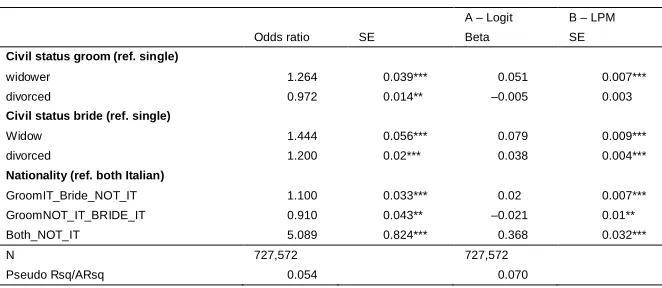
Table 1: (Continued)
A – Logit B – LPM
Odds ratio SE Beta SE
Civil status groom (ref. single)
widower 1.264 0.039*** 0.051 0.007***
divorced 0.972 0.014** –0.005 0.003
Civil status bride (ref. single)
Widow 1.444 0.056*** 0.079 0.009***
divorced 1.200 0.02*** 0.038 0.004***
Nationality (ref. both Italian)
GroomIT_Bride_NOT_IT 1.100 0.033*** 0.02 0.007***
GroomNOT_IT_BRIDE_IT 0.910 0.043** –0.021 0.01**
Both_NOT_IT 5.089 0.824*** 0.368 0.032***
N 727,572 727,572
Pseudo Rsq/ARsq 0.054 0.070
The regressions include both a dummy for each province and a dummy for each year.
Note: Sig. * <0.10; **<0.05; ***< 0.01. Robust cluster SE at provincial level
Finally, considering the nationality of the spouses, the odds ratio associated with the dummy capturing couples in which both spouses are not Italian is five times that associated with Italian couples. This may be a consequence of the fact that foreigners probably do not have an exact knowledge of Italian law on marital property.
Interestingly, we obtained different results in the case of mixed-nationality marriages depending on whether the groom was Italian or not. With regard to mixed-nationality marriages in Italy, Maffioli, Paterno, and Gabrielli (2014) note that “the mechanism of mate selection implies that foreigners’ appreciated qualities such as youth and high education may be offered in exchange for economic security, upward socio-economic mobility and access to the social network of the native partner” (2014: 1).
Social exchange seems to explain the results associated with couples where the groom is Italian and the bride is a foreigner, but not to hold in cases where the groom is not Italian and the bride is.
Figure 3: Territorial differences in the probability of opting for the pooled system
Note: Colors are attributed on the basis of the values assumed by the odds ratio in Table 1: The higher the odds in the province with
respect to Rome (province of reference) the darker the color.
These territorial differences are almost all statistically significant, thus indicating that there exists some cultural heterogeneity in the attitude toward resource pooling among provinces.
Finally, it is worth noting that our results are robust to different specifications of the link function of the econometric model and that our analysis is not affected by severe collinearity problems, at least according to the rule of thumb of jointly assessing the R square and the significance of the variables.
Demographic Research: Volume 36, Article 29
4. Conclusions
This work has analyzed the factors associated with the choice of marital property system in Italy. The lack of interest in this topic among academics is surprising since the way in which spouses decide to pool or separate resources is crucially tied to a family’s economic output and to labor supply choices. Furthermore, we believe that studying the relationship between religious marriages and marital property may offer indications about the level of secularization of religious precepts. It seems that academics have only recently started to look at the topic (Bayot and Voena 2015).
Using data on marriages solemnized in Italy in the period 2007‒2009, our study has shown that an Italian couple’s choice of the patrimonial regime is driven mainly by economic factors such as occupational status and the power distribution in the couple, rather than by religious beliefs.
Based on the intransigency of Catholicism when it comes to divorce, we hypothesized that couples who opt for religious marriages should be characterized by greater expectations regarding marriage duration than those who opt for a civil rite. Consequently, they were expected to have less incentive to take the precaution of opting for the separated property system. We interpret this rejection of our hypothesis as empirical support for Vignoli and Salvini (2014), who maintain that Italian couples tend to opt for marriage in church more for hedonistic motives than for reasons of religious adherence.
5. Acknowledgments
References
Bayot, D. and Voena, A. (2015). Prenuptial contracts, labor supply and household investments [unpublished manuscript]. Chicago: University of Chicago and NBER. Downloadable:https://sites.google.com/site/alevoena/
Breschi, M. and Ruiu, G. (2016). Superstitions, religiosity and secularization: An analysis of the periodic oscillations of weddings in Italy. Genus Journal of Population Studies 72(7).doi:10.1186/s41118-016-0012-0.
Diotallevi, L. (2002). Internal competition in a national religious monopoly: The Catholic effect and the Italian case. Sociology of Religion 63(2): 137‒155. doi:10.2307/3712562.
Lehrer, E.L. and Chiswick, C.U. (1993). Religion as a determinant of marital stability.
Demography 30(3): 385‒404.doi:10.2307/2061647.
Maffioli, D., Paterno, A., and Gabrielli, G. (2014). Transnational married and unmarried unions in Italy: Criteria of mate selection. International Migration
52(3): 161‒176.doi:10.1111/imig.12049.
Treas, J. (1993). Money in the bank: Transaction costs and the economic organization of marriage. American Sociological Review 58(5): 723‒734. doi:10.2307/2096283.