________________
*Corresponding author
Received October 8, 2016
150
Available online at http://scik.org
J. Math. Comput. Sci. 7 (2017), No. 1, 150-174
ISSN: 1927-5307
REVIEW OF MULTI-OBJECTIVE OPTIMIZATION MODELS FOR SOLID WASTE MANAGEMENT SYSTEMS WITH ENVIRONMENTAL CONSIDERATIONS
HALIDI ALLY LYEME1,3,*, ALLEN MUSHI2, YAW NKANSAH-GYEKYE1
1Department of Mathematical and Computer Sciences and Engineering, School of Computational and
Communication Science and Engineering, Nelson Mandela African Institution of Science and Technology, P. O. Box 447, Arusha, Tanzania
2Department of Mathematics, College of Natural and Applied Science, University of Dar es Salaam, P. O. Box
35062, Tanzania
3Department of Mathematics, Faculty of Science, Muslim University of Morogoro, P. O. Box 1031, Morogoro,
Tanzania
Copyright © 2017 Lyeme, Mushi and Nkansah-Gyekye. This is an open access article distributed under the Creative Commons Attribution License, which permits unrestricted use, distribution, and reproduction in any medium, provided the original work is properly cited.
Abstract. This paper analyzes more than 50 papers with a limited area in the field of solid waste management systems and supply chain management, extending over mathematical models that include economic factors, as well as environmental and/or waste flow allocation. The review finds that there are a number of limitations to the current research in sustainable solid waste management systems. The narrow scope of environmental factors as constraints in the current models means that there is a need to go further and include new environmental metrics. The effective inclusion of environmental objectives in models with improved multi-objective approaches is a gap that needs to be filled. Furthermore, there are significant gaps in sensitivity analysis of models limiting the general applicability of the models. The paper concludes with promising new avenues of research that demand effective inclusion of sustainability into solid waste management system models.
Keywords: multi-objective optimization; pareto optimality; solid waste management; ghg emission.
2010 AMS Subject Classification: 91B76.
1 Introduction
Population growth and the rapid pace of urbanization create many challenges to the environment
for large cities; one of the challenges is Solid Waste Management (SWM). The accumulation and
communicable diseases[1]. The release of gaseous toxic substances and emission of greenhouse
gases (GHGs) to the surrounding environment during waste management, expose communities
and individuals to serious health risks, such as, damage to the immune system, reproductive organs,
developmental organs and respiratory system, neuron and may cause cancer [2].
According to the European Union, Municipal Solid Waste is defined as “waste from households,
as well as other waste which, because of its nature or composition, is similar to waste from
households” [3]. ‘‘Solid-waste management may be defined as the discipline associated with
controlling the generation, storage, collection, transfer and transport, processing, and disposal of
solid waste in a manner that is in accordance with the best principles of health, economics,
engineering, conservation, aesthetics, and other environmental considerations, and that is also
responsive to public attitudes. In its scope, solid-waste management includes all administrative,
financial, legal, planning, and engineering functions involved in the solutions to all problems of
solid waste.’’ [4].
Since the early 1970s SWM in developing countries has received increasing attention from
researchers and policy makers hoping to establish a sustainable management system [3]. Every
society has diverse goals for implementing SWM plans depending on some circumstances and
issues. For example, a society facing a landfill space problem may set a target to reduce the quantity
of waste sent to landfill disposal and may consider source decrease, waste diversion through
recycling and volume reduction alternatives such as converting waste to energy. The most suitable
choice, however, is often not clear. The problem becomes difficult if landfill space may be very
inadequate, making recycling and volume reduction alternatives to be more attractive options [5].
One of the currently proposed ways of treating waste is the high temperature thermal treatment
with energy recovery, as waste is considered to contain a substantial amount of bio-waste, which
can lead to renewable energy production [6]. Some researchers affirm that energy recovery is
required, if the goals set for the waste exploitation rate are to be achieved [7]. The output of high
temperature thermal treatment with energy recovery from waste are primarily to reduce waste
volume remaining for land filling; frequently the output is about 10% of the incoming volume [8,
9].
In Tanzania the responsibility for SWM rests largely with municipal authorities who, for the most
part, focus primarily on organizational aspects such as improvement of municipal solid waste
as well as technical aspects such as upgrading of waste management tools. The fact is that waste
management is quite extended to economic sector, comprising a variety of interlinked actors,
activities and commodities which has been neglected since decades [3]. Instead, much emphasis
has been put on minimizing the costs of collection through transport route optimization as nearly
90% within the municipal SWM budget goes into waste collection and transportation [10].
This review is based on papers published from 1993 to 2015 on the single/multi-objective
optimization models and supply chain management for solid waste management systems. A total
of 50 references were collected from the most extensive journals about optimization models and
supply chain management for solid waste management systems. In order to find papers related to
mathematical models for solid waste management systems and supply chain management, the
following keywords were used on bibliographical databases and search engines, such as Science
direct, Google scholar, sage journal. Furthermore, the bibliographical references of papers have
served as a continuous search reference.
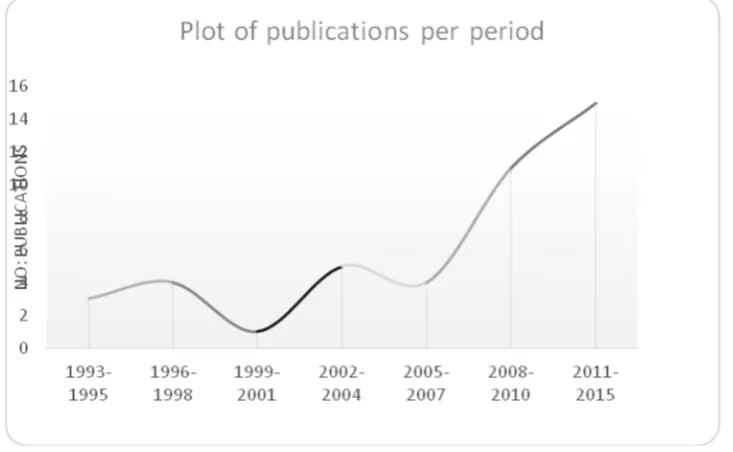
Figure 1 visualizes more than 50 publications on solid waste management from 1993 to 2015,
which indicates that SWM has received much attention by researchers in recent years.
Figure 1: Evaluation of Publications per Period from 1993 to 2015
Most relevant models in Solid Waste Management have multiple objectives and therefore require
the use of Multi-objective Optimization models.
In this review, we focus our attention to the identification of the main features of the
world so as to learn the best practices and identify possible gaps in relation to the Tanzanian
situation. such as the identification of the optimization criteria that drive the problem solution
(parameters), Such features includes; the different limitations that need to be taken into account in
each type of problem (constraints), the algorithms used for the solution of the optimization models
(methods/techniques) and the results obtained. Section 2 provides a review of the optimization
models for solid waste management systems, followed by discussion of the reviews in section 3
before conclusion and future research direction in section 4.
2 Optimization Models in Solid Waste Management System
A wide variety of real life problems in SWM are solved with optimization models, such as energy
management with overall environmental impact, waste minimization and solid waste management,
minimization of total transportation cost, facility locations, supply chain management, water
resources management and so on. However, this review only deals with a rather limited area of
solid waste management with environmental considerations, transportation cost and waste
minimization, facility location model and supply chain management.
2.1Solid Waste Management with Environmental Considerations
Optimization models have been expansively applied in solid waste management with
environmental considerations in the literature. A very comprehensive survey of operations
research in solid waste management is presented by [11]. The main objective of their work was to
present an updated survey of the most relevant operations research literature on SWM, mainly
focusing on strategic and tactical issues.
Nevertheless, various studies have been done on different facets of solid waste management over
the past decades with environmental considerations. For example, [12] have presented a
multi-objective optimization of solid waste flows model with the aim of supporting the decision maker
on the optimal flows of solid waste sent to recycling, landfill and different types of treatment plants,
whose sizes were also decision variables. Four objectives were considered which are related to
unrecycled waste, economic costs, sanitary landfill disposal and environmental impact (incinerator
emissions). Interactive reference point procedures have been developed to support decision
making; these methods were considered appropriate for multi-objective decision problems in
environmental applications. In addition, interactive methods were generally preferred by decision
makers as they can be directly involved in the various steps of the decision process. Some results
two different decision makers who were assumed to be in charge of planning the MSW system in
the municipality of Genova (Italy).
[13] developed a multi-objective model for SWM which considered both initial investment and
operative costs related to transportation and transfer stations. Two conflicting objectives were
evaluated, the minimization of total cost and the minimization of environmental impact, measured
by pollution. Weighted sum, goal programming and fuzzy multi-objective techniques were
employed to analyze the model. The analysis shows that different attitudes of the decision maker
towards the logic and structure of the problem results into the employment of different
methodologies and the obtaining of different results. The model was applied to the waste
management of optimal territorial ambit of Palermo (Italy).
In [14], a comprehensive fuzzy parametric programming with two objectives was developed. The
first objective was to minimize environmental risk and the second objective was to minimize cost.
Multi-period system to locate solid waste facilities such as transportation station, recycle center,
compost plants, incinerators and landfills were also considered. Some parameters were uncertain,
such as the amount of waste and operation capacity of each facility.
[15] proposed a multi-objective optimization model which integrating economic and
environmental aspects for a solid waste management system for the city of Duisburg (Germany).
The proposed model aims at minimizing the total solid waste management system costs by
considering different restrictions such as logistic, technical, environmental and social constraints.
[16] developed multi-objective mixed integer programming model for reasoning the potential
conflict between environmental and economic goals and for evaluating sustainable strategies for
waste management in the city of Kaohsiung in Taiwan. The results provided a set of total solutions
for long term waste stream such as allocation, sitting, resource recovery and tipping fees evaluation.
A multi-objective optimization model for the management of municipal solid waste using an
uncertainty approach was presented by [17]. System cost of solid waste management and the
environmental impact were objectives of the model and pollution loss theory to evaluate the
environmental impact was applied. The results of the model showed that the overall system cost
could be reduced by $1–2.4 per ton, i.e., $3.7 million per year.
[18] have presented a multi-objective mathematical programming model to evaluate and quantify
the effects of initiatives for diversion of current waste from landfill in Italy. They used economic
to energy plant and regional strategies of waste management to optimize financial and
environmental benefits of the sector. Moreover, a sensitivity analysis was used to test some of the
initial assumptions. The proposed waste management framework provides a concrete scheme for
future research in assessing quantitatively the effectiveness of waste management.
The work by [19] presents a multi-objective optimization model for solid waste management,
considering economic and environmental issues. A multi-objective mathematical strategy based
on the normalized constrained method was applied and industrial based case study was analyzed.
The proposed rigorous multi-objective optimization leads to reduced calculation effort and better
solution quality, since waste stream scheduling has been included in decision-making. On top of
that, a sequential approach is followed to further estimate the minimum heat requirements for the
diverse solutions obtained in the Pareto front using a MILP formulation of the heat exchange
problem.
In study by [20] a multi-objective mathematical model for the MSW management of the Athens
region in Greece was developed. The model provides the pareto optimal solutions for a MSW
management system performing structural, design and operational optimization. The Green House
Gas (GHG) emissions criterion and the economic criterion are taken into account as optimization
criterion. Therefore, the model did not obtain just an optimal solution, but a set of pareto optimal
solutions that spread from minimum GHG emissions to minimum cost. Each pareto optimal
solution provides the corresponding capacities and the technologies that are associated with it.
In the paper by [21] have developed the multi-objective model for solid waste collection system
in Madras city (India). Decision making approach was considered with economic,environmental,
technical and social aspects. Lexicographic goal programming technique used to analyze the model
and several possible scenarios were considered. Theproposed model considers a single planning
period of 5 years.
[22] have developed an integrated solid waste management model using integer linear
programming model. The objective function consisting of fixed and variable costs, transportation
cost and environmental cost/credit was developed subject to capacity, mass balance and
environmental constraints. Two case studies were carried out using the model. In the first case stud,
the model was tested with waste collection from three sources/zones in Accra Metropolitan
Assembly and dumping of waste at three landfill sites. In the second case study, a new landfill site
showed that the operational cost for the integrated solid waste management model was close to
that of the collection and dumping programmed initially. With increased revenue per ton of
compost and/or increased proportion of waste converted to compost, the overall operation cost was
reduced considerably in the case of the integrated solid waste management model making it more
efficient with reduced environmental pollution.
A bi-objective dynamic linear programming model was formulated by [23] for decision making
and supporting in the long-term operation of municipal solid waste management system. The
model simultaneously includes both economic and environmental pollution of MSW system over
time periods and the optimal trade off over the entire studied time horizon was the focus. The
computational result and analysis illustrate a deep insight of this model.
[24] have presented a mixed integer nonlinear programming decision support model for assisting
planners in decisions regarding the overall management of solid waste at a municipal level. The
model results show that, an optimal number of landfills and treatment plants, optimal quantities
and the characteristics of refuse that have to be sent to treatment plants, to landfills and to recycling
were determined. Various classes of constraints were considered in the problem formulation,
considering the regulations about the minimum requirements for incineration process requirements,
recycling, mass balance and sanitary landfill conservation. The objective function was composed
of transportation, maintenance costs and recycling.
The paper by [25] presents the new systems engineering optimization model, which incorporates
a life cycle assessment (LCA) methodology. The model used different weights to prioritize several
objectives such as minimizing greenhouse gas emissions or costs. A case study was analyzed,
covering different treatments of one tone of residual household waste: incineration of the all
amount or sorting out organic waste for biogas production for both combined heat and power
generation or as fuel in vehicles. The article shows that it is feasible to combine LCA methodology
with optimization. Moreover, it highlights the need for including the integrated waste and energy
system into the model.
The study done by [26] in Malaysia aims to evaluate the energy, economic and environmental
impact of waste-to-energy (WTE) for solid waste management. An existing landfill was selected
as the case study for consideration to implement the advanced WTE technologies including the
landfill gas recovery system (LFGRS), anaerobic digestion (AD), incineration and gasification.
discussion on waste incineration and AD as the two potential WTE options in Malaysia. The study
revealed that incineration as the better technology choice when the production of electricity and
heat were considered. However, AD is found to be more favourable under the consideration of
electricity production only.
[27] have developed a DSS for sustainable municipal solid waste management of Allahabad City
(India). Both environmental as well as economical sustainability of municipal solid waste
management were considered. Technological, institutional and financial aspects were taken in the
framework of integrated solid waste management. Technological aspects include geographical
information system in the database for waste related procedures such as waste production,
collection, treatment and disposal. The framework for the technological aspect of overall solid
waste management were categorized and worked out with four modules, namely: waste generation
module, waste collection module, waste transportation module and waste disposal module.
Institutional aspect considered identification of strengths, weaknesses, opportunities and threat of
working bodies governing the solid waste management. The financial aspect were considered for
reducing the direct economic burden on the municipal authorities by option of tariff from
commercial places, households, academic institutions and other waste generators.
Finally, the models are seen as a good representation of sustainable waste management methods
that are inclusive of environmental objectives with GHG emission minimization. Moreover, the
models are well addressed by presenting a decision variable for the selection of technology type.
However, environmental impact cannot only be considered in incinerator emissions as presented
by [12], but should consider other technologies such as recycling, composting and separation as
the sources for the emission of GHG. Furthermore, the limited range of environmental factors as
constraints as presented by [22, 24, 27] should go beyond that of including new environmental
metrics, that is environmental aspect should be treated as independent objective which includes all
technologies and transportation as the sources for GHG emission.
2.2Transportation Cost and Waste Minimization
A variety of deterministic mathematical programming models have been used for solid waste
management systems which focus on transportation cost and waste minimization. For example,
[28] have proposed mathematical model for municipal solid waste management process for Ilala
municipality in Tanzania. They used mixed integer programming method to model the problem
and their capacities. Their solution showed a least transportation cost with saving of 38.3%
compared to the existing system.
[29] have studied optimization of solid waste management systems using operational research
methodologies. They proposed a model for a municipal solid waste management system in Port
Said, Egypt which included the use of the concept of collection stations. Mixed integer
programming was used to model the proposed system and the solution was performed using MPL
software V4.2. Further, the results showed that the best model would include 27 collection stations
of 15-ton daily capacity and 2 collection stations of 10 ton daily capacity.
[30] proposed a mixed integer linear programming model which introduced a systematic planning
methodology for obtaining long-term waste management strategies for entire batch manufacturing
sites. Their work introduced a dynamic view of designing optimal waste management strategies
for a planning horizon of 5-10 years. The objective function minimizes the net present cost that
included the operating cost, the annualized capital investment and the maintenance costs. The
operating cost was obtained as the probabilistic average of the operating cost in the individual
waste forecast scenarios. The problem constraints included corporate-wide budget limitations,
special permit constraints, emission trading opportunities and emission limitations.
[31] analyzed the Municipal Solid Waste Management System in Amman, Jordan and considered
proper treatment of municipal solid wastes from its creation to disposal. The objective was to
investigate and evaluate the effects and impacts of adopting possible waste treatment technologies
based on the life cycle assessment method and to identify environmentally and economically
efficient system. Ten municipal solid waste management scenarios were designed considering
alternative waste collection, treatment, and final disposal methods to reduce landfill wastes and
emission of greenhouse gas and to enhance recycling and waste-to-energy conversion. The overall
environmental burden associated with each scenario was estimated and comprehensively evaluated
based on the life cycle assessment method. The weighted sum of greenhouse gas emissions with
Global Warming Potential, remaining capacity for landfill disposal, and recycling ratio are utilized
as major indicators for the environmental performance index to identify the best scenario. The
results showed that a proposed Integrated Solid Waste Management (ISWM) system was the best
scenario, which minimizes environmental loads, improves revenues, increases the recycling ratio,
and decreases final disposal of waste to the Landfill. This scenario was a combination of
incineration of the remainder, with energy recovery from incineration. Moreover, the results
showed that, an increase in recycled materials by 23 percent could be achieved if waste separation
at source was properly applied.
[32] have developed a multi-objective programming model to address the conflicting objectives of
minimization of the volume of solid waste in various collection centers in a municipality and
related cost. The model was tested using data collected from Abuja Municipal Solid Waste
Management Agency, waste management companies, waste recycling vendors and other
concerned stakeholders in Abuja, Nigeria. The model was solved using Microsoft Excel Solver
14.0 and revealed that all the volumes of wastes in the collection centers in the municipality can
be evacuated with 67% of the amount allocated daily. The remaining 33 % of the total amount
allocated daily was discovered to have been lost to contracted companies after the evacuation.
In the paper by [33] an optimal MSW collection and transportation plan that aims on minimizing
the length of each waste collection and transportation route was proposed. The mixed integer
program was used to formulate the MSW collection and transportation problem. A heuristic
method was used to find solution for the waste collection and transportation problem. Simulations
and real test results show that the proposed solution can considerably improve the MSW
performance. Therefore, this shows that the proposed plan is able to reduce more than 30% of the
total waste collection path length.
As a conclusion, the models are considered appropriate for the problem set. However, the models
presented by [28-31] have single objective function, which is addressing the environmental issues
in costs or as constraints. These are not sustainable for managing the environmental factors, since
they are not directly focused on the minimization of wastes emissions. Furthermore, even the
multi-objective function model presented by [32] did not consider environmental concerns.
Specifically these models considered only transportation cost and waste minimization without
taking a holistic approach to SWM.
2.3Facility Location Models
Facility location is the process of identifying the best geographic location for a service or
production facility and deciding on the best location for a facility [34]. In the context of solid waste
management, facility location implies identification of a physical area for waste collection centers,
cost while addressing other factors in terms of constraints. Many researchers have studied facility
location models for SWM.
A multi-objective model for locating solid waste transfer stations was proposed by [35]. Their
model focused on the compromise between minimizing transhipment costs and maximizing the
distance of the facilities from the residential zones. Only transfer station facilities were considered,
in which refuse was transferred from collection trucks for more economical shipping to distant
landfills. The public opposition to the location of facilities near to the inhabitant’s areas was
measured by a decreasing function of distance from facilities.
[36] have developed a fuzzy multi-objective model to locate undesirable facilities with two
objectives. First objective was cost minimization, which consists of transportation cost and fixed
cost. Second objective was about minimizing risk of site location impact. Two parameters were
considered uncertain in their model, including produced hazardous material per each center and
also related risk to locate a facility to a special site.
[37] have formulated a multi-objective model for determining locations of undesirable facilities.
The model was designed to address key issues, such as how many facilities should be located and
how large each facility should be. Two objectives were considered, to minimize total cost and the
minimization of the population opposition to the construction of the landfill in their area. Fuzzy
programming method was proposed as another way to treat uncertainties in locating undesirable
facilities in their model. [38] have proposed a model based on a multi-objective integer
programming approach to suggest the optimal configuration of facilities for transportation,
treatment and disposal with minimum cost and minimum risk to the environment.
[39] have proposed a multi-objective integer program with risk and cost objectives. In their model,
location of transfer yards and transportation routes were optimized. Multiple modes in routing
plans including highway and railway were also considered. Some constraints were introduced to
convert the model to a linear model to solve since the model was nonlinear and difficult to solve.
[40] have applied a bi-objective model to locate semi-desirable facility. Two objectives were
considered, to minimize weighted distance from facility and demand center as well as to minimize
cost of service for all facilities. An interactive geometrical branch and bound algorithm to solve
the model were suggested.
The authors in [11] proposed an integer programming model that helps decision makers in
in a residential town to be located at each collection site. Their model has constraints that force
each collection area to be capacitated enough to fit the expected waste to be directed to that area,
while considering the Quality of Service constraints from the society’s point of view. The results
on data from the city of Nardo (Italy) provide continually better solutions than the presently
implemented, resulting in a minimal number of activated collection sites, and a minimal number
of bins to be used.
[41] presented the multi-criteria mixed-integer linear programming model to solve the location–
allocation problem for municipal SWM at the regional level. They used the lexicographic
mini-max method to obtain a non-dominated solution. The result of the model consists of locations and
technologies for material recovery facilities, transfer stations, incinerators and sanitary landfills,
as well as the waste flow between these locations.
[42] presented a multi-objective locating-routing model for hazardous waste. Transportation risk
and minimization of total cost are two objectives of their model. Treatment centers and disposal
centers location and also routing different type of hazardous waste to compatible treatment centers
and disposal centers were considered. They dedicated percentage of recyclable hazardous waste,
at both of generation nodes and after passing treatment centers. They combined two objectives to
one objective with scalarization approach to solve the model.
[43] proposed a mixed-integer, multi-objective programming model to identify the locations and
capacities of facilities that includes four conflicting objectives. The one which minimizes the total
investment cost and the other one which minimizes the average distance from dwellings to the
respective multi-compartment container. The third objective minimizes the number of individuals
too close to any container, and the last minimizing the number of dwellings too far from the
respective multi-compartment container. The proposed model was tested with data from Coimbra
city (Portugal), where a large urban project, addressing about 800 buildings, is being undertaken.
The results show that different combinations of underground containers for the disposal of four
types of sorted waste in 12 candidate sites were produced. These results and trade-offs among the
objectives can be used as information to guide the decision maker in analyzing the complex
problem of solid waste management system. Nonetheless, this research showed that a particular
solution with a better objective balance can be identified.
[44] have presented a multi-level capacitated warehouse location network model for the recycling
intermediate facilities which have to be located. Scenario analysis was used to provide uncertainty
in location of the demand points and in the return flows.
[45] developed a multi-objective model for hazardous waste transportation and sitting treatment
facilities. Four objectives were considered; first one was to minimize total operation cost, second
to minimize total perceived risk, third was to equate distribution of risk among population centers
and last objective was to equate distribution of the disutility caused by the operation of the
treatment facilities. They proposed, a goal programming to solve the model. [46] have presented a
dynamic location model for landfills site. The model has four objectives including minimization
of operation cost, to minimize the total risk on human population, to minimize the total risk on
nonhuman population and minimization of inequity. A weighted method was used to generate
efficient solution by HYPER-LINDO mathematical programming software.
[47] have formulated a bi-objective mixed integer optimization problem for the locations of
landfills, transfer stations and simultaneously determine the sizes of the landfills. The model
objectives were the cost minimization and pollution minimization. The pollution was dealt with a
two approach: first one, the model included constraints that enforce legislated limits on pollution
and the second one, the objective functions attempted to minimize pollution effects. The results
were expected to aid decision makers in the choice of excluding and including sites for solid waste
facilities.
The location-allocation model for planning urban solid waste management system which has been
analyzed by heuristic techniques was developed by [48]. The results of the model show, the
number and the location of waste disposal facilities, the technology used the amount of solid waste
processed and the service basin of each facility. Meticulous is given to the case of the Italian region
Lombardy, the regional USWMS law was in fact a useful stimulus for a constructive comparison
between the actual system and possible alternatives.
However, the models presented above have only considered facility location such as landfill,
recycling, collection centre and incinerator. Cost minimization and minimizing risk of site location
impact which include environmental pollution, are worth emphasizing aspects in such models. The
models are incomplete from the sustainability point of view as they do not include a holistic
approach to SWM and worse enough have a poor focus on the environmental issues. A big
non-human population since the models do not model emission of GHG as well as the risks are not
clearly defined.
2.4Supply Chain Management
A supply chain is a network of facilities and distribution options that performs the functions of
procurement of materials, conversion of these materials in-between and finished products and the
allocation of these finished products to customers [49]. Supply chain management is the
coordination of manufacture, inventory, location, and transportation among the participants in a
supply chain to attain the most excellent responsiveness and efficiency for the market being served.
The concept of supply chain management has been introduced and expansively studied by many
researchers.
Some models, for instance the one designed by [50], have formulated a multi-period dynamic
model for the reverse network of waste management system in an environmentally friendly manner.
Their model aims to simultaneously minimize the system operating costs and environmental risks
imposed by waste recycling and disposal through material flow between different facilities at each
time period.
Some other studies such as [51] have proposed a new green supply chain design approach to deal
with the trade-offs between environmental and financial issues. The new approach incorporates a
closed loop network to accommodate the reprocessing paradigm of disposal products and a
multi-objective optimization mathematical model to minimize overall costs and carbon dioxide
emissions when setting the supply chain network. Weighted sum, weighted Tchebycheff and
augmented weighted Tchebycheff methods were used for the computation of the model.
Differences in the optimization results were analyzed to identify the advantages and drawbacks of
each approach when solving a case study.
[52] have integrated multi-objective mixed integer programming (MIP) and hierarchical cluster
analysis method to configure and optimize global logistics network. The proposed model
objectives were to minimize the network investments, meanwhile maximize the total profits
generated by the supply chain and satisfaction to customer demands. Weighted sum utility method
was applied for model analysis.
[53] have developed a bi-objective mathematical model for green supply chain network design
(GrSCND), which concurrently minimizes the overall system costs and environmental impacts.
volatile organic particles, generated by facility operations and transportation of goods within the
supply chain.
[54] have introduced a two-stage bi-objective location-routing model with time-windows for
GrSCND, and the optimal balance of costs and greenhouse gas emissions is the goal of this model.
The optimal supply chain network configuration is determined through selecting appropriate
number and locations of facilities as well as the route within each stage.
A bi-objective optimization model for green supply chain network design, which aims to balance
the trade-off between overall costs and environmental influence in terms of emissions have
been developed by [55]. The pareto optimal solutions were employed for model computation, and
a comprehensive numerical experiment is also conducted.
Thus, the models above are single period, single product, multi-stage supply chain network design,
which considers the movements between all network nodes together with suppliers and customers.
Moreover, those are the models with a complete cost objective function, alongside with
environmental costs. Nevertheless, it considers only emission as the source for GHG
emission without taking the holistic approach.
3 Discussion
From the above review of literature, different issues can be raised and several points for discussion
can be opened. These points for discussion can be examined from different aspects, but for the
purpose of this review, three of them are considered as vital. The first one is the modeling of the
problems (decision variables, parameters and constraints). The second is the methods used to
analyze the models (solving approaches) and finally, the results obtained after implementation of
the models.
3.1Modeling of the Problems
In the modeling problem point of view, the focus is on the objective functions, mainly the
environmental and economic ones, parameters and constraints used.
3.1.1 Objective Functions
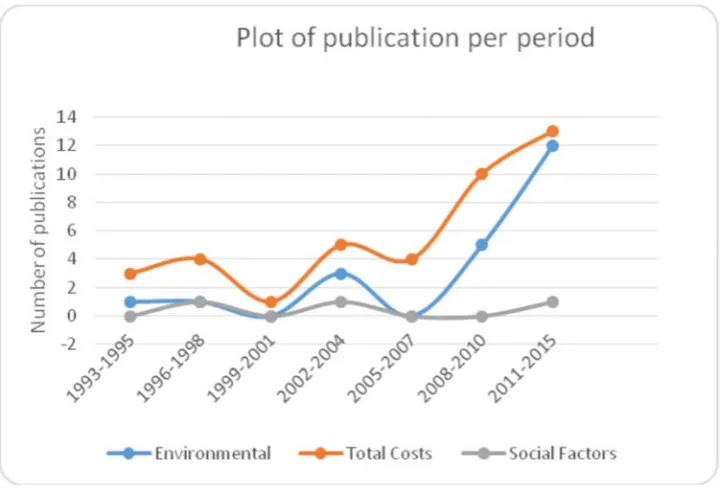
In this review two main objectives were observed in most publications, namely economic cost and
environmental objectives. Out of more than 50 reviewed papers 20 (40%) publications have
objective functions related to both economic and environmental pollution while 30 (60%)
publications have economic cost objective. However, 3 (6%) publications have social factors and
economic cost as objective functions, which show that it has received little attention by researchers.
2 CO
Figure 2 visualize the evaluation of objective functions; there are more papers with economic costs
objective function than the papers that have objective function related to environmental pollution
(GHG emissions).
Figure 2: Evaluation of Objective Functions from the year 1993 to 2015
In general, the environmental objective function can be seen to partly cover some aspects related
to environment, if we analyze the objective function in some models. For example the
environmental objective in [12] only considers the incinerator emission, in [51, 55] have only
considered emissions while in [14] considered environmental risk without defining those risks
such as GHG emissions and bad odor. Furthermore, an environmental emission is well done in
supply chain management literature although in different approaches as shown in [53] whereby
minimization of harmful gases such as , and volatile organic particle, generated by
facility operations and transportation were included. Even if they differ in approaches from each
other, the general agreement is that the environmental aspects should be present in decisions of
sustainable waste management systems, since they have strong impact on the trade-off between
the economic costs and the processing emissions from different facilities. The aspect of
environmental emission in supply chain can also be applied in SWM system with the inclusion of
methane ( ) gas which contribute much to the environmental pollution.
Regarding the economic objective functions, these have been fully developed since the literature
includes various economic cost types such as fixed and variable cost. Moreover, there is a general
2 CO NO2
concede on what should be included inside this function, except for the environmental cost as in
[22]. However, the environmental issue cannot be considered in the economic cost for sustainable
SWM, therefore it should be considered as independent entity in the modeling formulation.
3.1.2 Parameters and Constraints
As part of the modeling of problem, are also parameters and constraints; some parameters with
uncertainty were developed as in [14, 36]. The models have constraints that force each collection
area to be capacitated enough to fit the expected waste to be directed to that area, was formulated
by [11]. In addition to that, some constraints in [39] were introduced to convert the model to a
linear model since the nonlinear model is difficult to solve.
3.2Solution Methods
Traditional methods are frequently used as the solutions technique to analyze most of the reviewed
models. These methods allow the user to specify preferences, which may be expressed in terms of
the relative importance of different objectives. Most of these methods incorporate parameters,
which are coefficients, exponents and constraint limits. That can either be set to reflect
decision-maker preferences, or be continuously altered in an effort to stand for the complete Pareto optimal
set [56].
Moreover, some publications have used prior methods which are structured upon the pre-specified
preferences of the decision maker. In these methods, the complete preference information should
be stated first by the decision maker. The analyst then incorporates this preference information
into an optimization procedure to generate the best compromise solution. The widely used methods
are a weighting, lexicographic, branch and bound algorithm, and goal programming with some
modifications to suit for mathematical programming as discussed below.
3.2.1 Weighting Method
The majority of the publications in this review apply the weighting method to analyze the models.
Example can be found in [13, 42, 44, 46, 51] just to mention a few. The weighting method also
known as a scalarization method is the most basic technique for solving multi-objective problems.
In fact it is an approach that is combines multiple objectives into one single objective scalar
function. It can be mathematically formulated as:
(4)
(5)
k
i i if x
w Z
Minimize
1
) (
where, for all and the sum of all the weights, should be 1 [32]. This
technique needs an experienced person who knows the problem or a decision maker, which
requires a certain performance level from an optimization model, to set the weights for the
objectives [57].
Nonetheless, by setting only one of the weights, only one optimal solution can be obtained. Also,
there is a possibility that for a small change in the weights, some solutions will be going out of
feasible region. Furthermore, when the multi-objective problem is non-convex, the full
Pareto-front cannot be generated, thus limiting the use of the weighting method [57]. Therefore, this is
not an appropriate method for solving the multi-objective problems, since every problem has
different settings and every model behaves in a different way.
3.2.2 Goal Programming Method
This is an approach that is also used for solving multi-objective problems. In this approach the
deviations from the target values of every objective function are minimized. As a result, goal
setting by the decision maker is a more intuitive approach since it correlates to the behaviour of
the problem under study. In order to find optimal solutions, this approach is using the target levels
or goals to form a feasible point, where a solution is considered as feasible if the deviations from
that reference point is minimal [58]. Mathematically, this can be formulated as:
(6)
where (feasible region) and is the goal of the objective. takes the value of with
as the individual optimum of the objective, which represents the root mean square deviation
from the goals [59].
This method is suitable for bigger problems, with more variables and more objective functions. It
is very appropriate for the decision maker to capture the necessary elements of a problem and
formulate these into goals and constraints [60]. However, finding the optimal set of solutions can
be still a tricky task, since the deviations from the target levels can mislead the decision-maker.
Hence, the goal programming gives good results only if the target levels or goals are pessimistic
and restricting the area of optimal solutions. 0
i
w i1,2,...,k 1,
1
k i i w r n i r ii x y
Z Z Min / 1 1 ) ) ( (
Xx yi ith
r
2i
An example of model which applies goal programming can be found in [13, 21, 41, 45]. Moreover, a range of goal-programming forms has been proposed and frequently used by researchers, namely
weighted goal programming, Chebyshev goal programming and lexicographic goal programming.
These formulations are also known as mini-sum, mini-max, and pre-emptive priority goal
programming.
3.2.3 Lexicographic Method
The lexicographic method is another approach that is widely used for prioritization of the
objectives, where the decision maker makes an order of objective functions to be minimized. After
the first one is optimized, its value should be preserved in the following objective function
minimization, by setting up constraints. The process is terminated as soon as one of the
programming problems results in a single solution. In this review only 3 out of 50 papers apply
this method to analyze their models, this shows significant gap on the application of this solution
method. The lexicographic formulation is given as follow:
(7)
Subject to (8)
where represents a function’s position in the preferred sequence, and represents the
optimum of the objective function, found in the iteration. After the first iteration ,
is not necessarily the same as the independent minimum of because new constraints
have been introduced [56].
3.2.4 Branch and Bound Method
The Branch and Bound method employs a strategy in which the feasible region is divided into
smaller sub-groups (or nodes), each being examined for integer feasibility. The information
regarding the bounds on the objective function value is constantly updated and used to guide in a
selective examination of nodes. This method can be described as an iterative algorithm that
involves two operations, branching and bounding [61]. In this review there is only one publication
by [40] which apply this method, showing that little has been done to apply the iterative methods.
The main idea in branch and bound is to avoid growing the whole tree as much as possible, because
the entire tree is big enough in any real problem. Instead branch and bound grows the tree in stages
and grows only the most promising nodes at any stage. It determines which node is the most
promising by estimating a bound on the best value of the objective function that can be obtained )
(
minimize Fi x
. ,..., 2 , 1 , 1 , 1 ,..., 2 , 1 ), ( )
(x F x* j i i i k
Fj j j
i Fj(x*j)
jth jth (j1)
) ( *j j x
by growing that node to later stages. The name of the method comes from the branching that
happens when a node is selected for further growth and the next generation of children of that node
is created. The bounding comes in when the bound on the best value attained by growing a node
is estimated [62].
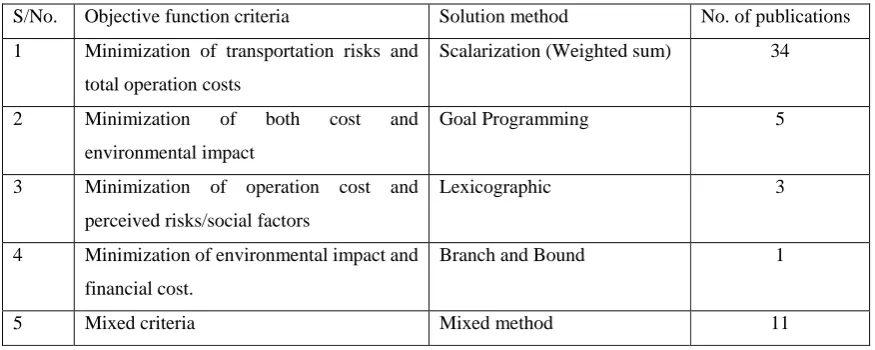
The number of publications per solution method and objective criteria are shown in table 1 below
which indicates that very little, has been done on the environmental related problems. Very few
studies have been considered environmental as independent objective function criteria.
Table 1: Number of Publications per Solution Method and Objective Criteria
S/No. Objective function criteria Solution method No. of publications 1 Minimization of transportation risks and
total operation costs
Scalarization (Weighted sum) 34
2 Minimization of both cost and
environmental impact
Goal Programming 5
3 Minimization of operation cost and perceived risks/social factors
Lexicographic 3
4 Minimization of environmental impact and financial cost.
Branch and Bound 1
5 Mixed criteria Mixed method 11
As a conclusion, some of the multi-objective solution approaches have been left so far in this
literature review, like evolutionary algorithms, trade-off curves technique and dynamic
programming, for addressing sustainable SWM system problems. This can be considered as a
research gap, where a contribution on the quality of the models can be seen by these
multi-objective modeling approaches.
3.3Model Implementation
The last point related to the models can be seen from the results of the various implementations of
the models. Several models are performing a good analysis, where some of the outcomes are
presented by [16], which provides a set of total solutions for long-term waste stream such as
allocation, setting resource recovery and tipping fees assessment. Moreover, the increases in
revenue per ton of compost and/or increased proportion of waste transformed to compost, means
that the whole operation cost can be reduced considerably in the case of the ISWM model making
it more efficient with reduced environmental pollution as presented by [22]. Besides that, the study
impacts, revenues improvement, the increment of the recycling ratio and decrease in final disposal
of waste to the landfill. Furthermore, there are significant gaps in sensitivity analysis of models as
only one publication by [18] was used to test some of the initial assumptions, this limiting a more
general applicability of the models in real life problem.
Finally, the factors related to social factors should be raised up since they are not well presented
in either side of the discussion. Thus, the implementation of the objective function with social
factors in sustainable multi-objective optimization models is inevitable. This issue should go
together with upgrading the environmental issues in the objective function to include new methods
of solving multi-objective models and sensitivity analysis.
4 Conclusion and Future Research Directions
A poorly planned solid waste management system without considering sustainable SWM will
result in extremely high costs, high risks and high GHG emissions; which will then lead to the
failure of a municipal in pursuing long-term sustainability of SWM system. The review finds that
there are a number of limitations to the current research in sustainable solid waste management
system. The narrow scope of environmental factors as constraints in some models should go
beyond that of including new environmental metrics. The more effective inclusion of the
environmental objective in models, which includes GHG emissions ( and ) from both
technologies and transportation with improved multi-objective approaches is needed. There are
also significant gaps in sensitivity analysis of models limiting more general applicability of the
models; something that can be considered as future research opportunities.
Therefore, in order to fill the gap, the mathematical model for SWM system operated in municipal
will be formulated in future so that the total costs for SWM, GHG emissions, and waste
minimization will be simultaneously considered in a multi-objective optimization model for SWM
and solved by the state of the art techniques.
Conflict of Interests
The authors declare that there is no conflict of interests.
Acknowledgements
The authors would like to thank the Government of the Republic of Tanzania through the
Commission for Science and Technology (COSTECH) for the full financial support of this study.
4
REFERENCES
[1] G. Tchobanoglous, et al., Integrated solid waste management: engineering principles and management issues: McGraw-Hill, Inc., 1993.
[2] O. Oyelola, et al., Health implications of solid waste disposal: case study of Olusosun dumpsite, Lagos, Nigeria, International Journal of Pure and Applied Sciences, 3(2009), 1-8.
[3] R. Gerlagh, et al., Integrated Modelling of Solid Waste in India: Collaborative research in the economics of environment and development (CREED), 1999.
[4] APO, Solid Waste Management: Issues and Challenge in Asia, Tokyo, Asian Productivity Organization, 2007.
[5] E. Solano, Multi-objective Linear Programming Optimization for Waste Management Simulation, presented at the The Fourth International Conference on Advances in System Simulation, 2012.
[6] A. Rentizelas and D. Georgakellos, Incorporating life cycle external cost in optimization of the electricity generation mix, Energy Policy, 65(2014), 134-149.
[7] M. Luoranen and M. Horttanainen, Feasibility of energy recovery from municipal solid waste in an integrated municipal energy supply and waste management system, Waste Management & Research, vol. 25(2007), 426-439.
[8] C. European, Brussels August 2006.
[9] WB, Technical Guidance Report, Word Bank, Washington D.C. 1999. [10] A. De-Souza, unpublished|.
[11] G. Ghiani, et al., Capacitated location of collection sites in an urban waste management system, Waste Management, 32(2012), 1291-1296.
[12] R. Minciardi, et al., Multi-objective optimization of solid waste flows: Environmentally sustainable strategies for municipalities, Waste Management, 28(2008), 2202-2212.
[13] G. Galante, et al., A multi-objective approach to solid waste management, Waste Management, 30(2010), 1720-1728.
[14] A. K. Srivastava and A. K. Nema, Fuzzy parametric programming model for multi-objective integrated solid waste management under uncertainty, Expert Systems with Applications, 39(2012) 4657-4678.
[15] B. Noche, et al., Optimization model for solid waste management system network design case study, in Computer and Automation Engineering (ICCAE), 2010 The 2nd International Conference on, 2010, pp. 230-236.
[16] N.-B. Chang and S. Wang, Solid waste management system analysis by multiobjective mixed integer programming model, Journal of Environmental Management, 48(1996), 17-43.
[17] J. Su, et al., An inexact multi-objective dynamic model and its application in China for the management of municipal solid waste, Waste Management, 28(2008), 2532-2541.
[19] C. Vadenbo, et al., Multi-objective optimization of waste and resource management in industrial networks– Part I: Model description, Resources, conservation and recycling, 89(2014), 52-63.
[20] G. Mavrotas, et al., Municipal solid waste management and energy production: Consideration of external cost through multi-objective optimization and its effect on waste-to-energy solutions, Renewable and Sustainable Energy Reviews, 51(2015), 1205-1222.
[21] V. Sudhir, et al., Integrated solid waste management in urban India: a critical operational research framework, Socio-Economic Planning Sciences, 30(1996), 163-181.
[22] C. K. Amenyah, Amponsah, S. K, Salhi, S, An Integrated Solid Waste Management Model (Case Study of Accra Metropolitan Assembly), Research Journal of Environmental Earth Sciences 3(2011), 203-213. [23] H. Yu, et al., Optimization of long-term performance of municipal solid waste management system: A
bi-objective mathematical model, Journal homepage: www. IJEE. IEEFoundation. org, 6(2015), 153-164. [24] P. Fiorucci, et al., Solid waste management in urban areas: development and application of a decision support
system, Resources, conservation and recycling, 37(2003), 301-328.
[25] M. Münster, et al., Economic and environmental optimization of waste treatment, Waste Management, 38(2015), 486-495.
[26] S. T. Tan, et al., Energy, economic and environmental (3E) analysis of waste-to-energy (WTE) strategies for municipal solid waste (MSW) management in Malaysia, Energy Conversion and Management, 2015. [27] S. Saxena, et al., Towards sustainable municipal solid waste management in Allahabad City, Management of
Environmental Quality: An International Journal, 21(2010), 308-323.
[28] H. A. Lyeme, et al., Optimization model for Solid Waste Management at Ilala Municipal, Tanzania, JOURNAL OF INFORMATICS AND VIRTUAL EDUCATION, p. 18, 2011.
[29] M. Badran and S. El-Haggar, Optimization of municipal solid waste management in Port Said–Egypt, Waste Management, 26(2006), 534-545.
[30] A. Chakraborty, et al., Optimal waste reduction and investment planning under uncertainty, Computers & chemical engineering, 28(2004), 1145-1156.
[31] M. Ikhlayel, Higano, Y., Yabar, H and Mizunoya, T, Proposal for a sustainable and integrated municipal solid waste management system in Amman, Jordan based on the life cycle assessment method, AJAST, pp. 119-130, 2010.
[32] M. Barma, Wajiga, G. M, Okolo, A and Hammandikko, G. M, Multi-objective Mathematical Programming Approach to Minimize Volume of Solid Waste at Waste Collection Centers in Municipalities, International Journal of Waste Management and Technology 1(2014), 1-22.
[33] S. Das and B. K. Bhattacharyya, Optimization of municipal solid waste collection and transportation routes, Waste Management, 43(2015), 9-18.
[34] R. D. R. a. N. R. Sanders, Operations Management, 4th ed.: Wiley, 2010.
[36] S. Mousavi, et al., A fuzzy Multi Objective Decision Making approach for locating undesirable Facilities and Hazardous Materials, in Management of Innovation and Technology, 2008. ICMIT 2008. 4th IEEE International Conference on, 2008, pp. 1094-1098.
[37] J. Rakas, et al., Multi-objective modeling for determining location of undesirable facilities, Transportation Research Part D: Transport and Environment, 9(2004), 125-138.
[38] A. Nema and S. Gupta, Multiobjective risk analysis and optimization of regional hazardous waste management system, Practice Periodical of Hazardous, Toxic, and Radioactive Waste Management, 7(2003), 69-77,.
[39] Y. Xie, et al., A multimodal location and routing model for hazardous materials transportation, Journal of hazardous materials, 227(2012), 135-141.
[40] E. Karasakal and D. Nadirler, An interactive solution approach for a bi-objective semi-desirable location problem, Journal of Global Optimization, 42(2008), 177-199.
[41] E. Erkut, et al., A multicriteria facility location model for municipal solid waste management in North Greece, European journal of operational research, 187(2008), 1402-1421.
[42] S. Alumur and B. Y. Kara, A new model for the hazardous waste location-routing problem, Computers & Operations Research, 34(2007), 1406-1423.
[43] L. Tralhão, et al., A multiobjective modeling approach to locate multi-compartment containers for urban-sorted waste, Waste Management, 30(2010), 2418-2429.
[44] A. I. Barros, Dekker, R and Scholten, V, A two level network for recycling sand: A case study, Erasmus University Rotterdam, The Netherlands 1996.
[45] I. Giannikos, A multiobjective programming model for locating treatment sites and routing hazardous wastes, European journal of operational research, 104(1998), 333-342.
[46] E. Melachrinoudis, et al., A multiobjective model for the dynamic location of landfills, Location Science, 3(1995), 143-166.
[47] H. A. Eiselt and V. Marianov, A bi-objective model for the location of landfills for municipal solid waste, European Journal of Operational Research, 235(2014), 187-194.
[48] C. Caruso, et al., The regional urban solid waste management system: a modelling approach, European journal of operational research, 70(1993), 16-30.
[49] R. Ganeshan and T. P. Harrison, An introduction to supply chain management, Department of Management Science and Information Systems, Penn State University, 1995.
[50] H. Yu, et al., A multi-objective decision support system for simulation and optimization of municipal solid waste management system, in Cognitive Infocommunications (CogInfoCom), 2012 IEEE 3rd International Conference on, 2012, pp. 193-199.
[51] K. P. Nurjanni, et al., Green Supply Chain Design with Multi-Objective Optimization, in Proceedings of the 2014 International Conference on Industrial Engineering and Operations Management Bali, 2014, pp. 7-9. [52] J.-B. Sheu and A. Y.-S. Lin, Hierarchical facility network planning model for global logistics network
[53] R. Jamshidi, et al., Multi-objective green supply chain optimization with a new hybrid memetic algorithm using the Taguchi method, Scientia Iranica, 19(2012), 1876-1886.
[54] K. Govindan, et al., Two-echelon multiple-vehicle location–routing problem with time windows for optimization of sustainable supply chain network of perishable food, International Journal of Production Economics, 152(2014), 9-28.
[55] F. Wang, et al., A multi-objective optimization for green supply chain network design, Decision Support Systems, 51(2011), 262-269.
[56] R. T. Marler and J. S. Arora, Survey of multi-objective optimization methods for engineering, Structural and multidisciplinary optimization, 26(2004), 369-395.
[57] K. Miettinen, Nonlinear Multiobjective Optimization, volume 12 of International Series in Operations Research and Management Science, ed: Kluwer Academic Publishers, Dordrecht, 1999.
[58] T. J. Stewart, A critical survey on the status of multiple criteria decision making theory and practice, Omega, 20(1992), 569-586.
[59] V. Bhaskar, et al., Applications of multiobjective optimization in chemical engineering, Reviews in Chemical Engineering, 16(2000), 1-54.
[60] Z. Wu, et al., Multi-criteria optimization applications in highway asset management, Journal of Transportation Engineering, 2010.
[61] S. Melfah, Optimizing Transportation Cost of Solid Waste: a case study in the New Juaben Municipality, 2012.