2014 January, Volume 3 Number 1, 63-78
The revised Appreciation of the Liberal Arts Scale
(ALAS-R): Development, reliability and validity
Reid, Howard
SUNY Buffalo State, USA ([email protected])
Kline, Brian
SUNY Buffalo State, USA ([email protected])
O’Quin, Karen
SUNY Buffalo State, USA ([email protected])
Received: 16 April 2013 Revised: 21 November 2013 Accepted: 22 November 2013
Available Online: 22 November 2013 DOI: 10.5861/ijrse.2013.416
ISSN: 2243-7703 Online ISSN: 2243-7711
OPEN ACCESS
Abstract
Three studies were conducted to develop and evaluate an Appreciation of the Liberal Arts Scale.
The final 24-item revision (ALAS-R) was reliable (
α
= .86). Students who had
a greater
appreciation of the liberal arts were less materialistic, had greater life satisfaction, had greater
ability to defer gratification, and reported greater openness to experiences, leadership, wisdom,
and judgment. In addition, ALAS-R scores were
predictably related to students’ choice of
academic major, with Arts and Humanities majors scoring higher. This scale has the potential
to contribute to prediction of student retention and major, as well as the assessment of a
dimension of college student development.
The revised Appreciation of the Liberal Arts Scale (ALAS-R):
Development, reliability and validity
1. Introduction
Many students choose to attend colleges and universities that focus upon providing a broad education instead of emphasizing the development of specialized career skills. This classic, or liberal arts, education was at one time restricted only to society’s elite. Today, the opportunity to gain a liberal arts education is widely available in both private and public colleges and universities.
Though there is now an unprecedented opportunity for a significant portion of the population to become liberally educated, students may not understand what a liberal education entails (Moore, 2006). According to Perry’s (1970) theory of college student development, this classic education should lead to transformative change from a reliance upon basic either/or thinking to an emphasis upon complex, contextually-specific perspectives. One component in achieving this transformation in understanding is the opportunity to engage in experiential learning (Hutchings & Wutzdorff, 1988). It contrasts with the rule-governed learning emphasized in much of early education, and rule-governed learning can be surprisingly inflexible (Lowe, 1979). The shift to a more reflective, integrative level of understanding is apparent in the student’s development of an informed worldview (Kronman, 2007). Among the salient characteristics of such a worldview are intellectual honesty, the need to remain a lifelong learner, and an emphasis upon civic engagement (reviewed in Long, 2012).
The value of a liberal arts education has sometimes been questioned. For instance, it was suggested that one consequence of the No Child Left Behind Act was reduced emphasis on teaching subjects such as foreign language, history and the arts in K-12 (“Schools Dropping,” 2004). There also may be a decline in university support for the study of foreign language (Corral & Patai, 2008). These are particularly troubling trends, as it is commonly acknowledged that the need to understand and communicate with individuals from other cultures is increasing. Perhaps of greatest concern, however, is that the United States Education Department has not provided clear guidance regarding the value of a liberal arts education (Basken, 2008). Some suggest that support for the incorporation of liberal arts principals in pedagogy has been lost through revisions of the U.S. education system (Mirel, 2011; Pascarella, Wolniak, Seifert, Cruce, & Blaich, 2005).
Not surprisingly, there have been efforts to emphasize the importance of the classic education. The Association of American Colleges and Universities’ Liberal Education and America’s Promise Campaign sought to understand and promote effective means for implementing a liberal arts agenda in education (Pingree, 2007). In addition, Arcilla (2007) provided a thoughtful defense against “the suspicion that liberal education is a dinosaur…” (p. 19) and as early as 1976 U.S. Senator Charles McC. Mathias Jr. encouraged a return to the goals of a liberal arts curriculum (“Return to Traditional,” 1976). Further, Common Core, a group promoting the liberal arts curriculum, has reported data showing “a stunning ignorance about basic facts of U.S. history and literature” among American 17-year-olds (Manzo, 2008). In summary, it has been noted that additional emphasis needs to be focused upon clarifying the positive impact of a liberal arts education (Seifert et al., 2008).
The revised Appreciation of the Liberal Arts Scale (ALAS-R): Development, reliability and validity
money (Schultz & Higbee, 2007; Webster, 1997).
2. Background and Purpose
To examine the extent to which a liberal arts education is valuable, one focus of research has been to compare outcomes of students at liberal arts colleges with the outcomes of students at other types of higher education institutions (Pascarella et al., 2005). The authors reported considerable inconsistency in their findings on the effects of a liberal arts education upon intellectual development. This was at least partially due to the difficulty of determining to what extent differences between institutions stemmed from pre-existing differences in the characteristics of students choosing to attend various types of colleges and universities, different recruitment strategies, different baselines used to report outcome gains, etc. In a review of existing literature the same authors noted positive, though not conclusive, results for the effects of a liberal arts education upon students’ personal development, persistence, and educational outcomes (Pascarella et al., 2005).
Research also has been conducted to define a liberal arts education. Research of this type has focused on identifying the central principles of a liberal arts education, intended liberal arts educational outcomes, and the historical origins of liberal arts concepts (King, Brown, Lindsay & VanHecke, 2007; Pascarella et al., 2005). King et al. (2007) identified liberal arts outcomes by grouping related themes in the liberal arts literature into seven categories: integration of learning, inclination to inquire and lifelong learning, effective reasoning and problem solving, moral character, intercultural effectiveness, leadership, and well-being. These authors suggested that the value of a liberal arts education is partially based upon the integration of these categories within the educational experience.
In a longitudinal study of more than 40 institutions, Pascarella et al. (2005) defined pedagogical practices and conditions that characterized liberal arts education. They also created scales for measurement purposes: a liberal arts emphasis scale aggregated at the institutional level, and self-reported liberal arts experiences scale for individual students. Results showed that merely attending a liberal arts college did not consistently impact students’ learning, and sometimes had a less-than-positive effect. However, when looking at students’ self-reports of their liberal arts experiences; Pascarella et al. (2005) did find consistent positive relationships with learning.
Seifert et al. (2008) utilized the college experiences scale developed by Pascarella et al. (2005) to measure liberal arts experiences of individual students. Students reported on many practices and conditions prevailing at their own institutions, such as the scholarly/intellectual emphasis of the campus, the number of essay exams they took, academic effort/involvement, integration of ideas, and many others. In regression analyses, Seifert et al. (2008) found that the liberal arts experiences scale was positively related to intercultural effectiveness, lifelong learning, well-being, and leadership (examples of psychosocial development during college).
Pascarella, Seifert, and Blaich (2010) explored the potential relationship between liberal arts outcomes and the current benchmarks of the National Survey of Student Engagement (NSSE) – a survey used widely to assess the quality of undergraduate education practices. The authors found that the NSSE benchmark scores had a significant positive relationship with liberal arts outcomes (Pascarella et al., 2010). This suggests similarities between educational practices that engage students effectively and liberal arts educational practices.
assessment in higher education has focused on content knowledge or skills development; however, attitudinal change is also a legitimate focus of assessment” (p. 67).
The present study was designed, therefore, to develop a measure of students’ attitudes toward the liberal arts. Existing scales (e.g., Pascarella et al., 2005) measure students’ exposure to liberal arts-related experiences at their institutions, but we were unable to identify in the literature a scale to measure appreciation of the liberal arts at the individual level. Initial development of scale items was based upon the views of faculty teaching an introduction to the liberal arts college course, student input, and a review of existing literature. With the development of this measurement instrument, we aimed to contribute to a more general effort to quantify the value of a liberal arts education and to identify factors affecting psychosocial development of college students.
A second goal was to establish convergent and discriminant validity of a scale to measure appreciation of the liberal arts by assessing the extent to which this scale was related to students’ values and characteristics. Deferment of gratification has been shown to predict grades after controlling for course rating, expected grade, interest, importance, and utility of academic task (Bembenutty, 2009). In a classic study, the ability to successfully resist temptation as a young child was associated with being more “cognitively and socially competent” when 17 years of age (Shoda, Mischel, & Peake, 1990). It appears, therefore, that the ability to defer gratification confers a long-term benefit in many aspects of life, thus an inability to defer gratification may represent a student characteristic antithetical to liberal arts values such as lifelong learning. Furthermore, based upon the core components of a liberal arts education identified by King et al. (2007), we also assessed openness to experience, leadership, wisdom, and judgment. This corresponds to Sullivan’s (2012) discussion about how to reconcile professional and liberal learning, which focused on the concepts of “practical wisdom” and judgment. Judgment was also mentioned by Harward (2012) as an essential element of the epistemological component of liberal education. It was hypothesized that these constructs, as well as a value system emphasizing low materialism would be related to appreciation of the liberal arts. Finally, it was predicted that satisfaction with life would be negatively associated with a materialistic orientation (e.g., Piko, 2006; Ryan & Dziurawiec, 2001), and thus positively associated with an appreciation of the liberal arts. This prediction is consistent with Harward’s assertion that among the outcomes of undergraduate education, students’ emotional well-being is an important and even transformative element.
3. General Method
3.1 Overview
Participants in all three studies were students at a medium-sized northeastern public liberal arts college attending a variety of classes.
3.2 Materials
The 18-item Materialism scale developed by Richins and Dawson (1992) was used in all three studies. Materialism items were answered on a 5-point Likert-format scale ranging from 1 = strongly agree, to 5 = strongly disagree. Sample items were: “I like to own things that impress people” and “Some of the most important achievements in life include acquiring material possessions.”
The 5-item Satisfaction with Life Scale (Diener, Emmons, Larsen, & Griffin, 1985) was used in all three studies. In Study 1, items were answered on a 7-point Likert-format scale from 1 = strongly disagree to 7 = strongly agree. A sample item was: “The conditions of my life are excellent.” In Studies 2 and 3, a 5-point response format was used.
The revised Appreciation of the Liberal Arts Scale (ALAS-R): Development, reliability and validity
money rather than spending it straight away?” and “Do you agree with the philosophy, ‘Eat, drink, and be merry, for tomorrow we may all be dead?’”
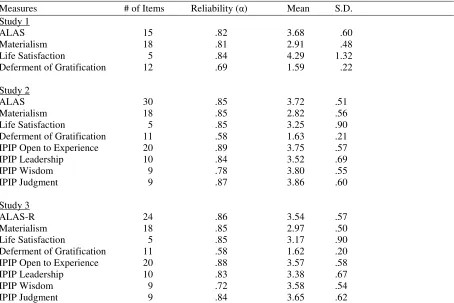
The additional scales utilized in Studies 2 and 3 are described in the method section of Study 2. Table 1 contains an overview of the measures used in all three studies, including reliabilities and descriptive statistics.
3.3 Procedure
A questionnaire containing ALAS items, along with the scales described above, was distributed to intact classroom groups ranging in size from approximately 20 to 60. Participants read and signed informed consent statements, and returned the completed questionnaires at the next class meeting. Completion times ranged from approximately 20 minutes in Study 1 to 30 minutes or longer for the more extensive questionnaires in Studies 2 and 3.
4. Analysis
4.1 Study 1
Participants - There were 137 participants, of whom 89 (65%) were female and 48 (35%) were male. In age,
43 (31.4%) were 18-20, 60 (43.8%) were 21-23, and 34 (24.8%) were 24 or older. There were 8 (5.8%) first-year students, 23 (16.8%) sophomores, 45 (32.8%) juniors, and 60 (43.8%) seniors; one student did not report his/her class standing. The majority (n = 102, 74.4%) were Caucasian, 19 (13.9%) were African-American, and 16 (11.7%) reported other ethnicity.
Materials - An initial pool of 28 items intended to measure attitudes toward the liberal arts was included in
the questionnaire. The items were generated by a) review of the literature and b) discussions with faculty and first-year students enrolled in an introductory course at the authors’ institution devoted partially to understanding the liberal arts. Among the issues addressed in the initial item pool were enjoyment of learning, the value of community involvement, the perception of income as a measure of success, and the perceived value of learning about the arts. The items on the initial version were administered in random order as part of a larger questionnaire. These 28 items were answered on a 5-point Likert-format scale labeled 1 = not at all me, 3 = somewhat like me, 5 = definitely describes me.
Procedure - Demographic items, as well as additional questions unrelated to the present study, were included in the questionnaire in the following order: demographic items, Materialism scale, Deferment of Gratification scale, Satisfaction with Life scale, attitudes toward the liberal arts, and unrelated items.
Results - ALAS development. Exploratory factor analysis (principal components, Varimax rotation) yielded
four factors with eigenvalues greater than 1. Examination of the rotated component matrix showed that many items loaded on more than one factor, indicating multidimensionality. The reliabilities (Cronbach’s alpha) of the four factors considered individually were unacceptably low (α < .60). Thus, we decided to focus on the concept as a whole, using repeated reliability analyses to remove items that did not contribute to the scale.
Table 1
Overview of Measures Used in Three Studies
Measures # of Items Reliability (α) Mean S.D.
Study 1
ALAS 15 .82 3.68 .60
Materialism 18 .81 2.91 .48
Life Satisfaction 5 .84 4.29 1.32
Deferment of Gratification 12 .69 1.59 .22
Study 2
ALAS 30 .85 3.72 .51
Materialism 18 .85 2.82 .56
Life Satisfaction 5 .85 3.25 .90
Deferment of Gratification 11 .58 1.63 .21
IPIP Open to Experience 20 .89 3.75 .57
IPIP Leadership 10 .84 3.52 .69
IPIP Wisdom 9 .78 3.80 .55
IPIP Judgment 9 .87 3.86 .60
Study 3
ALAS-R 24 .86 3.54 .57
Materialism 18 .85 2.97 .50
Life Satisfaction 5 .85 3.17 .90
Deferment of Gratification 11 .58 1.62 .20
IPIP Open to Experience 20 .88 3.57 .58
IPIP Leadership 10 .83 3.38 .67
IPIP Wisdom 9 .72 3.58 .54
IPIP Judgment 9 .84 3.65 .62
Note. In Studies 2 and 3, one item was inadvertently omitted from the Deferment of Gratification scale. The scale score was the mean of the items administered. In Study 1, Life Satisfaction was measured on a 7-point scale; in Study 2 and Study 3, a 5-point response scale was used.
Table 2 presents the correlations among the ALAS-15 and other measures administered. Those who reported more positive attitudes toward the liberal arts on the ALAS-15 indicated that they were less materialistic and had greater life satisfaction. Although those with more positive attitudes toward the liberal arts also indicated that they were better able to defer gratification, this correlation of .17 was only marginally significant (p = .054). These findings are consistent with our predictions. Table 2 also indicates that students who were better able to defer gratification were less materialistic. Materialism and life satisfaction also were found to be significantly negatively correlated, so that those with higher life satisfaction reported being less materialistic.
Table 2
Study 1: Correlation Matrix of the Initial Appreciation of Liberal Arts Scale (ALAS-15) & Three Other Measures
Scale 1 2 3
1. ALAS-15 --
2. Materialism Total -.28** --
3. Life Satisfaction .24** -.28** -- 4. Deferment/Gratification .17 -.32** .12 Note. High scores indicated more materialism, greater ability to defer gratification, more positive attitudes toward the liberal arts and higher life satisfaction. *p < .05 **p < .01
Demographic variables - Scores on the ALAS-15 were significantly related to two of the demographic measures in the present study: age of student and self-reported grade-point average (GPA). Older students reported more positive attitudes toward the liberal arts, r(137) = .23, p = .006, and students with higher GPAs also reported more positive attitudes toward the liberal arts, r(129) = .20, p = .022.
The revised Appreciation of the Liberal Arts Scale (ALAS-R): Development, reliability and validity
= .048; those reporting higher GPAs also reported being less materialistic. Self-reported GPA was also significantly related to deferment of gratification, r(129) = .34, p < .001, indicating that those reporting higher GPAs considered themselves better able to defer gratification.
Discussion - Study 1 had two goals – to develop an appreciation of the liberal arts measurement instrument
and to identify student values related to this scale. Iterative reliability analyses of a larger pool of items resulted in a 15-item Appreciation of the Liberal Arts scale (ALAS) with good reliability. As expected, greater appreciation of the liberal arts was associated with less materialism as well as greater life satisfaction, and somewhat enhanced ability to delay gratification.
Perhaps due to the relatively small sample size, and the small number of first-year students included in the study, college class was not found to be related to ALAS-15 scores. However, older students, and students with higher self-reported GPAs, did report more positive attitudes towards the liberal arts. Higher self-reported GPAs were also associated with a less materialistic outlook and a greater ability to defer gratification.
A limitation of Study 1 was that the original generation of ALAS items might not have covered fully the domain of attitudes toward the liberal arts. Accordingly, the purpose of Study 2 was to generate a much broader pool of items that would improve the content validity of the measure. In addition to the 15 items from Study 1, items were added to measure favorability toward new academic experiences, community interests, critical thinking, openness to change and challenges, a well-rounded education, and whether colleges should emphasize careers and jobs rather than traditional academic topics.
Furthermore, additional measures were added to examine the construct validity of the ALAS. Based upon similarities between the categories of liberal arts outcomes suggested previously (King et al., 2007; Pascarella et al., 2005) and traits such as wisdom, leadership, and judgment (Harward, 2012; Sullivan, 2012), it was hypothesized that measures of these traits would be significantly correlated with our measure of student appreciation of the liberal arts. An additional scale to assess construct validity of the ALAS, openness to experience, was included. Similar to the concept of valuing lifelong learning, openness to experience has been studied as a personality variable linked to academic success in the college environment (e.g., Harms, Roberts, & Winter, 2006).
4.2 Study 2
Participants - Data were analyzed from 160 college students; 115 (72%) were women and 45 (28%) were
men. Of these, 18 (11%) were first-year students, 21 (13%) were sophomores, 61 (38%) were juniors, and 60 (38%) were seniors. In age, 70 (44%) were 18-20, 55 (34%) were 21-23, 19 (12%) were 24-26, and 16 (10%) were 27 or older. The majority (n = 109, 68.1%) were Caucasian, 33 (20.6%) were African-American, and 18 (11.3%) reported other ethnicity.
Materials and Procedure - Students provided written consent and then completed a questionnaire consisting
of the broader pool of ALAS items, as well as the previously described scales for materialism, deferment of gratification, and life satisfaction. Fewer demographic items were included. Four new scales were included from the International Personality Item Pool (IPIP); the IPIP [VIA: Per] perspective/wisdom scale, the IPIP [NEO Domain] openness to experience scale, the IPIP [AB5C] leadership scale, and the IPIP [VIA: Jud] judgment/open-mindedness scale (International Personality Item Pool, 2001). Each of those was scored on a 5 point scale from 1 = very accurate to 5 = very inaccurate. Previous research has demonstrated all scales to have good reliability (α = .75, α = .89, α = .82, and α = .80, respectively). As may be seen in Table 1, all of the IPIP scales also yielded good reliabilities in Study 2; only Deferment of Gratification had a low reliability.
eliminating step-by-step those items that did not contribute to the scale’s reliability (iterative reliability analysis). The resulting 30-item revised ALAS was found to have good reliability (see Table 1; Reid, O’Quin & Kline, 2010).
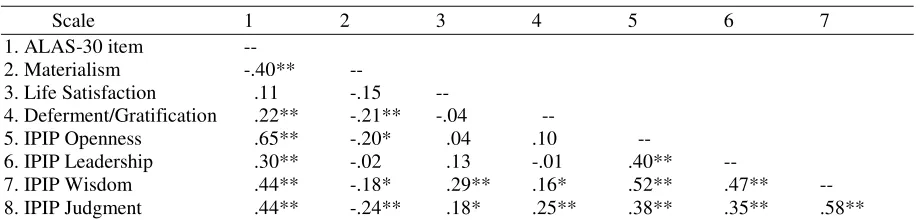
Results and Discussion - Students who reported being more open to the liberal arts, as measured by this revision of the ALAS, also reported being less materialistic. Correlations are presented in Table 3. Similar to results of Study 1, positive attitudes toward the liberal arts were correlated positively with self-reported ability to defer gratification. In addition, responses on this revision of the ALAS were strongly correlated with IPIP openness to new experiences, and positive relationships were found to a lesser degree between ALAS-30 scores and IPIP leadership, wisdom, and judgment scales. Furthermore, it was found that a materialistic outlook was associated with a self-reported reduction in the ability to defer gratification, and a poorer assessment of wisdom and judgment. Finally, as scores on the IPIP Openness to Experience scale were not significantly correlated with deferment of gratification, nor strongly correlated with materialism, we concluded that the ALAS and IPIP Openness to Experience scales were measuring distinctly different student characteristics. This pattern of results supports the construct validity of the ALAS-30.
Table 3
Study 2: Correlations of the Appreciation of Liberal Arts Scale (ALAS-30) and Seven Other Measures
Scale 1 2 3 4 5 6 7
1. ALAS-30 item --
2. Materialism -.40** --
3. Life Satisfaction .11 -.15 --
4. Deferment/Gratification .22** -.21** -.04 --
5. IPIP Openness .65** -.20* .04 .10 --
6. IPIP Leadership .30** -.02 .13 -.01 .40** --
7. IPIP Wisdom .44** -.18* .29** .16* .52** .47** -- 8. IPIP Judgment .44** -.24** .18* .25** .38** .35** .58** Note. High scores indicated more materialism, greater ability to defer gratification, more positive attitudes toward the liberal arts, higher life satisfaction, and higher self-evaluation of openness, leadership, wisdom, and judgment.
None of the demographic variables were significantly related to scores on the ALAS-30 (all r < .10, ns). However, older students reported lower life satisfaction, r(160) = -.17, p = .029.
Despite the revision of the ALAS in Study 2 including twice the number of items, the reliability of the scale was virtually unchanged from that in Study 1 (see Table 1). Thus, it appeared that some of the additional items included in Study 2 were not greatly contributing to the content validity of the scale. One purpose of Study 3, therefore, was to further refine the items of ALAS-30 to determine whether we could cover the domain of the concept with fewer items. A second purpose was to provide additional evidence for scale validity by examining its relationship to students’ choice of academic majors. We predicted that students who chose majors in fields traditionally considered to be liberal arts (e.g., Fine Arts, Humanities) would have higher scores on the ALAS than students in applied and professional majors (e.g., Business).
4.3 Study 3
Participants - Data were collected from 198 college students, 109 (55%) women and 89 (45%) men. In age,
118 (60%) were 18-20, 50 (25%) were 21-23, 11 (6%) were 24-26, and 18 (9%) were 27 or older; one student did not report age. In class standing, 105 (53%) were first-year students, 30 (15%) were sophomores, 36 (18%) were juniors, and 27 (14%) were seniors. The majority (n = 124, 62.6%) were Caucasian, 39 (19.7%) were African-American, and 35 (17.7%) reported other ethnicity. Majors were recruited from the School of Arts and Humanities (n = 25, 13%), Education (n = 25, 13%), Natural and Social Sciences (n = 44, 22%), and Professions (n = 66, 33%); the remaining students reported they did not have a major (None; n = 38, 19%).
The revised Appreciation of the Liberal Arts Scale (ALAS-R): Development, reliability and validity
the 30-item revision of the ALAS as well as the previously described scales for materialism, deferment of gratification, life satisfaction, and IPIP scales for openness, leadership, wisdom and judgment. Factor analysis (principal components, Varimax rotation) yielded 6 factors with eigenvalues greater than 1. However, Factor 1 was predominant (initial eigenvalue = 6.65, accounting for 19.55% of the variance). Our goal was to refine the scale, so this revision of the ALAS was also developed by iterative reliability analyses. Items were deleted one-by-one if their item-total correlation was low and the reliability of the scale would increase if the item were deleted. The resulting 24-item ALAS-R was found to have very good reliability (see Table 1). Items included in the final version of the ALAS-R are presented in Table 4.
Table 4
Study 3: Final 24 Items Comprising the Appreciation of Liberal Arts Scale-Revised (ALAS-R)
Items 1. I enjoy learning.
2. Colleges should emphasize traditional academic topics such as languages, literature, history, and philosophy.
3. I believe community involvement is an important activity in one’s life. 4. I believe learning history is meaningless since it describes what is past. (R) 5. The challenges faced by people in poor countries greatly concern me. 6. I view life as an opportunity for growth.
7. I believe the best measure of a person’s success is his/her income. (R) 8. I enjoy hearing or reading opinions that differ from my own.
9. I am interested in taking courses outside my major area of interest. 10. A broad education is more valuable than a narrow career focus. 11. I believe that learning about the arts is not important. (R)
12. When deciding upon a difficult issue, I try to gain a broad perspective. 13. I believe that learning about philosophy would be a valuable experience. 14. Volunteering to your community without being paid is a waste of time. (R) 15. I believe that to be a success, a person must live a life that emphasizes values. 16. There is more to life than making money.
17. All fields of knowledge have a great deal to offer me.
18. Occupational and professional skills should be the primary emphasis of colleges. (R) 19. I would rather be wise than rich.
20. I see myself as emphasizing a “life of the mind.”
21. The primary purpose of college is to help me get a good job. (R) 22. A well-rounded life includes appreciation of the arts and humanities. 23. I enjoy reading “challenging” books and articles.
24. I believe that taking a social science course would be useful.
Note. All items were answered on a 5-point Likert-format scale labeled 1 = not at all me, 3 = somewhat like me, 5 = definitely describes me. Items marked with (R) above were recoded before being averaged to form the scale.
Results - Reliabilities of all measures are presented in Table 1 and were good to excellent for all measures
except Deferment of Gratification. Consistent with Studies 1 and 2, findings showed that students who scored higher on the ALAS-R reported they were less materialistic, had greater life satisfaction, and were better able to defer gratification (see Table 5). In addition, responses on the ALAS-R were correlated with student openness to experience, leadership, wisdom and judgment, supporting its convergent validity. Further, evidence for divergent validity was provided by analyses indicating that, though the ALAS-R and the IPIP Openness to Experience Scale were strongly correlated, they were measuring different student characteristics because scores on the IPIP Openness to Experience Scale were not significantly correlated with scores on the materialism, life satisfaction, or the deferment of gratification scales. A materialistic outlook was associated with lower life satisfaction, and a poor ability to defer gratification, as was found previously in Studies 1 and 2.
For the first time among the three studies, gender was significantly related to other variables. Women in Study 3 were younger (r(198) = -.22, p = .022, reported a greater appreciation of the liberal arts, r(198) = .23, p
Study 3. Analyses of variance showed no significant difference due to class standing for any of the scales (all F < 2.3, all p > .08) except for IPIP judgment. Juniors reported significantly higher judgment scores than first-year students, F(3, 194) = 2.68, p = .048, η2 = .04.
Table 5
Study 3: Correlations of 24-Item ALAS-R and Seven Other Measures
Scales 1 2 3 4 5 6 7
1. ALAS-R --
2. Materialism -.31** --
3. Life Satisfaction .17* -.22** --
4. Deferment/Gratification .16* -.33** .27** --
5. IPIP Openness .63** -.12 .13 .01 --
6. IPIP Leadership .29** -.01 .36** -.00 .44** -- 7. IPIP Wisdom .40** -.07 .28** .10 .55** .59**
8. IPIP Judgment .43** -.11 .27** .16* .45** .35** .54** Note. High scores indicated more materialism, greater ability to defer gratification, and more positive attitudes toward the liberal arts. All other variables were coded positively.
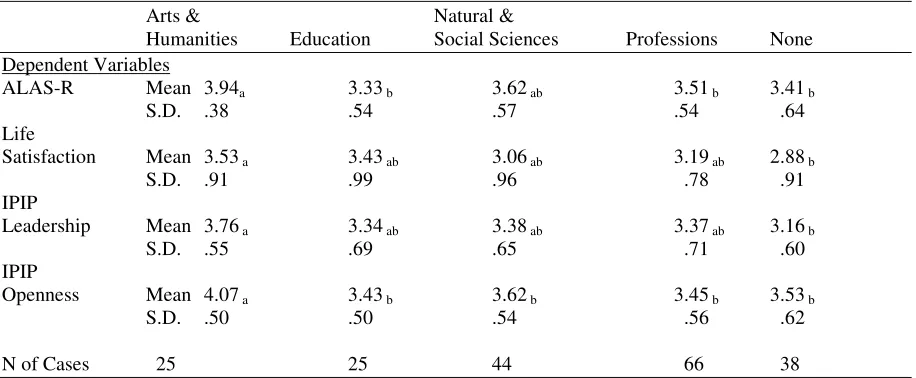
In a final validity analysis, a one-way ANOVA found significant differences on the ALAS-R for majors in the different schools, F(4, 193) = 4.90, p < .001, η2 = .09. Post hoc analysis showed that students in Arts and Humanities had the highest ALAS-R scores in this sample. Natural and Social Sciences students had the next highest scores, but were not different from students in the Schools of Education or the Professions, or students who reported not having a major. Students from the School of Education scored the lowest, but they did not score significantly lower than students from the School of the Professions or None (see Table 6).
Table 6 shows that in Study 3 students’ academic major was related to significant differences on three additional scales. For life satisfaction, students in Arts and Humanities scored higher than those who had no major, F(4, 193) = 2.73, p = .030,η2 = .05; the other three schools did not differ. A similar pattern of results was found for the IPIP leadership scale, F(4, 193) = 3.19, p = .015, η2 = .06, with Arts and Humanities students scoring higher than those with no major. For IPIP openness to experience, Arts and Humanities students were significantly higher than students in any of the other four schools, which did not differ from each other, F(4, 193) = 6.52, p < .001, η2 = .12. The IPIP wisdom and judgment scales did not differ across the school of major.
Table 6
Significant Differences by School of Students’ Majors
Arts & Natural &
Humanities Education Social Sciences Professions None Dependent Variables
ALAS-R Mean 3.94a 3.33 b 3.62 ab 3.51 b 3.41 b
S.D. .38 .54 .57 .54 .64
Life
Satisfaction Mean 3.53 a 3.43 ab 3.06 ab 3.19 ab 2.88 b
S.D. .91 .99 .96 .78 .91
IPIP
Leadership Mean 3.76 a 3.34 ab 3.38 ab 3.37 ab 3.16 b
S.D. .55 .69 .65 .71 .60
IPIP
Openness Mean 4.07 a 3.43 b 3.62 b 3.45 b 3.53 b
S.D. .50 .50 .54 .56 .62
N of Cases 25 25 44 66 38
Note. Means in the same row with the same subscript do not differ at the .05 level (Tukey HSD). Only dependent variables showing significant differences are included in Table 6.
The revised Appreciation of the Liberal Arts Scale (ALAS-R): Development, reliability and validity
24-item ALAS-R showed very good reliability. Consistent with Studies 1 and 2, those students who indicated having a materialistic value system, having lower life satisfaction, or having difficulty deferring gratification, reported a decreased appreciation of the liberal arts. In addition, openness to experience, leadership, wisdom and judgment were associated with an increased appreciation of the liberal arts. This pattern of results, confirmed across three studies, is evidence of the construct validity of the ALAS-R. As predicted, and as evidence of external validity, Arts and Humanities majors had the highest scores on the ALAS-R.
5. Summary and Concluding Discussion
At a most basic level, the current studies were based upon the assumption that the liberal arts are important to general education. Further, if this core educational construct is important, then liberal arts colleges have a particular responsibility to student development to enhance their appreciation of the liberal arts. Of course, before attitudinal change can be assessed there needs to be an accepted instrument to measure students’ attitudinal change. After all, “it is of little value to discuss the desirability of attitudinal change if that change cannot be effectively measured” (Teisl et al., 2011, p. 71). The primary goal of the current study was to develop a psychometrically supported scale to measure students’ appreciation of the liberal arts. The ALAS-R is the culmination of a three-study developmental process involving close to 500 participants. Its content is derived from the current liberal arts literature, student feedback, and the views of faculty teaching an introduction to the liberal arts college course.
The resulting 24-item ALAS-R was found to have very good reliability (.86) and encouraging evidence for validity. As predicted, the ALAS-R correlated positively with several constructs with which it should theoretically have been correlated. Specifically, greater appreciation of the liberal arts was associated with being less materialistic, having higher life satisfaction, having greater ability to defer gratification, and reporting greater openness to experience, leadership, wisdom, and judgment.
Another goal was to examine external validity by ascertaining whether ALAS-R outcomes were associated in a meaningful manner with student choice of academic major. As predicted, students majoring in the Arts and Humanities scored high on the ALAS-R compared to students in Education, the Professions, and those without a major. Scores of students majoring in the sciences were intermediate. Low scores on the ALAS-R, particularly for individuals majoring in education, may be a matter of societal concern and thus warrants further research.
The ALAS-R is psychometrically sound. This scale could be employed to directly assess the liberal arts
values of students both before and after taking a liberal arts course as a means of monitoring outcomes. It would also be useful to examine attitudinal change towards the liberal arts during students’ progression through college as a measure of student development. Theoretical discussions of college student development (e.g., Harward, 2012; Sullivan, 2012) suggest that students need the contributions of a liberal education to help them succeed in an increasingly-complex world. Our current cross-sectional data did not provide evidence that ALAS scores varied by class standing in any of our three studies. Our ability to detect such a difference may have been hindered by unequal numbers of participants across class levels. In addition, we did not ascertain whether students had transferred from another institution. Thus, we do not know the extent to which participants were exposed to a college experience that emphasized the liberal arts. A longitudinal study, although more difficult to execute, would provide direct evidence of attitude change attributable in good part to students’ college experiences.
both self-reported GPA and to delay of gratification, so it is not unreasonable to predict that ALAS scores might also predict retention.
Colleges are very interested in retention, evidenced by the considerable body of retention research. Zhang and RiCharde (1998) used several measures to study retention within the first few weeks of entering college; one factor found to be important was the mismatch between students’ expectations and the actual college experience. Breen and Lindsay (2002) indicated that students might enter college with “ill-conceived ideas of what it really means to study their discipline” (p. 720), suggesting that such a mismatch may lead to withdrawal, failure, or dissatisfying learning experiences. College experiences often include many general education (usually liberal arts) courses within the first year or two. The ALAS-R might prove to be of value in identifying students most likely to experience a mismatch between perception and experience. Similarly, first-generation college students have been reported to be at a disadvantage in the cognitive and psychosocial development associated with a liberal arts education (e.g., Padgett, Johnson, & Pascarella, 2012). Further research with the ALAS-R could be useful in this regard.
The ALAS-R could prove to be of value in advisement at several levels. At the college level, a student’s score on the ALAS-R could be helpful to both the student and his or her academic advisor in course and major selection. At the high school level, the ALAS-R could aid by assisting advisors in identifying the most compatible type of institution for a prospective college student. In Study 3, a slight majority of participants were first-year students; for these students, ALAS-R is measuring their choice of major upon entering college rather than measuring the impact of college. The ALAS-R also may prove to be of use in curriculum development, particularly with regard to general education programs. As colleges implement curriculum revisions, the ALAS-R could provide a reliable and valid measure of student attitude change and development. This may be particularly important in an era of tight budgets and increased accreditation review.
Based upon our experiences, some faculty members may not value the core principals of a liberal arts education, which include gaining a broad perspective and developing an extensive range of knowledge. This might seem unlikely at a liberal arts institution, but hiring and promotion decisions are typically made at the department level, and may not consider a faculty member’s willingness, ability, or interest in furthering the college’s overall commitment to a broad education for its students. Moore (2006) suggested that faculty members need to be active outside their departmental and divisional areas in order to increase student engagement. Moore (2006) also indicated that academia’s focus on “disciplinary courses, traditional departments and academic divisions” (p. 51) may have sometimes circumscribed faculty interest in liberal arts interchange in the past. Bain and Bass (2012) discussed faculty training, suggesting that faculty may need to move outside their own disciplines to provide the most effective classroom experiences for their students.
Further, it has been noted that the system of teacher education in the United States has developed largely independent from liberal arts influences (Mirel, 2011). For instance, as Mirel (2011) suggested:
…for most of the 20th century, dialogues between “ed school” faculty members and their liberal arts colleagues about how to train prospective teachers in such fields as English, history, mathematics, and science were scarce, with neither side respecting the expertise of the other….It is arguably one of the most important factors contributing to the poor quality of teacher education in this country. (p. 7)
The revised Appreciation of the Liberal Arts Scale (ALAS-R): Development, reliability and validity
appreciation for the benefits of being liberally educated.
In conclusion, never before has there been so great an opportunity for college students to receive a liberal arts education. At the same time, never before have colleges been under such pressure to justify their worth. Thus, evaluating the efficaciousness of a liberal arts education has become increasingly important. Current measures emphasizing intellectual development or self-reported gains in learning have yielded inconsistent results. The ALAS-R provides institutions with an easy-to-use scale that assesses an important component absent from existing scales that measure the value of a liberal arts education. ALAS-R measures student attitudes, and is psychometrically sound, correlating in predicted ways with student values and characteristics. It has potential applications in student advisement, curriculum development, and research examining ways to improve learning. All of these qualities are of central importance in the current period of enhanced student and institutional assessment.
6. References
Anderson, M. W., Teisl, M., Criner, G., Tisher, S., Smith, S., Hunter, M., & Bicknell, E. (2007). Attitude changes of undergraduate university students in general education courses. JGE: The Journal of General Education, 56(2), 149-168. http://dx.doi.org/10.1353/jge.2007.0016
Arcilla, R. (2007). The questions of liberal education. Liberal Education, 93(2), 14-19.
Bain, K. R., & Bass, R. J. (2012). Threshold concepts of teaching and learning that transform faculty practice (and the limits of individual change). In Harward, D. W. (Ed.), Transforming undergraduate education: Theory that compels and practices that succeed (pp. 189-207). Lanham, MD: Rowman and Littlefield. Basken, P. (2008). Spellings team fought over emphasizing liberal arts. The Chronicle of Higher Education,
54(44), 1.
Bembenutty, H. (1999). Sustaining motivation and academic goals: The role of academic delay of gratification.
Learning and Individual Differences, 11(3), 233-257. http://dx.doi.org/10.1016/S1041-6080(99)80002-8 Bembenutty, H. (2009). Teaching effectiveness, course evaluation, and academic performance: The role of
academic delay of gratification. Journal of Advanced Academics,20(2), 326-355. http://dx.doi.org/10.1177/1932202X0902000206
Breen, R., & Lindsay, R. (2002). Different disciplines require different motivations for student success. Research in Higher Education, 43, 693-725. http://dx.doi.org/10.1023/A:1020940615784
Corral, W. H., & Patai, D. (2008). An end to foreign languages, an end to the liberal arts. The Chronicle of Higher Education, 54(39), A30.
Diener, E., Emmons, R. A., Larsen, R. J., & Griffin, S. (1985). The satisfaction with life scale. Journal of Personality Assessment, 49(1), 71-75. http://dx.doi.org/10.1207/s15327752jpa4901_13
Goyette, K. A., & Mullen, A. L. (2006). Who studies the arts and sciences? Social background and the choice and consequences of undergraduate field of study. Journal of Higher Education, 77, 497-538. http://dx.doi.org/10.1353/jhe.2006.0020
Harms, P. D., Roberts, B. W., & Winter, D. (2006). Becoming the Harvard man: Person-environment fit, personality development, and academic success. Personality and Social Psychology Bulletin, 32, 851-865. http://dx.doi.org/10.1177/0146167206287720
Harward, D. W. (2012). The theoretical arguments and themes. In Harward, D. W. (Ed.), Transforming undergraduate education: Theory that compels and practices that succeed (pp. 3-33). Lanham, MD: Rowman and Littlefield.
Hollway, M. C. (2005). A comparison of the impact of two liberal arts general education core curricula on student humanitarian values. Journal of General Education, 54(3), 237-266.
http://dx.doi.org/10.1353/jge.2006.0004
Hunt, P. F., Boyd, V. S., Gast, L. K., Mitchell, A., & Wilson, W. (2012). Why some students leave college during their senior year. Journal of College Student Development, 53, 737-742.
Hutchings, P.n & Wutzdorff, A. (1988). Experiential learning across the curriculum: Assumptions and principles.
New Directions for Teaching and Learning, 35, 5-19. http://dx.doi.org/10.1002/tl.37219883503
International Personality Item Pool, (2001). A scientific collaboratory for the development of advanced measures of personality traits and other individual differences. Retrieved from http://ipip.ori.org
King, P. M., Brown, M., Lindsay, N. K., & VanHecke, J. R. (2007). Liberal arts student learning outcomes: An integrated approach. About Campus, 12(4), 2-9. http://dx.doi.org/10.1002/abc.222
Kronman, A. T. (2007). Education’s end: Why our colleges and universities have given up on the meaning of life. New Haven, CT: Yale University Press.
Long, T. E. (2012). Evoking wholeness: To renew the ideal of the educated person. In Harward, D. W. (Ed.),
Transforming undergraduate education: Theory that compels and practices that succeed. Lanham, MD: Rowman and Littlefield, pp. 125-140.
Lowe, C. F. (1979). Determinants of human operant behavior. In M. D. Zeller & P. Harzem (Eds.),
Reinforcement and the organization of behavior. New York, NY: Wiley.
Luttrell, V. R. Callen, B. W., Allen, C. S., Wood, M. D., Deeds, D. G., & Richard, D. C. S. (2010). The mathematics value inventory for general education students: Development and initial validation.
Educational and Psychological Measurement, 70, 142-160. http://dx.doi.org/10.1177/0013164409344526
Manzo, K. K. (2008). New group formed to promote liberal arts curriculum. Education Week, 27(26), 8. Mirel, J. (2011). Bridging the "widest street in the world": Reflections on the history of teacher education.
American Educator, 35(2), 6-12.
Moore, D. D. (2006). Shooting the gap: Engaging today's faculty in the liberal arts. Liberal Education, 92(3), 46-51.
Needle, A., Corbo, C., Wong, D., Greenfeder, G., Raths, L. & Fulop, Z. (2007). Combining art and science in “arts and sciences” education. College Teaching, 55(3), 114-119.
http://dx.doi.org/10.3200/CTCH.55.3.114-120
Pascarella, E. T., Seifert, T. A., & Blaich, C. (2010). How effective are the NSSE benchmarks in predicting important educational outcomes? Change, 42(1), 16-22. http://dx.doi.org/10.1080/00091380903449060 Pascarella, E. T., Wolniak, G. C., Seifert, T. A., Cruce, T. M., & Blaich, C. F. (2005). Liberal arts colleges and
liberal arts education: New evidence on impacts. ASHE Higher Education Report, 31(3). New York: Jossey-Bass.
Padgett, R. D., Johnson, M. P., & Pascarella, E. T. (2012). First-generation undergraduate students and the impacts of the first year of college: Additional evidence. Journal of College Student Development, 53, 243-266. http://dx.doi.org/10.1353/csd.2012.0032
Perry, W. G. (1970). Forms of ethical and intellectual development in the college years: A scheme. New York: Holt, Rinehart and Winston.
Pew Research Center for the People and the Press (2007, January 9). A portrait of “Generation Next”: How young people view their lives, futures and politics. Retrieved from
http://www.people-press.org/2007/01/09/a-portrait-of-generation-next/
Piko, B. F. (2006). Satisfaction with life, psychosocial health and materialism among Hungarian youth. Journal of Health Psychology, 11, 827-831. http://dx.doi.org/10.1177/1359105306069072
Pingree, S. E. (2007). Bringing theory to practice and liberal education: My perspective. Liberal Education, 93(1), 32-35.
Ray, J. J., & Najman, J. M. (1986). The generalizability of deferment of gratification. Journal of Social Psychology, 126(1), 117-119. http://dx.doi.org/10.1080/00224545.1986.9713578
Reid, H. M., O’Quin, K., & Kline, B. (2010, March). Reliability and correlates of the ALAS-R. Eastern Psychological Association Conference, New York.
Return to traditional goals: Mathias. (1976). The Chronicle of Higher Education, 13(12), 4.
Richins, M. L., & Dawson, S. (1992). A consumer values orientation for materialism and its measurement: Scale development and validation. Journal of Consumer Research, 19, 303-316.
The revised Appreciation of the Liberal Arts Scale (ALAS-R): Development, reliability and validity
Ryan, L., & Dziurawiec, S. (2001). Materialism and its relationship to life satisfaction. Social Indicators Research, 55(2), 185-197. http://dx.doi.org/10.1023/A:1011002123169
Schools dropping liberal arts curriculum. (2004). Education USA, 46(4), 10.
Schultz, J. L., & Higbee, J. L. (2007). Reasons for attending college: The student point of view. Research & Teaching in Developmental Education, 23(2), 69-76.
Seifert, T. A., Goodman, K. M., Lindsay, N., Jorgensen, J. D., Wolniak, G. C., Pascarella, E. T., & Blaich, C. (2008). The effects of liberal arts experiences on liberal arts outcomes. Research in Higher Education, 49(2), 107-125. http://dx.doi.org/10.1007/s11162-007-9070-7
Shiarella, A. H., McCarthy, A. M., & Tucker, M. L. (2000). Development and construct validity of scores on the community service attitudes scale. Educational and Psychological Measurement, 60, 286-300. http://dx.doi.org/10.1177/00131640021970510
Shoda, Y., Mischel, W., & Peake, P. K. (1990). Predicting adolescent cognitive and self-regulatory competencies from preschool delay of gratification: Identifying diagnostic conditions. Developmental Psychology, 26,
978-986. http://dx.doi.org/10.1037/0012-1649.26.6.978
Sullivan, W. M. (2012). Knowledge and judgment in practice as the twin aims of learning. In Harward, D. W. (Ed.), Transforming undergraduate education: Theory that compels and practices that succeed (pp. 141-157). Lanham, MD: Rowman and Littlefield.
Teisl, M. F., Anderson, M. W., Noblet, C. L., Criner, G. K., Rubin, J., & Dalton, T. (2011). Are environmental professors unbalanced? Evidence from the field. Journal of Environmental Education, 42(2), 67-83. http://dx.doi.org/10.1080/00958961003705899
Webster, D. S. (1997). The big chill: Changes in American politics and society from the late 1960s to the present. ERIC Document Reproduction Service No. ED403839.
Wintre, M. G., & Bowers, C. D. (2007). Predictors of persistence to graduation: Extending a model and data on the transition to university model. Canadian Journal of Behavioural Science, 39(3), 220-234.
http://dx.doi.org/10.1037/cjbs2007017