Vol. 32, No. 1, March, 2013, pp. 13–21. Copyright©2013 Faculty of Engineering, University of Nigeria. ISSN 1115-8443
PREDICTING THE COMPRESSIVE STRENGTH OF
CONCRETES MADE WITH GRANITE FROM EASTERN
NIGERIA USING ARTIFICIAL NEURAL NETWORKS
C.C. Nwobi-Okoyea,I.E. Umeonyiagub,C.G. Nwankwoc
a
Emeagwali Centre for Research, Anambra State University, Uli, Anambra State, Nigeria. Email: [email protected]
b
Department of Civil Engineering, Anambra State University, Uli, Anambra State, Nigeria.
Email: [email protected]
c
Department of Computer Engineering, Anambra State University, Uli, Anambra State, Nigeria.
Email: [email protected]
Abstract
Cases of collapsed buildings and structures are prevalent in Nigeria. In most of these cases the cause of the collapse could be traced to the strength of the construction materials, mainly concrete. Secondly, experimental determination of the strength of concrete materials used in buildings and structures is quite expensive and time consuming. This research seeks to develop a computational model based on artificial neural networks for the determination of the compressive strength of concrete materials made from a prevalent coarse aggregate component from Nigeria. The work involved building a multilayer perceptron neural network model which was trained using experimental data obtained from compressive strength test of concrete made from granite. The compressive strength predictions were compared with predictions from an alternative model based on regression analysis. The results of the study show that for the granite based concrete, the regression model prediction has a sum of squares error of 20.289 and a mean absolute percentage (relative) error of 1.149, while the neural network model prediction has a sum of squares error of 0.299 and a mean absolute percentage (relative) error of 0.047. Generally, the models predicted well, but the neural network model predicted better than the regression model. The result of the study has ably demonstrated a cheap, simple, very quick and accurate alternative to experimental method of concrete strength determination. The method is also simpler and quicker than analytical methods based on regression analysis. This work is therefore expected to be of immense benefit to civil engineers and construction professionals, and would help in economically determining the strength, as well as economical selection of appropriate mix of construction materials, a prelude to building strong and cheap buildings and structures.
Keywords: artificial neural network, concrete, granite, regression, modelling
1. Introduction
Strength being the most important property of con-crete determines the quality of concon-crete. Tradition-ally, laboratory trial mixes have been used to deter-mine the compressive strengths of concrete. Exper-imental determination of the strength characteristics of concrete materials is costly and time consuming. Often building contractors in Nigeria in their attempt to cut corners use low quality concrete materials in building constructions leading to cracking and in some cases total collapse of the building or structure. Here in Nigeria cases of collapsed buildings and structures are prevalent, and often lead to massive loss of lives
and properties [1, 2]. Olujumoke et al. [1] identified weak concrete mixes as one the major reasons for the collapse of most buildings in Nigeria. This has disas-trous socio-economic consequences for the country [1, 2].
by developing a computational model based on ar-tificial neuralnetwork technology for predicting the strength of concrete materials. With mathematical and computational models a designer can easily find the best combination of constituent material to bal-ance strength and cost.
An artificial neural network (ANN), usually called “neural network” (NN), is a mathematicalmodel or computational model that is inspired by the struc-ture and/or functional aspects of biological neural net-works [3]. The concept of artificial neurons was first introduced in 1943 [4]. Russell and Norvig [3] stated that since 1943 when McCulloch and Pitts introduced the concept of neurons, much more detailed and real-istic models have been developed both for neurons and for larger systems in the brain leading to the modern field of computational neuroscience. Since the work of McCulloch and Pitts in 1943, ANN has had wide ap-plication in many spheres of life. According to Maier and Dandy [5], in recent years, Artificial Neural Net-works (ANNs) have become extremely popular for pre-diction and forecasting in a number of areas, including finance, power generation, medicine, water resources and environmental science.
The utility of artificial neural network models lies in the fact that they can be used to infer a function from observations. This is particularly useful in ap-plications where the complexity of the data or task makes the design of such a function by hand imprac-tical [3]. The tasks to which artificial neural networks are applied tend to fall within the following broad cat-egories:
i. Function approximation, or regression analysis, including time series prediction, fitness approxi-mation and modelling.
ii. Classification, including pattern and sequence recognition, novelty detection and sequential de-cision making.
iii. Data processing, including filtering, clustering, blind source separation and compression.
iv. Robotics, including directing manipulators, Com-puter numerical control.
Many papers have been written on the application of ANNs to the prediction of strength of engineering materials. Mukherjee and Biswas [6] in their paper applied artificial neural networks to the prediction of the mechanical behaviour of concrete materials at high temperature. Their results were very encouraging. Oreta1 and Kawashima [7] in their paper proposed an artificial neural network (ANN) based model, to predict the confined compressive strength and cor-responding strain of circular concrete columns.Their study shows the importance of validating the ANN models in simulating physical processes especially when data are limited. The ANN model they devel-oped was also compared to some analyticalmodels and was found to perform well.Other papers on the
pre-diction of concrete strength using neural networks in-clude: Lee [8], Kasperkiewicz et al. [9], Ahmet et al. [10], Topcuand Saridemir [11] etc.
Maier and Dandy [5] reviewed 43 papers dealing with the use of neural network models for the pre-diction and forecasting of water resources variables in terms of the modelling process adopted. They iden-tified inadequate model building as the obstacle mili-tating against accurate predictions using artificial net-works. They suggested that ANN models must be properly evaluated before its application in time se-ries analysis.
Their assertion is corroborated by Chatfield [12] when commenting on the suitability of ANNs for time series analysis and forecasting, who commented thus: “when the dust has settled, it is usually found that the new technique is neither a miraculous cure-all nor a complete disaster, but rather an addition to the ana-lyst’s toolkit which works well in some situations and not in others”. It is important to note that a neu-ral network modelling is purely a computational tech-nique. Hence, if one wants to explain an underlying process or mathematical framework that produces the relationships between the dependent and independent variables, it would be better to use a more traditional statistical model like regression analysis. However, if model interpretability is not important, one can often obtain good model results more quickly using a neu-ral network. Properties of materials used in construc-tion vary from region to region and from country to country. Hence, accordingly, the properties of build-ing materials used in Nigeria are unique and differ significantly with what is obtained in other countries. Here we examined one major coarse aggregate com-ponent of concrete used as construction material in eastern Nigeria. This coarse aggregate is unwashed local gravel.
Concrete is a four component mix of water, cement, fine aggregate and coarse aggregate, of which the im-portant properties are strength (compressive and flex-ural), deformation under load, durability, permeabil-ity and shrinkage. But strength, being considered the most important of these properties determines the quality of the concrete.
ANN Prediction of Compressive Strength Of Concretes
2. Experimental Technique and Regression Methodology
The materials for the mixing and production of con-crete were obtained, prepared, and the concon-crete pro-duced tested. The test results were used to determine the coefficients of the regression model. The mate-rial preparation and testing procedure, as well as the regression model development are hereby presented.
2.1. Preparation, curing and testing of cube samples
The aggregates were sampled in accordance with the methods prescribed in British Standards Institu-tion (BS 882: Part 1: 1992) [15]. The test sieves were selected according to British Standards Institu-tion (BS 410: Part 1: 1986) [16]. The water absorp-tion, the apparent specific gravity and the bulk density of the coarse aggregates were determined following procedures prescribed in (BS 812: Part 2: 1975) [17]. The Los Angeles abrasion test was carried out in ac-cordance with American Society for Testing and Ma-terials (ASTM Standard C131:1976) [18]. The sieve analysis of the fine and coarse aggregate samples was done in accordance with British Standard Institution (BS 812: Part 1: 1975) [19] and satisfied British Stan-dard Institution (BS 882:1992) [20]. The sieving was performed by a sieve shaker. The water used in the preparing the experimental samples satisfied the con-ditions prescribed in British Standard Institution (BS 3148: 1980) [21]. These specimens were cured for 28 days in accordance with British Standard Institution (BS 1881: Part 111: 1983) [22]. The testing was done in accordance with British Standard Institution (BS 1881: Part 116: 1983) [23] using compressive testing machine.
2.2. Regression model development methodol-ogy
The experimental results were fitted to a polyno-mial regression model based on Scheffes (4,2) regres-sion model [13, 14]. The regresregres-sion models were:
For granite:
b
Y = 30x1+ 32x2+ 19x3+ 12x4+ 2.8x1x2−0.8x1x3
−5.6x1x4−2.8x2x3−8x2x4+ 12x3x4
(1)
The regression model assumed that each of the com-ponents of concrete namely:water, cement, fine aggre-gate and coarse aggreaggre-gate could be zero or one. But in reality none of these components could be zero or one. Hence, an appropriate transformation of the ac-tual components z1,z2, z3 andz4 was used to deter-mine the pseudo components x1, x2, x3 and x4 that was used in the regression equations above [13, 14].
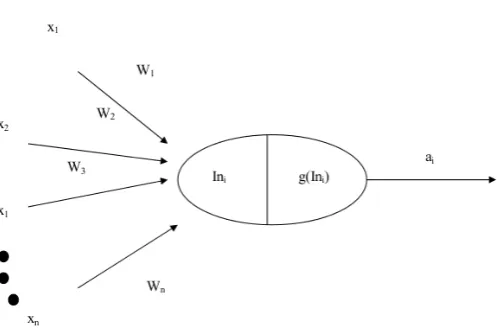
Figure 1: An artificial neuron. (Wi = weights;xi = inputs;
ai= output)
3. Neural Networks
As has been previously mentioned, the origin of ar-tificial neurons (ANNs) is based on the work of Mc-Culloch and Pitts in 1943 [4]. Artificial neurons are building blocks for artificial neural networks. We shall discuss here the structure of artificial neurons and neu-ral network used in this research.
3.1. Artificial neurons
Artificial neural networks make use of artificial neu-rons. Artificial neural networks (ANNs) simulate the manner of operation of natural neurons in the human body. The basic unit of operation of an ANN is the neuron shown in Figure 1.
In a typical neuron shown in Figure 1, the input to the neuron xi is multiplied by a weighting
func-tionWito generate the transformed inputWixi. The
transformed inputs are summed to obtain the summed input. The summed input constitutes the variables to the activation/transfer function, g, which generates the output ai. The output of the transfer function
is compared to a threshold value. If the output is greater than the threshold value, the neuron is ac-tivated and signal is transferred to the neuron out-put, alternatively, if it is less the signal is blocked. Given an input vectorX = (x1, x2, . . . , xn), the
acti-vations of the input units are set to (a1, a2, . . . , an) =
(x1, x2, . . . , xn) and the network computes to:
Ini = n
X
j=1
Wj,iaj (2)
ai =g(Ini) (3)
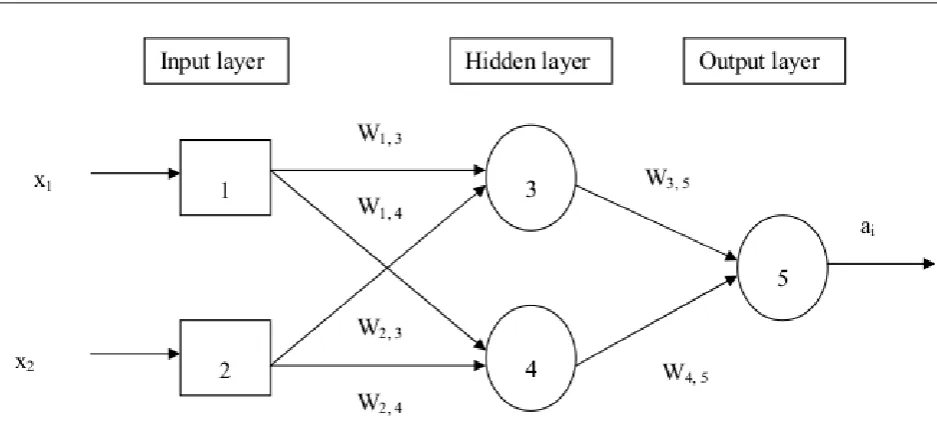
Figure 2: Two-input feed forward neural network model.
functions perform better than linear transfer function. Bearing these in mind, in this particular application we chose the sigmoid function. The sigmoid activation function which is given by the equation:
ai=g(Ini) =
1
1−e−Ini (4)
Training the network (learning) could be supervised or unsupervised training. In supervised training, the net-work is provided with the inputs and appropriate out-puts; hence the network is trained with a set of exam-ples in a specified manner. In unsupervised/adaptive learning, the network is provided with inputs but not the outputs. In this present application, we used the supervised learning, hence, the appropriate network architecture is the feedforward architecture.
3.2. The feedforward network architecture
As has been mentioned, the developed neural net-work models are feed forward multiplayer percep-tron networks (MLP). The hidden units as previously noted use the sigmoid activation function. The net-work model is shown in Figure 2.
In the feed forward network shown in Figure 2, the output of the network is compared with the desired output. The difference between the output and the desired output is known as the error,E. ANNs learn by trying to minimize this error. The learning pro-cess uses optimisation algorithms such as gradient de-scent algorithm, genetic algorithm or some other nat-ural optimisation algorithm. These algorithms work by adjusting the weights,Wi, such that the error,E,
is minimized. Most ANNs use the simple gradient de-scent optimisation algorithm. In this work we used this algorithm. Hence, the learning process uses the
sum of squares error criterionE to measure the effec-tiveness of the learning algorithm.
E=1 2Err
2≡1
2(y−hW(x))
2 (5)
Here y =Y = the true/experimental value
b
Y =hW(x) (6)
hW(x) is the output of the perceptron.
The learning process, as previously mentioned, uses Cauchys steepest descent or gradient descend algo-rithm optimisation method given by the formula [24]:
Wj(t+ 1) =Wj(t) +γ× 5E(Wj) (7)
Hereγ= non negative scalar that minimizes the func-tion,E(Wj), in the direction of the gradient and it is
equal to the network learning rate. While
5E(Wj) =
∂E ∂Wj
(8)
But
∂E ∂Wj
= ∂E
∂Err× ∂Err
∂Wj
(9)
Since
∂E
∂Err =Err (10)
Hence,
∂E ∂Wj
=Err×∂Err ∂Wj
(11)
But
∂Err ∂Wj
= ∂
∂Wj
y−gXj = 1nWjxj
ANN Prediction of Compressive Strength Of Concretes
Figure 3: The Four-input, 4 layers feed foreword neural network model.
∂Err ∂Wj
=−g0(in)×xj (13)
Substituting equation (13) into equation (11), equa-tion (14) is obtained:
∂Err ∂Wj
=−Err×g0(in)×xj (14)
Wj(t+ 1) =Wj(t) +γ×Err×g0(in)×xj (15)
4. The ANN for Predicting Compressive Strength of Concrete
Recall that our application is for concrete strength prediction, and we used supervised learning. Hence, Seventy five (75%) percent of the data was used for training, while twenty five (25%) percent was used for testing and validation. The number of epoch was set to 1000.
Single network architecture was used in the study. The network architecture consists of four input units, two hidden layers with four hidden units (nodes) and one output unit. The network structure is shown in Figure 3. The inputsZ1,Z2,Z3andZ4to the neural network consists of water/cement ratio, cement, fine aggregate and coarse aggregate respectively.
5. Results
Table 1 shows the experimentally determined strength for different mixture ratios for granite-concrete mixtures represented by Z.
5.1. Physical and mechanical properties of ag-gregates
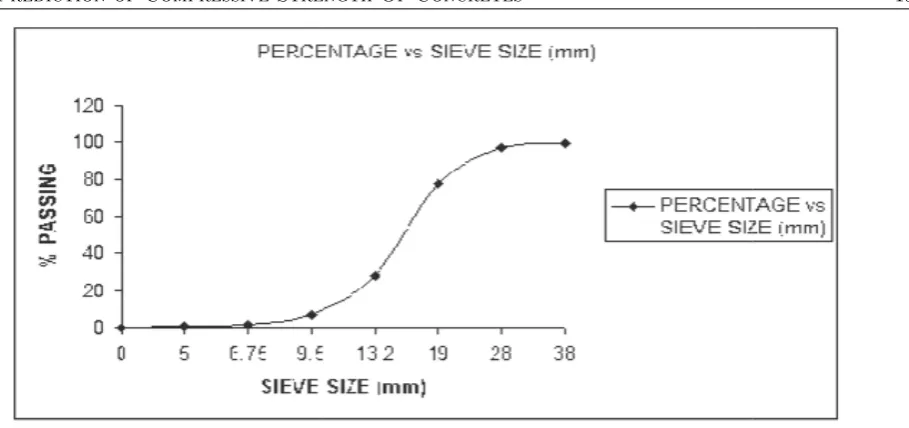
Sieve analyses of both the fine and coarse aggre-gates were performed and the grading curves are shown in Figures 4 and 5 respectively. These grading curves showed the particle size distribution of the aggregates. The physical and mechanical properties are summarized in table 2.
5.2. ANN prediction results
The results of the experimentally determined con-crete strength, analytically determined strength us-ing the regression model, and the strength predic-tion using neural network models are presented in this section. Table 3 shows the experimentally deter-mined strength for different mixture ratios for granite-concrete mixtures represented by Z.
Figure 4: Grading curve for the fine aggregate.
Table 1: Results of compressive strengths obtained experi-mentally.
Sample No
Y Z1 Z2 Z3 Z4
1 30 0.6 1 1.5 2
2 32 0.5 1 1 2
3 19 0.55 1 2 5
4 12 0.65 1 3 6
5 31.7 0.55 1 1.25 2
6 24.3 0.575 1 1.75 3.5
7 19.6 0.625 1 2.25 4
8 24.8 0.525 1 1.5 3.5
9 20 0.575 1 2 4
10 18.5 0.6 1 2.5 5.5
11 28 0.5625 1 1.5 2.75
12 22.5 0.6 1 2 3.75
13 23.3 0.55 1 1.75 3.75
14 22.9 0.575 1 1.875 3.75
15 30.8 0.575 1 1.375 2
16 27.6 0.5875 1 1.625 2.75
17 24.5 0.6125 1 1.875 3
18 28 0.5125 1 1.25 2.75
19 25.3 0.5375 1 1.5 3
20 19.4 0.585 1 2.25 5.25
Table 2: Physical and mechanical properties of the granite.
PROPERTIES GRANITE
Water absorption 2.7%
Moisture content 44.2%
Apparent specific gravity 2.26
Los Angeles abrasion 22%
Impact resistance 9.15%
Bulk density 2072.4 Kg/m3
Fineness modulus 4.89
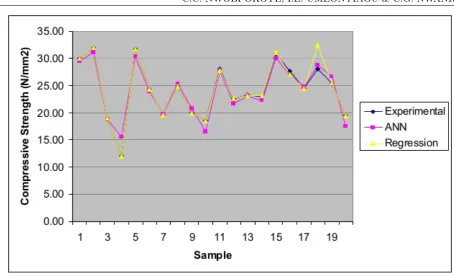
shown in Figure 6, the experimental values were in very good agreement with theoretical values obtained from the Scheffes regression model and the neural net-work model. Table 4 shows the comparison of the sum of squares error versus the relative error for the regres-sion and neural network models.
6. Discussion
From the analysis in this work we have seen that the strength of concrete materials depends on the propor-tion of its ingredients: water, cement, fine aggregate, and coarse aggregates. Figure 6 shows the plots of the artificial neural network predictions and regres-sion model predictions for granite-concrete, unwashed gravel concrete and washed gravel concrete. Gener-ally, the plots are in good agreement with the exper-imentally determined compressive strength. Examin-ing Table 2 above shows that for the granite based concrete the regression model prediction has a sum of squares error of 20.289 and a mean absolute percent-age (relative) error of 1.149. Similarly, for the granite based concrete the neural network model prediction has a sum of squares error of 0.299 and a mean abso-lute percentage (relative) error of 0.047.
ANN Prediction of Compressive Strength Of Concretes
Figure 5: Grading curve for granite.
Table 3: Results of compressive strengths obtained from ANN.
Sample No
ˆ
Y Z1 Z2 Z3 Z4
1 29.52 0.6 1 1.5 2
2 31.14 0.5 1 1 2
3 18.67 0.55 1 2 5
4 15.58 0.65 1 3 6
5 30.41 0.55 1 1.25 2
6 23.95 0.575 1 1.75 3.5
7 19.71 0.625 1 2.25 4
8 25.32 0.525 1 1.5 3.5
9 20.82 0.575 1 2 4
10 16.53 0.6 1 2.5 5.5
11 27.60 0.5625 1 1.5 2.75
12 21.68 0.6 1 2 3.75
13 22.99 0.55 1 1.75 3.75
14 22.33 0.575 1 1.875 3.75
15 29.99 0.575 1 1.375 2
16 26.98 0.5875 1 1.625 2.75
17 24.71 0.6125 1 1.875 3
18 28.75 0.5125 1 1.25 2.75
19 26.72 0.5375 1 1.5 3
20 17.46 0.585 1 2.25 5.25
Table 4: Model type vs errors.
Description Sum of
Squares Error
Relative Error (%)
Regression Model 20.289 1.149
Neural network model
0.299 0.047
performance of the network depends on the network design architecture [5, 6].
Generally, the neural network models were bereft of the messy mathematics and statistical analysis re-quired in building the regression model, while at the same time giving good model predictions. Hence, would be preferable when the underlying mathemat-ical structure behind the model predictions is irrele-vant to the modeller/analyst, and model building is required quickly.
Concrete compressive strength determination is very important in civil engineering and in the con-struction industry [1, 7]. It is obvious that neural network models will help in efficient and accurate de-termination of concrete strength for building and con-struction purposes using local materials obtained from Nigeria.
7. Conclusion
The construction industry is a major component of the economy of any nation. Building and structures are indispensable in any modern society. Concrete is the primary building material in Nigeria. As had noted by Olajumoke et al. [1] and Arum [2], cases of collapsed building and structures are endemic in Nigeria. These have resulted in loss of lives and prop-erties, in addition to these, the economy is impacted negatively [1, 2]. Often poor concrete mixtures and inadequate knowledge of the role of concrete mixture properties to its strength are to blame [1].
Figure 6: Comparison of ANN with experimental results and regression model prediction (granite).
prediction of compressive strength of concrete from lo-cal materials in Nigeria compares favourably with an equivalent mathematical model based on regression analysis. Computational models are simple because it does not involve complex mathematical analysis. Hence, what the engineer needs is good and reliable computer software and a matching hardware to do his analysis. The ubiquity of various computing platforms ranging from desktop PCs, laptops, palmtops, tablets etc means that such analysis is made even easier. The present application was done using a computer laptop which ran the artificial neural network software.
If the recommendations of this research are imple-mented by adopting this novel concrete strength pre-diction aid and making sure construction engineers and technicians stick to it, there will be resultant re-duction in cases of collapsed buildings and structures in Nigeria. This will have a very positive effect on the socio-economic situation of the country which has been declining over the years. The same applies to other countries that are in similar situation as Nige-ria.
Finally, neural network models for other common materials used in construction in Nigeria should be developed by engineers and scientists. This will fur-ther boost the quality of our building constructions.
References
1. Olajumoke, A.M., Oke, I.A., Fajobi A.B. and Oge-dengbe, M.O. Engineering Failure Analysis of a Failed
Building in Osun State, Nigeria. Journal of Failure Analysis and Prevention, 9(1), 2009, pp8–15.
2. Arum C. Verification of Properties of Concrete Rein-forcement Bars: Nigeria as a Case Study. Indoor and Built Environment, 17(4), 2008, pp370–376.
3. Russell, S.J. and Norvig, P.Artificial Intelligence: a
modern approach. Pearson Educational Inc., Upper
Saddle River, New Jersey, USA, 2003.
4. McCulloch, W.S. and Pitts, W. A logical calculus of the ideas imminent in nervous activity, Bulletin and Mathematical Biophysics, 5, 1943, pp 115–133.
5. Maier, H. R. and Dandy G. C. Neural networks for the prediction and forecasting of water resources vari-ables: a review of modelling issues and applications.
Environmental Modelling & Software, 15, 2000, pp 101–124.
6. Mukherjee, A. and Biswas, S.N. Artificial neural net-works in prediction of mechanical behavior of con-crete at high temperature. Nuclear Engineering and Design, 178(1), 1997, pp1–11.
7. Oreta1, A.W.C. and Kawashima, K. Neural Net-work Modeling of Confined Compressive Strength and Strain of Circular Concrete Columns. Journal of Structural Engineering, 129(4), 2003, pp 554–561.
8. Lee, S.C. Prediction of concrete strength using arti-ficial neural network. Eng. Structures, 25(3), 2003, pp849-857.
9. Kasperkiewicz, J., Racz, J. and Dubrawski, A. HPC strength prediction using artificial neural network. J.
ANN Prediction of Compressive Strength Of Concretes
10. Ahmet, O., Murat, P., Erdogan, O., Erdogan, K., Naci, C. and Bhatti, M.A. Predicting the compres-sive strength and slump high strength concrete using artificial neural network. Constructions and Building Materials, 20(9), 2006, pp769–775.
11. Topcu, I. and Saridemir, M. Predicting of compres-sive strength of concrete containing fly ash using arti-ficial neural networks and fuzzy logic. Computational Material Science, 41(3), 2008, pp305-311.
12. Chatfield, C. Neural networks: Forecasting break-through or just a passing fad? International Journal of Forecasting, 9, 1993, pp 1–3.
13. Scheffe, H. Experiment with Mixtures. Royal Statis-tical Society Journal, Series B, 20, 1958, pp340-360.
14. Umeonyiagu, I.E. Mathematical models for the pre-diction of the concrete strength characteristics of con-crete with coarse aggregates of variable sources. Un-published PhD Thesis, Nnamdi Azikiwe University, Awka, Nigeria, 2012.
15. BS 882. Sampling, shape, size and classification. Methods for sampling and testing of mineral aggre-gates, sands and fillers. British Standard Institution, London, 1992.
16. BS 410. Specification for test sieves. British Standard Institution, London, 1986.
17. BS 812, Part 1: Sampling, shape, size and
classifi-cation. Methods for sampling and testing of
min-eral aggregates, sands and fillers. Physical properties. British Standard Institution, London, 1975.
18. ASTM Standard C 131. Tests For Resistance to Abrasion of Small Size Coarse Aggregate by Use of the Los Angeles Machine. American Society for Test-ing and Materials, 1976.
19. BS 812, Part 2. Methods for sampling and testing of mineral aggregates, sands and fillers, Physical prop-erties. British Standard Institution, London, 1975.
20. BS 882. Specification for aggregates from natural sources for concrete. British Standard Institution, London, 1992.
21. BS 3148. Tests for water for making concrete. British Standard Institution, London, 1980.
22. BS 1881, Part 111. Method for normal curing of spec-imen (20). British Standard Institution, London, 1983.
23. BS 1881, Part 116. Methods for Determination of
Compressive Strength of Concrete Cubes. British
Standard Institution, London, 1983.