Vol.9 (2019) No. 2
ISSN: 2088-5334
Development of Production Creativity among Craftsmen by
Identifying Techniques for Characterizing Coconut Waste
Dumasari
#, Wayan Darmawan
*, Achmad Iqbal
+, Budi Dharmawan
+, Imam Santosa
^ #Faculty of Agriculture, Purwokerto Muhammadiyah University, Purwokerto, 53182, Central Java, Indonesia E-mail: [email protected]
*
Faculty of Forestry,Bogor Agricultural University, Bogor, 16680, West Java, Indonesia E-mail: [email protected]
+
Faculty of Agriculture, Jenderal Soedirman University, Purwokerto, 53123, Central Java, Indonesia E-mail: #[email protected]
^ Faculty of Social and Political Sciences, Jenderal Soedirman University, Purwokerto, 53122, Central Java, Indonesia E-mail: [email protected]
Abstract—The development of production creativity in handicraft micro-enterprises requires technical support. The primary mode of support is to identify the characteristics of the raw materials that make product design appear more creative, variation, and artistic. A right quality product can potentially increase profits. This knowledge transfer process has altered the behavior of craftsmen in Java, encouraging them to adopt coconut waste as a raw material. The location of this study was Purbalingga Wetan, Purbalingga District, Central Java Province. The study design was based on a participatory rural appraisal (PRA), with the application of both qualitative and quantitative approaches. It was found that the ability of respondents to identify coconut waste characteristics was crucial to improving product quality. The number of skilled respondents applying the technique increased significantly. The skilled respondents were able to identify traits based on the age, color, fiber pattern, visual form, thickness, texture, and fragility of coconut wood or shell. An understanding of all of these characteristics was essential to improve product quality. Skilled craftsmen choose good coconut waste can produce quality handicraft products. Quality handicrafts are produced with a variety of distinctive and artistic designs and motifs. The selling value of higher quality handicraft products significantly increases the income of craftsmen. The motivation and ability of craftsmen in the technique that identifies the characteristics of coconut waste needs to be continuously developed intensively. These efforts can be made through the willingness of craftsmen to share experiences. Another way is to increase the participation of craftsmen in training and demonstration of the characteristics of coconut waste as raw material for quality handicrafts.
Keywords— craftsmen; characteristic identification techniques; coconut waste; handicraft; motif design.
I. INTRODUCTION
The utilization of natural resources has the potential to empower farming societies. Tropical plantation trees and other agricultural products are increasingly regarded as valuable renewable natural resources [1]. In addition to newly harvested products, agricultural waste also has economic value. Several types of agricultural waste can be processed into a variety of products that have commercial value. Agricultural waste derived from coconut trees can be used as a raw material in creative products. Coconut trees are multifunctional because they can produce a variety of value-added products that benefit farmers [2]. Some of the essential coconut processed products include desiccated coconut, coconut milk, coconut sugar, nata de coco, cooking
oil, various coconut food products, coconut fiber, coconut furniture and handicraft products, hair care products, and fertilizers [3]. Coconut shells can be processed into liquid smoke for use as natural preservatives [4]. Coconuts have been used in this way by several farmer groups in Purbalingga, Central Java. The farmers have also developed skills as craftsmen, producing souvenirs or creative handcrafted goods from coconut waste [5]–[7].
market trends and have enhanced product quality. An increase in product price then becomes more feasible, and the market for the product is also widened and assured. These conditions have the potential to increase a craftsmen’s income. The development of a handicraft industry is crucial for supporting rural development because it has the potential to suppress urbanization. Handicraft enterprises can improve the productivity and income of farmers and rural workers [9].
The development of production creativity also encourages craftsmen to produce innovative and competitively priced products. Micromanaged businesses are profitable for the craftsmen. However, the situation is still not optimal, because the production creativity of some craftsmen is still low. Production creativity is an essential aspect of entrepreneurship. Entrepreneurship is the soul of economic empowerment [10]. Creativity and innovation are crucial because they are the core of entrepreneurship [11]. Therefore, craftsmen should continually strive to create more innovative products. Improving the efficiency of a micro-handicraft business is essential. Handicraft micro-enterprises have a role as a catalyst for youth employment in rural areas [12].
The sustainability of creative micro-handicraft businesses is guaranteed: raw materials are always available and can be obtained at a low cost. The stock of raw materials in the form of various types of coconut waste can be sourced from the Purbalingga Wetan region and its surrounding villages [6]. Various handcrafted goods have guaranteed markets. However, craftsmen face a series of management problems, especially concerning product quality improvements, which must be resolved to ensure an acceptable price. Handicraft enterprises provide significant opportunities for the development of rural trade services. However, craftsmen often struggle to produce high-quality handcrafted products, due to the limited resources available to them in the development of designs and motifs that match global market trends [13].
An appropriate solution is needed to ensure the quality improvement of souvenir goods. There is an urgent need for knowledge transfer to provide a technique to identify the characteristics of coconut waste. Once identified, these characteristics can then be considered to adjust the design and quality of various handicraft goods [14].
This knowledge transfer has little cost, is practical, and can be easily implemented by craftsmen. Not only is this an appropriate approach, but it can also reduce losses associated with the accumulation of unsold products due to broken, cracked, scratched, rough, and uneven surfaces, or damage resulting in visible white patches. Through this knowledge, transfer craftsmen can become more skilled and better able to develop their micro-handicraft businesses. It will also potentially support the diversification of productive and creative livelihoods through the utilization of local resources [4]–[6].
Given the background presented above, this study aimed to identify the characteristics of coconut waste that would make it suitable for handcrafted motif designs and able to satisfy market trends. This knowledge transfer process was also aimed at increasing the production creativity of craftsmen, ensuring the production of quality handcrafted
goods. The characteristics of craftsmen using coconut waste were also assessed.
II. MATERIALS AND METHOD
The location of the study area was determined using the purposive area technique, which resulted in the selection of Purbalingga Wetan, Purbalingga, Central Java Province. Purbalingga Wetan region is a production center for souvenirs and handicraft goods made from coconut waste.
The research used the participatory rural appraisal (PRA) proposed by [15] and was based on a qualitative and quantitative approach [16]. The techniques applied to induce behavioral change in the respondents involved identification of coconut waste characteristics facilitating its use of as raw material and improvement of the quality of handcrafted products. The indicators used were age, color, fiber pattern, visual form, thickness, texture, and degree of fragility of coconut wood, shells, leaves, bunches, sticks, and husks.
The study population was craftsmen who produce goods made from coconut waste in Purbalingga Wetan. The respondents were selected using a purposive sampling technique. The total number of respondents was 27: 15 craftsmen from the Manunggal Karya group and 12 from the Karya Mandiri group.
Primary data were collected to enable an analysis of changes in the behavior of the craftsmen. Other primary data were obtained from critical informants using the snowball sampling technique. The key informants were drawn from among collectors, traders, retailers, regular customers, and local community leaders. The primary data collection techniques used were in-depth interviews and participant observations. The data collected through the observations were used to implement a technique to identify various forms of waste from coconut trees. This was then adapted to determine which raw materials would produce the best quality tourism souvenir goods. A content analysis technique was used to collect secondary data.
Quantitative and qualitative data was collected and processed. These data were analyzed by descriptive statistical techniques, i.e., percentage, frequency distribution, scoring, tabulation, and graphical display. The qualitative data were analyzed by an interactive analytical model [17]. Once analyzed, the new data were interpreted and then presented in quantitative and qualitative terms.
III.RESULTS AND DISCUSSION
A. The Urgent Need to Identify the Characteristics of Coconut Waste
essential for the production of high-quality souvenirs. Craftsmen have typically shown little interest in developing techniques that would enable them to produce higher quality products.
By recognizing the characteristics of coconut waste, the craftsmen could use the waste in the design of motifs on tourism souvenirs. Different types of coconut waste can be processed into various handcrafted goods for tourists, including pieces of coconut wood, coconut fruit (shell and coconut), coconut leaves, and coconut bunches. The most common waste types reportedly used as raw material for handcrafted goods were coconut wood (45%) and shells (45%). Both of these coconut wastes were used by craftsmen to produce various unique designs and motifs for handcrafted goods of various sizes and shapes.
Coconut wood and shells were the most popular raw materials because of their guaranteed availability, ease of processing into various designs and motifs, and amenability to being freely formed with various cutting and shaping techniques. The majority of craftsmen did not distinguish between coconut wood and shells according to type, structure, texture, age, or origin; all coconut waste types were generally considered similar, and only a small number of craftsmen could distinguish between waste types and apply their knowledge for product shaping and patterning, and motif design and print orientation.
The coconut waste was obtained from several sawmills and furniture workshops, or via the processing of home sills. The price of coconut wood waste in various shapes and sizes is variable; however, it tends to be cheap because it is considered as waste. Typical prices were between IDR 5,000–15,000 per sack. Sometimes, craftsmen can obtain coconut wood pieces for free. The volume (%) of some types of coconut waste used as raw materials in souvenir production by craftsmen is detailed in Fig. 1.
Coconut wood
45% Shell
45% Coconut
Husk 5%
Stick
3% Coconut leaf1% Coconut bunches 1%
Fig. 1 Volume distribution (%) use of some kinds of coconut waste
Waste shells used by craftsmen tend to be old. This type of shell structure is more laborious to work because it is thick and large. The texture is also more prominent and can be bright or varied, and the color is blackish-brown. Old shells are more resistant to being cut, shaved, drilled, and sanded. Very few cracks, breaks, and scratches are apparent
in the shells, which can be processed for souvenirs or handcrafted goods with intricate designs and various motifs. Products made from old shells include bowls, teapots, decorative lights, piggy banks, ashtrays, tissue boxes, candy containers, and flower vases.
Young shells are also often used as raw materials for souvenirs or handcrafted goods, especially for simple products, with a common motif and no intricate accessories. Products made from young shells include buttons, brooches, key chains, hair clips, brooches, decorative belts, and badges. Shell waste was sourced from coconut scavenging, coconut businesses, and coconuts carved from gardens. Old shell waste is more expensive than young shell waste. The respondents bought old shells for between Rp 3,000–5,000 per sack. In contrast, the cost of young shell waste was around IDR 1,500-–3,500 per sack. The respondents indicated that they understood the importance of identifying specific characteristics of the vulnerable coconut waste so that the volume of waste raw materials available could be increased.
Coconut waste is difficult to process; the raw materials are easily broken, cracked, and scratched, thereby diminishing product quality [18]. Correctly identifying coconut and other woods would be beneficial to craftsmen working in sawmills and engaging in drilling, design printing, assembling, smoothing, and polishing of furniture or handcrafted products, and is also very important for meeting customer needs. Craftsmen are also able to vary their designs, and product function, color, texture, constituent materials, and decorations. Respondents who were skilled in identifying the characteristics of the coconut waste were able to incorporate them into a novel, high quality, and competitively priced products by combining the waste material with decorative materials [19], [20]. The incorporation of these materials to convert waste into useful products requires innovative and environmentally sustainable technology [21]. The ability to identify the characteristics of coconut waste was considered groundbreaking by coconut waste craftsmen.
Respondents who indicated that they were unconcerned about the utility of coconut waste as a raw material will likely be vulnerable to economic losses. Damage to work tools (e.g., broken saws or drill blades) is quite challenging to avoid and can slow the production process. One way to resolve this issue would be to improve the ability of craftsmen to identify various characteristics of coconut waste.
Local Wood: Age > 50 years Colour: Red White
Fiber Strength: Strong, sharp and protruding Fiber Style: Soft, smooth, faint
Visual Forms: Thick and heavy Thickness: High
Texture: Strong and Rigid Level of Brittleness: Low
Non Local Wood: Age > 20 years Colour: White redness
Visual Forms: Thin and light Thickness: Thinner Texture: Softer bending Level of Brittleness: Medium
Fig. 2 Characteristic of wood coconut waste
Differences between species and some of the characteristics of coconut wood waste result in certain peculiarities when they are used as raw materials for souvenirs or handcrafted products. Products made from old coconut waste have an exciting characteristic, i.e., their colors are sharper and more distinctive. The texture is also brighter and sharper, and the overall quality of the product is better than that of products made from fresh coconut waste. The products are also somewhat durable. In contrast, products made from young coconut have a less clear appearance, with faded reddish-white color, blurred textural characteristics and a moderate degree of fragility. Tree rings have been used for a long time in areas outside of the tropics to determine the transition point between juvenile and mature wood [22].
Different types of coconut waste have different physical appearances. Craftsmen, therefore, require special skills for their identification. Some craftsmen are skilled in identifying various types of coconut waste, such as the shell. Our respondents were able to distinguish between young and old shells, and some were also able to identify shells according to the coconut variety. These skilled respondents were able to recognize that the local coconut shells were stronger, harder, and thicker than the hybrid coconut shells. The hybrid coconut shells had a wider diameter (i.e., were larger) than the local coconut shells.
The shell is part of the coconut fruit. The type of coconut plant determines the weight, hardness, and thickness of the shell. It has been shown [23] that the weight of the shell accounts for about 15–19% of the total weight of the fruit of a coconut with a shell thickness of 3–5 mm. The coconut shell has a chemical composition similar to that of hardwood, being composed of lignin 36.51%, cellulose 33.61%, and semi cellulose 29.27% [16].
B. Development of Production Creativity of Craftsmen through the Technique of Identifying Coconut Waste
Respondents that were able to identify the characteristics of the shells were also able to distinguish the origin of the coconut plants that they were derived from. Coconut shells
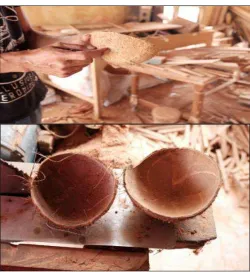
from mountainous areas were considered superior as a raw material for souvenirs because they are thick and hard. This was consistent with the results of a previous [14] study that found that coconut trees growing in mountainous areas had shells with a more exceptional thickness and hardness than trees growing in coastal areas. Differences in the thickness and hardness of the shell effect show handcrafted goods are produced. Coconuts with thinner and softer shells are more comfortable to process. Shell hardness also affects the quality and lifespan of the products. Fig. 3 shows example coconut shell, together with the characteristics that indicate their suitability as raw materials for handcrafted goods.
Fig .3 Coconut shell as handicraft goods raw material
shells with these physical characteristics was IDR 4,000– 5,000. The shells were suitable as raw materials for souvenir motifs of any shape, type, or design. This type of coconut waste can be processed into little souvenirs. The prices of wasting hybrid coconut shell are lower, ranging from IDR 2,500–3,500 per sack. The craftsmen also indicated using hybrid coconut shells that were lighter, thinner, and more fragile. The processing of these shells has to be more
thorough and careful because this type of coconut waste can be easily broken, cracked, and scratched. These shells have tremendous advantages for fabricating large souvenirs, including ashtrays, tissue boxes, pajamas, vases, and candy containers. Craftsmen have converted hybrid coconut shell pieces into miniature souvenirs with simple design motifs. Fig. 4 shows a selection of souvenirs and other handcrafted products made from local and hybrid coconut shells.
Local coconut shell
Hybrid coconut shell
Fig.4 Some handicraft motif designs from local and hybrid coconut shell waste
About 25% of the craftsmen, all members of the Manunggal Karya group, were able to identify the characteristics of the coconut waste; no members of the Karya Mandiri group had this ability. Based on respondents' explanations, it is known that this condition occurs because coconut waste used for handicraft raw materials is obtained collectively. Respondents did not have time to pay attention to the characteristics of each coconut waste. Only confident respondents can choose coconut waste by paying attention to excellent characteristics so that it can be processed into quality handicrafts. The majority of respondents received coconut waste with free characteristics. For the respondents, the most important thing is that raw materials for coconut waste for handicraft processing are available at all times. The percentage of craftsmen in different ability categories, identifying coconut waste pre-knowledge transfer concerning applying techniques, is shown in Fig. 5.
0 10 20 30 40 50 60 Skilled
Does not have ability but want to try
Less ability and did not want to try
Does not have ability and did not want to try
(%)
L
ev
el
o
f
A
b
il
it
y
Fig. 5 Craftsmen capability rate applying the identified technology of coconut waste character
The majority (> 50%) of the respondents were unable to apply techniques for identifying coconut waste characteristics. However, the respondents were interested in trying to do so because they were aware of the benefits of the techniques for improving product quality. Craftsmen learned the techniques while practicing identifying the color,
physical texture, style, hardness, and fragility of all types of coconut waste used as raw materials for souvenirs and handcrafted goods. One craftsman in the Manunggal Karya group was less-skilled and not interested in using the techniques; he was confident that any coconut waste material could be prsocessed into a product of economic value and so was not yet aware of the essential benefits of techniques for identifying raw material characteristics. In the Karya Mandiri Group, two craftsmen had the same attitude. There was also an unskilled respondent who was not interested in identifying the characteristics of coconut waste. Craftsmen with the low ability for performing these techniques produced low-quality souvenirs and handcrafted goods, and it was difficult to improve their revenue and profits.
The average income of respondents in the Manunggal Karya group was IDR 375,000 per production process, which was higher than that of the members of the Mandiri Karya group, who earned an average of IDR 245,000 per production process. Each production process lasts for 5–7 working days. The average income for both groups was IDR 310,000, which is not sufficient to meet the living needs of the craftsmen. Each craftsman requires an average income of IDR 350,000 to sustain their family. The economic conditions of the craftsmen indicate that the micro-souvenir business has not been optimized to ensure a guaranteed income: daily living needs are not being met.
respondents in both groups in this study who were able to apply coconut waste characteristic identification techniques increased. All respondents were interested in adopting the techniques post-knowledge transfer, as shown in Fig. 6.
0 20 40 60 80
Skilled Less skill but want to try
(%)
L
ev
el
o
f
ab
il
it
y
Fig.6 Level of craftsmen capability applying technology identification of coconut waste character
Previous results [8] provided evidence that management of the coconut waste micro-souvenir business also requires an initial period for preparation of the raw material, to ensure a satisfactory level of product quality. This would enable craftsmen to create products with well-designed motifs more easily. It could also increase the market price and yield a significant profit for the respondent. Thus, livelihood diversification through the management of creative micro-handicraft businesses would empower craftsmen via economic benefits [24]–[26]. Improving product quality through the application of techniques for identifying raw material characteristics is essential for craftsmen. The use of coconut waste as a raw material in creative handicraft businesses can also be considered a dynamic solution with the potential to reduce the volume of construction material waste [27]. The quality of processed wood products depends on the characteristics of the raw material, the accuracy of the technology and compliance with the selection of substitution materials [28], [29]. Also, it could improve the quality of the handcrafted goods through innovative and artistic finishing processes [30]. Craftsmen have special skills for manually producing products from simple materials [31]. Their motivation to identify the inputs to their handcrafted goods is an essential factor in product sustainability [32].
High-quality handcrafted products can be sold for a high price and eventually generate profit for craftsmen. The aesthetic design is an important factor in the marketability of handcrafted products [33]. Handicrafts are a vital component of socioeconomic activities [34]. Strengthening small handicraft businesses is a way to promote employment in marginal communities.
IV.CONCLUSIONS
The techniques used to identify the characteristics of waste coconut, a raw material for handcrafted goods, are very simple. However, only a small number of respondents were skilled at identifying the characteristics of the materials. The majority (> 50%) of the less-skilled
respondents were interested in applying the techniques to improve the quality of their products. The features of coconut waste that needed to be identified by the respondents were the age of the coconut wood or shell, and the color, fiber pattern, visual form, thickness, texture, and degree of fragility.
When less-skilled craftsmen use the techniques for identifying the characteristics of coconut waste, there is a risk that they will ultimately use raw materials prone to damage and deterioration. The quality of the finished product would be compromised by using raw materials that can be easily cracked, broken, or scratched. Amount of products that the remaining unsold would also likely increase. Consequently, the market price of the souvenirs would be constrained, and by extension so too would the income of the craftsmen. The benefits of micro-enterprises under such conditions are minimal, and some craftsmen rarely make a profit.
One solution to this problem is for craftsmen to adopt techniques for identifying the characteristics of coconut waste. By applying these techniques skillfully, it is expected that craftsmen would be able to identify the optimal characteristics of raw materials and adjust their souvenir motifs and designs accordingly. If craftsmen widely adopted such techniques, higher quality products, in terms of design, motifs, and decorations, could be produced as souvenirs and handcrafted goods.
ACKNOWLEDGMENT
The authors thank the Director at the Directorate of Research and Community Service, Directorate General of Research and Development Reinforcement, Kemenristekdikti RI for the trust given to the research team to conduct research-based knowledge transfer activities through the Science Program for the Community.
REFERENCES
[1] W. Darmawan, D. Nandika, E. Noviyanti, I. Alipraja, D, Lumongga, D. Gardner, and P. Ge´rardin, “Wettability and bonding quality of exterior coating on jabon and sengon wood surface,” Journal Coatings Technology and Research, vol. 15 (1), pp. 95-104, 2018. [2] A. Mithra, G.J. Swami, and S.P. Rajendran, “Coconut value-added
products,” Journal of Indian Food Industry Mag, vol. 32 (6), pp 29-36, 2013.
[3] S. Damanik, “The development of coconut (Cocos nucifera) for improving farmers income in Indragiri Hilir Regency Riau,” Perspektif Journal, vol. 6 (2), pp 94-104, 2007.
[4] J. Prananta, “Coconut shell utilization and coconut Shell for liquid smoke as a natural food preservative,” Research Report of Making Applied Technology Work For Marginal People Direktur Eksekutif Jingki Institute, Lhokseumawe: Malikus Saleh University, 2007. [5] D. Dumasari, W. Watemin, “Karakteristik sosial ekonomi petani
miskin dalam pengelolaan usaha mikro tourism souvenir goods,” Mimbar: Jurnal Sosial dan Pembangunan, vol. 29 (2), pp 205-214, 2013.
[6] D. Dumasari, and T.S.M. Rahayu, “Management strategy of creative souvenir microenterprise for the Empowerment of craftsmen peasant,” Mimbar: Jurnal Sosial dan Pembangunan, vol. 32 (1), pp 175-186, 2016.
[7] D. Dumasari, S. Budiningsih, W. Darmawan, I. Santosa, “Various determinant factors of production technology adoption in creative souvenir micro-enterprise,” Journal of Arts and Humanities, vol. 6 (10), pp 01-06, 2017.
[9] M. Redzuan, F. Aref, “Constraints and potentials of handicraft industry in an underdeveloped region of Malaysia,” African Journal of Business Management, vol... 5 (2), pp 256-260, 2011.
[10] M. Yusup, Pawit, T.S. Rachmawati, P. Subekti, “The behavior of information seeking and utilizing on livelihood among rural poor people,” Mimbar: Jurnal Sosial dan Pembangunan, vol. 33 (1), pp 46-54, 2017.
[11] U. Wahyudin, “Ecocultural entrepreneurship training for empowering rural poor people,” Mimbar: Jurnal Sosial dan Pembangunan, vol. XXVIII (1), pp 55-64, 2012.
[12] O.A. Abisuga, Oyekunle, and I.R. Fillis, “The Role of handicraft micro-enterprises as a catalyst for youth employment,” Journal Creative Industries, vol. 10 (1), pp 59-74, 2017.
[13] V.M. Vadakepat, “Rural retailing challenges to traditional handicraft,” Journal of Global Marketing, vol. 26 (5), pp 273-283, 2013.
[14] D. Pugersari, A. Syarief, and D. Larasati, “Experiments on the development of commercial value based commercial functional products of coconut shrimp with softening techniques,” Journal of Visual Art and Design, vol. 5 (1), pp 74-91, 2013.
[15] R. Chambers, “Participatory rural appraisal (PRA): challenges, potentials, and paradigm,” World Development Journal, vol. 22 (10), pp 1437-1454, 1994.
[16] J.W. Creswell, Research design qualitative and quantitative approaches. Thousand Oaks. Sage Publication. London. 1994. [17] M.B. Miles, A.M. Huberman, Qualitative data analysis: A
sourcebook of new methods. California; SAGE Publications Inc, 1984.
[18] R.N. Arancon, “The situation and prospects for the utilization of coconut wood in Asia and The Pacific,” Food and Agriculture Organization of The United Nations Regional Office for Asia and Pacific, 2009.
[19] G.A.M. Brasileiro, J.A.R. Vieira, L.S. Barreto, “Use of coir pith particles in composites with Portland cement,” Journal of Environmental Management,” vol. 131, pp 228-238, 2013.
[20] K.W. Corscadden, J.N. Biggs, D.K. Stiles, “Sheep’s wool insulation: A sustainable alternative use for a renewable resource,” Resources, Conservation, and Recycling Journal, vol. 86, pp 9–15, 2014. [21] K. Mori, A. Christodoulou, “Review of sustainability indices and
indicators: Towards a new City Sustainability Index (CSI),” Environmental Impact Assessment Review, vol. 32, pp 94–106, 2012.
[22] W. Darmawan, D. Nandika, B.D.H. Afaf, I. Rahayu, D. Lumongga, “Radial Variation in Selected Wood Properties of Indonesian Merkusii Pine,” Journal of the Korean Society of Wood Science and Technology, vol. 46 (4), pp 323-337, 2018.
[23] Z. Mahmud, Y. Ferry, “Prospects for processing of coconut fruits,” Journal of Plantation Research and Development Center, Bogor: Research and Development of Plantation, vol. 4 (2), 2005.
[24] O. Oyinbo, K.T. Olaleye, “Farm households livelihood diversification and poverty alleviation in Giwa local government area of Kaduna State, Nigeria,” The Journal of Sustainable Development, vol. 15 (1), pp 219-232, 2016.
[25] D.R. Malema, S. Naisoo, “The role of community arts and crafts in the empowerment of women living in a rural environment,” World Leisure Journal, vol. 59 (1), pp 54-60, 2017.
[26] E. Härkönen, M. Huhmarniemi, T. Jokela, “Crafting Sustainability: Handcraft in Contemporary Art and Cultural Sustainability in the Finnish Lapland,” Sustainability Journal, vol. 10, pp 2-14, 2018. [27] H. Suciati, T.J.W. Adi, I.P.A. Wiguna, “A dynamic model for
assessing the effects of construction worker waste behavior to reduce material waste,” International Journal on Advanced Science Engineering and Information Technology, vol. 8 (2), pp 44, 2018. [28] I. Yuningsih, I. Rahayu, D. Lumongga. W. Darmawan, “Wettability
and adherence of acrylic paints on long and short rotation teaks,” Journal of Wood Material Science & Engineering, vol. 14 (3) 2019. https://doi.org/10.1080/17480272.2019.1575903
[29] W. Darmawan, M. Azhari, I.S. Rahayu, D. Nandika, D. Lumongga, I. Malela, S. Nishio, “The chips generated during up-milling and down-milling of pine wood by helical router bits,” Journal of the Indian Academy of Wood Science. Vol 15 (2). Pages 172-180. 2018.
[30] Y. Fu, “Research on Influence of Handicraft in Design History from the Diagrammatic Perspective,” International Conference on Arts, Design and Contemporary Education (ICADCE), 2015.
[31] I.T. Koduah, A. Charles, “Entrepreneurship determinants of artisans/craftsmn in Kumasi Metropolis, Ghana,” American Journal of Industrial and Business Management, vol. 6 (2), pp 163-175, 2016. [32] A. Funso, S. Letema, M. Gerryshom, “Impact of Motivation on Productivityof Craftsmen in Construction Firms in Lagos, Nigeria,” International Journal of Economics and Finance, vol. 8 (4), pp 171-176, 2016.
[33] S.H. Hwang, C.H. Liu, “Promoting for community empowerment and network governance through craft movement,” The Science Design Bulletin of JSSD, vol. 64 (1), pp 11-19, 2016.