Vol.8 (2018) No. 6
ISSN: 2088-5334
A Study of The Upstream-downstream Interface in End-to-end
Tsunami Early Warning and Mitigation Systems
Maheshika Sakalasuriya
#, Dilanthi Amaratunga
#, Richard Haigh
#, and Siri Hettige
*#
Global Disaster resilience Centre, School of Art Design and Architecture, University of Huddersfield, Queensgate, Huddersfield, HD1 3DH, United Kingdom
Email: [email protected]
*Centre for Development Research and Interventions, 60/11 Mahamega Gardens, Maharagama, Western Province, Sri Lanka.
Abstract – The tsunami early warning and mitigation systems are typically used to detect the tsunami inundation before the impact so
that vulnerable communities can be alerted and the damage can be minimized. These systems typically entail upstream and downstream processes, starting from the detection of tsunami wave and finishing with safe evacuation of people. There is an interface between upstream and downstream mechanisms where the warning is issued and the decision to evacuate people are taken. In individual countries, the system by which the information is disseminated from a national point to individual communities varies significantly. Due to the complex nature of different administrative systems, it is difficult to understand who takes the decision to evacuate, at which point and how is it taken. This paper is the first part of a more extensive study undertaken to understand and evaluate the interface between the upstream and downstream mechanisms of the tsunami early warning system. The objective of the paper is to present the findings of a literature review conducted as an initial step to the above study and to understand state of the art and practices related to the interface of an end-to-end tsunami warning and mitigation system. The literature is grouped and analyzed using the conceptual analysis method, in order to understand the concepts related to the tsunami early warning system, mainly focusing on the issues pertaining to the interface. Through the literature review, a conceptual framework is developed, presenting nine concepts and their relationships within the interface. This conceptual framework will serve as a strong theoretical foundation for the future steps to be taken under the above study.
Keywords— interface; tsunami; early warning; evacuation; decision-making.
I. INTRODUCTION
After a large number of deaths and massive devastation caused by the 2004 Indian ocean tsunami, tsunami preparedness has become a significant aspect in the research and practice of disaster resilience. A tsunami early warning and mitigation system was introduced in the Indian ocean region for the first time, and the system became fully operational in 2013. These systems typically entail upstream and downstream processes. After the detection of the tsunami by the warning center, the regional tsunami service provider communicates the warning to the national tsunami warning center (NTWC) in each country. This is the upstream end of the mechanism. The downstream process occurs at the national and local levels in which evacuation decision is made, and any subsequent warning is disseminated to the community.
Between these upstream and downstream processes, there occurs a phase where the received warning information is conveyed through the formal authorities and decision to
In order to fill the gap of knowledge and practical tools related to the interface of an end-to-end tsunami early warning and mitigation system (TEWMS), a study is undertaken to aim to understand the technical, legal and socio-cultural complexities that occur at the interface between upstream and downstream mechanisms of the tsunami early warning system. This interface involves a wide array of jurisdictional agencies and response partners, including regional tsunami service providers, tsunami national contact points, and a range of sub-national emergency operations centers and related actors. Using the cases of Indonesia and Sri Lanka, the study aims to develop a framework to understand the nature and operation of the interface between the upstream warning and downstream threat, and thereby propose a set of practical guidelines for better decision making and information dissemination during the interface of end-to-end TEWMS in the Indian Ocean region. The final guidelines established by the study will seek to be a substantial theoretical and practical contribution that can be applied across the globe in different types of early warning systems related to tsunami preparedness.
As an initial step for this study, a literature review was undertaken to understand state of the art related to the interface of an end-to-end TEWMS and to analyze the theoretical context pertaining to the early warning systems as a whole. The objective of this paper is to present the conceptual framework developed through the literature review, which will contribute to providing a strong theoretical foundation for the broader study. The following section describes the methodology used in developing the conceptual framework. In section three, the literature related to the early warning systems are analyzed to understand the main features and requirements, and the interface of the early warning system is defined. In section four, the conceptual framework is presented, analyzing each concept within the framework. The last two sections are allocated for conclusion, summary and to describe the future work related to the study.
II. MATERIAL AND METHOD
The literature review was conducted using keywords related to the interface mechanism. Different groups of literature were used for different purposes. Scientific peer-reviewed journal papers and books were used for theoretical knowledge pertaining to the subject, while reports, documents by tsunami stakeholders and publications by international actors were used for information purposes. In order to develop a conceptual framework, the conceptual
analysis method was used. This method was used by
Jabareen [1] in developing a conceptual framework for post-conflict reconstruction. It allows the grouping of concepts related to a particular topic and discusses the issues under each of these groups.
A. What is a tsunami early warning system and why?
Tsunamis are widely known to have caused massive destruction of human lives and property in recent years. The Indian Ocean tsunami in 2004 affected about 14 countries, killing more than 230, 000 people across the globe [2]. After the tsunami caused by the earthquake off the Pacific coast of
Japan in 2011, a number of 15, 429 people were killed, and 7.781 were reported to be missing [3].
Therefore, many efforts have been made by those countries exposed to a tsunami threat and the wider international community to minimize the impact on communities through more effective preparedness and the issuing of warnings. Tsunami, early warning systems, are recognized as the most effective way of predicting the impact of tsunami and issue warnings to people, and thereby to minimize the damage [4]. Its prime objective is to alert coastal communities about the possibility of the tsunami [5]. It typically uses a number of specific institutions to provide timely and adequate information, so that the communities can take actions to reduce the risk and prepare to respond [6]. Some of the mandatory requirements of tsunami early warning system include fast prediction, active alarm, reliable response, secure communication, coherency and consistency [4, 7, 8]. The implementation and operation of an early warning system require the knowledge of both natural and social sciences and involves theoretical and practical properties [9]. According to United Nations international strategy for disaster reduction (UNISDR), any hazard warning system includes four interactive elements, namely risk knowledge, monitoring and warning service, dissemination and communication, and response capability[10, 11]. Basher [7] claims that monitoring and warning is the most prominent part of the system, while the failures in the system commonly occur in the preparedness and communication.
B. End-to-end tsunami early warning and mitigation system
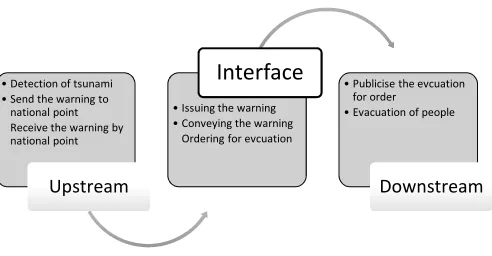
A tsunami early warning system not only includes the technical aspect, where the possibility of an earthquake is predicted using scientific tools, but also human and social components related to decision making and human responses. This process starts with the detection of the earthquake and extends to the evacuation of people and their safe return to homes [11]. This is called an end-to-end tsunami early warning and mitigation system, which has components within the geographical limits of the country and beyond, and therefore, involves local and regional institutions for its smooth operation [5]. Due to its complexity, the end-to-end TEWMS is traditionally divided into two by the academics and practitioners as upstream and downstream phases. The upstream includes detection of the wave, verification, threat evaluation, and forecasting. After the warning is disseminated and the decision to evacuate people is taken, the downstream mechanism takes place including delivery of public safety messages, initiate national counter-measures and prepare and implement standardized operation [5, 12].
C. The interface of an end-to-end TEWMS
the decision to evacuate the people takes place between these two mechanisms. This is where the interface of the warning system occurs. Those actors and institutions involved in the interface mechanism vary significantly from country to country, as well as within a single country. Figure 1 is used to explain and understand the complexity of this process.
Fig. 1 Tsunami warning chain, adapted from IOC/UNESCO [5]
Once the regional tsunami service provider (TSP) detects a tsunami threat, a warning is sent to the national tsunami warning center (NTWC). It is usually analyzed within the NTWC to decide the size of local threat and the volume of the affected community, before sending the warning information to national disaster management organization (NDMO). The role of NDMO and its responsibilities vary widely depending on the geographic and demographic factors. In some countries, the warning is sent to local authorities, people and media directly by the NDMO, whereas in some others it is sent to another local authority for further decision making. Whether the decision for evacuation is taken either at the national level or at the local level, in most cases, it is unclear who bares the ultimate responsibility of pressing the button for evacuation. This decision-making mechanism is taking place during the interface that occurs between the upstream and downstream processes. However, the starting and finishing points of the interface in the end-to-end tsunami warning and mitigation system are not clear. Nevertheless, it is clear that warning dissemination and evacuation decision happens during this phase. Therefore, a working definition for the interface of end-to-end tsunami warning and mitigation systems is described in the following section.
D. Working definition for the interface;
The interface is where the warning is received by the national focal point and processed, and the decision to evacuation is taken before disseminating it to the public and involves the three principal actions of issuing the warning, conveying the warning and ordering for evacuation.
Fig. 2 The position of the interface within the end-to-end TEWMS, authors’ composition
Although these terms related to warning and evacuation have been mentioned in research and practice, they are not analyzed in the context of interface and related to decision making when faced with a tsunami threat. Researchers that focus on tsunami warning tend to deal with technical aspects, and less so on human interventions. On the other hand, research on evacuation decision making tends to focus on the downstream mechanism. It is necessary to understand the terminology and the specific issues related to the interface of the warning system. In the following section, a conceptual framework is presented to understand the key elements and issues within the end-to-end tsunami warning and mitigation system, that is specifically relevant for the interface mechanism.
III.RESULTS AND DISCUSSION A. Decision-making mechanisms
Platt [13] presents a typology of decision making related to disasters, as meta-decisions, operational decisions, and planning decisions. Meta-decisions taken by the gov’t in disaster situations are associated with authority and governance as well as speed and deliberation, both applicable in the interface. The governance structure of a country influences the way in which the decisions are taken, and the information is disseminated in different countries. In Japan, the meteorological agency issues the warning to the public and the media units at the district level [14]. In Indonesia, after the national authority issue the warning, it is up to the local mayor to order for evacuation [15]. At the same time, fast and effective decision making is required in case of tsunami inundation, and the failure to do so will leave the communities at risk [16].
According to Rosenthal and Kouzmin [17], government decisions in unexpected events are based on 5 dimensions; scale, official response, government style, response strategy, and timing. These dimensions become highly significant with respect to the interface. The decision making in the interface will be affected by the size of the disaster and, thus the geopolitical borders of the vulnerable community, by whether the decision to evacuate can be taken nationally or locally, the level of openness of the government, and the capacity to act deliberately.
• Detection of tsunami • Send the warning to
national point Receive the warning by national point
Upstream
• Issuing the warning • Conveying the warning
Ordering for evcuation
Interface
• Publicise the evcuation for order
• Evacuation of people
B. Clearly defined actors
In order for any mechanism to work effectively, individuals and institutions involved should have a clear idea of their roles and responsibilities. An integrated approach to early warning should be inclusive of the actors that are not typically recognized as part of the system, especially those in political and administrative roles, as well as community leaders [7]. As shown in figure 1, there are a number of prominent actors in an end-to-end TEWMS. However, their role during the interface varies depending on the country’s geographic, demographic and socio-cultural background [18]. For example, in Thailand, once a threat is predicted by the meteorological department, the national disaster warning center (NDWC) and the public relations department are sending the early warning, which operates respectively under the ministry of information and communication technology and the office of the prime minister. The warning message is then sent to provincial and local authorities for evacuation and response [19]. In Timor Leste, the information from the national point is sent in 2 ways. The national disaster operation center (NDMO) evaluates the threat and issue the warning to the public while sending the warning information to national disaster management doctorate (NDMD) for further action [20].
A study by InterWorks [21] reveals that NDMO can be located in different organizations or ministries under different names, and their responsibilities may vary according to local needs. In some countries, the NDMOs are common for all disasters, and the responsibility of warning and evacuation is spread among different institutions. The methods of dealing with disasters vary within the countries in some instances, based on local practices [21]. While warning and evacuation can be under a single unit or in different units depending on the country situation, in most cases the local or provincial warning units and their roles within the early warning system are not clearly defined. In Indonesia, the major issues the final warning to the public at the local level, but in some cases, there were conflicts between LDMO and the mayor [15].
C. The centralized vs. decentralized approach
Kapucu and Garayev [22] argue that traditional approaches to disaster risk reduction have increasingly become ineffective, and thus the hierarchical and centralized approaches should be replaced by decentralization. The risk reduction, which is traditionally being understood as a primary responsibility of the government is increasingly getting the local governments and well as the private sector to share the risk and take actions [23]. However, the interface involves crucial decisions of issuing the warning, conveying the warning to national and local authorities, and ordering for evacuation of people. These decisions must be taken by those who have enough knowledge as well as the sufficient authority, and those individuals or institutions can be held accountable for the information and orders dispatched by them. Samarajiva [24] highlights disaster warning as a ‘core business of the government.’ Typically, the warning and preparedness are more centrally operated while the local governments focus more on relief and reconstruction [21]. According to de León, et al. [11], monitoring and forecasting can be either centrally operated
by a national organization, or decentralized among local agents to carry out their own warning and evacuation programmes. Although a decentralized approach is useful in the evacuation and response process, de León et al. [11] adds that it may use less sophisticated technology that could result in imprecise information. The extent of centralization in taking the decisions for warning and evacuation largely depends on the geopolitical and demographic factors. In Sri Lanka, the warning and evacuation decision is principally taken by NDMO, and disseminated to local authorities for further action [25]. On the contrary, in Indonesia, the national warning is further evaluated for the local impact based on the official guidelines and the local mayor is issuing the official warning [26].
D. Standardization of interface
The national and local institutions usually follow standard operating procedures (SOPs) related to the bulletins or advice regarding the warning [27]. An SOP describes the procedures agreed on by relevant stakeholder institutions on coordinating who, what, when, where and how for tsunami early warning and response [28]. Ideally, each actor involved in the interface should have their own SOPs to deal with the emergency situation. Although SOPs for TEWMS as a whole, are clearly defined for most of the countries, it is not clear which of these apply specifically for the interface. The Intergovernmental Oceanographic Commission (IOC) encourages individual countries to develop and maintain SOPs at all levels of decision making in TEWMS [18]. On the other hand, while the SOPs are mostly developed for national level disaster institutions, they are not clearly defined for local level authorities, as well as other departments involved in the decision-making process. In countries where there are fewer occurrences of tsunami (Pakistan, Timor Leste) SOPs are available only for the public warning and disaster management institutions [20, 29]. In Sri Lanka, although there are several guidelines and SOPs at the national and department level, they are not clearly integrated into a single work plan for smooth operation [25]. At the same time, the SOPs for local governments are not clearly defined in the case of Sri Lanka.
As described by Steinmetz, et al. [30], decision support system (DSS) is an innovative approach to provide operational guidelines at all stakeholder levels. It uses the knowledge from several disciplines to support the decision of warning and evacuation for the local officers and is currently used by several countries. However, this system is heavily reliant on technology for information dissemination, which could act as a barrier in cases of technical failures.
E. Technical capacity
years, rather than to the predicted tsunami risk. It also depends on the financial capacity and economic development level of a country and could also be a result of socio-political influences. TEWS cannot afford to fail during an emergency since it carries a large responsibility to provide reliable information [31]. However, several cases of technological failures were recorded during recent tsunami inundations. Indonesia, in partnership with the German government, has primarily invested in developing the national and local technical capacity to strengthen the core elements of the early warning system [26]. This system works very efficiently in giving decision guidance to local officers and timely warnings to people. Nevertheless, a few problems were reported when the national warning center failed to issue the warning due to technical failures in alarms and warning buoys [15]. On the other hand, the local institutions in developing countries are not adequately equipped with technology to measure the magnitude and the timing of the local impact, and much work need to be done in this regard [11].
F. Human capacity
The human factor plays a significant role in a people-centered approach to risk reduction in case of natural hazards [32]. de León, et al. [11] highlights that the link between the technical aspect of warning and the capacity of human response is weak in most developing countries. The disaster management organizations and community organizations lack the ability to respond rapidly. Insufficient organizational capacity and inadequate preparedness for emergency response are two critical reasons for failures in the operation of TEWMS [22]. Therefore, it is necessary to review and revise the traditional responsibilities assigned to each role, focusing on collaboration and solution-based approaches. The problems in issuing the warning, which is a central component of the interface, could also be a result of human failures [15]. In cases, where critical decisions of warning and evacuation are taken by local officials, they need to be equipped with adequate scientific knowledge, training, technical staff and up-to-date information [33].
G. Spatial and socio-cultural
An effective early warning system requires the risk reduction to be mainstreamed into public policy and include community participation as a part of its strategy [34]. Including tsunami mitigation in education has become more common, and in some cases mandatory, in order to target a large number of vulnerable communities and to build a culture of awareness [35]. At the same time, hazard maps are useful tools for designing evacuation planning and ensuring safety in case of a tsunami threat [36]. Hazard mapping is a crucial element in hazard assessment and mitigation and empowers the local communities to act according to their own requirements [37]. In a paper presenting the tsunami hazard mapping in Padang, Indonesia, the authors reiterate the need to map the tsunami hazard at the local community level, while accounting for microscopic temporal and spatial dynamics of the tsunami inundation [38]. Indigenous knowledge and socio-cultural features play a significant role in decision making during disasters in individual communities, and thus community-based disaster
management tools can be used for risk reduction [39]. The cultural values, practices, and beliefs affect the people’s capacity to believe in the risk of tsunami threat. Cultural differences including language and religion also condition them to evaluate the tsunami risk in certain ways and affect their emotional response [40].
H. Vertical and horizontal coordination
Stakeholder coordination is essential for hazard risk assessment, warning, and mitigation in case of tsunami inundation. The various institutions bring together their capacities for the common objective of providing safety to people [41]. Scientific institutions should coordinate effectively with national warning center and the disaster management organizations, together with civil society, non-governmental organizations (NGOs), other government bodies and media outlets [42]. As the early warning systems developed through time, one of the major issues encountered by the practitioners is the problems of coordination and understanding between national and local actors, as well as among different national institutions. As a result of a lack of coordination, communities can be misguided and may also face problems of discrimination [8]. Historically, there were problems of coordinating between national and local governments, due to personal agendas, perceptions, and priorities. In some countries, there is a lack of understanding about the central objectives and strategies [21]. In all cases of recent natural disasters and extreme events, collaborative management of the emergency situation has proved to be essential [43]. Moreover, the participation of many stakeholders in a single mechanism, primarily related to decision making, can cause difficulties unless the coordination is effective and systematic. Defining clear roles and responsibilities for institutions, as well as capacity building within and among the organizations, is necessary to overcome these problems [22]. It is necessary to empower the national level institutions to organize and coordinate effectively with each other, and this should be a prior demand of the core national point of tsunami risk reduction. On the other hand, the communities can feedback to the preparedness plan through their local organizations, which link the public response with the national level organizations [41].
I. Formal and informal communication mechanisms
information given through the media [41]. Mobile, internet and social media have become increasingly useful in collaborating among different stakeholders as well as in communicating the warning information to the public [45]. The social media is increasingly used by government organizations to communicate the warnings to the public. However, the unprecedented and uncontrolled information in social media can also cause spreading of misinformation. However, some researchers suggest that despite the spreading of fabrication, these channels promise to be the most effective and leading information disseminating tool in tsunami warnings in the future [46].
IV.CONCLUSIONS
In an effort to understand the interface of an end-to-end TEWMS, a conceptual framework consisting of nine key elements was developed using the existing literature and other information sources. These elements are related to the necessary principal actions that take place during the interface; issuing the warning, conveying the warning and ordering for evacuation. Started from the decision-making mechanism, some of the key features and issues related to tsunami warning and interface were identified, including diverse decision-making mechanisms, hierarchical structures, and political and administrative factors. It is essential to have a clearly defined set of actors who operate within the interface, and there are several confusions and disparities regarding the roles and responsibilities of these actors. Depending on geographic, demographic and political circumstances the issue of warning and order for evacuation within a country can be either centralized by the government or decentralized across local governments and other relevant institutions. In terms of standardization, international organizations highlight the need for the availability of clear SOPs for all national and local stakeholders. Having clear guidelines reduces the confusion and facilitates the speedy and accurate delivery of information to the public. The technical and human capacity within the organizations involved in the interface of end-to-end TEWMS affects the decision-making power of those actors. It is necessary to equip the key organization with the up-to-date technology, adequate trained staff and access to scientific knowledge. Tools such as education, indigenous knowledge, cultural inclusion, and hazard mapping can be used to mainstream the tsunami preparedness and mitigation, and to increase community participation in key decision-making. The effective vertical and horizontal coordination among the national and local actors can contribute to accurate and deliberate warning dissemination, and thus it becomes a decisive element during the interface. This should be followed by a well-organized communication mechanism to facilitate collaboration among different institutions. While formal and informal methods of communication are used in TEWS, both of which have their own advantages and disadvantages, there is an increasing trend to use social media for information dissemination.
The conceptual framework will inform further empirical studies into the interface of end-to-end TEWMS in different countries. Guidelines are being established to conduct interviews and focus group discussions taking place under the two case studies conducted in Indonesia and Sri Lanka.
Given the ever-present threat of a Tsunami in the Indian Ocean region, the establishment and maintenance of a fully functional TEWMS in each of the countries in terms of both the required human and technical capacities, in the long run, is a necessity. Yet, such a system cannot exist independent of the economic, political, cultural and social realities in the countries concerned. It is in this sense that the case studies currently underway in Indonesia and Sri Lanka promise to identify and understand the challenges in order to develop and refine the conceptual framework further so that appropriate recommendations can be made to streamline the TEWMS at national and local levels with a particular focus on the interface being the two levels. The above framework will be continuously improved and modified throughout the data collection process and will be used as a guideline for data analysis.
ACKNOWLEDGMENT
Co-funded by the Erasmus+ programme of the European Union, grant CABARET 573816-EPP-1-2016-1-UK-EPPKA2-CBHE-JP.
The European Commission support for this study does not constitute an endorsement of the contents which reflects the views only of the authors, and the Commission cannot be held responsible for any use which may be made of the information contained therein."
REFERENCES
[1] Y. Jabareen, "Conceptualizing “Post-Conflict Reconstruction” and “Ongoing Conflict Reconstruction” of Failed States," International Journal of Politics, Culture, and Society, vol. 26, no. 2, pp. 107-125, 2013.
[2] UNESCO. (28.03.2018). Indian Ocean Tsunami Warning System: An Intergovernmental Endeavor. Available: http://www.unesco.org/new/en/unesco/themes/pcpd/unesco-in-post-crisis-situations/tsunami-warning-system/
[3] IOC/UNESCO. (03.28.2018). The 11 March 2011 Earthquake off the Pacific Coast of Tohoku, Japan Available: http://www.ioc-tsunami.org/index.php?option=com_content&view=article&id=65:th e-11-march-2011-earthquake-off-the-pacific-coast-of-tohoku-japan&catid=20:latest-news&Itemid=68
[4] C. Cecioni, G. Bellotti, A. Romano, A. Abdolali, P. Sammarco, and L. Franco, "Tsunami early warning system based on real-time measurements of hydro-acoustic waves," Procedia Engineering, vol. 70, pp. 311-320, 2014.
[5] IOC/UNESCO, "Tsunami risk assessment and mitigation for the Indian Ocean; knowing your risk and what to do about it," in "Manuals and Guides - 52," UNESCO, IOC/UNESCO2015. [6] ISDR, "ISDR 2005a Disaster statistics 1994-2004," in "ISDR 2005a
Disaster statistics 1994-2004," International Strategy for Disaster Reduction Secretariat, Geneva2004, Available: http://www.unisdr.org/eng/ library/lib-terminology-eng%20home.htm
[7] R. Basher, "Global early warning systems for natural hazards: systematic and people-centered," Philosophical Transactions of the Royal Society of London A: Mathematical, Physical and Engineering Sciences, vol. 364, no. 1845, pp. 2167-2182, 2006.
[8] R. W. Perry and M. R. Green, "The Role of Ethnicity in the Emergency Decision-Making Process*," Sociological Inquiry, vol. 52, no. 4, pp. 306-334, 1982.
[9] J. Zschau and A. Küppers, "Early warning systems for disaster mitigation," ed: Springer, Berlin, 2002.
[10] ISDR-PPEW, "International Early Warning Programme (IEWP). Brochure," I. P. f. t. P. o. E. W. (PPEW), Ed., ed. Bonn: ISDR Platform for the Promotion of Early Warning (PPEW), 2005. [11] J. C. V. de León, J. Bogardi, S. Dannenmann, and R. Basher, "Early
[12] E. Bernard and V. Titov, "Evolution of tsunami warning systems and products," Phil. Trans. R. Soc. A vol. 373, no. 2053, p. 20140371, 2015.
[13] S. Platt, "A decision-making model of disaster resilience and recovery," in SECED 2015 Conference: Earthquake Risk and Engineering Towards a Resilient World, 2015, pp. 9-10.
[14] M. Hoshiba and T. Ozaki, "Earthquake Early Warning and Tsunami Warning of the Japan Meteorological Agency, and Their Performance in the 2011 off the Pacific Coast of Tohoku Earthquake ($ ${M} _ {{\mathrm {w}}} $ $9.0)," in Early Warning for Geological Disasters: Springer, 2014, pp. 1-28.
[15] A. T. Chatfield and U. Brajawidagda, "Twitter early tsunami warning system: A case study in Indonesia's natural disaster management," in System Sciences (HICSS), 2013 46th Hawaii international conference on, 2013, pp. 2050-2060: IEEE.
[16] F. Ai, L. K. Comfort, Y. Dong, and T. Znati, "A dynamic decision support system based on geographical information and mobile social networks: A model for tsunami risk mitigation in Padang, Indonesia," Safety Science, vol. 90, pp. 62-74, 2016.
[17] U. Rosenthal and A. Kouzmin, "Crises and crisis management: Toward comprehensive government decision making," Journal of Public Administration Research and Theory, vol. 7, no. 2, pp. 277-304, 1997.
[18] IOC/UNESCO. (2016, 23.03.2018). IOTWMS Standard Operating Procedures Workshop. Pre-IOWave16 Workshop on Standard Operating Procedures for Tsunami Warning and Emergency Response for Indian Ocean Countries Available: http://www.ioc-unesco.org/index.php?option=com_oe&task=viewEventDocs&eventI D=1837
[19] R. Chareonmak and P. Sirikorn, "Tsunami SOPs for Thailand " in "IOTWMS Standard Operating Procedures Workshop. Pre-IOWave16 Workshop on Standard Operating Procedures for Tsunami Warning and Emergency Response for Indian Ocean Countries " Intergovernmental Oceanographic Commission, Australia 2016, Available: http://www.ioc-unesco.org/index.php?option=com_oe&task=viewDocumentRecord &docID=17245.
[20] L. Xavier and F. M. Araujo, "Timor Leste SOPs for tsunami warning and emergency response, from national to community level," in "IOTWMS Standard Operating Procedures Workshop. Pre-IOWave16 Workshop on Standard Operating Procedures for Tsunami Warning and Emergency Response for Indian Ocean Countries " Intergovernmental Oceanographic Commission, Australia 2016, Available: http://www.ioc-unesco.org/index.php?option=com_oe&task=viewDocumentRecord &docID=17246.
[21] InterWorks, "Model for a National Disaster Management Structure, Preparedness Plan, and Supporting Legislation.," in "Disaster Management Training Programme " 1998, Available: http://www.preventionweb.net/files/5142_US01MH840-Ft.pdf. [22] N. Kapucu and V. Garayev, "Collaborative decision-making in
emergency and disaster management," International Journal of Public Administration, vol. 34, no. 6, pp. 366-375, 2011.
[23] J. P. Sarmiento et al., "Private sector and disaster risk reduction: The cases of Bogota, Miami, Kingston, San Jose, Santiago, and Vancouver," International Journal of Disaster Risk Reduction, vol. 14, pp. 225-237, 2015.
[24] R. Samarajiva, "Policy Commentary: Mobilizing information and communications technologies for effective disaster warning: lessons from the 2004 tsunami," New Media & Society, vol. 7, no. 6, pp. 731-747, 2005.
[25] K. H. M. S. Premalal and P. Kodippili, "Early warning & Emergency Response In Sri Lanka," in "IOTWMS Standard Operating Procedures Workshop. Pre-IOWave16 Workshop on Standard Operating Procedures for Tsunami Warning and Emergency Response for Indian Ocean Countries " Intergovernmental Oceanographic Commission, Australia 2016, Available:
http://www.ioc-unesco.org/index.php?option=com_oe&task=viewEventDocs&eventI D=1837.
[26] H. Spahn, M. Hoppe, H. Vidiarina, and B. Usdianto, "Experience from three years of local capacity development for tsunami early warning in Indonesia: challenges, lessons and the way ahead," Natural Hazards and Earth System Sciences, vol. 10, no. 7, pp. 1411-1429, 2010.
[27] S. Nayak and T. Srinivasa Kumar, "Addressing the Risk of the Tsunami in the Indian Ocean," Journal of South Asia Disaster Studies, vol. 1, no. 1, pp. 45-57, 2008.
[28] United Nations ESCAP. IOC-SOP Capacity Building; Strengthening Tsunami warning and emergency response Available: https://www.unescap.org/sites/default/files/tsunami-warning-emergency-sop-tor.pdf
[29] G. Naeem, "Pakistan NTWC Tsunami Warning SoPs," in "IOTWMS Standard Operating Procedures Workshop. Pre-IOWave16 Workshop on Standard Operating Procedures for Tsunami Warning and Emergency Response for Indian Ocean Countries " Intergovernmental Oceanographic Commission, Australia2016,
Available:
http://www.ioc-unesco.org/index.php?option=com_oe&task=viewDocumentRecord &docID=17242.
[30] T. Steinmetz et al., "Tsunami early warning and decision support," Natural Hazards and Earth System Sciences, vol. 10, no. 9, p. 1839, 2010.
[31] M. Grabowski and K. Roberts, "High-reliability virtual organizations: Co-adaptive technology and organizational structures in tsunami warning systems," ACM Transactions on Computer-Human Interaction (TOCHI), vol. 18, no. 4, p. 19, 2011.
[32] R. W. Perry, "Evacuation decision-making in natural disasters," Mass emergencies, vol. 4, no. 1, pp. 25-38, 1979.
[33] W. A. Anderson, "Disaster warning and communication processes in two communities," Journal of Communication, vol. 19, no. 2, pp. 92-104, 1969.
[34] M. L. Collins and N. Kapucu, "Early warning systems and disaster preparedness and response in local government," Disaster Prevention and Management: An International Journal, vol. 17, no. 5, pp. 587-600, 2008.
[35] L. Dengler, "The role of education in the national tsunami hazard mitigation program," Natural Hazards, vol. 35, no. 1, pp. 141-153, 2005.
[36] V. V. Titov, F. I. González, H. O. Mofjeld, and A. J. Venturato, NOAA time Seattle tsunami mapping project: procedures, data sources, and products. US Department of Commerce, National Oceanic and Atmospheric Administration, Oceanic and Atmospheric Research Laboratories, Pacific Marine Environmental Laboratory, 2003.
[37] E. N. Bernard, "The US National Tsunami Hazard Mitigation Program: A Successful State-Federal Partnership," in Developing Tsunami-Resilient Communities: Springer, 2005, pp. 5-24.
[38] T. Schlurmann, W. Kongko, N. Goseberg, D. Natawidjaja, and K. Sieh, "Near-field tsunami hazard map Padang, West Sumatra: Utilizing high-resolution geospatial data and reasonable source scenarios," Coastal Engineering, vol. 2, 2010.
[39] B. G. McAdoo, A. Moore, and J. Baumwoll, "Indigenous knowledge and the near-field population response during the 2007 Solomon Islands tsunami," Natural Hazards, vol. 48, no. 1, pp. 73-82, 2009. [40] S. D. Perry, "Tsunami warning dissemination in Mauritius," Journal
of Applied Communication Research, vol. 35, no. 4, pp. 399-417, 2007.
[41] H. Taubenböck et al., " Last-Mile" preparation for a potential disaster-Interdisciplinary approach towards tsunami early warning and an evacuation information system for the coastal city of Padang, Indonesia," Natural hazards and earth system sciences, vol. 9, no. 4, p. 1509, 2009.
[42] T. Elliott, "The Tsunami Warning Chain from NTWC to Community," in IOTWMS Regional Pre-IOWave16 Workshop on Standard Operating Procedures for Tsunami Warning and Emergency Response for Indian Ocean Countries, Melbourne, Australia, 2016. [43] W. L. Waugh and G. Streib, "Collaboration and leadership for
effective emergency management," Public administration review, vol. 66, no. s1, pp. 131-140, 2006.
[44] R. G. Aldunate, F. Pena‐Mora, and G. E. Robinson, "Collaborative distributed decision making for large scale disaster relief operations: Drawing analogies from robust natural systems," Complexity, vol. 11, no. 2, pp. 28-38, 2005.
[45] S. R. Hiltz, P. Diaz, and G. Mark, "Introduction: Social media and collaborative systems for crisis management," ACM Transactions on Computer-Human Interaction (TOCHI), vol. 18, no. 4, p. 18, 2011. [46] G. Mersham, "Social media and public information management: