Evaluation of E-Business Micro and Macro Determinants by Multiple Indicators
Multiple Causes Model
Rita Remeikiene
1, Martin Cepel
2,
Ligita Gaspareniene
31,3Mykolas Romeris University
Ateities str. 20, LT 08303, Vilnius, Lithuania
E-mail. [email protected]; [email protected]
2Paneuropean University in Bratislava
Tematinska 10, 851 05, Bratislava, Slovak Republic E-mail. [email protected]
http://dx.doi.org/10.5755/j01.ee.30.5.19639
The methods employed for the research include comparative and systematic literature analysis, statistical data analysis, expert evaluation and the Multiple Indicators Multiple Causes (MIMIC) model.There are several research gaps in the field of e-business: 1) there is no simplified factor model which would denote the development of e-business, including its causes and consequences, and which, due to its universality, could be adapted to any country; 2) the studies of e-business development lack a comprehensive assessment which would consider this phenomenon in both quantitative and qualitative terms.
On the basis of the theoretical analysis, a model for assessment of e-business development has been formed. The results of the empirical evaluation have revealed that in the group of micro environmental determinants development of e-business in Lithuania is, to the largest extent, determined by business managers’ motivation to reach the defined aims and their positive viewpoint that e-business may become a perfect auxiliary tool to ensure business competitiveness. In the group of macro environmental determinants, the determinants of socio-cultural environment can be indicated as the major ones that affect the development of e-business.Application of the MIMIC model has enabled to identify the following macro economical determinants (for the euro area): real effective exchange rate for the euro area; level of households with the Internet access; quantity of individuals using the Internet for ordering goods or services; government deficit/surplus; youth employment, and individuals using the Internet for interaction with public authorities.
Keywords:E-Business; E-Business Development; Determinants; Lithuania; Eurozone; MIMIC ModeL.
Introduction
Topicality of the problem. Digitalisation of the population’s lifestyle as well as the prevalent habit to operate in e-environment serve as the major drivers which push business enterprises all over the world to adjust their strategies and change operational environment from traditional to digital one in order to retain a competitive advantage in the market. Economically-developed countries, such as Great Britain or the USA, see the soaring scopes of e-commerce, and further development of these countries cannot be imagined without an active and constant exploitation of IT.
The development of e-business processes has contributed to the formation of a new value chain, which links main business activities to sales and distribution channels. The new value chain, in turn, generates the demand for fast data transmission. The results of the scientific studies (Laudon & Traver, 2009; Niranjanamurthy et al., 2013; Maditinos, Chatzoudes, & Sarigiannidis, 2014; Verdu-Jover, Alos-Simo, & Gomez-Gras, 2014, etc.) disclosed that application of new network technologies may ensure more efficient business operation, expand traditional markets to electronic ones and create extensive organizational structures composed of an enterprise, customers, suppliers and partners.
E-business in developing countries is also gathering pace, but, with reference to the report of the State Control Department (2015), the process of e-business development remains comparatively slow (the case of Lithuania). Considering the significant role of e-business, entrepreneurs must direct their effort towards broadening the range of products and services offered online. Following the Mikalajunas and Pabedinskaite (2010), e-business is a type of e-business, where the infrastructure of information technologies is employed to increase business efficiency and create the foundation for the development of new products and services.
Nevertheless, both e-business start-up and development require careful consideration of what micro and macro factors may determine the successful course of operation.
Rita Remeikiene, Martin Cepel, Ligita Gaspareniene. Evaluation of E-Business Micro and Macro Determinants by… State Control Department (2015), Mikalajunas and
Pabedinskaite (2010) and other scientists. However, in spite of the abundance of the research directions, the analysis of the scientific literature has enabled to establish that some scientists (Aragon-Correa, Garcia-Morales, & Cordon-Pozo, 2007; Bordonaba-Juste, Lucia-Palacios, & Polo-Redondo, 2012; Tsai, Li, Lee, & Tung, 2011; Tsironis, Gotzamani, & Mastos, 2017, etc.) focus on internal (e.g. micro environmental) determinants of e-business, while macro environmental determinants are considered only partly (Zekos, 2003; Filis, Johansson, & Wagner, 2004; Elbeltagi, 2007; Li & Xie, 2012; Torres, Lisboa, & Yasin, 2014; Mangiaracina, Marchet, Perotti, & Tumino, 2015; Armas-Cruz, Gil-Soto, Oreja-Rodriguez, 2017, etc.).
Research gap: several scientific gaps are listed out in scientific studies, covering e-business: 1) there is no simplified factors model, which denotes e-business development, including causes and consequences, and which could be adapted to any country due to its universality; 2) the studies of e-business development lack a comprehensive assessment, in which the development of e-business is analysed using both mathematical methods and qualitative methods.
The gap in the research is important for the Government institutions, responsible for the improvement of business environment, and promoting entrepreneurship at international level.
Keeping in mind the lack of the research that would combine evaluation of the impact of micro and macro environmental determinants on e-business development, especially when it concerns the analysis of e-business determinants, the problem of this study is defined as a question: which micro and macro determinants have the most significant impact on e-business?
The purpose of the study is to evaluate e-business determinants. In order to fulfil the defined purpose, the following objectives were raised: 1) to analyse the theoretical literature on e-business determinants and develop the model of e-business development; 2) to select and substantiate the methodology of the research; 3) to conduct the empirical evaluation of e-business determinants and identify the determinants of e-business success (failure). The methods of the research include systematic and comparative analysis of the scientific literature, statistical data analysis, expert evaluation, Multiple Indicators Multiple Causes (MIMIC) model.
E-Business Determinants: Theoretical Background
Successful development of e-business calls for the comprehensive analysis of its determinants. Some authors, who conducted the studies on this topic, stress the importance of microeconomic determinants such as characteristics of a business manager (in particular, knowledge in e-business and IT, attitude to innovations), characteristics of a business (e.g. business complexity, comparative advantage, adjustment costs), characteristics of an organisation (e.g. IT skills of the staff, e-technologies employed, business size, firm scope, Chief executive officers knowledge, adoption costs) (Filis et al., 2004; Jeon et al., 2006; Chatzoglou, & Chatzoudes, 2016), learningabilities of an organisation (availability of training, technical competence, general level of knowledge), knowledge management skills (knowledge accumulation, application and sharing), preparation of an organisation for operation in new environment (Maditinos et al., 2014), organisational resources (financial resources and competences) (Bordonaba-Juste et al., 2012), type of a product or service (Filis et al., 2004). In other words, the model of micro environmental determinants of e-business is based on the theory of organisational abilities and resources (Maditinos et al., 2014; Alos-Simo, Verdu-Jover, & Gomez-Grass, 2017). Following the findings of previous scientific studies, the size of an organization, internal resources, motivation of business managers, covering management style and leadership and staff knowledge are considered the most influential micro environmental determinants of e-business.
From macroeconomical point of view, e-business is recognised to be driven by the impact of globalization, elimination of physical barriers and governmental policies, which were discussed by Zekos (2003), Filis et al. (2004), Elbeltagi (2007), Li and Xie (2012), Torres et al. (2014), Mangiaracina et al. (2015) and others. Having researched 292 SMEs in Indonesia, Rahayu and Day (2015) found that perceived benefits, technology readiness, owners’ innovativeness, owners’ IT ability and owners’ IT experience are the determinant factors that influence adoption of e-commerce in business enterprises. Maia, Lunardi, Longaray, & Munhoz (2018) highlight the importance of the quality of information, which makes e-commerce more attractive to consumers, while Gatautis (2017) stresses the significance of online platforms (Google, Amazon, Apple, etc.) that innovate business models and value systems. According to Kartiwi et al. (2018), the key antecedents to achieve and sustain the value of e-commerce, among others, include market orientation and business partnerships. They also note that technological innovations in companies are pushed by external pressure, legal structures and the level of Internet usage in society.
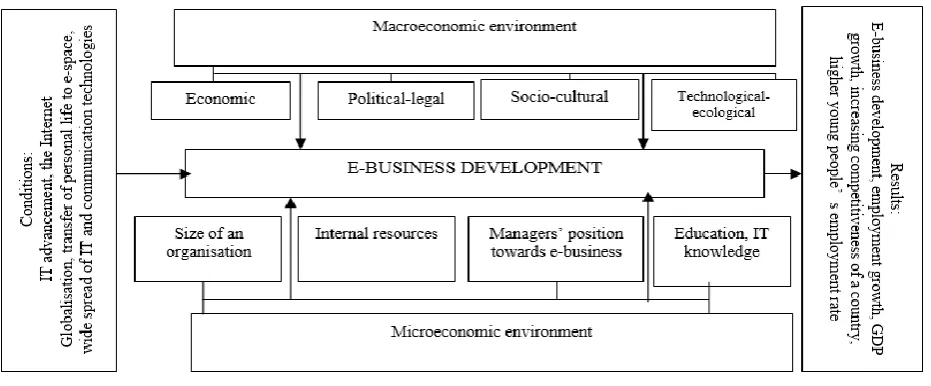
Figure 1. The Model of E-Business Development
Economic environment of e-business in the model in Figure 1 combines the effects of GDP, employment rate, average wages, inflation, government debt, country’s competitiveness, the development of financial innovations and business freedom. Political-legal environment refers to the general tax level, business regulation (e.g. the norms of business establishment), bureaucratic and administrational restrictions, regulation of IT sector and the mechanisms developed to detect and punish illegal entrepreneurs in e-space. Socio-cultural environment refers to the general IT spread in the country, dependence of customers on IT (i.e. intensity of IT usage at work and at home expressed as the number of hours spent in e-space), virtuality and immediacy of e-business (i.e. the extent to which a customer can have an unlimited access to the Internet, can visit an unlimited number of websites, can collect the unlimited quantities of information, etc.), and simplicity of e-business processes (Mikalajunas & Pabedinskaite, 2010). Technological-cultural environment covers the effects of the degree of innovation of a product or service (with reference to Gurtoo and Antony (2007), innovations usually emerge via the well-developed information infrastructure), quality and speed of the IT and the Internet available to customers, the rate of population literacy, and saving of resources (e.g. usage of IT and telecommunications may contribute to reduction of paper and fuel consumption, etc.).
Summarising, e-business is influenced by numerous determinants of micro and macro environment. Although scientific literature emphasises the impact of internal factors, such as staff competence, motivation of business managers, and ability of large enterprises to accumulate and purposefully exploit available resources, the role of macroeconomic determinants on e-business development is not less significant: economic environment may open new business prospects, especially during the periods of economic recession; political-legal environment plays an important role in business form selection; socio-cultural environment is linked to the formation of customer habits; finally, technological-ecological environment has a significant impact on implementation of innovations and regular renewal of business functions. The impact of these
determinants on e-business development in Lithuania will be analysed in the further sections of this article.
The Ethodology of the Research
In this article Lithuania has been chosen as a case of good practice in assessing the speed of the Internet. According to Lithuanian Statistics Department (2016), Lithuania was recognized as the country with the fastest wireless public Internet, Lithuania is an information technology country, the information technology sector has received the largest investment from abroad in the last five years among five countries that had the fastest wireless internet.
In order to identify the determinants of e-business development in Lithuania, the qualitative method of expert evaluation was employed. With reference to Augustinaitis, et al. (2009), expert evaluation is one of the methods most commonly applied for socio-economic research. In addition, selection of the method of expert evaluation was determined by the lack of the primary statistical data on the topic under research. To collect the data on the position of the experts towards the determinants of e-business development, the method of questionnaire survey was employed.
Rita Remeikiene, Martin Cepel, Ligita Gaspareniene. Evaluation of E-Business Micro and Macro Determinants by…
x
x vy
The expert evaluation was conducted indirectly, i.e. by surveying the experts via telephone and e-mail. The questionnaire was composed of 3 parts. The first part was developed to collect the general information about an expert (his/her experience in e-business and the activity field). The second part helped to find out the opinion of the experts on the impact of micro environmental and macro environmental determinants on e-business development. Finally, the third part enabled to form recommendations on e-business development Reliability of the questionnaire was verified by employing the calculations of Cronbach alpha coefficient and Kendall’s coefficient of concordance. For assessment of the impact of the statistically-substantial determinants, the MIMIC model was applied. It enabled to identify the determinants that affected the development of e-business in the euro area over the period 2008-2015. For obtainment of the most accurate results, a comparatively wide geographical area (19 Eurozone member states) was selected. GDP value of Euro area represented 20,31 percent of the world economy in 2017. Euro area seasonally adjusted unemployment rate was 7,9 percent in 2018. This is the lowest rate recorded in the Euro area since 2008. Inflation Rate in the Euro Area averaged 2 percent from 1991 until 2019, reaching an all time high of 5 percent in July of 1991 and a record low of -0.60 percent in July of 2009 (Trading Economics, 2019).
The MIMIC multiple causes model is considered the most comprehensive methodology developed for estimation of the size of the shadow economy. Nevertheless, it is also applicable in cases when phenomena under research do not show any consistent dynamic data lines. In this model, e-business is considered as a latent variable, which, on one side, is related to the set of observed indicators, and on the other side – to the set of causal variables, which have a considerable impact on the multitude of the researched phenomenon. When a sufficient quantity of indicative and causal data is available, the model is developed by employing pretty standard procedures of econometrics.
The e-business (ή) is a scalar variable which is linearly described by a set of directly observed variables X1, X2, ..., Xq and scalar random noise (ζ).
(1) The latent (hidden) variable (ή), in turn, directly describes endogenous variables Y1, ζY2, ..., Yp, which are dependent on the levels of scalar noise ɛ1, ɛ2,...,ɛp:
(2) Structural noise (ζ) and estimation errors ɛ have a normal distribution and are linearly independent. Then, the following marking is introduced:
XT = (x1, x2, …, xq) – observed exogenous variables (causes);
YT = (Y
1, Y2, …, Yq) – structural parameters (structural model);
yT = (y1, y2, …, yq) – observed endogenous variables (indicators);
λT = (λ1, λ2, …, λq) – structural parameters (estimation model);
ɛT = (ɛ
1, ɛ2, …, ɛq) – estimation errors;
vT = (v1, v2, …, vq) - standard deviation of estimation errors.
Formulas (1) and (2) can be rewritten as:
(3)
(4) (4)
where E – mean, Θ – p x p covariance matrix, Θpxp – quadratic matrix of p order.
It is presumed that E(ζɛT) = 0, E(ζ2) = σ2, and E(ɛɛT) = Θ2.
Θpxp refers to a diagonal matrix with v, which is inherent to its diagonal.
The model can be converted into a reduced form, i.e. into a function of observed variables:
(5)
Here П = λYT, and v = λζ + ɛ.
This way, the matrix of model covariation is developed:
(6) where ψ – Var (ξt); φ – q x q covariance matrix of the causes xt
The latent (hidden) variable (ή) is invisible, and its value remains unknown. The other parameters of the model have to be evaluated by analysing the links between the observed variables in the dispersion and covariation. The main aim is to find the values of parameters Y and λ, and the estimate Σ.
The results of the survey were processed with SSPS (Statistical Package for Social Sciences) and Microsoft Excel software; the results of mathematical calculations were processed with Lisrel.
The Results of the Empirical Evaluation on E-Business Determinants: Cases of Lithuania and Eurozone
The values of Cronbach alpha coefficient calculated for all the question groups were equal to 0.881, which proposes that all the statements in the questionnaire reflect the researched dimension with appropriate accuracy.
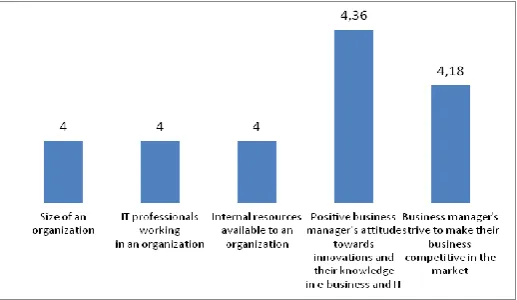
With reference to the model of e-business development (see Figure 1), the experts were asked to evaluate the statements about the significance (insignificance) of particular micro environmental and macro environmental determinants. The value of Kendall’s coefficient of concordance (W(a)) equal to 0.104 and value p equal to 0.03 propose that the results of the survey can be considered statistically significant, which is also confirmed by the estimations of the average values. The determinants with average values higher than 3.5 are considered significant to e-business development (Lithuanian case) (see Figure 2).
1122qq
p p p y y y 2 2 2 1 1 1 t t Tt x
t t t
y
T / T T /
Figure 2. Identification of Micro Environmental Determinants of E-Business Development, Average Ranks
The graph in Figure 2 shows that positive business managers’ attitude towards innovations and their knowledge in e-business and IT can be considered the most influential determinant of e-business with its average rank equal to 4.36 points. Business managers’ strive to make their business competitive in the market, i.e. business managers’ motivation to reach for competitive advantage in the market by expoiting e-business opportunities, is the second influential determinant with its average rank equal to 4.18. Average ranks equal to 4 were calculated for the other three microevironmental determinants of e-business, i.e. for the size of an organisation, the number of IT professionals in an organisation and internal resources (such as e-business technologies, applied e-business models, the Internet and IT) available to an organisation.
Summarising the results of the empirical research on the impact of micro environmental determinants on e-business (Lithuanian case), it can be stated that positive business managers’ position and motivation in respect of e-business is the main determinant of e-business development in the country. However, successful entrance in the new market as well as retention of the current market position require abundance of the staff with IT competence and internal IT resources, acquisition of which to a large extent depends on the size of an organisation (larger organisations usually have more financial funds to accumulate neccesary resources and pay for skilled staff). While analysing the impact of macro environmental determinants on e-business development, the experts involved in the survey were asked to evaluate the significance (insignificance) of the following statements:
1. Favourable economic situation in the country (growing GDP, decreasing inflation and unemployment rates) have a positive impact on e-business development.
2. Lower taxes for e-business in comparison to the taxes charged for traditional business contribute to e-business development.
3. Absence of a unified political trend in respect of e-business burdens e-e-business development.
4. Services of e-government and transfer of the daily public services to e-space facilitate e-business development.
5. Legalisation of e-signature and e-documents contribute to e-business development.
6. Social factors (wide-spread usage of IT, dependence of customers on IT, virtuality and immediacy of e-business (unlimited access to the Internet, unlimited quantities of available information, simplicity and intelligibility of e-business processes, etc.) have the most significant impact on the spread of e-business. 7. The risk of hacking into e-business systems and
hacker attacks discourage from e-business development.
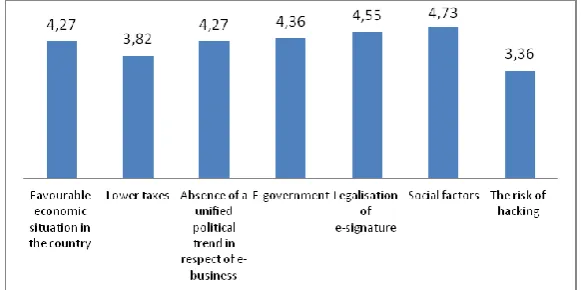
The value of Kendall’s coefficient of concordance (W(a)) equal to 0.291 and value p equal to 0.04 propose that the results of the survey can be considered statistically significant. With reference to the evaluations of the experts, social determinants were identified as the most influential macro environmental determinants of e-business development with the average rank equal to 4.73 (see Figure 3).
Rita Remeikiene, Martin Cepel, Ligita Gaspareniene. Evaluation of E-Business Micro and Macro Determinants by…
The significance of social determinants can be explained by the increasing dependence of consumers on IT, fast spread of the Internet, tablets and social networks. Expanded opportunities determined by the emergence of financial innovations, virtual money and e-banking promote usage of IT even further. As a result, business organisations have to react to the changes in consumer habits and transfer a part of their operations to e-space. What is more, e-business processes have become simpler in comparison to the processes of traditional business; they save cosumers’ time and expand geographical availability of products and services.
Legalisation of e-signature and e-documents was acknowledged as the second significant determinant of e-business development with the average rank equal to 4.55. Indeed, legalisation of e-signature and e-documents has considerably simplified business processes: with e-signature having the same juridical validation as a regular signature, a physical or juridical entity may confirm one’s identity and sign the documents at request. By employing e-signature, customers may unimpededly connect to the systems of e-service providers and e-banking. According to the experts, services of e-government and transfer of the daily public services to e-space facilitate e-business development (average rank is equal to 4.36). This determinant can also be attributed to the group of technological determinants minding that the functions of e-government combine provision of different types of public services (e.g. preparation of documents, submission of applications, tax collection, etc.). The biggest advantage of such e-services is that citizens may perform numerous actions without leaving their works or home.
The experts confirmed that the favourable economic situation in the country is an influential determinant of e-business development (average rank is equal to 4.27). They also envisaged the necessity to unify political trends in respect of e-business development (the same average rank as for the determinant of favourable economic situation in the country). Although Lithuania made some legal steps to promote e-business (legalisation of e-signature, confirmation of the procedures for registration and supervision of e-signature service providers, etc.), the country still lacks unified political decisions on e-business development. First of all, public authorities should draw their attention to the leaks in the poorly regulated IT sector. Weak legal framework is not able to ensure protection
from crimes in cyberspace. The authorised crime detection and prevention institutions are facing the problem of the lack of skilled staff. As as result, all of the above-mentioned causes lead to high number of e-shops and websites break-ins. Despite the fact that the experts did not appointed the risk of hacking into e-business systems and hacker attacks as the determinant that discourages from e-business development, failure to reinforce protection from hacking causes the feeling of uncertainty for potential e-entrepreneurs since each type of business requires safe operational environment. What is more, e-business is, to a large extent, dependent on a favourable economic situation in the country (average rank is equal to 4.27), which is described by such macroeconomic indicators as rising consumer purchase power, growing GDP, reduction of unemployment rate, etc. Finally, the determinant of lower taxes for e-business in comparison to the taxes charged for traditional business was recognised as a significant macroeconomic determinants of e-business development in Lithuania. At present, Lithuanian people who want to perform any commercial activities (regardless of whether it is traditional or e-business) are obliged to pay taxes to the state budget. If a person trades particular products or services in the Internet and earns revenues from this activity, he is obliged to acquire a business licence or register an individual activity. If e-business is run in a parallel with earlier established traditional business, e-activities can be performed under the name of the latter. Depending on which business form is selected, entrepreneurs have to follow different tax estimation and payment procedures. In addition, depending on which types of products or services are traded, licences and other special permissions might be required. The rest part of expenses consist of e-shop establishment costs, server maintenance costs and payment module maintenance costs. The third part of the questionnaire was developed in order to formulate the recommendations on e-business development. With reference to the theoretical aspects of e-business development, the experts were introduced to the list of the plausible directions of e-business development. Kendall’s coefficient of concordance (W(a)), estimated for this part of the questionnaire, is equal to 0.205, and value p is equal to 0.01, which proposes that the results of the survey can be considered statistically significant (the average ranks of the expert evaluations see in Figure 4).
Figure 4 shows that the experts emphasised such directions of e-business development as legitimation and application of tax exemptions for e-business, and simplification of staff recruitment (average ranks are equal to 4.36). Practical implementation of these recommendations could serve as an incentive for the establishement of new e-businesses and would contribute to the development of e-business as a branch of traditional business. Furthermore, e-business development would be promoted in case the regulations of accounting were simplified (average rank is equal to 4.27). Since at present e-business (Lithuanian case) is established following the norms of traditional business establishment, introduction of a new and attractive form of e-business establishment was acknowledged as measure of e-business promotion (average rank is equal to 4.18).
The fact that collection of the statistical data on the situation of e-business in Lithuania and other European Union countries is rather occasional was also noted by the experts – according to the results of the survey, legitimation of the collection of the statistical data on establishment and discontinuation of different forms of e-business would facilitate the perception of current and potential entrepreneurs about the situation in electronic markets (average rank is equal to 4.09). What is more, issuance of e-business laws and regulations would increase entrepreneurs and customers’ trust in e-business (average rank is equal to 4.09). Lack of regulations on the steals of credentials were noted as significant (average rank is equal to 3.09), although the least significant in comparison to the
other plausible recommendations. Nevertheless, it should not be overlooked that 5.6 percent of the customers face the problems of the steal of credentials in e-space (Štitilis, 2014), which, in turn, decreases public trust in e-commerce and slows down e-economics. Negative public attitudes towards e-services and e-business have a negative impact on opportunities of e-business development and revenue flows in the country.
Interpretations of the results by the MIMIC model. Selection of the MIMIC model was determined not by a pursue to estimate the number of e-business enterprises, but by the need to identify causal determinants of e-business. A total of 18 causal and 6 indicative variables were included in the research. Compatibility of the model is confirmed by the following indicators:
AIC (Akaike) – high values of this indicator confirm high reliability of the model;
RMSEA (Root Mean Square Error of Approximation) – the result is positive when the value of RMSEA is lower than 0.1;
GFI (Goodness of Fit Index) – the model well-aligned with the data when the value of GFI is close to 0.95;
NFI (Normed Fit Index) – the result is positive when the value of NFI is close to 0.95;
The summary of the models with their estimates and results of different tests has been presented in Table 1 (fixed variable Y4 (Individuals using the internet for selling goods or services) with the assigned value +1).
Table 1
Output – Lisrel – MIMIC Model Summary
Notes: t-statistics are given in parentheses. * Means |t-statistic|>1.96.
Values t, |t | > 1.96, marked with Italic style in Table 1, show that the variables are statistically insignificant and, therefore, should be excluded from the model. In addition, the indicators of the model compatibility show that the model is not completely compatible. After elimination of variable X6, the values of χ2 and AIC decreased, which revealed that the degree of the model compatibility had slightly increased, but as the value of RMSE still exceeded 0.1, the model could not be considered fully compatible. Nevertheless, the last model MIMIC 6-1-2 could be considered the most compatible of all alternatives The main difference between MIMIC 7-1-2 and MIMIC 6-1-2 is that X 6 is not included in the model of MIMIC 6-1-2, also some parameters of model are better (GFI is closer to 0.95; χ2is higher).
Further in the research, the MIMIC equation was developed:
E-business = 3.086*X12 - 0.368*X13 + 1.207*X14 - 0.546*X15 - 0.606*X16 + 0.666*X17 (7) The values of the variables in the equation stand for: X12 – Real effective exchange rate for the euro area (based on HICP/CPI); this indicator aims to assess a
country (or a currency area's) price or cost competitiveness relative to its principal competitors in the euro area;
X13 – Households, level of the Internet access, i.e. percentage of the households with the Internet access at home. All forms of the Internet use are included. The population considered is aged from 16 to 74;
X14 – Individuals using the Internet for ordering goods or services;
X15 – Individuals using the Internet for interaction with public authorities;
X16 - Government deficit/surplus, debt; it is the net borrowing/net lending of the central government;
X17 - Youth employment, aged from 15 to 29; Y2 - Export market shares – a percentage change for 5 years;
Y4 - Individuals using the Internet for selling goods or services.
The estimations by the MIMIC model have revealed that variable X12, i.e. competitiveness of a country in comparison to the competitiveness of the other euro area countries in terms of costs or prices, makes the most significant impact (the value is equal to 3.086) on the
Model X6 X12 X13 X14 X15 X16 X17 Y2 χ2 RMSE GFI NFI AIC MIMIC
7-1-2
-0.000 (-0.000)
3.261 (18.78) -0.494 (-3.082) 1.297 (9.001) -0.587 (-6.613) -0.708 (-3.320) 0.691 (9.440) 0.229 (3.788) 23.14 (0.000) 0.1 59 (0.003)
0.983 0.971 6398
MIMIC 6-1-2 3.086 (9.797) -0.386 (-1.730) 1.207 (5.604) -0.546 (-6.695) -0.606 (-2.217) 0.666 (7.530) 0.241 (3.461) 20.39 (0.000) 0.169 (0.003)
Rita Remeikiene, Martin Cepel, Ligita Gaspareniene. Evaluation of E-Business Micro and Macro Determinants by… development of e-business in this country. Second by the
significance is variable X14 (the value is equal to 1.207), i.e. the individuals who use the Internet for ordering goods and services. The other variables, such as usage of the Internet for interaction between individuals and public authorities, youth employment and indebtedness of the central government, were not found to be significant for e-business development.
Discussion and Conclusions
Summarising the results of the theoretical and the empirical research, the following conclusions can be made: 1. After the analysis of the scientific literature model of groups determining the factors influencing the development of e-business has been created, which can be applied to every Eurozone / EU country. The model complements the theories explaining the e-business environment and demonstrates that effective monitoring of identified groups of factors can have a positive impact on e-business development.
2. The results of the expert evaluation have disclosed that positive business managers’ attitude towards innovations and their knowledge in e-business is the most significant micro environmental determinant of e-business development. In this respect, business managers follow the attitudes that e-business may serve as as a perfect additional tool to improve business competitiveness and seek further recognition in international markets. In the group of macro environmental determinants, the experts emphasised significance of the factors of socio-cultural environment. Technological, political and economic determinants were recognised as less significant, but also having positive impact on e-business development in Lithuania. Technological advancement (e.g. legalisation of e-signature and e-document, services of e-government) contributes to fast and smooth performance of e-business operations, but political-legal and economic environment is not able to provide efficient e-business promotion measures (e.g. an attractive form of e-business registration,
simplification of staff employment, facilitation of accounting, lower taxes, etc.).
1. With reference to the research results, the following recommendations for e-business development can be proposed:
2. Creation of a favourable legal environment (e.g. unification of local laws with the ones of EU and basic trade partners of Lithuania and other Eurozones countries, integration of e-business regulations into the current legal framework, assurance of compatibility among traditional and e-business laws, assurance of customer right protection in e-space, avoidance of legal overregulation and confusion, etc.) would increase business managers’ as well as consumers’ trust in the efficiency and stability of e-business.
Development of a favourable economic environment (e.g. assurance of accessibility to a wide spectrum of economic activities, in particular, the introduction of new and attractive business forms, tax reduction and application of exemptions to e-business) alongside with simplification of e-business administration (e.g. simplification of staff employment, facilitation of accounting) would increase the attractiveness of e-business not only as a measure of competitiveness promotion, but also as the way to increase the overall business efficiency.
3. Promotion of population’s IT education (e.g. increase in the number of IT students in state-funded programs, creation of structures, institutions and programs for continuous learning) would enable to complement business resources with skilled IT professionals.
Limitations of the research: small sample of e-business statistical data (availability only from the year of 2009). As a result the factors, which have not been analyzed in previous researches, were included to MIMIC model. What is more, the limitation of the research impacts the results of the research – 18 causal factors and 6 indicative factors have been identified by the qualitative research, associated with the development of e-business and the factors, and which make the biggest impact for e-business development in Eurozone, have been listed out.
Further research is related to qualitative researches of factors, identified by MIMIC model.
References
Adomako, S., & Danso, A. (2014). Regulatory environment, environmental dynamism, political ties, and performance: Study of entrepreneurial firms in a developing economy. Journal of Small Business andEnterprise Development, 21(2), 212–230. https://doi.org/10.1108/JSBED-01-2014-0004
Al-Khattab, A., Aldehayyat, J., Alrawad, M., Al-Yatama, S., & Al-Khattab, S. (2012). Executives' perception of political‐legal business environment in international projects. International Journal ofCommerce and Management, 22(3), 168–181. https://doi.org/10.1108/10569211211260328
Alos-Simo, L., Verdu-Jover, A. J., & Gomez-Grass, J. M. (2017). How transformational leadership facilitates e-business adoption. Industrial Management&Data Systems 117 (2), 382–397. https://doi.org/10.1108/IMDS-01-2016-0038 Aragon-Correa, J. A., Garcia-Morales, V. J., & Cordon-Pozo, E. (2007). Leadership and organisational learning's role on
innovation and performance: lessons from Spain. Industrial Marketing Management, 36 (3), 349–359. https://doi.org/10.1016/j.indmarman.2005.09.006
Augustinaitis, A., Rudzkiene, V., Petrauskas, R., Dagyte, I., Martinaityte, E., Leichteris, E., Malinauskiene, E., Visnevska, V., & Zilioniene, I. (2009). Lietuvos e. valdzios gaires: ateities ižvalgu tyrimas : kolektyvine monografija [The guidelines of Lithuanian e-government: the research of future insights: collective monograph]. Vilnius: Mykolas Romeris University Publishing Centre.
Beheshti, H. M., & Salehi-Sangar, E. (2007). The benefits of e-business adoption: an empirical study of Swedish SMEs. Service Business, 1, 233–245. https://doi.org/10.1007/s11628-006-0010-y
Bordonaba-Juste, V., Lucia-Palacios, P., & Polo-Redondo, Y. (2012). The influence of organizational factors on e-business use: analysis of firm size. Marketing Intelligence & Planning, 30(2), 212–229. https://doi.org/10.1108/02 634501211211984
Chatzoglou, P., & Chatzoudes, D. (2016). Factors affecting e-business adoption in SME's: an empirical research. Journal of Enterprise Information Management 29 (3), 327–358. https://doi.org/10.1108/JEIM-03-2014-0033
Elbeltagi, I. (2007). E‐commerce and globalization: an exploratory study of Egypt. Cross Cultural Management: An International Journal, 14(3), 196–201. https://doi.org/10.1108/13527600710775748
Filis, I., Johansson, U., & Wagner, B. (2004). Factors impacting on e-business adoption and development in the smaller firm. International Journal of Entrepreneurial Behavior & Research, 10(3), 178–191. https://doi.org/10.1108/ 13552550410536762
Gatautis, R. (2017). The rise of the platforms: business model innovation perspectives. Engineering Economics, 28(5), 585–592. https://doi.org/10.5755/j01.ee.28.5.19579
Gurtoo, A., & Antony, S. J. (2007). Environmental regulations: Indirect and unintended consequences on economy and business. Management of Environmental Quality: An International Journal, 18(6), 626–642. https://doi.org/10.1108/ 14777830710826676
Hogevold, N. M., Svensson, G., Wagner, B., Petzer, D. J., Klopper, H. B., Varela, J. C. S., Padin, C., & Ferro, C. (2014). Sustainable business models: Corporate reasons, economic effects, social boundaries, environmental actions and organizational challenges in sustainable business practices. Baltic Journal of Management, 9(3), 357–380. https://doi.org/10.1108/BJM-09-2013-0147
Jeon, B. N., Han, K. S., & Lee, M. J. (2006). Determining factors for the adoption of e-business: the case of SMEs in Korea. Applied Economics, 38, 1905–1916. https://doi.org/10.1080/00036840500427262
Kartiwi, M., Hussin, H., Suhaimi, M. A., Jalaldeen, M. R. M., & Amin. M. R. (2018). Impact of external factors determining E-commerce benefits among SMEs in Malaysia. Journal of Global EntrepreneurshipResearch, 8(18), 1–12. https://doi.org/10.1186/s40497-018-0105-7
Laudon, K. C., & Traver, C. G. (2009). E-commerce business models and concepts. Available from internet: http://www.csie.ntu.edu.tw/~ec/Laudon/Chapter2.pdf
Li, P., & Xie, W. (2012). A strategic framework for determining e‐commerce adoption. Journal of Technology Management in China, 7(1), 22 –35. https://doi.org/10.1108/17468771211207321
Ma, B., Xu, X., Sun, Y., & Bian, Y. (2017). Online search-based advertising strategy for e- business platform with the consideration of consumer search cost. Kybernetes 46(2), 291–309. https://doi.org/10.1108/K-10-2016-0296
Maditinos, D., Chatzoudes, D., & Sarigiannidis, L. (2014). Factors affecting e-business successful implementation. International Journal of Commerce and Management, 24(4), 300–320. https://doi.org/10.1108/IJCoMA-07-2012-0043
Maia, C., Lunardi, G., Longaray, A., & Munhoz, P. (2018). Factors and characteristics that influence consumers' participation in social commerce. Revista de Gestao, 25(2), 194–211. https://doi.org/10.1108/REGE-03-2018-031 Mangiaracina, R., Marchet, G., Perotti, S., & Tumino, A. (2015). A review of the environmental implications of B2C
e-commerce: a logistics perspective. International Journal of Physical Distribution & Logistics Management, 45(6), 565–591. https://doi.org/10.1108/IJPDLM-06-2014-0133
Martinez, F. (2012). The syncretism of environmental and social responsibility with business economic performance. Management of Environmental Quality: An International Journal, 23(6), 597–614. https://doi.org/10.1108/1477 7831211262891
Mikalajunas, A., & Pabedinskaite, A. (2010). Elektroninio verslo pletra Lietuvoje [The development of electronic business in Lithuania]. Business, Management and Education, 3, 1–9.
Rita Remeikiene, Martin Cepel, Ligita Gaspareniene. Evaluation of E-Business Micro and Macro Determinants by… Niranjanamurthy, M., Kavyashree, N., Jagannath, S., & Chahar, D. (2013). Analysis of E- Commerce and M-Commerce:
Advantages, Limitations and Security issues. International Journal of Advanced Research in Computer and Communication Engineering, 2(6), 2360–2370.
OECD. (2013). Electronic and Mobile Commerce. OECD Digital Economy Papers, 228, 1–42.Available from internet: https://doi.org/10.1787/5k437p2gxw6g-en
Rahayu, R., & Day, J. (2015). Determinant factors of e-commerce adoption by SMEs in developing country: evidence from Indonesia. Procedia - Social and Behavioral Sciences, 195(3), 142–150. https://doi.org/10.1016/j.sbs pro.2015.06.423
Svensson, G., & Wagner, B. (2015). Implementing and managing economic, social and environmental efforts of business sustainability: Propositions for measurement and structural models. Management of Environmental Quality: An International Journal, 26(2), 195–213. https://doi.org/10.1108/MEQ-09-2013-0099
Sarmah, B., Sharma, & S., Gupta, S. (2017). Antecedents of e-business adoption intention: an empirical study. International Journal of Innovation Science 9(4), 417–434. https://doi.org/10.1108/IJIS-05-2017-0048
Štitilis, D. (2014), Asmens tapatybes vagystes: teisinio reguliavimo ir praktiniai aspektai [Steals of credentials: legal and practical aspects of regulation]. Available from internet: http://www3.lrs.lt/docs2/PSQYPQHG.PDF
The State Control Department. (2015), Elektronines prekybos kontrole [The control of electronic commerce]. Available from internet: https://www.vkontrole.lt/failas.aspx?id=3324
Torres, P. M., Lisboa, J. V., & Yasin, M. M. (2014). E-commerce strategies and corporate performance: an empirical investigation. Competitiveness Review, 24(5), 463–481. https://doi.org/10.1108/CR-06-2013-0064
Trading economics. Euro Area inflation rate. Available from internet: https://tradingeconomics.com/euro-area/inflation-cpi
Tsai, M. T., Li, E.Y., Lee, K. W., & Tung, W. H. (2011). Beyond ERP implementation: the moderating effect of knowledge management on business performance. Total Quality Management, 22(2), 131–144. https://doi.org/10. 1080/14783363.2010.529638
Tsironis, L. K., Gotzamani, K. D., & Mastos, T. D. (2017). E-business critical success factors: towards the development of an integrated success model. Business Process Management Journal 23 (5), 874–896. https://doi.org/10.11 08/BPMJ-02-2016-0030
Velmurugan, M. S. (2009). Security and trust in e-business: problems and prospects. International Journal of Electronic Business Management, 7(3), 151–158.
Verdu-Jover, A., J., Alos-Simo, L., & Gomez-Gras, J. M. (2014). Strategic flexibility in business adapters and e-business start-ups. In F. J. Martinez-Lopez (Eds.), Handbook of Strategic e-Business Management (pp. 139–154). New York: Springer Science & Business Media. https://doi.org/10.1007/978-3-642-39747-9_6
Ye, G., Wan, Q., & Chen, J. (2011). Political resources, business model and headquarters location of private enterprises. Nankai Business Review International, 2(2), 172–194. https://doi.org/10.1108/20408741111139936
Zekos, G. I. (2003). MNEs, globalisation and digital economy: legal and economic aspects. Managerial Law, 45(1/2), 1– 296. https://doi.org/10.1108/03090550310770875
Zhu, K., & Kraemer, K. L. (2002). E-commerce metrics for Net-enhanced organizations: Assessing the value of e-commerce to firm performance in the manufacturing sector. Information Systems Research, 13(3), 275–295. https://doi.org/10.1287/isre.13.3.275.82
Zsolnai, L. (2002). Green business or community economy? International Journal of Social Economics, 29(8), 652–662. https://doi.org/10.1108/03068290210434198